Feeds:
Posts
Comments

Archive for the ‘Murder’ Category

SOUNDTRACK: ROY AYERS-Tiny Desk Concert #712 (March 1, 2018).

I hadn’t heard of Roy Ayers, although I imagine I’ve heard his work somewhere before.  I love the vibes so I was looking forward to his set.

I was a little bummed to hear him singing–I assumed it would be all instrumental. Especially since his songs aren’t exactly lyrically masterful.  But the jazzy funky solos were pretty great.

Roy Ayers [is a] 77-year-old jazz-funk icon.  He sauntered through the office with a Cheshire grin on his face, sharing jokes with anyone within earshot. Accompanying him was a trio of brilliantly seasoned musicians — keyboardist Mark Adams, bassist Trevor Allen and drummer Christopher De Carmine. Later during the performance, pride washed across Ayers’ face as his bandmates took the spotlight. (Be sure to watch as Adams woos not just the room but brightens Ayers’ face during his solo.)

The set began with one of Ayers’ more recognizable hits: an extended version of “Searching,” a song that embodies the eternal quest for peace and love.  The vibes solo at 2 and a half minutes is worth the wait, though.

The lyrics are essentially.  I’m searching, searching, searching searching. It takes over a minute for him to even get to the vibes!  It’s followed by a groovy keyboard solo that starts mellow be really takes off by the end.

During “Black Family” (from his 1983 album Lots Of Love), you’ll hear him call out “Fela” throughout. That’s because Afrobeat legend Fela Kuti was a huge influence on Ayers in the late 1970s; the two eventually collaborated on an album, 1980’s Music Of Many Colors. “Black Family” is, in part, a tribute to Fela, even if the original version didn’t include his name.

Again the lyrics: “lo-lo-lo-lo-long time ago” and not much else repeated over and over and over. But it’s all lead up to a great vibes solo (as the band gets more and more intense).  I love that the keyboardist has a keytar as well and is playing both keys at the same time–soloing on the keytar with an awesome funky sound.  There’s even a cool bass solo.

Concluding this mini-concert, Ayers closed the set out with his signature tune, “Everybody Loves the Sunshine”, a feel-good ode if there ever was one. The essence of this song flowed right through him and out to the NPR audience.

Another terrific vibes solo is followed by a keytar solo which is full of samples of people singing notes (they sound like Steely Dan samples)–it’s weird and kind of cool.

[READ: August 2017] McSweeney’s No 46

As the subtitle reflects this issue is all about Latin American crime.  It features thirteen stories selected by Daniel Galera.  And in his introduction he explains what he was looking for:

DANIEL GALERA-Introduction
He says it used to be easy to talk about Latin American fiction–magical realism, slums and urban violence.  But now things have expanded.  So he asked 13 writers to put their own Latin American spin on the crime story.

And of course, each McSweeney’s starts with

Letters

DANIEL ALARCÓN writes passionately about Diego Maradona’s famous “Goal of the Century” and how as a child he watched it dozens of times and then saw it thousands of times in his head.  When he learned of Maradona’s questionable “Hand of God” goal, his father said that his previous goal was so good it counted twice.  But Daniel grows sad realizing that the goal of the century also marked the beginning of Maradona’s decline.

LAIA JUFRESA this was a fascinating tale about a game called Let’s Kill Carlo that her family played.   It involves a convoluted history including her mother “inventing” a child in order for her husband to come to Mexico from Italy and avoid conscription there.  But when this child “Carlo” “came of age” they had to think of reason why he wasn’t there anymore–so they invented the Let’s Kill Carlo game.

YURI HERRERA waiting for a bus in New Orleans as a man lay in the gutter also waiting.

VALERIA LUISELLI her friend recently moved to Minneapolis with her nervous wreck Chihuahua named President.   He was diagnoses with terminal cancer and the vet encouraged all manner of alternative therapies.  This friend was a very sweet person and had many virtues. And yet perhaps through her virtue the alternative therapy seems to have worked.

FRANCISCO GOLDMAN wants to know why immigration officers at Newark Airport are such dicks (and this was before Trump–#ITMFA).  He speaks of personal examples of Mexican citizens being treated badly.  He had asked a friend to brings books for him and she was harassed terribly asked why did she need so many bags for such a short stay.  Another time he was flying back to NYC with a Mexican girlfriend.   She went through customs and he didn’t hear anything for hours.  He didn’t know if she would even make it though customs at all–even though she’d done nothing wrong.   He imagines wondering how these officers live and what their lives must be like that they seem to take pleasure in messing with other people’s lives. (more…)

Read Full Post »

SOUNDTRACK: SHAKEY GRAVES-Tiny Desk Concert #495 (December 14, 2015).

I thought I had posted about every Tiny Desk Concert, but on double checking I found that I had missed this one.  I had heard of Shakey Graves and I assumed he was a country/folkie singer.  Which he is, although really his style is to mix country, blues and rock ‘n’ roll.  I also had no idea his real name is Alejandro Rose-Garcia.

This set sees Graves on acoustic guitar (with a strap with his name on it) accompanied by another acoustic guitar (which seems rather small) and a mandolin.

“To Cure What Ails” is a pretty, slow folk song. It’s simple enough with nice high mandolin notes and a good guitar line between verses.  Shakey has a nice voice and the song feels compelling like a story, although I don’t think it is.  He’s also charming and funny in little ways–he makes a lot of funny faces and chuckles.  But his music is really solid and the harmony at he end of the song is really great.

For “The Perfect Parts” the mandolin switches to bass and they have a little discussion n how to play it.  Shakey tells the drummer how to play the beat and then says they’re going to make it us as they go along.  This song is darker and has a cool sinister vibe.  He sings in kind of deep mumble for this song which works well for this song.  The song gets a little intense for a few lines.  And by the end it builds pretty loud with some good whoa ho ho backing vocals.  So much so that for the last chord, “he attempted a stage dive at the Tiny Desk.”

For the last song, “Only Son,” he:

breaks out his guitar and suitcase kick drum/hi-hat, [and] a palpable rush of swooning adrenaline hits the room. I felt that at the Americana Festival in Nashville, at the Newport Folk Festival and here at the Tiny Desk.

He says it is soon to be the last of the suitcase kick drums (this is his third).  He dreamed about having an object that he could cart around with him and still make a lot of noise.  The drum is actually behind him and he stomps the pedals with his heels (I can;t believe the camera never zoomed in on it).

He says the song is about “the moment in your life when you realize you’re not alone… there’s an aha! moment where you’re like ‘not just me?’  The drummer plays bass, the mandolin player has the mandolin back and Shakey has the kick drum suitcase.  There’s some terrific harmonies (and chuckling ) throughout the song, and I love the way it stops and starts.

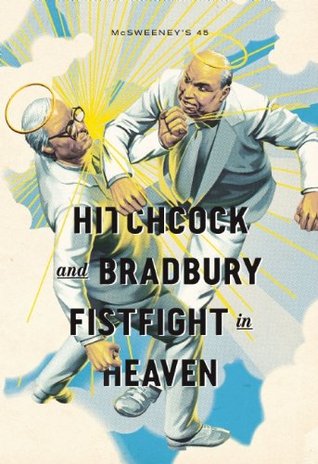
[READ: Late 2016 and early 2017] McSweeney’s #45

The premise of this collection was just too juicy to pass up.  Although it did take me a while to read it.  Eggers’ introduction talks about the contents of this issue.

DAVE EGGERS-Introduction
Eggers says he came across a collection of stories edited by Hitchcock. He really liked it and then learned that Hitchcock had edited 60 volumes over the course of 35 years.  He was excited to read literary genre fiction.  But he was more impressed that theses stories did what literary fiction often forgets: having something happen.  He then bought a cheap book edited by Bradbury (Timeless Stories for Today and Tomorrow) and he liked it too.  He was surprised that there were so many canonical writers (Steinbeck, Kafka, Cheever) in a Bradbury collection.

So, why not make a new collection in which we can compare the two genres.

Despite this looking like a pulpy paperback, there were still Letters.

LETTERS

CORY DOCTOROW
Doctorow says that Science fiction is not, indeed, predictive.  That any genre which deals with so many potential future events is bound to get some things right.

JAMIE QUATRO
Quatro says she was asked to write a letter for this genre issue, but Quatro doesn’t do genre, so she was about to pass.  Then her son, from the backseat, asks what bulwark means.  Then inimical.  Then miasma.  He is reading a book called Deathwatch about soldiers whose brains are removed so they no longer fear. Suddenly, when she compares this idea to her essay on Barthelme, she sees that maybe McSweeney’s was on to something after all.

BENAJMIN PERCY
In fifth grade Percy (who has a story below) gave his teacher a jar full of ectoplasm.  He has always been different.  He proposes the Exploding Helicopter clause: if a story does not contain an exploding helicopter (or giant sharks, or robots with lasers for eyes or demons, sexy vampires. et al), they won’t publish it.

ANTHONY MARRA
Marra discusses Michael Crichton and how something doesn’t have to be Good to be good.  He says Crichton was a starting point for him as an adult reader.  And what can be wrong with that? (more…)

Read Full Post »

815SOUNDTRACK: BORIS-DEAR (2017).

The plan was that after 25 years, Boris would retire.  They recorded songs for Dear, but then toured the anniversary of the album Pink.  This inspired them to write more songs, and somehow through all of that, Dear was created (with apparently enough music for two more albums).

Then they toured Dear (a tour I was lucky enough to see) and are still going.  Who knows if they are done.  Who knows if this is their final album.  Either way, this is a doozy.

10 songs and 70 minutes (on the U.S. release), Dear specialized in slow droney heavy songs.  The album opens with seven smacks of a drum before loud heavy chords signal the beginning of “D.O.W.N -Domination of Waiting Noise.”  The vocals are loud but just loud enough to add to the overall drone sound.  Things slow down further with “Deadsong” a deep bass drone with whispered, rather spooky/demonic vocals.

Despite the drones there are moments of catchiness (relative).  “Absoluego” is a faster, downtuned song with a big shouted chorus and “Beyond” is a quiet, moody song featuring Wata on vocals.  About 90 seconds into the song there is blast of metal guitars and drums that lasts for 30 seconds or so before fading out.  When it happens again, one of the guys starts singing too, a faster heavier, catchier melody.

“Kagero” opens with a low rumble.  Eventually a slow, heavy guitar comes in with near falsetto singing.  “Biotope” has a steady pulsing bass drum through the track.  The guitars are slower with an occasional plucked string that resonates. This song even has some ooohs in it.

“The Power” has my favorite Boris riff since “Tu la la.”  It’s got six notes all of which are strangely menacing and yet catchy at the same time. This was a great song to see live.  “Momentio Mori” is slow and menacing with cool echoed/chorused vocals–there’s an Alice in Chains vibe to the vocals.  With about a minute left, the song slows down and grows quiet almost as a lead in to the 12 minute “Dystopia -Vanishing Point.”  This song opens with two minutes of warbly accordion (I loved watching Wata play this part live) and some thundering drums.  It all fades away into some quiet ringing guitars and whispered vocals.  This continues for a few minutes as waves of guitars are added.  And then at 7 minutes the loud guitars and drums blast forth and Wata gets to do a screaming solo for the final 4 minutes.  She is still soloing as the song abruptly ends and switches to the final track.

“Dear” opens with those low downtuned guitars echoing.  I love that the guitars simply slide up to a very high note and hold it until sliding back down.  There’s a muffled chug on the low chords while the heavily echoed vocals ring out.  The song continues like this, a mountain of low rumble, for 9 minutes until it starts to consume itself–feedbacking and disintegrating until it sounds like all of the plugs are pulled.

There’s not a lot of diversity on this disc, which resembles some of their earlier music.  I’m very curious to see what they do next.

[READ: February 9, 2016] “The Republic of Bad Taste”

This story (it feels complete and not like an excerpt, although the title seems unlikely as a short story title) was 20 pages long in this issue of the New Yorker.  That’s one of the longest pieces I’ve seen in the magazine.

And it covers a lot of ground.

Like how does an at-risk-youth counselor agree to commit murder?

It begins by introducing us to Andreas Wolf in East Germany circa 1987.  He is a disaffected youth, an atheist with a super libido and he has found employment at the church on Siegfeldstrasse.  Andreas felt the whole regime was ridiculous.  In fact he felt that a lot of things were ridiculous.  The Republic was just so German that it couldn’t even go after misfits unless it was by the book.

His “job” at the church was as a youth counselor.  He was surprisingly good at it. In part because he really didn’t care and in part because he himself was almost at risk.  He wasn’t really at risk because his father had a good position with the government, but they had more or less disowned him (aside from agreeing to make sure he never got into real trouble).  Plus, he was pretty good-looking so many of the at risk girls found him attractive–with all that implies.

He took advantage of this.  He found that his monetary reward was so pitiful that a reward in beautiful girls made up for it.  At the same time, he did have some scruples.  He never had sex with anyone underage or anyone who had been sexually abused.  What a guy. (more…)

Read Full Post »

SOUNDTRACK: IBEYI-Tiny Desk Concert #703 (February 7, 2018).

ibeyiI have been fascinated with Ibeyi since I first heard them a couple years ago.  Their more recent song “Deathless” is just outstanding.  I’d also heard they put on a great show.

So I was looking forward to this Tiny Desk.

But just who are they?

They come by their connection to the Afro-Cuban culture by way of their late father, Miguel “Anga” Diaz, an in-demand Cuban percussionist who was part of a vanguard musicians who reinvigorated Cuban music before he died prematurely at age 45 in 2006. The sisters, Lisa-Kaindé (in blue) and Naomi (in orange) Díaz, carry that calling in their DNA, and how they’ve manifested it into their own art is nothing short of amazing.

The show begins with the sisters singing a capella: an invocation of a West African Yoruba deity called “Oddudua.”

The first song they play is “Deathless.”  “This song is dear to our hearts.  It’s made for you; for us.  Whatever happens, this moment is deathless.  We made it for you to feel for three minutes and believe it.”  Naomi hits a sampler to get the horns going and then Lisa-Kaindé plays the nifty buzzy keyboard melody and vocal samples.  Then Naomi starts playing the batá, which is really fun to watch.  Lisa-Kaindé sings lead (her voice breaks on one of the high notes)

The twins (Ibeyi means ‘twins” in Yoruban) perform their music with the batá drums associated with Yoruban sacred music and their elaborate vocal arrangements channel the call-and-response of traditional African music. The melding of their voices when they harmonize can be breathtaking, but the same can be said about the messages behind their songs, themes that inspire both inward introspection and celebrations of life.

The drums are such a cool percussive element that I didn’t expect.  The chorus is so uplifting and joyful even as it has a tinge of menace.  They get he audience to sing along in a rather inspiring call and response of the chorus.

“Valé” is a lullaby written for their niece–she sings frozen and she’s really into it.   Naomi sings leads while Lisa-Kaindé plays the pretty piano melody.  It is a delicate, quiet song (a lullaby, duh).  Then Lisa-Kaindé sings lead and Naomi plays cool percussion on a box drum which include lap-slapping as well.

Lisa-Kaindé says “Transmission” is the heart of their album.  It’s nearly seven minutes long and goes through several changes throughout.  They are both by the keys for the start of this one, with Naomi playing bass notes and both of them singing out of the same microphone.

The audience sings the gentle “Transmission” chorus as Naomi speaks in Spanish and then she adds the batá and sings some lovely harmonies.  It’s quite moving.

[READ: February 6, 2018] “Stanville”

I’ve been meaning to read one of Kushner’s novels for a while now because of great reviews.  But in the meantime, I have these short stories.

I’m not sure if this is an excerpt or not.  It feels pretty full on its own, but I coud easily see it going much further.

This story is done from two points of view.  A third person POV for the one main character, Gordon Hauser.  And then, later, a first person point of view for another major character Romy Hall.

Gordon Hauser is teaching G.E.D. classes in a women’s prison.  He was surprised to find that people would much rather teach in men’s prisons.  Indeed, no guard wanted to work in a women’s prison “female prisoners bickered with the guards and contested everything, and the guards seemed to find this more treacherous than having to subdue riots.” (more…)

Read Full Post »

SOUNDTRACK: FIRST AID KIT-The Lion’s Roar (2012).

This album was my first exposure to First Aid Kit and I immediately loved the harmonies and the dark but positive-sounding vocals.

I’m probably one of ten people on earth who doesn’t love Bright Eyes, but I love the production by Bright Eyes’ Mike Mogis (with contributions from Bright Eyes’ Nate Walcott and band leader Conor Oberst–maybe I need to re-listen to Bright Eyes).

The first song I’d heard was the opening cut “The Lion’s Roar.”  The song starts with a minor key guitar chord progression and “electronic flute.”  It’s atmospheric and a bit spooky-sounding, but when they come in with the chorus “And I’m a goddamn coward, but then again so are you” in wonderful harmony that is at times right on and other times kind of dissonant, it’s goose-bump-inducing.  Oh wow. what a moment

Pitchfork describes that electronic flute as “one deeply eerie flute tone that lingers throughout, floating in and out of scenes like a sly specter” and that’s pretty accurate.

It’s followed by “Emmylou” the most gorgeous country song I’ve ever heard, complete with pedal steel guitar and a wonderfully evocative chorus: “I’ll be your Emmylou, and I’ll be your June/ If you’ll be my Gram and my Johnny, too,” (do watch them sing it to Emmylou Harris at an award ceremony and watch her brought to tears).

“In The Hearts Of Men” slows things down with some wonderful moments as the sisters sing the “la la las” throughout the chorus.  Once again, there’s surprisingly dark lyrics for two women around 23 and 21.  And speaking of dark lyrics, the pretty xylophone and guitar play a chirpy melody in “Blue” which has this stark and dark verse:

And the only man you ever loved / You thought was gonna marry you / Died in a car accident when he was only 22 / Then you just decided, love wasn’t for you / And every year since then / Has proved it to be true

Damn.  How does a song with that lyrics have a beautiful soaring chorus that is so uplifting and Abba-esque and yet again lyrically:

But you’re just a shell of / Your former you / That stranger in the mirror / Oh, that’s you / Why’d you look so blue?

“This Old Routine” features more of that uncanny, how are you only 21 years old lyrics sung with such beautiful harmony (and delicate mandolin sprinkled in):

This old routine will drive you mad
It’s just a mumble never spoken out loud
And sometimes you don’t even know why you loved her.
Well you look at her now, and you see why.

The second half of the song has strings and such, playing a simple five note melody.  There’s a moment near the end where the strings play that five note riff and its followed by the mandolin playing the same melody one step up and it’s just gorgeous.

“To a Poet” has a fast tight guitar melody.  As the song builds, a harmonium is added.  The chorus goes in a high register until the simple catchy end line: “There’s nothing more to it / I just get through it.”  The poet in question is Frank O’Hara

But Frank put it best when he said
“You can’t plan on the heart”
Those words keep me on my feet
When I think I might just fall apart

The string section ending is bit of a surprise since neither one of them palsy on it but it does add some nice texture to this song that has just grown from a tiny guitar to full orchestration over the course of 6 minutes.

That cool flute sound returns on “I Found a Way,” as it runs through the falsetto-filled chorus.  “Dance To Another Tune” slows things down for a while until the middle features another string section.  This time the sisters add their “bah bah bahs” to it and it sound terrific.

“New Year’s Eve” brings back the autoharp (you can really hear the plectrum zipping along the strings–something I’ve never noticed when others play it).  It’s a suitably quiet song with a gentle harmony on the final line of the chorus: “that’s what’s going to save me.”  And I love that no other instrumentation is added.

The end of the record is quite different from anything else.  “King of the World’ is a dynamic romp, easily their fastest, loudest, stompingest song.  It’s got a full band behind them and a vocal turn from Conor Oberst.  There’s all kinds of strings and mandolin tucked in the corners that peek out here and there.  There’s even horns which sound a bit like Calexico.

This album is just fantastic.  And their harmonies get better and more confident with each album.

[READ: January 22, 2018] “Writing Teacher”

I have not really enjoyed any of the stories I’ve read by Wideman.  This was the first one that I felt was on the right path to my enjoyment.  And then it kind of drifted away from me at the end.

It also features one of the things I hate most in stories–more on that in a moment.

This is the story of a writing teacher.  He is reading and reviewing a story by a student, Teresa McConnell who, “wants to help other people.”  The story “wishes to save the life of its main character, a young woman of color, a few years out of high school, single, child to support, no money, shitty job, living with her mother who never misses an I-told-you-so chance to criticize her daughter’s choices.”

What I hate most in stories comes a few sentences later: (more…)

Read Full Post »

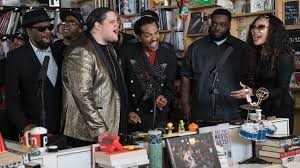
SOUNDTRACK: ARTISTS FROM THE “TAKE ME TO THE RIVER” TOUR-Tiny Desk Concert #692 (January 15, 2018).

This is a touring band playing classic soul.  But I found the modern updates to be unpleasant and almost undermined the tone of the show.  The blurb says:

“Take Me To The River” is a 1974 song from the legendary Al Green and guitarist “Teenie” Hodges. And though it wasn’t a big hit at the time, this song’s mix of religion and desire has become part of pop music’s canon.

Here at the Tiny Desk, some of the original players of this deep southern soul have come together to honor and update this tradition. It’s a celebration of Memphis soul old and new, with 13 musicians wedged behind the desk.

Some of those players of the old include singers Bobby Rush and William Bell; on the Hammond organ, Rev. Charles Hodges and LeRoy Hodges on bass. But it’s what’s new that makes this more than a look back – the addition of southern rappers Frayser Boy and Al Kapone – that truly puts this project on new musical ground.

But it is this update–Frayser Boy and Al Kapone who really ruined this show for me.

I’m not suggesting that the original lyrics to “Push and Pull” are profound.  They are not, but Frayser Bay’s rap is just up front and graphic whereas the original song is more understated (as much as something called “Push and Pull” can be).  Bobby Rush is a great singer and he looks spectacular in his sequined jacket.  Rush has a nice harmonica solo too.  That rap just seemed to come in and mess the whole thing up.

“I Forget To Be Your Lover” suffers from the same problem.  William Bell has a great sound–a cool rough voice.  And the original has this conceit: “I forgot to be your lover and I’m sorry.”  Al Kapone  comes in with a fairly explicit and hardly apologetic rap.  And what’s even stranger is that Rev. Charles Hodges who plays an outstanding organ throughout the show (I loved seeing the organ’s spinning fan that makes the great organ sound), plays really sour notes while Kapone is rapping.  Each verse has this weird nauseating sound. In every other section it sounds amazing, but during the rap it’s almost like he’s commenting on the rudeness of the rap.  The contrast is even more stark when Bell takes back the song mid way through and holds a high falsetto note for about 10 seconds–which really shows his power and range.

The backing vocals by Ashton Riker and Evvie McKinney are a nice touch.   Then on “Take Me to the River” Riker shares lead duties with Bobby Rush and they sound great together.  Riker hits some powerful high notes while Rush keeps it all together.  This is the song that really sells the show.  But look at how uncomfortable Frayser Boy looks during this song.

The rest of the band sounds just fine, playing quiet and understated:  LeRoy Hodges (bass), Edward Cleveland (drums), Andrew Saino (guitar), Jamel Mitchell (sax), Scott Thompson (trumpet), Martin Shore (percussion).

[READ: November 10, 2017] The Talented Ribkins

I saw Ladee Hubbard on Seth Meyers.  She was really interesting (and went to Princeton) and her book sounded fascinating.

On the surface the book is fairly simple, even fairly uneventful. Johnny Ribkin has to come up with $100,000 in a week because he has run afoul of a powerful man.

A few things separate this from similar books.  The first is that over the course of his life, Johnny buried various amounts of money and possessions in random places around the state of Florida.  He should be able to find the money fairly easily.  The reason why he buried all of this is part of the story.

Another thing is that he and his siblings all have special powers.  Not exactly superpowers, but certainly special powers.  And while these powers don’t exactly come into play in the quest, they are ever-present and unavoidable.

So what the heck is going on here? (more…)

Read Full Post »

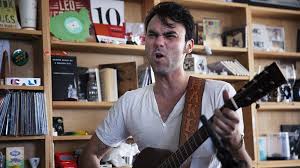
SOUNDTRACK: CIGARETTES AFTER SEX-Tiny Desk Concert #684 (December 13, 2017).

I only know of Cigarettes After Sex from when NPR played a song of theirs and Bob asked us to guess whether the singer was a man or a woman.

Greg Gonzalez has one of those wonderful voices that is deep and husky and sounds feminine (although his speaking voice is very deep).

This Tiny Desk Concert is very quiet (like The XX).  It is just Gonzalez on heavily echoed guitar and vocals and his unmoving, emotion-free longtime bandmate Phillip Tubbs on spare keyboards.

Although there’s not a lot to these songs, the melodies are truly terrific.

The three songs sound very similar–unmistakably them.

“K.,” the opening track to this Tiny Desk Concert – and the opening cut to the band’s eight year-long awaited debut album – is especially memorable. The lyrics are simple and easy to remember: “Kristen, come right back/I’ve been waiting for you to slip back in bed/When you light the candle.”

Amazingly, for almost half of each song, there are no keyboards, just the guitar.  So that extra, gentle wash of music sounds huge.  “Apocalypse” has the lovely swooning chorus of “you’ve been locked in here forever and you just can’t say goodbye” and “Nothing’s Gonna Hurt You Baby” follows that same pretty structure (although it’s my least favorite of the three).  With the minimalism:

each note and each word seems to count for more  …  and the office environment of the Tiny Desk Concert [may work better] than in a club, where just the chatter of a crowd can drown out this gentle music.

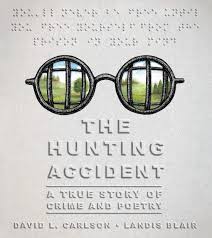
[READ: November 1, 2017] The Hunting Accident

I loved this book. Everything about it was utterly fantastic.  The story, the way it was told, and the amazing drawings of Landis Blair

The book opens on a snowy day in Chicago in 1959.  A boy whose mother has just died has moved from sunny California to miserable Chicago to live with his blind father, Matt.   The boy had lived with his mother since he was four (his mother’s mother thought that his father was a trouble and that they needed to get away from him).  So he barely knew his father.  And now it was time to find out everything about the man.  Like, first off, how he became blind.

The father told the boy all about the hunting accident.  He and his friends were screwing around, playing by the train tracks.  They were having fun scaring each other.  All the kids were afraid of real life bogeymen Leopold & Loeb local murderers.  The boys even believed they found the pipe in which Leopold & Loeb stuffed their victim.

There’s even little reminder of the crime:

In 1924, two wealthy educated men kidnapped and brutally murdered Bobby Franks, a 14-year-old neighbor…just for the thrill of it… to see if they could commit “the perfect crime.”

Anyhow, the boys had a shotgun and heard a deer.  When one of those boys shot at the deer he missed and his Charlie’s father right in the face.

Soon Charlie must learn what it is like to live with a blind man–how everything must be in the exact same place.

Charlie’s father writes all the time (on a braille machine).  He writes about morality and poetry.  He quotes Dante.  And soon, Charlie’s dad was having Charlie help with the writing–by proofing and checking things (Charlie learned a lot at the same time).

Charlie’s grandmother also said that Chicago was dangerous, but not for Charlie.  He got along fine. He even made friends with Steve Garza–the coolest kid in the neighborhood.    Garza was so cool he bummed cigarettes off of Charlie (from his dad–even though Matt, counted them and got mad about it).

Charlie also began getting involved in extracurricular activities–he loved tap dancing and tried the cello–two things his father appreciated. But soon Steve and his buddy started pressuring Charlie.  He “left” his tap shoes at the park, he stopped playing cello and he got involved in some ugly things.

Garza wanted to join the JPs–a local mob related gang.  But he was too young so he started the Junior JPs and soon enough that involved theft.  And since they were dumb, they were easily caught.

And that’s when the truth comes out.

I was already hooked into the story and then I was blown away.  Charlie’s dad did not lose his sight in a hunting accident.  Charlie is furious that his dad lied to him.

Garza convinces Charlie to head for Canada to avoid the cops.  (The third guy has already gotten there and is at a free-love commune or something).  Charlie is prepared to drive them both (he’s the one with the car after all).  And then his dad tells him the whole truth, which gets Charlie to pause.

The rest of the book cover’s Matt’s story.

He was poor in 193os Chicago and got mixed up with the wrong crowd.  His did go blind from a gun shot, but it was a very different setting–and it led to prison.

On the day he got to prison, the same prison that Leopold and Loeb were in, Richard Loeb was killed in the shower.  This left Leopold alone.

Charlie asks if he met Leopold.   And Charlie’s dad says that Nathan Leopold is the reason for his divorce.  What?

Turns out hat not only did Charlie’s dad know Nathan Leopold. He was Leopold’s cell mate.  Since Loeb was killed there was concern that Leopold might be next.  And since Matt was blind, they were put together under watch.

After Matt was out of prison, Leopold sent him a letter (in braille) which the grandmother intercepted.  Matt had never told anyone he was in jail, and that made Matt a Liar.

Matt was miserable in jail.  He couldn’t see, his father was disappointed in him and he had nothing to live for.  He just wanted to die, but that was pretty hard to do under constant supervision. We see daily life for a blind man in jail–food stolen all the time and knocking his cellmate’s things over.

Leopold was angry and bitter and wanted nothing to do with a blind man.  But soon, Leopold began talking to Matt about the life of the mind–something he realized that Matt lived all the time.  Because he couldn’t see everything was in his mind. Leopold used to hold educational lessons in the library at the jail.  He also showed Matt how to make a Glim Box (a way to use a spinning coin to light a fire to light cigarettes).

Matt tells Leopold that he has no family.  Meanwhile, Leopold’s dad visits every two weeks (the visits are awkward and uncomfortable but are a way for Leopold to get things from the outside).

Soon, Leopold is trying to convince Matt to learn Braille.  Why?  well, this gave opportunity for Leopold to learn it to and thereafter he could read after lights out.  (Leopold was a master of many languages and picked up braille easily).

And that’s when Leopold persuaded Matt to read Dante’s Inferno.

The story of Matt’s imprisonment jumps back to the present where Charlie is still annoyed with his father, but is really interested in the story. Especially when he leans that his father almost committed suicide there.

I loved the philosophical ideas in the story–they way the book interprets both Plato and Dante for the everyman .  I loved that Matt’s story runs throughout the book and I loved the whole idea of a blind man helping one of the most notorious criminals of he 20th century.

This story is thought-provoking and exciting at the same time.

The only thing that I feel was left out–did Charlie wind up going to jail or not?  It’s never addressed.

The end of the story and that final two-page spread are just breathtaking.

I also love that David L. Carlson more or less found out about this amazing true story by accident.

Read Full Post »

SOUNDTRACK: HANSON FOR THE HOLIDAYS-Tiny Desk Concert #686 (December 18, 2017).

The Hanson Tiny Desk Concert back in October ended with them saying “See you for Christmas everybody.”  And, lo, here they are.

But it turns out that Christmas was in October this year.

During the break, the NPR crew set up the Tiny Desk to look like Christmas.  Two of the three (why not all three?) brothers even wear Christmas sweaters.

They play three Christmas songs.  Two originals and one “traditional” medley.

The two originals are rocking, very piano heavy (the pianist does a LOT of sliding down the keyboard as they rock n toll out).

“Finally, It’s Christmas” is fun and bouncy song that I imagine we’ll hear a lot next year.

“To New Year’s Night” is a very conventional rock n roll song about a North Pole Party.  The guitarist with his gruffer voice (and no sweater) sings this song about needing a toddy for hid body (since I think of Hasnon as being 8-12 years old (although they obviously aren’t), it’s weird to hear them singing about drinking.  It’s a pretty standard rocker, they even quote “da do ron ron.”  After rocking out, they comment “Can anyone saw ‘sweat”ers.”  Since it is obviously not Christmastime.

It has been 20 years since their first Christmas record.  So they decided it was time to do a new one.  While they are talking Bob starts blowing snow all over them.  This leads to them singing “Joy to the Mountain” an a capella mash up of “Joy to the World” and “Go Tell It On the Mountain.”  They sin the melody in a non traditional way.  Their harmonies are really good even if I don’t care for their delivery.

2017 has been a pretty strange (mostly bad) year.  I never would have guessed I’d be watching two Tiny Desk Concerts with Hanson (and more or less enjoying both of them).

[READ: December 25, 2017] “A Chaparral Christmas Gift”

Once again, I have ordered The Short Story Advent Calendar.  This year, there are brief interviews with each author posted on the date of their story.

Hello. Welcome. It’s finally here: Short Story Advent Calendar time.

If you’re reading along at home, now’s the time to start cracking those seals, one by one, and discover some truly brilliant writing inside. Then check back here each morning for an exclusive interview with the author of that day’s story.

(Want to join in? It’s not too late. Order your copy here.)

This year I’m pairing each story with a holiday disc from our personal collection. (more…)

Read Full Post »

SOUNDTRACK: THE KLEZMER CONSERVATORY BAND-Oy Chanukah! (1987).

For the first day of Hanukkah, it’s time for a Chanukah album.

This is a collection of traditional Chanukah songs interspersed with brief stories and a history of the holiday.

It works as a musical collection, although the dialogue does obviously stop the flow every couple of minutes.

Klezmer music is fun (provided you like the clarinet), but it really can’t be dissociated from the stories behind it.

The first narrator talks about the Maccabees and the Festival of Lights.  There’s the tales of Judith and Hannah and memories of klezmorim coming to the shtetl.  There’s even a recipe for latkes and the story of the dreydl.

Some of the songs have words (sung in Yiddish) but just as many are instrumentalist.  The majority of the songs are traditional, of course, but my favorite is “Klezzified,” which is written by one of the band.

This disc is a good introduction to Chanukah music.

[READ: December 12, 2017] “Souterrain”

Once again, I have ordered The Short Story Advent Calendar.  This year, there are brief interviews with each author posted on the date of their story.

Hello. Welcome. It’s finally here: Short Story Advent Calendar time.

If you’re reading along at home, now’s the time to start cracking those seals, one by one, and discover some truly brilliant writing inside. Then check back here each morning for an exclusive interview with the author of that day’s story.

(Want to join in? It’s not too late. Order your copy here.)

This year I’m pairing each story with a holiday disc from our personal collection

This story was really powerful and it revealed all of the details and connections in a slow and excruciating way–once you realized what was happening.

There are several characters in the story which takes place primarily in France.   (more…)

Read Full Post »

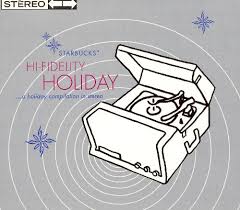
SOUNDTRACK: STARBUCKS Hi-Fidelity Holiday (1998).

This is one of my favorite Holiday CDs.  Say what you will about Starbucks (and I know you will), they know their audience (even if I don’t drink coffee).  Almost the entire CD is excellent, or at least in that groovy Hi-Fi style.  There are a few songs that don’t quite fit with the others, but overall, this is a keeper.

ESQUIVEL-“Jingle Bells”
I love Esquivel, and this space age jingle Bells is just the most fun.  You look ravishing tonight.

KEB’ MO’-“Jingle Bell Jamboree”
Keb’ Mo’ is a great performer, but this song doesn’t quite fit on this CD.  Especially after Esquivel.  Maybe if it was a little later in the sequence?  But the song itself is great and should be heard more at Christmas time.

COCTEAU TWINS-“Winter Wonderland”
I have loved Cocteau Twins for decades.  This version of “Winter Wonderland” has been a perennial favorite.  I love what they do with the song and how they keep it faithful but make it their own.  This should have followed Esquivel.

DEAN MARTIN-“Baby It’s Cold Outside”
This song is problematic for many reasons.  But if you can get past the creepiness, Dean’s version is fun.  It’s interesting that the female singers are practically a chorus of voices.

COMBUSTIBLE EDISON-“Sleigh Ride”
I’ve pretty much forgotten about Combustible Edison, but I love this swinging instrumental version of this song.  It’s totally terrific.

LEONARD COHEN-“Hallelujah”
This is not a Christmas song.  At all. It is also so over played that I never really want to hear it again.

XTC-“Thanks for Christmas”
I love this song.  It’s bright and happy and the XTC voices and guitars are just perfect.

EL VEZ-“Christmas Wish”
I have a soft spot for El Vez, but man I don’t care for this version of this song.  It’s not bad, but I kept thinking it was some B list actor form a 1950s rock n roll film (like Arch Hall).  I suppose if it was more in the El Vez spirit I’d enjoy it more.

JAMES BROWN-“Merry Christmas, Baby”
I like this song except it always bugs me that there’s a line about not being drunk but being all lit up like a Christmas Tree.  James seems a little not into this recording, to be honest.

THE ALARM-“Happy Christmas (War is Over)”
This song bugs me.  I think it’s the obnoxious (but well meaning) idea that war can be over if we want it.  But whatever.  This version is kind of flat, which is springing given The Alarm is all stadiumed out most of the time.

THE TEMPTATIONS-“Little Drummer Boy”
This song is tough to pull off.  The Temptations were a little flat at first I thought, but they pulled through to the end and won me over.

PEGGY LEE-“I Like a Sleighride (Jingle Bells)”
This song is weird and fun.  The “I like a sleighride” chorus is weird and kind of creepy, but it’s got a real fun feel overall.

ROBBIE ROBERTSON-“Christmas Must Be Tonight”
So I listened to this song and had literally no recollection of ever hearing it before–even though I have listened to this disc every year for a decade.  And even now, I have no recollection of it either.

THE BLUE HAWAIIANS-“We Four Kings (Little Drummer Boy)”
Is it because I have heard every Christmas song a million times that I gravitate to the oddball recording?  Probably.  I love this surf guitar instrumental version of “We Three Kings,” it brightens my day.

BOBBY DARIN-“Christmas Auld Lang Syne”
This is a classic.  It used to bug me that he goes so over the top with the LOOOOOOORD business at he end, but it doesn’t bug me much anymore–its makes me smile.  I really like the melody and the way the songs are conflated.

Overall this is a great collection of songs.  It’s not all as groovy and space-age as it appears, but it’s still good holiday fun.

[READ: December 1, 2017] “Skinks”

Near the end of November, I found out about The Short Story Advent Calendar.  Which is what exactly?  Well…

The Short Story Advent Calendar returns, not a moment too soon, to spice up your holidays with another collection of 24 stories that readers open one by one on the mornings leading up to Christmas.  This year’s stories once again come from some of your favourite writers across the continent—plus a couple of new crushes you haven’t met yet. Most of the stories have never appeared in a book before. Some have never been published, period.

I already had plans for what to post about in December, but since this arrived I’ve decided to post about every story on each day.

This story is told by a little boy, Wendell, who wants to be called Dilly.  He tells us that Jesse doesn’t like it when he calls him Dad.  Jesse always says “Two things.”  Like “One, your dad left a long time ago and two, although you don’t want to say he’s your dad, he still is.  I’m not.  Clear?

Clear.  Clear as mud, he says.

Jesse is now in the hospital and the boy has been talking to his mom a lot.

When he goes into Jesse’s room the pastor is in there.  “He thinks all the answers are in that book,” his mother says to him.  She then says to the pastor, “I know it’s serious, but that was years ago when you both loved getting into trouble.  He’s different now.”

The pastor bristles at this and says “some of us know better than to get into fights over things people say.”

There’s a lot of observations from the boy about his mother (and what both she and Jesse say about women in general)

And sometimes he just goes in and talks to Jesse, which he thinks is weird, but he does it anyway.  When he heard there was skink in the hospital he knew Jesse would want to see it. “It’s a weird word but I like it.”

But mom and a police officer enter and Dilly hears the officer say, “I’m sorry, but things have changed.”  Before he can leave the room he sees that Jesse is now restrained.

The pastor comes out while Dilly is outside and asks Dilly what he’s doing.  When Dilly mentions the skink, the pastor gives him some suggestions about bait and ways to catch them.   During this brief conversation, a lot of truths come out.  About Jesse, about Dilly’s father and about the pastor.

But I feel a little too much like Dilly in this story–like everyone is talking around me.  There’ a few too many gaps that I can’t fill in to fully get what happened.

Read Full Post »

« Newer Posts - Older Posts »