Feeds:
Posts
Comments

Archive for the ‘Morality’ Category

SOUNDTRACK:  PUBLIC ENEMY-Live at All Tomorrow’s Parties, Convention Hall, October 2, 2011 (2011).

NPR was cool enough to record and provide as a download most of the shows at the All Tomorrow’s Parties festival in Asbury Park, NJ.  (Portishead wouldn’t allow their show to be recorded, sadly).  But Public Enemy was a welcome surprise!
This tour is in celebration of the anniversary of Fear of a Black Planet.  And they play most of Fear and a lot of other things too (with almost nothing from their 2000 era CDs.

I can remember back in the early days of rap that it was hard to imagine what a rap show would be like live since they didn’t play instruments and much of the music was sampled.  Well, PE has musicians on stage and they have DJ Lord filling in for Terminator X behind the turntables (big shoes to fill, but done largely well–especially his fun “solo” in which he samples The White Stripes and Nirvana–although he should have mixed in Portishead, no?).  And mostly they have the personalities of Chuck D and Flavor Flav.

I suspect that this show would be a bit more fun to watch than it is to listen to–Flavor Flav’s antics don’t always translate well without his visuals.    Like when he asks the audience if that can all say “Ho” (which he eventually holds for 33 seconds!), it seems like a delay tactic in audio, but is probably fun to witness.

What’s especially cool about the show is that PE play so many songs, including small snippets of songs as segues to other ones (like the seventy second version of “Anti-Nigger Machine” that intros “Burn Hollywood Burn” which is practically hardcore) or the minute and a half of “He Got Game” that follows “Night of the Living Baseheads.”  I like that they even threw in some skits from the record like “Meet the G That Killed Me” and “Incident at 66.6FM.”

But of course the real joy is the full length songs, “Brothers Gonna Work It Out,” “911 is a Joke,” and of course “Bring the Noise” and “Fight the Power.”

Some of the improv sections don’t work all that well, the guitar solo in “Power to the People” leaves something to be desired (Khari Wynn maybe a legend, but he;s no Vernon Reid),  although the  “Jungle Boogie” riff is cool.   But the improv with guest drummer Denis Davis was pretty bad ass.  Flavor Flav hopped on the drums and was quite good for “Timebomb.”  We also got to meet Flav’s daughter Jasmine.  And Professor Griff was there too.

It’s also interesting that they keep saying they have no time left in the set (Portishead is next) but they play for at least 30 minutes after this.  Including a wonderful “By the Time I Get to Arizona and the set ending “Fight the Power.”

Chuck D has still got it and Flav is just as crazy and fun as ever (even if his screams and yos seems out of tune from time to time).  Of course, Flav has to get the last word in by raging  on for six and a half minutes  at the end (and about six-minutes in the beginning as well where he gave himself props about his reality show.

It’s a really good set–a little distorted from time to time, but really solid.  Here’s a link to the downloadable show.

[READ: October 2, 2012] Hocus Pocus

This book may have put me over the edge in terms of Vonnegut exhaustion.  I bought this book some time in 1992, but I never read it. It’s been in my house for twenty years and it was about time I read it.

But as I’ve been noticing, each Vonnegut book has been getting darker and more misanthropic.  And this one is no exception.  The construction of the book follows Vonnegut’s cut and paste style but it feels even more shuffled and indirect than usual (more on that later).  In many of Vonnegut’s books, the “climax” occurs somewhere in the middle and he fills in the details later.  For this one, the climax came around h.and I wouldn’t have felt like I missed anything.

In this book, the main character, Eugene Debs Hartke  is a Vietnam vet (usually his protagonists are military men, and Vonnegut has criticized Vietnam a lot, but this is the first time he’s had a Vietnam vet as protagonist).  He married his wife and had a wonderful family until he learned that his mother in law had a disease that made her crazy–but it only kicked in later in life, after he married her daughter.  And that his wife has the same disease–so by the middle of the story both of the women in his life are crazy “hags.”  And, like in his other stories, his children hate him. (more…)

Read Full Post »

SOUNDTRACK: JAPANDROIDS-Live on KEXP, June 16, 2009 (2009).

Back in 2009,  one of the guys from Japandroids had surgery and they had to cancel some dates.  That’s only relevant to this because when this set is over, the guitarist is bleeding from his scar.

Japandroids are two guys and they make a lot of noise.  I can recall jamming on guitar with my friend on drums and even when we were totally in synch, we never sounded this good.  It really sounds like there are four or five people playing.  This set has three songs from their debut album and an amazing cover of Big Black’s “Racer X.”

The three  songs are very good and the guys pay hard and fast and, as I said, they sound amazing.  It’s a great set.  You can hear the whole thing here.  There’s also video of the performance.  It’s broken  into two parts.  This is part two, with the blistering cover of “Racer X.”

[READ: September 17, 2012] Bluebeard

I’ve mentioned this book a few times in the last couple of days as something that I’d been struggling with.  And, indeed, I found it to be a little slow going.  I was excited to start reading it because, as the subtitle says, this is an autobiography of Rabo Karabekian, an artist who appeared in Breakfast of Champions–I love that Vonnegut keeps working within his own universe.  But there was something about the early pages of the story that were just not that compelling.

Rabo is having a hard time getting his book going, and while that is a dramatic effect, I had a hard time getting into the book too.  It’s not that complicated of a story.  There are really only about a half dozen characters in the book:

Rabo–he is an American Abstract Expressionist painter (contemporary of Jackson Pollack, Jasper Johns, et al).
Circe Berman–she is an author who writes under the pseudonym Polly Madison (ha).  Madison’s books look at the real life of American young people and are staggeringly popular.
Paul Slazinger–Rabo’s next door neighbor who spends most of his time in Rabo’s house, although he and Rabo mostly ignore each other.  Slazinger is a writer with a decades long writer’s block.
Dan Gregory–a famous artist for whom Rabo apprenticed.  Gregory was such a good detailist that he once created a perfect forgery of a bill (on a dare).  Gregory was also a terrible racist and philanderer and treated Rabo with contempt at best.
Marilee Kemp–Gregory’s mistress and sometime muse.  She inadvertently sends Rabo an encouraging letter on behalf of Gregory and then she and Rabo begin a writing relationship which blossoms when they eventually meet. (more…)

Read Full Post »

SOUNDTRACK: …AND YOU WILL KNOW US BY THE TRAIL OF DEAD-Live on KEXP, March 12, 2009 (2009).

Back in 2009, …And You Will Know Us by the Trail of Dead had been hit by a truck.  Really.  Evidently no one was hurt too bad, but they did have to cancel a show in Salt Lake City. 

Nevertheless, they managed to get to KEXP to play a four song set from their latest album The Century of Self.  The opener “The Giant’s Causeway” is full of bombast and noise  and has a surprisingly catchy melody in the middle.  It merges into “The Far Pavillion” (just like on the album) which sounds like pretty typical Trail of Dead–rocking and yet melodic, with some good screaming parts.

“Luna Park” is something of a surprise to me as it’s a piano-based ballad (which I suppose Trail of Dead plays, but which I don’t associate with them).   “Bells of Creation” also opens with a piano, but it quickly grows very loud.  It’s a cool song with lots of depth.

I had actually stopped listening to Trail of Dead after Worlds Apart (and album I liked, but I guess the band fell off my radar) so it’s nice to hear they’ve still got it.  At least as of three years ago.

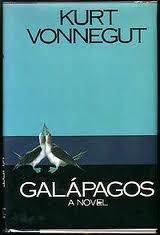
[READ: September 17, 2012] Galápagos

Each of these 1980’s era Vonnegut books gets darker than the last.  In this one the entire human race is wiped out (except for a few people who spawn what eventually becomes of the human race in a million years).  For indeed, this book is set one million years in the future and it is written by a person who was there, one million years in the past when the human race destroyed itself.  It’s not till very late in the book that we learn who the narrator is and, hilariously, what his relationship is to the Vonnegut canon.

In typically Vonnegut fashion, the story is told in that spiral style in which he tells you a bit of something and then circles back to it again later and comes back again later until finally 200 or so pages into the book you get all the details of what is happening.  Interspersed with the respawning f the human race (and flippers) is the story of the Adam and Eve and Eve and Eve and Eve and Eve who created the human race–how they got to be together, what their lives were like before and what contribution they made to humanity, such as it is now.

In another bizarre and fascinating twist, every character who is going to die in the near future gets a star next to his name so that the reader knows that that person is going to die.  We get a lot of things like ★Andrew MacIntosh for many pages until the character finally dies.  And pretty much everybody does die.  Well, obviously if it is set a million years in the future, but aside from that part, only a few of the characters survive.

So here’s how these few people managed to create a new human race in the Galápagos Islands.   (more…)

Read Full Post »

SOUNDTRACK: OF MONSTERS AND MEN-Live from Iceland Airwaves (2011).

This brief set was recorded at KEX hostel in Reykjavik, Iceland (how on earth KEXP in Seattle was there I don’t know).  This set was performed before the release of their debut EP, although “Dirty Paws” which they play was not on that EP.  “Little Talks” their (reasonably) huge hit them was on the EP and is on their full length album–it’s a great duet (and reminds me a bit of Stars).

There’s an amusing fail in the horn solo on “Lake House,” which is kind of surprising, but not terribly tragic or anything.  The band sounds great, especially in front of a home country crowd (I love hearing them say “Takk” at the end of the songs).  There’s five songs in all, and by  the final one, they feel  sound like they’re really enjoying themselves.

[READ: September 1, 2012] Wampeters, Foma & Granfaloons

This collection contains essays reviews and speeches.  So it’s non-fiction.  Except that, ever the contrarian, Vonnegut includes one fiction piece–a short play.  The title of this book comes from three words from his novel Cat’s Cradle: “a wampeter is an object around which the lives of many otherwise unrelated people may revolve.  The Holy Grail would be a case in point.  Foma are harmless untruths, intended to comfort simple souls.  An example: ‘Prosperity is just around the corner.’ A granfallooon is a proud and meaningless association of human beings.”

That all comes from the preface.  The preface also says that there are people who have collected everything he has ever written (even stuff he has forgotten about) but he will not let most of that see the light of day.  Here he has whittled down the least embarrassing stuff for publication.  He also explains that at some point (supported by reading this) he decided to stop giving speeches; to stop “talking” and to concentrate on writing.  So he did.

The final straw for this was a comment from the President of the American Academy of Arts and Letters.  Vonnegut had prepared a speech.  The president reread it and hated it, but the president told Vonnegut that nobody would actually listen to the words: “People are seldom interested in the actual content of a speech.  They simply want to learn from your tone and gestures and expressions whether or not you are an honest man.”

While Vonnegut’s essays are powerful and effective, it’s the Preface that really tells it straightg.”Not nearly as many Biafrans were butchered by the Nigerians at the end of the war as I had thought would be.  At a minimum those damaged children at the exact middle of the universe will be more honorable than Richard M Nixon.  [Nixon] is the first president to hate the American people and all they stand for.”

Get ready for a happy collection. (more…)

Read Full Post »

SOUNDTRACK: NADA SURF-The Stars Are Indifferent to Astronomy (2012).

Nada Surf continues to put out poppy guitar rock.  I tend to link them with Guster, in that they write really catchy pop songs about unexpected things.  The songs are usually fast, but they also writes some slower songs too.  They would make a good double bill.

This album with the wonderful title is 38 minutes long, a perfect light summer album.  If you don’t get “Waiting for Something” (which I agree is repeated waaay too often in the chorus) stuck in your head, then you haven’t been listening to this record.

All ten songs feature bouncy guitars (except “When I Was Young” which opens as a slow ballad), although even this song, after about 2 minutes, calls forth loud electric guitars.  There are some elements that show the band “maturing”–strings on “When I Was Young” horns on “Let the Fight Do the Fighting.”  But one of the songs references Gilligan’s Island, so they’re not maturing too much.

And some of the songs sound like throwbacks to other eras too, the 60s guitar intro of “Jules and Jim,” the R.E.M. ish intro of “Waiting for Something.”  It’s a great album, fun, catchy and perfect for driving.

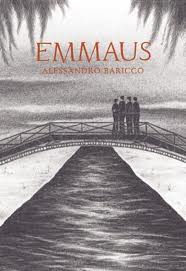
[READ: July 24, 2012] Emmaus

I had no idea who Alessandro Baricco was when I got this book as part of my Book of the Month deal with McSweeney’s.  But I’ve never been disappointed by one of their new books before, so it was worth checking out.

The book is short–134 pages–and is novella length, which is the perfect length for this story.  [I had just read about Jim Harrison and his novellas, and I believe that there needs to be more novellas published].  This book was originally written in Italian and was translated by Ann Goldstein.

There is a prologue which is completely exciting and absolutely wonderful.  It’s only a page and a half, but it is intriguing, funny, deep and, most of all, really surprising.

The opening of the book doesn’t quite match the excitement of the prologue, but that’s because this novella has two aspects–deep, thoughtful introspection and base, animal instinct.  And Baricco/Goldstein does an excellent job keeping the flow and continuity going between these two very different writing extremes.

The book reminds me of Jeffrey Eugenides’ The Virgin Suicides for two reasons.  One: it is written about a group of boys and is written in the second person plural (at least the beginning is) and two: they are all watching a girl who is beyond their ken–someone of their world but not, someone who is en route to hurt herself.  And there’s nothing they can do about it.

But this book is entirely its own.  There are four boys who make up the initial “we” (and when it diverges from plural to singular, you really feel the loss of the other boys).  And so the book starts: “We’re all sixteen or seventeen years old, but we aren’t really aware of it.”  The four boys are good boys–Catholic (and believers, at that), who play in the church band, who volunteer removing catheters at the poor person’s hospital and who plan to not have sex before marriage (heavy petting is okay but it never goes too far).  The four boys are: the narrator, whose name is never given I don’t think; Luca, whose father is rumored to be suicidal; Bobby, the most outgoing of the bunch and The Saint, a very pious young man who has designed for the priesthood and who is not afraid to be seen as more pious than you. (more…)

Read Full Post »

SOUNDTRACK: SIX ORGANS OF ADMITTANCE-“Even If You Knew” (2012).

Lars from NPR’s All Things Considered picked this as his summer music preview song.  I don’t know a thing about Six Organs of Admittance, but their discussion of this song makes it seem like this is atypical for the band (which has a massive output).  Evidently they’re usually more droney sounding. But man, this song is pummeling and wonderful.

It’s seven minutes long and opens with a simple, plodding heavy bass riff.  The vocals are kind of whispered and strained.  But then comes the guitar solo–a raging piece of distortion that complements the bass.  And that’s just the first three minutes.

The second half of the song features a quieter section–the bass is quieter, while the guitar noodles around and the vocals play over the rhythm.  The song slowly builds again, and by the last minute or so there’s another fierce guitar solo. Until the song is exhausted by the final distorted notes.

This is some beautiful noise.  And, no I have no idea what the band’s name means.

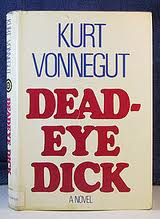
[READ: June 27, 2012] Deadeye Dick

Deadeye Dick is the last Vonnegut book that I was completely unfamiliar with.  I had no idea what it would be about.  So I didn’t realize until very late in the book, and then I looked online and confirmed that this book is set in the same location as Breakfast of Champions, Midland City, Ohio.  Indeed, some of the same characters appear in this book as appeared in that book.  But more about that later.

Vonnegut is not known for his happy books.  Misanthropy is pretty rampant in his pages.  But this book is one of his bleakest books yet.  The story concerns the Waltz family–Rudy (the protagonist) and his brother Felix are the only children of Otto and Emma Waltz.  Pretty early in the story we learn that Rudy is a double murderer.  Yipes!

As with most Vonnegut stories, this one is told in a convoluted and non-linear fashion.  He foreshadows (and really just casually mentions) a lot of crazy things that are going to happen in the book.  Like the fact that Midland City is going to be devastated by a neutron bomb.  In fact, his preface (like with many of his prefaces) tells us a lot about what’s in the book and who the characters are based on and the fact that there is a neutron bomb (but the reality of a neutron bomb is different from what he says).  There is something about knowing this information ahead of time that impacts the way you read the story.  Whether you think maybe he’s not telling the truth about what will happen (can the narrator really be a double murderer?) or maybe somehow the foreshadowing makes it even worse when it actually happens–the revelations are perhaps more deliberate.  But the style–a recursive style in which he says what happens and then he goes back and fills in the details, makes the events that much more powerful.

The funny thing about this story is that a lot happens to the characters in the beginning of the story and then not too much happens to them after that.  But that early stuff is pretty exciting and it has an impact all the way through. (more…)

Read Full Post »

SOUNDTRACK: MOUNT KIMBIE-Tiny Desk Concert #121 (April 18, 2011).

After subscribing to the NPR Podcasts, I found out that every few days, a new concert gets downloaded to my folder (which is pretty cool, but which I must check on from time to time so I don’t fill my machine!).

This Tiny Desk concert came along unannounced by a band I’d never heard of.  I’m not planning to listen to every concert that comes along, but this band seemed interesting.  Mount Kimbie’s Crooks and Lovers made the NPR list of “Albums We Missed in 2010” and the song they play there “Before I Move Off” is a fun and twisted song of blips and bleeps set to a catchy beat.  About mid way, the samples (cut up and unrecognizable) come in and add a new (almost creepy) texture to this song.

This concert reveals the less “programmed” side of the band as there is an electric guitar and (evidently from the notes) a live drum.  What’s most interesting about these songs is that even after a few minutes of riff and repeat, they throw something in that changes things.  Like the vocals (!) on “Maybes” (which frankly don’t live up to the rest of the song) that begin in the last-minute of a 5 minute song.  (The opening noises are really great).

The other two tracks “Ode to Bear” and “Field” are good, interesting electronic tracks.  But after a couple of listens to the show, I was actually growing a little bored with them.  It wa s good introduction, but that’s probably as far as it will go for me and Mount Kimbie.

[READ: April 6, 2011] “Two Fables”

A fable is defined as “a short story to teach a moral lesson.”  Given this definition, I would say that these stories failed as fables. I didn’t get any kind of moral lesson from either of them.  Indeed, I have a hard time with a lot of things that claim to be modern fables if only because of the definition…a vague or missing moral seems to me that it fails as a fable. (more…)

Read Full Post »

SOUNDTRACK: LOW-Tiny Desk Concert #129 (May 22, 2011).

In March, I reviewed (and loved) Low’s new single, “Try to Sleep.”  That song and two others are presented here in this Tiny Desk concert.

The band for this gig is just Alan Sparhawk on guitar and vocals and his wife Mimi Parker on backing vocals (and thigh slaps).  It’s a very stripped down sound, but it really suits these songs (I don’t know the originals of the other two–“Nightingale” and “Something’s Turning Over”) which all come from their new album C’mon.

Their harmonies are wonderful (they are quite striking on “Something’s Turning Over” where I thought she was playing a keyboard, but it is her voice!) and the melodies are pretty terrific too.   As I said last time, I’ve never really listened to Low very much (I’ve been sort of turned off at the idea of their being spare and depressing).  Strangely, this session which is just the two of them is the opposite of spare.  I don’t know if this is a good introduction to the band, but it’s a wonderful introduction to this album.   And it’s a surprisingly catchy collection of songs from a bunch of ol’ mopesters.

Although, perhaps the biggest surprise comes at the end of the show when, before leaving, Sparhawk starts playing “Sweet Home Alabama” and Parker even gets the “turn it up” part right.

I wasn’t expecting to listen to this more than once or twice, but I’m really entranced by this session.

[READ: May 10, 2011] Emily of New Moon

Sarah loves the Anne of Green Gables and Emily of New Moon book series.  She still has the books from when she was a kid (the copy I read has her signature and phone number (several area code changes ago) written on the inside front cover).  After reading the L.M. Montgomery biography, I figured it was time to look into these books. I was going to start with Anne, but we watched the movie not too long ago so I decided that I’d start fresh with an unknown subject.

Emily is a 12-year-old girl whose mother has died and whose father is deathly ill.  Indeed, within a chapter or two, Emily finds herself an orphan.  I don’t know a thing about 100 year old adoption laws in Canada, but the upshot is that someone from Emily’ mother’s family, the Murrays, will take care of her until she is old enough to do so on her own.  However Emily’s mother ran off with a boy when she was very young (which was a disgrace to the family name), and Emily herself is a willful and strong child.  Frankly, no one wants her.  So, with Emily eavesdropping, the Murray clan discusses her future and decides to make her draw straws for her fate. (more…)

Read Full Post »

SOUNDTRACK: BEN FOLDS/NICK HORNBY-Lonely Avenue (2010).

As the cover of this album notes: “Ben Folds adds music and melody to Nick Hornby’s words.”  And that is true. The only surprising thing about this combination is that Folds is quite a good lyricist himself, so it’s surprising that he would sacrifice his words.  But regardless, the fit is a good one.

Sometimes it seems like Hornby is challenging Folds to come up with melodies for some of his more difficult lyrics which Folds lives up to).  But they have such similar sensibilities that (aside from occasional references to British things) the words could have come from Folds himself (although, Hornby’s a better writer, so Folds wouldn’t have written exactly the same things).

The big surprise is the diversity of musical styles on the disc.  Folds of course does play lots of different types of music on his previous discs, but I guess since the cohesion is Hornby’s words so Folds can really let loose.

The opener, “A Working Day” is a keyboard pop confection, a surprisingly 80s sounding synth song with some wry lyrics about being a writer/performer (“some guy on the net thinks I suck and he should know, he’s got his own blog”).  “Picture Window” is a beautiful downer, a string-filled song that seems like a companion to Folds’ “Brick” (“You know what hope is, hope is a bastard”).  It’s just as sad but the melody is gorgeous.

“Levi Johnson’s Blues” is a strangely topical song (in fact, it took me a minute to remember who he was when I first listened to the song.  Anyhow, it’s a silly song about what happened to the father of Sarah Palin’s grandchild.  And yet, despite the novelty of it, it’s actually a somewhat sympathetic portrait of the guy (sure he’s a redneck, but he’s just a normal guy thrust into a ridiculous spotlight–the liner notes say the chorus came from Levis (redacted) Facebook page).

“Doc Pomus” feels like a classic piano song.  While “Young Dogs: is a fast romper (with great vocals) and more keyboards.  “Practical Amanda” is a slow ballad (and Hornby says it’s not autobiographical at all).  While “Claire’s Ninth” is a story about a young girl of divorced parents who hates having two birthdays.  (With sweeping choruses!) Hornby states that this was his first accepted short story (modified for the song, of course) but the magazine that accepted it stopped publishing before his appeared.  D’oh!

“Password” is a wonderful song which only makes sense when you know the name of it (which I didn’t at first, as I usually don’t look at titles right away).  Throughout the song Ben spells words which leads to a cool conclusion–it’s wonderfully clever writing and it’s done in a fascinating R&B-lite style.

“From Above” is a jaunty rocker about people who never meet, although their paths cross quite often.  “Saskia Hamilton” is the “single” from the record.  It’s another great 80’s keyboard fueled romp.  Since I have a friend named Saskia (hi, Saskia) I’m fond of this song–her name is fun to say.  They have a bunch of fun in the recording too.

The final track, “Belinda” is designed like a classic 70s piano ballad (there’s a lengthy email printed in the notes that explains the construction of the song–reading that makes the song even more impressive).

It’s a great Ben Folds album.  It’s not as tidy as some of his other ones–but all of that experimentation leads to some new avenues of melody. It’s a risk that paid off.

[READ: May 10, 2011] Five Dials Number 7

This issue of Five Dials was primarily about Memoir.  Typically, I don’t like memoirs, but I’m finding (and this coincides with what one of the memoirs below states), that I just don’t like celebrity memoirs.  Or perhaps I just like three page accounts of an incident in someone’s life (which these are).

Each of the writers below is given an introduction in which they summarize WHY they write memoirs.  It’s interesting to see that many of them do, in fact, take other people’s feeling into consideration (not as seriously as Mark Twain who waited 100 years for the publication of his), but they try to do something or other to spare people’s feelings.  I was intrigued also that several of the writers also talk about finding themselves through writing.  One or two of them make the exercise of writing memoir sound obnoxiously solipsistic (which of course it is), but it’s nice to read ones that are interesting and not too self-centered.

CRAIG TAYLOR-A Letter from the Editor: “On Audio Detective Work and Memoir”
This letter explains the extent of the audio detective work that went into the interview (presented later) between Raymond Chandler and Ian Fleming.  Since I love playing with audio software, this was of especial interest to me.  And it made me really look forward to the interview. (more…)

Read Full Post »

SOUNDTRACK: BATTLES-“Ice Cream” (2011).

My friend Lar told me about Battles way back in 2007.  I listened to the concert he sent me, and it was great. But my memory of the band was that they were really heavy (the drummer was in Helmet and Tomahawk for cripessakes).

But they’re not so much heavy as noisy and crazy.  And this track is a head-spinning amalgam of keybaords, unsettling rhythms, processed guitars and singing from Argentinean techno producer Matias Aguayo.  The lyrics sound like they are not English, but they are (with heavy effects on them).

The song is weird, indeed. But after just one listen, I was totally hooked.  It’s catchy and bouncy and very sunny and it’s a real joy to listen to.   I absolutely must go back and check out their debut Mirrored.

Listen at NPR.

[READ: April 28, 2011] Five Dials Number 6

Five Dials Number 5 was an excellent issue that I enjoyed immensely.  They followed it up with Number 6, which deals with a subject that I was very passionate about in the early 90s: censorship/obscenity.  When I was in high school and college, the PMRC was the big bogeyman for advocates of free speech (of which I am one).  I still advocate passionately for freedom of speech (now that I’m in a library, the issue can be part of my daily life), but it seems like there are so many more important issues in the world, that stickers on a record seem kind of silly.

Nevetheless, as this issue reminds us, those who control what is said control what we hear.  And that’s true for music and books, as well as our everyday news.  So, free speech should never be taken lightly.  Although this issue looks largely at obscenity in England, they also pull up some good information from Jello Biafra as well.

CRAIG TAYLOR-A Letter from the Editor: On John Mortimer and Obscenity
John Mortimer appears later in the issue. He was the lawyer who defended Lady Chatterly’s Lover against accusations of obscenity.  And Taylor points out that Mortimer’s attitude was that he “understood the silliness of censorship.”  And with that attitude, he was able to work to convince juries of that silliness.  The rest of the issue looks at important cases of censorship over the years, from The Dead Kennedys to NWA (it’s nice to be reminded about how “dangerous” they were when they came out).  He also laughs at the lame attempts at putting adult content on network TV (Fudge you!). (more…)

Read Full Post »

« Newer Posts - Older Posts »