Feeds:
Posts
Comments

Archive for the ‘Memoirs’ Category

SOUNDTRACK: BILLY BRAGG-Tiny Desk Concert #281 (June 17, 2013).

I really like Billy Bragg.  Not necessarily all of his music, but I like a lot of it and I certainly love what he stands for.  If you like his instantly recognizable voice (which I do), then just about anything he does sounds good.  But no doubt some songs are catchier than others.

Bragg played a Tiny Desk Concert in 2016 with someone else as part of a duo.  I’d listened to that one first, but I liked this one more.

For this one he is accompanied on the first two songs by dobro player C.J. Hillman.

Bragg talks a lot–he has many lengthy stories between songs–and he’s pretty much always funny or thoughtful.  He introduces the first song by saying that moving into a new building always has troubles–you’ll always need someone to fix things up.  With that, his first song is called “Handyman Blues.”

It’s a great story song.  I especially like this line:

Don’t be expecting me to put up shelves or build a garden shed / but I can write a song about how much I love you instead.

It’s amusing that in the next song workers actually interrupt his song.  They were “met with lot of hammering on our rooftop by some real handymen as they put the finishing touches on NPR’s new home.”

For the second song they

channeled the spirit of legendary American folksinger Woody Guthrie, with whom Bragg collaborated — albeit posthumously, in Guthrie’s case — when he took Guthrie’s unsung words and set them to song with the help of Wilco. Here, he takes a song Guthrie himself co-opted and altered: a gospel tune (“This World Is Not My Home”) he’d turned into an anthem against inaction.

Bragg introduces this song as saying he took it over when the U.S. was having the debate about universal health care.  He says that people still face all the same problems that this classic song talks about–people losing homes to banks or families struggling to make ends meet.  But the middle verse is about a wife who dies on the floor for want of proper health care.  Bragg says that that doesn’t happen in his country anymore and it’s hard for people in his country to imagine that a generous country like the US still hasn’t resolved that issue (and five years later things are even worse with Trumpcare–#ITMFA #RESIST).

Guthrie called the song “I Ain’t Got No Home (In This World Anymore”).  After he sings a verse, the hammering starts and they pause the song to wait for the work to finish before he re-starts the song.  In the meantime they talk about what his band should do in Washington.  Someone says the National Archives and he jokes the Nashville Archive?  He says that they really enjoyed Nashville.  Then he mentions the National Archive to CJ and says

We can find out how the Americans started the war of 1812.  (chuckles).  I just played Annapolis, they’re still sore about it over there.  Never mind who won the war but who started it.

It’s another nice story song.  The dobro works perfectly with it.

“Sexuality” is the only song on this set that I knew.  It’s an old favorite that is serious and funny as well (and very progressive for when it was written).  It sounds terrific and is super catchy.  Although he comments that the acoustics aren’t that great in this new building–there’s not much bounce back off the walls “for those of us who technically aren’t great singers.  But for those of us who are buskers like myself, it’s not bad.”

Introducing the final song, “No One Knows Nothing Anymore” he says he read an article on the BBC about a kid who proved that economics professors were wrong and the article commented that “the trouble with economics is that no one knows nothing anymore.”  He says that had just written a song with that same name, so he’s with the zeitgeist.

He also interjects that there will be pedants–“and there are one or two who listen to NPR, I’m sure” who will write in to say it should be ‘no one knows anything any more.’  But the first thing they teach you at songwriting school is that alliteration trumps grammar.

And then he starts strumming “Sexuality “and says “Oh, I’ve just played that.”

“No One Knows Nothing Anymore” is a nice folkie, very-Billy Bragg song–good melody and really good lyrics.

At the end, as the camera fades to black he says “Chris, pass the hat around.”

I’m so happy that Billy Bragg is still making music.

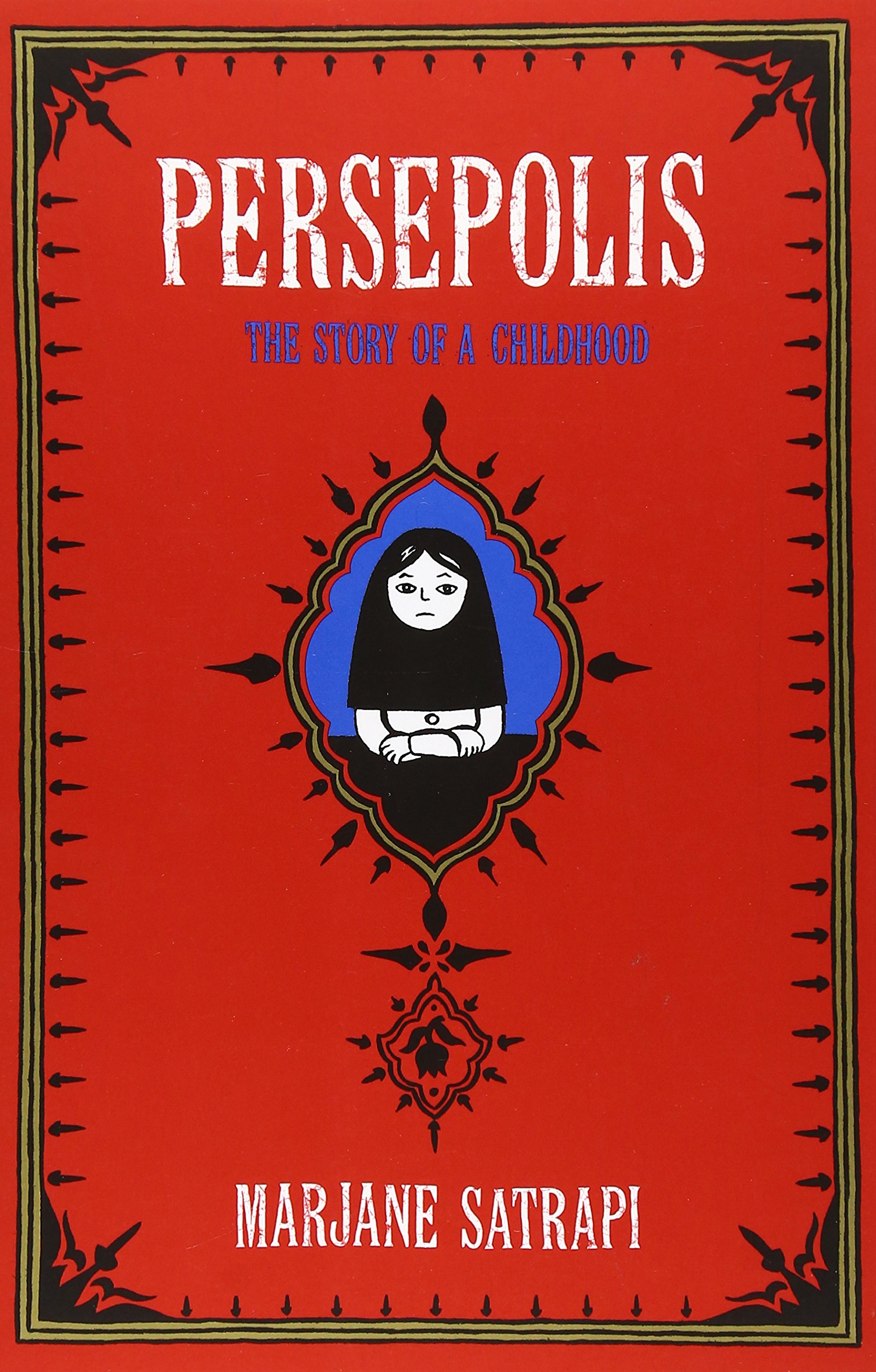
[READ: March 26, 2016] Persepolis

This graphic novel is legendary, and I’m embarrassed it has taken me 13 years to read it.

Persepolis is a memoir of a young girl growing up in Iran during the 70s and 80s.  I appreciated the contextualizing introduction in which she explains the history of the country.

The introduction lays out a basic outline of the history of Iran and the Middle East (that goes all the way back to B.C years).  She explains that Iran has always been a rich nation and has constantly been under attack.  When oil was discovered, the West came calling.  Great Britain wielded a powerful influence over Iranian economy.  During WWII, Iran remained neutral but then was invaded by the west.

The Prime Minister of Iran (not the Shah) nationalized the oil industry in 1951 which led to an embargo and a coup organized by the CIA.  The leader, Reza Shah was succeeded by his son, Mohammad Reza Shah–known simply as the Shah of Iran.  The Shah stayed in power until 1979 when he fled to escape the Islamic Revolution.

She says that since the Islamic revolution Iran has been associated with fundamentalism, fanaticism and terrorism, but she knows that this is far from the truth.  And that’s what inspired her to writ this book.

(more…)

Read Full Post »

SOUNDTRACK: DONNY McCASLIN-Tiny Desk Concert #590 (January 9, 2017).

Donny McCaslin’s band was responsible for the jazzy music that propelled David Bowie’s final album.  As the Tiny Desk blurb says:

David Bowie had long wanted to make a record with a jazz band, and on Jan. 8 of last year, he realized his dream with the release of Blackstar. Two days later, he was gone. Donny McCaslin’s band helped him make that record, and now, a year later, we pay tribute to Bowie and Blackstar by bringing McCaslin’s band

As a bandleader and sax player, [McCaslin’s] put out a dozen albums, the most recent of which is Beyond Now, with musicians Tim Lefebvre on bass, drummer Mark Guiliana and keyboardist Jason Lindner.

Beyond Now was recorded after Blackstar, features a few Bowie covers and stretches the band’s own usual boundaries. For this Tiny Desk concert, you can hear an extraordinary group playing extraordinary music — including an instrumental version of “Lazarus,” from Blackstar.

The band plays three pieces.  “Shake Loose” is 7 and a half minutes.  The music is great behind the sax—dramatic and interesting.  I think I just don’t care for the sound of saxophones as much these days, because I love the bass thumping and the great sounds from the keys but the soloing doesn’t excite me.  I love in the middle of the song that there are really cool spacey sound on the keys.   And the whole middle section where it’s the keys playing weirdo stuff and the drums keeping a groovy jazz beat–that’s awesome.

So I may be the only person in America who has not heard the whole of Blackstar.  I actually don’t even really like the one song I did hear (I don’t care for the jazzy parts).  So I can’t compare this six-minute instrumental version to the original of “Lazarus.”  I love that the keyboard is playing a very convincing grungy guitar sound.  I’m not sure if the sax is doing a vocal line or just playing around, but I love the music for this song a lot.

“Glory” is about the glory of the creation of the beautiful world that we live in “that will hopefully be intact as we move forward.”  This is an 11 minute song with all kinds of great swirling keyboard sounds.  I really like this song—the bass and keys together are great.  And either I’ve grown more used to the sax or its mixed a little lower, but it works so much better with the music.  About three minutes in there’s a lengthy trippy mid-70s Pink Floyd echoing synth solo.  Which is pretty cool.  So overall, I really enjoyed this set.  And maybe I need to go give Blackstar a listen.

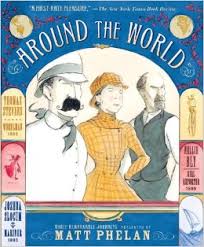
[READ: March 25, 2016] Around

I really enjoyed Phelan’s Bluffton.  The story was interesting and I really enjoyed Phelan’s artwork–subtle with delicate coloring and very thin, expressive lines.

This book also contains Phelan’ wonderful artwork and the story (or stories) are also really interesting.  For this is a book about three remarkable journeys around the world.

Phelan gives a fictionalized (but accurate) history of the adventures of Thomas Stevens (Wheelman in 1884), Nellie Bly (Girl Reporter 1889) and Joshua Slocum (Mariner 1895).

I hadn’t heard of the two men and I found their stories quiet fascinating.  I knew of Bly’s journey but I didn’t know all of the details and I found it equally interesting. (more…)

Read Full Post »

talkingSOUNDTRACK: HOSPITALITY-Tiny Desk Concert #212 (April 30, 2012).

hospitalHospitality are a four piece band from New York.  They play fairly quiet, kind of delicate music.  Most of the songs have a delicately picked out guitar line on the electric guitar and strummed chords on the acoustic.  Amber Papini is the lead singer and rhythm guitarist.

“Sleepover” the first song, starts out even more quietly, with Papini picking out notes on the acoustic guitar while singing in what is practically a whisper.   There’s an interesting part in the middle where both guitars are picking out melodies and its the bass that is playing the most prominent line of the melody.

“The Birthday” picks things up a bit with a relatively more intense song.  The chords are louder and Papini sings more intensely.  This song ends with a whole series of “la da de das.”  Some songs can’t pull that off, but it works perfectly with this one–especially when the bassist adds harmony vocals–it’s super catchy.

“Betty Wang” opens with just the acoustic guitar and drums as Papini sings.  She won me over immediately with the echoed and rising notes of “so shy so shy so shy.”  With the electric guitar bursts and rather loud drumming this song is practically raucous.

The band is quite but their melodies are really catchy.

[READ: December 28, 2016] Talking as Fast as I Can

I was so excited that they were making a continuation of Gilmore Girls.  And while it was no doubt hard to live up to all the expectations of all of the fans, I thought the new series was great.  It captured the old show very nicely even though everyone had moved on ten years.

I wasn’t expecting a new book from Graham, and certainly not a memoir.  But, with some down time, she was able to push this book out as well as doing everything else she’s been doing lately.

For a memoir, this book is a little skimpy (208 pages), and yet, if that’s all she had to say I’m glad it wasn’t padded out with a ton of fluff.  Plus, Graham doesn’t tell us everything about everything.  She talks about her childhood, about acting, about being single and about Parenthood and Gilmore Girls.  It’s all done in what has become Graham’s trademark style (although since we are reading it and not hearing her, the pace is probably much slower). (more…)

Read Full Post »

dfwreadSOUNDTRACK: CHRISTIAN SCOTT aTUNDE ADJUAH-Tiny Desk Concert #477 (October 9, 2015).

aacsChristian Scott aTunde Adjuah and his septet play what he calls stretch music: “the particular type of jazz fusion he’s up to: something more seamless than a simple collision of genre signifiers.”

They note that even his appearance stretches traditional jazz: “You may note that he showed up in a Joy Division sleeveless T-shirt and gold chain.” It’s sleek and clearly modern, awash in guitar riffs, but also bold and emotionally naked.

Christian Scott aTunde Adjuah (not sure how to abbreviate that) is a trumpeter and he can hit some loud powerful and long –held notes.   It’s funny that when he bends over the trumpet grows quieter—those ic really are direction-based.

For the first song “TWIN” he does some impressive soloing over a simple and cool beat—piano and delicate guitar riffs (there’s also an upright bass and drummer).   After his lengthy solo there’s a flute solo that also works perfectly (if less dramatically) with the background music.  (Christian plays tambourine during her solo).  He says that this song is about being a twin.  His brother, Kyle Scott is a film director and for whom Christians scores the music.  Christian also explains that he comes from an African-American and Native-American background and that this song has rhythms as a sort of history of his family that touches on Mali, Senegal Gambia and The Ivory Coast and makes its way to the Caribbean, Cuba and into New Orleans.

He’s pleased to play the Tiny Desk Concert for an audience that appreciates “Music that has nutritional value.”

For the second song, “West of the West” he brings on a young alto-saxophonist who plays with his drummer in a different band. The song opens with a rocking electric guitar solo and then the jazzy band kicks in behind it.  The instrumental features a couple of solos by the saxophonist, the pianist and the bassist.

“K.K.P.D.” is a dramatic song for which he gives a lengthy back story.  Many years ago in his home of New Orleans, he was stopped by New Orleans police late at night for no reason other than to harass and intimidate him.  he was coming back from a gig.  He resisted and was in a serious situation and was seriously threatened—the story is long and very affecting, especially given how articulate (I know, terrible word, but true) and calm he is about retelling this horrifying story.  His pride almost made him do something ill-advised, but instead he channeled that pent-up frustration into a piece of music whose long-form title is “Ku Klux Police Department.”

He adds that we see things on TV about inner cities or the ninth ward and we believe them to be true.  Like that the neighborhood is happy that the police are clearing out the youth there.  We begin to think that the narrative is true, although the people who live there can tell you otherwise.  Despite the title and the origin, the is song is designed to reach a consensus to move forward –not to build derision or hate.  He says that we have to start working on that now, because if it doesn’t start now then our children will continue to inherit this situation.

It opens with a noisy guitar wash and fast drums.  It’s quite noisy and chaotic although it resolves very nicely into an almost sweet piano-based song with slow horns.  The middle of the song ramps up with some intense soloing from Christian.  I love how that segues into a very different section with an electronic drum and delicate piano.  Chritsian’s next solo is much more optimistic.  The final section is just wonderfully catchy.

When he introduces the band, he points out just how young some of his newest members are: Drummer Corey Fonville (another new member) used a djembe as a bass drum, and also brought a MIDI pad so he could emulate the sound of a drum machine; Lawrence Fields, piano; Kris Funn, bass; Dominic Minix , guitar (21 years old); Braxton Cook, saxophone (24 years-old) and Elena Pinderhughes, flute: 20 years old!

I don’t listen to a ton of jazz, but I really liked this Tiny Desk Concert a lot.

[READ: July-October 2016] The David Foster Wallace Reader

I’ve had this book since Sarah bought it for me for Christmas in 2014.  I haven’t been in a huge hurry to read it because I have read almost everything in it already.  And some of that I have even read recently.  But this summer I decided to read some of my bigger books, so this was a good time as any.

One of the fascinating things about reading this book is the excerpting in the fiction section.  I have never really read excerpts from DFWs longer books before.  And once you decontextualize the parts, you can really appreciate them for themselves rather than as a means to the end of the story.  This is especially true of the excerpts from Broom of the System and Infinite Jest.  But also just reading some of these sections as a short story makes for an interesting experience.

It was also very interesting to read the non-fiction all together like that.  These pieces come from difference anthologies, but they have thematic similarities  So, placing them together like that allows for really comparing the stories.

And of course, the selling point for most DFW fans is the teaching materials in the center of the book–an opportunity to look into the man’s mind at work shaping younger minds.

I have written about virtually everything in this book already (title links refer back to previous posts), so mostly these are thoughts about the pieces themselves and not a part of a whole. (more…)

Read Full Post »

newSOUNDTRACK: DANISH STRING QUARTET-Tiny Desk Concert #399 (October 25, 2014).

danishI always enjoy hearing a string quartet that I’m unlikely to hear anywhere other than a Tiny Desk Concert.  It’s fun to listen to them before reading anything about them to try to imagine where they’re coming from musically.   The opening notes of the first song made me think they were a modernist quartet playing music that was repetitive and mildly atonal.

But they quickly swing it around into what turns out to be the first of many traditional Danish wedding folk songs!

While the quartet does play classical pieces as well, for this Tiny Desk Concert, they focus only on songs from their then recent album Wood Works.  The blurb says “the group recently took a musical detour that landed them in the foggy inlets of the Faroe Islands (a Danish outpost halfway between Norway and Iceland) and various Nordic hamlets where folk tunes are played and passed on.”

The first piece is actually three melodies: “Traditional: Ye Honest Bridal Couple — Sønderho Bridal Trilogy Parts I & II”  The piece begins somewhat atonally, but about 2 and a half minutes in the somber tones give way to a spritely melody that sounds like a great lost Irish jig.  But soon enough with the addition of the other strings it sounds very romantic indeed.  In what I presume is part II, around 6 minutes, the cello plays a wonderfully upbeat and catchy rhythm. The violins play staccato notes that keep the rhythm going while the viola and cello continue the melody–it’s pretty awesome.  Especially as the song fades and each of the strings plays the riff in succession.

The second piece is in fact two pieces: Traditional: Sekstur from Vendsyssel — The Peat Dance.”  Once again the two melodies sound kind of like Irish dances (I guess it’s time to call them Danish dances).  The second half of the first part sound great as the full quartet plays a wonderful melody.  But when the second part of the set comes and the super fast fiddling begins, it s hard not to dance (you can even hear someone tapping his foot as he plays).  The big difference between this and Irish dance is the rather formal sounding and lovely ending melody.

The final piece is the third part of the Bridal Trilogy from the first piece: “Traditional (arr. Nikolaj Busk): Sønderho Bridal Trilogy Part III.”  He says that these melodies date back many 100 years and are still used today.  It begins very slowly and almost somberly.  It doesn’t feel very wedding-like to me and of the three this is my least favorite.

The quartet sounds amazing. The players are Violinists Rune Tonsgaard Sørensen and Frederik Øland, violist Asbjørn Nørgaard and cellist Fredrik Schøyen Sjölin.  It’s also kind of funny since three of the four have beards–not something you typically see on a string quartet. They acknowledge this on their website: “We are simply your friendly neighborhood string quartet with above average amounts of beard.”

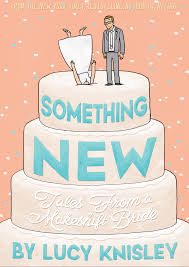
[READ: June 20, 2016] Something New

Knisley has made a rather successful career out of writing graphic novel memoirs.  She has covered food and travel.  And, in a somewhat surprising twist (if you have been following her books), she just got married.

This is surprising because the man she married is the man she broke up with in one of the previous books.  The story basically tells how they were on an off sorta kinda for years until they finally tied the knot.

So this book is the story of their relationship and their engagement. But beyond that it is also an interesting and helpful guide-book for those who want to get married but who may not be totally on board with all of the conventions and trapping of the wedding industry. (more…)

Read Full Post »

carrieSOUNDTRACK: CATE LE BON-Tiny Desk Concert #337 (February 18, 2014).

cateCate Le Bon has a very interesting style of singing–it reminds me of Grace Slick in her enunciation, but also like someone whose speaking accent is very strong and is somewhat masked by her singing (like the way she sings “reason” as “ree-sun” as opposed to “reezun”).

The blurb explains that her “phrasing is completely tied to her Welsh dialect — in fact, her first record was in Welsh…. The enunciation is completely tied to the loneliness and the questioning.”

 For this concert it is just her and her fellow guitarist H. Hawkline (both wearing super cozy sweaters).  They share the guitar licks very nicely–it’s not always clear who is playing what–with her sometimes finishing his lines (I believe).

“Are You With Me Now?” has a very catchy chorus (with an “ah ha ha ha ha” part that makes it sound like an olde English ballad).

“No God” plays with very simple guitar lines (chords played very high on the neck of her guitar and a simple accompanying riff).  Hawkline plays keys (and sings some great falsetto backing vocals) to flesh out this song.  Everything is so clean you can hear each note from the guitar and her voice.

“Duke” opens with some interesting slightly off sounding from Cate while Hawkline plays a simple chord pattern (his fingers are enormous, by the way).  Hawkline’s falsetto is almost as engaging as the vocal lines that match the guitar line which Cate plays.  And when she says “I’ll see you here” in that unexpected pronunciation, it’s totally captivating.

I like Le Bon a lot and want to hear what she wounds like on record.

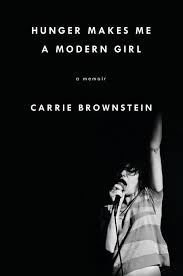
[READ: May 18, 2016] Hunger Makes Me a Modern Girl

After finishing Bob Boilen’s book and thinking about how I don’t really love music-based books, I immediately read Carrie Brownstein’s book.  Carrie Brownstein is one of the two guitarists in Sleater-Kinney and Wild Flag.  She is also one of the leads (writer and actor) on Portlandia.  And she wrote for NPR for a while, too.  Basically, Carrie is the shit.

One thing I took away from this book is that I’ve read a few musician memoirs (Mötley Crüe and Marilyn Manson to name a few) and this is the first one I’ve read that was filled with so much sadness.  Not “I was stoned and regret sleeping with that person with an STD sadness,” but like, real family problems and even a dead pet.  And, as Carrie herself jokes, her stories of being on tour and ending up in the hospital are not based on drugs or other debauchery, but on anxiety and even worse, shingles.

The beginning of the book starts in 2006, around the initial break up (hiatus) of Sleater-Kinney.  Carrie is in pain–emotional and physical–and she can’t take much more.  She starts punching herself hard in the face. (more…)

Read Full Post »

SlewisOUNDTRACK: BEN FOLDS-Tiny Desk Concert #508 (February 16, 2016).

benfolds I’ve liked Ben Folds for many many years.  He’s funny, he’s amazing live and he plays a mighty good song or two.  He’s the kind of artist you say, Has he really not done a Tiny Desk Concert before? (He did an episode of Live from Daryl’s House after all).  But he’s finally here to bang the hell out of their piano and curse up a storm.

He plays several songs from his new album So There, which is  a collaboration with the sextet yMusic.  I haven’t actually listened to the record much because I gave it to Sarah and haven’t grabbed it from her pile yet.  Since there’s no strings for this Tiny Desk, these songs sound just like normal Ben Folds songs–clever lyrics, fun piano and unexpected twists.

The first song is “Phone in a Pool,” one of his rollicking stompers.  It’s catchy and fun to sing a long to and after one listen, you’re right there with him in New Orleans throwing a phone in a pool.  Midway through the song, he forgets the words and just starts laughing: “In a world where you get applause for fucking up.”  And then he makes up a verse about forgetting the words.

“Not a Fan” is a slower song with a beautiful piano melody and biting, funny lyrics (get your T-shirt signed, fangirl).

“Capable of Anything” is a fast, romping song.  He says on the record the vocals are very quiet, so he’ll see what he can do.  After a run through a verse he stops and realizes that he has knocked the piano out of tune.   And when he bangs on the keys at the end, its easy to see how.  There’s some really fast piano work (and you can hear him stomping along).

he says he’ll play some old songs.  He asks for a song and someone shouts “Emeline,” which he immediately starts playing.  And then about a verse in, he gives some story behind the song.  He says that when he was a kid 8 or 9, he wrote earnest songs, but when he was a teenager he wrote “cool”s songs like “Having Two Dicks is Cool.”

And then he started using songwriter vernacular, words you only use in pop songs, “why’d you make me cry, girl?”  Why do people do that? When he was 18 or 19 he started to write songs that were more natural, like Emeline, the first song he was proud of–using the word “stupid” or a money analogy–and which he still loves playing.

He’s willing to do more songs and asks for requests saying which ones he can or can’t do.  And then Bob points out that he’s going to miss his plane if he does more than one song.  So he chooses for everyone and plays an amazing version of “One Angry Dwarf And 200 Solemn Faces.”  he says it can probably be done and will put the rest of the piano out of tune.  And he’s not kidding.  He really pounds the heck out of that thing–how does his own piano manage?

The song is bouncy and fun and he even jokes with the lyrics near the end.

It’s an amazing, invigorating set and has me really excited to see him this summer.

[READ: February 28, 2016] Lewis and Clark

In 2014, Bertozzi made the excellent Shackleton graphic novel.  But three years earlier he had created another historical graphic novel, this one about Lewis and Clark.

Like Shackleton, it aims to be truthful but not comprehensive.  Bertozzi himself explains that it is not meant to be a replacement for the scholarly recounting of the journey.  Rather, he hopes to show the “experience” of the journey.

The book doesn’t really include any historical context, so in a brief summary:

Shortly after the Louisiana Purchase in 1803, President Jefferson commissioned a group of U.S. Army volunteers under the command of Captain Meriwether Lewis and his close friend, Second Lieutenant William Clark to explore the territory.  Their journey lasted from May 1804 to September 1806. The primary objective was to explore and map the newly acquired territory, find a practical route across the Western half of the continent, and establish an American presence in this territory before Britain and other European powers tried to claim it.The campaign’s secondary objectives were scientific and economic: to study the area’s plants, animal life, and geography, and establish trade with local Native American tribes.

(more…)

Read Full Post »

stitches SOUNDTRACK: SON LUX-Tiny Desk Concert #464 (August 21 2015).
sonlux
I really only know about Son Lux from NPR.  And the more I hear from them, the more I like them.

Recently Son Lux has become a trio (it was originally the project of singer/instrumentalist Ryan Lott).  But in this Tiny Desk, rather than staying small, Son Lux went big, adding off-duty, civilian horn players from the United States Marine Band.

I love the opening of “You Don’t Know Me” with the unexpected stops and starts amid the whole section of horns.  And then Lott’s voice comes in, it’s unusual, dramatic and theatrical.  While the horns are more powerful than everything else in this song, as it nears the middle, the guitar line comes in and is groovy and simple.  And then of course there’s the drummer, Ian Chang.  It’s a shame he’s stuck in the back corner because he is incredible.  The rhythms and rolls are tight and furious, but never overwhelming, they are like perfect accents.  And the accessories he uses–simple and effective—all on such at tiny kit. It’s amazing.  All of this goes on for half the song before Lott sits at the piano and plays along.  I love how the song drops out and leaves just the horns to play the end.

For “Now I Want” Chang plays piano.  He plays a simple set of notes moving the song along until he jumps back to drums and Lott takes over on piano (a much more accomplished melody).  There’s great guitar sounds by Rafiq Bhatia (who knew you could get a guitar to do that–he even has a dollar bill under some strings for some of the song) and more amazing drum work.  I love the way the song completely slows down for a gentle piano melody in the middle and the builds back up again.

Lott is a fun and charismatic lead, whether he’s clapping for his band mates, or encouraging people to sing along.

For “Your Day Will Come” some of the horns leave, with only a trio remaining.  Lott opens on piano, with some guitar sounds played over the top.  This song is primarily Lott’s as he sings his heart out (some really loud sections) as the music gently swells.

[READ: July 10, 2015] Stitches

I’m not sure what attracted me to this book, but as soon as I brought it home Sarah said she knew it.

This is a memoir of the young life of David Small.  His drawing and painting style is very dark, and the people he draws are pretty creepy–which just makes his upbringing seem all the more horrible.

His drawings of himself as a baby are unflattering.  And his mother and father both wear glasses so we never really see their eyes–just white where the glass is (their faces are a little darker, so the white really stands out).

He was born tiny and with bad sinuses and a bad digestive system.  His father was a doctor and did all kinds of technological things to him to try to cure him.  Which at that time consisted primarily of radiation.  His father seemed caring, but he was totally committed to his science and had little time for his family.

This meant that he sent most of his time with his mother.  And she didn’t speak very much.  She communicated by slamming doors.  Unless she was very mad and then the screaming began.
(more…)

Read Full Post »

ttydwymSOUNDTRACK: THE HOLMES BROTHERS-Tiny Desk Concert #71 (August 2, 2010).

brosI’ve never heard of The Holmes Brothers.  So I was a little surprised to hear that they have been playing together for 30 years.

The trio consists of Sherman Holmes on bass, Wendell Holmes on guitar and Popsy Dixon on drums (in this case, just a snare and a lot of rim shots).

They play soul music steeped in Baptist hymns, blues and spirituals.  Wendell is a great guitarist, playing effortless solos–playing with the volume and creating interesting effects.  Sherman plays a fun bass with some cool bass lines (although felt he may have been a tad too loud in the mix).  And Dixon keeps the beat–nothing fancy, but he propels the song along and it would never sound as good without him.

They play three songs from their then new album.  Sherman sings lead on “Dark Cloud” while Wendell sings lead on “Pledging My Love” and “Feed My Soul.”  Especially noteworthy on the latter two tracks is Dixon’s falsetto which is really amazing (I thought they had a female backing vocalist hidden somewhere).  In fact, the three of them sound like there might be four or five people in the band.

They put on quite a show.

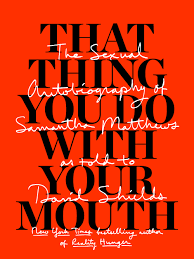
[READ: August 7, 2015] That Thing You Do with Your Mouth

I often don’t know what McSweeney’s books are about before I read them.  I had a vague inkling that this book was about sex (I’d read that Matthews did voice over for Italian porn), but I didn’t know that this was going to be a kind of biography of Matthews and her history of sexual abuse.

According to the introduction, Matthews told her story to David Shields (author and also Matthews’ cousin) who says that the interview garnered 700 pages worth of material.  Thank goodness he edited it.  I felt this book (which comes in at 113 large print pages) was way too long as it is.

Despite all of the accolades on the cover, Matthews is not a very compelling individual.  It’s strange to read personal incidents from a person that you’ve never heard of or, for that matter, was someone who hadn’t done anything terribly interesting. (more…)

Read Full Post »

milkSOUNDTRACK: ANNA & ELIZABETH–Tiny Desk Concert #447 (June 8, 2015). 

annaelizAnna Roberts-Gevalt and Elizabeth LaPrelle are from different parts of the country but share a love of old stories and songs.  This Tiny Desk features three songs and one story (with visuals), and it’s quite different from pretty much anything I’ve ever seen.

“Long Time Traveling” is an a capella song that has a very olde sound of what I can only call “mountain music.”  The women have lovely harmonies reminiscent of O Brother, Where Art Thou?

And just when you think you’ve got these two figured out, they do “Lella Todd Crankie.”  This is a spoken word piece.  Anna (the taller one) explains that they would go into archives and listen to blank CDs of people telling stories from the old days.  And this is one that they memorized.  But just telling the story isn’t enough.  They have resurrected the “crankie” which is like a mural on a spool.  Each one is drawn and crafted to be hand-cranked and unfurled at the pace of a song.  This visual accompaniment (hand cranked by Elizabeth) follows the story as it is told, with visuals that relate perfectly to the story (I’m not sure who created those either).  Part of this story tells of how Miss Lella played fiddle, and as they get to that part, Anna starts playing the fiddle, and it is magical.

“Goin Cross The Mountain” is a war-based song on banjo and guitar with, again, great harmonies.  “Little Black Train” is a judgment day dark song sung with great harmonies and Anna’s twangy guitar.

I don’t think I could do a whole concert with them, but this little fifteen minute show is mesmerizing.

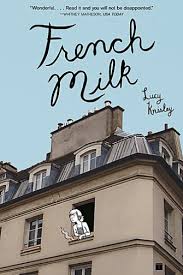
[READ: May 25, 2015] French Milk

I had gotten this book out at the same time of Age of License.  But since that one couldn’t be renewed (someone else wanted it) I read that first.  So, out of sequence, I now read this, her first book.  I’m kind of glad I did read it out of sequence, because the events of Age of License shed some light on this book, which is pretty neat.

This book looks at the trip that Knisley and her mom took to France back in 2007.  They lived in a rental apartment for New Years and much of January.  The book sets the standard for her other books–lots of (really good but simple drawings–the sample faces on page 78 are really amazing–and belie the simplicity of her other “simpler” drawings ), many photos–rather blurry frankly, which is weird (see page 8 for an example), although the non blurry one of her mom in front of a nudie magazine is very funny.

We see some of her life before the trip.  We meet John, the awesome boyfriend (spoiler: she has broken up with him by Age of License).  She describes the airport, airplane (complete with kicking child) and arrival.  (The descriptions in License are more enjoyable–she had become a better writer by then).

Knisley is a foodie.  She talks a lot about the food they eat, including a bunch of foie gras and baguettes, sausages and the delicious French Milk (which she says is the best milk she’s ever had).

I enjoyed her descriptions of her apartment (and the creepy half-cat head on the door).  The strange standing screen which blocks nothing and has hunting fabric.

There’s also talk of them not paying attention to the world around them (like the execution of Saddam Hussein–although honestly if you’re on vacation for a month in France I think its okay to be oblivious although by 2015, it would be virtually impossible to be so oblivious).

They spend a lot of time in art museums, and she says by the end that she is basically sick on naked women, even if her favorite painting is “L’Origine du Monde.”  And I loved her disappointment to find out that famous Moulin Rouge is “a papier-mache windmill on the roof of a strip joint”

But as the book hits its final third, Knisley gets really bummed out.  She starts thinking about failure and that fact that she is turning (gasp) twenty-two.  And that’s when I wanted to throw the book against the wall.  A 22 year-old being whisked around Paris has no right to complain about financial responsibility–nor even does her mother have a right to talk to her about it on the trip.  The quote on page 125: “Even though I’m in my 20s, because I’m an only child, sometimes I feel a little like a spoiled brat…”  Well, it has nothing to do with being an only child if you can spend a month in France.  And when she says that her pie chart of her time management is spent 50% worrying 30% eating and 20% thinking about sex?  No, I will not accept that.  Go out and enjoy Paris for Christ’s sake.

I think its’ nice that her divorced parents are still friends and that he came to visit in France (how can a former English professor afford that?).

And then after a few more meals they are wending their way back home.  The flight back is hilarious and I love that they punished the person who complained about their DVD player by talking really loudly instead.

I can’t help but feel that each book has gotten progressively better.  And while I didn’t enjoy this one as much, I feel like each book has gotten better.  But how much more can she travel?

Read Full Post »

« Newer Posts - Older Posts »