Feeds:
Posts
Comments

Archive for the ‘Marriage Trouble’ Category

SOUNDTRACK: BEN FOLDS/NICK HORNBY-Lonely Avenue (2010).

As the cover of this album notes: “Ben Folds adds music and melody to Nick Hornby’s words.”  And that is true. The only surprising thing about this combination is that Folds is quite a good lyricist himself, so it’s surprising that he would sacrifice his words.  But regardless, the fit is a good one.

Sometimes it seems like Hornby is challenging Folds to come up with melodies for some of his more difficult lyrics which Folds lives up to).  But they have such similar sensibilities that (aside from occasional references to British things) the words could have come from Folds himself (although, Hornby’s a better writer, so Folds wouldn’t have written exactly the same things).

The big surprise is the diversity of musical styles on the disc.  Folds of course does play lots of different types of music on his previous discs, but I guess since the cohesion is Hornby’s words so Folds can really let loose.

The opener, “A Working Day” is a keyboard pop confection, a surprisingly 80s sounding synth song with some wry lyrics about being a writer/performer (“some guy on the net thinks I suck and he should know, he’s got his own blog”).  “Picture Window” is a beautiful downer, a string-filled song that seems like a companion to Folds’ “Brick” (“You know what hope is, hope is a bastard”).  It’s just as sad but the melody is gorgeous.

“Levi Johnson’s Blues” is a strangely topical song (in fact, it took me a minute to remember who he was when I first listened to the song.  Anyhow, it’s a silly song about what happened to the father of Sarah Palin’s grandchild.  And yet, despite the novelty of it, it’s actually a somewhat sympathetic portrait of the guy (sure he’s a redneck, but he’s just a normal guy thrust into a ridiculous spotlight–the liner notes say the chorus came from Levis (redacted) Facebook page).

“Doc Pomus” feels like a classic piano song.  While “Young Dogs: is a fast romper (with great vocals) and more keyboards.  “Practical Amanda” is a slow ballad (and Hornby says it’s not autobiographical at all).  While “Claire’s Ninth” is a story about a young girl of divorced parents who hates having two birthdays.  (With sweeping choruses!) Hornby states that this was his first accepted short story (modified for the song, of course) but the magazine that accepted it stopped publishing before his appeared.  D’oh!

“Password” is a wonderful song which only makes sense when you know the name of it (which I didn’t at first, as I usually don’t look at titles right away).  Throughout the song Ben spells words which leads to a cool conclusion–it’s wonderfully clever writing and it’s done in a fascinating R&B-lite style.

“From Above” is a jaunty rocker about people who never meet, although their paths cross quite often.  “Saskia Hamilton” is the “single” from the record.  It’s another great 80’s keyboard fueled romp.  Since I have a friend named Saskia (hi, Saskia) I’m fond of this song–her name is fun to say.  They have a bunch of fun in the recording too.

The final track, “Belinda” is designed like a classic 70s piano ballad (there’s a lengthy email printed in the notes that explains the construction of the song–reading that makes the song even more impressive).

It’s a great Ben Folds album.  It’s not as tidy as some of his other ones–but all of that experimentation leads to some new avenues of melody. It’s a risk that paid off.

[READ: May 10, 2011] Five Dials Number 7

This issue of Five Dials was primarily about Memoir.  Typically, I don’t like memoirs, but I’m finding (and this coincides with what one of the memoirs below states), that I just don’t like celebrity memoirs.  Or perhaps I just like three page accounts of an incident in someone’s life (which these are).

Each of the writers below is given an introduction in which they summarize WHY they write memoirs.  It’s interesting to see that many of them do, in fact, take other people’s feeling into consideration (not as seriously as Mark Twain who waited 100 years for the publication of his), but they try to do something or other to spare people’s feelings.  I was intrigued also that several of the writers also talk about finding themselves through writing.  One or two of them make the exercise of writing memoir sound obnoxiously solipsistic (which of course it is), but it’s nice to read ones that are interesting and not too self-centered.

CRAIG TAYLOR-A Letter from the Editor: “On Audio Detective Work and Memoir”
This letter explains the extent of the audio detective work that went into the interview (presented later) between Raymond Chandler and Ian Fleming.  Since I love playing with audio software, this was of especial interest to me.  And it made me really look forward to the interview. (more…)

Read Full Post »

SOUNDTRACK: PEARL JAM-East Rutherford, NJ 6.3.06 (2006).

This concert was a free download with the purchase of Backspacer. I chose this because this is the show that I should have gone to.  [How many concerts have I seen at the Meadowlands–or whatever it is called now?].  Not to mention, this is the last concert date of the first leg of the tour, and the last concerts are usually a little longer, a little wilder, a little more fun.

And there’s a number of reasons why this is true during this show.

The first is the technical flaw.  Midway through their fifth song, “Animal” there is some kind of power failure (the flaw with audio from concerts is that you have no idea what’s really going on).  The song shuts down, there’s some crowd chanting and then the power comes back on.  This gives Eddie Vedder a chance to make a Springsteen joke (did he leave for tour without paying the electric bill) and the band resumes, even more intense than before.

There are a number of Springsteen moments during the show.  They thank him for introducing them to the Community Food Bank of New Jersey–where proceeds from this night’s show go).  Later, Eddie’s explains that his failure to figure out the chords to Springsteen’s “Atlantic City” led to his creating the song “Gone”.  And Eddie’s “Pre-Opener” (sadly not on the download, but you can hear it here) is a cover of Springsteen’s “No Surrender.”

Springsteen aside, this is a great show.  The download is three discs long (the first disc is 25 minutes or so and comprises the audio from up to the power failure).  But even with the confusion, the band sounds wonderful.  They run through all kinds of songs from throughout their career, “Even Flow,” “Alive,” “Why Go,” “Black,” “Porch,” and “Garden” from Ten.  “Animal,” “Rats” and “Leash” from Vs. “Last Exit,” “Whipping” and “Corduroy” from Vitalogy, “Habit” and “Lukin” from No Code, “In Hiding” from Yield. “Love Boat Captain” and “I am Mine” from Riot Act, and about half of the songs from Pearl Jam.  There’s also a whole bunch of songs from Lost Dogs: “Hard to Imagine,” “Yellow Ledbetter,” “Last Kiss” and “Don’t Gimme No Lip” and even “State of Love and Trust” and “Crazy Mary.”

The show is a pretty rocking show overall.  In fact, as you can see above they don’t even play their more crowd pleasing ballads (“Betterman,” “Daughter”).  And the set in no way suffers from it.

This show also has a special guest and a special announcement.  Vedder explains that June 3 is West Memphis 3 Recognition Day.  Wikipedia says The WM3 are three teenagers who were tried and convicted of the murders of three little boys in West Memphis, Arkansas in 1993 by a prosecution team that put forth the idea that the only purported motive in the case was that the slayings were part of a Satanic ritual. In July 2007, new forensic evidence was presented in the case, including evidence that none of the DNA collected at the crime scene matched the defendants, but did match Terry Hobbs, the stepfather of one of the victims, along with DNA from a friend of Hobbs’ whom he had been with on the day of the murders.

The WM3.org site shows that many musicians are behind them, offering support and free music.   A new trial date has been tentatively set for October 2011.  If they are found not guilty they would have spent eighteen years in jail for nothing.  Damien Echols (who was sentenced to death) co wrote “Army Reserve” with Vedder, and Echols’ wife says a few words on stage.

Another great moment comes in “Crazy Mary” when Boom Gaspar and Mike McCready have a kind of dueling organ vs guitar solo.   It goes on for several minutes and Gaspar’s Hammond sounds great.  Later in the show, Vedder toasts the crowd for being great.  It may also be the only toast to incorporate the phrase “fucking assholes” (as in if people don’t think you were amazing, they’re fucking assholes).

One of the great things about Pearl Jam shows is that they pack a lot of music into them.  I was especially mindful that when they came out for their second encore, they played nine more songs for about 30 minutes.  Not a bad encore at all.

This is a great set if you’re looking for live Pearl Jam.

[READ: May 24, 2011] Breakfast of Champions

I read this whole book during my trip to BEA.  I read it while on the bus (two and a half hours total) and then while waiting on line for various author signings.  I don’t know that I’ve ever read a book in such a short period before.  It’s not a long book by any means and it is full of illustrations (more on that later).  It was an ideal book to choose for a day of book reading.

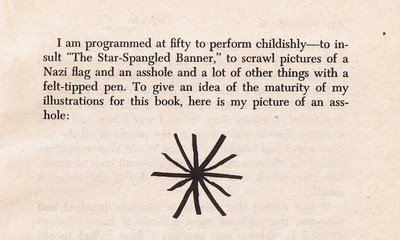
So the novel is actually set up as a story within a story.  The Preface explains that the story is written by Philboyd Stuge (Vonnegut has a lot of fun with names).  It explains that “Breakfast of Champions” is a trademark of General Mills and he is neither  associated with GM nor disparaging them by using the phrase so much (it doesn’t occur frequently until much later in the book).  Stuge explains some of the background information about ideas in the book (that people are actually robots and how Armistice Day was a better name for the holiday than Veterans’ Day).  He also explains that he is writing this book as a 50th birthday present to himself (Vonnegut was born in 1922).  And for his 50th birthday, he is going to act childishly and draw illustrations in the book.  So I found this picture from the novel

That may give you an idea of what to expect inside (although most of the illustrations are “better” than that one).

What is especially helpful about the story is that it tells you what will happen as it goes along.  So the novel starts:

This is a tale of a meeting of two lonesome, skinny, fairly old white men on a planet which was dying fast.

One of them was a science fiction writer named Kilgore Trout.  He was a nobody at the time, and he supposed his life was over.  He was mistaken.  As a consequence of the meeting, he became one of the most beloved and respected human beings in history.

The man he met was an automobile dealer, a Pontiac dealer named Dwayne Hoover.  Dwayne Hoover was on the brink of going insane.

And that is literally the story.  So why is the book 297 pages long then?  Vonnegut is really out to talk about contemporary society:  America mostly, but not exclusively.  And does he ever. (more…)

Read Full Post »

SOUNDTRACK: ROBYN-Body Talk Pt 1 (2010).

Robyn’s Body Talk albums got a lot of praise in 2010.   When I looked at them online, they were really cheap (and considered EPs), so I bought Pt 1.  I was disappointed when I first listened because it seemed like such a sparse album, that I felt there wasn’t much to it.  (Oh, and before I continue, yes, I knew that Robyn was a big time pop singer, but reviewers that I respected–like Sasha Frere Jones raved about the albums).

The opening song “Don’t Fucking Tell Me What to Do” is a really strange song.  The verses are simply Robyn stating that different things are killing her.  It’s strangely compelling despite the repetitiveness.  There’s virtually no music (eventually a single keyboard line keeps a bare melody.  And then the titular chorus.  After two listens I found that I really liked the song even though the first time I heard it I totally blew it off.

“Fembot” is the first proper song, and it’s a simple twist on the stereotype of “woman as robot” since she, the fembot, embraces her sexuality (over a very simple catchy pop melody).  “Dancing On My Own” is an even better song.  Fuller, more complex and with a great chorus.  Two songs seemed like they’d have been destined for Glee: “Cry When You Get Older” & “Hang with Me” they’re a bit too pop for my liking.

The second half of the disk is where it gets odd and interesting.  “Dancehall Queen” has Robyn (a Swedish sing mind you) singing in a Jamaican dancehall accent–which, since I’m infrequently exposed to it, I really like).  It’s super catchy (and I love when she sings “the riddim goes boom boom boom”).  “None of Dem” is another odd song, with a great minor key transition in the chorus and music by Royksopp.

The disc ends with “Jag Vet e Dejlig Rosa” a sweet lullaby sung in Swedish.

The entire EP displays her impressive vocal range and styles.  And even though I really didn’t like it at first it has not only grown on me but gotten my to consider getting Pt 2.  (She released Body Talk Pt 1 (an EP) and Pt 2 (an EP) and then Body Talk which is a combination of some of 1 & 2 with more songs thrown in–a cash in, in my opinion).

[READ: April 30, 2011] “The Good Samaritan”

This was a rather dark story that explores people’s generosity and gullibility.

I was confused through the whole story because the main character’s name was Szabo, and I couldn’t figure out if the ethnicity of the character made a difference (I don’t think so) or even if that was his first or last name.  But that’s a very minor criticism of an otherwise thoroughly engaging story.  I was particularly delighted that while I thought Szabo was going to be a certain kind of character, he turned out to be something else entirely.

As the story opens, it reveals Szabo’s land.  He doesn’t like to call it a ranch (the word is abused by developers), rather he calls it “the property.”  I kind of assumed this story would be about a downtrodden rancher, but that turns out to not be the case at all.  Szabo owns and runs “the property” as a not-very-lucrative side business.  He grows racehorse-quality alfalfa hay for a handful of grateful buyers (he sells in small amounts which most dealers won’t).  It’s true he barely breaks even, but he loves it.  He loves everything about the property–the planting, the reaping and especially the John Deere, which he treats like a baby.

Then one day the baby bites back.  While climbing on the tractor, Szabo slips and dislocates his shoulder.  He calls on his secretary and she assists him to the hospital.  His secretary, Melinda, is from his “real” job, and she is a saintly woman. I was delighted that the story went into so much detail about his “other” life and this woman who helps him.  Szabo’s main career is as a kind of middle man for parts.  He used to manufacture them, but he learned where the money was and took advantage of it  Now he sits in an office (and “the property” is his release).  But Melinda is his saving grace.  She knows everything about him and what he wants and their history together is wonderfully explained. (more…)

Read Full Post »

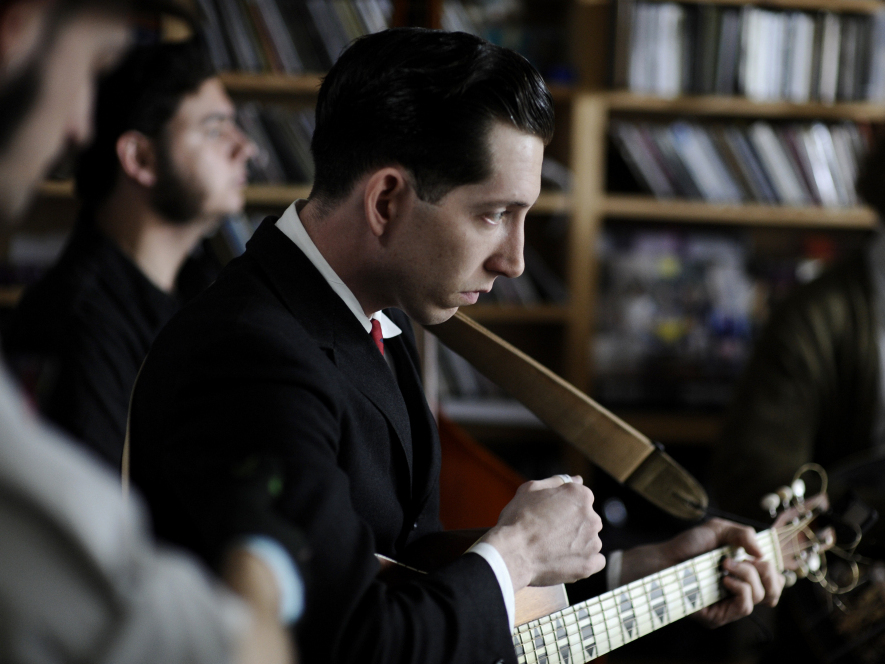
SOUNDTRACK: POKEY LaFARGE-Tiny Desk Concert #122 (April 20, 2011).

I had never heard of Pokey LaFarge before this Tiny Desk concert was sitting in my download folder.  In fact, the notes on the page say that they had never heard of him before they saw him wandering around SXSW.  And then he climbed onstage and played a great set.

LaFarge plays an old-timey style of music.  It’s a kind of Squirrel Nut Zippers retro sound.  As with the Zippers, I love their music in small doses.  And so, this Tiny Desk set is a perfect little sample of LaFarge’s music: happy, bouncy, jazzy.  There’s an upright bass solo, songs about being happy and singing “La La La” and other upbeat stuff.  It’s quite satisfying.

Especially if, as the notes say, you use it as a kind of antidote to the raucous music that you generally listen to.  A Pokey LaFarge song will perk you out of any self-inflicted gloom.  I just don’t need to hear more than three.

[READ: April 15, 2011] 2 book reviews

It looks like Zadie Smith has become a regular fixture at Harper’s.  I’m undecided if I’m going to review all of her book reviews from now on (perhaps I’ll lump some together in one post).  But in the meantime, I’m mentioning this one primarily because she reviews the story that I mentioned in yesterday’s post: Edouard Levé’s Suicide. (more…)

Read Full Post »

SOUNDTRACK: KANYE WEST-My Beautiful Dark Twisted Fantasy (2010).

Before buying this album I really only knew of Kanye West as a loudmouthed guy who tweeted a lot and told off George Bush.  But then everyone was raving about this album (Pitchfork gave it a 10 out of 10!).  So I decided to check it out.  And I can’t get over how great an album it is.

Now I’m going to start this review by mentioning a few things I dislike about rap as a genre.  1) I dislike all of the “guests” that appear on a record–I bought the album because for you, not your friends.  2) I dislike excessive use of “unh” and “yeah” at the beginning of a track; when you have nothing to say–let the backing music flow, save your voice for actual words.  3) Rap is still terribly misogynist and vulgar–I’ve nothing against vulgarity per se (I do have something against misogyny) but excessive use is lazy, and it stands out much more in a rap song since you’re saying the words not singing them.

The Kanye West album is guilty of all three of these things, and yet I still think it’s fantastic.  The first reason is because it goes beyond a lot of rap by introducing real musical content into the songs.  This is not an “all rap is just a beatbox” dismissal of rap, it’s an observation that rap tends to be more about the lyrics and the musical accompaniment can get kind of lazy.  West’s songs have (beautiful) choruses, strings, and samples that augment the rest of the song, as opposed to samples that ARE the song.  And Kanye West’s voice is great.  His delivery is weird and twisted, a little cocky but more funny, with a twisted attitude that is really cool–and to my rather limited palate of rappers, it’s original.

The opening of the disc “Dark Fantasy” has a chorus singing “Can we get much higher” which is catchy and cool (and is used in the promo for The Hangover 2).  The switch from this opening to the rapping works well (aside from the FOUR “yea”s).  Although I don’t love the yeahs, I love his delivery, and that he occasionally ends lines with these weird “hunh” sounds, that are wonderfully emphatic.

The guests start showing up on track 2, but even the guests can’t detract from the excellent guitars of the song (and the cool solo). And I’ll say about the guests that I like some of them, but for the most part I’d rather hear Kanye.

“Power” samples King Crimson’s, “21st Century Schizoid Man”; anyone who samples King Crimson is alright with me.  But to use it so perfectly, to make it part of your song is real genius.  It works musically as well as within the overall concept of the album.

“All of the Lights” (with the pretty piano intro) features scads of guests including John Legend, The-Dream, Elly Jackson, Alicia Keys, Fergie, Kid Cudi, Elton John (!), and Rihanna.  I can hear some of these people but not Elton John (why would he agree to be on a track where you can’t even hear him?).  It is a beautiful pop track nevertheless.

“Monster” is a monster of tracks with yet more guests (I like that some of these guests break with the typical guest, like Bon Iver (!)).  And I really like Nicki Minaj’s verse.  [I’m not familiar with her work at all (in fact I keep wanting to say Minja instead of Minaj) but her verse with the wonderfully crazy vocal styling she displays is weird and cool and very powerful–I would like to check out her solo album, but the samples I heard weren’t that interesting].  It also has a great repeated chorus of being a “motherfucking monster.”

It’s followed by the even more catchy “So Appalled” (with FIVE guest rappers–some of whom I’ve never heard of but who do a good job.  I love Cyhi da Prince’s lyrics: “I am so outrageous, I wear my pride on my sleeve like a bracelet, if God had an iPod, I’d be on his playlist”  or  “So call my lady Rosa Parks/I am nothing like them niggas baby those are marks/I met this girl on Valentine’s Day/fucked her in May/she found out about April so she chose to March” or this line, “y’all just some major haters and some math minors.”

“Devil in a New Dress” opens with a bunch of “unhs” (which I dislike) but this is nice ballad in the midst of all of the noise (and it has some clever lyrics).  It morphs right into “Runaway” one of the more audacious singles I can think of.  The piano melody is so simple (a single note to start) and the lyrics show Kanye as a loser in relationships.  It’s a surprisingly thoughtful song for a song with a chorus that goes: “Lets have a toast for the douchebags, let’s have a toast for the asshole; a toast for the scumbags every one of them that I know.  You been putting up with my shit for way too long…runaway fast as you can.”  It gets even more audacious when you realize the last 4 minutes of the song are a solo with distorted voice.  And the video…the video is 35 minutes long!

The sentiment of that song is erased by the next one, “Hell of  a Life”.  It opens with a great distorted guitar riff and lyrics about sex with a porn star.   “Blame Game” is a surprisingly honest song about being nasty to your girlfriend (“I’d rather argue with you than be with someone else”).  It features a sample of Aphex Twin’s (!) “Avril 14th”.  And it’s quite a sad but lovely track.  It ends with a very long skit by Chris Rock.  I like Chris Rock, but this dialogue is kind of creepy because the woman who Rock is talking to (about the great sex she gave him) seems to be a robotic sample–why not have an actual woman talk to him?

The final track, “Lost in the World” has a lengthy intro by an auto-tuned Bon Iver.  It’s one of my favorite tracks on the disc, especially the end, where the processed vocals get even weirder but accent the beat wonderfully.  This track morphs into what is the actual final track, “Who Will Survive in America” which is basically a long recitation from Gil-Scot Heron.  It works great as an album closer.

So, despite several things I don’t like about the disc, overall, it’s really an amazing release.  And I can overlook the few things I dislike because the rest is so solid.  I can’t decide if it’s worth looking for his earlier releases.  How can they live up to this one?

[READ: May 6, 2011] McSweeney’s #37

This is the first McSweeney’s book where I’ve had to complain about the binding.  The glue peeled off pretty quickly from the center cover.  Fortunately, the back cover held up well.  I’m guessing it’s because there’s an extra book tucked into the front cover which prevents the book from closing nicely when it’s removed.

But aside from that, the design of the cover is very cool.  It is meant to look like a book (duh), but actually like a 3-D book, so the bottom right and top left corners are cut on diagonals (this makes for a very disconcerting-looking book inside–with triangles cut across the top).  The artwork inside is also cool.  In keeping with this appearance, each two page spread looks like a book with a spine drawing in the gutter of the pages).  And the bottom of each page has lines making it look like the bottom of a book.  (The illustrated margins are by SOPHIA CARA FRYDMAN and HENRY JAMES and there are interior paintings by JONATHAN RUNCIO).

The front matter is wonderful.  Although it gives the usual publishing information, the bulk of this small print section is devoted to counteracting all the claims that the book is dead.  It offers plenty of statistics to show that not only are the public reading, they are reading more than ever.  The introduction also goes a long way towards arguing against the idea that people are reading less now than in the past.  When was this “golden age” of readers?  There’s also the wonderfully encouraging news that 98% of American are considered literate.

This issue opens with letters. (more…)

Read Full Post »

SOUNDTRACK: GOGOL BORDELLO-Tiny Desk Concert #66 (June 28, 2010).

I had heard a few minutes of Gogol Bordello before this concert but it was during a TV show that I was half watching.  When I sat down and listened to this show, I was blown away by hem and immediately bought two of their CDs. Gogol Bordello is a multi-piece, multi ethic band that plays rocked-up Russian folk music (mor or less).  The sound is very traditional, with a kind of gypsy edge sprinkled onto it.  I’m not sure how many people are in the band, or how may people showed up for this concert but it sounds like about 100 in the tint room.  This is also the longest Tiny Desk show that I’ve heard (it runs almost 25 minutes).

The band plays five songs (and there’s a little chatting in between) and as the session goes on the band gets more rowdy (and more fun).  The video (also available at the same site) shows the singer sitting in the laps of the NPR folks and jumping on some desks and just having a blast.  And even though I enjoy shoegazing music, this is the kind of rollicking fun that I would love to see in concert.

The songs are political, but not overtly so, it’s more of a communal feel, of people uniting (which is indeed political).  I think they could get old kind of quickly, but in small doses the band is energizing and wonderful.

[READ: March 27, 2011] “U.F.O. in Kushiro”

This story was originally published in the March 19, 2001 issue and was inspired by the incidents of the 1995 earthquake in Kobe, Japan.  It was reprinted here to memorialize the recent earthquake in Japan.  The story is accompanied by rather devastating photos (and some surreal ones) of the aftermath of the earthquake in Kobe.

The story (translated by Jay Rubin) opens a few days after the Kobe Earthquake.  And even five days after the Kobe earthquake, Komura’s wife is still engrossed in the TV footage from Kobe.  She never leaves the set.  He doesn’t see her eat or even go to the bathroom.  When he returns from work on the sixth day, she is gone.  She has left a note to the effect that she’s not coming back and that she wants a divorce.  Komura’s wind is knocked out of him. (more…)

Read Full Post »

SOUNDTRACK: WU MAN-Tiny Desk Concert #124 (April 27, 2011).

Wu Man is considered the master of the pipa. If that sentence was complete gibberish, the pipa is a 4 stringed lute-like instrument and Wu Man is a Chinese virtuosi of the instrument.  This Tiny Desk Concert shows Wu Man playing three songs, solo.

The songs are, if not traditional Chinese songs, then at least traditional in style.  Needless to say they are not for everyone (and really, they’re not even my cup of tea–I’m not downloading it, just watching it), but watching her fingers move on this instrument and really paying attention to the kind of things she’s doing with four strings, it’s quite an impressive feat.

She doesn’t sing, and the songs do not follow western musical structure at all.  But it’s an interesting look into Chinese musical culture.

Even if you only watch the first song, it’s worth the time.

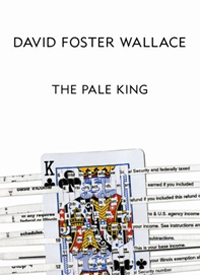
[READ: April 29, 2011] The Pale King

[Note: this review is pretty much free from spoilers–some details are given but I don;t think they ruin anything–but it is full of speculation and imaginings of what could have been]

I finished The Pale King today.  It took about a month, but that was because I only read it at lunch hour.  And I was surprised to find that, unlike with other books, I didn’t always feel up to pushing my lunch hour a few extra minutes to get some extra pages in.  Not because I didn’t like the book, but I think it was just really dense and often quite intense.

I’ll also state that I hadn’t been making any kind of notations when I started.  Then, a bit of the way through, when I realized there were a lot of characters, I started jotting down some names and characteristics.  But then I stopped again, because it was interfering with my absorption of the story as a story (such as it is).  So, this review is based on an initial read (yes, I’ll be reading it again in the not too distant future, that’s for sure), without any real note taking.

Is note taking necessary?  Well, yes, at least to keep the characters straight.  There are many many characters and most of them do not interact (or at least not explicitly) so it’s not always easy to know who is who or which person’s weird characteristics are showing up in any given chapter.  Plus, there are dozens of chapters in which unnamed people are described.  It’s hard to know how deliberate that was or how much of it is just the fact that book was unfinished.

The other thing is the ending, of course.  DFW fiction is notorious for its “lack” of endings.  Broom of the System ends mid-sentence, Infinite Jest ends in the middle of a scene, so who can imagine what The Pale King would have ended.  As such, we have only to go by editor Michael Pietsch’s placement of chapters.

So, in many respects, this book is very much Pietsch’s project.  Sure, DFW wrote all the words, but it was Pietsch’s job to piece them together.  Who is to say that DFW would have wanted §50 to end the book?  Pietsch also includes about ten pages of notes at the end of the book all showing ideas that DFW had asked himself about the nature of the finished product.  Some of these questions are minor, but others are quite significant, and would effect not only connections in the novel, but also the overall shape of the book.  It also implies that there could have been as much as another 500 pages coming.

The book feels like a kind of culmination of all of the things that he has been putting into his work for the past few collections.  There are character sketches based on interviews (Brief Interviews), there are lengthy sections of bureaucratic minutiae, lovingly rendered (“Mr Squishy”), there are scenes of conformist office work (“The Soul is Not a Smithy”) and there is redemption in the everyday (“This is Water”).  The mind reels at what this could have been had it been finished.

So this book is obviously, radically unfinished (and yet it’s still over 500 pages long).  So, why bother reading it?

(Here’s where the review really starts).

Because what is here is amazing. (more…)

Read Full Post »

SOUNDTRACK: PJ HARVEY-Uh Huh Her (2004).

After the sort of mellow, almost commercial release of Stories from the Sea, PJ Harvey throws the fans a left turn once again with Uh Huh Her.  It’s a heavy, raw album although not raw like Dry was.  It seems  simpler, somehow.  And I think it’s with this disc that you realize that every PJ Harvey record is going to be different.  It was apparent that she had a trajectory on those first few discs, but this one changes everything, and she proves that you’ll never know what’s going to come from her.

“The Life and Death of Mr Badmouth” has a very simple blues riff with kind of chanting (and occasional creepy backing vocals) by PJ.  While “Shame” adds more texture (melodica?) and some more washes of sound.  “Who the Fuck?” is a wonderfully vulgar and raw track with brutal guitars and overly loud vocals.  “Pocket Knife” is a buzzy but quiet track which feels like a demo (the guitar even seems out of tune), while “The Letter” has a great fuzzy guitar sound and a cool melody.

“The Slow Drug” is one of several slower pieces.  As with many of her quieter stuff this does nothing for me, although it’s a nice change on the disc.  “No Child of Mine” is a brief acoustic number.  It feels more like an excerpt or a transitional song than any actual song (being only a minute long).  It leads to the rocking “Cat on a Wall.”  “You Came Through”  mixes things up very nicely with a heavy percussion.  The effects in the song are really captivating.

“It’s You” is a slow piano-based song, while “The End” is a brief instrumental (more melodica).  And “The Desperate Kingdom of Love” is a dark ballad.  The oddest track is “Seagulls” which is a minute of actual seagulls squawking…an unusual addition for any disc.  The album ends with “The Darker Days of Me & Him.” It’s a quiet acoustic song which shows just how many different style she’s willing to experiment with even on one disc.  Even though to me this is a raw rocking disc, there are still a number of acoustic tracks as well.

This album feels like some kind of psychic purge.

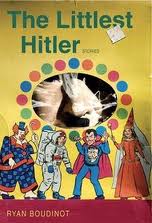
[READ: March 31, 2011] The Littlest Hitler

I picked up this collection of stories because I enjoyed Boudinot’s story in the BlackBook collection very much.  I didn’t realize that that story was in fact part one of a two-part story (although part two bore no relation to part one, as you’ll see).  The story in BlackBook was funny and dark, but it didn’t prepare me for just how dark these stories would get.  And for the most part, it seemed like the darkness came at the very end; a surprise, a shock.   I admit i grew a little weary of the device by the end of the collection, although not all of the stories employed it, so there was some diversity. (more…)

Read Full Post »

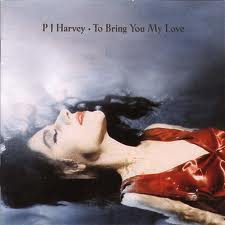
SOUNDTRACK: PJ HARVEY-To Bring You My Love (1995).

After the intensity of Rid of Me, To Bring You My Love ratchets things down a bit.   In fact, it almost seems like Harvey wanted to explore a more mellow side.  I was disappointed in the disc when it came out, although I do think it has a couple of her best songs on it.  The overall tone is simply too atmospheric for me (and I like atmospheric music, I think I just don’t like her version of it).

She dumped the PJ Harvey band, and worked primarily with John Parrish on this disc.  But her voice is deep and resonant throughout the disc.  The disc seems to be easily broken into three styles of song:  brooding, quiet songs; distorted loud romps and catchy songs that have  kind of folk base.

The broody quiet songs dominate the disc.  “Working for the Man” is a very quiet–drums, quiet organ,and a shaker.  “Teclo” and “I Think I’m a Mother” are moody pieces.  After the dynamics of Rid of Me, you expect a big noisy section to come next, but it never emerges.

The louder, more rocking songs are sonically loud.  The title song is pretty much just her and a distorted guitar (not unlike Neil Young), while “Meet Za Monster” has a Tom Waits quality.  Of course, the real power comes from the devastating “Long Snake Moan.”  It’s a five-minute scorcher of a song full of screaming intensity.  And also from the amazing single, “Down By the Water.”  It has an intense distorted bass that buzzes seductively through the whole song.  And when the whispered vocals come in it’s an unexpected sonic triumph.

The third style, acoustic rockers, shows up on “C’mon Billy,” a gorgeous acoustic track with Harvey’s voice strong and proud, and “Send His Love to Me” another intense vocal song.  Both of these songs thread her wonderfully catchy acoustic guitar playing with her rocking sensibilities.

The final track on the disc doesn’t fit neatly into any camp.  “The Dancer” is a moody piece, but Harvey’s vocals are loud and strong and probably the most interesting on the disc.

Even though I don’t like this disc as much as her others, I still acknowledge that there’s some great stuff here.

UPDATE: My friend Lar mentions an interview with PJ Harvey in Mojo.  I’ve made it accessible here.

[READ: March 17, 2011] “Rollingwood”

This is a story about a man who is overwhelmed by his life.  But unlike those of us who suffer from general overwhelmedness, Mather has some very specific problems that conspire against him.

The second, and less obvious one is that his work is less than forthright to him.  His supervisor doesn’t communicate well, there are temps in his cubical and, worst of all, the daycare center where his son goes during the day is closed inexplicably.

The first and more obvious problem is his son, Andy.  Well, more to the point the problem is that his ex simultaneously doesn’t think he does a good job rasing their son, but she also has no problem leaving Andy with him when she runs off with her new boyfriend.

Of course, Mather doesn’t speak up for himself in any of these situations so he is not innocent in the problems.  However, Andy’s mother is pretty much a capital b bitch.  She takes off with her new boyfriend for an unspecified amount of time and doesn’t leave any kind of contact number (Andy has health problems, too), yet she still doesn’t accept responsibility for her actions.  And when Mather’s office’s day care center is closed, there’s not very much that he can do. (more…)

Read Full Post »

SOUNDTRACK: MOGWAI-4 Satin EP (1997).

Mogwai seemed to thunder onto the scene back in 1997.  I missed this disc when it came out but I was on board with their debut.  And then it seemed like a whole bunch of stuff was released right away: a collection of early EPs and a remix album.  It was a little hard to keep everything straight including what the band actually sounded like.

This EP is pretty representative of their early sound: it has three songs that are less “songs” than they are soundscapes (or something).   It’s something of a noise fest.  Unlike their later songs which have discernible melodies (and are actually quite catchy) the three songs on this EP are more percussion and effects than actual melodies.

“Superheroes of BMX” is a series of washes over a simple series of electronic-sounding beats (it actually seems appropriate that they were on Chemical Underground records).  Although by around 5 minutes the minimal guitar structures do come out.  “Now You’re Taken” is closer to a proper song.  It has a beautiful understated structure and vocals (!) by Aidan Moffat of Arab Strap.

But it’s “Stereodee” that really stands out: 13 minutes of noise and crashing and feedback.  At about the ten minute mark, my five year-old son said, “I like this song daddy, it sounds like monsters crashing through a small hole.”  I couldn’t agree more.

[READ: March 7, 2011] “Honor”

Golly, this story is dark.  How’s this for an opener: “My father was supposedly dead, and I found out only years later that he’d left walked out when I was eighteen months old….”  Yipes.

And I’ll say that the story doesn’t get any brighter.

So the narrator, born in the late 50s, tells the story of her mother raising a daughter (with the help of her mother who lives close by), and somehow making ends meet.  Of course she would never even consider moving back home with her mom, but she is happy to have her so close.

The mother and the narrator are strong-willed and hard to stop.  And when they are on the same side, they are formidable together. But when they disagree with each other (which they did pretty much all the time once she was a teen), it was tough being in their house.

The story unveils a plot about half way through.  The plot concerns her Aunt Andy.  Aunt Andy is her father’s brother’s wife.  And she comes to stay with them for a period of time.  In the past, Andy was shy but a little superior.  Her husband is a used car salesman and quite wealthy.  But on this visit she is pale and visibly shaken.  She is quiet and doesn’t mention her son at all.  In the past, her son was a real jerk, so she’s somewhat relieved that the boy isn’t staying with them.

Andy won’t say what the problem is and her mother refuses to tell her anything serious.  But even at the young age the narrator knows something is wrong.  And then there’s the trial. (more…)

Read Full Post »

« Newer Posts - Older Posts »