Feeds:
Posts
Comments

Archive for the ‘Marriage Trouble’ Category

SOUNDTRACKTHE FLAMING LIPS AND STARDEATH AND THE WHITE DWARF WITH HENRY ROLLINS AND PEACHES-“Money” (2011).
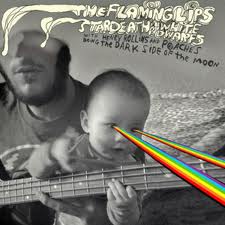
I’ve already mentioned this full length album, but how can you not talk about JR without mentioning this song.  (I probably could have dine a post a week about all of the covers of it).

This is one of the most famous songs certainly by Pink Floyd on one of the most popular album s of all time.  So how do you cover it?  You can’t lose the bass line, it’s way too important to the song.

But aside from that the song is pretty different–the vocals are machine tuned almost out of recognizability.  And that’s when you realize that although this is a pretty faithful cover, it’s also a goofy cover.  Not silly, not really disrespectful but not entirely right either (notes are out of tune and flubbed).  It’s very mechanized, as if they are talking about the auto-tuned nature of making hit songs.

  Henry Rollins takes the roll of the random punters ranting at the end of the song, and that’s pretty fun.

The whole thing is kind of  a trifle.  It works better in context of the album because you can understand what the group is doing.  On its own it’s a bit of  shock.

[READ: Week of July 9, 2012] JR Week 4

This week continues where last week left off–in the middle of trying to get Dan to convince Ann to drop the lawsuit against the school (for firing Bast). Whiteback tries to speak for Vern, but Vern will have none of it–Whiteback, despite being president of the school and the bank, is proving to be more and more of a pushover as the story goes along.

Vern gives his take on the school:

The function of this school is custodial.  It’s here to keep these kids off the streets until the girls are big enough to get pregnant and the boys are old enough to go out and hold up a gas station, it’s strictly custodial and the rest is plumbing.  If these teachers of yours strike just sit still and keep the doors open, by the time these kids have been lying around the house for a week their parents will march the teachers back in at gunpoint (226).

Dan interrupts the proceedings to talk to Whiteback about his mortgage (Vern magnanimously tells Dan to go ahead and conduct personal business during work hours).  Dan’s mortgage is not working out so well because the studs in his house are too far apart–causing it to be less insurable and causing him to pay a lot more. When Whiteback commends Major Hyde’s house for being spectacularly built Dan says that he was surprised to see that Hyde was moving.  Hyde doesn’t know what he’s talking about.  Dan tells him that there was a moving van in his driveway taking all of his things out.  There’s some chaos (and a stolen car) when JR comes in and tells them that Buzzie (who was sent down for possession) has taken off down the hall. (more…)

Read Full Post »

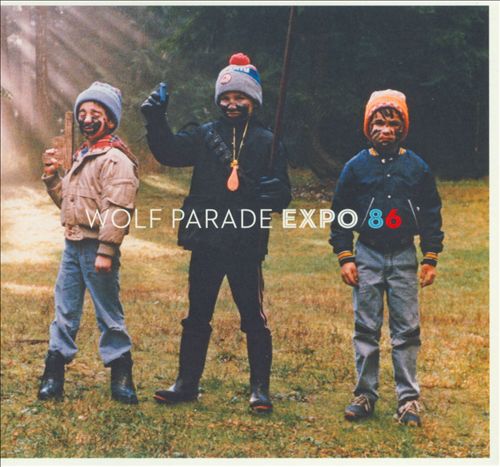
SOUNDTRACK: WOLF PARADE-Expo 86 (2010).

Wolf Parade is a strange band, no doubt. Both singers can craft super catchy songs, but they like to layer them with odd sounds and lots of song parts making the songs more challenging (and better in the long run).

“Cloud Shadow on the Mountain” starts the disc off with drums and an eccentric voice.  And the lyrics? “I was asleep in a hammock/I was dreaming that I was a web/I was a dream-catcher hanging in the window of a minivan/Parked by the water’s edge./I’d say that I was all alone.”

The song has some loud guitars, some great guitars riffs and (the most notable feature on the album) retro sounding keyboards.  On this song the keys play an alternate melody that compliments the song very well.  There’s some heavy rocking sections and a slowed down drums and vocals section.  It’s fairly exhausting how much is in this one song.  By the end, he’s repeating “you will never be born as a scorpion.”

“Palm Road” is a more straightforward and catchy song, although it’s certainly offbeat.  “What Did My Lover Say” opens with a cool guitar riff an counterpointed keyboards.  As with most of the songs on this record headphones or at least good stereo speakers really make a difference.  The rest of the album is hard to speak of in different terms because each song is unusual with angular guitars and interesting vocals.  The keyboards also provide unsettling atmospherics.   None of the songs are easy to sing along to, until one day the shifts in melody and phrasing sink in and it all sounds wonderful.

What I find notable about these songs is that they are all long (most are around 5 minutes) and they feel long–not in a dragging out way (although maybe “In the Direction of the Moon” drags) but in a–so much has been going on, this song must be really long kind of way.

Some other highlights include “Ghost Pressure” with its great keyboard riff (that feels not unlike The Cars).  Speaking of The Cars, the keyboards on “Oh You, Old Thing” have the great spacey Cars sound from the 80s.  “Pobody’s Nerfect” melds the catchiness that the guys are capable of with just the right mix of unexpectedness.  And the closing song “Cave-O-Sapien” seems to combine all of the best qualities of the above songs in to one–a great riff, catchy “oh oh ohs,” and bizarre lyrics, “I had a dream of a gorilla.”

This album is definitely not for everyone, but multiple listen reap big rewards.

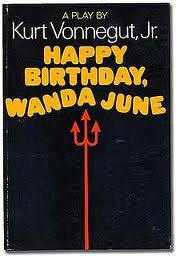
[READ: July 8, 2012] Happy Birthday, Wanda June

I have been chugging along nicely through Kurt Vonnegut’s oeuvre.  My plan was to read all of his novels and then read his short stories.  And then maybe read his plays (I wasn’t sure about that last bit).  But as I mentioned yesterday, reading a simple play can be a delight (and can be a very quick read, too).

Vonnegut opens the book with a prologue about how and when he wrote the book.  It was originally a play called Penelope, and he thought it was terrible.  Fifteen years later he kept the basic idea and rewrote it as Happy Birthday, Wanda June.  And the idea is straight out of Homer.  In the Odyssey, Penelope is Ulysses’ long-suffering wife.  When Ulysses came home from his travels some twenty years later, he was feted as a hero and the world (well, his world) rejoiced (except for Penelope’s suitors, of course).

So in this play, Harold Ryan is a loud, manly hunter and soldier, ready and happy to kill anything in his way.  He has been on an expedition for eight years–his plane went down and he  is presumed dead–even Mutual of Omaha thinks so.  His wife, Penelope Ryan believes him to be dead and has been entertaining two suitors–Dr Norbert Woodly, a pacifistic doctor and Herb Shuttle, a vacuum cleaner salesman.  The only person who doesn’t presume him dead is their son Paul Ryan, who bristles not only at the thought of his father being dead, but even more so at these wimpy suitors.  Although Paul is too young to ever have rally known his father (he’s 12), he keeps hopes alive that his father will return one day.

What I like about the play is that it maintains Vonnegut’s voice right from the start.  It opens with a speech from Penelope:

My name is Penelope Ryan.  This is a simple-minded play about men who enjoy killing–and those who don’t. (more…)

Read Full Post »

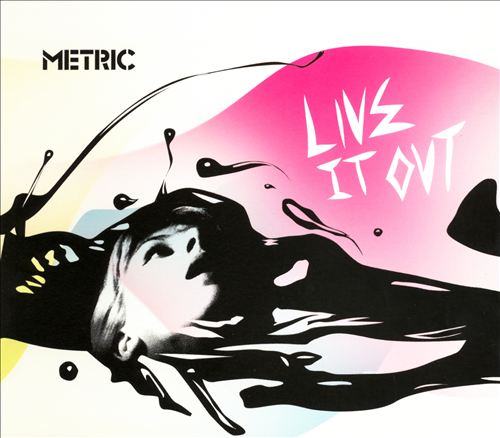
SOUNDTRACK: METRIC-Live It Out (2005).

I enjoyed Metric’s Fantasies album so much that I bought their previous album (an album that I had written down as worth checking out about 5 years ago).  At first I was a little disappointed–the album doesn’t have the glow (or perhaps sheen or polish) of Fantasies.  Normally I prefer raw to polished, but it’s surprising to go the other way sometimes.  And after a couple more listens I really started to appreciate this album’s rawness.

The guitars are loud and pushy.  There are keyboards that dominate some songs, but they never make the songs poppy.  And Emily Haines’ voice sounds great.  The opener “Empty” has a lot of quiet sections, but the guitars really just burst forth.  It’s 6 minutes long but that’s mostly through a long intro and outro.  The rest of the songs stick firmly in the 3-4 minute range.  “Glass Ceiling” has a cool stuttering riff and a kind of awkward bridge–these first two songs kind of resist admittance (the piano/guitar solo is certainly a weird combination–which I like now of course).  “Handshakes” shows their more commercial side–a slick kind of guitar riff with Haines’ more aggressive vocals.  True the siren sound may turn off some, but it’s certainly a signature.  “Too Little Too Late” is a slow sultry number, but even more sultry is the sleazy-feeling (no doubt because of the keyboards) “Poster of a Girl.”  In addition to a cool spoken word section in French (the whole song is bilingual), we get the English lines “Coming in your pants/For the off chance/With a…poster of a girl.”

“Monster Hospital” is a fun punk blast that is still a live favorite for the band.  “Patriarch on a Vespa” has another rough riff with some cool bass.  It also features some disconcerting singing (ahahs that sound more than a little spooky).  “The Police and the Private” is one of the cool songs with easily singable but easily confusable lyrics.  While “Ending Start” has some great guitar riffs near the end.   “Live It Out” ends the disc with a staccato punk number.  It’s a perfect summation of Metric before they got more commercial.  And it’s a great addition for fans of the band.

[READ: July 8, 2012] The Big Meal

This play came as a supplement with Lucky Peach issue #4.

I have often maintained that it is much better to see a play than to read one.  Not a daring opinion, by any stretch. I have taken that to something of an extreme however, which means that I pretty much never read plays.  This has severely limited by Shakespeare intact, naturally.  It also means that a lot of great works are lost to me.

I’m using that information by way of introduction, not because I think this play compares to Shakespeare, but because this is one of a few plays that I have read recently that I’ve really enjoyed.  So I’m retracting some of my earlier thoughts about reading plays.  True, some plays with multiple characters can be confusing to keep straight (since defining characteristics are not given).  But in shorter plays or plays with not too many characters, it’s not so hard to read them.  And in fact, it can be a quick and enjoyable read.

Although this play complicates things immensely because of its (very cool) setup.  The setup is described in the introduction to the play: “The actors play multiple generations of one family…as they glide through time.  As the characters age, their “essences” pass from younger to older actors.”  So, the story takes places over a few generations of time.  There are eight actors.  Each actor plays multiple roles.  These roles correspond to the characters at certain ages.  So, for example, the youngest actor plays Character A as a child; the adolescent actor plays Character A as an older child; the middle-aged actor plays Character A as a middle-aged person, etc.   So that’s a little confusing (although I’ll bet it makes sense seeing it live).  What I like though is that this “gimmick” is not so much a gimmick at all, but a real indication of how we turn into our parents and an indication of how quickly time passes in this play. (more…)

Read Full Post »

SOUNDTRACK: RUSH-“Something for Nothing” (1976).

This song comes from Rush’s 2112 album.  Since I’ve started reading JR, the refrain keeps popping into my head.  People talk of the influence of Ayn Rand on the band at this time and this song fits the bill.  When you think about the themes of most rock songs (carefree sex and partying) the lyrics to this song are totally conservative: “You don’t get something for nothing, you can’t have freedom for free.”  Rush has always been a hard working band, so this attitude makes sense.

And the song also resounds with the capitalists in this story–make your money (and other people’s money) work for you.  “Countless ways you pass the day.”

The song starts quietly but man it rocks hard with some really heavy guitars.  And the solo is intimidatingly noisy.

Oh and as for Rand, “What you own is your own kingdom.”

Of course, there is a little less capitalism as the song ends: “in your head is the answer, let it guide you along, let your heart be the anchor and the beat of your song.”  So, the message is not one of greed, but that to make your dreams come true you have to work for it.  Not bad advice, really.  Unless you were born into money of course.  In which case, never mind.

[READ: Week of July 2, 2012] JR Week 3

My JR posts are proving to be a day late (but not a… nope I won’t say it). It’s not the reading that’s hard it’s finding time to write these up.  So, apologies for those waiting with bated breath.

The week’s section opens with sex, specifically, Polaroids of sex.  Mr Angel, Stella’s husband, gets a call from Coen at the hospital (he got into an accident because of his broken glasses (ha–it was not reckless driving).  Then he starts talking with Terry about sprucing up the place–nice paneling, some plants–she thinks that’s a great idea (and actually buy a plant with her own money later).  They are interrupted by Mr Angel’s worker Leo who presents him with a stack of photos of the same Terry engaging in various graphic sexual positions (the boys in shipping had them).  With multiple men.  And although none of the men work in the office, the pictures are taken in this very office.  Mr Angel suggests that the photos could be doctored, to which Leo replies, “You’d have to have a picture of her eating a cucumber to paste onto this one, that’s some doctor” (151).   Childish but very funny.

Mr Angel goes off to Dayton to deal with some business and we see that quickest passage of time yet in the book.  Most of the book so far has been set in a day or two, but as we stay with the secretaries, several days pass in Mr Angel’ absence.  Terry and Myrna move their things into the same area so they can talk and listen to the radio while they work.  So there’s the gossip and the radio chatter vying for attention (the radio comes in Spanish as well as English) and the scene stays with them over a few days and through weekend.  Although this book doesn’t shy at all from potty humor, I enjoyed this little exchange before he leaves: Mr Angel say that she’s left the letter “s” off the word scrap on one of the documents.  She’s so embarrassed!

Terry also says she has something to tell Mr Angel about Leo…but that never gets said aloud, even when he returns and reminds her. (more…)

Read Full Post »

SOUNDTRACK: K’NAAN-“Wavin’ Flag” (2009).

Like most people in America I don’t know much about K’naan.  This is despite the fact that this song (in a modified form) was the anthem for Coca-Cola and the 2010 World Cup and was HUGE (except in America where we like one and ignore the other).  There’s an article about K’naan in the July/August issue of The Walrus.  He is a Somali-born Canadian rapper and he is looking to break into the US market.

And that’s as much as I knew of him.  So imagine my surprise upon listening to this song to realize that it is an acoustic-pop song not unlike Coldplay (lots of Whoa-ohs) set to a martial beat.

It’s a catchy anthem indeed–made perfect for an event with lots of waving flags like the World Cup.  However, the original lyrics are impressive (and talk obliquely about his life in Somalia).

Out of the darkness, I came the farthest Among the hardest survival
Learn from these streets, it can be bleak Accept no defeat, surrender, retreat

So many wars, settling scores Bringing us promises, leaving us poor
I heard them say ‘love is the way’ ‘Love is the answer,’ that’s what they say

And yet the chorus is pretty uplifting:
When I get older I will be stronger They’ll call me freedom just like a wavin’ flag And then it goes back, and then it goes back And then it goes back, oh
Chorus aside, these lyrics aren’t exactly going to sell product, so it’s not surprising that the Coca Cola Celebration Remix has changed some lyrics:
Saying forever young Singing songs underneath the sun Let’s rejoice in the beautiful game
And together at the end of the day, we all say
Although this lyric could have been in either version
In the streets our heads are liftin’ As we lose our inhibition
Celebration, it surrounds us Every nation, all around us
And the chorus remains the same.
The remix is a bit more interesting musically.  The original is just him on an acoustic guitar with some drums.  It reminds me of Bob Marley (and references “Buffalo Soldier”).  The remix has a really cool drum intro.  It’s beefed up throughout as well.  I guess it’s easy to say it’s a sell out (but well, duh), but it’s still as catchy as the original without being too obnoxiously overproduced.  And heck, maybe people learned a bit about Somalia from it.  Stranger things have happened.

[READ: July 4, 2012] “And They Danced by the Light of the Moon”

Some stories are one thing at heart.  No matter how much you gussy them up and make them look all fancy, they’re always going to have heavy metal T-shirts under their formal wear (I should know).

And so it with this story set in the 70s in the Quebec town of Val de Loups (the fact that it is set here changes enough of the story that although the story is not atypical, it is at least in an unfamiliar setting (to me)).  Jules knows that he is in love with Manon.  Manon doesn’t know anything about love.  Jules is an only child, living in a trailer park, trying not to get beaten by his father. Manon is the youngest of 11 children (her mother kept trying until she had a girl).  She is beautiful with golden ringlets and a magical laugh and she is under the constant supervision and protection of her ten massive brothers (one is a wrestler, three work in the mines).

Jules is an intelligent boy who always gets in trouble.  He’s a class clown because he likes it when people pay attention to him, although he doesn’t really have any friends per se (when he gets in trouble, they aren’t there with him).  His last prank was an invitation to the aliens–spray painted in the school parking lot.  This gets him kicked out of the upcoming dance (even though he did a lot of the getting it setup).  He’s really bummed because Manon said she’d go with him.  Manon likes him because of the way he can roller skate.

Despite not being allowed into the dance, they meet up outside the building and go to a house in town where Jules is plant-sitting.  With the right music, the right lighting, the right setting, this would be a joyous romp of explored sexuality and post-dance bliss.  But this is Val de Loups, where no one leaves, where everyone is trapped. (more…)

Read Full Post »

SOUNDTRACK: BUILT TO SPILL-“Carry the Zero” (1999).

For a time, before the bands each took off, I lumped Built to Spill, Death Cab for Cutie and Modest Mouse into a pile of bands I really liked but wasn’t always sure who was who.  They each have melodic sections, noisy sections and high pitched singers.  (It also turns out that both Modest Mouse and Death Cab for Cutie cite Built to Spill as a big influence).  The big difference between the three is that Built to Spill’s Doug Martsch is a guitar god—he does amazing solos which is why his songs are so long (their Live album features a 20 minute version of Neil Young’s “Cortez the Killer.”

I have no real idea what this song is about, but I love it.  It’s catchy and fun with a great melody.  And, in this case it kind of ties in to JR, because JR is all about making money but his basic math is shaky.  In the same way, carrying the zero won’t do anything in basic math.  Although “you have become a fraction of the sum” is a nice refrain.

This was the song and album that introduced me to Built to Spill and I love it.  Great 90s alt rock.

[READ: Week of June 25, 2012] JR Week 2

And since there are no paragraph breaks, week two picks up mid-flow.  However, this proved to be a good breaking point because almost the entire read for this week is about Mrs Joubert and her class on their field trip to the New York Stock Exchange.  And Edward Bast is steamrollered into doing (and paying for) everything.   Gaddis’ style completely allows for the miscommunication and ease with which Bast is overtaken by Joubert and Gibbs.  While it certainly calls into question Bast’s ability to stand up for himself, it also shows how easily one can be pushed into doing things (although in real life I suspect you’d just say “wait a minute, I can’t,” at some point).  It’s still very funny and the action moves along so quickly that it works perfectly with the flow.

The scene begins with Mrs Joubert herding the kids onto a car and then talking to Mr Bast.  He apologizes for what happened yesterday,  Of course, he is talking about his disastrous TV meltdown but she thinks he means the loss of the bag of money and its turning up 3 pennies short.  Through a series of unsubtle hints from Mrs Joubert, Mr Bast winds up joining their trip to the city.  He had business to conduct in Manhattan so he was going in anyway, but now he’s roped in with the kids.  There’s a lot of sexual tension on this trip–the boys are watching women bend over and Mr Bast keeps pressing his body again “her unyielding thigh.”

Then we get our first really big scene with JR.  In this scene he and a friend (unnamed as far as I can tell) are going through all of their free mail publications and doing trades.  Everything the boys try to trade is a load of crap (a word count on “crap” would be very high indeed). So the kids start looking through their brochures: K’ung-p’a, piano lessons, rare coins, scientific method builds powerful muscles,government surplus (a Tank that turns out to be an airplane gas tank (ha)), How to Make Big Profits Overseas, selling shoes, etc.  There’s some very funny back and forth as smart-assed kids will do (he really has young kids’ dialogue down very well), like :What are you gonna do where it says “married” or what are you gonna do when it says shoe size and you put yours? (more…)

Read Full Post »

SOUNDTRACK: SIX ORGANS OF ADMITTANCE-“Even If You Knew” (2012).

Lars from NPR’s All Things Considered picked this as his summer music preview song.  I don’t know a thing about Six Organs of Admittance, but their discussion of this song makes it seem like this is atypical for the band (which has a massive output).  Evidently they’re usually more droney sounding. But man, this song is pummeling and wonderful.

It’s seven minutes long and opens with a simple, plodding heavy bass riff.  The vocals are kind of whispered and strained.  But then comes the guitar solo–a raging piece of distortion that complements the bass.  And that’s just the first three minutes.

The second half of the song features a quieter section–the bass is quieter, while the guitar noodles around and the vocals play over the rhythm.  The song slowly builds again, and by the last minute or so there’s another fierce guitar solo. Until the song is exhausted by the final distorted notes.

This is some beautiful noise.  And, no I have no idea what the band’s name means.

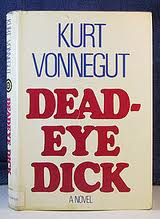
[READ: June 27, 2012] Deadeye Dick

Deadeye Dick is the last Vonnegut book that I was completely unfamiliar with.  I had no idea what it would be about.  So I didn’t realize until very late in the book, and then I looked online and confirmed that this book is set in the same location as Breakfast of Champions, Midland City, Ohio.  Indeed, some of the same characters appear in this book as appeared in that book.  But more about that later.

Vonnegut is not known for his happy books.  Misanthropy is pretty rampant in his pages.  But this book is one of his bleakest books yet.  The story concerns the Waltz family–Rudy (the protagonist) and his brother Felix are the only children of Otto and Emma Waltz.  Pretty early in the story we learn that Rudy is a double murderer.  Yipes!

As with most Vonnegut stories, this one is told in a convoluted and non-linear fashion.  He foreshadows (and really just casually mentions) a lot of crazy things that are going to happen in the book.  Like the fact that Midland City is going to be devastated by a neutron bomb.  In fact, his preface (like with many of his prefaces) tells us a lot about what’s in the book and who the characters are based on and the fact that there is a neutron bomb (but the reality of a neutron bomb is different from what he says).  There is something about knowing this information ahead of time that impacts the way you read the story.  Whether you think maybe he’s not telling the truth about what will happen (can the narrator really be a double murderer?) or maybe somehow the foreshadowing makes it even worse when it actually happens–the revelations are perhaps more deliberate.  But the style–a recursive style in which he says what happens and then he goes back and fills in the details, makes the events that much more powerful.

The funny thing about this story is that a lot happens to the characters in the beginning of the story and then not too much happens to them after that.  But that early stuff is pretty exciting and it has an impact all the way through. (more…)

Read Full Post »

SOUNDTRACK: EAST OF THE WALL-“False Build” (2011).

Viking picked this song back in September of 2011 as his song of the week (or however often he posted then).  I’d never heard of East of the Wall, despite their New Jersey pedigree.  (I know I don’t know every band from New jersey, but usually by the time a band has three records out I’ve at least heard of them).

This song is just over five minutes long and the vocals don’t come in until about three an a half minutes.  By the time the vocals come in, we’ve had three or four different stylistic changes.  And, by  the time the vocals have been with us for a minute it’s possible that there are four vocalists in the band.

It opens with some clean guitars playing an open (but slightly off) chord progression.  Over that comes a slightly distorted guitar and a bass playing mostly the same notes but just enough to be notably different.  Then add some drums so the song is builds very nicely.  The solo gets more and more complicated and when the drums rumble in for a climactic progression…the songs shifts into a kind of loud heavy rock/almost funk.  A new more angular solo plays over the funk riffs and it all works wonderfully.  Then the song becomes a rapid fire snare drum metal song and that’s where the vocals kick in.  I assume this is all one vocalist but who knows.  For the sake of argument I’ll pretend they are all different.

The first vocalist is a screamer–hard to understand but fitting in perfectly with the now heavy riffs.  He doesn’t say much before the second vocalist comes in.  This section of the music is mellow and kind of prog rocky and the vocalist fist perfectly–actually crooning along with the melody.  Until vocalist three comes in with a kind of cookie monster vocal which is interspersed with a different cookie monster vocalist.  By the quarter to 5 moment the first vocalist comes back, and there’s more screaming until the song ends.  It’s chaotic and cool and keeps you on the edge of your seat.  I wonder what they’re singing about.

Wow.  If I’m this exhausted writing about it, imagine how they must feel playing it.  I’m going to have to check out more from them.

[READ: June 28, 2012] “Another Life”

This story is disconcerting in that the first paragraph is a page and a half long.  And it works very well stylistically.  The whole first paragraph concerns a man (the husband) as he returns from a party for father-in-law.  He’d rather not have gone to at all, but since he is also sick and on medication, he takes the opportunity to leave early.  He arrives back at the hotel and sits down to read Rousseau’s Discourse on the Origin of Inequality.  (Holy crap!).  He can’t focus on the book so he decides to go down to the hotel bar (with the book) just to mix things up.

There are a few people in the room, but he sits alone at the bar.  The bartender (whose name is later revealed to be April P) is very nice and chats as she serves him.  She sees his book and asks what he’s reading.  He’s a bit embarrassed, because she’s never heard of Rousseau.  But she says that she reads everything and her favorite is Emily Dickinson.  He is thrown by her choice of authors and by the fact that he can’t think of anything clever to say about Dickinson.  He fumbles a bit.  She remains nice but is clearly unimpressed. (more…)

Read Full Post »

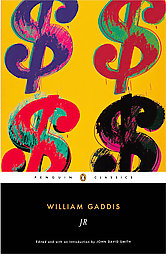
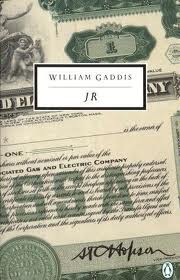
The edition I’m using.

SOUNDTRACK: RICHARD WAGNER-“Ride of the Valkyries” (1856).

Possibly the most famous piece of music from any opera (known for a billion reasons other than the opera itself).  This song was introduced to be by Bugs Bunny.  And then cemented in my consciousness in Apocalypse Now.

It’s really impossible for me to listen to it without seeing helicopters dropping napalm.

I’ve never seen it performed before.  Most of us think of it as an instrumental, but there are vocals, and they add a lot to the performance.  I also didn’t realize that the whole first minutes is a prelude to the third Act–with a darkened stage.  I just watched this version by the Danish Royal Opera in which the setting is updated.  The Stage is amazing and it’s a pretty powerful image, that won’t leave me head too soon.  And of course, the women sound phenomenal.

Smells like victory to me.

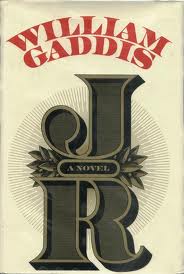
[READ: Week of June 19, 2012] JR Week 1

And so begins the saga of JR.  A little of my background:

I read JR about a decade ago.  I recall the structure and some of what happens, but not enough to actually remember anything ahead of time, plotwise.

Usually for these weekly group reads, I post fairly detailed recaps of the book.  And usually I do that because there’s so much going on in a large book, that it’s one way for me to keep track.  JR is going to be a little different.  If you’ve gotten this far in the book, you’ll notice that there’s not a lot of plot going on.  There’s a few scenes with lots of dialogue and maybe something comes of it, maybe not.  So, I’m certainly not going to try to recap everything that happens in the dialogue, nor am I even going to try to figure out who said what or even who is in every conversation–I’m not even sure that’s possible.  But I am going to talk about each scene a bit and see if I can pick out anything that seems important.

The book strikes me as being like an unedited film.  Or like a Picasso–Gaddis wants to show you everything, and let you pick out the important bits.  And so the book feels like a boom mike has been inserted into a room or scene.  We’re not really sure who everyone is, or even who is talking at a given moment.  But we hear everything that’s said. And then the boom mike pulls out and the camera pans somewhere else and the boom mike goes down and we hear some more.  It’s not always clear even that a scene has shifted–although usually a dense paragraph of prose indicates a shift in scene.

As far as characters, it’s not clear if anyone mentioned early on is going to stay with us through the book.  It’s clear that JR will be here (although his first real scene is right after my spoiler line for this week).  There’s also the Bast family who will no doubt play some ind of important role.  Then there’s a lot of teachers as well. (more…)

Read Full Post »

SOUNDTRACK: KATHLEEN EDWARDS-Voyageur (2012).

This is Kathleen Edwards’ latest album.  And every time I listen to it, it gets better.  Her songwriting has reached amazing heights.  The lyrics are wonderful and the melodies are just outstanding.  “Empty Threat” (“I’m moving to America…it’s an empty threat), opens the disc with a bouncy acoustic guitar and, eventually, a full band.  The lyrics for “Chameleon/Comedian” are wonderful: the juxtaposition between these two ideas is just amazing—each verse gets more complex.  I would quote them, but the whole song is great.  And, amazingly, the “I don’t need a punchline” is easy to sing along to as well.  “Soft Place to Land” is a nice ballad—a full band that never gets overwhelmed by any of the instruments—the violin adds a nice texture as do the military drums mid way through.  “Change the Sheets” is one of my favorite songs of the year.  It starts out slow, with simple guitars and more great lyrics.  As it builds (of course it builds) it grows into an amazing bridge/chorus that just dares you not to tap your feet.

“House Full of Empty Rooms” is like a minor palate cleanser before “Mint.”  “Mint” opens like a classic 70s rock song (Bad Company or Tom Petty), but she brings in her unique voice and phrasings and changes the song into something very different.  But again, that chorus–how can you not sing along to the catchy/voice-breaking chorus after the minor key verses?  The tension builds wonderfully.  “Sidecars” is a fun poppy track (“You and I will be sidecars, we chase down the hard stuff”).

“Pink Champagne” is a five-minute piano ballad.  It’s more akin to her earlier more country songs.  It’s a wee bit long but never overstays itself.  It’s followed by “Going to Hell,” which features some great screaming guitars in the midst of more delicate singing.  “For the Record” closes the album with a seven minute slow burner.  It begins quietly, and builds and builds–never the ecstatic heights–but with a chorus that is as catchy as it is mournful.

I have this CD in my car and every time it comes up, i just can’t stop listening.

[READ: June 18,2012] I Dream of Zenia with the Bright Red Teeth

I received this limited (autographed!) chapbook from The Walrus when I re-subscribed recently.  That’s pretty cool.  It has been sitting around because I thought it was a much longer piece.  When I received the latest issue of The Walrus, and saw that the same story was in there, well, I realized that this was just a short story and could be polished off pretty quickly.  The issue of The Walrus also told me that this story is a kind of follow-up to The Robber Bride.

I have never read The Robber Bride (I like Atwood quite a lot and yet have never read her most iconic books!).  So I would never have known that this was a sequel (of sorts).  As I said, I don’t know The Robber Bride, (and hope to read it maybe this year).  I don’t know exactly how it ties to the novel (the first line of the Wikipedia entry tells me that the three main characters are the same), and given the tone of the story, I assume it is simply catching up on them some twenty-five years later.

In this story, Claris, Tony and Roz (who are all women, I didn’t realize that right away) are going for their weekly walk in the woods together (because it’s good for you and Roz hopes to increase their cellular autophagic rates).  Tony and Roz bought (from a shelter) a dog for Claris called Ouida.  Ouida is a wild terrier mix (who hops on Roz’s orange coat and leaves footprints).

It quickly becomes apparent that Claris is something of a hippy—organic, vegetarian, communing with spirits and whatnot.  Claris just had a dream about Zenia.  Zenia (who I assume is in The Robber Bride, because why wouldn’t she be), was a woman from their past.  She stole a man from each one of them—with varying outcomes in each woman’s case.  Zenia died about twenty years ago but she has come back, Claris believes, to tell her about Billy. (more…)

Read Full Post »

« Newer Posts - Older Posts »