Feeds:
Posts
Comments

Archive for the ‘Marriage Trouble’ Category

rek2SOUNDTRACK: OF MONTREAL-Tiny Desk Concert #263 (January 28, 2013).

of-montrealWhen I saw that Of Montreal was doing a Tiny Desk Concert I really had no idea what to expect.  I mean, it could have been anything.  The blurb even jokes that Of Montreal concerts have been described as “wildly theatrical,” “flamboyant,” “synchronized dancing” and having “strange, wandering creatures that look like amoebas.”

So I was absolutely not expecting to see two guys with acoustic guitars and a woman singing a gentle folk song.  I actually double checked to make sure I was watching the right show.

Evidently around this time, Kevin Barnes (the man behind Of Montreal) had been working on quieter, more personal work. And so we get these three songs which are, more or less, Barnes solo.

The first song, “Feminine Effects” has the assistance of singer Rebecca Cash and guitarist Bryan Poole.  Cash sings the entire song, and it’s quite lovely, if not a little dark.

The next two songs “Imbecile Rages” and “Amphibian Days” are Barnes by himself, strumming guitar and singing.  The music is fairly straightforward, although he does throw in some unexpected chords which makes the songs stand out. And, of course, his lyrics and delivery are quirky. His enunciation is peculiar and even more pronounced in this setting.

This is a real surprise for Of Montreal fans, and frankly almost a red herring for anyone new to the band.

[READ: December 31, 2016] The Impossible Fortress

Sarah received an advanced reader’s copy of this book from her friend Mary Lynn and thought I would like it.  And boy did I ever.  I read this book in half a day.  It’s a quick read and while not profound of life-changing, it was really fun and funny–with a fairly dark twist.

There are two major plots in this book and they intertwine very nicely.

The first–the “action” plot–involves the Vanna White Playboy issue.  The second–the main character plot–involves coding a video game on a Commodore 64.  For this book is set in 1987 in the suburban New Jersey town of Wetbridge.  Our protagonists are 14-year-old boys who never really fit into other cliques.

The story is about Billy Marvin.  He never knew his father and his mother has started working the overnight shift at the Food Mart to make an extra dollar an hour.  Billy’s mom has really high hopes for Billy.  But his school life is pretty dismal.  His mom believes that Billy is really smart and she tries to get Billy into honors classes.  But his grades indicate remedial classes.  If he can succeed in these classes he can get moved up.  But he does not succeed. At all. (more…)

Read Full Post »

ny928SOUNDTRACK: COMMON-Tiny Desk Concert #569 (at the White House–October 4, 2016).

comonFor the first time in Tiny Desk history, they moved the desk from Bob’s corner of the office to The White House.  Not a bad move.

Boilen explains:

the White House called and said they were putting on an event called South by South Lawn, a day-long festival filled with innovators and creators from the worlds of technology and art, including music, we jumped at the chance to get involved. We chose Common as the performer and the White House library as the space.

I don’t know much about Common.  And, I don’t know what his album tracks are like.  But for this concert, Boilen explains:

Common put together a special six-piece band of close friends that includes the great Robert Glasper, with his eloquent and delicate touch, on keyboards and Derrick Hodge, whose music spans from hip-hop to folk and has made a big imprint on the world of jazz, on bass. Common also asked his longtime friend and collaborator Bilal to sing on two songs.

I didn’t know his lyrics, but I found his songs to be thought-provoking and smart. Perfect for the White House library.  But that is apparently what Common (who used to be known as Common Sense) is all about: “morality and responsibility continue to play significant roles in his songs”

Common plays four songs: three brand new songs, along with one classic, “I Used To Love H.E.R.”

“I Used To Love H.E.R.” is a very clever ode to hip-hop in which he uses a woman as a metaphor for the genre. It’s really well done.  “Letter To The Free” is about how slavery has not really been abolished–it has just turned into mass incarceration.  “The Day The Women Took Over” is an ode to women and certainly sounds like a song that was written for the woman who was then in the White House and the woman who should have been our next president.  “Little Chicago Boy” is a tribute to his father–a man that Common has always respected.

Musically, the group sounds great–a light, jazzy feel with some great flute from his sister and perfect playing from the rest of the band.

The blurb ends

Common told us that he’d been invited to the White House many times before, including by Michelle Obama for a poetry reading back in 2011, but he was thrilled by the prospect of performing his music during Barack Obama’s final months as president.

And with the Great Liar presumably heading to the White House, this may be the last time any musician I’d want to hear will appear there again.

[READ: March 10, 2016] “Three”

This story was told in three parts with a narrative bookend holding it together.  I had to reread the “introduction” after reading the whole story to see what an interestingly crafted tale this was.

The intro begins “This is an account of three people who died.  Quite recently, one after the other….  They weren’t important, as the wide world defines ‘importance.'”

And then we meet the three people who all lived in this provincial town in the north of Italy.  She says they share no real connection either, except “purity of spirit.”

The first person was her mother-in-law Ombretta.  She was never intrusive to the narrator and even though the narrator was her son’s second wife, there was never any weirdness about that either.  There was a big celebration for her 90th birthday.  Soon after, she took ill.

And this is when the narrator realized how much she had fallen in love with Nonna Ombretta.  And as part of her summation of Ombretta’s death we learn some interesting details about her. (more…)

Read Full Post »

slowreadSOUNDTRACK: DIRTY THREE-Tiny Desk Concert #245 (October 15, 2012).

dirty-3For a Murakami collection I should really have picked a jazz Tiny Desk Concert.  But none jumped out at my on my list.  So I decided to do something that might be jazzy in spirit, even if it is nothing like jazz at all.

Dirty Three are a three-piece band which consists of violinist Warren Ellis (who works closely with Nick Cave), drummer Jim White (who I had the pleasure of seeing live with Xylouris White), and guitarist Mick Turner (who has released a string of gorgeous instrumental solo albums and worked a lot with Will Oldham).

I’ve liked Dirty Three for years, although I kind of lost touch with them back around 2000.  So it was fun to see that they are still working.  (They’ve released all of 3 albums since 2000).

Jim White plays an eccentric but very cool style of drum–it always feels improvised and random, and maybe it is, but it’s never “wrong.”  Turner is the only one who is keeping the song, shall we say, “stable.”  He’s got the rhythm and melody both with his strumming.  And Ellis is all over the place with melody lines and bowing.

For this Tiny Desk, they play three songs.  Their music is ostensibly instrumental although Warren Ellis is not above shouting and yelling and keening when appropriate.

The first two songs are from their 2012 album and the last one is from Ocean Songs.

“Rain Song” opens with Ellis strumming the violin while Turner plays slightly different chords.  Then Ellis takes off on a series of spiralling violin rolls.  As always, White is back there waving his arms around with the loosest grip on drumsticks I’ve ever seen.  He plays brushes on this song but the drums are far from quiet.  Meanwhile Ellis is soloing away, yelling where appropriate and doing high kicks when White hits the cymbals.   As the song comes to an end, White is going nuts on the drums and Ellis takes off his jacket (revealing a wonderful purple shirt) .  He starts screaming wildly as he physically gets into his violin playing.

“The Pier” is about realizing that it’s the rest of the world that is driving you crazy.  It’s about “trying to undermine Facebook and realize a new way of communicating with people beyond the internet.”  It’ about… are you ready Mick?  Okay.  “The Pier” is a slower song with some plucked violin.  Ellis climbs up on the desk and dances around as he plays.  This one feels a but more controlled but in no way staid.

For “Last Horse in the Sand,” white switches to mallets and adds a tambourine to his cymbal.  It’s really interesting to watch White play around with things–moving his gear around as he plays.  He switches sticks and seems to be not even paying attention, but without ever really losing momentum or timing.  For this song, Ellis and Turner are the mellow ones while White is just all over the place with his amazing drumming.

I haven’t said anything about Turner because he is really the grounding of the band, while the other two are taking flights of fancy.

This is a wild and untamed set and it’s a lot of fun.  It’s also amusing to watch the audience witnessing this seeming chaos.

[READ: December 16, 2016] Slow Reader Vol. 1

Madras Press had released 16 small books, which I enjoyed reading quite a lot.  I have posted about some and will post about more in the new year.  But word is that they have given up on the small books and have switched their attention to a new magazine/journal called Slow Reader.  The first issue came out this month and it collects stories, essays, poems, illustrations, and other things that center around novelist Haruki Murakami.

Support this small press!  You can order this issue directly (and name your price, although I think the asking price is $6).

From an article elsewhere I’ve learned that future issues will cluster around M.F.K. Fisher, Kazuo Ishiguro, and Patricia Highsmith.

This issue contains essays, fiction and illustrations, some dating back as far as 2000.

CHIP KIDD-cover illustration (wind-up bird)
Chip Kidd is awesome

GRANT SNIDER-Murakami Bingo Board
This bingo is hilariously apt–covering most of the bases of Murakami’s writing: cats, jazz, running, and even a Chip Kidd cover.

JESSE BALL-Sheep Man
A line drawing of a sheep standing upright with the caption “The sheep man’s peculiar tail was never visible to me.”

HARRIET LEE-MERRION-Diner illustration
A nice line drawing of a corner diner

KAREN MURPHY-Sputnik and two moon illustrations
Two simple drawings of Sputnik and two moons.

BEIDI GUO-Hard Boiled Wonderland and the End of the World map
A cool map of the locations of the novel.

DINA AVILA–Murakami Tasting Menu at Nodoguro in Portland, OR
I don’t really get if the menu items are related to the stories but it’s a neat idea that there are foods named after his works. But why are so many called IQ84?

EUGENIA BURCHI–IQ84 menus
A drawing of foods with what I think are character names (I haven’t read the novel yet).

FABIO VALESINI-train illustrations taken from the book trailer for Colorless Tsukuru Tazaki and His Years of Pilgrimage
No idea what the original context is, but it’s a neat, clean drawing of a train station.

JEFFREY BROWN-“In Conversation” What Jeffrey Brown Thinks About
The first piece is an amusing cartoon in which Brown scores a job at an indie bookstore by mentioning Murakami.  The little blurb says that it is an only slightly exaggerated account. There’s also a later picture by Brown of Murakami’s face posted on a bulletin board (with a lost cat flier), that’s really great.

DANIEL HANDLER-“I Love Murakami”
Handler begins his piece by apologizing to dozens of authors before saying that Murakami is our greatest living practitioner of fiction.  He mentions a few books but heaps a ton of praise on Wind Up Bird Chronicles and mentions his excitement at  finally getting Norwegian Wood in English (it had been untranslated for many years).  He wrote this essay in 2000.

YOKO OGAWA-“On Murakami’s “The Last Lawn of the Afternoon” [Translated from the Japanese by Stephen Snyder]
Ogawa writes about a house in her neighborhood which has a lawn that she finds unsettling–it’s perfectly manicured and a pale, cool shade of green.  She is reminded of the Murakami story in which a boy mows a woman’s lawn and she asks him an unexpected question.  Ogawa imagines a woman in that home asking the same kinds of questions.

ETGAR KERET-“What Do We Have in Our Pockets?”
This was inspired by Murakami’s story “On Seeing the 100% Perfect Girl One Beautiful April Morning.”  This story is about a man whose pockets are always bulging with unusual items.  People often say to him, “What the fuck do you have in your pockets?”  And his answer is that he carries things that he imagines the perfect woman needing–a stamp or a toothpick.  It is a wonderfully charming story.

RIVKA GALCHEN-“The Monkey Did It”
Of all of the items in this collection, this is  the only piece I’d read before.  I remembered parts of it (particularly the excerpts from “A Shinagawa Monkey,” and her talking about Colorless Tsukuru Tazaki.  I also recalled her saying that she liked his short stories better than his novels, but that she was perhaps wrong in thinking that.  The one thing I didn’t pick up on last time was that in the beginning of the essay she writes about Toricelli’s Trumpet or Gabriel’s Horn–an item with finite volume but infinite surface area.  She says this perfect describes Murakami’s work.  And I love that she ties it to translator Philip Gabriel who is a gentle and modest translator–perfect for the watery novel.

TESS GALLAGHER-“Murakami and Carver Meet at Sky House”
Before he had written any substantial works, Murakami translated Raymond Carver’s works into Japanese.  Ray was excited and bemused that Haruki and his wife Yoko would travel from Japan to meet with him.  This essay tells us that the following poem came about as Ray tried to imagine how his poems could possibly be appreciated in Japan.  Murakami told him how both the Japanese and American people of the 1980s were experiencing humiliation at being unable to make a decent living.  Gallagher says that if they were to meet today Ray would be awkward about Haruki’s stature.  But he would have loved knowing that Murakami had translated everything he had written.

RAYMOND CARVER-“The Projectile”
This poem is wonderful. It begins with Carver speaking about his meeting with Murakami and then flashing back to when he was 16 and was hit with an ice ball.  It was thrown from someone in the street through a small crack in the window of the car he was riding in–a chance in a million.

RICHARD POWERS-“The Global Distributed Self-Mirroring Subterranean Neurological Soul-Sharing Picture Show”
This is the most abstract and “intellectual” of the essays here.  It speaks of a team of neuroscientists discovering a lucky accident–that neurons in the brain fire when someone else makes a motion that we recognize.  Similarly, in Murakami–representation is the beginning of reality.  He speaks of the parallel narratives in Hard Boiled Wonderland.  He wonders at the universality of dreams and ideas in Murakami.  “But if his own stories are steeped in the endless weirdness hiding just inside everyday life, how then to account for Murakami’s astonishing popularity throughout the world?”

MARY MORRIS-“The Interpreter”
I loved this story.  An American business woman is giving a series of lectures in Japan.  She is assigned a translator who goes with her nearly everywhere.  She is a little annoyed that he is always there, but he is very respectful of her and only speaks when spoken to.  She assumes he is translating her speeches correctly, but during one, the audience laughs where there was nothing funny.  She doesn’t want to disrespect him, but she can’t imagine what he said to them.  In the next one, they are practically doubled over with laughter at what he says.  Finally she has to confront him about it.  He reveals astonishing insights into her personal life.  And the next day he is called away–just as she has begun to feel close to him.

In the author’s note, she says that the she was at an writer’s meeting in Princeton (where she teaches) and Murakami was there eating with them. He was by himself, and she talked to him because she was a fan of his work.  She relates a story of holding up a sign for him when he ran the New York City Marathon.  She says that the part about the translator and his family (which I didn’t mention) is from an actual translator she met in Japan.

AIMEE BENDER-“Spelunking with Murakami”
Bender speaks of trusting Murakami.  She says when the cat started speaking in one of his books, she began to mistrust him.  Nevertheless, she says, she loves a lot of writers but only trusts a few of them.  She’s not trusting Murakami’s honesty or his ability to make her smarter.  Rather, she trusts him like a man with a torch in a cave–someone who is willing to explore–and to be in front leading the way.

SUMANTH PRABHAKER-Editor’s Note
Prabhaker would like to ask the world’s philosophers why some things seem to happen to us in a random fashion.

Read Full Post »

tinySOUNDTRACK: GREGORY PORTER-Tiny Desk Concert #550 (July 18, 2016).

gregory Gregory Porter is a soul singer.  For this Tiny Desk Concert, it’s just his voice and a piano played by Chip Crawford.  It’s odd that in the middle of July he’s wearing a suit and what looks like a balaclava, but whatever.

The first song, “No Love Dying” is a slow piece and Porter doesn’t really get to show off his power too much.  But his voice sounds great.  When it’s over he says he likes to think of that song in times of trouble, and we are welcome to take it into our houses in time of trouble as well.

“Take Me To The Alley” is about the backstreets and forgotten places and how we treat the people who are in those alleys.  This is also a slow, pretty song.

The final song is a warning, and we’ll know what’ its about when we hear the lyric: “Don’t Be a Fool” that’s all you need to know.  It, too, is a mellow piece, full of love and offering advice to not be a fool.

I didn’t know Porter before this, and I was pleasantly surprised by his songs.

[READ: November 18, 2016] The Tiny Wife

Back in 2014, I ordered all 16 books from Madras Press. Unfortunately, after publishing the 16 books they seem to have gone out of business (actually they are switching to non-fiction, it seems). They still have a web presence where you can buy remaining copies of books.  But what a great business idea this is/was

Madras Press publishes limited-edition short stories and novella-length booklets and distributes the proceeds to a growing list of non-profit organizations chosen by our authors.  The format of our books provides readers with the opportunity to experience stories on their own, with no advertisements or miscellaneous stuff surrounding them.

The format is a 5″ x 5″ square books that easily fit into a pocket.

Proceeds from Kaufman’s book go to Sketch— Working Arts for Street Involved and Homeless Youth.

This has been my favorite story from Madras Press so far. It was suitably weird but it followed its own internal logic and was really funny/intense at the same time. (more…)

Read Full Post »

storiesSOUNDTRACKPOLYPHONIC SPREE-Tiny Desk Concert #259 (December 21, 2012).

The Polyphonic Spree performs a Tiny Desk Concert.I really enjoyed Polyphonic Spree’s first album (and their strange robes and cult-like following (apparently even within the band).

They put out a Christmas album some time ago, and since we have a big pile of Christmas albums, I grabbed that one.  I didn’t love it, but it was a fun addition to our collection.

This Tiny Desk Concert is notable for just how many members of the band are behind (and on the side of) the Tiny Desk (perhaps 18?).

And the band is suitably musical–trombone, trumpet, keys, drums, bass, cello, violin and a ten (or so) piece choir.

Interestingly, I find that the weak link in this whole thing is leader Chris DeLaughter.  It’s just that his voice is really not that interesting. It’s especially notable on “The Christmas Song” where he sings some high notes unaccompanied.  When the choir comes in (and they change the melody) it sounds really cool.  I especially love the way they make “reindeer really know how to fly” into a high note.

The first song is “Happy Xmas (War Is Over)” which I feel is the Christmas song they might be best known for.  It’s pretty traditional to the original, with the choir filling in for the kids.  The addition of horns really adds a lot to it.

“Silver Bells” gets a pretty rocking treatment–the buildup at the beginning is pretty cool.  They change the main melody to an almost circus-like waltz. I love the way it sounds when everyone joins in–and when the choir is singing along to the rocking end (with a very different melody) it sounds great.  But once again DeLaughter’s voice doesn’t seem up to the task of leading this larger group.

But it’s festive and fun, especially with everyone in red robes (and DeLaughters green one).

[READ: December 2016] Christmas Stories (1854-1864)

Last year, I started reading some Charles Dickens Christmas Stories in December.  I imagined that I’d finish the whole book this season (all 750 pages of it), but I didn’t come close.  I enjoy these stories but they are not quick reads by any standard.

The fascinating thing with a lot of these stories is that they appeared in All the Year Round, a Victorian periodical founded and owned by Dickens and published between 1859 and 1895 throughout the United Kingdom.  But just because these stories came out for the Christmas issue doesn’t mean they have anything to do with Christmas directly.

I thought I’d be reading a whole chunk of the book in a row, but I wound up skipping around a bit.  Maybe next year I’ll finish the remaining stories. (more…)

Read Full Post »

2016-12-05-21-06-09SOUNDTRACK: YVA LAS VEGASS-Tiny Desk Concert #241 (September 24, 2012).

I’d published these posts without Soundtracks while I was reading the calendars.  But I decided to add Tiny Desk Concerts to them when I realized that I’d love to post about all of the remaining 100 or shows and this was a good way to knock out 25 of them.

yvaYva Las Vegass is a fascinating performer.  With just her voice and a small stringed instrument she sounds like no one else I’ve heard.

The blurb says:

she infuses Venezuelan folk traditions with a punk aesthetic. I heard songs as allegories, songs that told stories and songs that felt like deep primal screams, all accompanied by a traditional Venezuelan cuatro — a small stringed instrument similar to a ukulele.

She does not use a pick and her strumming varies from delicate and soft to aggressive and loud   And her voice is really powerful.

“Mariposas” starts off slowly with some delicate strumming and her singing.  When she gets to the fast chorus, her playing is so hard and percussive that the song changes tempo incredibly.

Introducing “Tonadas Y Cantos” she says that people in Venezuela sing this song to milk their cows.  It’s a traditional song but she plays it a little harder and a little punk “because that’s who I am.”  She sings fast and aggressive (some lyrics so fast it’s impossible to even know what the words are).   And while most of the song is in Spanish, there are some English lyrics too: “What do you do when you can’t pretend anymore. What do you when being dead sounds good.  Be brave be strong.”

This song ends very abruptly and the next one starts just as fast—there was clearly an edit–I wonder what they edited out.

“Polo Margaritenoio” is a traditional Venezuelan song “with no author because someone stole it.”  The writer “was a woman who was very vulgar like me.”

Yva is a fascinating performer and while she’s not very flashy, she commands attention with her voice and her playing.  I only wish I knew what she was singing.

The blurb continues:

You can’t quite see her cut-off jeans and Chuck Taylor high-top sneakers behind Bob Boilen’s desk, but in attitude and style, Yva Las Vegass is punk-rock through and through.

As the show ends, she says “I worked my ass off, you can tell by how much I sweated in my wool hat.”

[READ: December 22, 2016] “At Christmas Time”

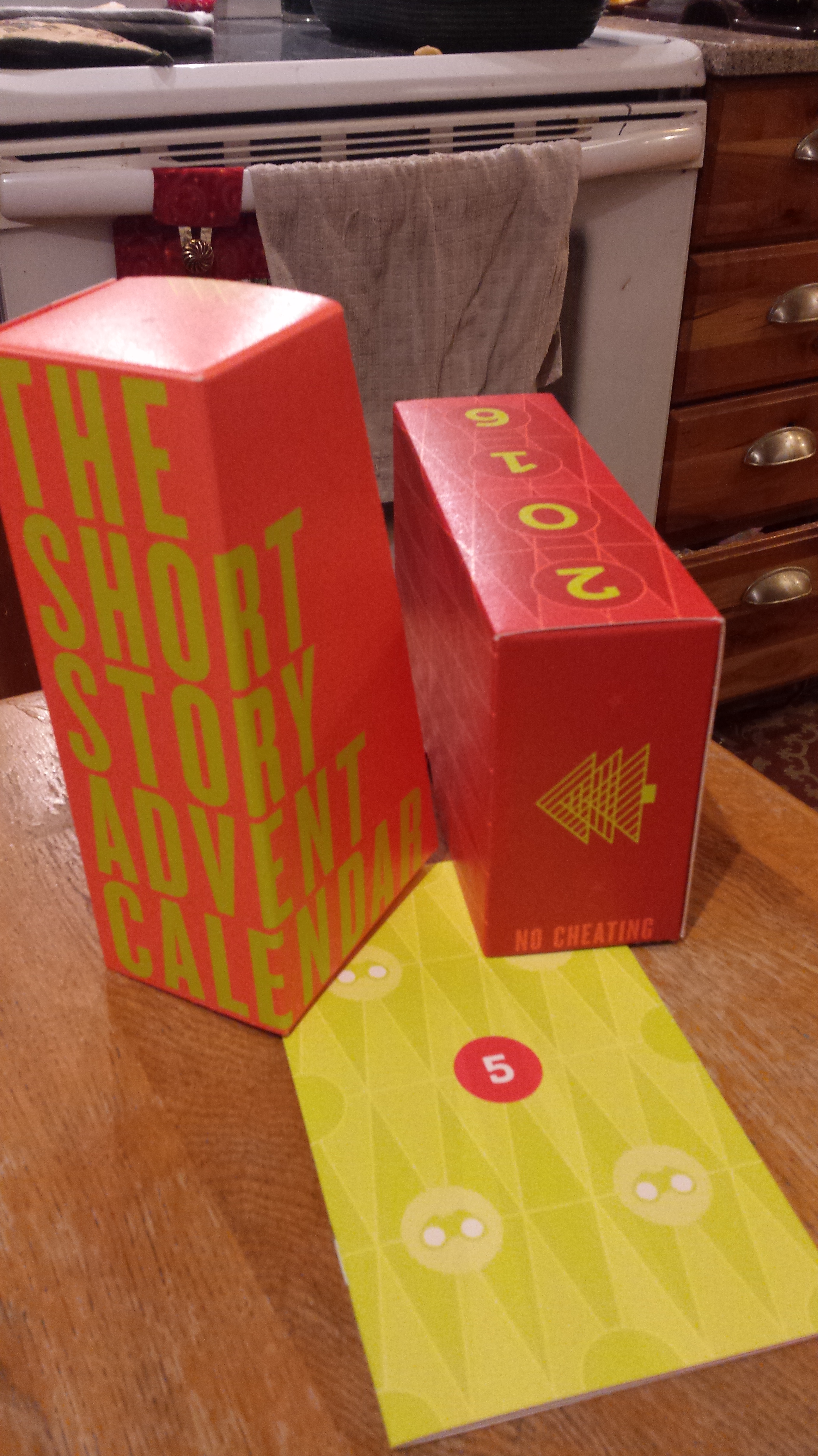
Near the end of November, I found out about The Short Story Advent Calendar.  Which is what exactly?  Well…

The Short Story Advent Calendar returns, not a moment too soon, to spice up your holidays with another collection of 24 stories that readers open one by one on the mornings leading up to Christmas.  This year’s stories once again come from some of your favourite writers across the continent—plus a couple of new crushes you haven’t met yet. Most of the stories have never appeared in a book before. Some have never been published, period.

I already had plans for what to post about in December, but since this arrived I’ve decided to post about every story on each day.

This is the first story on this collection that I have read before!  That’s not bad out of 22 stories.  (Or it’s very bad t hat I haven’t been reading enough stories).

I haven’t read that much Chekov, but I have read this one.  When I read it last time, I liked it but was more than a little confused by the ending.

I feel like I got a little bit more out of it this time, but the ending is still a puzzle.

This very short story is set up in two parts.

In the first part, an old couple from the country wish to send a letter to their daughter in the city whom they have not seen in four years.  She had gotten married and had sent two letters to them.  But they have not heard from her since that second letter several years ago.  Her mother, Vasilissa , wanted to send a letter sooner, but there was no one to write it for her.

At long last, and with so much to say, Vasilissa finally she asks Yegor, the innkeeper’s wife’s brother, “who had done nothing but sit idly at home in the tavern since he had come back from military service, but of whom people said that he wrote the most beautiful letters, if only one paid him enough.” She pays him 15 kopecks.

Vasilissa had spent so much time imagining what to say to her daughter.  But now that she is under pressure, she has drawn a blank.  Yegor asks what their son-in-law does.  He used to a be a soldier but now he is a door-keeper at a hospital.

Yegor begins writing some very formal sounding military instructions, “Fate has ordained you for the military profession.”  Of course the mother wants to tell her daughter about the famine and their poor crops.  And she wonders if she is a grandmother yet.

Vasilissa is revolted by this man (although I’m unclear if she knows what he is writing or not).  But she looks at him: “He was the very essence of coarse, arrogant, stiff-necked vulgarity, proud to have been born and bred in a pot-house, and Vasilissa well knew how vulgar he was, but could not find words to express it.”

The next morning, Vasilissa walked 11 miles to the post office and mailed the letter.

Part Two opens on New year’s Day, with the daughter’s husband working as a porter at a doctor’s office.  He receives the letter and delivers it to his wife.  The daughter is very excited to receive the letter. She reads the letter to her children.  And she is excited–laughing or crying, it’s hard to tell.  She reads of the snow and the warm fire and the doggie.  She huddles close with her children until he leaves the room.

The husband remembers back to three or four letters that she had asked him to send but which are still lying around somewhere.

And it’s super poignant.  And the more I think about it and reread it, the more powerful it is.

But then there’s a final line which I simply didn’t get.  I even translated the French “Charcot douche,” but it didn’t really help.  I can’t decide if those final words are meant to be significant or just suggesting that life goes on.

Incidentally, there are several different translations of this story available.  This one was by Constance Garnett.  Although I found the version online at Eldritch Press, translated by Marian Fell to be a bit easier to read–despite the fact that it was translated in 1915.

Read Full Post »

2016-12-05-21-06-09SOUNDTRACK: LUCIUS-Tiny Desk Concert #261 (January 7, 2013).

I’d published these posts without Soundtracks while I was reading the calendars.  But I decided to add Tiny Desk Concerts to them when I realized that I’d love to post about all of the remaining 100 or shows and this was a good way to knock out 25 of them.

luciusThis Tiny Desk Concert has a wonderful blurb:

We brought Lucius to the Tiny Desk because I fell in love with one joyous, catchy song: “Don’t Just Sit There.” That’s all I had to go on — I’d never seen the group live — and though I expected fun, we also got fabulous. Not only are Jess Wolfe and Holly Laessig a winning singing duo, but their charisma and charm helps turn good pop songwriting into an endearing performance.

The two singers are dressed identically–although they don’t really look much alike, they appear almost identical up there (and I’m not sure who is who).  The three men in the band: Danny Molad, Peter Lalish and Andrew Burri fill out the group with guitars and drums and are also dressed identically–in crisp white shirts and suspenders.

“Go Home” starts out slow with a rattling slide guitar and simple percussion.  The two women sing slowly over the bassline.  It’s a pretty, nice song.  And then the chorus kicks in and while the song doesn’t really get all that much bigger, their voices soar incredibly, in close harmony. It is a remarkable change in texture in the song and they instantly won me over.

It segues into “Don’t Just Sit There” which is a beautiful song with a slightly faster quiet section.  But again, the chorus “did you find love” just soars with their great harmonies.  I can see why Bob fell for them.

“Turn It Around” starts out with an “aha ha” and claps and a more poppy singing style.  And I find that while I like Lucius overall there are parts that I really don’t.  Like the beginning to this.  And yet, once again, when they get to that chorus “looking through the wrong end,” the song is super catchy and wonderful and I find myself singing that part a lot.  Even with the minimal backing guitar and drums, it sounds great.

After the third song, they get high-fives and Bob asks if they want to do another.  Usually, they edit out this type of thing, but it’s really fun to watch the band discuss what song they should play as they sort their percussion parts out.  I loved watching them go through Bob’s box of interesting percussion instruments until they found good ones.

When they finally get around to the song, “Genevieve,” it is a bouncy percussion-filled fun song.  Of the four, it’s my least favorite but that’s because it doesn’t really soar like the other ones do.  But it’s still fun.

[READ: December 21, 2016] “Circumstances Of Hatred”

Near the end of November, I found out about The Short Story Advent Calendar.  Which is what exactly?  Well…

The Short Story Advent Calendar returns, not a moment too soon, to spice up your holidays with another collection of 24 stories that readers open one by one on the mornings leading up to Christmas.  This year’s stories once again come from some of your favourite writers across the continent—plus a couple of new crushes you haven’t met yet. Most of the stories have never appeared in a book before. Some have never been published, period.

I already had plans for what to post about in December, but since this arrived I’ve decided to post about every story on each day.

There’s a fantastic plot point in this story that I don’t want to spoil.  And that makes it really hard to talk about the story.

But I really enjoyed it a lot.  And I can reveal the basic setup.

It had been 17 years since Nicholas was in his grandfather’s house.  And now that his grandfather was dead, Nicholas was willed the man’s property.  So he and his new wife Ann leave their current place in Victoria and head out to Halifax to make a new life in their new house.

Ann hated Halifax–the cold, the gray, the wilted produce.  And she hated the house. (more…)

Read Full Post »

2016-12-05-21-06-09SOUNDTRACK: RUFUS WAINWRIGHT-Tiny Desk Concert #237 (August 20, 2012).

I’d published these posts without Soundtracks while I was reading the calendars.  But I decided to add Tiny Desk Concerts to them when I realized that I’d love to post about all of the remaining 100 or shows and this was a good way to knock out 25 of them.

rufusPreceding his sister by a few months at the Tiny Desk was Rufus Wainwright.  I love Rufus’ delivery and style.  I really like his voice too.  The problem is I don’t really like his music all that much.  I wish I did, because I love hearing him sing.  But for some reason it doesn’t do anything for me.  We even saw him live (on a bill with Guster and Ben Folds) and left half way through his set because it’s such a different energy than the other two.

But I love this little bit of information about this show:

We’d never tried to squeeze a piano behind the Tiny Desk, but when I saw a chance to have Rufus Wainwright play here, I wouldn’t — and he probably wouldn’t — have had it any other way

That’s particularly funny because now some five years later they have had all kinds of things behind his desk.

He plays three songs on the piano.

“The Art Teacher”is a sad story about, yes an art teacher.  Really listening to the lyrics (full of art references) makes the song come alive.

Before the second song, he says I’m promoting my new album Out of the Game…yes, you may applaud if you wish.  Covers a lot of genres of music, one is, briefly, country.  Today is a lazy hazy day in the South–while we’re near the South.

“Respectable Dive”is a slow song (the country song, but not sounding country here) and again, the lyrics are great.

“Montauk” is about several people.  His daughter Viva Katherine Wainwright Cohen and his fiance.  Viva’s bilogical mother is Lorca Cohen who is Leonard Cohen’s daughter.  The last verse is about “my mother, the great Kate McGarrigle” (Rufus’ father is Loudon Wainwright III).

This song is, as the blurb says:

Wainwright at his best. The piano lines flow with forward motion in a Philip Glass way, and there’s also a hauntingly beautiful story. Wainwright sings to his daughter Viva, [imagining her] grown up and visiting her two fathers in Montauk, a small community on the eastern tip of Long Island.

So I am torn between really liking his voice but feeling that his delivery is a little too slow to fully understand the great lyrics.  There’s so much greatness in his stuff, and yet I can’t find my way in.

[READ: December 20, 2016] “Defamer”

Near the end of November, I found out about The Short Story Advent Calendar.  Which is what exactly?  Well…

The Short Story Advent Calendar returns, not a moment too soon, to spice up your holidays with another collection of 24 stories that readers open one by one on the mornings leading up to Christmas.  This year’s stories once again come from some of your favourite writers across the continent—plus a couple of new crushes you haven’t met yet. Most of the stories have never appeared in a book before. Some have never been published, period.

I already had plans for what to post about in December, but since this arrived I’ve decided to post about every story on each day.

I really liked yesterday’s story and I really liked this one as well, even though it is very different.

This is a the sad story of a woman named Birdie.  Boy oh boy everything goes wrong in her life.  She works at an office.

Big boss takes a four-hour lunch.  He has suffered no major disasters in his life.  [He and his wife plan] their vacation to Maine a year in advance.  This is one way to live.

Birdie works in a corner cubicle near Bog Boss’ office… [She] makes $20,000 a year forwarding emails to people who make $15,000 a year.

Birdie assumes that her boss is having an affair on his four-hour lunches.  But one day she see him during his lunch break working at a deli, frantically making sandwiches for customers.  Nothing makes sense. (more…)

Read Full Post »

thrilignSOUNDTRACK: ADIA VICTORIA-Tiny Desk Concert #545 (June 30, 2016).

adiaAdia Victoria has a rough, raw voice that goes well with her simple, exposed guitar sound.  The blurb says her music “carries the singular perspective of a Southern black woman with a Seventh Day Adventist upbringing, who never felt like she’d fit in.”

She sings three song, mostly in a great, raspy voice.  For “Stuck in the South” she actually seems to be gritting her teeth as she sings: “I don’t know nothing ’bout Southern belles / but I can tell you something ’bout Southern hell.”  When the first verse ends, and her band kicks in, it adds such interesting textures.  A distorted bass and a lead guitar playing quietly distorted sounds.  This song is really captivating.

“And Then You Die” with its swirling sounds and keyboards has a very distinctly Nick Cave feel–gothic in the Southern sense of the word.  Indeed, the first verse is spoken in a delivery that would make Nick proud. This is no to say she cribbed from Cave but it would work very well as a companion song  I really like the way it builds, but the ending is so abrupt–I could have used some more verses.

After the second song the band heads away and Bob says “They’re all leaving you.”  She looks at them and growls, “Get off the stage!” to much laughter.

She sings the final song “Heathen” with just her on acoustic guitar.  It is a simple two chord song.  It’s less interesting than the others, but again, it’s the lyrics that stand out: “I guess that makes me a heathen, something lower than dirt / I hear them calling me heathen, ooh like they think it hurts.”

I’m curious to hear just what Adia would do with these songs when she’s not in this Tiny format.  I imagine she can be really powerful.

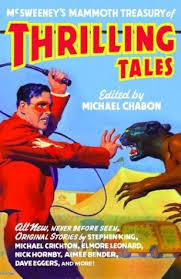
[READ: November 23, 2016] McSweeney’s Mammoth Treasury of Thrilling Tales

For some reason or another I have put off reading this McSweeney’s volume for many years.  This is technically McSweeney’s #10, although it was also released in this printing from a  major publisher. Sadly for me, my McSweeney’s subscription had expired sometime around here so I’ve never actually seen the “official” Volume 10 which I understand has the exact same content but a slightly different cover.

One of the reasons I’ve put off reading this was the small print and pulpy paper–I don’t like pulpy paper.  And it was pretty long, too.

But I think the big reason is that I don’t really like genre fiction.  But I think that’s the point of this issue.  To give people who read non-genre fiction some exposure to genre stuff.

Interestingly I think I’ve learned that I do enjoy some genre fiction after all.  And yet, a lot of the stories here really weren’t very genre-y.  Or very thrilling.  They seemed to have trappings of genre ideas–mystery, horror–but all the while remaining internal stories rather than action-packed.

Which is not to say I didn’t enjoy anything here. I enjoyed a bunch of the stories quite a bit, especially if I didn’t think of them as genre stories.  Although there were a couple of less than exiting stories here, too. (more…)

Read Full Post »

clarkSOUNDTRACK: JOHN CONGLETON AND THE NIGHTY NITE-Tiny Desk Concert #551 (July 22, 2016).

congleton John Congleton is a music producer (and a really good one at that–he’s had his hands on great albums both obscure and really poplar). But he is also a musician.  And a pretty weird one at that.  Here, as the blurb says, “he creates haunting tension with just acoustic guitar, brilliant electronics from Jordan Geiger, and words passionately sung.”

These songs are interesting because Congleton plays a very traditional sounding acoustic guitar.  His songs are typical folk chords.  But the lyrics are pretty dark and confrontational and those keyboards are often really creepy or disturbing (appropriate for the lyrics)

The first song, “Just Lay Still” is a rollicking  track with the guitar playing quickly and the keyboards playing off-kilter and deliberately creepy chords.   Lyrically, the song is about the subject that Congleton seems to be exploring on all of these songs–what it is like to be human.  “I love you like a lion loves its kill / I will touch you like a doctor, just lay still.  Let the implements molest you in your sleep / You belong to me…  We’ve got you surrounded (creepy chord).  We’ve got you surrounded.”

Congleton says “Your Temporary Custodian” is a devotional song about indifference.” It opens with crazy siren-like sounds over Congleton’s acoustic guitar. The blurb notes that the song addresses “what it means to face the fact that we are flesh-and-blood ‘temporary custodians’ in vessels that will inevitably return to the earth and decay.”  It’s got lyrics like:  “You phenomenal nominal nominal nominal nothing” and “we will not be saved / we went looking for the sublime / we found only the inane”  and “what an extraordinary thing it is to be this ordinary thing.”

Before the final song he thanks everyone (he’s very polite given his lyrics) and then jokes, as taxpayers we expect a full tour [of the NPR building].  “Animal Rites” is also a fast song with more great lyrics: “I’d love to hold you but I need to hold my own.”   Or “Biology kicks virtues’ ass every time” or my favorite: “When you’re crazy at 20 you’re sex to be had / when you’re crazy at 50 you’re not sexy, you’re sad.”  And then the crux of the matter: “You’re with an animal / you’re with a warm body, carbon contents, atoms and proteins.”  This song is much longer than the other two.  It has two parts separated by a solo is a bunch of noise and mayhem from the keyboards.  The second half slows down but eventually comes back to the main thrust of the song.

These songs were definitely unusual, and strangely catchy.  I’m curious to hear what this album sounds like (assuming he produced it himself–I expect impeccable work.

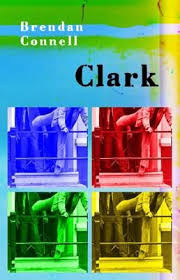
[READ: November 30, 2016] Clark

One of the things that I admire about Brendan Connell as an author is the astonishing depth and detail work he puts into his books.  Connell is an amazing polymath, with books that fully bring to life such diverse topics as food, religion, philosophy, violence, sex and now, Italian cinema.

Clark is the story of Eric Clark a devoted actor who rarely refused a role.  We watch his introduction to the world of film, his embrace of said world (and its embrace of him) and his subsequent decline.  This book also shows an amazing amount of detail about the Italian film industry–a topic I know nothing about.  Now I realize that Clark and his films are made up, but I have to assume that everything else that Connell says about the industry, its ability to make movies quickly and for 10% of the price of American films is all correct.  And if it isn’t, then he’s done an even more remarkable job of making it all up. (more…)

Read Full Post »

« Newer Posts - Older Posts »