Feeds:
Posts
Comments

Archive for the ‘Marriage (Happy)’ Category

SOUNDTRACK: BLUE ÖYSTER CULT-compilations and live releases (1978-2010).

For a band that had basically two hits (“Don’t Fear the Reaper” and “Burnin’ for You”) and maybe a half a dozen other songs that people might have heard of, BOC has an astonishing number of “greatest hits” collections.

Starting in 1987 we got Career of Evil: The Metal Years (1987), Don’t Fear the Reaper (1989), On Flame with Rock n’ Roll (1990), Cult Classic (which is actually the band re-recording their old tracks (!)) (1994), and the two cd collection Workshop of the Telescopes (1995).  There’s even Singles Collection, (2005) which is a collection of their European singles & Bsides.

This doesn’t include any of the “budget price” collections: E.T.I. Revisited, Tattoo Vampire, Super Hits, Then and Now, The Essential, Are You Ready To Rock?, Shooting Shark, Best of, and the 2010 release: Playlist: The Very Best of).

The lesson is that you evidently won’t lose money making a BOC collection.

I don’t know that any of these collections are any better than the others.

The 2 CD one is for completists, but for the most part you’re going to get the same basic tracks on all of them.

And, although none of them have “Monsters” for the average person looking for some BOC, any disc is a good one.

Regardless of the number of hits they had, BOC was tremendous live.  And, as a result, there have also been a ton of live records released.  Initially the band (like Rush) released a live album after every three studio albums. On Your Feet or On Your Knees (1975) Some Enchanted Evening (1978) and Extraterrestrial Live (1982) were the “real releases.”

Then, in 1994 we got Live 1976 as both CD and DVD (which spares us nothing, including Eric Bloom’s lengthy harangue about the unfairness of…the speed limit).  It’s the most raw and unpolished on live sets.  2002 saw the release of A Long Day’s Night, a recording of a 2002 concert (also on DVD) which had Eric Bloom, Buck Dharma an Allan Lanier reunited.

They also have a number of might-be real live releases (fans debate the legitimacy of many of these).  Picking a concert disc is tough if only because it depends on the era you like.  ETLive is regarded as the best “real” live disc, although the reissued double disc set of Some Enchanted Evening is hard to pass up.  Likewise, the 2002 recording is a good overview of their career, and includes some of their more recent work.

If you consider live albums best of’s (which many people do) I think it’s far to say that BOC has more best of’s than original discs.  Fascinating.  Many BOC fans believe that if they buy all the best of discs, it will convince Columbia to finally reissue the rest of the original discs (and there are a number of worthy contenders!) in deluxe packages.  I don’t know if it will work, but I applaud the effort.

[READ: October 2009-February 2010] State By State

This is a big book. And, since it’s a collection essays, it’s not really the kind of big book that you read straight through.  It’s a perfect dip in book.  And that’s why it took me so long to get through.

I would love to spend a huge amount of time devoting a post to each essay in the book.  But, well, there’s 51 (including D.C.) and quite a few of them I read so long ago I couldn’t say anything meaningful about.  But I will summarize or at least give a sentence about each essay, because they’re all so different.

I’ll also say that I read the Introduction and Preface last (which may have been a mistake, but whatever).  The Preface reveals that what I took to be a flaw in the book was actually intentional.  But let me back up and set up the book better.

The catalyst for the book is the WPA American Guide Series and sort of Steinbeck’s Travels with Charley.  The WPA Guides were written in the 1930s as part of the Works Progress Administration.  48 guide books were written, one for each state.  Some famous writers wrote the books, but they were ultimately edited (and many say watered down) by a committee.  I haven’t read any of them, but am quite interested in them (and am looking to get the New Jersey one).  Each guide was multiple hundreds of pages (the New Jersey one is over 800).

State By State is written in the spirit of that series, except the whole book is 500 pages (which is about 10 pages per state, give or take).  And, once again, famous writers were asked to contribute (no committee edited this book, though).  I’ve included the entire list of authors at the end of the post, for quick access.

So I started the book with New Jersey, of course.  I didn’t realize who Anthony Bourdain was until I looked him up in the contributor’s list (I’m sure he is thrilled to hear that).  And his contribution was simultaneously exciting and disappointing,.  Exciting because he and I had quite similar upbringings: he grew up in North Jersey (although in the wealitheir county next to mine) and had similar (although, again, more wealthy) experiences. The disappointing thing for me was that Bourdain fled the state  for New York City (and, as I now know, untold wealth and fame (except by me))  I felt that his fleeing the state, while something many people aspire to, is not really representative of the residents of the state as a whole.

And that dissatisfaction is what I thought of as the flaw of the book (until I read the Preface).  In the Preface, Matt Weiland explains that they asked all different authors to write about states.  They asked some natives, they asked some moved-ins, they asked some temporary residents and they asked a couple of people to go to a state for the first time.  In reality, this decision makes for a very diverse and highly entertaining reading.  In my idealized world, I feel like it’s disingenuous to have people who just stop in to give their impression of an area.  But hey, that’s not the kind of book they wanted to compile, and I did enjoy what they gave us, so idealism be damned.

For most of the book, whenever I read an essay by someone who wasn’t a native or a resident of a state, I assumed that there weren’t any famous writers from that state.  I’ve no idea if that played into anything or not.  From what I gather, they had a list of authors, and a list of states (I was delighted to read that three people wanted to write about New Jersey-if the other two writers ever decided to put 1,000 words  to paper, I’d love to read them (hey editors, how about State by State Bonus Features online, including any extra essays that people may have wanted to write).

From New Jersey, I proceeded alphabetically.  And, I have to say that I’m a little glad I did.  I say this because the first few states in the book come across as rather negative and kind of unpleasant.  Alabama (written by George Packer) comes across as downtrodden, like a place you’d really have to love to live there.  Even Alaska, which ended up being a very cool story, felt like a veil of oppression resided over the state (or at  least the part of the state that Paul Greenberg wrote bout.)  But what I liked about this essay and the book in general was that the authors often focused on unexpected or little known aspects of each state.  So the Alaska essay focused on Native fisherman and the salmon industry.  Obviously it doesn’t do justice to the rest of that enormous state,  but that’s not what the book is about.

The book is meant to be a personal account of the author’s experiences in the state. (more…)

Read Full Post »

[READ: February 18, 2010] “Vagabonds”

After reading Infinite Jest, I got totally het up about reading all of David Foster Wallace’s works. Of course, I discovered that he had an awful lot of uncollected works (which were all conveniently gathered in one location by a much bigger DFW fan than I). Since I’m reading 2666 as part of an online group, I wondered if I would be similarly obsessed with Bolaño’s output.

Well first, I’m not loving 2666 as much as I did Infinite Jest (but I’m only 1/3 of the way through, so that may change).  But, on a more literal note, there seems to be very few short stories literred around the place. A very cursory search revealed a couple things in Harper’s and a couple things in the New Yorker, but very little else.  Now, I assume that’s primarily because his stories need to be translated first, so there’s possibly a bunch of uncollected Spanish stories, but as for English ones?  Well, let’s just say that scouring the globe for a complete list of short stories in English that are not part of a previously released collections is something of a dificult task.

In fact, further investigation into the stories from The New Yorker and Harper’s shows that these stories are either already released or soon to be published in translated collections.

One of the things I found in my search was this article which is more or less a review of Bolano’s, The Savage Detectives.  However, in true New Yorker fashion, it is also a detailed overview of Bolaño’s life as well. (more…)

Read Full Post »

SOUNDTRACK: LES CLAYPOOL-Of Fungi and Foe (2009).

Claypool was asked to score a video game called The Spore Wars and, at around the same time, to score a movie called Pig Hunt.  According to the liner notes of the disc, he used the templates that he made for the scores and fleshed them out to make this album.

This was the first Claypool solo album I’d bought in several years (since 2002’s Purple Onion).  I’d heard “Mushroom Men” on the radio and really liked it, so I decided to get the disc.  And I have to say overall I’m a little disappointed.

Now, I’ve been a Primus fan for years (I even saw them right after Suck on This) so I know what I’m getting with Les.  And yet, maybe I don’t anymore.  The disc is very percussion heavy, with lots of rather long songs.  And although I love long songs, I love long songs that aren’t the same thing for 6 or so minutes.  I also rather miss Claypool’s voice.  He doesn’t sing a lot of these songs in his typical falsetto.  There’s a lot of very deep voiced, rather processed sounding voices here (it works great on the muh muh muh muhshroom men, but not so great elsewhere).  Because when you combine that with the bass and percussion, it’ really hard to hear what he’s on about (and Claypool lyrics are half the fun).

Plus, we know that with Primus’ own brand of weirdness, a little goes a long way.  So, hearing the same bizarro riff for 4 minutes can be trying.

Despite the criticisms, the disc is good in small doses.  The first 4 tracks are all really solid.  But that 5th track, “What would George Martin Do?” just sucks all the life out of the disc.  The same goofy riff for 6 minutes with completely unintelligible lyrics.  Ouch.   But “You Can’t Tell Errol Anything” picks up the pace somewhat with a wonderful Tom Waits-ian soundtrack.  The addition of Eugene Hutz on insane wailing vocals brings a wonderful new level of dementia to the disc.

Throughout the disc there some amazing bass riffs (of course) and some really cool effects thrown onto the bass (and other instruments).  But the overall feel of the disc is just too samey.  I think the music would probably work really well as soundtrack music, but it lacks a little something by itself.

I’m not suggesting that Claypool needs to be more poppy, because that’s hardly it (although he does have an amazing gift for clever hooks), but it’s possible that he needs an editor.  Was that the role Ler played in Primus?  Who will ever know?

[READ: February 5, 2010] Diario de Oaxaca

Wa-HA-Ca (that’s how you pronounce Oaxaca (the first question I had)).

I ordered this book for our Spanish collection without really knowing what it was about.  When it arrived I had a hard time deciding where to catalog it…is it a graphic novel?  a biography?  It’s bilingual so does it even go in the Spanish collection, which has much less circulation than our English collection?  As I flipped though the book, it looked really cool, so I decided to just read it and figure it out for myself.

Peter Kuper is, among other things, the drawer of Mad Magazine’s Spy vs Spy since about 1997.  Sometime in 2006, Kuper decided to go on sabbatical from the politics of George W. Bush.  He and his family packed up and moved to Oaxaca, Mexico for two years.  While he was there, the city experienced a semi-annual teacher’s strike.  However, this particular strike turned bloody when the President of Oaxaca turned his soldiers against the strikers. (more…)

Read Full Post »

SOUNDTRACK: THE SAW DOCTORS-If This Is Rock’n’Roll, I Want My Old Job Back (1991).

A line from a Saw Doctors song is quoted in this book, so why not review the whole disc,yeah?

I’d first heard of The Saw Doctors in college.  My friend Jaime brought this very disc over to a party (although I prefer the title of their second disc: All the Way from Tuam, better).  I din’t really give them much thought after that.  But then, several years later I saw them live at the Guinness Fleadh Festival and they were fantastic.  I saw them at another show elsewhere (details are sketchy now) and they were excellent then too.

This is their first disc and it’s a bit more subdued and folky than their later releases.  The fun part, of course, is the singer’s greatly Irish-accented singing and so many of the regional references.  I mentioned earlier that there’s a song quoted in this book, and that song is “N17” one of the great anthem songs of all time (even if you’ve never been on the N17, which indeed, I have not, I’ll still happily sing “I wish I was on the N SEVENTEEN, stone walls and the grass is green”).

In general, but even moreso on their later discs, they sing anthemic folk rock (the kind of songs that work very well live).  But they mix elements of trad, punk and just good old rock in as well.  In many ways they’re like a clean cut version of the Pogues (I mean, just look at them on the cover of their greatest hits).  And their Greatest Hits is a good place to check them out.  You get a lot of singles (and they are definitely a singles band), for a good oul’ Oirish rocking time.

I recently learned that they are one of the highest selling Irish artists of all time (although I can think of maybe one other band that has outsold them, yeah?).

[READ: January 31, 2010] These Green fields

Full disclosure right up front.  The author of this book is the boyfriend of one of my friend’s sisters.  Of course, I’ve never met him, and I’ve only met her once or twice, so it’s not like they’re any conflict of interest, but I know how the internet likes to gossip, so I’ll be straight witcha.

I ordered the book from his site, and when it arrived, I was a little concerned because the back cover and the prologue were rather confusing.  Confusing not because they’re about hurling (a lot more on that later) but confusing because the writing wasn’t that sharp.  The back cover just didn’t really grab me, and the prologue, while in retrospect makes a lot of sense, it just wasn’t all that exciting.  But that problem was cleared up once the book proper started,  so I had my guard up for naught.

But so what’s this about hurling?  Well, hurling is an Irish sport (and I’m going to mangle this, so my apologies to those who know the game better than me).  Okay, so basically, you’re on a big field with goals at either end (like soccer, say).  But each goal, in addition to having a net (which has a goalkeeper) also has uprights (like American football, say).  Points are scored in two ways: Hit the ball through the uprights and you get one point.  Hit the ball past the goalie and you get 3 points.  But just to confuse matters, the scoring delineates between the two forms of scoring: Goals-Points, so you see scores like 2-16 to 3-19.  I believe that it’s the total point tally that picks the winner, but it’s amazing how quickly fans can look at these tallies and tell who won.

And what a bout the ball?  Well, I’ll back a up a little and say that thee are two sports that are played on this field.  (Both sports are sponsored by the GAA, the Gaelic Athletic Association): Gaelic Football and Hurling.  Gaelic Football uses a ball like a soccer ball (forgive me, Gaelic Footballers for that simplification).  But hurling, glorious hurling, goes in another route altogether.  The ball is similar to a baseball and the bat–yes they use a bat–is like a field hockey stick, except the base is flat.  (I have a sliotar (the ball) and a hurley (the bat) at home, although I’ve never really gotten to use them.

So the men (women play a similar game called camogie) run up and down the field with these hurleys scooping up the ball and running with the ball balanced on the end of the hurley (you can only use your hands to catch a ball in the air or to throw it to yourself for self-hitting purposes).   And when you get close enough, as you might imagine, you whack the ball at the goal.  I’ll repeat.  You run with the bat and ball, stop and whack the ball down the field with your stick.  Is there any doubt what sport real men play?  By the way helmets became compulsory on Jan 1, 2010.  American Football, you’re a bunch of nancy-boys compared to this.

Oh, and the players are all volunteers!  My friend Louise told me that her teachers used to play on the weekend and they would routinely come into class with black eyes or busted teeth.

For an official explanation of this awesome game, check out these videos (#2 has some great footage and playing rules):

But hey we’re here for a book, right? (more…)

Read Full Post »

SOUNDTRACK: KATHLEEN EDWARDS-Failer (2003).

I really enjoyed Edwards’ Asking for Flowers.  So much so that I decided I had to track down her earlier discs, too.  This is her debut album (aside from a self released demo type EP that I don’t think is available anymore).  And, no doubt, it will get re-released one of these days making the 500 holders of that first EP very cross indeed.
I’m very torn as to whether Edwards is a country singer or not.  My gut says no, because I like her so much.  And yet, there are many country tinges that sprinkle this disc.

But that’s really irrelevant, especially if you like the disc, which I do. The amazing thing about Edwards is that it’s hard to tell what disc her songs come from.  She has a singular style of writing and singing that makes her songs timeless.  This is not to say that she’s stuck in a rut by any means, because nothing sounds tired.

Edwards is a wonderfully talented songwriter, with a gift for storytelling and a wonderful twist of wordplay: “One more song the radio won’t like”; “And if you weren’t so old I’d probably keep you / If you weren’t so old I’d tell my friends / But I don’t think your wife would like my friends.”  And beyond that there are simply great songs: “Hockey Skates” is a wonderful metaphor (and a damn catchy song).  “National Steel” has a wonderful hook.

I really can’t get enough of this disc.  Or her follow-up either.

[READ: January 20, 2010] “A Death in Kitchawank”

My recent comment about T.C Boyle’s named being shortened from Coraghessan must have been an editorial choice by Harper‘s because here it is in full splendor in the New Yorker. I also find it odd when the same writer appears in two locations very close together. Is it like when an actor has a big movie out and appears in several periodicals in a month?  I suppose Boyle has a book coming out?

Whatever the case, I enjoyed this Boyle story quite a lot too. And, once again, it undermined my expectations of what he writes (so I guess my expectations should change by now, huh?).

This story is set in a lake community in Kitchawank, NY.   When the story opens we see a woman tanning herself to a golden brown (this is the first clue that it’s set in the 70s. Which it is).  We watch as the woman, Miriam, relishes her family’s life and their friends in their close-knit, Jewish, lakefront community. (more…)

Read Full Post »

SOUNDTRACKTOM WAITS-Glitter and Doom Live (2009).

Sarah bought me Tom Waits’s 3 disc collection for Christmas last year and I was sure it would be another Waits Xmas since this was nicely timed for an under the tree gift.  But no!  I had to buy this one myself (she says she forgot, but as punishment I may just make her listen to this one).

It’s a two disc set.  The first is a collection of live tracks from all over the world (well actually Birmingham, Edinburgh, Tulsa, Knoxville, Milan, Jacksonville, Paris, Dublin, Atlanta and Columbus–a strange Western Europe-Southern U.S. Tour, apparently).

I’ve never seen Tom live, although I have seen videos from Big Time.  And this is the first batch of live tracks I’ve heard in these latter days of his career.  And I have to say he sounds great.  The gravel in his throat is thick and gritty, yet he still hits all the notes.   And while his studio tracks are full of all kinds of cool instrumentation and embellishments, the spare live band (who sound fantastic) shows that his songs are great even without the bells and whistles.

The funny thing to me is how “Dirt in the Ground” an older song that I love sounds so very different, even though Tom’s voice isn’t all that different.  Of course, he plays some even older tracks that are totally reworked. And they sound great, too.  This all keeps the tracks fluid and seamless, and while the older tracks wouldn’t sound dated anyhow, it makes them all sound new.

Disc Two is a 35 minute track called “Tom’s Tales.”  It is a spliced together “story” of all the interstitial talking bits that Tom throws into his shows.  There’s jokes, there’s stories, there’s nonsense, and it’s all good fun.  For all his dour music, he;s quite a funny performer.  It’ll probably get one or two plays at most, but it’s certainly fun to listen to.

I just read a review of the disc that complains about the separation of music and talk.  And I see the critic’s point: cutting out the banter removes an essential part of Tom’s shows, while having all the talking bits together kind of dooms that disc to be listened to only once or twice.

While I agree with the sentiment, I’m not sure about the musical disc lacking something without the banter.  While it would be fun to have it in there, there is something nice about having just the music.  (And of course, there is one tale tacked on like an encore break (and one song at the end of the music disc, too).  It keeps the flow very solid and makes for an excellent song collection.

It’s a great place to find out what Tom has been up to on the last half dozen or so albums.

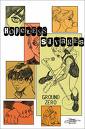
[READ: January 17, 2010] Ground Zero

Trade paperback #2 of Hopeless Savages collects the entire second series, with a few extras thrown in (and a very nice introduction).  And while I enjoyed the first series, Ground Zero is leaps and bounds more sophisticated and satisfying.  Even the title is a pun, what with Zero, the youngest Hopeless-Savage being grounded for most of the story.

The main focus is Zero’s burgeoning romance.  She is mostly off the boys at her school (typical comment: Your name is Skank, you must be easy), until she meets a boy in her science class who totally impresses her.  He’s named Ginger, after Ginger Baker, nice touch there.  And in a flashback we learn that although she hasn’t paid him any attention, he has loved her for years since their first accidental meeting.

I’m going to quote from Andrew Wheeler’s introduction because he sums up exactly what I think of the story: “It tells us that the most courageous thing of all is simply to fall in love.  The bravest thing to do is to place your heart in someone else’s hand.”  And that hits the nail on the head.  Pretty good for a comic book. (more…)

Read Full Post »

SOUNDTRACK: SARAH HARMER-I’m a Mountain (2005).

I first heard Sarah Harmer in 2000, with her “Basement Apartment” single (which always made me think of my friend Ailish who, at the time, lived in a basement apartment in Brookline, Mass.)

My wife Sarah has this CD playing in the car and I’d forgotten how much I liked it.  Unlike the You Were Here, I’m a Mountain is much more country music sounding. I’m not much of a fan of country music as a rule, but there is something about country music from Canada that just sounds better to me.  It tends to have more of a crossover sound, and is lyrically more interesting to me.  Maybe it has something to do withe Calgary Stampede.

While two or three tracks on here could easily fit on a country station, the album still got nominated for a Juno for Best Adult Alternative album.

To me, the album really kicks into high gear with the title track, which is funny and catchy (the line about Wal Mart is a good one).  The cover of Dolly Parton’s “Will He Be Waiting for Me?” is beautiful.  And the French song “Salamandre” sounds gorgeous even if I have no idea what she’s on about.”  The disc closes with my favorite song: “Luther’s Got the Blues” a wonderfully funny country song written by Luther Wright.  And in Sarah’s hands, it turns into a yodeling masterpiece.

You might hear Sarah’s voice backing up all kinds of bands.  And her voice really is fantastic.  So, should you tend to shy from country music as I do, this may be an entry way for you.

[READ: January 15, 2010] Hopeless Savages

I read this comic years ago, and loved it quite a lot.  I found it right around when I found Blue Monday. I recently tacked down the third trade paperback, so I figured I’d read all three again.

The premise here is that Dirk Hopeless and Nikki Savage, two old school punk rockers fall in love and settle down.  They have four kids: Rat Bastard, Arsenal Fierce, Twitch Strummer & Skank Zero Hopeless-Savage.  Each kid is a traditional punk: bad assed, fierce and take no shit.  But they are also pacifist by trade (Ronald Reagan took on the world with force, so force is for fascists, too right!).  Self defense is okay, mind you.

In this first story (there’s three trade volumes published so far), there’s not too much punks-in-proper-society comedy, because it’s all action.  The kids’ mum and da have been kidnapped, and its up to the four of them to find them.  Well, actually it’s up to the three of them to find Rat and then find their parents. For you see, Rat Bastard has sold out and gone commercial. (more…)

Read Full Post »

SOUNDTRACK: RHEOSTATICSStatic Journey Volume 2: Melville (2008).

At this stage, I realized just what the fine creator of this box set has set out to do: he is basically recreating the Rheos’ discs with live tracks, demos and other cool things.  Initially I assumed that everything would be chronological (live concerts only from that tour, for instance).  But he has gone beyond that simple task and is selecting the best version he can find.  So a concert from, say, 2007 which features an awesome recording of a track from Melville will follows a track from a show circa 2000.  It’s a very cool way to experience the disc.

And of course, if there isn’t an available live track, he plays the album track.

All of this cool stuff is supplemented with interviews, stage banter introducing tracks (even if the banter is not from the same show as the track).  The live versions on this disc are spectacularly smoking, and the songs sounds fantastic.  And, there’s enough jamming on these tracks so you can see the band really let loose.

Interestingly, I am finding this an excellent way to get reintroduced to the album.   There’s something about an amazing live track that really lets you appreciate the quality of the song.

I’m totally hooked on this box set.

[READ: January 4, 2009] The Guinea Pig Diaries

This was another surprise Christmas gift from Sarah and it was another great one.  I’ve enjoyed AJ’s (as he calls himself in the book) experiments in Esquire.  The book contains at least three experiments which I’d already read in Esquire.  There are some minor changes to the stories (most of which are designed to have them fit in with the general narrative of the book).  But even if you’ve read them (and one of them goes back to 2005!) there’s a Coda at the end of each one with a sort of follow up to the experiment that was not included in the article.

The experiments include (read more about them on his site, but only after you finish all of this!):

My Life as  Beautiful Woman
My Outsourced Life
I Think You’re Fat
240 Minutes of Fame
The Rationality Project
The Truth About Nakedness
What Would George Washington Do?
The Unitasker
Whipped

Jacobs is a very funny writer.  He is neurotic and constantly trying to improve himself.  And so, he undertakes these fairly absurd tasks is an attempt to make his life better/easier/less stressful/more awesome. (more…)

Read Full Post »

nySOUNDTRACK: TINDERSTICKS-Simple Pleasure (1999).

tinderTindersticks changed a bit with this disc.  And it’s evident from the moment the opening track kicks in: “Can We Start Again” is the most upbeat (musically) song they’ve ever done.  (Even if lyrically it’s not exactly puppies and rainbows).  And it is a truly magnificent song.  The next track, “If You’re Looking for a Way Out” has Staples singing so emotionally, his voice almost seems to break.”

As the disc proceeds, new aspects of the Tindersticks come into view.  The biggest change is an influx of soul stylings.  Staples actually croons from time to time; but the two biggest soul aspects are the groovy keyboards (not unheard of on previous discs, but very prominent here) and some gorgeous female backing vocals.  Indeed, “From the Inside” is propulsive instrumental with very 60s-sounding organ.

“If She’s Torn” sounds like a beautiful long-lost soul song, especially with the delicate keyboard notes that sprinkle down as the songs ends.  The final two tracks “I Know That Loving” and “CF GF” prominently feature the backing vocalists and they end the disc on a glorious note.

This disc is considerably shorter than their previous ones.  It seems like rather than making an epic mood piece, they settled down to make a more simple soul, almost pop record (although surely not pop by conventional standards).

This was the first Tindersticks disc I bought and it remains one of my favorites.

[READ: October 29, 2009] “While the Women Are Sleeping”

I have not read any Marías before.  And I was delighted by the multifaceted nature of this story.

It begins rather lightly with a man and his wife people-watching on a beach.  He needs glasses but, as this is the beach, he doesn’t wear them (no facial tan lines!).  So, he squints at people until, through some fascinating physics, he looks through his wife’s straw hat and is able to see much better.  (The image of a man with a straw hat held to his face is quite amusing).

After relaxing and spying for a few days, a new couple appears on the beach.  She is stunningly beautiful and is pretty much always naked on the lounger (this is Europe after all).  Her boyfriend is a considerably older, overweight, balding man.  He spends his entire time on the beach filming her, every inch of her, while she rests/sleeps/checks for blemishes. (more…)

Read Full Post »

sonoraSOUNDTRACK: TINDERSTICKS-Nénette et Boni [soundtrack] (1996).

boniAfter releasing two albums of atmospheric brilliance, Tindersticks were called upon to score the music for the film Nénette et Boni.

And this disc answers the question of whether it is Stuart Staples’ voice that is the driving force behind the band.  And the answer is, indeed not.  This disc is almost entirely instrumental (except for “Tiny Tears” which is a different version from the second disc and is here titled “Petites gouttes d’eau”).  The band brings the same atmospheric/noir quality to this disc that they bring to the ir previous works, but you get to hear it in all of its glory (since you’re not trying to figure out what Stuart is talking about).

I haven’t seen the film, so I can’t say how well it works for the film.  But I feel like I know the film quite well from the tone and music (and what I think may be sounds from the film) that are present.  If you like the band musically, you absolutely cannot go wrong here.  There’s not a bad track on the disc.  Even the half dozen or so tracks that are only about a minute (this is a soundtrack after all) are quite evocative.

I read a brief description of the film online, and I’m not entirely sure I want to see it.  But I sure do enjoy listening to the music.

The reissued disc comes with a bonus disc called Marks Moods.  Marks Moods was a promo disc sent out to film producers to showcase just what the band could do (again, without Stuart’s vocals).  So this is another moody instrumental disc.  The difference is that there are many songs from other discs that are done (or re-done, I can’t be entirely sure) as instrumentals.  The four tracks with vocals are “Sleepy Song,” “Don’t Look Down,” and “Buried Bones” which is actually a duet.  And then there’s “For Those…” one of my favorite songs which seems to crop up all over the place but never on an actual album.

This appears to have been something of a find back in the day.  I’m not sure if it was really worth hunting down, but it is a nice bonus to this disc.

[READ: October 18, 2009] “/Solomon Silverfish/”

The last few uncollected DFW stories that I read were a little less than satisfying.  So I wasn’t looking forward to this one very much.  But man, was it good.  It seems to be a hearty precursor to Infinite Jest (without the endnotes).  It even has a character named Wardine!

The story is typographically a little odd.  The title and “section” headings are in backslashes.  (I have no idea if that signifies anything other than a typographical choice of DFW or the magazine).  The section headings are the names of the character whose point of view the section is.  So, when the story opens we see /Solomon/.

But aside from that, the most unusual thing in the story is that it is written in the voice of a very Jewish individual.  For Solomon Silverfish speaks in an almost stereotypical Jewish vernacular.  Solomon is married to Sophie Shoenweiss, a Jewish woman who is dying of breast cancer.  As the story opens, Solomon is fielding a phone call (at 2 in the morning) from Sophie’s brother Ira.  Ira has just been caught with his third DUI and he’s begging his brother-in-law, a fine public defendant, to bail him out (again). (more…)

Read Full Post »

« Newer Posts - Older Posts »