Feeds:
Posts
Comments

Archive for the ‘Marriage (Happy)’ Category

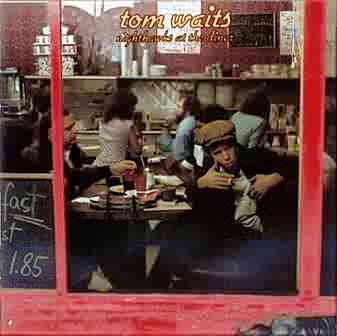
SOUNDTRACK: TOM WAITS-Nighthawks at the Diner (1975).

This is Waits’ third album, a live recording (!) which was actually recorded live in the studio. But not the way most bands record live in the studio. The producers brought in tables and chairs and created a bar-like atmosphere into the (evidently rather large) studio.  Then they invited fans in to watch the performance. Wild, man.

Just as wild is the bebopping and scatting that Waits does here. The opening “Emotional Weather Report” is all kinds of comical phrasing and silliness about himself.  It’s funny and quite enjoyable.  And it makes it feel like a nightclub.  He also introduces mos of his sings with a story, and for most of the songs, the introductions are almost longer than the song.  The two-minute intro to “On a Foggy Night” is full of Tom’s storytelling–but in a much more improv jazzy style.  Indeed, it’s not entirely clear when the intro ends and the song begins.

The intro to “Eggs and Sausage” has the very funny conceit that the food he has eaten in some greasy spoon is pretty frightening.  The veal came down to beat the shit out of his coffee, but the coffee wasnt strong enough to defend itself.  Nice.  “Better Off Without a Wife” he talks about having an evening just to yourself, you know, for pleasure.  We all do it, he says, but I’m not weird about it; I don’t tie myself up or anything.

Overall, this is a fun album.  It’s loose, the crowd is at ease and so is Tom.  It’s long album–about 70 minutes, which might be a little too long, but you get the whole vibe of a night out–good stories and good music.

[READ: September 21, 2011] “Starlight”

This story is four short pieces.  The titles should tell you everything you need to know about the content: “Mrs. Nixon Joins the Final Official Photograph,” “Mrs. Nixon reacts to RN: The memoirs of Richard Nixon,” “Brownie,” and “Mrs. Nixon’s Thoughts, Late-Night Walk, San Clemente”

So, clearly these are four short pieces that delve into the mind of Richard Nixon’s wife, Pat.  I don’t know a lot about her or about Nixon himself, really (I know all the highlights or low lights but I haven’t really ever looked into the man aside from what the sitcoms say about him).

So when I was reading the first excerpt I just couldn’t get into it.  I didn’t know who the people were for sure.  I assumed Ollie was Ollie North, but who knows.  I almost didn’t read any more, I was so uninspired by the first one.  But the next day I decided to try again.  (more…)

Read Full Post »

SOUNDTRACK: NEIL YOUNG-Trans (1982).

By most standards this Neil Young album is a disaster.  It’s so bad that despite updating his entire catalog and releasing all kinds of bootleg concerts, he has never issued this disc on CD in the States.  So, just what’s so awful about this disc?

Well, mostly it’s awful as a Neil Young disc.  Meaning, if you like Neil Young (either flavor: country/folk or hard rock/grunge) this disc is a big fat HUH??  Neil Young has gone all synthy?  And not just synth but computerized synthy–sometimes his voice is utterly like a computer.  It’s a travesty, it’s a shame, it’s an incredible surprise.  Unless you listen to it without thinking of it as a Neil Young record.

But after all that introduction, the biggest surprise is the first song.  You’ve been prepped for this weird album full of computer nonsense and you get the fairly standard (if a little dull) rockabilly type music of “A Little Thing Called Love.”  It’s a pretty standard Neil Young song for the time.  Hmm, maybe the album isn’t that weird.

Well, then comes “Computer Age” and the keyboards kick in.  Interestingly, to me anyhow, this is the year that Rush released Signals.  Signals was the album where Rush fans said Woah, what’s with the keyboards guys.  Similarly, “Computer Age” makes you say, geez, was there a sale on keyboards in Canada?  The keyboards are kind of thin and wheedly, but the real surprise comes in the processed vocals (Rush never went that far).  The vocals are basically the 1980s equivalent of auto-tune (no idea how they did this back then).  Because the song is all about the computer age it kind of makes sense that he would use this weird robotic voice.  Sometimes it’s the only voice, although he also uses the computer voice as a high-pitched harmony over his normal singing voice.

“We R in Control” sounds like it might be a heavy rocker (anemic production notwithstanding) until we get more computer vocals.  Again, conceptually it works (its all about the dominance of CCTV), but it is pretty weird as a Neil Young song.

And then comes yet another shock, “Transformer Man.”  Yes, THAT “Transformer Man,” except not.  This original version of the song is sung entirely in a processed super high pitched computer voice that is almost hard to understand).  The only “normal’ part of the song is the occasional chorus and the “do do do dos.”  It sounds like a weird cover.  Sarah, who loves Neil Young, practically ran out of the room when she heard this version.

“Computer Cowboy (aka Syscrusher)” continues in that same vein.  Musically it’s a bit more experimental (and the computer vocals are in a much lower register).  Although I think it’s probably the least interesting of these songs.

Just to confuse the listener further, “Hold On to Your Love” is a conventional poppy song–no computer anything (aside from occasional keyboard notes).  Then comes the 8 minute “Sample and Hold” the most computerized song of the bunch and one of the weirder, cooler songs on the disc.  It really feels like a complete song–all vocodered out with multiple layers of vocals, not thin and lacking substance like some of the tracks.  It opens with personal stats (hair: blonde, eyes: blue) and proceeds through a litany of repeated “new design, new design” motifs.

This is followed by a remake of “Mr Soul” previously only on Decade.  This is a new vocodered-harmonies version of the song.

The biggest failure of the disc to me is “Like an Inca” it’s nine minutes of virtually the same guitar riff.  The chorus is pretty wonderful, but it’s a very minor part of the song itself.  It is fairly traditional Neil song, I just wish it were much shorter.

So, this travesty of a disc is actually pretty interesting and, for me, pretty enjoyable.  Most of these synthy songs sound kind of weak but I think that has more to do with the production of the time. I’d love to hear newly recorded versions of these songs (with or without the vocoder) to see what he could do with a great production team behind him.

Trans is not a Neil Young disc in any conventional sense, but as an experiment, as a document of early 80s synth music, it not only holds up, it actually pushes a lot of envelopes.   I’m not saying he was trying to out Kraftwerk Kraftwerk or anything like that, but for a folk/rock singer to take chances like this was pretty admirable.  Shame everybody hated it.

[READ: July 5, 2011] Five Dials 19

Five Dials 19 is the Parenting Issue.  But rather than offering parenting advice, the writers simply talk about what it’s like to be a parent, or to have a parent.  It was one of the most enjoyable Five Dials issues I have read so far.

CRAIG TAYLOR & DIEDRE DOLAN-On Foreign Bureuas and Parenting Issues
I enjoyed Taylor’s introduction, in which he explains that he is not very useful for a parenting issue   That most of the duties will be taken on by Diedre Dolan in NYC.  They are currently in her house working while her daughter plays in the next room.  His ending comment was hilarious:

Also, as is traditional at most newsweeklies, someone just put a plastic tiara on my head and then ran away laughing at me.

I resist Parenting magazines, from Parents to Parenting to Fretful Mother, they all offer some sound advice but only after they offer heaps and heaps of guilt and impossible standards.  So I was delighted to see that Five Dials would take an approach to parenting that I fully approve of.  Dolan writes:

Nobody knows what works. Most people just make some choices and defend them for the next 18 to 50 years – claiming nurture (good manners) or nature (crippling shyness) when it suits them best.

And indeed, the magazine made me feel a lot better about my skills (or lack) as a parent. (more…)

Read Full Post »

SOUNDTRACK: BILLY BRAGG-Live at the Newport Folk Festival (2009).

Billy Bragg is one of the great holdouts of aggressive political liberalism in music.  For every “American Idiot” that young bands play, Billy can whip out “There is Power in a Union” or the more prescient, “No Power without Accountability.”  Lyrics:

IMF, WTO,
I hear these words just every place I go
Who are these people? Who elected them?
And how do I replace them with some of my friends?

He’s an old school American folkie, despite the fact that he is so outrageously British that his singing accent is stronger than most British folks’ speaking voices.

But he’s not all politics (well, yes he is, but sometimes he disguises it).  Like on his minor hit “Sexuality.”  With some of the first gay positive lyrics I can remember hearing on the radio: “I’ve had relations with girls from many nations/I’ve made passes at women of all classes/And just because you’re gay I won’t turn you away/If you stick around I’m sure that we can find some common ground.”

Billy’s set is pretty great.  He plays the electric guitar for most of it (with an amusing moment where he switches to the acoustic guitar and references Dylan), and really, he needs no accompaniment.  He plays several of his own songs as well as a number of Woody Guthrie songs (both ones that Guthrie recorded and ones that Bragg and friends recorded for the Mermaid Avenue project).

Bragg also talks.  A lot.  His stage banter is as funny as it is impassioned.  And he urges people not to give in to cynicism about their newly elected President (the task is too great for him to please everyone).   Sometimes he comes across as really inspirational and other times as simply idealistic.

The only part of the show that I don’t really like is the “cover” of “One Love.”  I don’t particularly like the song to begin with and this version is 6 minutes long.  True, he modifies the lyric, but the basics are  the same.  Aside from that it’s a pretty rousing set (even if the DJs interrupt him about 40 minutes in, apparently thinking he was going to be end).

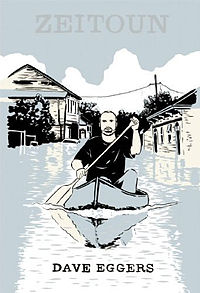
[READ: August 1, 2011] Zeitoun

I loved A Heartbreaking Work of Staggering Genius.  And I liked You Shall Know Our Velocity quite a bit too (and I just found out that YSKOV was rereleased as Sacrament with an extra 45 page section from Hand’s point of view–and that apparently there is only one copy available anywhere in the world and it costs $250!).

Anyhow, It was through Eggers that I found McSweeney’s (and its vast empire).  And yet during that time, I sort of gave up on reading Eggers’ published works.  When Zeitoun came out, I wasn’t all that interested to read it.  Mostly because I knew the book was about Hurricane Katrina, and I didn’t think I could handle a book about such a tragedy.

But recently, several people in book clubs had mentioned how good (and quick) of a read it was.  So I decided to give it a read.  And I’m really glad I did.

The book is about Abdulrahman Zeitoun, a Syrian born American.  He was living in New Orleans and was the owner of a very successful remodelling business (as well as the landlord of several properties around New Orleans).  Zeitoun is a hard-working, exceptionally conscientious man (the flashback to him running to work, carrying his broken bicycle on his back is as inspirational as it is amusing).  He rarely takes a vacation (much to his family’s chagrin) and oftentimes his wife has taken their kids on a vacation without him.  (One time they dragged into the car with his bags already in it without telling him they were going away for a weeklong vacation). (more…)

Read Full Post »

SOUNDTRACK: WAVVES-Live at Sasquatch, May 28, 2011 (2011).

I learned about Wavves from NPR–in fact I listened to their other NPR concert before even getting their album.  So this marks my second concert from them.  What makes me laugh about Wavves is that the songs are really short and Nathan Williams is a total chatterbox. When I burn these concerts onto CD, I use Audacity and I make tracks for songs and band chatter.  Which means that this Wavves show, which is just under 40 minutes has 20 tracks.  (Whereas S. Carey, at about the same length, has only 11).

This show has 14 songs.  Four of the songs are from their second album, called Wavves (which is also their second album called Wavves).  The rest come from King of the Beach (except “Wavves” from their first album and a couple of newer tracks).

The band blasts through these songs (I’m not even sure who is in the band, since the Wavves albums are a solo endeavor), and they all sound very good.  The album has kind of a tinny sound (on purpose, I suspect), whereas live the songs sound a bit fuller.

Lead Wavves guy Nathan Williams wasn’t that friendly in the previous show; he seems to be having a bit more fun here.  But really it doesn’t seem like you don’t go to a Wavves show to hear him talk, you go for what is undoubtedly the pogofest that is Wavves’ punk.  It’s a good set.

[READ: July 2, 2011] “Friendly Fire

Pam runs a small but successful cleaning business–but her workers are pretty unreliable.  So her friend Shelley, the real protagonist of the story, helps out once in a while.  Shelley enjoys the work once in a while (she has a real job after all)–she can use the extra cash.

This job was cleaning a warehouse–not the warehouse section itself, but the bathrooms, kitchens and offices.  They arrive early, but the workers come in while they are working and Shelley enjoys teasing/flirting with the men when they come in to use the bathroom and find her bent over, ass waving in their face. (more…)

Read Full Post »

SOUNDTRACK: THE DECEMBERISTS-Tiny Desk Concert #135 (June 20, 2011).

NPR has loved the Decemberists for years, so it’s no surprise that they made it to Bob Boilen’s office for a Tiny Desk concert.  And yet they are probably one of the biggest bands to appear at the Tiny Desk, so I was quite excited to hear this show.  They play 3 songs, all from The King is Dead: “Down by the Water” (naturally), “Rox in the Box” and “The June Hymn.”

Colin is in good chatty form (after almost getting hit in the face by a violin bow) and makes a very funny comment about thinking that everyone would be working while they played.  He also—I think a first in Tiny Desk history—screws up a song (“The June Hymn”) and has to restart the whole thing—it’s a very minor flub, only noticeable if you listen a few times, but he noticed and clearly felt bad (and didn’t curse either).

The songs sound great even if they’re not radically different from the recorded version (the harmonica solos are the big “improv” moments).  And this set confirms what a solid bunch of songs The King is Dead is.

[READ: July 7, 2011] Wildwood

I had this book signed by Colin and Carson at BEA.  I was so psyched to see that they were signing there, that I got up super early, took the bus into Manhattan and got to the convention center before it opened (I thought they were signing at 7:30, but it was actually 8:30). Of course, I didn’t see the fine print that said I needed a ticket to meet the author and illustrator.  In fact, I didn’t even realize that people were holding tickets until I was next on line. I asked the nice BEA worker if I could still go.   She said they wouldn’t sign a book, but that I could say hello.

I told Colin and Carson that I loved their stuff and I gushed over them like a little fanboy (even mentioned having a Tarkus album) and they gave me a copy of the book anyway (signed by them both).  How cool!

So this book is an older children’s book (I would say on a level of The Mysterious Benedict Society–which the book reminded me of because Carson did the illustrations for that series as well, although the books are nothing alike in content).

I have always loved Colin’s lyrics (yeah, he signed my book, we’re on a first name basis now). They are fantastical and fantastic, and he has a great vocabulary, pulling out obscure words for rhymes.  There’s a generally accepted tenet in writing that poetry is more powerful than prose because poems are typically honed with perfect word choices, whereas prose tends to be a bit lazier because there’s so many more words to play with (ideally, prose should also be finely honed, but it’s much more noticable in poetry).  And so given this, I guess it’s no surprise that Wildwood is not as impactful as Colin’s songs.  There are couplets from Decemberists songs that run through my head all the time, but there weren’t any great phrases in the book that really stuck with me.  Of course, at 540 pages you wouldn’t expect too many phrases to jump out at you (images and scenes and chracters yes, but phrases, no).

All of this is a long way of saying that I really enjoyed the story, but I wasn’t blown away by the language of the book.

The story follows Prue McKeel, a young girl who is pretty ordinary.  She lives in Portland (the Wildwood of the title is in Oregon, not New Jersey, which isn’t surprising since they’re from Oregon, but a Jersey kid can hope), goes to school and has a pretty happy home life.  Her mom and dad are nice (I love that her parents are suffused with all the trappings of hippie Oregon–it’s like Portlandia in print!) and her baby brother, Mac, is pretty okay too.  The image that will stick with me is of Prue taking her brother for a bike ride: she transports him through the most peculiar (and reckless and dangerous) way I can imagine–she attaches a Radio Flyer wagon to her bike and plops him in the wagon.  I just have to ask–how did he not fall out??

The story immediately announces itself as fantastical when a murder of crows swoops down out of the sky and grabs Mac from the ground and flies away with him.  Now, Prue was supposed to be watching Mac, so although it’s not her fault a bunch of birds grabbed Mac and flew away with him, it is her fault, you know?  So Prue hops on her bike and follows the birds through the city (a very exciting scene of reckless bike riding).  She skids to a halt when she sees them fly into The Impassable Wilderness. (more…)

Read Full Post »

SOUNDTRACK: KOPECKY FAMILY BAND-Embraces EP (2008).

I learned about Kopecky Family Band from NPR’s Tiny Desk Concert.  When I investigated further, I found that I could download this EP for free. I compared their Tiny Desk show favorably to The Head and the Heart.  This earlier EP has a bit more punky edge to it (as their other stuff may as well–Tiny Desk doesn’t really lend towards punk).

And so this EP leads me to compare them more towards Stars.  But perhaps we’ll call them a more acoustic version of Stars.  There is some wonderfully intense musical construction on this EP, and the dynamic of the duel vocalists really bring great tensions.

This is a wonderful EP.  The strings belie the rather heavy chords  (especially on “Trainwreck”) and the harmonies throughout are really infectious.

[READ: June 30, 2011] “A Mouthful of Cut Glass”

I’ve really enjoyed Tessa Hadley’s recent stories in The New Yorker.  So I decided to go back through their archives and read the other stories of hers that they have published.  It turns out that she has been published in the New Yorker since 2002.  But many of the earlier stories were collected in her previous collection which I’ll read one of these days.  But rather, I started with the first ones that have yet to be collected.

“A Mouthful of Cut Glass” is a conflation of two expressions, neither of which I was familiar with: “talking through a mouth full of plums” and “an accent like cut glass.”  The malaprop came from the protagonist’s boyfriends’ mother.  And yet, I say protagonist as if Shiela is the real protagonist.  The story quite clearly opens with Neil.

In 1952 Neil was born into a very poor household.  But over the years, he was able to rise above his sattion and become a successful University student.  It was at University that Neil met Sheila.  Sheila grew up in a vicar’s house with a gaggle of brothers and sisters.  The two of them hit it off very well and began a serious relationship. (more…)

Read Full Post »

SOUNDTRACK: MOGWAI-Happy Songs for Happy People (2003).

Happy Songs for Happy People follows up Rock Action with more sedate music from Mogwai.  In fact, while Rock Action was pretty mellow (with a few bursts of noise) HMFHP is even more mellow.

Although it does open with a rocking track: “Hunted By a Freak.”  “Hunted” is one of Mogwai’s best songs.  It opens the disc with a catchy riff, some cool synthesized vocals and great washes of sounds.  It’s great on record and even better live.  But starting with “Moses I Am’n’t” the album takes a decidedly more mellow approach.  “Moses” is a song of slow washes layered on each other. There’s interesting textural sounds on display, but not a lot of melody.  It leads to “Kids Will Be Skeletons,” another mellow layered song.  It has a simple melody with delicate (!) keyboard washes.

But just when you think Mogwai have gone all soft, “Killing All the Flies” adds some intense sounds to the disc. It is similarly structured to the earlier songs on the disc, although it has some rather happy-sounding guitar lines in it.  It also grows in intensity about two-thirds of the way through.

“Boring Machines Disturbs Sleep” (sic) is a short, quiet song with subdued vocals.  It’s followed by “Ratts of the Capital” the only really long song here (8 and a half minutes).  It opens in this more subdued vein (is that a glockenspiel I hear?), but by 4 and a half minutes all you hear is guitar–growing louder and louder.  There are solos buried in the noise that threaten to explode out of the speakers, but they ultimately seem to hold back a wee bit.

“Golden Porsche” mellows things out again with a very pretty, very simple song (almost 3 minutes of beautiful melody) that reminds me of the interludes in Twin Peaks.  “I Know You Are But What Am I?” opens with a tense kind of piano (with some slightly off chords).  They merge with pretty keyboard notes which counteract the somewhat sinister feel of the main riff.

The disc ends with “Stop Coming to My House” (Mogwai have always excelled at song titles).  It’s a very subdued track (quiet drums propel waves of keyboards) and as the songs continues, more and more waves layer on each other until it just all fades away.

I obviously prefer the louder, more raucous Mogwai tracks, so these two albums are not what I think of when I think Mogwai.  These two albums feel like the work of a more mature, more restrained band–as if they are deliberately trying to put constraints on their music to see what they can achieve.  But even if they are less intense, the songs are wonderfully structured and show a still show a great emotional range.

[READ: June 07, 2011] “Clever Girl”

This was a fascinating story and is yet another story by Tessa Hadley that I really enjoyed.  And it’s another story that I didn’t realize was set in England until the fourth paragraph, which opens “Mum unpacked.”

Anyhow, this story follows Stella, a young girl whose family moves to a small suburb that has recently been developed (trees were cut down and none newly planted).  Stella and her mother used to live alone together for many years, but recently Stella’s mom met Norbert.  They married and moved into this new suburban house.

The story is told in past tense about the events from Stella’s childhood.  But there are occasional moments where the narrator pops in and offers some moments of “grown up Stella” perspective–like maybe she could have been nicer to Norbert.  Grown up Stella realizes that Nortbert was really perfect for her mom (especially since she was an older woman,  with a grown daughter).  At the time, she thought that Norbert seemed okay, but the whole move has upset her sensibilities.  [I also love that Norbert is known as “Nor,” which is wonderfully contradictory.] (more…)

Read Full Post »

SOUNDTRACK: PJ HARVEY-Uh Huh Her (2004).

After the sort of mellow, almost commercial release of Stories from the Sea, PJ Harvey throws the fans a left turn once again with Uh Huh Her.  It’s a heavy, raw album although not raw like Dry was.  It seems  simpler, somehow.  And I think it’s with this disc that you realize that every PJ Harvey record is going to be different.  It was apparent that she had a trajectory on those first few discs, but this one changes everything, and she proves that you’ll never know what’s going to come from her.

“The Life and Death of Mr Badmouth” has a very simple blues riff with kind of chanting (and occasional creepy backing vocals) by PJ.  While “Shame” adds more texture (melodica?) and some more washes of sound.  “Who the Fuck?” is a wonderfully vulgar and raw track with brutal guitars and overly loud vocals.  “Pocket Knife” is a buzzy but quiet track which feels like a demo (the guitar even seems out of tune), while “The Letter” has a great fuzzy guitar sound and a cool melody.

“The Slow Drug” is one of several slower pieces.  As with many of her quieter stuff this does nothing for me, although it’s a nice change on the disc.  “No Child of Mine” is a brief acoustic number.  It feels more like an excerpt or a transitional song than any actual song (being only a minute long).  It leads to the rocking “Cat on a Wall.”  “You Came Through”  mixes things up very nicely with a heavy percussion.  The effects in the song are really captivating.

“It’s You” is a slow piano-based song, while “The End” is a brief instrumental (more melodica).  And “The Desperate Kingdom of Love” is a dark ballad.  The oddest track is “Seagulls” which is a minute of actual seagulls squawking…an unusual addition for any disc.  The album ends with “The Darker Days of Me & Him.” It’s a quiet acoustic song which shows just how many different style she’s willing to experiment with even on one disc.  Even though to me this is a raw rocking disc, there are still a number of acoustic tracks as well.

This album feels like some kind of psychic purge.

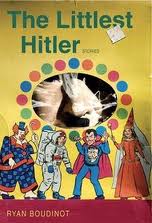
[READ: March 31, 2011] The Littlest Hitler

I picked up this collection of stories because I enjoyed Boudinot’s story in the BlackBook collection very much.  I didn’t realize that that story was in fact part one of a two-part story (although part two bore no relation to part one, as you’ll see).  The story in BlackBook was funny and dark, but it didn’t prepare me for just how dark these stories would get.  And for the most part, it seemed like the darkness came at the very end; a surprise, a shock.   I admit i grew a little weary of the device by the end of the collection, although not all of the stories employed it, so there was some diversity. (more…)

Read Full Post »

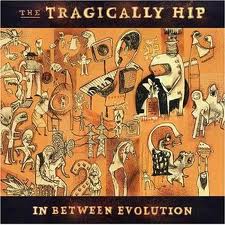
SOUNDTRACK: THE TRAGICALLY HIP-In Between Evolution (2004).

The Hip are still putting out solid rock records.  And “evolution” is a good word in the title, for the Hip are clearly no longer the band they were.  And yet there is a sense they are returning to something…if not their own roots necessarily, perhaps a more basic sound.

The opener, “Heaven is a Better Place Today” is so upbeat it’s almost shocking.  It’s bouncy and catchy with some very cool riffs.  It’s followed by “Summer’s Killing Us, a raucous, rocker with another great chorus.

This album has some of my favorite tracks of recent Hip albums.  The best song on the album is “Gus: The Polar Bear from Central Park.” Between the riff and the way Downie sings the song, it’s got a brooding intensity that I can’t resist.  “Vaccination Scar” has a really rocking slide guitar.  And it continues in the vein of the album in which the band sounds more like Pearl Jam than R.E.M.

“It Can’t Be Nashville Every Night” is another song that sounds typically Hip and yet with a bit more oomph.  Even some of the later tracks (tracks which tend to be less than stellar on Hip discs–am I wrong?) are really strong.

“Makeshift We Are” has a great stuttery quality to the chorus, and “You’re Everywhere” has an unending power with a great chorus.  “Mean Streak” sounds like a pretty typical Hip song until about half way through when it throws in a minor chord break that really surprises.

“The Heart of the Melt” and “One Night in Copenhagen” are two late album tracks that are short and urgent.  “Melt” is a speedy loud rocker and “Copenhagen” screams along until it comes to a catchy end.

This isn’t really a return to the Hip’s roots, but it is a return to an urgency that the Hips early albums possessed.

[READ: February 16, 2011] “If Things Happen for a Reason”

This story starts in a fairly shocking way: the narrator wakes up from blacking out to hear a man she doesn’t know saying that their kids will laugh over this someday.

We pull back to see that the woman was in a bicycle accident (face first into the pavement–ouch) and the man helped her up and brought her to a hospital.  The story proceeds with his declaration and her belief that indeed, they will have kids together (even though she hadn’t met him before that moment).

Her family believes she is too young for anything like that so she hides him from them.  Eventually the truth comes out and she introduces him.  And they settle down into a happy stability (even if they can’t always pay their bills on time). (more…)

Read Full Post »

SOUNDTRACK: JIAN-The First 6 Songs (2001).
Being American and apolitical in my youth, I had no idea who Pierre Trudeau was until about 2001.  And my first real introduction was through this album by Jian Ghomeshi.  Jian was one of the four guys in Moxy Früvous (and man has his career skyrocketed since then…watch his great interview show Q online–in particular, check out the crazily uncomfortable interview with Billy Bob Thornton or the wonderful hour long interview with Rush).

Moxy Früvous had just broken up and Jian, who was one of my faves in the band, put out the optimistically title The first 6 songs (no other songs have arrived yet).

Jian is a mostly folk rock album which features Jian’s gentle voice.  And gentleness is one of Jian’s trademarks, it would seem.  But more than gentleness, his songs are about accountability and justice.  And yet lyrically, he’s not naive or obvious.  “Quebec City” is about the Summit of the Americas in Quebec City in 2001 (“the whole world is watching”).

I’ve always felt connected to the last track, “Lousy Boy”:

“And a man Is a man If he’s got a gun in his hand
Well I never wanted to destroy I always made a lousy boy….  And I know guys who are just like me
They like hockey and poetry
I think in retrospect that we have won
I’m a full-grown man and I don’t own a gun.”

Früvous has similarly thoughtful lyrics but in addition to the lyrics, the music is always interesting.   So the unexpected chord changes in the bridge to “Astronaut” turn the song from a simple folk song into a moving rocker.  And “Baby Don’t Lie” is a 5 minute track that builds on a folk base and is a catchy sing along.

of course, this all leads to the song “Father (For Pierre Trudeau)” the song that first taught me a little bit about the Prime Minister.  The song covers a few moments of his media-saturated leadership.  But mostly it’s a reflection about Trudeau on the day of his death.  The personal touch of course is that Ghomeshi’s father wanted to meet him (as did Jian) but now they w0uld never get to.  It’s a very touching song, and I have a hard time imagining someone writing a similar song about a President.

It was this song that got me to investigate the life and leadership of Trudeau.  (I even wrote an email to Jian, to which he quickly responded…I only wish I still had that email account active).

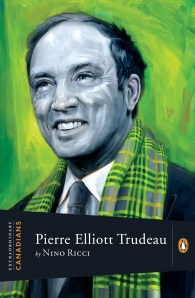
[READ: January 12, 2011] Pierre Elliot Trudeau

This is one of the more exciting biographies that I’ve read.  Which is pretty great.  Although one of the reasons it is so exciting is because he presumes that the reader knows a lot about Trudeau already.  And to be fair, I assume most Canadians would know the global picture (and most of the details) about him already.  So, basically, you get a summary picture of Trudeau, but instead of a quick outline that glosses over details, we get a lot of details, but no gloss.

What I’m getting at is that there are a number of places where Ricci talks about events and movements as if we know them.  So this makes for incredible fluency even if the novice is left puzzling exactly what all the fuss was about.  In fairness, contextually it’s easy to figure out, it’s just a bit surprising.

Another fascinating thing: Ricci skips over Trudeau’s childhood pretty much completely.  The book opens with Ricci’s memory of seeing Trudeau in 1967 when he (Ricci) was a young boy and seeing the way his teachers an adults seemed mesmerized by him.

Nostalgia aside, Ricci quickly explains what a polarizing figure Trudeau has been.  Warmly loved by many and yet (according to Macleans) ranked 5th of all Canadian Prime Ministers (despite being re-elected several times).  Actually, the way that Ricci words it it sounds like he came much lower than that (he says “third tier” which seems much mower than 5th).  And, judging by comments on YouTube videos, utterly hated by others.

The next chapter continues in 1968 at the beginning of Trudeaumania. Treudeaumania sounds a lot like Obamamania–a young, relatively inexperienced politician makes some noise and is thrust into prominence.  (Of course, in 1968, Trudeau only ran for office for a month and a half before being elected–ah the bliss of a short campaign season).

A video of Trudeaumania shows people swooning over him.

The biography does cover some of Trudeau’s earlier years (taken largely from Young Trudeau by Max and Monique Nemni).  He was a somewhat rebellious youth and his teen behavior was full of the usual (and not so usual) rebellions.  But the thing with Trudeau is that it is never clear whether he seriously held certain beliefs or if he was just trying to get a reaction out of people.

He established a society called les X whose purpose was to create an independent Quebec (organized under fascist principles).  les X faded from Trudeau’s life and existence with very little fanfare, and evidently radical groups like that sprang up all the time in Quebec at that time.  Really, it seems to point to his growing bored at his school and with the provincialism of Quebec.

When he left Quebec for Harvard and later for Europe, his mind was expanded and his beliefs opened up accordingly.  He had written many anti-Semitic things in his Montreal youth but once he actually met some Jews, he quickly changed his tune. Indeed, Harvard seems to have really shaped his later outlook in life.  And his exposure to vastly different attitudes during his studying Paris and then later in London exposed him to so much more in the world.

When he returned home to Quebec he found everything small and narrow (which is exactly how it (and he) was when he left it).  And he quickly finds himself embroiled in politics with the Asbestos Strike of 1949.  He took a position (and offered free legal assistance to anyone striking) which raised his profile and quickly made him persona non grata in his province.

This led him to leave for Ottawa, where he was less known and (since his credentials were great) where he could easily get a low position in politics and establish his career.  The main thing he learned, though, was that Ottawa was not the enemy (as is generally held to be true in Quebec).

Trudeau eventually returned to Quebec for Cité libre.  This is one of the things that Ricci glosses over…I’m still not exactly sure what Cité libre is (okay, an influential political journal), but I’m well aware of Trudeau’s involvement in it.  And how it helped him to state his principles and beliefs.

There’s a lengthy passage where Ricci explains how Trudeau’s federalism came to blossom so powerfully for him.  And this argument is one of the reasons why I am in the camp of Trudeau, because even though his piece is meant to be just about Quebec, I find it holds true for the U.S. as well (substitute out Quebec for any special interest).

The sort of independent Quebec he had dreamed of as a young man, he saw now, would only have given greater rein to the ruling elites to exploit nationalism for their own end, as Duplessis has done. In a Quebec obsessed with the survival of French-Canadian culture it was too easy for leaders to manipulate the electorate by promoting vague ideological goals rather than more practical ones, such as those providing infrastructure and employment (103).

Trudeaumania quickly swept him into office, but he was most reviled by his home province which felt betrayed by his turning his back on separatism.  He was the target of an attack by the FLQ, which captured and killed Trudeau’s friend and cabinet minister Pierre Laport. This was known as the October Crisis.  Trudeau’s reaction was swift and hard, he called for martial law (and the Mounties certainly abused their rights). But when questioned about whether he should or could step so hard on a province his answer was “Just watch me”

Now, it turns out that that quote comes at the end of a lengthy interview and makes for a glib soundbite when in fact Trudeau was anything but glib.

The next big moment of excitement for Trudeaumania was when he married Margaret Sinclair.  For a brief time, they were the it couple.  He was 51, she was just 22, and she was beautiful.  Trudeau seemed to be a confirmed bachelor or at least a consummate playboy, so to have him settled down was quite a story.  But how hard must it have been to be a young woman suddenly thrust into the political spotlight.

Naturally, cracks would surface in their marriage.  In fact, in 1977, Maggie decided to party with The Rolling Stones rather than attend her sixth wedding anniversary party (read the wonderful article in People about it–I love the tsk tsk tone!).

But the penultimate chapter is, mostly, about Trudeau’s disappointments.  He had taken office in a hail of excitement but really had not a lot to show for it.  He was even set for retirement, until he was drawn back in.  And in this final term, he was finally able to achieve his legacy.  And this legacy seems to be summarized by two words: federalism and patriation.  (With the downside being summed up in the word “notwithstanding”).  Now, this is obviously something that Canadians know all about, and it seems foolish to summarize what this meant for readers who lived it.  But for me, who knows precious little about the mechanics of Canadian politics, I was a little lost in the details.

I got the Federalism thing, but the constitution is a bit confusing.  And the whole notwithstanding clause really kind of lost me.  Nevertheless, the chapter that covered this was rather exciting because Ricci writes as if there is one man whose mission is to see him fail.  And this nemesis is Rene Lévesque.  It’s a classic mano a mano battle between two Quebeckers and it’s really rather exciting (especially if you didn’t know the results).

The final chapter talks of Trudeau’s legacy.  And in this chapter Ricci seems to side with Trudeau.  He cites specific examples of being the best man at a same-sex wedding ceremony, something that would not be possible without Trudeau (even though Trudeau never envisioned it).  Indeed, there’s a comment that:

during the 1968 leaders’ debate, Réal Caouette, leader of the Ralliement créditistes, joked that Trudeau’s Criminal Code amendments might lead to a situation where “a man, a mature man, could in the future marry another mature man” Caouette had his joke while Trudeau, awaiting his response time, smiled civilly and held his tongue.

Because I’m not part of the culture, I don’t know to read Ricci’s take on the man.  He is not afraid to show off all of Trudeau’s faults.  In fact, in many instances he rather highlights them.  For instance, the debt under Trudeau expanded exponentially.  When Trudeau took office in 1968 Canada had a debt of $18 billion; when he left office in 1984, that debt stood at $200 billion, an increase of 83% in real terms.  And yet at the end of a nasty passage he will present some evidence which ameliorates Trudeau either in whole or (more typically) in part.

I guess in that sense it is an excellent primer on Trudeau’s political life.  But it’s also personal enough that you can see how one man impacted people.  Not citizens, but people.  And when he describes the people lined up for Trudeau’s funeral it ties right back to Jian’s song.  It really shows the impact that one person can have on the lives of so many.

And, here’s a shameless plug to the folks at Penguin Canada–I will absolutely post about all of the books in this series if you want to send me the rest of them.  I don’t know how much attention these titles will get outside of Canada, but I am quite interested in a number of the subjects, and will happily read all of the books if you want to send them to me.  Just contact me here!

For ease of searching I include: Fruvous, creditistes, Real Caouette, Rene Levesque, Cite libre

Read Full Post »

« Newer Posts - Older Posts »