Feeds:
Posts
Comments

Archive for the ‘New Yorker’ Category

SOUNDTRACK: ADELE-Tiny Desk Concert #112 (February 17, 2011).

Adele is one of the few pop superstars who I not only like but who I like quite a lot.  21 is a really great album.  And what this Tiny Desk Concert proves is that, whatever she is marketed as, she is not just a pop singer.

Adele sings three songs here (and she has a cold or something).  She does the biggie, “Someone Like You” which sounds even more naked and unprotected in this version, because the piano is mixed quite low.  Next is “Chasing Pavements,” a song I knew from when it was first released two years ago.  It’s got a straightforward adult alternative vibe and sounds great here.

The final track is “Rolling in the Deep” which is one of my favorite songs lately, even if I don’t quite understand what the lyrics mean.  But this is where you know that Adele’s voice is amazing.  She belts this song out like she’s in a massive concert hall, not a tiny office.  And she sounds incredible.  It’s a wonderful version of the song.

The funniest thing about this Tiny Desk Concert is hearing Adele talk.  I don’t know a thing about her.  And I had no idea that her speaking voice was so heavily accented. She sounds like some crazy teen from a British sitcom.  Especially when she cackles.  To hear her prattling on about something and then shift in a second to that amazing singing voice is a moment of mystery to behold.

Check it out here.

[READ: January 13, 2012] “A Brief Encounter with the Enemy”

Saïd Sayrafiezadeh has written some very cool stories (and some cool pieces for Five Dials).  But I have to admit I was a little concerned when I saw that this was going to be a military story.

Lately I’ve been reading outside of my comfort zone quite a bit.  And this is another one.  I just don’t like military stories.  I’m not a war guy, I don’t really like guns, and in my limited experience, military stories are about little more than degradation, death and violence, glorious violence.

But as I said, I’ve enjoyed Sayrafiezadeh’s varied stories quite a lot, so I wondered what his take on the issue would be.  And I was pleasantly surprised by the story.  Even though, really, the story (the bulk of it anyway) is kind of a downer.  (more…)

Read Full Post »

SOUNDTRACK: JEFF The Brotherhood-“Bone Jam” (2009).

My friend Andrew pointed me to this song after reading my write up about JEFF’s other song a few days ago.  I’m still not sure just who JEFF the Brotherhood is, but this is easily the most catchy song I’ve heard in ages.  I mean, the whole song is practically one long “oooh”.  And the parts that aren’t “oohs” are simply: “I’m gonna grind your bones to make my bread” and “How much money can we spend?”  This latter lyric is hilariously appropriate when paired with the cheap cheap cheap video that they’ve made. 

The song is simple, fuzzy guitars, three chords and a steady beat.  It’s free of pretension and complexity.  And it will stay with you all day and you’ll wonder why you’re just walking around going “oooooh.   oooohh.  ooooh”

Speaking of the video, I don’t think there’s anyone who looks less like a rock front man than the lead singer and guitarist of JEFF.  I don’t even know what his name is, but look at him.  His mustache makes Prince look hirsute.  Somehow it’s even more charming.  As is the fact that there’s only two of them (not including the guy playing the leaf blower). 

The JEFF package just gets better and better with each exposure.

[READ: January 6, 2012] “Expectations

Following hot on the heels of a broke family in the Ozarks who I didn’t think I’d care about, I get this story about a rich son a bitch London banker who I didn’t think I’d care about.

The story starts with Roger Yount trying to figure out if he’ll be getting £1,000,000 for his bonus this year.  “Oh, fuck you,” was my first thought.  The story seems to try to give us perspective on this guy and how he needs the million pound bonus because their huge house with £600,000 of additions and their £1,000,000 summer house simply cost a lot of money to keep up.  Especially since the million pound summer house is a bit too dowdy to go for the summer, so they still need a vacation spot. 

Why did I still keep reading this?

There was something about the prose.  It didn’t give sympathy for the man, but it also didn’t vilify him.  It just made him seem human.  Not a bad thing at all.  Plus at this point I figured the story had to end with a massive comeuppance.  I figured the comeuppance would be obvious and predictable and I was bound to be disappointed when it happened.  But I was still curious to see what the comeuppance would be–a poor person who makes him see the goodness of people at Christmas (bleah)?  OWS protestors (too topical)?  A bomb in the building (unexpected by possible)? What? (more…)

Read Full Post »

SOUNDTRACK: THE DIVINE COMEDY-BANG goes the Knighthood (2010).

I’ve really enjoyed The Divine Comedy since their earliest Michael Nymanesque music.  I loved the orchestral pop that Neil Hannon seemed to effortlessly create.  His last few records have been less exciting to me.  He has toned down the orchestration and made his songs more subtle.  They’re still beautiful but they’re not always as immediately arresting.  I thought that was true of this album as well, although I found that when I sat down and really listen to the music and words together (what a novel idea) the music played so well with the lyrics that the album overall is easily one of his best.  Although I still prefer the pomp and full orchestration of the earlier music, this newer stuff is very interesting. An artist has got to grow, right?

The new sound is more Tin Pan Alley.  It’s piano with guitars and occasional horns–very limited strings are present at all.  And, as any fan knows, Neil writes wonderful songs about love, and the songs on here are some more great love songs.  The non-love songs span the gamut of ideas–from emotionally wrenching to downright silly.  Neil is definitely a “get to know him” kind of songwriter.  And it’s rewarding when you do.

“Down in the Street Below” is a piano based song that morphs into a jaunty little number after some quiet verses.  It features yet another of his great melodies.  “The Complete Banker” is a jaunty piano song that mercilessly mocks the banking industry.  Not terribly original but certainly fun and lyrically it’s quite clever.  “Neapolitan Girl” is a faster song (reminds me of a Broadway musical or movie instrumental) which is (as they all are) very fun to sing along to).  “Bang Goes the Knighthood” is a musical hall song that is really quite funny despite the somber sound of the music (it’s about a knighted man who indulges in certain proclivities that might cost him what he has).

“The Indie Disco” is the exact opposite, it’s bouncy and shuffly and yet understated as only an indie disco can be (this may be the softest, least excited “yea!” in any song ever.  Name checking Morrissey may not be original but it would be a less real picture without him.  The songs he mentions are kind of dated, but are probably pretty accurate to what gets played in an indie disco these days.  “Have You Ever Been in Love” could be used in any rom-com film montage.  Although maybe it’s too obvious?  Sweetly filled with strings (yes strings).

“Assume the Perpendicular” is a slightly faster song, as befits lyrics, “I can’t abide a horizontal life while “The Lost Art of Conversation” is another bouncy tune with a whistle for an ending!

“Island Life” is one of the first duets I can think of from the Divine Comedy–it sounds like something out of the movie Brazil.  “When a Man Cries” is an emotionally wrenching song.  It seems somewhat out of place for Hannon’s usual topic, but it’s quite beautiful.  The silly fun of “Can You Stand Up on One Leg” is the perfect antidote.  Each verse provides something that’s harder to do than you think.  The final verse offers, “can you hold a singing note for a stupidly long time…. Let’s see how long you can hoooooooooo….oooold on to a note.” For the record, Neil’s note is 29 seconds long….stupidly long!  Is that really him holding that high note for 29 seconds?

The final song “I Like” is a wonderful poppy ditty, in which the full band rocks out (more or less) to another great melody.  It’s a perfect love song (even modernized to include a kind of rhyme with sexy and texting).

Initially I was a little disappointed by this disc, but it really proved to be fantastic.  More, Neil, more!

[READ: December 28, 2011] Is Everyone Hanging Out Without Me?

Is Mindy Kaling a big enough celebrity to write a book (memoir or otherwise?).  To use her own in-book comparison, she’s nowhere near Tina Fey’s level of fame, right? (although I actually think she is funnier).  I mean, she’s a minor character on a popular show.  True, she’s also a writer and producer, but that’s not going to lead you to fame or anything.  The more I read about her in the book, the more I wondered exactly who would know her aside from fans of The Office.

None of that is to say that Kaling isn’t awesome.  She is.  She’s funny and talented and I am thrilled she wrote a book–sometimes within an ensemble your individual voice will get lost.  But I have to wonder how much name recognition she has.  And the book doesn’t do a lot to dispel this sense for me.  I mean, she tells about everything she’s done, and really all she had done was write Matt & Ben (which sounds awesome and which I remember hearing about back in the day) and work (a lot) for The Office.  Not minor accomplishments by any stretch, but not a fame-inducing resume.  Nevertheless, good for her that someone was interested in letting her write a book.  And good for us who read it.  If you are amused by the use of the subtitle of the book (which I am) you will like enjoy the humor here.

I had read some excerpts from the book so I assumed it was all funny essays and whatnot, but it’s not.  It’s actually a memoir with funny essays mixed in.   Of course, Mindy’s life before Matt & Ben isn’t really very “interesting” (the book is very funny during this time of her life, even if she really didn’t do much more than babysit for rich folks and watch Comedy Central).

In the Introduction, Mindy provides a FAQ about the book.  One of the questions is if she is going to offer advice and she says yes.  And here’s the thing, Mindy’s advice is outstanding.  She offers advice about many topics and I don’t think I disagreed with her about anything (except maybe pea coats).  She’s like the voice of reason in a world gone mad and an excellent role model for anyone. (more…)

Read Full Post »

SOUNDTRACK: DANKO JONES-Below the Belt (2010).

I love Danko Jones.  He’s bad, he’s cruel, he’s crass and he rocks.  He’s everything a 15 year-old boy loves in rock.  And yet there’s something about him that even I (far older than 15) think is wonderful (perhaps he’s the thinking man’s Andrew W.K.?). 

I’m sure it’s because his early stuff was short, fast blasts of over the top machismo.  He hasn’t started too far from that template (his songs are now three minutes, but that’s okay).  And I still love him even if every song is a cliché (and that he still thinks a Cadillac is the height of coolness).

“I Think Bad Thoughts” is a stupid balls-out rocker about how bad Danko is.  Best line, “That’s how it is as a knight in Satan’s service.”  A nice nod to Kiss.  And this song is followed by the very early-Kiss sounding “Active Volcanoes.”  “Tonight is Fine” is a heavy rocker (okay they all are, that’s redundant), but “Magic Snake” is surprising because it seems to be addressing impotence (“It’s friday night but your magic snake don’t slither no more”.)–not doing anything about it, just addressing it.  “Had Enough” has a great sing-along chorus (when Danko is not yelling at you, he croons with the best of ’em).

Of course a song title like “I Can’t Handle Moderation” should tell you all you need to know about Danko (he must have his tongue in cheek, at least I hope he does.  I’ve never seen him in anything other than album covers, so I have no idea what his off-stage life is like).  It’s always a surprise when Danko reveals a softer side.  And even though “Full of Regrets” seems like it would show that softer side, it’s actually about how he’s full of regrets about any lonely nights he spent.  Heh.  “The Sore Loser” is a not very nice song about a woman.  But it’s funny.  “Like Dynamite” is all about sex, of course.

I love the aggressive riff of “Apology Accepted,” it’s faster and more furious (even if it is about accepting an apology).  And the final song “I Wanna Break Up with You” cracks me up.  It’s a song about wanting to break up with someone.  Did he imagine it as a breakup anthem?  Something you play in the background when you dump your significant other?  I particularly like the chanting “break up break up everybody break up” at the end.

There are two bonus songs on the disc (an idea as antiquated as his lyrics, but which is strangely charming).  Neither sounds like it shouldn’t be on the record–they continue what he does so well.  They’re both about guest lists, but I particularly enjoy “Rock n Roll Proletariat.” It sounds a lot like AC/DC but who fits the lyric “I pledge allegiance to the Rock n Roll Proletariat” into a chorus?  Genius!

Yup, his album covers are as sexist as his lyrics.  But there is something just cartoonish enough that I can’t help but think hes a really nice guy under it all (maybe it’s because he’s Canadian).

[READ: December 28, 2011] “Creative Writing”

Sometimes a very short, very well written story can really make your day.  I read this story this morning (because it was so short–a page and a quarter) and I was immediately hooked. 

It opens with a woman, Maya, taking a creative writing course (at the suggestion of her mother).  Maya just had a miscarriage and has been just sitting in the house not doing anything, and her mother thought that an activity wold be beneficial.  Maya’s first story was quite interesting.  [In fact, I LOVE the conceits behind each of her stories and while I immediately thought I’d like to read them, I’m not sure how will they would work beyond the simple concept presented here.  But the ideas are so clever that I wanted to read the full things right then!–maybe make this story longer and include Maya’s full works?]

All of her stories have to do with love or marriage or birth, but in wonderfully metaphorical ways.  The first story, about people who split in half to generate offspring has an ending that her teacher calls wonderful but which her husband finds quite dull.  [Incidentally, I’m all for reading stories from other cultures.  It’s fun and interesting.  But man, sometimes it’s so hard to tell the  gender of a person by his or her name is you don’t know the culture.  This story was written in Hebrew (translated by Sondra Silverston) and the secondary character’s name is Avaid.  In addition to not really knowing how to say the name, I had no idea if it was a male or female name.  I suppose it is not really up to the writer to compensate for ignorant audiences, but perhaps sometime earlier in the story an author can subtly hint at the gender of the person?  (We get the “he” in paragraph three).  Shy of a dramatis personae, there’s little that you can do organically for the story, I suppose. ] (more…)

Read Full Post »

SOUNDTRACK: LONDON PHILHARMONIC ORCHESTRA-Angry Birds Theme (2011).

My son, Clark, loves Angry Birds.  I’ve played it a few times and found it enjoyable, but he is obsessed.  He is absolutely the target market for this song.  And who knows maybe it will get him to like classical music.

I wasn’t sure if I’d recognize the tune, but it is already ingrained in my head.

This version is wonderful.  It sounds like it might be from a Tim Burton movie. 

The full CD is a collection of video game themes.  We don’t have a console, so I don’t know any of the other songs on the disc. But I do rather like this one.  I can’t wait to see his face when he hears it.

Check it out on NPR!

[READ: December 15, 2011] “What We Talk About When We Talk About Anne Frank”

This story went from being a (rather) funny piece about Hasidic Jews to being a (rather) emotional story about marriage, religion and self-preservation.

As the story opens, Mark and Lauren are visiting the narrator and Deb.  Deb and Lauren grew up together.  But after school Lauren met Mark and they moved to Israel where they became Hasidic (and took the new names Shoshana and Yerucham).  As the story opens, the narrator (a non-observant Jew) is trying to hold his tongue while these religious folks are well, kind of judging  them.  It’s wonderfully summed up by this comment:

“Jewish to you?” I say.  “The hat, the beard, the blocky shoes.  A lot of pressures, I’d venture, to look jewish to you.  Like, say, maybe Ozzy Osbourne or the guys from Kiss, like them telling Paul Simon, ‘You do not look like a musician to me.'”  [Is there a joke in there since the guys from Kiss are indeed Jewish, or no?]

The narrator and Deb has a son, Trevor, who is sixteen.  The scene where he comes into the room to discover the Hasidic couple is hilariously subtle (very well written).  Then we learn that Shoshana and Yerucham (which Deb calls them) have ten children–all girls.  Yikes.  But the narrator continues to refer to them (at least in his story) as Mark and Lauren.  And the more questions he asks the more we find out that although they keep Holy the traditions, they are a bit lax about some of the rules (maybe?)  I actually don’t know the rules so I don’t know if what they’re doing is “wrong” or not.  And, amusingly there’s a bit in the story in which Yerucham complains about non-Jews giving them shit for what they do–“Can you eat in there?” kind of questions.

So, when the narrator asks if they can drink, Yerucham says he can make the whiskey kosher.  And that starts them on their way. (more…)

Read Full Post »

SOUNDTRACK: LAND OF KUSH’S EGYPTIAN LIGHT ORCHESTRA-Monogamy [CST066] (2011).

The Land of Kush makes music that I would describe as challenging to Western ears.  Sam Shalibi has always played middle eastern music (he’s a master of the oud) and he has usually incorporates it with varying degrees of poppiness into a western style.  The LoKELO is one of the most overt blendings of the two styles.

Land of Kush pretty much throws all rules into the wind.  My first listen to this record I thought it was just too all over the place to be any good.  But after really digging in to it…man, is it solidly cool.

The first track “The 1st and the Last” has a robotic voice reciting a modified lyric of “Helter Skelter” which seems to be called Helter Smegma (“When I get to ass I go back to top….you may be a dancer but you ain’t no porno.”)  The more you listen to the voice, the more you realize the lyrics are just really vulgar and obscene.  This creepy computer voice is layered over the top of a middle eastern keening female voice.  (I’m sure there’s a name for this kind of singing, but I don’t know what it is).  There’s beautiful middle eastern music in the background, but the combination is very unsettling.  Then there’s 2 minutes of simple oud instrumental.

The song morphs into the 17 minute “Scars.”  “Scars” opens with a hypnotizing middle eastern melody and sultry vocals from Elizabeth Anka Vajagic.  After about 7 minutes, the computerized voice comes back.  At the 11 minute mark, the music stops and Vajagic comes back with some solo vocals–she has a very beautiful voice.  The song ends with a somber string section (which I assume is not a violin).

Track 3, “Boo” is listed as an improvisation of clarinet and contrebasse based on “Scars.”  I don’t really see the connection and although I like imrov, I actually prefer the written out pieces on the disc.

Track 4 is the 9 minute “Tunnel Vision.”  It opens slowly with Katie Moore’s delicate voice singing over acoustic music and bird sounds.  At about 7 minutes, a wild saxophone solo kicks in.  It’s low and bassy and very different from the rest of the song, as is the tempo, provided by some wild drums.

“Fisherman” brings back the computer voice (“How I love to fuck a dyke…” this is the easiest to understand and probably the dirtiest.  It really seems like lyrics from another song, but I can’t find it online–although  listening closely there is some spin on “Magic Bus” going on (“stick in the test tube to impregnate you–too much magic bus…I’m so nervous because all the while–too much magic bus–you don’t know you’re going to pop out a child”)).  After about 3:15, the song proper starts.  This is my favorite song of the bunch.  Ariel Engle’s vocals are transcendent.  I’m still not even sure what she’s singing about but her voice is amazing.  There’s an intermission of computer voice which rewrites the lyrics to “Total Eclipse of the Heart”–think x-Rated Weird Al than anything else.  And then at the 9 and a half-minute mark, Engle returns with an amazing vocal line over a great baritone sax riff.  And when Engle starts wailing, it is amazing. I could listen to that section for ten minutes easily–shame it’s only two.  But there’s another beautiful middle eastern string solo at the end of this song too.  Must be the oud.

“Monogamy” opens with a slow and steady drumbeat while Molly Sweeney sings a fascinating alphabet (B is for Beelzebub…F is for the fucking that you did, outside).  There’s a cool chorus to this recitation, it’s another real highlight of the disc.  The middle section sounds a bit like Pink Floyd’s “Several Species of Small Furry Animals Gathered Together in a Cave and Grooving with a Pict”

The final track is “Like the Thread of a Spider.”  It is a slow acoustic song with vocals by the people of the Syrian Arab Republic. It’s a beautiful somber ending to an exciting disc.

This is not for everyone; it’s not even for most people.  But if you’re looking for something adventurous, try this out.  It’s challenging and rewarding.

[READ: December 14, 2011] “Stone Mattress”

I haven’t read a Margaret Atwood piece in a while and this one was totally worth the wait.

It’s a very simple story and it opens with a wonderful grabber: “At the outset Verna had not intended to kill anyone.  What she had in mind was a vacation, pure and simple.”

Verna decided to go on a trip to the Arctic.  We learn through the course of the story that Verna chose the Arctic because although she is older, she’s still quite fit–not bathing suit in the Caribbean fit, but certainly arctic wear fit.  And since she’s just lost her 4th husband, she’s sort of on the prowl again.

As the story progresses we learn a bit about Verna’s history.  She’s been married four times, and in each case her husband has died–never under suspicious circumstances, although, maybe, Verna’s medical knowledge could have assisted in saving (or dispatching) them.  But that’s all the past.  She’s a wealthy older woman now.  (more…)

Read Full Post »

SOUNDTRACK: ULVER-A Quick Fix of Melancholy (2005).

This EP came two years after Teachings in Silence (with a movie soundtrack and “greatest hits” collection in between).  This first track, “Little Blue Bird” is a simple soundscape with echoey keyboards.  When Garm starts singing, his most emotional side comes through (even if I really can’t understand him most of the time).

“Doom Sticks” belies its name and the EP title by being somewhat upbeat.  There are kind of squeaky keyboards that pulsate through the track.  After about a minute and a half, distorted drums keep a martial beat.  But it quickly morphs into a twinkly section that makes me think of the Nutcracker or some other kind of Christmas special.

“Vowels” is similarly upbeat (the music on both of these two tracks has a vaguely Christmastime feel somewhere in there–not that anyone would think these were in any way Christmas songs, or maybe it’s because I’m listening in mid-December).  For this, we get a return of Garm’s choral voice: deep, resonant and hard to understand (although I undertsand the lyrics are from a poem by Christian Bok).   But the poem quickly makes way for some dramatic staccato strings. 

“Eitttlane” begins with some menacing keybaords and staccato notes, creating a feel of a noir movie.  But when the vocal choir comes in, it gets even more sinister.

These Ulver EPs are really true EPs–stopgap recordings for fans.  Their larger works tend to be more substantial, but these EPs allow them to play around with different styles.

[READ: December 1, 2011] “Laureate of Terror”

Two authors I admire in one article, how about that!  In this book review, Martin Amis reviews Don DeLillo’s first collection of short stories and gives a summary of DeLillo’s work.

Amis opens the article by undermining my plans for this blog.  He states point blank than when we say we love an author’s works, we “really mean…that we love about half of it.”  He gives an example of how people who love Joyce pretty much only love Ulysses, that George Eliot gave us one readable book and that “every page of Dickens contains a paragraph to warm to and a paragraph to veer back from.”  Also, Janeites will “never admit that three of the six novels are comparative weaklings (Sense and Sensibility, Mansfield Park and Persusaion).  [I still hope to read all of the books by the authors I like].

Amis says he loves DeLillo (by which he means, End Zone, Running Dog, White Noise, Libra, Mao II and the first and last section of Underworld).  And he also seems to really like The Angel Esmeralda: Nine Stories,(well, much of it anyway), DeLillo’s first (!) short story collection

His main assement is that these pieces are a vital addition to DeLillo’s corpus.  (more…)

Read Full Post »

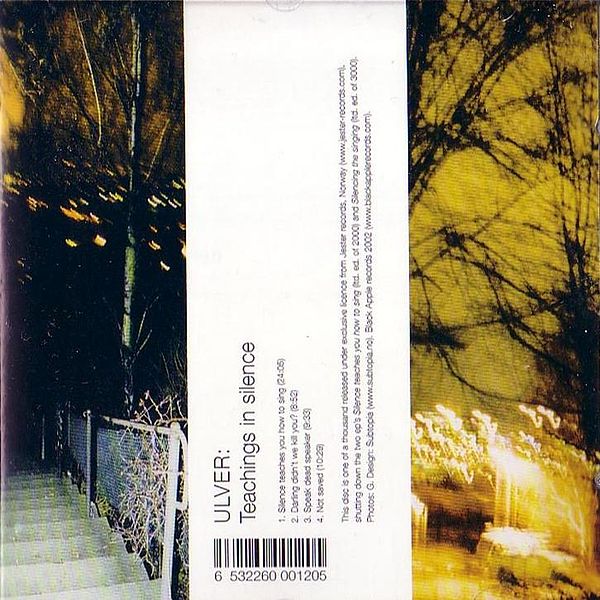
SOUNDTRACK: ULVER-Teachings In Silence (2002).

This EP is a collection of Ulver’s two previous limited edition EPs: Silence Teaches You How to Sing and Silencing the Singing.  It was originally released as a limited edition of 1000 copies, but has since been given wide release.  The two EPs that it replaced were officially retired (after print runs of 2000 and 3000 respectively).

“Silence Teaches You How to Sing” seems like perhaps Ulver has pulled a fast one.  The song starts with static…waves of static.  And you think, what, 24 minutes of THIS?  But after about four minutes, some quiet guitars layer through the static.  By 5 minutes a melody emerges, rather Twin Peaks theme-like.  Static resumes and then another wave of music bursts through and then, around 11 minutes, distant voices can be heard.  As the track nears the end you can hear a distant choir.  And by the end you’re listening so intently that you hear all kinds of things.

That was the only track on the first EP.  The second EP had three shorter tracks.  They are in a similar style to Silence, although there is more music.  “Darling Didn’t We Kill You” has a somber guitar melody and distant choral voices or a buzzing drone.

“Speak Dead Speaker” is more static (it’s easy to see why these two EPs were bundled together).  There’s more Twin Peaks style washes over the static.  I keep picturing the Pacific Northwest.  The last two minutes are a surprise cello version of the themes from the first 7 minutes.  It’s lovely and sorrowful.

The final track is a beautiful melody that repeats itself more and more quietly (with a wonderful loud funeral bell keeping time).  It repeats its cycle three times before ending.

Ulver continues to confound listeners.  Neither one of these EPs is really essential, but they are both interesting and really create a mood.

[READ: November 3, 2011] “Nilda”

This is the final uncollected story (according to Wikipedia anyhow) by Junot Díaz that I was able to access online.  There are two more stories “Invierno” (Glimmer Train 1998) and “Flaca” (Story, Autumn 1999) that I can’t seem to access online.  The rest of the listed short stories appear in Drown

This story is about longing and making the wrong choices.  Having read a bunch of Junot Díaz stories lately, this feels very much like a story he would write (I probably should have read Drown before I read these stories, but when I get to it, I’ll be able to confirm my suspicions).

In this story, Yunior, who is evidently the constant narrator in his earlier works (and in Oscar Wao) knows Nilda from school.  She was a friend of his–a kind of teasable friend–until puberty hit and her chest was to die for.  Unfortunately for Yunior, they were already friends, and she was off with other boys.

Indeed, Nilda was trouble more or less from the start–“brown trash,” he calls her.  Her mother was an alcoholic and Nilda was defiant.  She even spent time in a group home.  But she was nice and easy to talk to.  Dammit, why did she have to start dating Yunior’s brother Rafa? (more…)

Read Full Post »

SOUNDTRACKPEARL JAM-Austin City Limits (2009).

Pearl Jam records (and sells) most of their shows and they occasionally videotape them as well.  But they don’t do TV all that much (excepting the recent Late Late Show episodes).  There seemed to be something special, or at least different, about Pearl Jam on Austin City Limits.  Think of it almost like Unplugged Updated.

It opens slow with Eddie on an acoustic guitar and strings behind him.  In fact, the whole set seems less heavy than many of their sets.  But that’s not to say that the band doesn’t rock out, because they do.

The first six songs of the set come from Backspacer.   And then they bust out “Army Reserve” (which makes sense given who is in the audience, see below).  Then there’s a wonderfully raucous version of “Do the Evolution” (one of my favorite PJ songs).

After that riotous track, they bring the strings out for one more song.  It’s a rather funny little joke because it’s just the strings and Eddie on acoustic guitar playing “Lukin,” the 80-second song that is so fast you can barely hear the words.

For an extra treat, touring mate Ben Harper comes out to play slide guitar on “Red Mosquito” (which is always a treat).  And the set ends with an amazing version of “Porch” with a super long guitar solo in which Mike McCready really shows off his chops.  There’s even a moment where Mike and Stone are riffing off each other, classic rock style.
The set ends the Eddie talking about playing for the wounded veterans in the audience and how it was quite moving for him given all they have done for us.  Over the closing credits you see the band mingling with the veterans (including a guy who has lost a leg).  It’s all surprisingly touching for a rock show.

[READ: November 20, 2011] “Perchance to Dream”

A while back I read all of the Jonathan Franzen articles that were published in The New Yorker.  I thought I had read everything he’d published until I realized I had forgotten to read this piece (possibly his most famous) that was published in Harper’s.  It fits in well with this weekend’s theme because it was mentioned in Evan Hughes’ article that I talked about yesterday and because David Foster Wallace is mentioned in it.

As with most of Franzen’s non-fiction, it’s not easy to write about critically unless I want to argue with him, which I don’t necessarily want to do.  So instead, I’ll try to summarize.  Of course, this is a long and somewhat difficult article, so let’s see what we can do with it.

The first surreal thing is when you see the byline: “Jonathan Franzen is the author of two novels, The Twenty-Seventh City and Strong Motion, and is writing a third.”  It’s hard to imagine he got a huge article in Harper’s before he wrote The Corrections.

The second surreal thing comes in the text: It opens with “The country was preparing for war ecstatically, whipped on by William Safire (for whom Saddam Hussein was ‘this generation’s Hitler’) and George Bush, whose approval stood at 89 percent.”  And it is only a few paragraphs later when he mentions Patriot missiles that it clicked that this was written in 1996 and not 2001 and that he was talking about the 1991 Iraq invasion.  He mentions this as a prelude, saying that he was trying to sequester himself in order to start writing again.

Then he talks about Paula Fox’s novel Desperate Characters as a benchmark in terms of insight and personal conflict, even if it is so crazily outdated (that someone would throw an inkwell!).   He talks about this book quite a bit. I’m, not sure I found it compelling enough to want to read, but it’s always interesting to hear a fan write about a book I’ve never heard of.  He will return to this book throughout the essay. (more…)

Read Full Post »

SOUNDTRACK: ULVER-Perdition City: An Interior Soundtrack (2000).

Uver’s previous EP hinted at what would come next–electronic ambient tunes.  But it didn’t quite prepare anyone for this–a soundtrack to a film that doesn’t exist.  And yet with a title like Perdition City, you can pretty well anticipate the music that’s coming: think noir.

It is more electronica, and yet it is not just electronica.  The opening song “Lost in Moments” has a saxophone (!) solo.  And the song sounds like a perfect David Lynch/noir soundtrack to a dark and stormy night. 

What’s novel about the approach are the electronic noises and eccentric drum beats that punctuate the track.  The second track, “Porn Piece or The Scars of Cold Kisses” is broken into two parts: the first is a low, rumbling section with skittery noises and the second part has soulful singing (Garm, the only consistent member of Ulver (who goes by a different name on just about every record) has a surprising range of voices at his disposal).

“Hallways of Always,” “Tomorrow Never Knows” and “The Future Sound of Music” are sort of ambient tracks.  “Hallways” is quiet while “Future” grows in volume and chaos as the song proceeds.  “Tomorrow” is the most menacing of the three, projecting a state of noise and tension.  The interesting thing about these tracks is that although they seem like pretty conventional electronic instrumentals, they are actually fairly complicated in detail.  Some of the electronic pieces go on a bit too long, but as they are meant to be atmospheric rather than narrative, I guess that’s okay.

“We Are the Dead” bring in vocals again.  This time, it’s a spoken word narration over distorted radio voices.  And “Dead City Centers” also brings back some vocals.  Although only after about 4 minutes of noises and tension.  This time the vocals are more ominous (as the music grows more intense).

“Catalept” is the most interesting track on the disc–a remix of music from Psycho.  While the final song “Nowhere/Catastrophe” is an actual song–verses and vocals!  It’s a fairly soft song but it has moments of darkness that are quite cool. 

As a soundtrack this works wonders.  And if Ulver wanted to get into the soundtrack business, apparently their model of “making up your own soundtrack” worked.  Since this release they have recorded the soundtracks for two external films. 

As an overall release it’s a bit all over the place–jazzy sax, electronica, spoken word.  The mood is pretty consistent though, and although I don’t think I would do what the liner notes recommend: “This is music for the stations before and after sleep.  Headphones and darkness recommended,” I still enjoyed it.

[READ:  November 5, 2011] “Alma”

This is a very short story that falls pretty squarely into standard Junot Díaz territory (he says, having read like four pieces by him). 

I’m fascinated by these stories because Díaz is all about women being super hot and yet they are never objectified.  Well, in some ways they are of course–he lingers over their bodies as he describes them, but they are never just a body.  They are often smart or interesting, they are strong and powerful, and even when they are victimized (some by cheating boyfriends, others by far worse), they either fight back or get themselves to safety.  It’s nice to read about powerful women,even if the point of view is from her boyfriend.

This is the story of a young man falling hard for a hot woman (with a beautiful ass).  What fascinates me about Junot Díaz’s stories is that the women that his narrators fall for are Dominican, but they are also alternative to their culture.  So in this case, Alma is a “Sonic Youth, comic-book-reading alternatina” which makes me like her already. (more…)

Read Full Post »

« Newer Posts - Older Posts »