Feeds:
Posts
Comments

Archive for the ‘New Yorker’ Category

SOUNDTRACK: TRENCHMOUTH-Inside the Future (1993).

This album came before the other Trenchmouth CD I reviewed.  And it’s safe to say that all of the ideas were still in place for this CD as well. 

What I love about Trenchmouth is that all 4 members seem to be playing different songs and yet they all work so well together.  True, it sounds chaotic and at times unpleasant (such is the nature of punk) and yet when you listen a few times you hear how it all works.

“Telescopic” opens with a crazy punk bass line, the guitars are just screams of noise and the drums are rhythmic yet chaotic (that’s Fred Armisen on drums and he is a wild man).  Then lay over the top the disaffected vocals (which are in a different ke)y and you get one hell of  a punk song.  The feedback squalls at the end let you know that they have no intention of being on the radio.

“Power to the Amplifier” condenses all of that noise into 2 minutes of fury. 

“The Dawning of a New Sound System” starts with some crazy guitar chords (showing you just how weird the guitars are) but this song has a pretty catchy chorus (with backing vocal shouts of “Hail Hail”).  “Yes, This is the Place” offers slightly less abrasive guitars and a very smooth middle section.

“Capsule” actually opens with a sound similar to Prodigy’s “Smack My Bitch Up” and it has a different vocalist (although I don’t know who).    The percussion on “Confectionery” is amazing, while “In the Event of a Struggle” is another 2 minute cycle of styles.  “The Future Vs. Centrifugal Force” sounds the most like that mid 80s SST style that I like so much–kind of a jam feel, but short and punky.

“Sea of Serenity” is listed as “Swing Version”, although I don’t know if there’s another version.  This one has intense guitars (don’t they all) and frantic drumming.   It also has a wonderful third part with a great off-kilter guitar riff.   The final proper song is “Hit Men Will Suffocate the City” and it is more of the same noisy wonderment.  It ends with a great bass line.

The final track is “Now I Have Tasted Life” and it is absolute filler.  A weird addition, it’s 7 minutes of slow melodica noodling and occasional reggae sounding guitars with random percussion  There’s also some feedback squalls.  It sounds like one of their real songs stretched out and slowed down.  It would be okay if it weren’t so long.  But it’s hard to blame anyone for experimentation when the rest of their experimentation is so good.

It’s obvious why Trenchmouth weren’t popular (although you can hear proto-Primus all over this record–I wonder if Les and Ler knew Trenchmouth at all?), but it’s a shame their music is so hard to find.

[READ: November 30, 2011] “The Musical Brain”

I have been meaning to read César Aira for a little while now.  He’s on my list of new authors to check out.  So I was pretty delighted to see this story (translated by Chris Andrews) in the New Yorker.

There are so many wonderful and unexpected aspects to this story that I was constantly kept on my toes.  This also made it somewhat challenging to write about.

The story appears to be autobiographical (we learn late in the story that the narrator is named César), about an incident that happened when he was 4 or 5.   It is set in the Argentinian city of Coronel Pringles and it talks a lot about his family and the town that he lived in.

I loved the strange little details he threw in about his family.  Like his mother’s “invincible suspicion of any food she hadn’t prepared herself” or the provenance and outrageousness of his father’s wallet.

 As the story opens, César remembers a night when the family went out to dinner.  And on that occasion, he recalls the high school headmistress Sarita Subercaseaux holding forth in the corner of the restaurant while people brought her boxes of books.  He concludes (in the present, but had no idea at the time) that they are donations for the new library that is to be built (and of which Subercaseaux will be the head librarian).

He remembers Subercaseaux very fondly both from the library and from school, and when he asks his mother about her, we get the first of many erasures of the past.  His mother informs him that Subercaseaux died long before he was born.  Which of course he knows is impossible.  But his mother’s memory is better than his! (more…)

Read Full Post »

SOUNDTRACKART OF TIME ENSEMBLE WITH STEVEN PAGE-A Singer Must Die (2009).

According to their website, “Art of Time Ensemble is one of Canada’s most innovative and artistically accomplished music ensembles. Their mandate is to give classical music the contemporary relevance and context it needs to maintain a broader audience to survive.”

So what you get is a modern orchestra playing contemporary music.  It’s not a unique idea, but in this case, it works very effectively.  And what you also get is Steven Page, former singer of the Barenaked Ladies as the vocalist.  Page has an awesome voice.  I’ve often said I could listen to him sing anything.  And here’s a good example of him singing anything.

The great thing is that the song choices are unusual and wonderful–not immediate pop hits or classic standards–it’s a cool menagerie of songs with great lyrics and equally great compositions.  This is no heavy metal with strings, this is majestic songs with orchestral scoring.  The orchestra includes: piano, sax/clarinet, cello, violin, guitar and bass.

And the song choices are fascinating.  And with Page’s amazing theatrical voice, the songs sound quite different, mostly because the original singers don’t have powerful voices.  They all have interesting and distinctive voices, but not operatic ones.  So this brings a new aspect to these songs (I knew about half of them before hand).

THE MOUNTAIN GOATS-Lion’s Teeth.
This is a very dramatic reading of this dramatic song.  It pushes the boundaries of the original song.

ELVIS COSTELLO-I Want You.
I had never heard this Costello song.  With Costello you never know what the original will sound like–punk pop, orchestral, honky tonk?  It’s a fascinating song, though and Page hits some really striking and I would say uncomfortable notes.

RUFUS WAINWRIGHT-Foolish Love
I don’t know Rufus’ work very well, although I immediately recognized this as one of his songs.  Page plays with Wainwright’s wonderful theatrics and makes this song his own.

BARENAKED LADIES-Running Out of Ink
Covering one of his own songs, this is fascinating change.  The original is a fast, almost punky song, and it seems very upbeat.  This string version brings out the angst that the lyrics really talk about (Page is definitely a drama queen).

LEONARD COHEN-A Singer Must Die
This is one of the great self-pitying songs and the lyrics are tremendous.  Page takes Cohen’s usual gruff delivery and fills it with theater. It’s a great version.

JANE SIBERRY-The Taxi Ride
Coming from her early album The Speckless Sky, this is a wonderfully angsty song with the premise that is summarized: “it’s a long, long, lonely ride to find the perfect lover for your lover.”  Page hits one of the highest notes I’ve heard from him here.  Very dramatic.

THE DIVINE COMEDY-Tonight We Fly
This is one of my favorite Divine Comedy songs.  Of course it is already string filled, so this version isn’t very different.  But its wonderful to hear it in another context.

THE WEAKERTHANS-Virtute the Cat Explains Her Departure
I love this song.  This is a guitar filled pop punk song, so the strings add a new edge to it.

THE MAGNETIC FIELDS-For We Are the King of the Boudoir
I know the Magnetic Fields but not this song.  It’s quite clever and funny (as the Fields tend to be) and Page makes some very dramatic moments.

RADIOHEAD-Paranoid Android
I recently reviewed a covers album of OK Computer, wondering how someone could cover the record.  The same applies to this song.  A string orchestra is a good choice for it, as there is so much swirling and crescendo.  And while nothing could compare to the original (and they don’t try to duplicate it), this is an interetsing choice.  As is Page’s voice.  He has a much better voice than Thom Yorke, but that actually hinders the song somewhat when he gets a little too operatic in parts.  Nevertheless, it is an interetsing and enjoyable cover.

The whole record is full of over the top drama.   It’s perfectly suited for Page and it’s a side of him that has peeked out on various releases but which he really gets to show off here.  As an album, the compositions all work very well–they are, after all, trying to make classical pieces out of them–not just covering them.  And the choices of songs are really inspired.  Dramatic and interesting and when the music slows down, the lyrics lend to a wonderfully over the top performance.

If you like Page or orchestral rock, this is worth tracking down.

[READ: November 28, 2011] “Leaving Maverly”

For some reason I was under the impression that Alice Munro was no longer writing.  I’m glad that’s not true, and really, what else would she do with herself–she has so many more stories to tell.

I think of Munro’s stories as being straightforward, but this one was slightly convoluted and actually had two things going on at once.  It opens by discussing the old town of Maverly.  Like many towns it once had a movie theatre.  The protectionist and owner was a grumpy man who didn’t deal well with the public, and that’s why he hired a young girl to take the tickets and be the face of the theatre.  When she got in the family way, he was annoyed, but immediately set out to hire someone else.  Which he did.  The new girl, Leah, came from a very religious family.  She was permitted to work there under the stipulation that she never see or hear a movie or even know anything about them.  And that she get a ride home.  The owner balked at this second idea–he surely wasn’t going to drive her home.  So instead, he asked the local policeman Ray, to walk her home.  Which he agreed to do.

The next section of the story looks at Ray.  And although the story is ostensibly about Leah, we get a lot more history of Ray.   He was a night policeman only because his wife, Isabel, needed help at home during the day.  We learn about the scandalous way he met his wife and how they managed through the years until she became ill.

Ray talks with Leah on their walks home, something he found terribly awkward because of how cloistered she was.  Then he would get home and talk with Isabel about Leah. This young girl who meant nothing to him was suddenly a significant part of his life.

And then one day the theater owner came to report that Leah was missing.  They went to see her father at the mill, but she wasn’t there.  And there was really no other place where Leah went, so they were at a loss.  It was winter and they feared the worst. (more…)

Read Full Post »

SOUNDTRACK: ULVER-Metamorphosis EP (1999).

After Ulver’s first CD, they jumped around in genres (their second was a kind of folk CD and their third CD was more black metal–I have not heard either one).  Their 4th CD was the William Blake CD of crazed experimental music.  And then they released this EP.  And I can’t think of too many bands who keep their fans guessing as much as these guys do.  This EP is full on electronica.  Dark electronica, yes, but still, it’s all electronic.

There are four songs.  The first one, “Of Wolves and Vibrancy” is like  rocking dance song from the 90s (like The Prodigy).  The drums are quite intense.  While the second song, “Gnosis” is a slower, more ambient track. There are still loud drums, but the pace is slower and less manic. At around the 6 minutes mark vocals come in.  They sound like some of Metallica’s chanting voices on later albums.

Track three, “Limbo Central (Theme from Perdition City)” is less than 4 minutes long.  It’ s another dark electronic soundtrack with more great drums. 

The final song, “Of Wolves and Withdrawal” is almost 9 minutes of very quiet noises that grow louder in pulses. It seems to be three sections of different pulsing sounds.  The first time I listened to it, the opening was so quiet that I thought it was just all silence so I fast forwarded through the whole thing.  But because the pulses are so mechanically timed it didn’t even register as noises while as fast forwarded.  I finally had to turn it up pretty loud before I heard all of it. 

I was tempted to say that going from that first Ulver album to this one is a massive change.  But it seems that every Ulver record is a whiplash of stylistic changes.  Nevertheless, this is about as far from black metal as you can get and still be dark and scary.

[READ: November 4, 2011] “The Sun, The Moon, The Stars”

This is one of Díaz’s short stories that does not appear in Drown (it came out about two years after Drown).  It has been frequently anthologized, however, which makes it a pretty important story.

There’s a reason why I like to read author’s works in chronological order, and reading this story now confirms that for me.  The story, written in 1998, is the fictionalization of the essay, “Homecoming with Turtle” that I reviewed a few weeks ago (the one that I said pertained to Oscar Wao because of the turtle).  Well, there’s no turtle in this story, and there’s no dentists, but the rest of the story is pretty much the same as his nonfiction account.

After saying all of that though, what’s fun about reading this out of order is that since I know what the “truth” is about this situation, it’s fun to see what he has massaged into fiction.

So in this story, Yunior has been dating Magdalena for some time.  Magda is a good girl: wouldn’t sleep with him until they had been dating awhile, took him to church, introduced him to her parents, the whole bit.  And he really loves her.  The problem is that they only see each other once a week.

So, when a hot girl starts working at his office and she tells him that her man doesn’t treat her well and Yunior confides that the sex with Magda isn’t very good, well, things happen.  But they didn’t happen very often or for very long and Yunior tried to forget it.  Until the girl sent Magda a letter.  A very detailed letter. (more…)

Read Full Post »

SOUNDTRACK: GRINDERMAN-Grinderman 2 (2010).

The first Grinderman album was a sleazy delight.  And this Grinderman is much of the same sleazy heavy rock, although it’s slightly different.  It opens with “Mickey Mouse and the Goodbye Man” which lets you know that Grinderman are still dirty and sleazy.  The song just rocks.  Screaming blistering rock.

Now, fans of old Nick Cave and The Birthday Party know that Nick is no stranger to noise and dissonance.  Some of these songs harken back to those days–the music (on”Worm Tamer” is crazy–feedback squalls and trippy organ) and yet they never veer into chaos.  They are tightly controlled but with wonderfully loose edges.   It also features the wonderful lyrics: “My baby calls me the Loch Ness Monster–two big humps and then I’m gone”).  “Heathen Child” is a loud, raucous, blasphemous treat, one of the best on the disc.

“When My Baby Comes” slows things down a bit and actually veers terribly close to Bad Seeds territory (which isn’t a bad thing by any means, but Grinderman is supposed to be an escape from that, right?).  The song loudens up, though and a really cool slippery bass propels it for the rest of its 7 minute length.  “What I Know” is like a slow prose poem, but it is followed up by the blast that is “Evil!” a wonderfully brash 3-minute blast of noise rock.  The chanting backing vocals are wonderfully evil.  “Kitchenette” ups the sleaze factor nicely.

“Palaces of Montezuma” is another mellow song–also very Bad Seeds like.  It seems like it would be long (like it would keep building), but it’s only 3:30.   “Bellringer Blues” ends the disc with some cool backwards guitar and more chanted vocals (definitely the signature sound of Grinderman).  It ends this awesome disc on a very high note.

[READ: November 18, 2011] “The Climber Room”

I really enjoyed Lipsyte’s The Ask, so I ‘m delighted to see him with a new short story.   This one concerns a young (but no longer that young) woman named Tovah.  She has taken a job at a daycare center called Sweet Apple.  As the story opens, Tovah meets the other main character of the story, a man whose name she (hilariously) mishears as Randy Goat.  It turns out that Randy Gauthier is a rich man whose children have all gone to Sweet Apple and his new girl Dezzy is now enrolling.

Tovah isn’t trained for this job–she’s just there part time–and either despite or because of this, Dezzy takes to her immediately.  On a day that Tovah is not there and Dezzy fell off the Climbing Room (a jungle gym) she cried and cried for Tovah.   Mr Gauthier spies Tovah the next day and informs her that he has switched her schedule so that she will only be there when Dezzy is there.  Tovah is (understandably) freaked and a little pissed.  But when he tells her to Google him, she learns why he can have such sway over things.  (more…)

Read Full Post »

SOUNDTRACK: DAVE BIDINI-“The List” (2007).

This song appears as a bonus track on the Bidiniband album.  But I’ve been aware of it since 2007 when he played it on his solo tours.  It is essentially a list of 4 Canadians who are “killing us, killing us now.”  The list includes Tim Horton’s (purveyor of delicious donuts), Chad Krueger (from Nickelback), Zack Werner (a judge on Canadian Idol), and Stephen Harper (I shouldn’t have to tell you).

But the key to the song is the chorus: “where are the angry young ones….”  This song should become the unofficial song from Occupy Wall Street.  It would be very easy to modify.  Hey Dave, if you’re free you should head on down and serenade these angry young ones.

Here’s a great live version done in a record store in which he is close enough to have a casual chat about the very song he is singing in the middle of the song.

He also ends it a little differently than the original.  It’s catchy and easily adaptable.  Good on ya, Dave.

[READ: November 19, 2011] “Who Wrote Shakespeare?”

No one has traded off of his Monty Python fame as much as Eric Idle.  All of the other Pythons have moved on in one direction or another, but Eric keeps the torch alive (see Eric Idle Sings Monty Python and Spamalot).  He even has a little nod to MP in this essay with the asterisk next to his name which leads to (*Most likely Michael Palin, really).  This refusal to let go of Python has at least kept his wit sharp, as we see in this Shouts & Murmurs.

My main problem (as I’ve said before) with the Shouts & Murmurs is that they are usually too long.  But, as Python knew, keep it short and funny and you’ll succeed.  So this two-column piece never really flags in its simple premise.

Which is that everyone knows that Ben Jonson really wrote all of Shakespeare.  Idle presents a list of all of the famous books that were really written by someone else.  For example, “Simone de Beauvoir wrote all of Balzac and a good deal of ‘Les Misérables,’ despite the fact that she was not born yet when she did so.”   And my favorite: “‘Moby Dick’ was written not by Herman Melville but by Hermann Melbrooks, who wrote most of it in Yiddish on the boat from Coney island.”  The joke about Henry James is very funny and too good to spoil. (more…)

Read Full Post »

SOUNDTRACK: WILD FLAG-World Cafe, November 10, 2011 (2011).

I’ve been really enjoying Wild Flag’s debut album.  Wild Flag consists of Carrie Brownstein and Janet Weiss of Sleater-Kinney, Rebecca Cole, who I don’t know but who has been in a few different indie bands, and Mary Timony from Helium.

This World Cafe episode is a brief interview (mostly with Carrie, although all four women are present), in which they talk about the origins of the band and what it’s like to play as a foursome. 

There are three songs and the band sounds tight and perfect.  In fact they sound so perfect I almost wondered if they were really playing live (but there’s one keyboard flub that proves that humans are involved).

It’s a great sample of the record, which is all great, and it’s a good chance to get caught up with these rocking women. 

[READ: November 15, 2011] “The First Venom”

This is an excerpt from Marcus’ forthcoming novel, The Flame Alphabet.   I’ve read a number of Marcus’ things in the past and I realized that most of his McSweeney’s pieces I do not like.  Some of the short stories in the New Yorker I have enjoyed, although usually not right away.  So, clearly Marcus and I don’t see eye to eye on fiction.

And that’s the case with this excerpt.  It’s hard for me to say I wouldn’t read a longer piece based just on an excerpt because who knows what else the rest of the book contains (this could be a small fraction of a much different story), but this excerpt absolutely didn’t make me want to read any more.

In the excerpt, a married couple is sickened by their daughter.  Literally.  All of the words that she says and whispers and scribbles wash a sickness over her parents.  They cringe and try to get away but she keeps talking and talking.

At first this seemed like a metaphorical sickness–who hasn’t grown tired of their kid’s incessant chatter, but it soon becomes clear that this is very real. (more…)

Read Full Post »

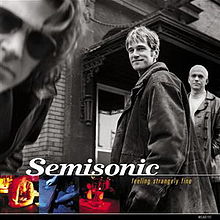
SOUNDTRACK: SEMISONIC-Feeling Strangely Fine (1998).

In my mind, Feeling Strangely Fine is the pinnacle of Semisonic’s pop greatness.  I mean, it’s got “Closing Time” on it.  And while I am now pretty tired of the song (can it really be 13 years old?), when it came out it was pretty awesome.  And so I tend to think of The Great Divide as being in the shadow of this record.  But in retrospect, I think I have to favor Divide over Fine.  This album has a bit too much polish, a bit too much smoothness for my liking.  And while there are some great songs on it, I’m not entirely sure it matches up to The Great Divide.

“Singing in My Sleep” is a supremely catchy song–a simple riff, mellow verses and an urgent chorus.  It should have been huge too.   And “Never You Mind” has that Semisonic quality in spades–simple accents that make a song catchy (a little guitar riff) and really catchy choruses.  Plus lyrically, it’s rather clever.  “Secret Smile” is one of their few ballads that I really like.  I guess they have just mastered pop hooks for this record.

But to me the rest of the record pales a bit compared  to The Great Divide.  “DND” is a similar slow song although it’s a bit slinkier.  And there’s some very mild funk on “Completely Pleased” which is a welcome return to the rockier songs but which doesn’t quite reach the heights that they have hit before.

“California” is a fun track.  It could use a bit of oomph but it shows off some fun noises at the end.  And the last two tracks just kind of fade the disc out.

Nothing on the album is really bad.  And indeed, in the right frame of mind these songs are all really enjoyable, but i think after comparing them to some of the earlier tracks and even the earlier tracks on this record overall this one comes up a bit short.

[READ: November 6, 2011] “Exorcism”

This is a Eugene O’Neill play that was believed to be lost forever.  He staged the play in 1920 but after a brief run, he destroyed every copy, possibly to assuage his dying father.  But this copy was recently found amongst a friend’s papers.

So that’s pretty exciting that a new Eugene O’Neill one-act play is now available.  I believe the whole thing is printed here–it’s so hard to tell with the New Yorker.  But they also say that Yale University Press will be publishing the play in the spring.  If the whole thing fits onto 7 New Yorker pages, how are  they going to publish it as a book?  Well, that’s Yale’s problem.

I don’t know that I have read many, if any, O’Neill plays.  I’ve never really taken any drama classes, although I know about O’Neill’s mastery of drama.

So this is probably as good a place to start as any.

This is the classic “nothing happens” kind of story which proves to be a powerfully emotional story (especially as it resonates so closely to his own life). (more…)

Read Full Post »

SOUNDTRACK: SEMISONIC-Pleasure EP (1995).

The Pleasure EP is an even more alterna version of what we’d get on The Great Divide.  Divide duplicates some songs from this earlier EP, and you can see them all polished up on the full length.

“The Prize” which has a great squeaky solo on Divide is even more raw and noisy here.  And “Brand New Baby” which was dumped near the end of Divide shines here in its more raw version (again, not really raw, just a little raw).

“In the Veins” has some fuzzy guitars (which show the band’s origins) and a bit of a punk feel.  And “Wishing Well” is more or less a typical ballad except instead of piano or acoustic guitar the music is a distorted electric guitar.  It mixes things up a bit, and while it doesn’t really have the hooks that Semisonic would later develop, it’s got a wicked guitar solo.

“Star” is a nice ballad, but “Sculpture Garden” is a good rocker to (sort of) end the album.

I say sort of because the band included seven 20-second ditties at the end of the disc, which they call “Shuffle Stuff.”  So when you put the disc on shuffle, you’ll get all kinds of funny little bits.  It’s nothing special, but it’s fun.  Kind of like this EP.

[READ: November 9, 2011] “Miracle Polish”

I’ve enjoyed Millhauser’s stories in the past, and I enjoyed this one very much as well.  It was a little obvious (I mean with this set up only one thing can happen) right from the get go but I thought he did a good job in changing my expectations and pointing the story in a slightly different direction.  And even though it was a little predictable, it was still enjoyable.

There was something wonderfully old-fashioned about the story.  It opens with a man walking door-to-door selling bottles out of his satchel.  The narrator feels sorry for him and, although he immediately regrets inviting him in, he decides to buy whatever he is selling and be done with it.  The salesman, painfully slow and meticulous, talks about his “miracle polish” which you just wipe on a mirror and…  The narrator says he’ll take one. 

The salesman is a bit shocked by the brusqueness and tries to get him to buy more than one, but the narrator basically tells him not to push his luck. 

He takes the medicine bottle of Miracle Polish and puts it away, more or less forgetting about it.  A few days later, however, while checking himself in the mirror, he notices a smudge in the corner of the glass.  He grabs the polish and rubs it on the mirror.  The smudged area now looks super clear, so he rubs it on the whole mirror.  And he is blown away. (more…)

Read Full Post »

SOUNDTRACK: SEMISONIC-The Great Divide (1996).

Before Semisonic took over the world (and irritated everyone) with “Closing Time,” they were a band that formed out of the ashes of Trip Shakespeare.  Dan Wilson created Semisonic evidently because he wanted to be more poppy (which he perfected in “Closing Time,” obviously).

This album came out two years before “Closing Time” and it is a wonderful collection of alternapop.  There’s nothing terribly aggressive or weird in this collection, but neither is there anything so commercial that you want to scream.

The highlight for me is “Down in Flames.”  It goes in a few unexpected directions (especially with that screechy solo).  It’s a little dark, but it’s really catchy without ever pandering to Top 40 sensibilities.  It’s a really great song.

Some other highlights are the first three songs on the disc: “F.N.T.” is a poppy delight, “If I Run” has some great hooks and “Delicious” is a slinky sexy song with some unexpected moments.

Even a song like “Across the Great Divide” which isn’t the best on the disc has some nice surprises-when the vocals suddenly go falsetto.

There’s a couple of clunkers in the middle.  “Temptation” is a little too pop ballady for my liking and “No One Else” is a little bland.  I think their more uptempo songs are their strongest.

But “The Prize” is a satisfying pop rocker.  And “Brand New Baby” has some surprising pop vocals and a wonderful third part that is worth getting to the end of the album for.  While “Falling” is a surprisingly dark but catchy number (a Semisonic trait it seems).

The end of the album is rather unremarkable, but it’s still a solid collection of songs with nothing overplayable.  Sometimes one hit wonders are unfairly labelled as such.

[READ: November 8, 2011] “Sun City”

This was a fascinating story because it went in directions that I never anticipated.

I found the opening a little confusing as there were several women mentioned and no real relationship is given among them.  But it turns out that Vera and Bev are “roommates” and Rose is Vera’s granddaughter.  Vera just died (unexpectedly at 87) and Rose has travelled out to Arizona to go through her things.  Rose’s mom (Vera’s daughter) had a falling out with Vera years ago and won’t be going to the house.

Vera loved Rose but was somewhat disappointed in her–she was single and a bartender.  But Vera was not disappointed that Rose is a lesbian.  And Vera’s acceptance of that led Rose to believe that Vera and Bev were more than “roommates” as well. (more…)

Read Full Post »

SOUNDTRACK: ARCADE FIRE-“We Used to Wait” (Saturday Night Live, November 13, 2010) (2010).

I know they played two songs that night but I just watched the rerun and they only showed one song.

I’ve always thought that Arcade Fire were pretty cool live.  And this set from SNL proves me right.  “We Used to Wait” comes from The Suburbs and it’s a pretty mild song on the record.  But live, the band plays with really weird sounds and explores different types of cacophony.

This is especially true from guitarist Richard Reed Perry (who plays all kinds of other instruments too).   He plays some of the more riff-based notes in the song, but he also plays some really loud, unusual chords as well.  Some of them are quite dissonant and they really bring a dramatic noise to the song.

The string section (three violins on this show) in addition to playing the strings also added some really cool dissonance.  In fact, the first time the strings came in, the sound was quite surprising.

I also love the percussive nature of the band.  By the end of the song it seems like half the band are banging on drums (while playing other things as well, no doubt). 

Win Butler is an intimidating frontman–I find his face to be open, almost blank.  He’s kind of hard to read.  He’s also very tall.  When he walks out into the audience in the middle of the song, it’s a little unnerving. 

One thing that I have liked about Arcade Fire from the beginning was their intensity, and this song certainly displays it.

[READ: November 7, 2011] “The Stain”

This is another Tessa Hadley story about a woman who cleans up.  It’s nothing at all like “Friendly Fire,” but I still think it’s interesting that she has another character who opts to do cleaning work.

In this one, Marina is a mother of a young boy, Liam.  To makes extra money she takes on a job as a house cleaner and “companion” to an elderly man.  He’s 89 and from South Africa.  He has recently come to Britain after his daughter (who has lived here for a long time) moved him here.  And the house where he lives is a house not far from where Marina lives.  Indeed, it’s one that she grew up looking at and wondering what it looked like inside (it’s a very big house).

The old man is notorious for making cleaning women go away–he is cantankerous and crotchety.  But Marina soothes him right away and they form a kind of bond.  Marina even brings Liam over a few times and he gets along quite well with the old man. (more…)

Read Full Post »

« Newer Posts - Older Posts »