Feeds:
Posts
Comments

Archive for the ‘Language’ Category

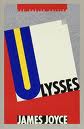
[LISTENED TO: Week of September 6] Ulysses

This week I almost finished Episode 15.  I’ve just finished where Bella turns into Bello and things get really weird.  And I have to say that this Episode, for all of its craziness, is masterfully handled by Donal Donnelly.  I’ve already raved about his vocal stylings in the earlier chapters, dealing with so many different men.  But in this chapter he proves to be very dextrous at male and female voices, with a very delicate voice for some and an incredibly masculine woman’s voice for Bello (very well done indeed).  He has also proven himself to be a treat with sound effects (of which there are many here).  I won’t say for certain that it makes this insane Episode a lot clearer, but it certainly makes it easier to follow.

Back to Episode 13. The Gertie section is written in a style that is supposed to be romantic, very quick and flowy.  And Donal really nails it.   After the business of Episode 12, the lightness of 13 is wonderful, and it really brings to life the scene, especially when the rockets go off.

One thing I picked up this time is that Bloom assumes that he knows exactly when Blazes and Molly consummated their affair.  Even re-reading it now, it wasn’t quite as clear as the way he read it aloud:

Funny my watch stopped at half past four. Dust. Shark liver oil they use to clean could do it myself. Save. Was that just when he, she?
O, he did. Into her. She did. Done.
Ah!

So, yes I suppose it’s obvious, but sometimes reading along you just don’t pick things up.  And it took the way he read it for me to realize just what those short sentences meant. (more…)

Read Full Post »

[LISTENED TO: Week of August 30, 2010] Ulysses

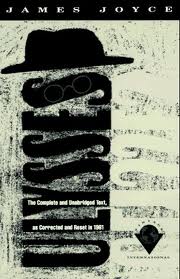
While I was reading Ulysses for the group read at Infinite Zombies, I thought it would be (more) enjoyable to listen to the book.  So much of the book is, if not musical, at least euphonious [since I’m talking Ulysses, I’m throwing in big words, eh?].

Nevertheless, when you receive the Ulysses box from another library and you see that it is FORTY discs, and the running time is over 40 hours, it’s a bit daunting.   When you start reading a book you have a vague sense of how long it will take you, but you never see it written so starkly: 40 hours.  Jaysus wept.

I’m almost 20 hours into the book now, so I’m going to mention things up to Episode 12. (more…)

Read Full Post »

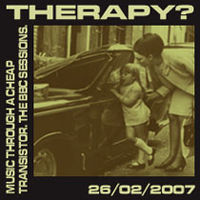
SOUNDTRACK: THERAPY?: Music Through a Cheap Transistor: The BBC Sessions (2007).

I enjoy the title of this disc quite a bit.  Fortunately, I also enjoy the music quite a bit.  This is a collection of BBC recordings from Therapy?

It’s a strange collection in that they recorded songs on five separate occasions and yet there is a lot of duplication of tracks (the liner notes deal with this issue).

John Peel Sessions (and there’s much made in the liner notes about the fact that they thought they’d be meeting Peel himself when they went in, when in fact it was just a random engineer) are essentially live recordings done in the studio.  They tend to be slightly more experimental (done after a band has toured and messed around with the songs some) and for some bands (like Therapy?) they tend to be more raucous.

This collection was recorded from 1991-1995 with a final show in 1998.  Obviously the band isn’t thinking about the future CD release of the sessions when they recorded these sessions, so it probably didn’t seem strange to record “Totally Random Man” 3 times.  But it does seem strange to listen to it like that.

The songs are definitely rawer than the studio versions.  Even their more poppy tracks from 1998 are a bit harsher.  However, their first EPs were really raw, so these songs sound much better (much cleaner).  They also include a lot of fun/weird unreleased tracks and covers.

My only complaint is that neither version of  “Teethgrinder” features that awesome drum sound that is my favorite part of the track.  Otherwise, it’s a great collection.

[READ: June 1, 2010] Lost in the Funhouse

I checked out this book so I could read the title story.  I enjoyed that one quite a bit so I decided to read the whole collection.  The Author’s Note says, “while some of these pieces were composed expressly for print, others were not. For instance: “‘Glossolalia” will make no sense unless heard in live or recorded voices, male and female, or read as if so heard.”  Um, yeah.

The first story: “Frame-Tale” consists entirely of this: “Cut on dotted line, twist end once and fasten AB to ab, CD to cd.” The cut part is a strip of paper that reads: “Once Upon a Time There/Was a Story That Began.”  It’s cute.

The next story, “Night-Sea Journey” is a proper story of a night sea journey. The secret to the story is gradually revealed, and is rather amusing. (more…)

Read Full Post »

SOUNDTRACK: THE YOUNG DUBLINERS-Rocky Road ep (1994).

The Young Dubliners are not really a trad Irish band.  They play a sort of folk rock in the vein of The Waterboys (anthemic rock that soars and soars).

I believe I bought this on the basis of their awesome cover of “Rocky Road to Dublin” which is somewhat traditional in the beginning but which bursts into a rollicking, punky good time.

The rest of the tracks are okay.  None of them are all that memorable, but neither are they terrible.  Although I’m just reading that “Last House on the Street” was a radio hit.  They’ve toured with Collective Soul, which should tell you a lot about their sound.

They’ve released a number of albums since this ep, including one in 2009, but I pretty much still only like “Rocky Road to Dublin.”  I’ll bet they are fun live, though.

[READ: Week of August 9, 2010] Ulysses: Episodes 13-14

Only two episodes this week, but man, that second one killed me.  Pages and pages unbroken by paragraphs.  Paragraphs and paragraphs about heaven knows what.  Holy cow! Sure and begorrah!

Episode 13, however, was a treat.  It was sweet and tender and beautiful and vivacious and lascivious and sexy and dirty and and and ahhhhh. (more…)

Read Full Post »

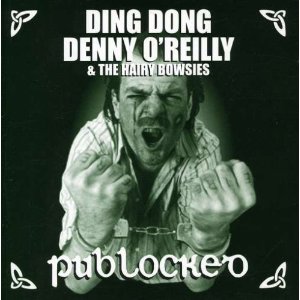
SOUNDTRACK: DING DONG DENNY O’REILLY & THE HAIRY BOWSIES-publocked (1996).

My friend Lar introduced me to this ol’fella (he may have even sent me this CD, as I can’t imagine where I’d have found it on my own).

Ding Dong Denny is the alter ego of Paul Woodfull (who created the Joshua Trio a U2 tribute/pisspull).  And, as I know precious little else about the man, I’ll let the more enlightened pass along the details.

Publocked is a lowbrow amalgam of all kinds of Oirish nonsense.  It’s vulgar and crass and often quite funny.  (Some of the bits stand up to repeated listening–the songs more than the chatty bits, although the chatty bits are especially funny).

Take “The Ballad of Jayus Christ” which sounds like a pretty standard simple ballad until you realize what he’s singing:  “Jaysus O Jaysus As cool as bleeding ice…It’s funny you never rode, coz its you I do my shouting for each time I shoot me load.”

But it’s not all blasphemy.  The “single” “Flow River Flow” is a very sensitive track about the benefits and majesty of the sacred waters (with tin whistles and everything): “When I was just a young man, I sit on the river bank  I loved your gentle water so much I’d have a wank”  With the glorious swelling chorus: “Flow river flow, fuck off to the sea, go where you are wanted, to the deserts of Gobi”

True, now, that’s all kind of crass.  But Ding Dong takes a political stance, too. Take “Spit at the Brits.”  “We Spit at the Brits an we showered’em in a lovely shade of green…we spit at the brits, and then they blew us all to smithereens.”

And what Irishman could ignore the Famine.   “The Potatoes Aren’t Looking the Best” is a view of the famine through the eyes of a farmer.  Shite.

Not everything is a winner, “I Get A Round” is a “cover” of “I Get Around.”   The lyrics are changed to reflect being in a pub (get it?).  And “My Heart Gets So Full (You’d Swear I Had Tits)” is pretty funny, especially since it’s played as an oh so serious ballad, but there’s not much in the world that’s funny for 7 minutes.

So, yes, it’s not quite Joyce, but then Joyce does talk about masturbating by the water, so it’s all equal, right?

[READ: Week of July 26, 2010] Ulysses: Episodes 7-9

Before I begin, I want to make sure that everyone has checked out Ulysses Seen.  It’s an illustrated rendition of the book.  The details are exquisite and you’ll no doubt pick up things that weren’t as apparent in the proper text.  The only bad thing I can say about it is that it’s not finished yet.  So far Robert Perry has only completed Episode One, and it sure looks like that took a long time (it’s really stunning); but between the details ion the drawing and the extensive reader’s guide that comes with it, one can perch there for quite a while.

I admit that this week’s slog through Ulysses was rather unpleasant for me.  The three episodes included here were massive doses of stream of consciousness.  I actually found them exhausting to read.  Not to mention, in terms of plot advancement, they’re rather paltry. (more…)

Read Full Post »

SOUNDTRACK: THE POGUES-If I Should Fall From Grace with God (1988).
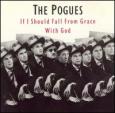
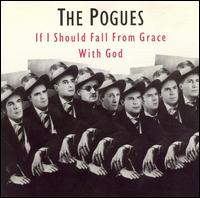
So the cover of this album has James Joyce on it (and a hilarious pastiche of the rest of the band).  I guess we know what we’re in for, then.  This is the Pogues third album and the one that tamed the wildness of their first shambling discs into a (somewhat) presentable collection of songs.  And, jaysus, it’s fantastic.

The Pogues seamlessly blended punk and traditional Irish music (and on this disc they expanded into latin & middle eastern motifs too).  The first track opens with a fast paced Irish whistle playing what is pretty darn close to a jig.  And then Shane MacGowan (whose teeth are not to be believed–or if you are lucky, not to be seen) sings his slurred, fantastic lyrics.  MacGowan always presented such a contradictory figure for this band of well dressed resctable players.  And it’s often confusing wondering how he became the front man of this band.  But he adds that certain something to make the band unforgettable.

“Fairytale of New York” is one of the most gorgeous, sad Christmas anthems ever.  It’s a duet with the much missed Kirsty MacColl and it’s moving and charming, even with the lyrics: “you scumbag, you maggot, you cheap lousy faggot, happy Christmas me arse, I pray God it’s our last.”

Then you get a crazy instrumental, “Metropolis” fast paced, manic energy and a great riff (and of course, let’s not forget the quoted musical passage too).

What’s surprising is when you get a tender ballad like, “Thousands Are Sailing.”  Lyrically it is stunning, and you wonder why is Shane singing it with that slurry voice of his.  And then you realize it works perfectly as a drunken lament.  And then you get to the chorus, and you stop caring and just enjoy the song.

They even throw in a couple of traditional songs, like “South Australia” and “Medley” (which incorporates “Rocky Road to Dublin.”)  But after “Fairytale,” I think my favorite track is “Fiesta” which is a Spanish/Mexican sounding song with loud horns and absurd faux Spanish lyrics.  Ole!

And, just so we know, it’s not all drinking and rollicking, Shane also wrote “Birmingham Six.”  “There were six men in Birmingham / In Guildford there’s four / That were picked up and tortured / And framed by the law / And the filth got promotion / But they’re still doing time / For being Irish in the wrong place /And at the wrong time / In Ireland they’ll put you away in the Maze
In England they’ll keep you for seven long days”

The Pogues would release two more albums before Shane MacGowan took off. And they’re all pretty darn good, but I’ve always been partial to this one.

[READ: Week of July 12, 2010] Ulysses: Episodes 1-3

This is my third time reading Ulysses.  The first time I was a freshman or sophomore in college and I signed up for a James Joyce class because, get this, the Canadian band Triumph had released a CD called Thunder 7 which was supposedly based on the 100-letter words in Joyce’s Finnegans Wake (which I had bought and found impenetrable).  Our teacher was intense and tried to scare everyone off (which worked for some, but not me).  The class was hard (first assignment : read The Odyssey over the weekend for a quiz on Monday).  I enjoyed Dubliners and Portrait of an Artist as a Young Man, but I thought Ulysses was pretty daunting.

I read it again when I re-took the class with the same teacher (not for credit this time, but because I wanted to, imagine that).  And that time I learned to really appreciate what Ulysses had going on for it.  I was also inspired by it to try to write challenging fiction, paying careful attention to every single word, and even possibly using different writing styles in the same book.  (The world appreciates that that never panned out).

But so the careful attention thing: Joyce spent seven years working on Ulysses.  Every single word was charged with meaning.  He even made up his own words.  And it’s very apparent that he was the inspiration for countless modern authors (for better or worse).

I’m excited to pick the book up again.  In part, because it was ranked number 1 on the MLA list of books, but also because for twenty-some years I’ve felt the book was fantastic.  And I wanted to see if I would enjoy it without guided instruction.

I was curious about which edition to read.   Since my class, when there was only really one edition available, many many editions have been published.  There’s a great discussion about this at Infinite Zombies, and I considered getting the third one Judd mentions.  But when I consulted with my old professor, he said the Gabler edition is still the best, so I went with that one.  And that edition is littered with all the notes I took from class and from the supplemental resources.

I decided not to read the supplemental resources this time (although I can;t help but look at my notes), to see what I can get from the story AS A STORY.

I remember a bunch from the class, but one thing that I distinctly remember is that to get everything out of Ulysses, you need to understand Catholicism (the mass in particular), The Odyssey, European history–especially Irish history, and popular Irish culture circa 1920.  It also helps to know Latin.  And these are all things that Joyce would have known and his audience probably would have known.  Every year we move away from its publication, means we know less about what he was writing about.  But that’s all the little details and jokes and blasphemies.  I wanted to see (with some background, which certainly gives me an advantage) if I could enjoy the story without all the help.

So… (more…)

Read Full Post »

SOUNDTRACK: BILLY BRAGG-Talking to the Taxman About Poetry (1986).
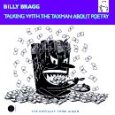
I’ve liked Billy for ages now.  I’ve seen him live a few times, and I’ve always loved that his accent is so prominent when he sings.  Over the years he has become somewhat less overtly political, but he is still a man of issues and causes.

This is Billy Bragg’s second full length.  He was still primarily a man with a voice and a guitar at this stage.  His melodies are strong, and since there’s no other instrumentation, all that’s left to talk about is the lyrics.

“Greetings to the New Brunette” is an adorable love song, followed closely by the anti-marriage “The Marriage”: “If I share my bed with you Must I also share my life Love is just a moment of giving And marriage is when we admit our parents were right.” (which doesn’t quite jibe with Sophia, but it’s close.

But really what you come to Billy Bragg for is the politics.  LIke in “Ideology”:  The voices of the people Are falling on deaf ears Our politicians all become careerists They must declare their interests  But not their company cars  Is there more to a seat in parliament  Then sitting on your arse.”

He also covers a public domain song which I wondered how well it would fit here.  “There is Power in a Union” seems like it’s saying the right thing, but some of the characters here would disagree about the end: There is power in a factory, power in the land Power in the hands of a worker But it all amounts to nothing if together we don’t stand There is power in a Union.”

This album also features the great track, “Help Save the Youth of America.”

Over the years Billy would expand his sound (he even worked with Wilco on two discs), but he always sings for the people.

[READ: Week of July 2, 2010] Letters of Insurgents [Fourth Letters]

As I’ve been going along in the story, I began to wonder if the two letter writers were going to be rehashing the same arguments in each letter.  I had confidence in Perlman that the story would be interesting (it sure had been so far), but I couldn’t imagine how he would keep it original, especially since Yarostan was in jail for so long–he has no information except secondhand.

This week’s reading gave two examples of how he’d do it:  Jasna comes to visit Yarostan and she updates everyone about what had happened to all of their fellow workers, and Sophia reveals a horrible situation in which she hits rock bottom–a real physical bottom, not a philosophical one. (more…)

Read Full Post »

SOUNDTRACK: THE BEATLES-Help! (1965).

At last, a Beatles album that I knew from start to finish.  And here it is, another soundtrack album.  This disc is the first that starts to really embrace the diversity that The Beatles were capable of.

The title track starts out with the fairly shocking screams of “Help!” but it settles nicely into a poppy Beatles track.  Of course, I’ve yet to see the film of Help, so I don’t know how these songs fit in the movie. But as with A Hard Day’s Night, the first half of the songs were in the movie and the second half were not.  And somehow I’m surprised that “Act Naturally” (one of their funnier songs, even if they didn’t write it themselves) was not in the film.

Their other cover, “Dizzy Miss Lizzy” is probably my least favorite track (I just don’t like their cover choices).  But by then, the disc has well proven itself to be fantastic.

This also leads me to my first “huh?” moment with Beatles lyrics.  I have never understood “Ticket to Ride.” “She’s got a ticket to ride and she don’t care.”  Okay.  Why should I care, then?  I suppose the verses reveal more of the story, but from a chorus point of view, that’s a head scratcher.

To me, this is where The Beatles became THE BEATLES.

Oh, and did you know the semaphore doesn’t actually spell “HELP”?  They were going to do that, but the photographer didn’t like the way those semaphore letters looked.  So, he created this arrangement, which spells “NUJV.”

[READ: May 25, 2010] “please, thank you”

This story is written from the point of view of a stroke victim.  Mr Sanchez had a stroke and is hospitalized.  And we see him watching, unable to communicate, frustrated as people–nurses and others–hover around him, asking questions, turning on lights when he’s trying to sleep, and–the nerve–speaking to him in Spanish as if that was why he didn’t answer.

As the story progresses, we watch Mr Sanchez get stronger, go to therapy, feel better about himself and even, kind of, become friendly with the nurses and others who work in the hospital.

The story is basically that simple: regrowth after a stroke.  However, the writing style–the first person narrative–was absolutely compelling.  I enjoyed that the story was from his point of view, so we learned details as he felt they were worth revealing.  I enjoyed slowly learning more about his family.  And I really enjoyed learning why the story was written with no capital letters. (more…)

Read Full Post »

SOUNDTRACK: THERAPY?-Never Apologise Never Explain (2004).
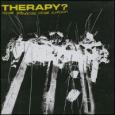
This album is the prior release to One Cure Fits All. It’s not true that Therapy? works on a harsh release/melodic release kind of schedule, although judging by these two discs it sure seems that way.  Never Apologise begins with a blistering, noisy “Rise Up.”  The really notable difference with this disc and other Therapy? releases is the amount of noise in the track. One of Therapy?’s most notable sounds has been a guitar that is so clean it sounds almost unreal.

This disc is far more sludgy (and seems even more angry), witness: “Die Like a Motherfucker.”

The whole disc is fairly short (under 40 minutes), very fast, and in relative Therapy? terms, lyrically not very interesting.  Consider this a solid rawk album.  And, again, one that is not available in the States.

[READ: April 29, 2010] Metrophilias

Brendan Connell’s new book is a short story collection.  And the short stories are indeed very short.  The longest one is 4 pages; most are 2.  There are 36 stories in all and each is named after a city.

I love the title of the book.  Metrophilias.  Technically, what? City love?  Love in a major city?  [Of course the prefix metro- means “mother” so I guess the title is literally motherlove, but that’s not how it’s intended].  And so each short story shows a snapshot of an individual in love in that city.

Each city is represented by at least a small nod that locates it, whether it is a street name or a building, or as in many cases, by an entire culture coming to the fore.  As such, some cities are far more identifiable as cities, and yet the content of the stories is so individualized that the city itself is (in many cases) irrelevant.  Of course, some of them could only be set where they are.  But before I get too obsessed with that aspect of the stories, I should move on to the people on the stories. (more…)

Read Full Post »

SOUNDTRACK: FUGAZI-Steady Diet of Nothing (1991).

Jangly noisy guitars open the track (and then a lengthy silence after a minute or so).  And this loud/soft dynamic is pretty dramatic on this disc.

There’s a slot of really cool sounds (within the framework of loud noisy alterna-punk).  “Reclamation” opens with some harsh guitar harmonics over a kind of spoken verse, but it bursts into a great chorus.  “Nice New Outfit” is quite catchy (even if lyrically it’s very dark).  But by the middle of the disc, it feels like some of the songs aren’t quite as interesting.

Of course, the instrumental “Steady Diet” is noisy and wonderful.  And “Runaway Return” has a catchy noisiness to it.  But the band comes back to a high point with “Polish” and the thoughtful “Justice Letter” (written about favored  Supreme Court Justice William Brennan who retired in 1990).

This record is a cool departure from the first disc.  To me it’s not quite as immeiate as Repeater, and yet it still has some really powerful songs.  I find that no matter how many times I listen to it there’s a few tracks that never grab me, but overall, this is another great release from Fugazi.

[READ: Week of April 26, 2010]  2666 [pg 831-893]

Wow.

The book is over and I am blown away.  I don’t know if it was the set up, or my utterly lowered expectations or the complete lack of connections previous to this, but I had assumed that this story would end (well, actually exactly as it did, with him going to Mexico) but the 30 pages before the end blew me away.  I can’t get over how nicely he tied so much together and in such an unexpected way.  I could not tear myself away from the end.  Wow.

I’m still not sure how I feel about the whole book.  I’ll do a final thoughts post after I digest, but the ending of the book was immensely satisfying. (more…)

Read Full Post »

« Newer Posts - Older Posts »