Feeds:
Posts
Comments

Archive for the ‘Interviews’ Category

dq25SOUNDTRACK: ARCHER PREWITT-“O, KY” (2005).

wikldernessArcher Prewitt formed The Coctails (a kitschy lounge act) in the early 90s, several years before the lounge revival.  Then he joined The Sea and Cake and has been making amazing music with them.  And he has also released several solo albums.

He has also published some comics (Sof’ Boy) with Drawn & Quarterly.

This song comes from his album Wilderness.  The title of the song is clever, too.

It’s upbeat and folky with a little psychedlia and rock thrown in.  I like Prewitt’s voice quite a bit–it’s simple but really strong.  But the selling point on this song (and others from this album that I have listened to) is the composition and arrangement of these songs.

I like the way this one goes from simple guitar to orchestration (although presumably not a real orchestra) for the chorus.  And how post chorus there are flutes and other instruments to pick up the momentum which adds a vaguely psychedelic feel to it.

At four minutes (the song is five) it changes direction entirely and turns into a nearly new song with big guitars and drums. And it rather rocks.

And just to make Archer the all around dude that he is.  He also drew the cover art.  Jeez.  He’s probably super nice and friendly, too.

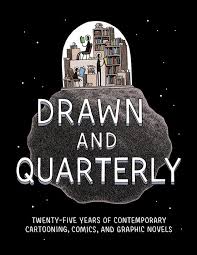
[READ: January 3, 2016] Drawn and Quarterly: Twenty Five Years 

I have liked a lot of D+Q books for a long time, although I never really considered a comprehensive look at their publishing house.  This book–about 775 pages long–is about as comprehensive as it gets.

This book contains a few previously published cartoons and excerpts as well as a whole slew of previously unpublished pieces.  There are essays and histories and reminiscences and love love love for the little Montreal graphic novel publisher.

I didn’t know much about the history of D+Q–that Chris Oliveros started the publisher in 1989 out of his house.  That he was the only employee for years.  And that he was essential in getting the term “graphic novel” used by everyone–including the library of congress!

He weathered distribution problems, he weathered the rise and fall of indie comics in the late 90s and he has come through with some of the most beautiful books published.  D+Q has also brought attention to foreign artists as well as out of print artists.

Really, if you have any respect for graphic novels (that aren’t superhero-based) you owe thanks to D+Q. (more…)

Read Full Post »

borgesSOUNDTRACK: SEU JORGE-Tiny Desk Concert #79 (September 13, 2010).

seuSeu Jorge was the melancholy singer in Wes Anderson’s movie The Life Aquatic With Steve Zissou. He sang the David Bowie songs and was amazingly soulful and brought a completely unexpected quality to the Bowie songs.

He plays these five songs with his band Almaz.  For reasons unclear to me only one of the songs is on the video, but the other four are available in audio format.

He sings three songs in Portuguese, and his voice is husky and passionate, so even if you don’t know what he’s singing about, you can feel the emotion.

The first song in English “Everybody Loves the Sunshine” has a cool trippy 70s vibe, with some cool keyboards.  Although I don’t love his version of “Rock with You” which I imagine was super fun to sing, but it’s so different from the Michael Jackson version that it’s hard to reconcile the tow.

  • Cirandar” (Audio Only)
  • “Saudosa Bahia” (Audio Only)
  • “Everybody Loves The Sunshine” (Audio Only)
  • “Pai Joao”
  • “Rock With You” (Audio Only)

[READ: October 19, 2015] The Last Interview and Other Conversations

I have never really read any Borges (a piece here and there sure, but I have his Collected Fictions waiting for me and just haven’t gotten to it. However, when I saw this book at work I decided to give it a read. I have very much enjoyed the other books in The Last Interview series (there are ten and I have read four) so I thought I’d like this too, and I did.

Borges is a fascinating individual. He was legally blind from a youngish age and was completely blind by the time of the last interview. He was humble (but not exactly humble—he genuinely didn’t think he was that great of an author). He was a pacifist (remaining neutral even in WWII) and basically spent his whole life immersed in books.

This book contains three interviews

“Original Mythology” by Richard Burgin (from Conversations with Jorge Luis Borges, 1968)

“Borges and I” by Daniel Bourne, Stephen Cape, Charles Silver (Artful Dodger 1980)

“The Last Interview” by Gloria Lopez Lecube (La Isla FM Radio, Argentina, 1985) [translated by Kit Maude] (more…)

Read Full Post »

ayoade SOUNDTRACK: MAVIS STAPLES-Tiny Desk Concert #72 (August 9, 2010).

mavisMavis Staples is a legend.  She has been singing for decades.  And her voice still sounds amazing.

For this Tiny Desk Concert, it’s just her singing and Rick Holmstrom playing guitar.  Staples sings two songs from her then new album (recorded at Wilco’s studio).  In fact, the first song she sings “Only the Lord Knows” was written by Jeff Tweedy.  It’s a great bluesy number.  And Staples hits notes all over the place–it’s great.

Before the second song, she calls Rick Holmstrom “Pops Jr.” and he says “I wish.”

Next she plays “You’re Not Alone.”  There’s a funny moment after the first verse where she forgets the words–she shouts “don’t tell nobody.”  She says she was busy looking at all the friendly faces and got lost.  But she comes back and knocks the song out.

For a brief encore she does a few verses and a chorus of “I’ll Take You There.”  And you can hear the disappointment in the audience when she sings, “And that’s all for today” after a chorus.  She is happy and claps and does apologize saying “you all will make me hurt myself.”

It’s amazing how good Mavis sounds after all these years, and how she wins over the crowd in an instant.

[READ: July 15, 2015] Ayoade on Ayoade

Richard Ayoade is best known by me as Moss on The It Crowd.  Probably the most frequently asked question by me about him is how the Rhell you say his last name.  The book does not help with that, although online searches reveal eye-oo-WAH-dee to be pretty accurate.

Ayoade cracks me up whenever I see him.  And he even starts the funny before you open the cover of the book.  The cover sticker notes: “Once in every generation, a man writes a book.  This is that book. I am a man.”

I knew that Ayoade had recently released The Double (I read the screenplay), but I wasn’t aware of his previous film, Submarine.  (I have subsequently watched it and enjoyed it very much–it’s an unusually dark comedy about young love).  And these facts, along with maybe one or two others are what I gleaned from this book.  The rest is pure nonsense–a right silly lark, full of Ayoade’s outrageously self-deprecating wit and scathing comments about his own writing, acting and directing skills. (more…)

Read Full Post »

5dials31SOUNDTRACK: BEACH SLANG-Tiny Desk Concert #431 (April 10, 2015)

beachslangI had never heard of Beach Slang before watching this Tiny Desk Concert.  Evidently they are a new band with only a couple EPs out.  The write up says they are a punk band.  But in this Tiny Desk show, it’s just lead dude James Snyder and his guitar.

He plays four songs.  They are all sort of jaunty acoustic songs.  They are almost anthemic, but not quite.  The strangest thing is Snyder’s super-raspy singing voice, especially since his speaking voice is gentle and his laugh is kind of high-pitched. He is very funny and nervous when he talks, which I enjoyed quite a bit.

Exploring a little their bandcamp site, I see that they do a cover of the Psychedelic Furs’ Love My Way, and that sound is pretty apt.

Their recorded versions are heavier and actually sound a bit like the Goo Goo Dolls.

This is a brief but enjoyable set.  I find him so charming that I like it more than I might normally.

[READ: April 1, 2015] Five Dials 31

It has been quite a while since I’ve read a Five Dials.  And that’s no fault of the magazine–its all on me.  I always think, I’ll just put it off till I have time, and then I realize that I can always find something to read…so I just need to actually make time for Five Dials because it is totally worth it.

So this issue came out about a year ago.  Maybe that’s not too bad?

It begins with the contributors page and is followed by the Unable to Contribute page which lists five journalists who are currently in prison (find out more at the Committee to Protect Journalists).  Page 5 is a Table of Contents which I feel they haven’t done before.  It has a cool drawing on the bottom.  All drawings from this issue came from The Public Domain Collection of the British Library.

Then there’s a Frequently Asked Questions page.  Many pertain to corresponding with Five Dials, but others, well: (more…)

Read Full Post »

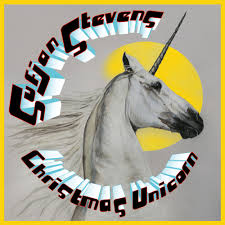
bolano SOUNDTRACK: SUFJAN STEVENS Christmas Unicorn: Songs for Christmas, Vol. X (2010).

sufjan 10This is the final disc in the second Sufjan Steven Christmas box set.  It is comprised of mostly shorter songs except for the final one which is 13 minutes long.

Interspersed in the disc are three short instrumentals (under a minute each).  “It Came Upon A Midnight Clear” “Angels We Have Heard On High” and “We Three Kings” are all pretty with flutes and minimal electronics.

The more traditional songs are “Have Yourself A Merry Little Christmas” which sounds very much like a Sufjan song with some fun electronic sounds and orchestration and some unusual vocals.  “Up on the Housetop” features lots of drums and layered vocals. It is the standard version but tinkered with with in fun ways.  “We Need a Little Christmas” is a fun and traditional version with choral vocals.

The other three tracks are originals from Sufjan.  “Happy Karma Christmas” a slow track of mostly drums and echoed vocals. It reminds me of Beck’s discoey electronic moments.  “Justice Delivers Its Death” is based on the lyrics of “Silver and Gold” (from Rudolph) but it is a much darker song (obviously, given the title) and sounds nothing like it.

The final track is “Christmas Unicorn.”  It’s a sweet song with funny/thoughtful lyrics.  After three minutes it turns into a nice instrumental.  At the four minute mark a new refrain begins. It sounds like the song is going to fade to end, but it doesn’t. At 6:30, drums come back in and the song takes off with more singers and a fugue style of interweaving vocals.  At 7:36 a new melody is introduced which is, Joy Divisions’ “Love will Tear Us Apart.” They incorporate that into the fugue vocals and it works very well.  It’s a strange song and very unChristmassey, but it’s very cool and quite catchy by the end.

I don’t enjoy this second box set as much as the first, since it is so unChristmassey, but it has some really interesting songs on it.

[READ: December 13, 2014] Bolaño: A Biography in Conversations

I don’t often read biographies about authors I like, but once in a while one will catch my eye.  I knew Maristain’s name from Bolaño’s last published interview, so I was curious what she would do with this collection.  It was translated by Kit Maude, and I am also curious about some of the words that Maude chose to use (the word savage/savages comes up an awful lot when not referring to The Savage Detectives).  But overall it was an easy, quick read.

As the subtitle suggests, Maristain has compiled a loose biography of Bolaño based on interviews with others.  Some are interviews that she has conducted and others are previously existing interviews that she has cobbled together.  The people interviewed are primarily his family and his fellow poets/novelists/friends.

Bolaño was born April 28 1953 in Santiago de Chile.  Soon after, they moved to Valparaiso, and then other smaller towns in Chile. In 1968 they moved to the Mexico City because of his mother’s asthma (although he never set foot in Sonora, the scene of the crimes in 2666). They lived close to the Olympic park and were within walking distance of the Olympic torch during the 1968 Olympics.

He had a difficult upbringing, with his parents splitting up and his mother moving out and taking his sister with her.  Roberto, meanwhile, stayed with his father.  They eventually had a falling out and Roberto went twenty years without seeing him.  His father was a boxer and an opinionated man, and there are lots of quotes from him in the book.

In 1977 Bolaño left Mexico for Spain (and never went back) and that’s when we start getting into his publishing history. (more…)

Read Full Post »

[LISTENED TO: November 21, 2013] “You Must Know Everything” podcast

podcastIn the fourth New Yorker fiction podcast, George Saunders reads Isaac Babel.  I know Saunders very well, although I knew next to nothing about Isaac Babel.

Saunders sets up this story very briefly before diving in to the read.  There’s something fantastic about the way Saunders read the story–full of emotion and affect.  He absolutely made the story come to life and his commentary at the end made the story even better.

Babel was 21 when he wrote this story (he was amazingly prolific–his Complete Works is over 1,000 pages), and Saunders is blown away by the amount of depth such a young writer fits into the story.  Saunders says that for him Babel is a combination of Hemingway and Kerouac–Hemingway because Babel edited his storied very intensely and Kerouac because he wasn’t afraid to add the occasional poetic touch.

In the story, a young boy is going to visit his grandmother.  As the story opens, he explains that he was always very observant.  He knew everything about the streets of his city, Odessa.  He knew the stores and the anomalies in the buildings.  He observed every new window.  Until someone teased him for looking in a lingerie store. (more…)

Read Full Post »

[LISTENED TO: November 20, 2013] “Urban Planning” podcast

podcastIn the third New Yorker fiction podcast, Donald Antrim reads Donald Barthelme.  I know both writers, but neither one all that well.

The story is absurdist and very funny.  In it, the narrator buys “a little city,”Galveston, Texas.  He keeps things pretty much the way they are–he doesn’t want anything too imaginative going on.  He tears down several houses and builds new developments (cut in the shape of puzzle pieces).  But he’s a little bored so he goes out and shoots 6,000 dogs, and then makes a front page announcement that he had done it.  This causes some upset (naturally), and he’s appreciative for the excitement.

But overall he is unsatisfied because he is in love with a married woman.  And she won’t leave her husband (and may not even know who the narrator is–except that he owns the city).  Eventually he had to sell the city back (and he took a real soaking financially on that deal).

The story has many many funny lines–laugh out loud funny–and (dog killing aside) it is a funny and delightfully weird story that retains its voice no matter how odd it seems. (more…)

Read Full Post »

[LISTENED TO: November 20, 2013] “The Dating Game” podcast

outkoudIn the second New Yorker fiction podcast, Edwidge Danticat doesn’t read Díaz’s story but rather she discusses it and her connection to Díaz after listening to the audio from the New Yorker Out Loud 2 CD (the story is read by Junot Díaz with Gail Thomas doing the female voices).

I have yet to read Díaz’s Drown (for no real reason, I just haven’t), which is where this story appears.  And I enjoyed that this story is written in the same style as his later stories about Junior (sure, I suppose he will need to move beyond Junior as a character but it seems like he has plenty of stories to tell).  And I found this story unsettling and very enjoyable.

The story is a funny/obnoxious (I mean, re-read the title) story about, as the title suggests, how to date a girl–there are different specifics depending on her race (white girls will put out, but local girls you need to take to the fancy restaurant).  And be sure to take the government cheese out of the fridge so she doesn’t see it–but be damn sure to put it back before your mom gets home.

The reading is wonderful and having Thomas do the female voices really adds a nice touch.  I would say more about the story, but Danticat says a lot of what I was thinking about it.  (more…)

Read Full Post »

[LISTENED TO: November 19, 2013] “Reunions” podcast

podcastIn the very first New Yorker fiction podcast, Richard Ford reads a story by John Cheever from 1962.  This is an especially apt pairing because Ford explains that when he does author appearances, he often reads Cheever’s story “Reunion” before reading his own story “Reunion.”  The reason, he explains, is that the Cheever story inspired his own.  [I haven’t read the Ford story although it too appears in the New Yorker, but from the way he describes it, it doesn’t sound like it’s all that similar, just “inspired” by the Cheever piece].

I don’t know a lot of Cheever (which Ford says is a common and sad problem for American readers), but I have always loved his story “The Swimmer,” which I think is fantastic.

“Reunion” (the Cheever story) is very simple and yet it speaks a lot about family. (Both Ford and the New Yorker host talk about how remarkably short (about 1,000 words) and yet how powerfully concise it is.)  In the story, a young man has time to kill between trains in Gran Central Station.  He is en route from school and had about 90 minutes before his next train arrives. So he contacts his father to see about having lunch.  He hasn’t seen his father in about three years and he thinks this will be nice. (more…)

Read Full Post »

nov 2013SOUNDTRACK: VIC CHESNUTT-Tiny Desk Concert #2 (June 5, 2008).

chesnuttVic Chesnutt seems to have come into my life at random times. I bought the charity record/tribute album (Sweet Relief II) only because I liked a lot of the artists on it–I’d never heard of him at the time.  More recently his records were released on Constellation, a label I trust wholeheartedly.  And then just as I was really starting to appreciate him, he died in 2009 from an overdose of muscle relaxants.

He was a fascinating person.  A 1983 car accident left him partially paralyzed; he used a wheelchair and had limited use of his hands (which you can see in the video).   He struggled with drugs and alcohol and depression.  Despite all of this, he released his first album in 1990.

Robin Hilton, music dude at NPR, introduces him here and talks about how much he loves his music.  But even Hilton’s association with Chesnutt is checkered.  He writes that when he was younger and went to see him in concert, “[Chesnutt] was often drunk and sometimes belligerent. I walked out of at least one performance,” and “all of this probably made it easy to dismiss Vic Chesnutt’s music. He was a challenging guy, and his unpolished, idiosyncratic songs weren’t easily digested.”

And yet for all of that Chesnutt seems rather shy and unsettled in this Tiny Desk setting.  He seems unsure about what he wants to play and often asks if he should play this or that song.

He plays 5 songs (for 26 minutes total).  The opener is “When the Bottom Fell Out.”  A lot of Chesnutt’s songs, especially in this setting sound similar.  His voice is incredibly distinctive, as is his playing.  But since most of his songs are just him strumming and singing, they sound quite similar.  The second song, “Very Friendly Lighthouses” sounds a little different because he plays a “horn” solo using his mouth as a trumpet. It is a web request which he says he’ll “try” to do (and that he needs a cheat sheet).  I don’t know the song but it sounds fine to me.  He also emphatically states that the song is not about Kristin Hersh (something she has claimed).

“Panic Pure” also has a Kristin Hersh connection (she recorded it on Sweet Relief).  He says he stole the melody from “Two Sleepy People” by Hoagy Carmichael.  He turned it to a minor key and wrote his song.

For the next track, he asks if he should try a new song that he just wrote–more or less asking permission to do this unreleased track.  “You really want me to try out a new song that might suuuck?” (resounding yes). “We Were Strolling Hand in Hand” proves to be a very good song indeed.

The final track “Glossolalia” comes from North Star Deserter, the album I own.  It’s about being an atheist songwriter in a Christian country.  It’s funny that he says he hasn’t played it in a long time (it’s from his then new album…).

Chesnutt was not for everyone, clearly.  But his music is haunting and beautiful in its own way, and this is a very engaging setting to see him perform.

[READ: November 8, 2013] “Lovely, Dark, Deep”

Karen told me to check out this story and while I was planning to, she got me to move it up higher on my pile.  And I’m really glad she did because there is so much going on in this story that I was glad to be prepared for it.

The story seems simple enough, a young girl goes to interview famed poet Robert Frost at a writer’s workshop.  She is an unknown writer writing for a small college journal (Poetry Parnassus) and really has no business interviewing the Poet Himself.  She is shy and literally virginal.  When she walks up on Frost, he is sound asleep on a porch.  She dares to take a few pictures of the man (which later sold for a lot of money…although presumably not for her).

When Frost wakes up he is surprised and a little disconcerted by the young girl.  And then he gets cocky with her, suggesting she sit on the bench with him.  She demurs and begins trying to be as professional as possible.

Frost proves to be an obnoxious interviewee, full of ego for himself and nothing but disdain for all other poets.  She is intimidated by him, fearing that all of her questions are silly.  Then she tries to ask him some insightful questions but he tends to dismiss them as obvious or simply ignore them.  Eventually she asks one personal question too many and he becomes blatantly offensive.  He asks about her panties and if they are now wet (the cushion she is sitting on is damp from rain).  And he bullies her terribly.  She is offended but remains strong and continues to ask him questions. (more…)

Read Full Post »

« Newer Posts - Older Posts »