Feeds:
Posts
Comments

Archive for the ‘Humiliation’ Category

flies1SOUNDTRACK: PUBLIC SERVICE BROADCASTING-Tiny Desk Concert #354 (May 5, 2014).

indexI heard about Public Service Broadcasting via NPR and I loved their song “Spitfire,” a rocking instrumental with interesting samples scattered throughout.  Well, it turns out that live, the rock just as hard.  Even though there’s only two of them.  There’s J. Willgoose, Esq. on guitar, banjo and electronics and Wrigglesworth on drums. The samples come from British public-service films from roughly the 1940s through the 1960s.

Watching this video, I was stunned at just how much Willgoose is doing, and just how much noise these two guys can make.  There’s even a video going on behind them.   The only problem here was that the samples were not loud enough.

 “Signal 30” opens with samples and samples and then a rocking guitar and solid drums. It amazing watching Willgoose do some many different things while playing the guitar. The change of tone at the middle of the song is great and I love watching him just bang the guitar to keep the notes going (while he is playing the keyboard).

 After the song, there is a sample of “Thank you very much” in an arch British voice (the duo don’t speak during the show).   “Spitfire” also sounds great hear–the song is surprisingly complex for an instrumental, and for what seems like it might be a novelty band, the song is really solid.  After this song, Willgoose had to fetch something and the talking sample said “talk amongst yourselves!” The final track “Everest” has a very catchy riff and some really great drumming.  But I love most watching Willgoose play the guitar with one hand and play a solo on the keyboard with the other.

This is definitely a band to check out live.

[READ: June 4, 2014] King of the Flies 1. Hallorave

Hallorave is a dark, violent, sexual comic series written by Pirus and drawn by Mezzo.  Both artists are French and have worked together before.  This book was translated by Helge Dascher and John Kadlecek (and it was translated very well–I didn’t realize it wasn’t American until they started talking about Euros sometime in the middle of the book.

So this is actually a series of short stories narrated by different people.  They seem unrelated, but after a couple of stories, you see the connections.  And there proves to be a core collection of characters all living in this suburb (the location is really irrelevant).

The first story starts with Eric (who proves to be the main protagonist) drinking, reading magazines and sitting on a couch on the (dried up and dead) lawn of his mother’s house.  He is also jealous of his best friend Damien because he is very hot for Damien’s girlfriend Sal.

That first story introduces us to a visual that will run through the book: Eric sitting with a giant fly head on.  The three are going to a Hallorave for Halloween.  Eric is King of the Flies, Sal has a giant cat’s head on and Damien is a skeleton.  By the end of the party, they are all high (you can seem them feeding each other drugs in the picture below).  Eric pledged his love to Sal in front of Damien, and Damien is in a foul mood.  He gets in a fight with some other party goers. By the end of the short story, Eric and Sal are having sex (with their costume heads on) and Damien has been hit by a car and killed.  That’s the kind of stories we’re getting here. (more…)

Read Full Post »

SCV1_TNY_04_21_14Brunetti.inddOUNDTRACK: JUANA MOLINA-Tiny Desk Concert #361 (May 31, 2014).

juana I had heard of Juana Molina but had never heard anything she sang. In fact I didn’t really know anything about her. So, she’s from Buenos Aires and is 51 this year. She has released 6 albums. I don’t know if they all sound like this, but these threes songs are really cool and interesting. The sounds are wholly unexpected—weird effects on guitar and on keyboard. Interesting samples (played by all three members) and delightfully odd backing vocals all accompany Molina’s pretty voice (she sings mostly in Spanish).

   “Eras” opens with a stuttering guitar line that proves to be not a guitar at all. By the time the song moves along there’s a groovy guitar line, spare vocals (at one point counting mostly in Spanish uno tres cuatro cinco seis (yes there’s no dos)) and a very catchy chorus.

   “Wed 21” has an insane guitar riff that in addition to being unusual in itself is also crazily wobbly. Then there’s processed vocals which act almost as a percussion instrument.  All of this once again leads to a super catchy chorus.  When the strange noises reappear after the chorus it sounds even more peculiar.

Molina proves to be very familiar with the Tiny Desk Concerts.  She is excited to be there, which is always fun to see in a performer. She also says that now she knows what people are looking at when the scan the audience.

   The same odd vibrato guitar opens “Sin Guia, No” as well. After a slinky voice (Molina’s voice is delicate and whispery for much of the songs but can get big and loud as needed) with some interesting backing vocals (that sound like they are coming from a well), Molina adds a new guitar line to the mix.  There’s a lot of music coming from this trio.  And I like it a lot.

[READ: June 4, 2014] “Hubcaps”

Stories about 70s families are pretty much always sad.  In the decade of smoking and drinking parents and of neglected children, there’s never going to be happiness there.  Although there is sometimes comedy.  And yet for all of the sadness of the fictionalized decade, I often enjoy reading about it.

This story opens with Owen knowing that when his parents break open their first cocktails in the later afternoon, that’s pretty much the end of the night for them–and a chance for Owen to sneak out.  Mostly he goes to the homemade baseball field(!) of his friends the Kershaws.  The oldest Kershaw boy is a good athlete, the middle one is working on his paper route and the youngest is physically and mentally challenged.  But they all love baseball, especially the youngest, Ben.  And given his specialness, he is excellent at remembering statistics of baseball.  Owen finds his knowledge fascinating, so he hangs around with him on the bus and sometimes after school.  Ben is also pretty good at baseball, so he is always picked for a team.  As is Owen.  It seems idyllic, except for Owen’s family life.

But Owen manages to catch and raise some tiny turtles (don’t get too attached to them). (more…)

Read Full Post »

shantySOUNDTRACK: RHEOSTATICS-Mrs. Robinson’s, Kitchener, Ontario (December 20, 1997).

kitchener

What’s most fascinating about these Rheostatics live shows is coming across venues that have no internet presence.  I can’t find a photo or anything of Mrs Robinson’s in Kitchener.  Did it even exist?  Who knows?

The quality of this show is very good although the overall volume is too low. There are also complaints from Dave about his monitor not working.  It doesn’t impact the sound for us, but I guess he couldn’t hear very well.  The intro of “Michael Jackson” is all messed up, but they play on through it.  Then they actually take a pause for an unspecified length of time to fix it (but still do a show that’s over 2 hours long).

Martin and Dave are very chatty for this show.  The intro is quite long, with some good banter including a discussion of the weird table in front of the stage which people can use for stage diving or go go dancing.  Martin explains the origins of “Junction Foil Ball” (about a guy who makes a ball out of the tin foil in cigarette packs.  They make a joke about Don the drummer being from Kirkwood Lake which is where Alan Thicke is from.  And a joke about Polkaroo.

They also introduce Tim Mech (their guitar tech) whose band PEEP-SHOW was one of the winners of Musician magazine’s “Best Unsigned Band Competition” in 1997.  He takes a long solo in “Claire.”

This was their last show of 1997, so this wish everyone a Merry Christmas.

[READ: March 3, 2014] Shantytown

This has been my favorite Aira book so far (and I’m now caught up to his English language releases).  The plot was simple and interesting, and the fantastical elements really worked with the story instead of overshadowing it (which his stories sometimes allow, but which isn’t really a criticism per se, just a point of fact).

This story begins with Maxi, a kind-hearted, but not terribly smart or sensible young man.  He is unemployed, did not finish any real schooling and doesn’t have a lot to do.  He has been going to the gym daily, so he is very strong. And he has recently begun helping the garbage scavengers.

These scavengers are people who live in the Shantytown nearby.  It is a collection of houses, most very tiny and quickly constructed, where the poorest people live.  And many of these people collect and either sell or use rich people’s garbage.  They come up every night before a garbage pick up and root through the streets for anything they can use.  And Maxi has begun helping them shift their carts  Since he is so strong, he finds that none of the their carts are very heavy.  And although he has never spoken to any of them and they have not spoken to him, he decided to start helping them and now he gets great satisfaction in carrying their stuff.

The shantytown is an unsavory place where drugs are sold and not too long ago a young girl was murdered.  Recently a policeman, Agent Cabezas has been trying to get to the bottom of this whole drug thing.  The drug of choice is proxidine which makes things clearer. Even Cabezas himself takes it (even though it is illegal).  But there has been a lot of suspicious activity with a man dressed as a pastor who might be a dealer.  And then there’s Maxi who is suddenly hanging around the shantytown.  And, quite frankly, Cabezas has decided that he’s tired of being a good cop.  He is ready to take what is his. (more…)

Read Full Post »

CV1_TNY_11_11_13Blitt.inddSOUNDTRACK: DARK MEAT-Tiny Desk Concert #25 (August 31, 2009).

darkmeatFor those keeping track, I wrote about Tiny Desk Concert #24 (The Swell Season) quite some time ago.

Dark Meat is a ramshackle band which I had not heard of before this Tiny Desk Concert.  The blurb says that they have had as many as 20 people in their band and often play loud rambunctious music.    In this Tiny Desk Concert, there are only 8 of them (they have reduced for this tour), but they’re still a huge band for a Tiny Desk.

This concert is an acoustic jam –mandolin, guitars, trombone and piccolo—and is apparently quite different from their usual show.  As such, I can’t really imagine what they typically sound like, because they sound like a pretty solid folk band.

Initially I wasn’t all that impressed, but after a couple listens I found myself getting into their sloppy fun folk rock.  I enjoyed their first song, “The Faint Smell of Moss” a little more than the others because of the great backing vocals, and the possibly slightly off sounding trombone.  The second song, “Dead Man” is long, but it has a fun middle second in which the singer invites the office to sing along (and howl like dogs).  “When the Shelter Came’ is a rambling track which I think actually suffers from the trombone at the end.

I don’t know anything else about the band, but I imagine them playing folk festivals.  I’ll be they’re fun to see live, although I can admit that i didn’t find their songs all that memorable.

 [READ: January 22, 2014] “Benji”

“Benji” is the story of wealth and idleness.  As the story opens, we learn that Benji, now 40 years old, is the last remaining male in the family.  His mother, Mrs Anyaogu  is telling her guest that Benji must choose someone to marry because anyone who remains unmarried, even a man, is suspect at that age.

Then we meet the guest who Benji’s mother is speaking to—a woman named Alare.  Alare also got married pretty late—in her thirties–to a man who was about 40.  Her husband was not wealthy—he was a gardener.  And this was something of a sore subject in their marriage,  Of course, he must have also felt the embarrassment of his employment, but that was his lot in life.

Alare and Mrs Anyaogu became friends when Alare’s congregation had disintegrated because of a scandal with the pastor and she joined Mrs Anyaogu’s Deep Life church.

Alare was aware of the wealth that the Anyaogus possessed, but she hadn’t witnessed it until today.  While the house was beautiful, she felt that the furnishing were tacky—not entirely, but enough.  Nevertheless, the lunch was nice and the food was delicious.  The groundskeeper, Godwin, kept the garden beautiful and Benji complimented the man on his loyalty and hard work. (more…)

Read Full Post »

SOUNDTRACK: SARAH SISKIND-Tiny Desk Concert #23 (July 27, 2009).

sarahsI don’t know much about Sarah Siskind.  She is a country-ish singer who seems to have gained some fame once Bon Iver started covering her song “Lovin’s for Fools.”  She tells a pretty interesting story about how he came to learn her song (by looping it–thereby missing out on the words to the second chorus.  And yes she did wonder why he didn’t play that chorus).

She plays three songs in this Concert. I like her guitar work, especially on the first song, “Falling Stars.”  But there’s something about either her voice or her delivery that I just don’t really like. I’ve listened a few times ow and I have grown to appreciate her style, but it’s just a matter of personal taste that I don’t really care for her.

Listen for yourself.

[READ: January 17, 2014] “The Bear Came Over the Mountain”

One thing that I like so much about Alice Munro is that her stories are so timeless.  This story was originally published in 1999 (wonder why they didn’t re-publish that first story which I wrote about yesterday), but there are no real indicators of when it was written.  (There are some clues to the time frame of the story, but it was clearly not set in the late 90s).

This is a straightforward but fairly complex story, with a lot of emotional heft.  A married couple, Grant and Fiona, have been together for a long time.  Fiona had always written notes to herself, but Grant sensed recently that the notes were becoming somewhat alarming.  Instead of books to read or appointments to keep, she was writing “cutlery” on the kitchen drawers. Then she started forgetting normal things–like how to drive home or that something which she thought had happened last year had actually happened 12 years ago. Not major problems, but causes for concern.

And so, Fiona was sent, at first temporarily, to Meadowlake.  And Grant was not to show up for the first month–they found that patients settled in better if they were not reminded of their house and old life.  After a month of wondering about her and thinking about her, Grant goes to Meadowlake, excited to see Fiona.  But when he arrives she is not in her room–the touching reuniting scene will not be enacted as he pictured.  And the nurse seems rather impatient with him when he asks where she is. (more…)

Read Full Post »

holoSOUNDTRACK: SIGUR RÓS-() (2003).
rosAfter a staggeringly successful tour, Sigur Rós took some time off. They returned about four years after their successful album with ().  I like to think they were trying to make it easier for English speakers to not have to pronounce their Icelandic words, but perhaps they were just being more difficult.  For they have made an album title that is hard to search for and hard to say.  To make it worse, there are no song titles on the record either.  (Although the band did have I guess unofficial titles for them):

  • 1.”-” (“Vaka”) 6:38
  • 2.”-” (“Fyrsta”) 7:33
  • 3.”-” (“Samskeyti”) 6:33
  • 4.”-” (“Njósnavélin”) 6:57
  • 5. “-” (“Álafoss”) 9:57
  • 6. “-” (“E-Bow”) 8:48
  • 7. “-” (“Dauðalagið”) 12:52
  • 8. “-” (“Popplagið”) 11:43

While looking for these song tracks, I learned that a lot of people think this album is mopey and depressing.  And I couldn’t disagree more.  I find the songs to be wonderful builders of drama.  Track 1 opens with lovely piano and vocals.  It’s a pretty melody that is punctuated with odd, squeaky voices.   Track 2 is slower, with a nice guitar melody instead of pianos. Track 3 opens with organs and more lovely pianos.  The pianos are slow which I usually don’t like, but there’s something about the simplicity and solitariness of their pianos that I find really captivating.  I love that it is repetitive and building, edging towards a dramatic conclusion.  Track 4 has low drumming that propels the echoing song.

Each of these 4 songs is around 7 minutes long.  And while they are not vastly different from Ágætis byrjun, they show the band experimenting within the form.  Also, Ágætis byrjun contained several different styles mixed between their epics, whereas this album is all epic.

After the 4th song there is 30 seconds of silence.  Which signifies something of a change for the second half of the album.

Track 5 is the slowest, saddest music on the album.  But it builds slowly, growing out of that sadness with a cathartic explosion at the end.  Track 6 opens with very loud drums (the percussion is spectacular on this album) and drones.  It builds and builds with more catharsis at the end.  Track 7 is the 12 minute epic that opens with organs and washes of guitars.  The opening is slow but you get the sense that it is building towards something–there is tension in the music, especially when it shifts to a minor key around 3:30.  It takes over 4 minutes to get to the chorus.  And then the song repeats and builds again.  The end is an unholy racket until Jonsi is left singing by himself.  It’s incredibly satisfying.  The final track is 11 minutes long and opens with an upbeat guitar sound.  It’s a good song and then the drums kick in around 6:20 and the song gets even better.

So yes, this is a long album full of long songs.  And none of it is in English.  Not exactly a pop seller, and yet there is something magical about the music on it.

[READ: October 10, 2013] A Hologram for the King

I had been putting off reading this book because I didn’t really like or get the title.  Sarah laughed at me when I said this, because the title is very explicit, but I honestly didn’t know what it was supposed to mean.  My mind reeled with the metaphorical possibilities.  So imagine my surprise when the title is indeed very literal.

The book is about a man named Alan Clay who is an IT sales person.  He will be doing a presentation–which will include an interactive hologram–to Saudi Arabia’s King Abdullah.  So, a hologram for the king.  Simple.

And indeed, the story is quite simple.  I had read an excerpt from it in McSweeney’s 38 and enjoyed it quite a bit–not realizing that it was from this book, of course.  The excerpt has been changed since then but most of the elements have been incorporated.  About the excerpt I said:

a man named Alan is on a flight to Saudi Arabia for business.  We learn through the course of the chapter that he has very little money left, that he is divorced and that his daughter is now fighting with her mother (his ex-wife).  He composes letters in his head to her trying to figure out the best way to placate the scenario.  But he also knows how important this deal is, both for him and for his daughter who needs money for school.  So he tries to put everything out of his mind so he can sleep.  There’s a lot of wonderful details in this chapter.

None of those details have changed, except we don’t really see as much of the flight.

Alan has landed in Saudi Arabia after not sleeping for 60 hours.  He misses the shuttle bust to KAEC (pronounce cake) the King Abdullah Economic Center.  So he calls for a taxi.  Instead, he gets a young man name Yousef who drives him the 60 or so miles to KAEC.  Along the way, Alan and Yousef talk a lot and they hit it off. Yousef has been to America (he studied for a year there) so he understands Americans.  He also has no hope for the future of the KAEC.  Alan likes Yousef and is dismayed by his attitude about KAEC, but finds him to be enjoyable company (Yousef enjoys jokes and, as a salesman, Alan is full of them). (more…)

Read Full Post »

curesSOUNDTRACK: PHISH-Billy Breathes (1996).

billyBilly Breathes is a much more mellow, acoustic feeling album from Phish.

Although the opener “Free” is a great song, with wonderful riffs.  It’s another of my favorites live, although the production sounds a little flat here, but the harmonies are great.  “Character Zero” again has a real ZZ Top feel (something many don’t really associate with Phish I’m sure).  But once the song proper kicks in, it rocks in a very Phish way.  “Waste” is a delicate song about insecurities that turns into a nice love song.  “Taste” is a rollicking piano-heavy song that gets played live pretty often and it sounds good here.

“Cars Trucks Buses” is a 2 minute instrumental that has a lot of organ in it, it’s very groovy.  “Talk” is an acoustic guitar/folky song.  You don’t hear it much live.  “Theme from the Bottom” gets us back into often-played territory, with its weird opening riff.  I really enjoy the way the bridge goes into a brief minor key, despite the overall happy vibe.  I like the harmonies towards the end, although the actual end of the song is a bit dull (the live endings are a bit more fun).

From here the album mellows out a lot.  “Train Song” is a pretty acoustic number with nice harmonies.  “Bliss” is an acoustic guitar solo.  “Billy Breathes” has more delicate harmonies and an acoustic feel.  “Sept Away” is another delicate short (90 second) song, with some more great harmonies. “Steep” is a slow, simple song (also 90 seconds) that has a pretty melody but serves more as an introduction to “Prince Caspian.”   “Prince Caspian” is a great epic-seeming song (even though it’s only 5 minutes long).  The build up is long , with the pretty chords repeating and growing fuller.  It’s a great live song and a great ending to this disc.

Although this disc has some great songs on it, it’s definitely not my favorite overall.

[READ: October 4, 2013] The Miracle Cures of Dr. Aira

This was another weird and fun book by César Aira (one of about six books he wrote that year). This one was translated by Kathleen Silver.  Ever since reading that Aira doesn’t edit his books—that he simply begins writing and lets the story keep coming out–I’ve grown suspicious of the beginnings of his stories. And so I am with this one. In the beginning there’s a whole thing about Dr Aira sleepwalking through a town.  He wakes up in various places, unsure where he is, but he’s never lost because he knows the streets so well.  This goes on for a few pages and then the plot kicks in.

Dr Aira is picked up by an ambulance—a man is dying right there in the ambulance and only Dr. Aira can save him.  Won’t Dr Aira help him? The Dr. refuses point blank.  He is convinced that this whole thing is a set up—why else would the ambulance (which he had heard for many blocks going up and down the street) be driving around with a sick man looking just for him instead of going to the hospital?  He will not help this man.  Disgusted, the ambulance driver pulls over and the Dr gets out.

So what is all this about? (more…)

Read Full Post »

harper juneSOUNDTRACK: PHISH-A Picture of Nectar (1992).

nectarA Picture of Nectar plays with expectations of Phish somewhat (as many as could be formed after two albums).  This album has sixteen songs, with half of them at 3 minutes or less.  These include the pretty jazz instrumental “Eliza,”  “Poor Heart” which is a slide guitar filled short country-ish romp, “Manteca” thirty seconds of nonsense.  “Magila” is a jazz instrumental which has solos by both piano and guitar.  “The Landlady” is another instrumental, but one that is a rocking guitar workout. “Faht” is a pretty, simple guitar piece with birds playing in the background

After somewhat anemic recordings, A Picture of Nectar feels a lot more full.  “Llama” bursts out of the gate sounding very complete with all of the instruments at the same power and breadth.  “Cavern” has a pretty ridiculous drum sound—very big and echoey and the pace is a little slower than is typical live, but it sounds very good. “Stash” clocks in at 7 minutes and it sounds very similar to the albums (although there are a still a bunch of silly voices like the one who says “Please don’t do that.”  “Guelah Papyrus” (no idea what that name is about) sounds fine here—very much like the live versions, full and fun.

“Glide” features the “glad glad glad” chorus in multipart harmony that makes this song seem like a barbershop number and sounds wonderful.  The longest song on the album is perennial favorite “Tweezer.”  The song is very much like the live versions except that the middle section has a crazy noisy breakdown which is a little disconcerting.  The solo then moves into a typical jam for Phish which really shows what they would do with this song live.  “The Mango Song” is a fun piano based jaunty number that highlights the band’s harmonies.  It sounds really good too.  “Chalk Dust Torture” sounds different because the voice is very different.  It sounds like Trey through a processor of some sort, or possibly somebody else singing.

The album ends with “Tweezer Reprise” because the song is so good it needs a proper ending.  This is another successful album from Phish.

[READ: September 20, 2013] “East Texas Lumber”

I wasn’t sure I would like this story about an unsuccessful guy in East Texas.  But I really did.

The narrator is Brian, a guy who has not been very successful since he got out of school.  He’s trying to save up to be a locksmith, but in the meantime he’s working at East Texas lumber.  And he’s thankful to divine providence for sending a tornado which helped him get the job.

A tornado ripped through their town and because of all of the rebuilding, the lumber store needed extra help, and that’s where Brian came in.  Even though on his first day he crushed some drywall and put a nail in his foot, they kept him on.  He was paired with Jimmy, a goof who had been working there for a long time.  Jimmy liked to smoke pot and go to parties, but he was the only one willing to partner up with potential liability Brian.

On this day their boss has given them a cushy job.  Deliver two loads of shingles to two different locations.  This was easy work—a lot of driving and no lumber to stack.  And it should get them back around 4, which is just enough time to goof off for the last hour, and get to The Hangout by 5 PM. (more…)

Read Full Post »

lp8SOUNDTRACK: CHASTITY BELT-“Black Sail” (2013).

noregerstChastity Belt are notorious for their band photo.  And the fact that their album is called No Regerts (sic).  By rights they should play ugly abrasive punk or something weird and edgy and probably a little scary.

So imagine the surprise when “Black Sail” opens and sounds like a Guster song–simple chords with a very catchy melody (it reminds me of a rawer version of “Architects and Engineers”).

Then the vocals come in and the singer sounds a bit like Jefferson Airplane-era Grace Slick–powerful but kind of slow.  It’s a very compelling mix.

Especially when things change in the chorus–a simple, pretty guitar riff leads us into the simple chorus “black sail, strong wind.”

The difference between the image and the music is so striking that i wonder if I’d have been as taken with the music with out the picture.  Was this a brilliant strategy or just a really bad idea (it has already made a list of unfortunate band photos).  You can decide for yourself, I’m including the picture at the end of the post.

And you can listen to the song on NPR or at their bandcamp site.

[READ: September 12, 2013] “Amaranth”

Amaranth is a 12-year-old girl who goes by the name Merry.  She is out driving with her father one night when he gets a call from his business partner.  Amaranth pretends to be asleep while her father goes to talk to the man.  But rather than a conversation, the partner, Otto, kills her dad.  And Amaranth saw the whole thing happen.

Amaranth is devastated.  But she is even more devastated when Otto starts coming around.  Like a remake of Hamlet, soon Otto and Amaranth’s mother are getting married.

Amaranth wants nothing to do with this; the rest of the story details the ways she rebels against the unpardonable acts.

First she begins starving herself.  She eats just enough to survive but her mother hates how thin she is getting. Eventually they send her to a place for girls with eating disorders.  She returns plumper, but with a new scheme.  This time her rebelliousness gets her put into a special hospital. (more…)

Read Full Post »

vanSOUNDTRACK: FRANK TURNER-Tiny Desk Concert #287 (July 13, 2013).

turnertinydeskNPR introduced me to Frank Turner and I’m pretty delighted that they did.  I really enjoyed his set at the Newport Folk Festival.  And here’s another live recording (a Tiny Desk Concert).

In this brief set, Frank and mandolin player Matt Nasir (he’s only been playing it for 6 months) blast through 3 of his rockingest folk songs.  “Recovery,” “The Way I Tend to Be,” (with a very funny lead story) and a rousing mandolin solo-filled and a (reluctant) NPR audience singalong. of the great “Photosynthesis.”  I imagine it was quite loud in their offices that day.

Turner is fantastic live—he’s personable and funny and even more so in this intimate setting.  It’s a wonderful set.

Check it out.

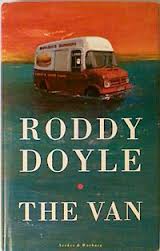
[READ: August 23, 2013] The Van

This is the final book in the “Barrytown Trilogy” (except for the new one coming out next year).  Whereas The Snapper was tied to The Commitments by virtue of it being the same family, The Van is tied to The Snapper because it follows the same guy—Jimmy Rabbitte Sr.

It’s 1990 (a few years after The Snapper because the baby from that book is now talking and mobile) and like many older people in Ireland, Jimmy Sr. has been laid off.  The first third of the book looks at life on the dole in Ireland—skimpy Christmas presents and getting handouts from your son.  And yet there’s always money for a pint or two—so Jimmy still gets to hang out with his mates at the pub a few nights a week.  He also goes out with the baby from time to time and occupies himself in various ways (pitch n putt).  There’s a lot of humor and silliness in this section–especially within the family when the twin girls start getting older and even cheekier.  And the focal point is the World Cup—because Ireland is actually going to be in it this year—Italia ’90!

And the Jimmy’s mate Bimbo gets laid off.  And that’s where the titular van comes in (over 100 pages into the story).  Bimbo is crushed to be laid off, but Jimmy is a little pleased.  He’s not happy that Bimbo is laid off, but he is happy that he has someone to waste the day with.  They go golfing together (and win a prize or two) and they do their best trying to stay happy.  But they’ve noticed that the fish and chips van that used to be parked outside of the bar is no longer there.  It’s a sad state of affairs when you’re drunk and hungry at midnight and can’t get a fish n chips.

And that’s when their friend Bertie (who can get anything for anyone) comes through on Bimbo’s half serious question–could Bertie get him a chipper van?  Bertie finds one—an unholy filthy mess of a thing with no engine.  And Bimbo uses his redundancy money, £800, to buy the mess.  Jimmy is appalled until Bimbo starts talking about the two of them being partners—working together to makes some money and sell chips to their drunken mates and—even better—to the punters who are enjoying the World Cup!  And suddenly it seems like a real idea. (more…)

Read Full Post »

« Newer Posts - Older Posts »