Feeds:
Posts
Comments

Archive for the ‘Hospitals’ Category

SOUNDTRACK: RHEOSTATICS-Calgary Folk Fest, Calgary, AB (July 1996).
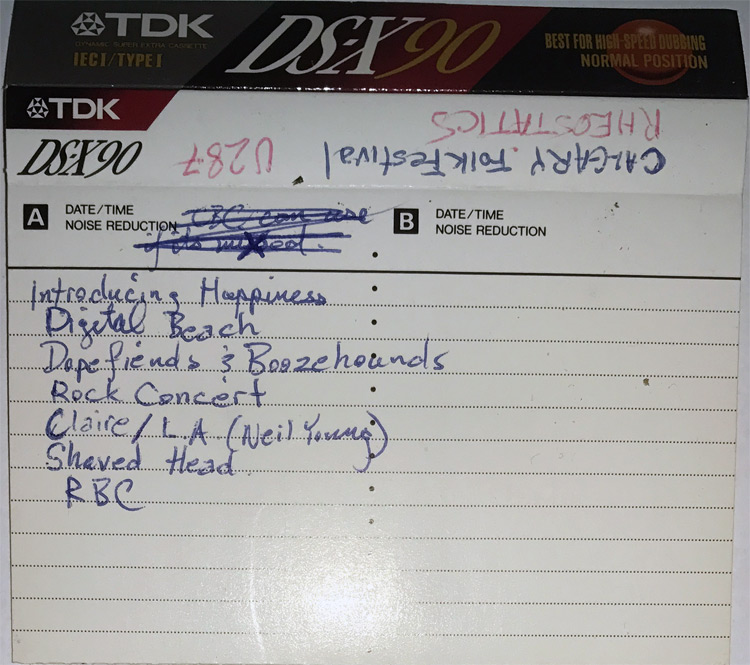
1996 is an interesting year for Rheostatics Live recordings.  In addition to this Folk Festival show, there’s a show they do at their old high school.  And then there are many shows with them supporting The Tragically Hip.

This is an acoustic set from July 1996 at the Calgary Folk Festival – don’t know exact date. It features Martin Tielli, Dave Bidini and Tim Vesely. There is no drummer though Tim does play a bit on My First Rock Concert. Dave Allen plays violin on Shaved Head and RBC and Dan X of the Rhinos and played drums on RBC. It’s available here.

The introduction is a nice one: “My favorite eastern band… the Rheostatics.”  Dave jokes, playing like you’ve never seen them before.

Teh show (which is fairly short) sounds very different.  It’s all acoustic and they seems to have created special arrangements for the songs.

For the first few songs it’s just Martin, Dave and Tim.  They open with “Introducing Happiness.”  There’s a few sloppy moments near the end but otherwise it’s a very interesting version.  Tim says it’s “a song for my cats back home.”

Dave dedicates the second song (a delicate “Digital Beach”) to Graham James and his wife who drove out here “from somewhere in Saskatchewan to come and see us play and to take in the weekend and the festivities.”  He asks, “any other people from Saskatchewan?  We love that place.  We love Melville.

There’s a long intro for a mellow “Dope Fiends” that features some really great harmonies.  It’s very loose and fun with the guys shouting out lines. It feels like a real campfire version.

After the song Martin says, “It’s hard to sit down.”
Dave: “You like sitting down?”
Martin: “Not particularly.”
Dave: “Me neither”
Martin “I’m squirrely as hell.”
Dave: “We thought if we sat down for once it would be a whole new thing and catch on.  But we plan to get up later for the show-stopping finale.”

Dave plays “My First Rock Show” (one of the earliest times I’ve heard it played live).  He says, “This is a song about attending a rock festival.  This is folk festival.  The song is the first time I went to a rock festival.  It was at the CNE (Canadian National Exhibition).  As the song starts he says there’s a Janis Ian kind a feel happening.

After Dave sings the “Took away the car keys” he says, “Timmy, get on the drums there, brother.”

After the song Dave says that earlier today we saw a young fellow with a tattoo.   A Rheostatics tattoo! It’s not real, it’s magic marker.  But you gotta show it off!  You rubbed it off?  Aw!

“Clarie” goes out to James Meritetch (?)  There’s a kind a classical opening and after the solo Martin segues the song into Neil Young’s “L.A.”

And then the guests start coming.  Dave says “A friend of ours from Kingston Ontario, a noted member of the drinking band The Mahones,  Dave Allen the doctor is in the house….  well …park.  We haven’t played with Dave for four years–he was on Whale Music.  He says they didn’t expect to see hm but he showed up at the festival and “they lassooed him, as you do.”  They play great, moody acoustic “Shaved Head.”

Then Dan Michell, Dan X of The Rhinos from Guelph and Kitchener–everyone here from Ontario is on stage now.  They play an interesting folkie “Record Body Count” with a violin. There’s an electric guitar solo.  Interestingly, they end with an extra chorus. And then they are gone.

The announcer says, “The Rheostatics!” …   “A drum stick!” … “The Rheostatics!”

It’s one of their more interesting shows and quite fun.

[READ: July 6, 2017] “Caring for Plants”

This was a rather dark story translated from the Korean by Sora Kim-Russell.  At first I thought that there was no way this story could be as long as it was–it seemed almost over when it started.  But then by the end, I wanted it to go on for many pages more.

The story opens with Oghi in the hospital.  He has been there for 8 days since the car accident.  His wife died in the accident and he was badly mangled.  He cannot speak, he is in incredible pain and is clinging to life thanks to an IV drip.  His face looks like a waffle stuck to the iron–that’s how his wife would have described it.  And worst of all is that he accident was his fault.

It took six months before he could go home. His mother-in-law had been taking care of his wife’s garden (the only thing his wife loved taking care of).  Since he cannot speak, his mother-in-law is more or less doing whatever she wants in the house–going through the jewelry and taking what she wants–things he doesn’t even recognize. (more…)

Read Full Post »

[LISTENED TO: August 2017] The Trouble with Twins

I grabbed this book because it seemed kind of interesting.  I see also that this book was released in the UK as Missing Arabella, which I think is a slightly better title).  I wasn’t entirely sure if we’d like it.  I mean, we don’t have twins and this is about twins and I wasn’t sure that our 12-year-old boy would like a book about twin girls.

But holy cow was this book outstanding!  It was utterly hilarious and the way it was read aloud was genius.

The book begins with this wonderful setup:

And so it begins in front of the fire, the story of two twin sisters.  One remains with her family in their lovely country house, where yellow roses perfume the air.  The other waits for her in another house, where she stands alone at huge arched windows.  She is restless, pacing wooden floors that creak in the night when a cat jumps down from the bed to chase at shadows.

And then in different typeface:

“What are their names?” the girls asks.  “The sisters.”
“Arabella and Henrietta.”
“Are they lonely,” asks the girl.
“They belong together,” says the mother.  “And it makes them sad to be apart.”
“Can’t you tell a happy story?” the girl asks.
“With puppies and a garden?”
“Yes!” says the girl.
“I’m only telling it the way my mother told it to me,” the mother says.
“And will there be puppies?” the girls persists.  “Or only gloomy girls at windows?”

(more…)

Read Full Post »

[LISTENED TO: August 2017] Adventures with Waffles

I saw this book in the library and the title sounded interesting. The blurb on the back when enticing as well, so I grabbed it for our family road trip.

I had no idea that the book was a translation of a Norwegian story (Vafflehjarte) nor that it had already been translated into English as Waffle Hearts (a much more accurate, and frankly much more satisfying title).  I gather from a little research that Waffle Hearts is a British translation and Adventures with Waffles is an American one (although they both have the same translator, Guy Puzey).

The story is about Trille and Lena, two kids who live next door to each other in the village of Mathildawick Cove in Norway.  Their village is small and there are only 9 kids in their grade.  Lena is the only girl. The bully Kai-Tommy wishes she weren’t in their class.  But Trille feels that Lena is his best friend (he hopes it is reciprocated, but is unsure).  She is wild, she is spontaneous, she is dangerous.  And she is a lot of fun. (more…)

Read Full Post »

SOUNDTRACK: VANILLA FUDGE-The Beat Goes On (1968).

I thought the first Vanilla Fudge album was odd–covers of contemporary songs done slowly and with little resemblance to the originals.

Well, this second album was downright bizarre.

It  doesn’t really have any “songs.”  Rather, it’s more of a collage–a history of recorded sound as interpreted by the Vanilla Fudge.  There’s a few snippets of classical pieces, some rocks songs, historical vocal recordings and final words from the guys in the band.  All sandwiched between snippets of them playing The Beat Goes On, the Sonny Bono song.

It’s a weird enough record on its own, but when you read just a little but about it, it gets even weirder.  According to the Wikipedia entry:

The group was at odds with producer George “Shadow” Morton during recording, as Morton made his own concept album without significant input from them. In the liner notes of Sundazed Records’ 1990 CD reissue, the band denounces it as a failed experiment on the producer’s part.     ….
In his autobiography Stick It!, Carmine Appice declares: “Even listening to it now – which, let me tell you, I rarely fucking do – The Beat Goes On sounds like an album that Spinal Tap would be wary of making.”

The album opens with an instrumental “sketch.”  It is primarily the Vanilla Fudge keyboard sound with some occasional piano and guitar sounds washing in and out.

After a recording of Thomas Edison reciting Mary Had a Little Lamb, a ponderous voice says PHASE ONE and they start with the first iteration of “The Beat Goes On.”

Then comes what is now probably the fourth surprise already.  The track is titles “Eighteenth Century: Variations on a Theme by Mozart: “Divertimento No. 13 In F Major”” and it’s 45 seconds of Mozart on harpsichord!  It’s followed by a 45 second version of “Old Black Joe” by Stephen Forster, this time sung quietly with acoustic guitar and bass.

That was meant to represent the nineteenth century.  The twentieth century has a bit more diversity with Cole Porter, Glenn Miller and Elvis.  There’s rags on piano with a trap drum.  “In the Mood” sounds like it’s in a roller rink and “Hound Dog” sounds really tinny and awful.  The music is played perfectly, but the quality of the recording is deliberately (I assume) poor.

The next section is called The Beatles, because they clearly didn’t record enough Beatles on their first album.  But this time they do it more like the originals, not like the Vanilla Fudge.  In less than two minutes, they run through excerpts from “I Want To Hold Your Hand,” “I Feel Fine,” “Day Tripper,” “She Loves You,” and “Hello Goodbye.”   Except that for the final track they sing “You say hello and I say goodbye…”  And they laugh into…

PHASE TWO.  This has another version of “The Beat Goes On” followed by six minutes of Beethoven (if you;re keeping track, Beethoven was before the 20th century).  They play “Fur Elise” & “Moonlight Sonata” on keys with bass.  But it builds up with rocking drums and   build rocking with drums and keys and guitar.  It gets crazy fast and loud.

Then another version of “The Beat Goes On” followed by another version of it (the original would have switched sides at this point.

PHASE THREE is called “Voices in Time” and it is literally 8 minutes of historical recordings by: Neville Chamberlain, Winston Churchill, Franklin Delano Roosevelt, Harry S. Truman and John F. Kennedy.

Then on to PHASE FOUR which after one version of “The Beat Goes On” is talking sections with the band members.  They are labelled “Merchant/The Game is Over”

Vinnie on guitar says a few things concluding with “As life goes on, the beat goes on.”  Tim on bass does an “interview” in which he (or someone) asks him questions which he answers–about sex, politics and ice cream among other things.  He sounds pretty much  like an ass.

Carmine says “I play drums.  Listen to my drums if you wanna hear me talk.”  And finally after some Indian style music comes Mark the lead vocalist.  He uses his time to read a bit of the Bible, a passage about Moab.

The whole business ends with the longest yet version of “The Beat Goes On.”

The CD comes with a Bonus Phase.  There’s a cover of The Beatles’ “You Can;t Do That” and an original  These two songs are certainly the highlight, especially their original song “Come By Day, Come By Night.”  I love the bassline and choral voices.  This really points out what a waste it was not to record their own songs.

The sixties were a weird time.

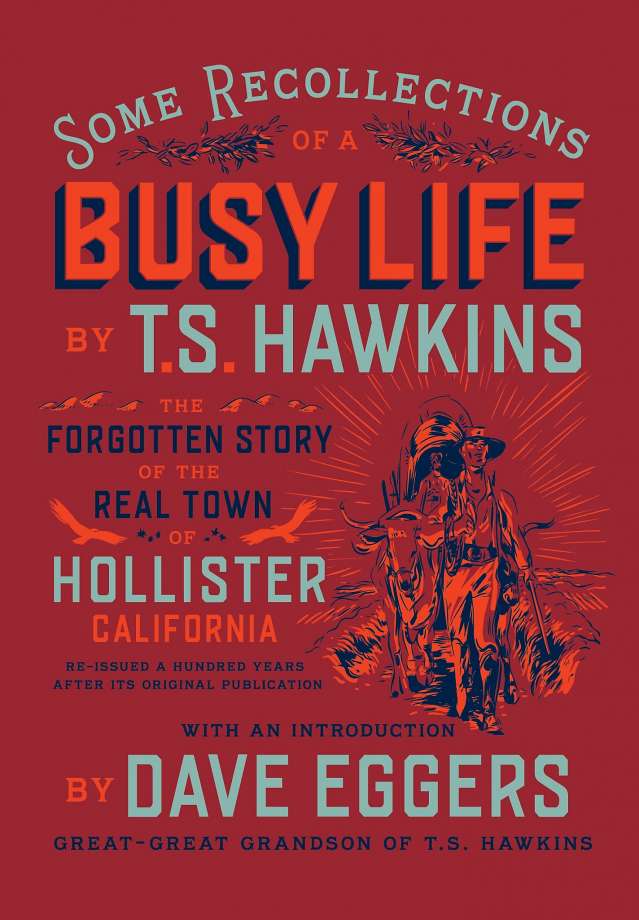
[READ: July 22, 2017] Some Recollections of a Busy Life

The beginning of this book includes Dave Eggers’ essay that was in the New Yorker, July 20, 2015 issue.

Read about it here.

T.S. Hawkins was Dave Eggers’ great-great grandfather.  In 1913 Hawkins wrote Some Recollections of a Busy Life and printed 300 copies.  Now 102 years later, Eggers was able to use his press to get it reprinted,

What’s even more disconcerting is that we’re prepared for the book to be 102 years old, but it starts with Hawkins talking about what it was like seventy years ago.  So the beginning of this book is actually set in the 1840s and 50s.  He was born March 6, 1836 in Missouri about 12 miles from the Mississippi River. His grandfather had been from Virginia and then moved to Kentucky and then on to Missouri.

He is writing his recollection not believing that the general public would care about them but he hopes his children and grandchildren might be interested in the changes which have taken places over the years of their grandfather’s life.

He grew up West of the Mississippi with no railroads and no telegraphic or telephonic communication with the rest of the world.  News in the East took weeks to reach them.  Electrical lighting was a thing undreamed of.  They made their own soap with the ashes from their fires.  Their clothes were homemade. (more…)

Read Full Post »

pittanecSOUNDTRACK: VALLEY QUEEN-Tiny Desk Concert #547 (July 8, 2016).

valley-queenTypically, but not always, bands that play the Tiny Desk Concert are fairly established.  Valley Queen had only released a couple of singles on bandcamp when they performed theirs.

Bob Boilen had seen them at SXSW and was impressed enough to bring them in.

They play three sings that are bright and sunny all centered around Natalie Carol’s soaring voice.  Sometimes it feels like her voice gets away from her (could be the setting), but for the most part she sings wonderfully with a distinctiveness that I rather like.  At times, her voice sounds like an old English folk singer–dare I say unencumbered by precision.

The band plays a kind of light and breezy folk (the main guitar is a hollow bodied electric).  “In My Place” is a pretty song that really comes to life when the rest of the band adds their harmonies for the chorus. It’s really catchy with a lot of delightful guitar lines.  The way the song ends on a high note (literally) is pretty cool.

I also really like the way the bass is largely unobtrusive but occasionally plays some interesting lines that add some nice lines while the other instruments are jangling along.

I don’t quite understand what her accent is.  In the second song, Hold on You” there are moments where she enunciates in such a strange way.   This song is pleasant although somewhat unremarkable.

After the second song she says that they would have been jazzed just to take a tour of the place, so they’re really excited to be playing there.

The final song is more dramatic and instantly grabbing.  I love the chord progression of the chorus.  The way the chords bounce along as she sings that one word “Ride” and holds it for a long time.  I love the vibrato guitar sound which gives it a strangely 4AD quality.

My first listen through I wasn’t all that taken with these songs, but by a third listen I was really hooked.

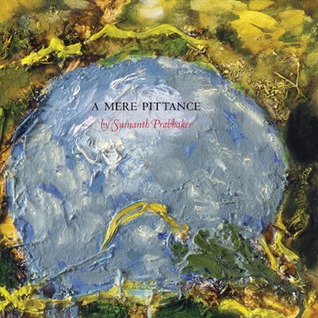
[READ: November 18, 2016] A Mere Pittance

Back in 2014, I ordered all 16 books from Madras Press. Unfortunately, after publishing the 16 books they seem to have gone out of business (actually they are switching to non-fiction, it seems). They still have a web presence where you can buy remaining copies of books.  But what a great business idea this is/was

Madras Press publishes limited-edition short stories and novella-length booklets and distributes the proceeds to a growing list of non-profit organizations chosen by our authors.  The format of our books provides readers with the opportunity to experience stories on their own, with no advertisements or miscellaneous stuff surrounding them.

The format is a 5″ x 5″ square books that easily fit into a pocket.

Proceeds from Prabhaker’s book go to Helping Hands Monkey Helpers.

This story is constructed entirely in dialogue.  We never learn the names of our speakers and the location of one of them is a closely guarded secret.  The story is mildly challenging to read.  In part because its’ dialogue (it’s mostly easy to follow, but you always get parts where there’s silence or a number of Yeses in a row that tends to confuse the speakers–that’s quickly resolved, though), but also because one of the speakers is deliberately trying to obfuscate things. (more…)

Read Full Post »

shadowSOUNDTRACK: ERIC CHENAUX-Skullsplitter [CST112] (2015).

chenAn album named Skullsplitter sounds like it should be really heavy and loud.  But if you know Chenaux, you know that that’s not his thing at all.  So what wins?

The traditional Chenaux wins.  At times light and beautiful and at times wobbly and disorienting, Skullsplitter sounds like many other Chenaux releases.  And you either like him or you don’t. His slow songs, vibratoed guitar and really delicate voice either win you or not.

“Have I Lost My Eyes?” has one of the most wobbly guitars I can thing of (even for him).  The slow electric guitar solo is pretty much perpetually played with wah-wah bar in motion.  After 90 second of this, Chenaux’s delicate tenor voice comes in and sings a melody that is not exactly suited to the music, but which doesn’t sound off, either.  Classic Chenaux.

Alternating with the vocal pieces are instrumentals.  Chenaux plays a lot of ringing and delicate solos and overdubs them.  And the instrumentation is pretty varied: Voice, electric guitar, un-amplified electric guitar, nylon-string guitar, speakers, melodica and electronics.  “The Pouget” is roughly two minutes long.  “My Romance” has a kind of warbling guitar solo over some mellotron.  “The Henri Favourite” is another 2 minute slow piece with a slow guitar solo played over some keyboards.  The last instrumental is quite different.  “La Vieux Favori” changes the tone with a bowed sound (although you can see there’s no violin listed–he must be bowing the guitar).  It doesn’t have the same smoothness as the other songs, although it is certainly interesting, especially near the end when it is just that bowed instrument with no accompaniment.

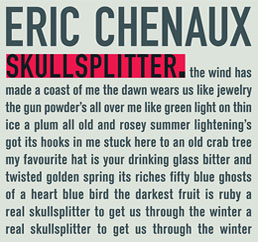
“Skullsplitter” is, as I said, a mellow song just like the others.  His voice is relaxing and calming and the music is also mellow with waves of keys.  I’ve never really tried to figures out the words to any of his songs before–he sings so slowly it’s kind of hard to follow the thoughts.  But the lyrics to this song are the cover art.  And seeing them printed, I still don’t know what they mean.

“Spring Has Been a Long Time Coming” is the most friendly song of the bunch–music and vocals meld perfectly, and Chenaux’s guitar sounds beautiful.  The 8-minute “Poor Time” has a jazzy feel as it unfurls slowly.  It intersperses his vocals with a delicate but wildly-wah-wahed solo.  The final track, “Summer & Time” ends the disc with some pretty acoustic guitars and Chenuaux’s delicately soaring voice.

[READ: June 1, 2016] Lighter Than My Shadow

I was looking on the shelves in the library for some books and I saw this book on the shelf next to them. I loved the title, Lighter Than My Shadow and when I pulled it off the shelf, I really liked the drawing style that Green employs.

I genuinely had no idea that this book was going to be about woman suffering from body issues and anorexia.  It all seems obvious, but i didn’t look that closely at first.  Such a topic could be really hard to read about, but I was also really surprised and delighted at how good the book was.

She covers her mental state in all capacities.  And she really demonstrates the way her body rebelled against herself.  In fact, this was the most compelling and complete look at anorexia that I have ever seen.

There is something about the way her drawings style–simple figures and even simpler backgrounds work perfectly in this story.  She is able to show herself getting thinner without resorting to shocking illustrations (well, there are one or two mildly shocking ones).  The most effective part of the book is the black scribble that hovers around her representing her interior self. (more…)

Read Full Post »

1282008SOUNDTRACK: MARIACHI FLOR DE TOLOACHE-Tiny Desk Concert #499 (January 8, 2016).

florI enjoyed Mariachi El Bronx not too long ago.  I guess I didn’t expect much more from Mariachi Flor De Toloache.  But wow, they blew me away.

I compared them to Mariachi El Bronx because they also wear the traditional Mariachi outfit and they use the somewhat comically over sized guitarron (played by Lisa Maree Dowling).

But about a minute through the first song, “Let Down” when the three women sing harmony (a wonderful three-part harmony)–it’s already amazing.  And it just gets better.

“Let Down” is a slow song sung (in English and Spanish) by Shae Fiol who also plays vihuela (which has a great sound for a tiny four-stringed guitar).  The trumpet solo (by Anna Garcia) is great and interesting and the pizzicato violin notes really add character.  But when the song suddenly picks up tempo half way through it gets really fun.  And then Shae sings the first of several beautiful and amazingly long notes.

The second song is a cumbia called “Dicen.”  This one is sung by the violinist Mireya Ramos who says “dont be shy, shake you shoulders “.  There’s group harmony and then she gets the audience to sing the chorus “Ay Ay Ay.”  The song merges into a verse of “Blue Skies” which makes the song even more fun.  Shae sings this part and once again shows off her vocal skills with some more amazingly powerful high notes.  And then Mireya really shows off her fiddling skills with a great solo and some dexterous bow work.  And then she shows off her own amazing vocal notes–holding an incredibly long note through several octaves with great control.

After those first two songs (16 minutes worth), they do yet another one.  This one straight from Mexico (the roots of mariachi) called “Guadalajara.”  It opens with great harmony vocals and a cool vihuela strumming until the trumpet announces a good old mariachi song.  Shae once again amazes with her high shrieks and calls.  And by this time the entire audience (even those of us listening at home) are totally into it.

How do they hold these notes for so long?  (Some are around fifteen seconds). It is truly a wonder to behold.

This was only a fraction of the band and apparently when they are all together live they are really something to see.

[READ: January 9, 2015] “The Reptile Garden”

With a name like “The Reptile Garden,” this story did not do anything that I thought it was going to. In fact, when I finished I had to rethink the story to remember why it was even called that.  That’s pretty cool (since it works).

The story is set in the fall of 1972.  The narrator is a half Native American woman who is going to study at the University of North Dakota.  She is very smart but she knows she doesn’t fit in.  She chose to study French because she dreamed of going to Paris some day.

She says the white girls listen to Joni Mitchel and grow their hair long, while other girls–Dakota, Chippewa or mixed blood like her were less obvious on campus.  Aside from a few who swaggered and had American Indian Movement boyfriends.  (more…)

Read Full Post »

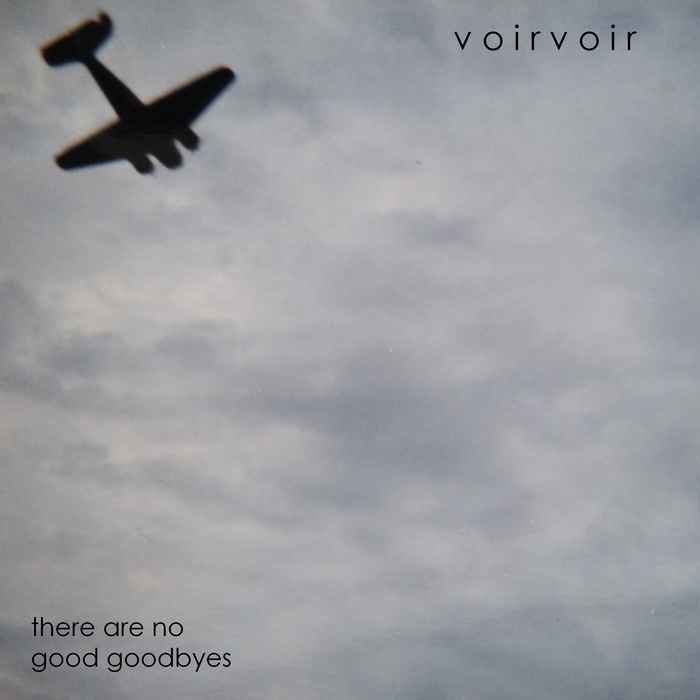
azyoumeSOUNDTRACK: VoirVoir-There are No Good Goodbyes (2015).

voiroivrVoirVoir eluded me at Musikfest this year.  I was supposed to see them open for the Flaming Lips but my shuttle arrived late.  And they played THREE TIMES on the following Saturday, but we couldn’t coordinate getting to a stage where they were playing.  Which is  shame because after missing their set the first night, I bought their CD and really liked it a lot.

My copy of the CD looks like the one at the right except that someone in the band hand cut out two irregular shapes in the cover so you can see through to the back, which is a cool touch.

The album itself is mostly punky and fast with vocals not unlike Superchunk or more accurately Built to Spill. Not that they copy either band, but you get that comfortable rocking feeling from these songs.

“I Wanna” is such a great opening statement. After the fast punky verse there’s a slower chorus which is just as catchy as the verses.  I could listen to this song all day.  “Make Your Bed” also has a wonderfully catchy chorus—the way it shifts into such an upbeat song after the buzzy and feedback filled verse is wonderful. “Stupid for Now” reminds me a lot of Built to Spill—there’s no guitar solos or anything, but in the catchiness and slow build of the verses and the much slower but still catchy chorus. It’s a great song.  And I love that there is a  glockenspiel as well as the guitars in the mix. “His Last Sound” continues in this vein with another great chorus.

Track five opens with a surprise when a new vocalist enters the mix.  My copy of the CD has precious little information about the band–just a list of names.  But I’ve pieced together some details to determine that the main vocalist is Matt Malchany and the female vocalist is (I assume) April Smith.  So “Be Your Machine” opens with Smith singing and her voice is great–hushed and deep–a stark contrast to Malchany’s voice, which takes over after the first verse.  She (or perhaps both women, guitarist Emily Meixell is also in the band) provide backing vocals to the more delicate chorus.

“Let’s Not” plays with the loud/quiet, male/female dynamic more as the verse is brash and loud and sung by Matt and the bridge is quiet and sung by April.  Then they mix it up further with a later quieter section sung by Matt.

“There are No Good Goodbyes” is a gentle song sung by April.  It has really interesting swirling guitar noises that are almost ominous.   I love the way she sings the chorus slowly as the music builds and builds faster and faster.  “If Miles Were Years” has some interesting dissonance as well, especially the closing ringing notes.  And once again, there’s a catchy chorus. I also really enjoy how much attention is paid to the percussion at the end of this song and many others (nice job Josh Maskornick).  And lest I forget bassist Matt Juknevic who keeps the rhythm steady throughout the variations of tone.

“Down Together” slows things down with a martial beat and a duet of vocals. It has couple of moments of loudness that build and drop off only to return to the delicate sound of the beginning.  The final song, “This is a Drag” is indeed a bit of a drag. It’s slow and repeats that chorus in a kind of monotonous voice.  It doesn’t really play well with the rest of the album, even if the end does build (and yes maybe by the you’re enjoying singing “this is a drag” along with them).  I can imagine it might be fun live if they can let it build and build and jam on it for a while, but the rest of the album is so up and fun that this closer is kind of a drag (especially since it’s the longest track on the record).

But despite that, I absolutely love this album.  And I love the way I discovered it, and I love that are from Bethlehem, PA, which means I’ll be able to see them live one of these days, surely.

Check out VoirVoir at their bandcamp site and order their album!  We need to hear more from them.

[READ: July 27, 2015] The A to Z of You and Me

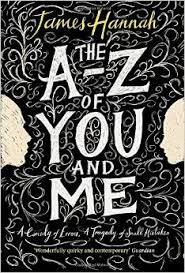
I admit that I am a sucker for stories that work along a kind of theme (or gimmick).  But only if the book is done well.  And when this book had the subtitle of A comedy of Errors, a Tragedy of Small Mistakes, it seemed interesting enough to dive in.

When I say that this book is narrated by a man in hospice, you can be sure that that information would normally be enough for me to stop reading.  The last thing I need to do is read a book by someone who is dying–especially if he is only 43.

But the way the story is told is really intriguing and it unfolds the plot in such a great way.  The A to Z part is something that the hospice nurse has told the narrator, Ivo, to do to keep his mind active.  Think of a body part for each letter of the alphabet and then think of the most interesting thing that has happened to that body part.  And so page one starts with Adam’s Apple.  And while he doesn’t exactly think back to his own, he does remember a teacher’s Adam’s apple from grade school and how it left quite an impression on his young life.

The book is written in first person but is mostly directed towards “you.”  And “you” is the woman that he was dating whom he is no longer dating. (more…)

Read Full Post »

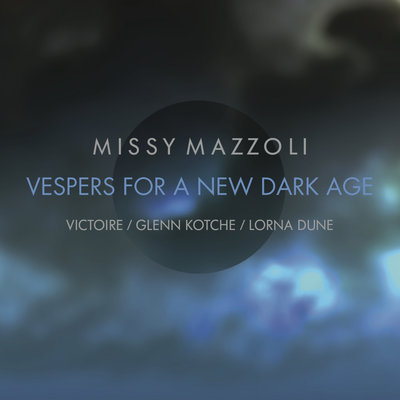
ampsSOUNDTRACK: MISSY MAZZOLI-Vespers For A New Dark Age (2015).

missymazzoli_sq-80d1109aad30ab9a4bfe1a45d5c82d99354bc079-s400-c85Missy Mazzoli’s Vespers for a New Dark Age, is a 30-minute suite for singers, chamber ensemble and electronics. The piece was commissioned by Carnegie Hall for the 2014 Ecstatic Music Festival.

It’s a fascinating mix of traditional and contemporary instruments.  And there’s a surprise musician as well: Martha Cluver and Virginia Warnken Kelsey from Roomful of Teeth, provide operatic soprano voices.  Mazzoli’s own ensemble Victoire, provides the music while Wilco drummer Glenn Kotche adds percussion and thunderous pounding.

As the suite opens, electronic chimes sound before the beautifully soaring voices come in (I don’t know who is who).  The instrumentation is complex and the vocals are often in English (but operatic and not always obvious to hear). There’s some great rising and falling notes from various instruments.

The first piece is called “Wayward Free Radical Dreams” and I like the surprise of the simple English phrase “Come on, come on come on” A bell ringing is the segue into part 2, “Hello Lord.”  Over a lonely flute and some synths, the vocalist sings a poem by Matthew Zapruder for lines like: “hello lord / sorry I woke you / because my plans / are important to me / and I need things / no one can buy / and don’t even know / what they are / I know I belong / in this new dark age.”

I love the rising and falling notes of “Interlude 1″ over the fast violin moments.  “Come On All You” opens with some ticking hi-hats and squeaky violins.  There’s a lot of drums in this song—some punctuate the melody until the soprano voice takes over and then around 4 minutes into the section, the drums burst to life.  “New Dark Age” has some moody synths under the soaring voices and “Interlude 2” opens with the sound of big deep bells.

“Machine” has a mechanical staccato feel in both strings and voices.  When it returns to “Come on Come on” refrain (this time with two voices), it’s very cool.  The “Postlude” ends the piece with moody strings and distorted mechanical sounds that overwhelm the voices at times.   The piece ends on an up note but not in an overwhelmingly happy feeling.

The final piece on the disc is not part of the suite, although it fits in sonically.  It is called “A Thousand Tongues (Lorna Dune Remix)” and it has echoing pianos and overlapping synths.  While this piece is pretty it is probably the least interesting of the disc.  Perhaps because there are fewer voices and more synth melodies.  Perhaps because it is a remix.  The song feels fine, but not as compelling as the suite.

I was happy to discover his disc, which really explores different classical motifs.

[READ: March 15, 2015] All My Puny Sorrows

As with many books, but especially those published by McSweeney’s, which I always read, I didn’t really know what this was about.  I can pretty much guarantee it would not have been high on my list had anyone told me it was about dealing with a suicidal sibling.

But what’s great about the McSweeney’s imprint is that they gather such a wide variety of books and most of them are of such good quality that I know I won’t be disappointed.  And this book not only didn’t disappoint, I found it really fantastic.

The story is fairly simple, although from my perspective it was also fairly exotic.  The main action of the book takes place in present day Winnipeg.  But there are flashbacks to the main characters’ childhood in 1979.  And the way it opens–with the family watching as the house that their father built is put on the back of a truck and driven away is one of the more memorable opening passages of a book that I’ve read.

The family consists of the narrator  Yolandi, her older sister Elfrieda and their parents.  And, perhaps most exotic to me they are Mennonites.  Their family is not entirely pious in the tradition in their town–they are seen as somewhat less than observant.  Things were made even worse by the deliberately provocative nature of Elf.  She was creative, she loved to read and she had a real sense of outrage.  The church pastor once accused her of “luxuriating in the afflictions of he own wanton emotions.”  She embraced poetry, particularly the line “all my puny sorrows” and decided it would be her slogan.  So she began spray paining AMPS all over the town. (more…)

Read Full Post »

curesSOUNDTRACK: PHISH-Billy Breathes (1996).

billyBilly Breathes is a much more mellow, acoustic feeling album from Phish.

Although the opener “Free” is a great song, with wonderful riffs.  It’s another of my favorites live, although the production sounds a little flat here, but the harmonies are great.  “Character Zero” again has a real ZZ Top feel (something many don’t really associate with Phish I’m sure).  But once the song proper kicks in, it rocks in a very Phish way.  “Waste” is a delicate song about insecurities that turns into a nice love song.  “Taste” is a rollicking piano-heavy song that gets played live pretty often and it sounds good here.

“Cars Trucks Buses” is a 2 minute instrumental that has a lot of organ in it, it’s very groovy.  “Talk” is an acoustic guitar/folky song.  You don’t hear it much live.  “Theme from the Bottom” gets us back into often-played territory, with its weird opening riff.  I really enjoy the way the bridge goes into a brief minor key, despite the overall happy vibe.  I like the harmonies towards the end, although the actual end of the song is a bit dull (the live endings are a bit more fun).

From here the album mellows out a lot.  “Train Song” is a pretty acoustic number with nice harmonies.  “Bliss” is an acoustic guitar solo.  “Billy Breathes” has more delicate harmonies and an acoustic feel.  “Sept Away” is another delicate short (90 second) song, with some more great harmonies. “Steep” is a slow, simple song (also 90 seconds) that has a pretty melody but serves more as an introduction to “Prince Caspian.”   “Prince Caspian” is a great epic-seeming song (even though it’s only 5 minutes long).  The build up is long , with the pretty chords repeating and growing fuller.  It’s a great live song and a great ending to this disc.

Although this disc has some great songs on it, it’s definitely not my favorite overall.

[READ: October 4, 2013] The Miracle Cures of Dr. Aira

This was another weird and fun book by César Aira (one of about six books he wrote that year). This one was translated by Kathleen Silver.  Ever since reading that Aira doesn’t edit his books—that he simply begins writing and lets the story keep coming out–I’ve grown suspicious of the beginnings of his stories. And so I am with this one. In the beginning there’s a whole thing about Dr Aira sleepwalking through a town.  He wakes up in various places, unsure where he is, but he’s never lost because he knows the streets so well.  This goes on for a few pages and then the plot kicks in.

Dr Aira is picked up by an ambulance—a man is dying right there in the ambulance and only Dr. Aira can save him.  Won’t Dr Aira help him? The Dr. refuses point blank.  He is convinced that this whole thing is a set up—why else would the ambulance (which he had heard for many blocks going up and down the street) be driving around with a sick man looking just for him instead of going to the hospital?  He will not help this man.  Disgusted, the ambulance driver pulls over and the Dr gets out.

So what is all this about? (more…)

Read Full Post »

« Newer Posts - Older Posts »