Feeds:
Posts
Comments

Archive for the ‘History’ Category

SOUNDTRACK: WALTER MARTIN-Tiny Desk Concert #679 (December 1, 2017).

Walter Martin’s name didn’t sound familiar.  So this blurb helped:

Best known as a singer and multi-instrumentalist with the band The Walkmen, Martin has spent his solo career making unabashedly joyful, sweetly innocent and playful music perfectly suited for quirky four-part harmonies.

I sort of know The Walkmen; I know them more as an outlet for Hamilton Leithauser.  But after watching this, I find Martin to be a more satisfying performer.

I really enjoy his easy singing style and the every loose way he has with his guitar and with the songs in general.

Only Walter Martin would bring a barbershop quartet to the Tiny Desk.   The barbershop quartet is known as The Glen Echoes, a group of singers he found online and met for rehearsals the day before coming to NPR. It works particularly well on the song with which he opens this performance, “I Went Alone On A Solo Australian Tour,” a brilliant and comical call-and-response story-song about, well, going alone on a solo Australian tour.

“I Went Alone On A Solo Australian Tour,” is indeed really enjoyable.  Martin is casual and I love how the quartet starts out singing with him, then questioning him and then just acting like casual acquaintances–he asks them questions, too and they sing the responses.  All without losing the pacing.

It’s funny but also thoughtful.

The second song, the equally charming if slightly more wistful “Me And McAlevey,” is about a dear friend who lives in Maine.  It’s about friendship and loyalty and life as a middle-aged father.

The song is relatively simple and straightforward, but the guitar picking is delightfully complex and pretty.  I really like his vocal delivery and the way he ends his verses.

Martin closes with “Sing To Me,” his best-known song, thanks in no small part to its appearance in an Apple ad.

He describes it as the romantic centerpiece of his children’s album.  It is a pretty song once again, with lovely sentiments.  The pianist switches to electric guitar for a rather different sound.

The whole Tiny Desk Concert is delightful and makes me want to check out more of his stuff.  There’s no mention of who play what, but the mudsicians were:  Josh Kaufman; Jamie Krents; Brian Kantor; Richard Cook; Ken Sleeman; Mike Holmes and  Al Blount.

[READ: March 28, 2017] Becca and the Prisoner’s Cross

This is the second (and final) novella in the series.  It comes between books 2 and 3.  And, as the title suggests it is all about Becca.

The end of book 2 had Becca “materialize” on a boat in the past–right next to Nicolaus Copernicus.  It was a weird ending for a book that while sometimes magical, seemed to follow some kind of reality.  But this was different.  What could it mean?

Well, this novella explains it all (sort of).  We suspect that Becca’s proximity to the Kronos device when it went off triggered something.  (I keep wondering if it has something to do with her hurt arm which, frankly, shouldn’t hurt anymore, it has been two weeks, right?).

Anyhow, what we determine is that Becca is sort of passing out at home and her mind is travelling to Copernicus.  No time passes at home, but she is able to spend time with the scientist.  The best reveal comes early in the book when Copernicus senses that someone is there as well. (more…)

Read Full Post »

SOUNDTRACKPHISH-Live Phish Downloads 7.6.98 Lucerna Theatre, Prague, Czech (2007).

After finishing recording “The Story of the Ghost” in Vermont and Bearsville in upstate New York, Phish embarked on June 27th for a short European tour.

What’s interesting is that the official comments about this show talk about hoe legendary it was, and my takeaway was just how often someone (usually Trey) messes up.

“Buried Alive” is a surprising opening track.  It rocks and segues into a choppy “AC/DC Bag.”  The song ends with a funky section that segues into a 15 minute “Ghost.”  “Ghost has a fast and scorching middle jam section.”  I’m going to include some of the online notes here:

They deconstructed Bag’s concise jam into a perfect segue to the centerpiece of the show – a fast, funky and furious “Ghost.”  You can clearly hear the sonic flourishes layered over a driving groove with confident vocals that seethed energy. The dynamic feel of “Ghost” lent deep drama to the lyrics, highlighted the loops and effects and provided an ideal platform for some hairy soloing. Page migrated from piano to synthesizer, Clavinet to Rhodes in a floating conversation with the band. Eventually “Ghost” took on an electronic tinge that hinted at the deepest post-hiatus improvisation. This was fueled by Trey’s Hendrix-esque leads with bent tone and pitch into a series of shifting polyrhythmic counterpoints. Expanding until it seemed the room would explode, the music evolved into a funky groove with starts and stops punctuated by the now-roaring crowd.

“Ghost” segues into Talking Heads’ “Cities” which has a really sharp (weird) drum sound.  There a lengthy intro before the song starts properly.  The choruses are really slow (and someone plays a wrong chord).  But the song end with a really groovy solo that encourages people to clap along.

“Cities” started in double-time and shifted effortlessly into normal rhythm for the first chorus and the rest of the song. With the lyrics “a lot of ghosts in a lot of houses”, “Cities” continued the eerie theme of this already-historic performance, blending a smooth, creative vibe with an aggressive, rocking attack. Seemingly on cue, the band dropped out of “Cities” and left Trey to end the song alone with the clapping crowd. The momentary pause after Cities was the first time the band stopped at all, having linked Buried > Bag > Ghost > Cities into a powerful opening sequence for the ages.

“Limb By Limb” is mellow with Trey on guitars.

 “Limb By Limb” followed. Written by Trey on a sequencer with a drum part intended to stump Fish, Limb is always a feat of execution. This performance exhibited an added sense of dynamics no doubt spurred on by the intimate setting, highlighting restrained melodic dialogue among the whole band. While sometimes this jam breathed fire, this groovy interlude danced intricate circles around the glowing embers, leaving space for Fish to lay down some outrageous fills and cymbal work. Trey’s final solo culminated in repeated guitar fanning, which brought the song to a cathartic close.

Then comes “Train Song” and “Roggae” which gets more mellow by the end.

“Train Song” provided a moment of tranquil reflection in the middle of the set. The second-ever live “Roggae” followed, giving a chance to show off more new material in a new country as the band fashioned a coda with so much inherent space that the notes hung slightly suspended between phrases.

The 12 minute “Maze” perks everyone up.  There’s a lengthy keyboard solo followed by a nice solo from Trey.  During Maze the band stopped on a dime to thank the audience (and appreciate the architecture) , then finished the song.  It’s amazing how tight that was.

“Maze” blossomed into an electric improvisation starting with Page’s lively organ solo followed by a cacophonous solo from Trey who shredded unabashedly until the whole band telepathically stopped on a dime for him to say “We hope you’re all having a good time tonight…we just want to say that we really appreciate your support and how much we enjoy playing in Prague here.” Page interjected “We love the architecture” while Trey continued “I don’t think we got a chance to thank you last night so we just thought we’d take this moment to thank you very much.” After a quick countdown, the band re-entered the song in the exact shred-space they’d occupied before the acrobatic stop. After Maze, they closed the first set with Golgi Apparatus that had a rave-up ending with Trey shouting, in an apparent nod to the World Cup Soccer quarterfinals, “Jon Fishman, Jon Fishman, Hey, Ho, Hey, Ho”.

I noticed that “Golgi Apparatus” has a whole series of mess ups—someone is in the wrong key and can’t get free.

Set Two opens with the fast verses of “Julius” and then the slow staccato “Meat.”

Set two began with a swinging “Julius” that got everyone moving and Fishman passionately testifying at the highest peaks. “Julius” led into “Meat,” a new song. “Meat” returned the show to its initial ghoulish theme, confounding the audience with its multiple stops and starts. Immediately after Meat came a soaring, adventurous “Piper.”

“Piper” is 19 minutes long with a scorching solo in the middle.

“Piper” stretched nearly twenty minutes and bumped up against the boundaries already shattered by “Ghost.” Piper sped into a ferocious jam characterized by intense guitar runs … before it settled into hard rock with plenty of room for the whole band to explore. Like the experimental “Ghost” in set one, “Piper” was fearless, building to massive peaks before floating off into a slower, more minimal section accented by loops from Trey and Mike atop Page’s piano and Fish’s cymbal rolls. This part of “Piper” hinted at “Fikus,” part three of the “Ghost” trilogy, becoming slow and funky before locking neatly into the rowdy reggae of “Makisupa Policeman.”

“Makisupa Policeman” is a little goofy and fun. “Petrov” (Page) sings lead vocals. During this song there’s a drum solo and Trey tells the audience that if the solo is long and boring they should just whistle to make him stop.

As he scatted around the lyrics of “Makisupa Policeman,” Trey uttered the key phrase, “stink-kind”, adding a touch of home with “policeman came to Vermont!” He handed things off to Page for a piano solo (calling him “Petrof” after the logo visible on the rented piano) during which Page developed a ska feel. Trey announced a drum solo next, saying if Fish soloed too long the crowd should start whistling, as the band did when he talked too much. Fish played along, rendering a minimal solo of high hat, kick drum and rim shots, returning to the song in the nick of time. After some dancehall-style dub effects, the band finished Makisupa and dove into David Bowie.

The 13 minute “David Bowie” has lengthy washes of guitars and some noisy parts.

A thematic jam hinted subtly at Santana before riding a dissonant wave into the ending changes of the second and final Bowie of the European tour. With scarcely a pause, Page hammered out the opening notes of Loving Cup, cementing the status of this magical night.  it segues into Loving cup a loose jam

“Loving Cup” is a loose, fun version running almost 10 minutes.  There is much cheering at the “I know I play a bad guitar” line.

The encore is “Possum.”  It’s kind of slow and loping but fun.

The band returned for an encore and repaid the rowdy crowd’s enthusiasm with Possum. The audience clapped along for a bit eventually leaving the band to a textbook performance that was at once conscious and passionate, restrained yet explosive. Trey dropped a quick tease of “Stash” as he propelled “Possum” through machine-gun fans entwined with soft, dynamic sections that made this a perfect encore for such an intimate show. As the crowd filtered into the streets of Prague it was clear that this had been an unforgettable night that could only have happened when and where it did.

So there’s two takes on the show.  You can read all of Kevin’s essay here. and I’m going to re-listen to this show to hear the magic foe myself.

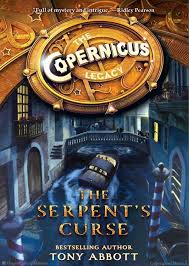
[READ: March 6, 2017] The Serpent’s Curse

This is the second full-sized book in the Copernicus series.  After reading the Copernicus Archives book I noted that the event of that book are not referenced in this book, but I was wrong.  There are several mentions to San Francisco.  It’s not a huge gap and you wouldn’t be lost without reading it, but it is odd that he would reference a book that apparently some people don’t read.

This book is pretty large–480 pages.  And I feel like it was kind of slow.  Or perhaps they just spent way too much time in Russia.  Or, and this is most likely the case–they spent the whole book looking for one relic.  And 500 pages is a lot of traveling for one item.

I’m bummed that I felt this way at the end because in the beginning I thought it was really exciting.  And Abbott filled in some things that a nitpicky reader might nitpick about with some interesting new developments.  One of the things that one has to wonder about is how this normal family will be able to jet set around the world.  Well, that comes with the assistance of a best-selling author with millions of dollars at his disposal.  Convenient? Sure.  But it’s a nice development.  The author, Terence Akroyd writes exciting thrillers (so of course he is interested in the plot) and he has a personal vendetta against the bad guys, so he’s happy to help out with money and resources, like his jets and technology. [That author is presumably not based on reality].

Terence also has a son, Julian, who is apparently pretty hot.  But he’s a few years older than our protagonists so presumably nothing will come from that.  Despite all of the potential romance between Wade and Becca in the first book and parts of this one, nothing is progressing on that front. (more…)

Read Full Post »

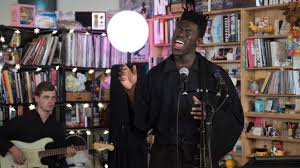
SOUNDTRACK: MOSES SUMNEY-Tiny Desk Concert #678 (November 29, 2017).

I had never heard of Moses Sumney before this show.  And the blurb seems to anticipate this:

If you don’t know this Los-Angeles-based force of nature, and haven’t heard him on tour with James Blake or Sufjan Stevens or perhaps on albums by Beck or Solange, then this is your chance to watch one of the most thoughtful talents of today as he makes music that is outside the box but easy to relate and connect to.

I’m very curious to know what he did with Beck.

I found Moses’ voice to be mesmerizing–a gorgeous soaring falsetto that he seemed to effortless get to rise higher and higher.  But beyond that, the blurb talks about his lyrics:

Moses Sumney puts a great deal of thought into the heartfelt music he creates. On his debut album, Aromanticism, he was inspired by everything from the works of Plato and Aristophanes’ account of the origin of humanity to the Bible, particularly Genesis and the story of creation. It’s all in an attempt to understand human relationships and the sorts of couplings we tend to be drawn to.

He plays 3 songs in the 20 minute time frame.  I wanted to describe the first song, but Bob’s description is too good:

The concert opens up with Moses not behind my desk, but at the piano we keep in our office. As his team of sax, harp and guitar players set up, Moses sat at the piano and began to play “Doomed.” He had instructed the band, which had already perched behind my desk 40 or so feet away, to create a transition for him to walk from piano to desk, continuing one of the most inspired 8-minute stretches I’ve witnessed here at the Tiny Desk.

So he plays the pretty piano melody and sings with those gorgeous falsetto vocals for about a minute and a half.  Then he strolls (in his cape) to the desk.  He activates some looping pedals.  He plays a beat on the microphone and then Sam Gendel plays a cool modified sax solo.  After 2 minutes of set up, he sings again.  The beats are in full and Brandee Younger is playing some simple gorgeous harp and Mike Haldeman has some echoed guitar on top.  Meanwhile, Sam has switched to a synth and Moses is also playing some kind of synth.  The song builds beautifully and he sings in a  higher and higher register.  It starts to sound otherworldly with the harp and his voice and the loops going faster and faster.  And then the wall of noise abruptly ends and the final minute is delicate and lovely.

He introduces the band and then says “we’re going to keep making noise.”  And then “hopefully no one’s printer goes off” (wonder if that happened).

“Quarrel” opens with him looping his own voice and then playing it faster and faster so it sound like a skipping CD.  Sam has picked up a guitar to pluck out notes (the head of his guitar is fascinating and I want to see it better).  Throughout the song Moses hits that looped vocal section for one or two seconds to add texture–it’s pretty cool.  The mix of that harsh(ish) electronic sound and the angelic harp is wonderful.

For the final song, “Plastic,” he removes his cape.  Everybody else leaves and he says “I want to make more room… for me!”  He picks up a guitar and says, “This is the end.  The bitter end.  Although for some of you, it will be sweet because it’s ending.”  It’s interesting how self-deprecating he is when his voice is so gorgeous.

This final song is much more jazzy with him playing interesting chords and singing to the guitar.  Overall it’s a bit less exciting than the other songs possibly because the last minute or so is just him repeating the line “my wings are made of plastic.”

But overall, Moses Sumney really impressed me with this set.  Right up to the end where he sinks slowly below the desk, to much laughter.

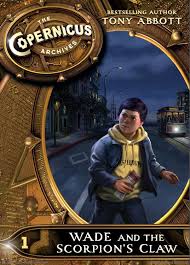
[READ: March 6, 2017] Wade and the Scorpion’s Claw

The Copernicus Legacy is a four book series.  But, in an interesting diversion, there are also two “extra” books inserted between the first two.  They are smaller and do not exactly affect the continuity of the main story, but they seem to delve into one character a little further (and there is some plot advancement).

Interestingly, Book One of the main series ends with Kaplans and their friends leaving Guam for New York.  The second book of the series opens with them in New York.  But this book, the first of the The Copernicus Archives, takes place between Guam and New York.  The big difference is that unlike the main books, this is told entirely from Wade’s Point of view.

En route to New York, the family has to stop in Hawaii.  They are in the airport for a while and they trust no one.  They are waiting for the flight to San Francisco when there are two notable people in the airport around them.  There’s a German man (you can tell by his shoes, Lily whispers) in a leather coat.  The kids don’t trust him and call him Leathercoat.  And then there’s a Chinese man doing acrobatics and other tricks to amuse some children while they wait. (more…)

Read Full Post »

SOUNDTRACKPHISH-Live Phish Downloads 12.7.97 Nutter Center, Dayton, OH (2007).

This concert included five covers out of a total of nineteen songs.

The show opens with a fairly slow “AC/DC Bag,” but there’s a seamless segue into an excellent cover of Talking Heads’ Psycho Killer” (only the second time they’d played it).  There’s some spacey sounds in the jam which then segues nicely into ZZ Top’s “Jesus Just Left Chicago,” a groovy blues.  The whole thing ends in a jaunty bluegrass “My Minds Got a Mind of Its Own.”

I have to admit at this point I’m pretty bummed by the setlist.  The songs are all good and the jams are fun, but if I were at this show I’d want to some actual Phish songs, you know?  I know a lot of people love the covers, but that’s not what I’m here for.

They rectify this with a fun “It’s Ice.”  There’s a lengthy piano solo and then the song segues into two deep cuts from Billy Breathes–a one minute “Swept Away” and then a one minute “Steep”–before closing “It’s Ice.”

Up next is a 10 minute “Theme from the Bottom” with a long solo and great harmonies at the end.  Then the band plays a great funky “Tube,” a non-album track with some great 70s sounding keyboards from Page.  After a pause (apparently the lights went out).  You can hear them chatting a bit and then they pick up a 6 minute instrumental called “Dayton Jam” that plays with the themes from “Tube.”

The set closes with a 12 minute “Slave to the Traffic Light.” There’s a great solo from Trey followed by a mellow section before coming to a good solid end.

Usually there’s a few really lengthy jams in the second set, but this upcoming set is full of mid-length songs.

It opens with a jam-filled 9 minute “Timber” and then a 7 minute “Wolfman’s Brother.”  This segues into yet another cover of Stevie Wonder’s “Boogie on Reggae Woman” before settling into a fast-paced 14 minute “Reba,” the longest song of the night.  The solos in the song remind me a bit of Frank Zappa.  It’s really amazing how tight they are during these jams.

Before they begin the next song, you can hear Trey ask, “Guyute?” and they play a 10 minute jam with a really fun middle section.  The show ends with a 12 minute “Possum.”  So while there are no really super long jams, there are a number of pretty long jams.

The Encore is a great loose version of The Beatles’ “A Day in the Life.”  I love how they handle the end.  The classic chord progression that ends the song is done sort of like that but more just fun noisy chaos.

[READ: March 6, 2017] The Forbidden Stone

I really like Tony Abbott books. He has tackled many different stories and I’ve found that I haven’t been disappointed by anything he’s written.  This series, The Copernicus Legacy is in the vein of The 39 Clues, although there are plenty of differences.  But as an outline, the premise is the same–some kids (and an adult) are trying to save the world from bad guys by collecting a bunch of things that cannot fall into the wrong hands.

Whereas The 39 Clues divides the family into 4 warring clans, this series seems to be basically good guys and bad guys.  The good guys are inspired by Copernicus.  This works out well because the main family loves astronomy.

So the main family is Wade Kaplan and his father Roald Kaplan.  Wade follows in his father’s footsteps and loves the stars and science. Roald is re-married to Sara (who is on a business trip as the book opens).  Sara has a son named Darrell.  Darrell is hip and cool and plays guitar.  He is also always hungry (a trait that Abbott loves to have in at least one character, although I haven’t seen it as being very important yet–and it seems to fade as the book goes on). I assume that Roald is not Darrell’s father as well, but I got a little lost in the family tree.  The crux is that Wade and Darrell are stepbrothers–and they get along really well.  The rest of the crew includes Wade’s cousin Lily and her friend Becca.  Lily is a techie girl who is able to wield a smart phone like a librarian.  And then there’s Becca  who is, interesting. Wade has had a crush on Becca (who is super smart and can speak several languages because her parents traveled so much) for a long time.

Okay, so there’s five people.  How does the excitement start? (more…)

Read Full Post »

SOUNDTRACK: AMINÉ-Tiny Desk Concert #671 (November 14, 2017).

Aminé–is rapper Adam Daniel’s middle name.  And while I like his light manner and fun hair, musically, nearly everything else about this Tiny Desk is cheesy to me.  From the cheesy guitar (by Pasqué) that opens up “Spice Girl” to the “clever” lyrics all about the spice girls

Scary and Sporty, tell her what I want
What I really, really want is a Spice Girl
Zig-a-zig-ah, fuck up my whole world .

It segues into his debut single “Caroline” which peaked at No. 11 on Billboard’s Hot 100 last year.  It is so full of curses I can’t believe it made it that high.

Don’t wanna talk it out, can we fuck it out?
‘Cause we gon’ be up all night, fuck a decaf
You say I’m a tall thug, guess I’m a G-raffe
If ya want safe-sex, baby use the knee pads
Freaky with the sticky-icky, baby give me kitty kitty

There’s also the backing vocalist Fahrelle Devine who mostly says single words (that weird R&B thing) until she harmonizes quite nicely.

Despite his rather crass songs, he’s an entertaining guy: “I was trying to go to the white house you can’t go up to the gate anymore. That’s really bad.  What’s up with that y’all? Ain’t got an answer, cool.  Lets go on to the next song.  “Slide” has more cheesy keys from Davon Jamison and Madison Stewart (who is male, I’m sorry to say) and cheesy b vocals.  I guess the lyrics are funny, but they seem really tone deaf.  “This ain’t a booty call it’s just a late night snack.”

His delivery and voice are really nice, I wish that he would sing about more substantial stuff.

Having said that, he introduces the final song “Wedding Crashers” with “You ever been a to a wedding before?  Can we go to one real quick?”  The song begins with almost childlike keyboard sounds.  And while the verses go too far, the chorus makes me smile

This is dedicated to my ex lovers
Hope that you hear this, never find another
Me and my friends, we don’t worry or pretend
Hope you play this at your wedding
Yeah, the one I won’t attend (Sike)

I did enjoy watching drummer Cory Limuaco because for such simple drumming, he uses all kinds of mallets and sticks and sides of sticks, which is always fun to see.

[READ: April 25, 2017] Chekhov’s First Play

This play was created by Dead Centre.  Dead Centre was formed in 2012 in Dublin by Ben Kidd, Bush Moukarzel and Adam Welsh.

The play is based on the fact that Anton Chekov wrote his first play at 19 and then more or less denounced it: “there are two scenes in my first play which are the work of genius, if you like.  But on the whole, it’s an unforgivable, if inconsistent, fraud.”  The intro notes: to this day it is unclear which two scenes Chekhov was talking about.

The play was discovered after he died.  It had no title, but is probably a play he referred to in is letters called Fatherlessness, although most renderings of the play have named it after the central character–a philandering charismatic schoolteacher named Platonov.  It first appeared after his death as “That Worthless Fellow Platonov.”  Although almost all scholars believe that the piece is a conversation piece rather than a viable addition to the repertory.

Here’s a little bit of interesting history of the play from Wikipedia: (more…)

Read Full Post »

SOUNDTRACK: THE PERCEPTIONISTS-Tiny Desk Concert #661 (October 20, 2017).

The Perceptionists are Mr. Lif [Jeffery Haynes] and Akrobatik [Jared Bridgeman] two emcees whose names rock bells among true hip-hop heads. The duo of Boston natives first teamed up as The Perceptionists in the early aughts to release Black Dialogue on El-P’s Def Jux label in 2005. Their side project went into indefinite hiatus soon afterward, but now LLif and Akrobatik are reunited on their new LP, Resolution.

In a world that often appears to be spiraling out of control, their Tiny Desk set provides a much-needed breather.

With sharp, heartfelt lyricism, The Perceptionists critique the current political climate on “Out Of Control.”  There’s some great lyrics in this song.  I especially like

Man, I’m right there with them
Keeping it funky
If I’m African American, tell me which country
Our differences shouldn’t make you wanna hunt me
When in reality every fruit came from one tree

The song has a groovy funky bass from the really animated (H)Ashish Vyas.

On “Lemme Find Out” they rhyme about the symbiotic human relationship with technology.  They say our lives are just so dominated by technology…  Mr Lif wonders “if I am living in the real reality or just a predetermined reality that I’ve been programmed with.”  Akrobatik says, “50 years from know humans are going to have craned necks from [cell phones].”  The track opens with a cool echoing somewhat sinister guitar riff from Van Gordon Martin [“Not known for shit startin’ but his name is Van Martin”]

Once again, I love Akrobatik’s rhymes:

Microchip implanted in my hip
Got me feeling like an alien that landed in a ship
Probed my frontal lobe now I’m standing here equipped
With abilities to flip
But I can’t get a grip on regular shit
I’m about to dodge my competitor’s wit
Hit them with something that they’ll never forget
Deprogram, roll up a hell of a spliff
And smoke Master Kush at the edge of a cliff

I really like the little growls that Mr Lif does at the end of the verses.

The next song is “A Different Light.”  This chorus is great:

Want to crucify me for toughest era in my life?
That’s all right…
Thought the world of you but now I see you in a different light
That’s all right…

The duo’s

conscious ethos is perfectly encapsulated by Ak’s lyrical run.  He raps: “But I’m above all of the melodrama / When they go low / We go high / Michelle Obama.”

Mr. Lif says, “Everyone enters a relationship with different levels of expectations.”  Sometimes we are looking too closely at our expectations and not looking at the other person and being present with the situations right in front of us.   The song is mellow with some gentle synths from “Chop” Lean Thomas. The end of the song has a retro flute sound.  There’s also a mellow guitar line that runs through the song.

The song tells the story of Ak’s near-death experience with a pernicious aortic dissection, as well as the betrayal of a close friend during his convalescence.

About that incident, Acrobatik raps:

I don’t need to call your name out – I ain’t trying to embarrass ya
This is not about revenge, it’s more about your character
Or lack thereof, step back there brov
How can you call someone a friend and then attack their love?

The final song is “Early Morning.”  It’s got some great funky bass and some great funky drums from “Tommy B” Benedetti.  They say they hope this resonates with us all.

As the song ends, there’s some great riffs on the guitar and then Ak says, “we can’t  make a crazy exit… don’t wanna knock shit over.”

[READ: February 13, 2017] Hip Hop Family Tree 3

Book three continues the rise of Hip-Hop and bands who really start selling big.

Interestingly, it starts with Rick Rubin setting the tone for hip hop: “Sorry but girls don’t sound good rapping” (said to Kate Schellenbach of Beastie Boys.  And then getting the Boys all dressed in matching tracksuits (Puma).  Kate gets two rather unflattering drawings of her as the Boys tell her that the three boys will be the first white rap group (with Rubin as DJ).

Two art critics also get involved with tagging and graffiti at this time. Martha Cooper and Henry Chalfant take photos of the art but find time and again that “legitimate” businesses want nothing to do with this illegal work.  This also accompanies the rise of break dancing–there’s a funny page in which people think that a group of kids break dancing is actually fighting with each other.

But this book really tracks the rise of Run D.M.C., with the promise by DJ Run that he wouldn’t leave Jay behind.  He was good to his word. (more…)

Read Full Post »

SOUNDTRACK: PARAMORE-Tiny Desk Concert #656 (October 2, 2017).

I had always thought that Paramore was someone else (although I don’t know who).  I thought they were a pop punk band.  And maybe they were.

But this six-piece incarnation of the band is not pop punk at all.

Indeed, the blurb says, Paramore

captures the moment between rapture and its comedown, the glitter wiped away, left with skin rubbed raw. It’s a record, more than a decade into the band’s career, that not only exposes the sparkling pop that’s always lit Paramore’s songs, but also deals with the ache of growing up and growing apart.

The first song “Hard Times” opens with a keyboard line that sounds vaguely like steel drums.  It makes me smile that Logan MacKenzie’s keyboard is about six inches long. There’s slices of jagged guitar, but the chorus is pure pop.  The drums (Zac Farro’s drum machine) have an Afro-pop texture and Joseph Howard’s bass plays a few sliding moments that seem very dancey.  Although I do like that the song ends with another jagged guitar chord.

Singer Hayley Williams has a really lovely voice.   Before the next song,  “26,” she say that the new songs are dancey and happy but this song is the most transparent in not covering up the emotions of the record.  Hope we don’t bum you out too much.

The song is simply a gentle echoed guitar from Taylor York and William’s exposed voice.  And the blurb assures us that Paramore’s quieter songs have never quite shown this depth of understated devastation and determination.

Bummed or not she does encourage everyone in the office to sing and dance along, unless that’s awkward.

The final song, “Fake Happy” has synth drums and more of those steel drum keyboard sounds.  The blurb says it’s a soaring anthem to expressing your truest self (and calling out those playing pretend).  There’s a groovy bass line and minimal dancey nods.  There’s some interesting guitar sounds from both Taylor and Justin York.  I like this song, although she tends to fall into some vocal pop trappings that I don’t like, especially in the middle section.

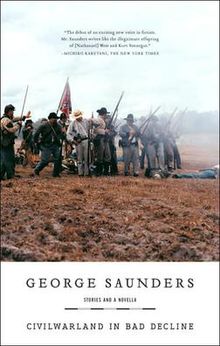
[READ: February 2, 2017] CivilWarLand in Bad Decline

I have been really enjoying George Saunders.  I had considered reading all of his published pieces in the New Yorker.  And then I realized that they were probably all collected in his books, right?  Well, yes, most of his pieces have been collected.  Although for this book, his first, there was only one New Yorker story, “Offloading for Mrs Schwartz.”

When I read In Persuasion Nation many years ago, I remembered thinking that Saunders is supposed to be very funny but that his stories really aren’t.  And now, after reading so many things about his generosity and kind spirit, I was expecting to get more of that from these stories too.  But in both cases, I feel like Saunders was a very different writer.  While there is certainly humor in these stories, it is very dark humor and is often surrounded by characters who are incredibly cruel.  It makes these stories rather hard to bear sometimes. (more…)

Read Full Post »

klosetrSOUNDTRACK: RHEOSTATICSFall Nationals The Horseshoe Tavern Toronto, ON. Night 1 of 13 (November 10, 2003).

This was the 1st night of their 13 night Fall Nationals run at the Horseshoe.  Rheostatics Live has recordings of nights 1, 3, 4, 5 and 7.

 The sound quality of this show is great, although it’s quite disconcerting how quiet it is between songs—must be soundboard with no audience pick up at all.

Dave chats with the crowd of course: “Always exciting on opening night—a tingle in the air.  We’re basking in the glow of David Miller’s victory tonight even if he doesn’t know the words to “Born to Run.”

David Raymond Miller is the president and CEO of WWF-Canada, the Canadian division of the international World Wildlife Fund. A former politician, Miller was the 63rd Mayor of Toronto from 2003 to 2010. He entered politics as a member of the New Democratic Party, although his mayoral campaign and terms in office were without any formal party affiliation. He did not renew his party membership in 2007.  After declining poll numbers, Miller announced on September 25, 2009, that he would not seek a third term as mayor in the 2010 election, citing family reasons.  He was replaced by Rob frickin Ford.

They play a lot of songs from their not yet released album (not until 2004, in fact) 2067.

They open with “The Tarleks” which is follows by 2001’s “Song of the Garden” and then back to 2067 with “I Dig Music.”  The new songs sound similar to the release but perhaps the words might not be solidified yet—there’s also no “too fucking bad” in “I Dig Music.”

Tim’s “In It Now” comes next with that cool opening riff.   It segues into one of my favorite Tim-sung songs “Marginalized” also from 2067.  I love the drums, the guitar riff, everything about it—although they are off-key as they start.

Dave says, “We’re surprising ourselves a little by playing new stuff.   But when Martin asks for requests and people say “Saskatchewan” Martin starts playing it (see, the squeaky wheel…).

“Fan letter for Ozzy Osbourne” (also from 2067)  it sounds a bit more spare and sad (with no wailing vocal at the end).  It’s followed by “a very old song we wrote in 1989, I think, but it still applies on this special occasion.”  He says it’s called “You can’t go back to Woodstock baby you were just 2 years old you, you weren’t even born.”

There’s a quiet “In This Town” that’s followed by a lengthy “When Winter Comes.”  This song features a remarkably pedestrian guitar solo (sloppy and very un-Martin like).

Dave says they were recording audio commentary from a show two years ago (for what?  is this available somewhere?).  He says that night wasn’t a very good patter night.  Good music night, though.

Tim says, “So we overdubbed good stage banter. … Till I sparked up a fattie and giggled like a moron.”
Martin: “till you sparked up a fattie and the ridiculousness of the situation became glaringly apparent.”
Dave: “Martin I can’t believe you just said ‘sparked up a fattie.'”
Martin: “The times they are a-changing.”

Martin introduces “Aliens” by saying “This would be a b-minor chord.  The whole thing seems a little weird–Martin does some odd voices and weird guitar noises—it almost sounds out of tune or like it’s just the wrong guitar.

Back to a new song with “Polar Bears and Trees” and they have fun chanting the “hey hey ho ho” section.

Dave calms things down with some details: We got some stuff planned over the next 13 days. Lucky 13.  Thursday there’s going to be 25 guest vocalists.  We’re gonna mail it in, basically.  And then on Saturday we have “Tim Vebron and the Rheostars.”  According to a review, this “band” is a goof: “Martin was wearing a lei and suspenders, MPW looked like an extra from THX1138.”   You can also get a pass to all 13 shows for $75.  For some good old live live Canadian shield rock.

Dave asks, “Tim did you get a contact high during aliens?  Some wise acre lit a marijuana cigarette.”  Tim:  “It’s just kicking in now.  I’m hungry.”

“PIN” sound great although in “Legal Age Life,” the sound drops out at 58 seconds and comes back on at 1:35.  During the song, Dave shouts G and they shift to “Crocodile Rock.”  It kind of clunkily falls back in to “LAL,” but it’s fun to see them jamming and exploring a bit.

Dave says “Crocodile Rock” was a very complicate dance, but it didn’t catch on.  I think the dance involved implements didn’t it. Tongs?”

“Stolen Car” starts quietly but builds and builds to a noisy climactic guitar solo.  Its pretty exciting.

During the encore break there’s repeated chants for “Horses.  Horses.”

You can hear Dave say, “‘Soul Glue?’ We’re not going to do that tonight, we’re going to say it for a special occasion.”  The audience member shouts, “the hell with you.” Dave: “Ok, bye. Yes I am going to hell.”

What song do you think cleans the palate for the song to come after it—A sherbet?

There’s some amusing commentary between Dace and the audience.  And then a little more local politics: “Did you think that was good speech by David Miller?  I didn’t. I don’t want to be a bad guy coz it’s his night but…”  Then Dave imagines a “David Miller ascension-to-power film starring Ed Begley Jr.”

The encore includes a rollicking “Satan is the Whistler” followed by a solid cover of The Clash’s “London Calling.”  Tim’s a little sloppy on the bass, but the guitar sound is perfect and Dave’s got the vocal sound just right.  As they leave you can still here that guy calling for “Horses.”

[READ: July 1, 2016] What If We’re Wrong?

I have enjoyed a lot of the essays I’ve read by Klosterman.  But I’ve never read one of his books before.  I saw him on Seth Meyers one night and this book sounded cool.  And then I saw it at work, so I grabbed it .

Klosterman is clever and funny and this book is clever and funny.  Although I found it a little long–every section of the book felt like it could have been shorter and it wouldn’t have lost any impact.  However, I loved the premise and I loved all of the examples.  I just got a little tired of each section before it ended.

So what is this book (with the upside down cover) about?  Well, as the blurb says, our cultural is pretty causally certain about things.  No matter how many times we are wrong, we know exactly how things are going to go. Until they do not go that way any more.  “What once seemed inevitable eventually becomes absurd.”  So what will people think of 2015/16 in 100 years?  And while some things seem like they may be obvious about how tastes change, he also wonders if our ideas about gravity will change.

This came out before the horrors of the 2016 election and I read it before them, so the whole premise of the book is even more magnified. (more…)

Read Full Post »

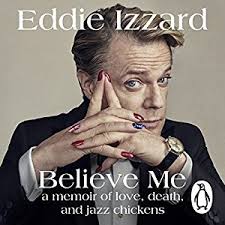
[LISTENED TO: September 13, 2017] Believe Me

When I saw that Eddie Izzard had a book out I was pretty interested to read it.  I have loved his stand-up since 1997 or 1998 and I was lucky enough to see him on his Circle Tour (on the date they recorded it!).  I have been keeping up with his career and trying to see him in whatever he does (although I like my comedy more than drama and he has certainly made the shift towards drama in recent years).

I thought an autobiography or memoir by him would be pretty interesting (even if he claims to be boring).  But when I saw that he read the audiobook, I knew I had to give it a listen (even if it was 12 discs)!

Amusingly, there was a long delay at the library.  The lady at the counter (who is not the librarian–we librarians know the difference) said if I knew his voice, I could just read the book to myself in his voice.  It was an amusing thought, and I possibly could do that, ….yes, but Eddie’s voice is just so fantastic that it never would have worked properly.  Plus, he throws in easily an extra hours worth of footnotes and rambles that aren’t in the print book!  That’s right, an extra hour’s worth of nonsense if you do the audio.   True you don;t get to see the pictures, but it’s a fair trade-off.

Well the book finally came in and I had plenty of driving time to make short work of this 12 hours behemoth.  And I laughed and laughed.  And cried and cried.

Because while Eddie Izzard is an action transvestite (transgender, now) and one of the best stand-ups around, he is also an extremely warm and thoughtful person. He worked very hard to become the success he is.  And he has used his fame to do some absolutely wonderful things for humanity–including raising millions of dollars.  Not bad for an atheist who is sometimes in girl mode and sometimes in boy mode. (more…)

Read Full Post »

SOUNDTRACK: VANILLA FUDGE-The Beat Goes On (1968).

I thought the first Vanilla Fudge album was odd–covers of contemporary songs done slowly and with little resemblance to the originals.

Well, this second album was downright bizarre.

It  doesn’t really have any “songs.”  Rather, it’s more of a collage–a history of recorded sound as interpreted by the Vanilla Fudge.  There’s a few snippets of classical pieces, some rocks songs, historical vocal recordings and final words from the guys in the band.  All sandwiched between snippets of them playing The Beat Goes On, the Sonny Bono song.

It’s a weird enough record on its own, but when you read just a little but about it, it gets even weirder.  According to the Wikipedia entry:

The group was at odds with producer George “Shadow” Morton during recording, as Morton made his own concept album without significant input from them. In the liner notes of Sundazed Records’ 1990 CD reissue, the band denounces it as a failed experiment on the producer’s part.     ….
In his autobiography Stick It!, Carmine Appice declares: “Even listening to it now – which, let me tell you, I rarely fucking do – The Beat Goes On sounds like an album that Spinal Tap would be wary of making.”

The album opens with an instrumental “sketch.”  It is primarily the Vanilla Fudge keyboard sound with some occasional piano and guitar sounds washing in and out.

After a recording of Thomas Edison reciting Mary Had a Little Lamb, a ponderous voice says PHASE ONE and they start with the first iteration of “The Beat Goes On.”

Then comes what is now probably the fourth surprise already.  The track is titles “Eighteenth Century: Variations on a Theme by Mozart: “Divertimento No. 13 In F Major”” and it’s 45 seconds of Mozart on harpsichord!  It’s followed by a 45 second version of “Old Black Joe” by Stephen Forster, this time sung quietly with acoustic guitar and bass.

That was meant to represent the nineteenth century.  The twentieth century has a bit more diversity with Cole Porter, Glenn Miller and Elvis.  There’s rags on piano with a trap drum.  “In the Mood” sounds like it’s in a roller rink and “Hound Dog” sounds really tinny and awful.  The music is played perfectly, but the quality of the recording is deliberately (I assume) poor.

The next section is called The Beatles, because they clearly didn’t record enough Beatles on their first album.  But this time they do it more like the originals, not like the Vanilla Fudge.  In less than two minutes, they run through excerpts from “I Want To Hold Your Hand,” “I Feel Fine,” “Day Tripper,” “She Loves You,” and “Hello Goodbye.”   Except that for the final track they sing “You say hello and I say goodbye…”  And they laugh into…

PHASE TWO.  This has another version of “The Beat Goes On” followed by six minutes of Beethoven (if you;re keeping track, Beethoven was before the 20th century).  They play “Fur Elise” & “Moonlight Sonata” on keys with bass.  But it builds up with rocking drums and   build rocking with drums and keys and guitar.  It gets crazy fast and loud.

Then another version of “The Beat Goes On” followed by another version of it (the original would have switched sides at this point.

PHASE THREE is called “Voices in Time” and it is literally 8 minutes of historical recordings by: Neville Chamberlain, Winston Churchill, Franklin Delano Roosevelt, Harry S. Truman and John F. Kennedy.

Then on to PHASE FOUR which after one version of “The Beat Goes On” is talking sections with the band members.  They are labelled “Merchant/The Game is Over”

Vinnie on guitar says a few things concluding with “As life goes on, the beat goes on.”  Tim on bass does an “interview” in which he (or someone) asks him questions which he answers–about sex, politics and ice cream among other things.  He sounds pretty much  like an ass.

Carmine says “I play drums.  Listen to my drums if you wanna hear me talk.”  And finally after some Indian style music comes Mark the lead vocalist.  He uses his time to read a bit of the Bible, a passage about Moab.

The whole business ends with the longest yet version of “The Beat Goes On.”

The CD comes with a Bonus Phase.  There’s a cover of The Beatles’ “You Can;t Do That” and an original  These two songs are certainly the highlight, especially their original song “Come By Day, Come By Night.”  I love the bassline and choral voices.  This really points out what a waste it was not to record their own songs.

The sixties were a weird time.

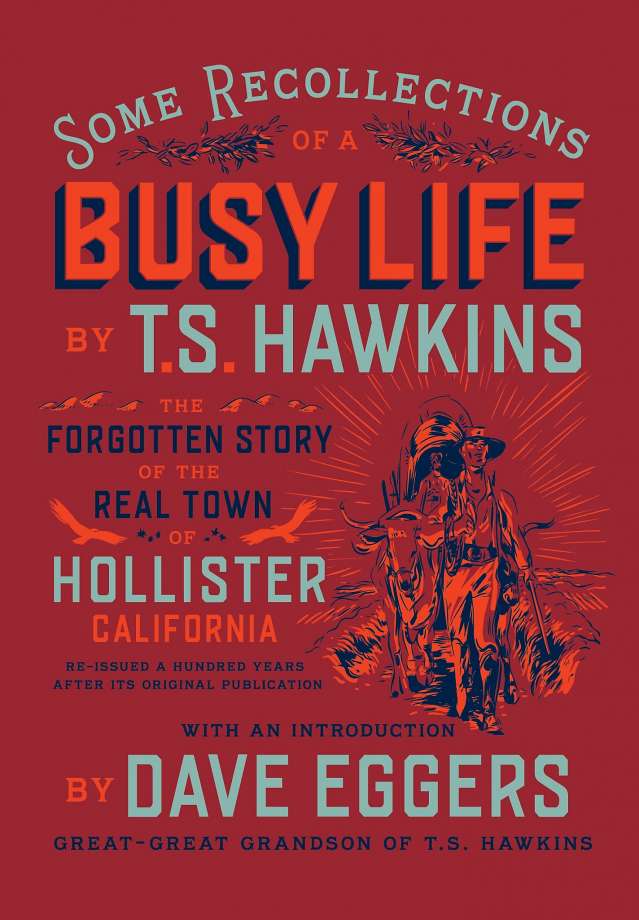
[READ: July 22, 2017] Some Recollections of a Busy Life

The beginning of this book includes Dave Eggers’ essay that was in the New Yorker, July 20, 2015 issue.

Read about it here.

T.S. Hawkins was Dave Eggers’ great-great grandfather.  In 1913 Hawkins wrote Some Recollections of a Busy Life and printed 300 copies.  Now 102 years later, Eggers was able to use his press to get it reprinted,

What’s even more disconcerting is that we’re prepared for the book to be 102 years old, but it starts with Hawkins talking about what it was like seventy years ago.  So the beginning of this book is actually set in the 1840s and 50s.  He was born March 6, 1836 in Missouri about 12 miles from the Mississippi River. His grandfather had been from Virginia and then moved to Kentucky and then on to Missouri.

He is writing his recollection not believing that the general public would care about them but he hopes his children and grandchildren might be interested in the changes which have taken places over the years of their grandfather’s life.

He grew up West of the Mississippi with no railroads and no telegraphic or telephonic communication with the rest of the world.  News in the East took weeks to reach them.  Electrical lighting was a thing undreamed of.  They made their own soap with the ashes from their fires.  Their clothes were homemade. (more…)

Read Full Post »

« Newer Posts - Older Posts »