Feeds:
Posts
Comments

Archive for the ‘History’ Category

SOUNDTRACK: GRINGO STAR-“Shadow’ (2011).

This song was forecast as a great Fall song on NPR.  The band’s name is perhaps too cutesy, but the music is interesting.  The verses are jangly and in no way prepare you for the Beatlesesque (ie., soaring harmonies) chorus that follows. 

There’s not a lot to the song, and on my first listen I wasn’t all that impressed in the beginning.  But by the end of the song I was won over. 

The song feels very familiar, but I can’t say that it sounds like anything in particular.  The ooo-ooohs in the chorus are really pretty, the intro guitar is more intricate than I realized.  And after just a few listens I was totally hooked.  It just seems like more of a summer record to me.

I’m curious to see what else is on this record. 

[READ: September 15, 2011] “A Hobo Memoir, 1936”

My company provided some links to interesting articles that are available on JSTOR, an electronic archiving resource.  If you have access to a university database, chances are you have access to these articles.  I was particularly struck by the fascinating subjects of a few of these pieces and for the next few posts I’m going to mention them.

I had to start with this article because for some reason my kids are obsessed with hobos.  I don’t really know how it came about–reading older kids’ stories, I suspect.  On our first train ride, we saw a freight car with a door open and there was much talk about hoboes sleeping in the cars and, hoo boy, it just escalated from there.  And, despite the fact that hobos haven’t really existed in eighty some years, once you keep an ear open for the word, you hear it quite a lot (Craig Ferguson was calling his audience hobos for a while–it’s a good comedy word).

This article contains an introduction by Elizabeth Rambeau, assistant editor of the magazine, who gives us a brief history of John Fawcett and of hobos in general.  Including this very informative distinction: a hobo is a transient person who looks for work while he travels, a tramp is a drifter who does not look for work and a bum is a stationary person who does not look for work.  So, be mindful of the epithets you use!  Fawcett, Rambeau tells us, was unlike most hoboes at the time.  Indeed, he wasn’t really a hobo at all.  He was the son of a wealthy doctor.  But he grew tired of his life at boarding school and decided to take a trip on the rails from West Virginia to Texas.  But he lived the hobo lifestyle, hopping trains, getting busted by the police, and not carrying any (or much, anyhow) money.  He even hung out with a hobo named Shorty.

The reason that this article is noteworthy (in terms of hobo literature) is that unlike other hobo memoirs from the time, Fawcett was an educated man and a decent writer in his own right (most hobo memoirs were recollections from the hobos themselves, written by ghostwriters).  This Memoir comes from meticulous diary entries that he kept during his entire trip.  And, of course, the article includes hobo signs, everyone’s favorite piece of folk art.  What’s interesting is that there are no extant records of original hobo signs.  They were made with chalk and all were ephemeral.  All of the signs we have are from people’s recollections and the signs included here were done by an art dept.

Fawcett’s original work comes from an unpublished 1991 book called Awakening of Conscience.  What we have is a twelve page excerpt.  In the author’s introduction, he explains his life situation, his family situation and his pressing need to have some freedom in his life.  In hindsight, he can’t imagine what kind of grief he put his parents through (he left a note saying he was going to a friend’s house but then took a month-long hobo journey) and he regrets that.   But he’s also pretty proud of what he did. (more…)

Read Full Post »

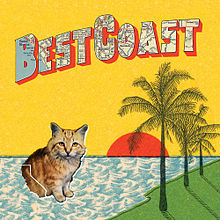
SOUNDTRACK: BEST COAST-Crazy for You (2010).

I really enjoyed the Best Coast concert that was downloadable from NPR.  I liked it enough for me to rethink my initial skepticism about this album.  But I have to say that I fall into a minority in that I really don’t like this album all that much.  In concert, the band is loud and raucous–the songs are poppy but they have a kind of growly edge and a punk veneer, and singer Bethany Cosentino has a sneer to her cutesy lyrics that gives them a nice edge.

But all of that is missing from the album.  In fact, to me this album sounds like a long-lost relic of girl groups from the 60s.  And, blasphemy as it may be, I just do not like girl groups from the 60s.  I hate the tinny sound and I hate the “my life sucks without a boy” sentiment that most of those songs project.  (I love a good love song, I hate an insecure love song).  And, for the first few songs at least, this album conveys both of those things. 

Nevertheless, there’s a lot I appreciate about this record.  I like that it’s lo-fi.  I like that it’s just the two of them making all this music.  I even like many of the lyrics (the lyrics that Cosentino describes as “about weed and my cat and being lazy a lot”).  I also like that the songs are super catchy and super short ( no songs are over 3 minutes and that most are only about 2 minutes long). 

So even if I don’t love the record sonically, I can appreciate the simplicity and ease of singing along that the album presents.  And there are a few songs on the disc that I do like.  I especially like “When I’m with You” (the bonus song) for being a stupid pop song but somehow transcending the stupidity. 

As for the lyrics.  They are little more than teen girl diary entries, except when they turn into college girl diary entries (and then they turn funny rather than sad).  From a lyrical standpoint I am much more in tune with “Goodbye” (“I lost my job, I miss my mom, I wish my cat could talk.  Everytime you leave the house, everything falls apart”) than with “Boyfriend” (“There’s nothing worse than sitting all alone at home.  And waiting waiting waiting waiting by the phone.  I hope that he’s at home.  Waiting by his phone”).

I guess, overall, there’s just something about California pop music that I don’t like as much as my East Coast bands.  [NYHC rules!].

[READ: September 14, 2011] The Emperor’s Code

Gordon Korman is back helming the series which is set in China. Now, I have seen pictures and movies of things in China, but the real scale of things has never come across to me until reading this book.  Which is kind of sad for me, but it’s really cool for the book.  I knew that the Great Wall of China was huge, but I never knew that it could stretch from Boston to San Diego with extra room at the end.  I never appreciated the kind of training the Shaolin monks undergo (the description of the statue of  Bodhidharma as being well over 750 steps up and taking over an hour to climb really sunk in for me just how big this place is!).  In short, while I know that parts of the story disregard history, the historical parts are fascinating and informative!

Dan and Amy’s first stop is the Forbidden City, where they sign up for a tour.  Dan sneaks out of the tour to enter an area where they think a clue is.  Much like with Pee Wee Herman looking for the basement of the Alamo, Dan Cahill looks for the attic of the Forbidden City.  And he finds it.  And then he is caught by guards.  But this little preview of Dan and Amy working separately doesn’t quite prepare us for the massive change in the series that Korman is preparing for us.  

Dan and Amy start talking about what the clues means and the fact that they are Madrigals–are they (and their whole family line) really killers?  This leads to much tension which ends with Amy wondering aloud if maybe their parents weren’t good people at all.  Dan and Amy fight and Dan storms off.  And through a series of scary events, he ends up in the clutches of Jonah Wizard (whom we have not seen for a long time).

And thus, for the bulk of the book, Dan is on his own.  Amy, Nellie and Saladin work hard to try to find Dan and maybe even a Clue.  Meanwhile, Dan is with Jonah, thinking that Jonah’s father is trying to contact Amy.  Dan is still pretty angry so he doesn’t really care what Amy is up to (and he believes she is not trying to find him).  But Amy is freaking out thinking of her 11-year-old brother in the most populous, hugest country all alone.  But he’s not alone, he’s got Jonah Wizard, yo.  And for much of the book, Dan lives the high life.  He hangs out with Jonah, plays video games, lives a first class lifestyle and even gets to be backstage to see what it’s like to have tens of thousands of fans screaming at you.  (more…)

Read Full Post »

SOUNDTRACK: METRIC-Live at the 9:30 Club, June 18, 2009 (2009).

I love the new Metric album and this tour supported that disc, so, it’s a win-win for me!  Metric sound great live, and the notes on the NPR page where I downloaded this give a fascinating history of the band.  Evidently they burnt out in 2005 while touring for Live It Out.  So they made solo records and kind of went their separate ways.  Then:

in March 2008, Haines was on stage, in the middle of a live solo performance, when she had an epiphany: She was tired of being sad. While playing one of the standout cuts from her gloomy but beautiful album Knives Don’t Have Your Back, Haines stopped, turned to the audience and said, “I don’t want to play these songs anymore.” Instead, she spent the rest of the show performing her favorite Metric tunes.

The band reunited and made Fantasies, the poptastic album that I love so much.

This show plays pretty much all of the album (except “Collect Call” and “Blindness”) and they rock the house!  The only odd part for me is the opening track, “Satellite Mind.”  The band chose to have the first half of the song performed with just the keyboards, so it has no bottom end at all.  It sounds kind of tinny and weird.  Then when the guitars and bass kick in (for the rest of the show, thankfully), the band sounds whole again.

The other weird thing is Emily Haines’ banter.  I like chatty lead singers (–The Swell Season’s banter is great, Wayne Coyne’s banter is emotional but enjoyable), but there’s something about Haines’ musing that are just kind of…lame.  She’s very earnest, but her thoughts are kind of, well, vapid.  So, I just skip past all the chatter and enjoy the music.

It’s a really great, rocking set and the crowd is very into it.

[READ: August 25, 2011] Atlas of Remote Islands

If you need an unusual but doubtlessly cool book, my brother-in-law Ben is your man.  For my birthday and Christmases he often gets me books that I have never heard of but that are weird and interesting.

This book is no exception.  As the subtitle states, this is a book about fifty remote islands that virtually no one lives on.  True, some are inhabited, but many are not.  And a goodly amount of them are little more than icebergs (I wonder how they will survive global warming).  There’s even one that the accompanying story implies was created from bird droppings. (more…)

Read Full Post »

SOUNDTRACK: FOO FIGHTERS-Wasting Light (2011).

The Foo Fighters are huge.  Duh.  But when I think of that, it amazes me that a) the Foo Fighters are the band from “the drummer from Nirvana” and that b) while Dave Grohl knows his way around a melody, he is a metal dude at heart, and some of his most popular songs are really heavy.  He can scream with the best of them.

I’ve enjoyed the Foos for many years, but I didn’t listen to their previous discs all that much (or at least I didn’t listen to the mellow disc from In Your Honor and I don’t remember anything off of Echoes…), but this new one is fantastic.  There’s not a dull song on the disc, and Grohl has hit new heights of catchiness and singalong-ness. 

I also like how noisy the disc is.  It opens with some great discord before turning in a majorly heavy rifftastic scream fest in “Bridge Burning.”  Despite the screaming and noise of the opening, the chorus is super catchy.  “Rope” was said to be inspired by Rush.  Knowing that, I can hear a lot of little Rush-isms in the track: The main riff is very Rush-like, there’s a cymbal tapping that reminds me of Neil Peart in the verses, as well as a little drum solo in the middle (with a cowbell!) and the solo is very Alex Lifeson. (It also feels longer than 4 minutes).

“Dear Rosemary” features Bob Mould on backing vocals (but you can hardly tell it’s him).  It’s got a great chorus as well.  “White Limo” is a wonderful punk song, completely incomprehensible lyrics and all.  Meanwhile “Arlandria” (whatever that means) is another totally catchy track (I find myself singing it a lot).

“These Days” should be the next single: catchy and easy on the ears.  I wonder why it hasn’t been released yet.  “Back and Forth” has another great noisy riff.  One thing that I like a lot about the Foos is that they put different things in the same song:  so “A Matter of Time” has a very simple verse and a catchy chorus, but there’s some really buzzing heavy guitars too.  “Miss the Misery” has a kind of sleazy feel which I think is new for the Foos.  And “I Should Have Known” is a kind of angry ballad (I’d like to see Richard Thompson cover it). 

The final track, “Walk” is a fast rocker that sums up the album really well.  Bravo Dave Grohl.  I can’t get enough of this disc, regardless of how popular it is.

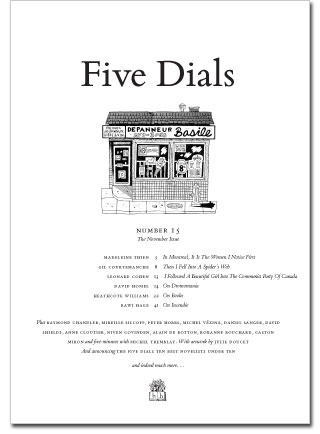
[READ: July 2, 2011] Five Dials Number 15

After the brevity of Number 14, Five Dials Number 15 comes back to a fuller size.  It’s strange to me that the issue is titled The November Issue, in part because they never tell us when the issues were published, but even more because this is actually the Québec Issue.  Most of the authors are Quécbecers and the issue release party was in Québec as well.

I’d like to point out that while I was looking something up about this issue (more later) I discovered the Five Dials News Page.  There are currently 43 pages worth of posts.  But most of them are short.  If there are any especially noteworthy ones, I’ll add them to reviews of future issues, but for the most part so far they’re just announcements of how well received their books are (I’ve already made notes to read two of them).  They also give release dates for the issues, which is how I have been able to retroactively attach dates to some of them.

There are many Québecois writers included in this issue (thoughtfully translated into English), as well as some standard features by Alain De Botton and frequent contributors David Shields and Raymond Chandler.

CRAIG TAYLOR-On Our Québec Issue, and Young Novelists
Taylor’s introduction discusses many Canadian’s attitudes about Québec and their (seemingly perennial) vote concerning separation from the country (“so, let them go”).

creepy beard

The confusing thing here is that it appears that Taylor is Canadian (or at least lived there in 1995/6).   But surely he is British, no?

There’s lots of information about Québec in here but no grand statement (except that Celine Dion’s husband’s beard is still creepy).

He also introduces a new section called “Our Town” which is all about London.  The final section of the note says that

we are releasing our second Five Dials list of Top Ten Novelists Under Ten (or ‘Ten Under Ten’,or ‘Ten-Ten’, or as some of the writers themselves call the list: ‘Tintin.’) As you know, many of the writers we chose for our first Ten Under Ten list went on to things such as high school.

This is how I discovered the Five Dials News page, because there certainly was no Ten Under Ten section in a previous issue of the magazine.  Of course, nor is there any mention in the news that I have seen.  So I can’t decide if the whole thing is just a big joke or what.  I assume it is (but I’d hate to not give credit to the waaaay precocious kids at the end of the issue). (more…)

Read Full Post »

SOUNDTRACK: MOGWAI-Mr. Beast (2006).

After several mellow, quiet albums, Mr Beast brings back a lot of the Mogwai noise.  I distinctly remember listening to Mr Beast when it first came out because it was the first time I was home with my son and I exposed him to something other than kids music (he was 8 months old at the time).

Mr Beast changes things up from previous disc in a few ways.  There’s no long songs on the disc (5:30 is the longest), but there’s a return of some of the noise from earlier discs.

“Auto Rock”, although featuring keyboard, is a pretty heavy track, with big drums and loud layers of music that try but fail to disguise a riff.  But the best song on the album comes next “Glasgow Mega-Snake” is that awesome Mogwai beast: rocking guitars, a memorable riff and powerful drumming.  It’s recognizable once it starts, it’s got cool screaming solo notes and just when you think it’s going to end quietly, pow–it is indeed mega.

Despite all evidence to the contrary I think of Mogwai as an instrumental band.  So it’s always surprising when they have vocals on a song.  But it’s even more surprising when the song has steel guitars, is exceedingly mellow and has gently sung, slightly synthesized vocals.  And that’s what “Acid Food” is.  It’s followed by “Travel is Dangerous” which features the least processed vocals of any Mogwai track that I can think of.  It’s a wall of sound from the guitars, but it’s also a pretty conventional verse/chorus structure–will wonders never cease?  Despite that, there’s some wonderful screaming feedback during the solo portion of the song.

Diversity is the name of the game on this album though, as “Team Handed” is a gentle piano ballad.  “Friend of the Night” is one of their catchiest melodies–the piano runs through a series of riffs and ending with a beautiful piano line.  “Emergency Trap” and “Folk Death 95” are two more mellow tracks, but these have some intricate guitar lines running through them as opposed to the ashes of sound from previous discs.

“I Chose Horses” has a spoken vocal part from Tetsuya Fukagawa from the Japanese band Envy.  He speaks slowly and placidly over a beautiful piano melody. The disc ends with “We’re No Here” a final blast of noise to show that they’ve not gotten all soft.  It starts like many of the other songs, but by the end, the guitars are ratcheted up, with a simple but powerful solo taking over the back half of the song until a final descending feedback closes out the disc.

It’s an amazing piece of music. The bonus DVD shows how they made the disc.  I think it was the first time I’d ever seen/heard the guys in the band.

[READ: July 6, 2011] Wonderstruck

Brian Selznick’s The Invention of Hugo Cabret was a fantastic pastiche of gorgeous pictures and exciting text–not quite graphic novel and not quite illustrated book.  While the story was wonderful, the pictures were truly amazing–beautiful pencil (charcoal?) pages, many of which spread across two pages.  They were textured and very detailed.  And they brought to life elements of the story in a way that the text couldn’t.

Wonderstruck follows the same format: several pages of wordless illustrations followed by several pages of text.  But unlike Hugo Cabret, the words and pictures tell two very different stories.  The pictures tell the story of a young deaf girl.  The girl adores the actress Lillian Mayhew and even sneaks out to the movies to watch her films (this is set before “talkies”, when the deaf could watch films the same as everyone else).  We follow her through her life as she runs to the New York City and runs into several important figures in her life.  There several surprises are in store for her (and the reader), which I will not spoil here.  Suffice it to say that several times I said, wow! (more…)

Read Full Post »

SOUNDTRACK: GUSTER-Easy Wonderful (2010).

This Guster album is confusing.  It’s rather short (compared to their other discs).  Combined with the (kind of flimsy) cardboard packaging, it feels almost like an EP.  It also seems to be kind of religious (although I don’t think it is)–like a themed EP.  And yet it isn’t off-putting or anything (a few mentions of Jesus is all, although that’s a lot more than usual).

But, like most of Guster’s releases, it’s super catchy kind of alternative jangly pop.  After one or two listens the songs are instantly recognizable.  There isn’t a bad song in the bunch.  However, they’re also mildly underwhelming compared to their previous releases.  The songs feel a bit more subtle, but really it seems like they might be just a little too smooth.  The dynamics aren’t quite as exciting as they have been.

Having said all that, the disc is still pretty great and I find myself humming a lot of these songs all day long.

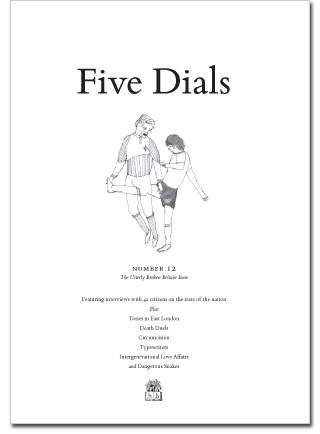
[READ: June 18, 2011] Five Dials Number 12

Five Dials Number 12 has a theme explicitly stated on the cover.  The premise of the theme is that the Conservative Party of Britain had been claiming (in their TV ads and billboards) that Britain was broken.  This idea was relentlessly pushed across Britain.  And Five Dials wondered if people thought that that was true in general.  So they asked 42 citizens (no idea what kind of random sample it may have been, realistically) and they recorded the results.

The rest of the issue has some of the standard Five Dials material we’ve come to expect: essays and fiction, advice and lists.  The theme gives an interesting tone to the proceedings.

CRAIG TAYLOR-A Letter from the Editor: On Broken Britain and Nick Dewar
Taylor addresses much of what is said above.  David Cameron (I still can’t get used to him being Prime Minister, it’s still Gordon Brown in my head–I guess Cameron hasn’t done much yet) is the man who keeps trying to “mend our broken society.”  Even though (and statistics are similar in the U.S.):

They found that violent crime had almost halved since 1995, while crime generally fell by an extraordinary 45%. The figures for teenage pregnancies – a favourite of those talking about social decay – remain constant since Labour came to power in 1997; so too do those for teenage abortions.

The rest of the letter is devoted to the passing of Nick Dewar.  Dewar drew the illustrations for Five Dials Number One.  I really liked Dewar’s style, and his absurdist sensibilities.  Taylor says that Dewar’s color work was even better.  And I think he’s right. (more…)

Read Full Post »

SOUNDTRACK: THE KOPECKY FAMILY BAND-Tiny Desk Concert #131 (June 6, 2011).

I’d never heard of The Kopecky Family Band, but the write-up about them was pretty interesting, so I decided to give the Tiny Desk concert a listen.  The band (all 7 of them) play a great collective of music: two guitars (acoustic & electic) bass, cello, violin, drums and keyboard.  They play a sort of traditional folk with a very full sound.

Indeed, they remind me an awful lot of The Head and the Heart (the singer’s voice in particular), although they are from different edges of the continent and have been playing music about as long as each other (indeed, The Kopecky Family Band released an EP in 2008 whereas Head and the Heart formed in 2009).

And the Kopecky website offers lots of free music (which is very cool).

“Howlin’ at the Moon” is a full acoustic sounding track.  “Birds” has a simply gorgeous whistle/xylophone melody that is as beautiful as it is catchy.  “Disaster” is a tender ballad with wonderful harmonies.  And “Red Devil” is a somewhat more rocking song, which really helps to demonstrate the bands’ diversity.

And the band is charming.  Keyboardist/singer Kelsey admits to having left a trinket of some kind of the office bookshelves (which are littered with things).  It’s a wonderful set, and because of it, I downloaded the band’s first EP from their site.

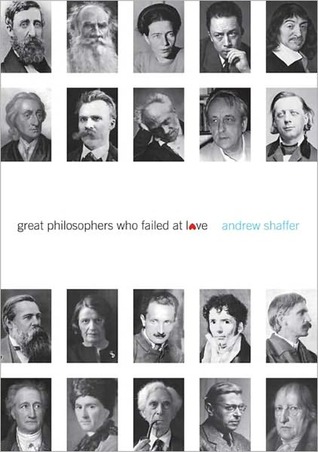
[READ: June 5, 2011] Great Philosophers Who Failed at Love

Shaffer was signing books at BEA this year.  My coworker told me that he was very funny and that he signed her book in an amusing way.  He happened to be signing at the table next to the line I was on. Sadly, he finished before I was able to get to him.  But I was pretty close to the beginning of the line, so I asked if I could grab a copy of his book, which I did (although no autograph for me).

This is a silly book of nonfiction.  It looks at thirty-seven philosopher or thinkers and their utter failure at love.  Each man (and occasional woman) has had some distinguishing characteristic that made them pretty lousy in the emotional range.

The title of the book is funny and is meant to be kind of surprising: these smart folks were terrible at love.  Of course, spending a minute or two thinking about who these people were and what they did, it’s not surprising that they were lousy at love.  These were intellectuals, people who spend most of their time in their own mind.  Of course they couldn’t have a serious relationship.

Nevertheless, these stories are all more or less amusing (Louis Althusser accidentally strangled his wife to death(!) which isn’t amusing per se, but the story of it is, kind of).  Shaffer does a great job at keeping each entry brief but really retaining the salient points of the thinker’s philosophy and a cogent example of his or her lousiness at love.  He also throws in some amusingly snarky comments of his own as he goes along.

I was delighted that the book order was done alphabetically rather than chronologically.  A chronological list would have been a little too samey in terms of each person’s context.  The alphabetical list allows for jumping around from say Plato to Ayn Rand which keeps the stories interesting and fresh.

At the end of each person’s piece, there’s an “In His Own Words” which offers a quote that details his or her written philosophy regarding love.

Dare I say that this is an ideal bathroom book?   It certainly is. And it makes you feel a little better about yourself (if you haven’t for instance, adopted your mistress as your daughter (Sartre)).

Read Full Post »

SOUNDTRACK: BATTLES-“Ice Cream” (2011).

My friend Lar told me about Battles way back in 2007.  I listened to the concert he sent me, and it was great. But my memory of the band was that they were really heavy (the drummer was in Helmet and Tomahawk for cripessakes).

But they’re not so much heavy as noisy and crazy.  And this track is a head-spinning amalgam of keybaords, unsettling rhythms, processed guitars and singing from Argentinean techno producer Matias Aguayo.  The lyrics sound like they are not English, but they are (with heavy effects on them).

The song is weird, indeed. But after just one listen, I was totally hooked.  It’s catchy and bouncy and very sunny and it’s a real joy to listen to.   I absolutely must go back and check out their debut Mirrored.

Listen at NPR.

[READ: April 28, 2011] Five Dials Number 6

Five Dials Number 5 was an excellent issue that I enjoyed immensely.  They followed it up with Number 6, which deals with a subject that I was very passionate about in the early 90s: censorship/obscenity.  When I was in high school and college, the PMRC was the big bogeyman for advocates of free speech (of which I am one).  I still advocate passionately for freedom of speech (now that I’m in a library, the issue can be part of my daily life), but it seems like there are so many more important issues in the world, that stickers on a record seem kind of silly.

Nevetheless, as this issue reminds us, those who control what is said control what we hear.  And that’s true for music and books, as well as our everyday news.  So, free speech should never be taken lightly.  Although this issue looks largely at obscenity in England, they also pull up some good information from Jello Biafra as well.

CRAIG TAYLOR-A Letter from the Editor: On John Mortimer and Obscenity
John Mortimer appears later in the issue. He was the lawyer who defended Lady Chatterly’s Lover against accusations of obscenity.  And Taylor points out that Mortimer’s attitude was that he “understood the silliness of censorship.”  And with that attitude, he was able to work to convince juries of that silliness.  The rest of the issue looks at important cases of censorship over the years, from The Dead Kennedys to NWA (it’s nice to be reminded about how “dangerous” they were when they came out).  He also laughs at the lame attempts at putting adult content on network TV (Fudge you!). (more…)

Read Full Post »

SOUNDTRACK: LIZ PHAIR-Exile in Guyville Live October 6, 2008 (2008).

Like all indie rock hipsters I loved Exile in Guyville when it came out.  And like all indie rock hipsters, I hated that Liz Phair later made an album that is had the top cover below.  I didn’t even care anymore when she made the album with the second cover below.

The irony of course is that Liz made Guyville because she was sick of the hipster boys who were living in Chicago at the time.  And now it was the same hipster boys (only older) who were dismissing her for selling out.  (At least, that’s what I get from the interview that’s attached to the end of the concert and this separate interview from around the same time).

But regardless of my hipster cred (and subsequent loss of same) I really didn’t like Liz’s new pop style (but good for her for still being hot, right?).  In fact, I hadn’t even really listened to her since 2000 anyhow so when she came out with her pop albums I just kind of shrugged.

So, what’s up with this return to Guyville?  Well, the interviews mention her needing some closure on the rough time in her life when she made the record.  And also feeling that since could actually play her guitar now, it was worth giving fans (and herself) the experience of actually enjoying playing the album live.  So, good vibes and happy feelings all around (and sex and sex and more sex).

The concert is the entire Guyville album, played start to finish, with occasional banter in between.  And she is quite faithful to the original (she even has a special guest sing the “Every time I see your face, I get all wet between my legs” line on “Flower.”  The main flaw with the concert is that the bassist hits a number of flat notes and also on at least two songs is either out of tune or just mixed too loud or something.

The other flaw is directly related to Liz saying how much better she is at performing.  Because as the set opens, her voice sounds really off on the first couple of songs.  In the interview, she says that she still feels uncomfortable on stage until about the fourth song. And maybe that’s what’s happening on 6′ 1″ or, quite possibly, she can’t hit those notes anymore (her voice is considerably higher on her newer songs and 6′ 1″ is a low register, almost flat singing style and she just doesn’t seem comfortable doing it).  Indeed, by the fourth or fifth song, she seems more comfortable and seems to be having more fun and the set moves pretty smoothly from there.

She has a good rapport with the audience.  Humility was never her strong suit, and it shows, which makes me her a little less likable, but she still has good banter.

When the album is over she comes back for a brief encore.  She plays two songs solo (which are okay).  And then the band comes back for two of her other hits: “Supernova” and “Polyester Bride” which both sound fantastic.

Listening to Exile in Guyville again was great, the songs hold up really well.  I’ll have to pull her old CDs out and listen to the originals again (the concert is mixed a little low, but–good on NPR–all of the bad words are left in!).  The NPR page also said that Guyville had gone out of print until it was reissued recently.  Is it really possible that Matador let it go out of print?

[READ: April 22, 2011] Five Dials Number 4

The conceit behind this issue is “Eleven writers tell us Exactly What Happened …Days Before It Happened.”  And the authors tell us in past tense what happened on the fateful night of the election between Obama nad McCain.  (even though they are written some time before it has happened).

This issue is short again (all of 14 pages), but with such a tidy topic, the fourteen pages are packed with information.  There are eleven authors who write about the election.  Most are just a couple of paragraphs, so I’m not going to try to summarize them.  I’m going to say their predictions for what happened and (in one case) the uncanny accuracy.

CRAIG TAYLOR-A Letter from the Editor “On Elections and Chomsky”
He lays out what the point of this speculation fiction is: “We’ve become tired of the uncertainty and of the waiting.  It’s time someone told us exactly how this election ends.”   And also, Chomsky is almost 80, and he’s still vibrant. (more…)

Read Full Post »

SOUNDTRACK: MEAT PUPPETS-KEXP in studio November 10, 2009 (2009).

According to my stats, this is my 1000th post.  Wow!

I had liked the Meat Puppets somewhat when I was into SST back in the 80s, then I really got into them in the late 90s (when Nirvana introduced us to them).  I thought Too High to Die was a great album.  But they kind of fell from those heights (and Cris Kirkwood fell into serious trouble–drugs and jail) by the end of the decade.  So Curt Kirkwood continued without Cris and I kind of didn’t care anymore.

This session from 2009 sees the return of Cris (who came back for their 2007 album) with songs taken from their 2009 album, Sewn Together.  I don’t know what the album sounds like but this session is heavy on the country feel.  The new songs seem quite mellow, and a bit less bizarre than some of their earlier songs.

They sound good though.  Even with the drummer playing garbage cans and recycling bins.  As a sort of encore, they play “Plateau” (a Nirvana cover, ha ha).  About midway through, Curt messes up the lyrics and gives up singing.  But they play the extended coda regardless.

Curt doesn’t come across as the nicest guy in the world, but he’s been through enough to not give a toss what anyone thinks.  I’m glad the Puppets are back together and recording, but I don’t think I’ll be delving too deeply into their new stuff.

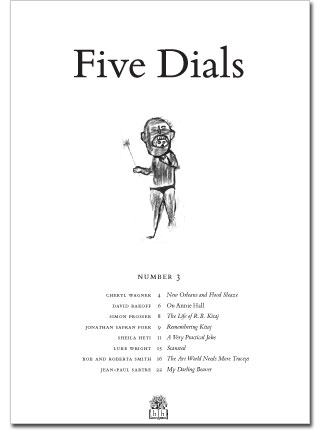
[READ: April 19, 2011] Five Dials Number 3

Five Dials Number 3 ups the page quantity a bit (26 in total) and also includes several art print reproductions  from Margaux Williamson, an artist who is mentioned in one of the articles.   This issue really solidifies the quality of this magazine.  It also introduces the possibility of correspondence with the readers.

CRAIG TAYLOR-On Alibis and Public Views
As mentioned, this letter introduces the idea that people are writing to the magazine.  Sadly there is no letters column (even if Paul F. Tompkins hates letters to the editor, for this magazine, I thought they’d be interesting).

CHERYL WAGNER-Current-ish Event: “The Ballad of Black Van.”
This is a true account of Wagner’s life in post-Katrina New Orleans, where a man in a black van is squatting in abandoned properties and selling everything imaginable.  And there’s no cops to help.  It’s a sad look at the state of New Orleans.

DAVID RAKOFF-A Single Film: Annie Hall
I haven’t read much David Rakoff, but he persist in amusing me whenever I do (hint to self: read more by David Rakoff).  This is an outstanding piece about the beloved film Annie Hall.  It’ s outstanding and goes in an unexpected direction too. (more…)

Read Full Post »

« Newer Posts - Older Posts »