Feeds:
Posts
Comments

Archive for the ‘History’ Category

yitaSOUNDTRACK: WXPN (88.5 Philadelphia) xpnand wxpn.org online-Prog rock Marathon (2012-??).

Every January, Dan Reed plays a prog rock marathon on WXPN.  This year I was able to enjoy portions of it.  I rather wish the playlist was still available (you can search, but only by artist), because I’d love to rave about the tracks they played (like the live “Supper’s Ready.”)

I was delighted by the great mix of songs they played and (as I learned from reading this book) I was surprised by how many prog artists I didn’t even know.

In 2014 I’ll be listening again and maybe this time I’ll copy the playlist to document what I’ve missed.

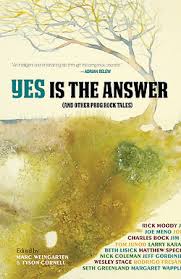
[READ: July 7, 2013] Yes is the Answer

This book was sitting on a cart outside of my cube.  I was intrigued by the title (it didn’t have that trippy cover, so I didn’t know what it was).  But “Yes is the Answer” was calling me.  Especially when I looked at the cover and saw that the cover had an excerpt from a William Vollmann story in which the protagonist plays In the Court of the Crimson King (track 5) for Reepah and watches her face as they band went Ahhhhhhhhhhhhhhhhhhhhhhhhhhhhhhhhhhhhhhhhhhhhhhhhhh!.

Quoting Vollmann (from The Rifles), playing King Crimson?  What could this book be?   Then I saw the subtitle and I knew I had to read it all.

I’m not going to review these essays because that would be like making a radio edit of a side long track, but I’ll mention the band the author focuses on and any other relevant details. (more…)

Read Full Post »

CV1_TNY_06_10_13Schossow.inddSOUNDTRACK: PAUL WILLIAMS-“The Hell of It” (1974).
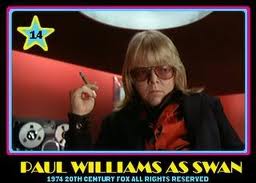
pwI learned of this song because the guys in Daft Punk said it was one of their favorite songs.  I don’t know all that much about Paul Williams except for a few things:

He wrote a bunch of songs that you don’t know he wrote, like: “Rainbow Connection,” “Rainy Days and Mondays,” “We’ve Only Just Begun,” and “An Old Fashioned Love Song.”  And, back in the 80s a random customer at the grocery store that I worked at said I looked like him (which I did not consider a complement).  I have since been told I look like Philip Seymour Hoffman, so I’ve got that going for me.

So this song starts with a rather dark and dramatic guitar riff.  When Williams starts singing, the lyrics are really dark and mean:

Winter comes and the winds blew colder
While some grew wiser, you just grew older
And you never listened anyway,
And that’s the hell of it.

But then the bridge comes in and it’s bright and uplifting (with chipper backing vocals and bouncy pianos). Although the lyrics remain dark dark dark:

Good for nothing, bad in bed
Nobody likes you and you’re better off dead
Goodbye, we’ve all come to say goodbye (goodbye)
Goodbye (goodbye)
Born defeated, died in vain
Super-destructive, you were hooked on pain
Though your music lingers on
All of us are glad you’re gone.

And then there’s another very short section section that is even more musically uplifting.  And yet the lyrics: are the most ruthless:

If I could live my life half as worthlessly as you
I’m convinced that I’d wind up burning too.

The music returns to that sinister guitar riff and the verses continue:

Love yourself as you loved no other
Be no man’s fool and be no man’s brother
We’re all born to die alone, you know, that’s the hell of it.

The last minute of the song  is all instrumental with that dark guitar sound underpinning a bright vaudevillian piano.  And since the song was from a  movie, I wonder if the end if all closing credits?

This song was written for the movie Phantom of the Paradise.  I have never heard of the film.  But I see that it was made by Brian DePalma, is a musical, starred Williams and was a mixture of of The Phantom of the Opera, The Picture of Dorian Gray and Faust, with hints of Frankenstein, Psycho and The Cabinet of Dr. Caligari.  Who would have guessed why it flopped (or why it now has a cult following).

Enjoy the strangeness:

[youtubehttp://www.youtube.com/watch?v=xuYdFYltUr0&feature=player_embedded#!]

[READ:June 17, 2013] “After Black Rock”

Joyce Carol Oates has the final True Crimes story in this weeks New Yorker.  And her story is quite different from the others.  Indeed, it was quite delightful how varied the topics of this special series were.

This piece concerns JCO’s historical family.  Back in 1917, her mother’s father was killed in a bar fight (he was Hungarian and prone to violence).  This devastated their family because he was the primary source of income.  Her mother’s mother had nine children.  Most of JCO’s siblings already worked (long hours for little pay, because immigrant kids didn’t go to school and there were no labor laws at the time).

And then came the shocking thing:  JCO’s mother’s mother gave JCO’s mother away.  She was none months old, they couldn’t afford to feed her, so they gave her to newlywed relatives who desperately wanted a child.  They were John and Lena Bush (the Americanized version of Bùs).  She was raised by them–given some school and some farm work and basically treated as their own. (more…)

Read Full Post »
htthinkSOUNDTRACK: DEPECHE MODE-“Fly on the Windscreen” (1986).

flyonEvery time I use the phrase ‘death is everywhere” (which I don’t do often, but which I do do below) I think of this song.

I forgot how synthy this song sounds when it opens–two different very synthy sounds.  After the vocals (which feature Dave Gahan’s voice at its strongest) the guitars come in and the song sounds a bit more complex.

It’s funny how the song which starts with the dark verses and  “death is everywhere” can have the cool and rather sweet bridge of “Come here, touch me, kiss me, touch me, now.”  (Gahan’s o’s are so wide when he sings, it’s great).

This song really marks the transition of Depeche Mode from synth pop to darker more angsty music.  Indeed, all of Black Celebration, with its noisy percussions and unusual instrumentation and of course, Martin Gore’s dark lyrics, shows a band transitioning to new levels of greatness.

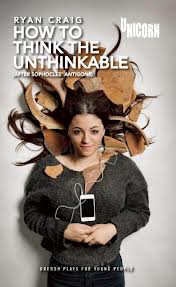
[READ: May 30, 2013] How to Think the Unthinkable

This play was created and produced for the Fringe Festival.  I tend to think of the Fringe Festival as, you know, stuff on the Fringe, so I imagined that this play that was “After Sophocle’s Antigone” would be a modern and possibly weird update of the story.  And it starts off that way with a guard coming back with three clothespins.  He explains that he always draws the short straw and he was the one sent off to get clothespins to block the noses of the other guards.  You see, they have been sitting watch over this body for a few days and he is starting to smell pretty bad.

But when the guard, Tom, arrives, he discovers that the other two guards (Roy and Bo) have fallen asleep and the body is gone.  Tom freaks out, he tells them (and us) that the body (of Polynices) cannot possibly be given a proper burial.  Polynices was a traitor to King Creon and his punishment is to be left to rot outside of the city walls.  How could they have let someone take and bury his body?  They were tired.  See, it’s funny.

Indeed, the other guards have no answer and are more or less comic relief.  Until Haemon shows up.  Haemon is Creon’s son.  He is super annoyed because he was the one who vouched for Tom and the others.  Now he looks bad and Creon will be pissed.

Cut to Creon ensuring the City Elder that he plays no favorites and if even his son is found guilty of a crime—like burying Polynices–well, the full force of punishment will come onto him as well.  Like any Greek tragedy, you can see the set up. (more…)

Read Full Post »

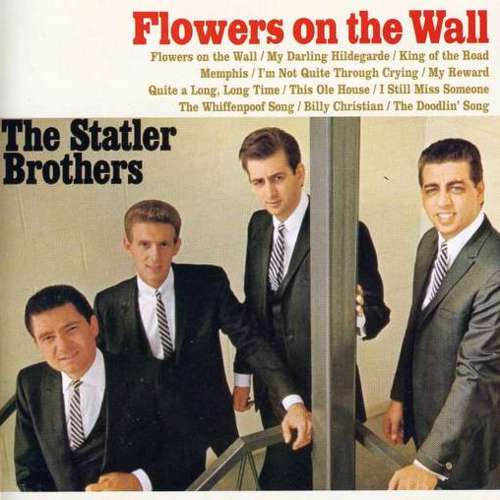
200px-FatesWorseThanDeathSOUNDTRACK: THE STATLER BROTHERS-“Flowers on the Wall” (1965).

flowersonthe Vonnegut mentions this Statler Brothers song in Palm Sunday as well.  I know this from Pulp Fiction–a song that I found very amusing and never would have guessed was a classic country song.  Country music was very different in 1965 than it is now.  I don’t even know if there was a folk or bluegrass category back then, and this song, with its banjo and bouncey acoustic guitar is a great example of the kind of country music I like.  And those harmonies!

This song certainly seems to be about insanity–about a man counting flowers on the wall, playing solitaire with a deck of 51 cards, smoking cigarettes and watching Captain KAN Kangaroo.  Don’t tell him he’s nothing to do.  What a weird little song.  And man is it catchy.  No wonder it was a #1 hit.

[READ: May 31, 2013] Fates Worse Than Death

After reading Palm Sunday I learned that Fates Worse Than Death was a kind of autobiographical sequel to that non fiction book.  I also learned that the two essays that make up Nothing is Lost Save Honor which is impossible to find (and for which I can’t even find a cover) are available in FwtD.  However, since there is no real contents or index, you do have to read the whole thing to find out which chapters contain the essays.  Or you can just look here and see that “The Worst Addiction of Them All” (which was published in The Nation) is in Chapter XIV and “Fates Worse Than Death” appears in Chapter XV.

The last time I read a bunch of Vonnegut together I got a bit burnt out on him and the same thing happened here.  The problem with Vonnegut’s nonfiction is that he tends to repeat himself.  A lot.  And while this book is ostensibly about the 1980s, he talks an awful lot about his family and his friends from the war and his other literary acquaintances., like he did in Palm Sunday.  In a number of places, he says that he doesn’t like to read himself in English, and it would seem that he doesn’t proofread to see if he said something already either.

This is not to say that the book is not worth reading.  Indeed, if you read Palm Sunday in the 80s and then this one in the 90s, you might not remember all of the details that pop up again, but when you read them days apart…well. (more…)

Read Full Post »

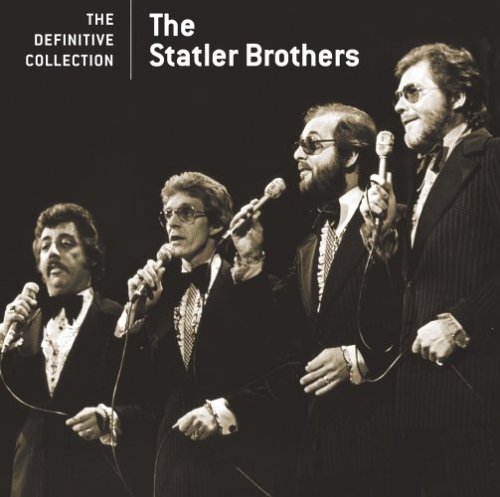
PalmSundayFrontandBackSOUNDTRACK: THE STATLER BROTHERS-“Class of ’57” (1972).

stalerI don’t know much about The Statler Brothers.  They are considered country, although this song is hardly country–it’s more folk with some bluegrass and, the real selling point–great harmonies (especially the bass singer with the big mustache).

The song is a wonderful coming of age song, sad and funny with a list of what happened to everyone in the class of ’57.  Like:

Betty runs a trailer park, Jan sells Tupperware,
Randy’s on an insane ward, Mary’s on welfare.
Charlie took a job with Ford, Joe took Freddie’s wife,
Charlotte took a millionaire, and Freddie took his life.

John is big in cattle, Ray is deep in debt,
Where Mavis finally wound up is anybody’s bet.

But the kicker comes at the chorus:

And the class of ’57 had its dreams,
Oh, we all thought we’d change the world with our great words and deeds.
Or maybe we just thought the world would change to fit our needs,
The class of ’57 had its dreams.

And then at the end:

And the class of ’57 had its dreams,
But living life from day to day is never like it seems.
Things get complicated when you get past eighteen,
But the class of ’57 had its dreams.

Vonnegut quotes the entirety of this song in the book and I’m glad he did, it’s a very moving song and really captures American life.

[READ: May 26, 2013] Palm Sunday

After writing several successful novels, Vonnegut paused to collect his thoughts.  And Palm Sunday begins: “This is a very great book by an American genius.”  It is also a “marvelous new literary form which combines the tidal power of a major novel with the bone-rattling immediacy of front-line journalism.”  After all the self praise, he decides that this collage–a collection of essays and speeches as well as a short story and a play which is all tied together with new pieces (in TV they would call this a clip show)–this new idea of a book should have a new name and he chooses: blivit (during his adolescence, this word was defined as “two pounds of shit in a one-pound bag.”  He proposes that all books combining facts and fiction be called blivits (which would even lead to a new category on the best seller list).  Until then, this great book should go on both lists.

This book is a collection of all manner of speeches and essays, but they are not arranged chronologically.  rather they are given a kind of narrative context.  What’s nice is that the table of contents lists what each of the items in the book is (or more specifically, what each small piece is when gathered under a certain topic).

Chapter 1 is The First Amendment in which he talks about Slaughterhouse Five being burned and how outraged he was by that–especially since the people so anxious to burn it hadn’t even read it (and the only “bad” thing is the word motherfucker).  The first speeches included are “Dear Mr. McCarthy” to the head of the school board where his books were burned and “Un-American Nonsense” an essay for the New York Times about his book being banned in New York State.  The next two are “God’s Law” for an A.C.L.U. fund raiser–it includes his confusion as to why people don’t support the A.C.L.U. which is working for all of our own civil liberties. (more…)

Read Full Post »

vormSOUNDTRACK: DEAD CAN DANCE-“Children of the Sun” (Live at KCRW, April 24, 2013).

deadcandanceDead Can Dance are timeless.  Their music sounds ancient and modern at the same time.  And Brendan Perry’s voice has an unearthly majesty to it that never seems to age.

I’ve known the band for decades (during which time they have broken up and reunited and broken up and reunited).  And in all that time, while their sound has changed in subtle ways, the band is instantly recognizable.  I’ve never really thought of them as a live entity–they just seem like such a creation of the studio that it would be impossible to do justice to their wash of music live.  Of course that was truer three decades ago before it was easy to fit an entire orchestra on an iPod.

You can watch this song on NPR.  It’s fun to watch a band with two keyboardists (and Lisa Gerrard on…autoharp?) and see all of them making very different sounds.  The only disappointing thing about watching this is that they have so many cool instruments strewn about which do not get used on this song (you can see the whole show here and watch him bust out that bouzouki).

This song is a new one and it doesn’t have quite the ponderous nature as their older material.  Which is a bit of a shame, as they were so over the top it was fabulous, but maybe they’re just settling into New Old Age.

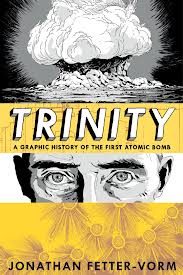
[READ: April 20, 2013] Trinity

Sarah brought this book home because it was on YALSA Hub Reading Challenge for 2013. I’m unlikely to do the challenge as I have so many other books to read, but I have already read 5 of the required 25.  Not too bad, although since the challenge is from Feb to June and I read a couple last year, I don’t even qualify for some of the ones I DID read.  Anyhow, she told me I’d like this and she was right (as usual).

Trinity is the story of the development of the atomic bomb done as a graphic novel.

It outlines how we came to develop and test the bomb and of course, the aftermath of its use.  What I liked about the story is that leading up to the detonation of the bomb, the quest for its discovery is presented in a fairly neutral way.  Essentially, once it was discovered that we could split the atom, it was deemed inevitable that someone would make a bomb out of it.  It stood to reason that if Hitler or the Japanese figured it out before us they would use it on us (since we were at war with them).  The intention was that America would be decent and not use it with impunity (which is not to say we wouldn’t use it at all).  The book presents that American can do spirit that the forties seem to be all about–a sort of gee whiz, let’s figure this out mentality.

I knew some of the history of the bomb, but there was a lot here that I didn’t know: that thousands of people moved to New Mexico to work on the bomb—housing was put up and families moved in, some 80,000 people in all.  And most of the people had no idea what they were working on.  It’s hard to fathom that there were thousands of people whose work helped to create a nuclear bomb and yet they can feel neither pride nor shame because they had no idea that’s what they were doing.  Weird. (more…)

Read Full Post »

vonlastintSOUNDTRACKSURFER BLOOD-“Demon Dance” (Live at SXSW, March 27, 2013).

surfer blood

I’ve liked Surfer Blood since I first heard them.  They write catchy, mostly short, poppy songs.  And usually after a few listens, the hooks really grab you.  The strange thing about the band is that the hooks aren’t always readily apparent, which makes their songs sound kind of samey sometimes.

Of course, samey isn’t a bad thing, necessarily.  Surfer Blood is quite distinctive and I tend to enjoy everything they do.  This new song sounds like their other stuff, which is fine.  But the most distinctive thing about the band of probably their singer who sounds like a less-affected Morrissey.

Having also listened to the song from the album I can say that the singer is far harder to understand live, so maybe live is not the best way to hear a new song from them, but for an old favorite, Surfer Blood has a great energy live.

Watch the show here and hear the studio version here.

[READ: March 27, 2013] The Last Interview and Other Conversations

Melville House has published a number of these “Last Interview” books, and as a completist I feel compelled to read them.  I have read criticisms of the series primarily because what the books are are collections of interviews including the last interview that the writer gave.  They don’t have anything new or proprietary.  The last interview just happens to be the last one he gave.   So it seems a little disingenuous, but is not technically wrong.

There’s so far five books in the series, and I figured I’d read at least three (Vonnegut, David Foster Wallace and Roberto Bolaño–the other two turned out to be Jorge Luis Borges–who I would be interested in reading about and Jacques Derrida (!) who I have always loved–I guess this series was tailor made for me).

At any rate, these interviews are from various times and locations in Vonnegut’s career.  There are six in total.  I don’t know if the titles they give here were the titles in the original publications but here’s what’s inside:

  • “Kurt Vonnegut: The Art of Fiction” from The Paris Review, Spring 1977 (by David Hayman, David Michaelis, George Plimpton, Richard Rhodes)
  • “There Must be More to Love Than Death” from The Nation, August 1980 (by Robert K. Musil)
  • “The Joe & Kurt Show” from Playboy, May 1982 (by Joseph Heller and Carole Mallory)
  • “The Melancholia of Everything Completed” from Stop Smiling, August 2006 (by J.C. Gabel)
  • “God Bless You, Mr. Vonnegut” from U.S. Airways Magazine (!!!), June 2007 (by J. Rentilly)
  • “The Last Interview” from In These Times May 9, 2007 (by Heather Augustyn) (more…)

Read Full Post »

McSweeney’s #13 (2006)

13SOUNDTRACKPARTS & LABOR-Stay Afraid (2006).

partslaborParts & Labor have changed t heir style over the years going from noisemakers who have a melody to being melodious noisemakers.  This album is one of their earlier releases when noise dominated.  Right from the opening you know the album is going to be a challenge.  The first song has pounding drums (electronics that sound like bagpipes) and heavy distorted shouty vocals.  By the end of the songs there is squealing feedback, punk speed drums and screaming distorted vocals (complete with space sound effects).  It’s an aggressive opening for sure.  Song two opens with a long low rumbling and then “Drastic Measures” proves to be another fast-paced song.

“A Pleasant Stay” is 5 minutes long (most of the rest of the album’s songs are about 3 minutes).  It continues in this fast framework, although it has a bit more open moments of just drums or just vocals.  The way the band plays with feedback in the last minute or so of the song  very cool.

“New Buildings” has a hardcore beat with a guitar part that sounds sped up.  “Death” is a thumping song (the drums are very loud on this disc), while “Timeline” is two minutes of squealing guitars.  “Stay Afraid” has a false start (although who knows why–how do these guys know if the feedback sounds are what  they wanted anyhow?).  The song ends with 30 seconds of sheer noise).  The album ends with the 5 minute “Changing of the Guard” a song not unlike the rest of the album–noisy with loud drumming and more noise.

The album is certainly challenging, it’s abrasive and off putting, but there;s surprising pleasures and melodies amidst the chaos.   Indeed, after a listen or two you start to really look forward to the hooks.  If you like this sort of thing, this album s a joy.  It’s also quite brief, so it never overstays its welcome.

[READ: April 15, 2011] McSweeney’s #13

I have been looking forward to reading this issue for quite some time.  Indeed, as soon as I received it I wanted to put aside time for it.  It only took eight years.  For this is the fabled comics issue.  Or as the cover puts it: Included with this paper: a free 264 page hardcover.  Because the cover is a fold-out poster–a gorgeous broadside done by Chris Ware called “God.”  And as with all Chris Ware stories, this is about life, the universe and everything.  On the flip side of the (seriously, really beautiful with gold foil and everything) Ware comic are the contributors’ list and a large drawing that is credited to LHOOQ which is the name of Marcel Duchamp’s art piece in which he put a mustache on the Mona Lisa.  It’s a kind of composite of the history of famous faces in art all done in a series of concentric squares.  It’s quite cool.

So, yes, this issue is all about comics.  There are a couple of essays, a couple of biographical sketches by Ware of artists that I assume many people don’t know and there’s a few unpublished pieces by famous mainstream artists.  But the bulk of the book is comprised of underground (and some who are not so underground anymore) artists showing of their goods.  It’s amazing how divergent the styles are for subject matter that is (for the most part) pretty similar: woe is me!  Angst fills these pages.  Whether it is the biographical angst of famous artists by Brunetti or the angst of not getting the girl (most of the others) or the angst of life (the remaining ones), there’s not a lot of joy here. Although there is a lot of humor.  A couple of these comics made it into the Best American Comics 2006.

There’s no letters this issue, which makes sense as the whole thing is Chris Ware’s baby.  But there are two special tiny books that fit nearly into the fold that the oversized cover makes.  There’s also two introductions.  One by Ira Glass (and yes I’d rather hear him say it but what can you do).  And the other by Ware.  Ware has advocated for underground comics forever and it’s cool that he has a forum for his ideas here.  I’m not sure I’ve ever read prose from him before. (more…)

Read Full Post »

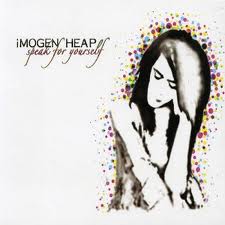
tobo3SOUNDTRACK: iMOGEN HEAP-Speak for Yourself (2005).

heapI really liked Heap’s first album i Megaphone, but I didn’t really think to much about her after that.  Sometime last year I heard a track she was in with Frou Frou, which I liked.  So I thought I’d get this album which was highly regarded.

The problem with it is that I have listened to it a bunch of times, often several times in a row and it really just never sticks with me.  I keep relistening to see if it ever does but it’s just a kind of nebulous dancey pop.  Heap has an interesting voice–she can hit major highs, but she can also do a raspy voice that is unusual and intriguing.  But I suppose the problem is that there’s so much going on that she is effectively lost in the sound.

The standout track is “Hide and Seek” but that’s because her voice is manipulated by a vocoder, making her sound like a machine. It’s a very cool effect, especially when she hits a very high note, but it can’t really be a good sign that the most memorable track on the album is the one where you sound like a machine.

This is not to say that the album is bad–there are a number of interesting moments on it, unfortunately there aren’t a lot of great songs.  When I was looking this disc up to see other comments about it, I see that it was very highly regarded in the dance genre.  And maybe given those parameters I should revise somewhat as well.  As dance music this is more interesting than your average four on the floor stuff.  I can see how it led to the duet of Frou Frou.  And yet, compared to i Megaphone, I fear that it’s a lot less exciting.

[READ: January 12, 2013] The Dangerous Animals Club

I don’t often read autobiographies or memoirs.  I really never even look for them.  But I was waiting online at the library and this book jumped out at me.  I don’t really know why.  The title is kind of interesting and catchy.  And the author’s named seemed, if not familiar, then at least compelling in a very-long-and-Polish-or-Russian way.  So I started flipping through it.  And it sounded interesting.

But who the hell is Stephen Tobolowsky?  Well, if you have seen just about any movie or TV show, you have seen him.  He has been in a ton of things.  He was in Groundhog Day, he was in Heroes, he is in Glee, he was in The Mindy Project briefly.  Community? yup.  The New Adventures of Old Christine?  you bet.  Deadwood for a lot of the show.  That 70’s Show for one episode.  He was in the unaired pilot of Buffy the Vampire Slayer.  He was even in a 1976 movie called Keep My Grave Open!

So who is he?   (more…)

Read Full Post »

12SOUNDTRACK: FRANK OCEAN-“Bad Religion” (2012).

frankoI didn’t know anything about Frank Ocean until I started looking at all of the  Best Albums of 2012 lists.  He was on everyone’s list and was pretty near the top of all of them.  So it was time to check him out.

It  turns out that he’s affiliated with the Odd Future collective, whom I’ve talked about in the past.  But he’s also been on a lot of big name records.  Channel Orange is his debut album (that’s not a mixtape) and the big surprise seems to be that this song (which he sang live on Jimmy Fallon) is about a male lover.  And I guess that’s progress.

So Ocean sings a slow R&B style, and I have to say his voice reminds me of Prince a lot.  Which is a good thing.  I really like this song.    It has gospelly keyboards (but in that Purple Rain kinda way).  And a really aching vocal line.  It’s really effective and it’s really simple.  And I think that’s what I liked best about this song and others that I’ve heard–he’s really understated.  Crazy, I know.

Now I do not like R&B, it’s one of the few genres that I just don;t get.  And yet there’s something about this album (the tracks I’ve listened to) that is really compelling.  It’s not awash in over the top R&B trappings, and it doesn’t try too hard.  It’s just Frank  (not his real name) and his voice over some simple beats.  A friend of mine recently said that all of a sudden she “got” this album, and  I think I may have to get it as well.

[READ: December 30, 2012] McSweeney’s #12

At the beginning of 2012, I said I’d read all of my old McSweeney’s issues this year.  I didn’t.  Indeed, I put it off for quite a while for no especial reason.  Now as the year draws to an end, I’m annoyed that I didn’t read them all, but it’s not like I read nothing.  Nevertheless, I managed to read a few in the last month and am delighted that I finished this one just under the wire.  For those keeping track, the only issues left are 13, 14, 15, 16, 20, 10, 38, (which I misplaced but have found again) and 42, which just arrived today.  My new plan in to have those first four read by Easter.  We’ll see.

So Issue #12 returns to a number of different fun ideas.  The cover:  It’s a paperback, but you can manipulate the front and back covers to make a very cool 3-D effect (by looking through two eyeholes) with a hippo.  The colophon/editor’s note is also back.  Someone had complained that he missed the small print ramble in the beginning of the book and so it is back, with the writer (Eggers? Horowitz?) sitting in Wales, in a B&B, and hating it.  It’s very funny and a welcome return.

As the title suggests, all of the stories here are from unpublished authors.  They debate about what exactly unpublished means, and come down on the side of not well known.  And so that’s what we have here, first time (for the mos part) stories.  And Roddy Doyle.

There are some other interesting things in this issue.  The pages come in four colors–each for a different section.  The Letters/Intro page [white], the main stories [pink], the Roddy Doyle piece (he’s not unpublished after all so he gets his own section) [gray] and the twenty minute stories [yellow].  There’s also photographs (with captions) of Yuri Gagarin.  And a series of drawing that introduce each story called “Dancewriting”–a stick figure on a five-lined staff.  They’re interesting but hard to fathom fully.

LETTERS (more…)

Read Full Post »

« Newer Posts - Older Posts »