 SOUNDTRACK: THE SPACE NEGROS Do Generic Ethnic Muzak Versions of All Your Favorite Punk/Psychedelic Songs from the Sixties (1987).
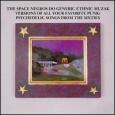 I stumbled upon this CD again when I was looking for a Sparklehorse disc (alphabetical you see). I originally discovered this album when I was a DJ in college and the absurdity of the title instantly grabbed me.
And never has a title so accurately described the music within (except for “the space negros” part which is just weird). Anyhow, the disc is indeed a collection of generic ethnic muzak recordings. But it predates that late 90’s “ironic” muzaky recordings of hipster songs.
Nevertheless, it is muzaky background versions of songs from the sixties (and a few originals). The difference comes in the instrumentation: zithers, harpsichords, clarinets, autoharp, etc. In other words, this isn’t a guy making cheesy Casio recordings of classic songs. This is a collection of musicians reinterpreting songs for fun (and presumably to get high to?).
The most noteworthy songs for me are “Silas Stingy/Boris the Spider” medley and The Stooges’ “We Will Fall.” In fact, I didn’t recognize any of the other songs on the disc (the 13th Floor Elevators and The Electric Prunes are the only bands that I recognize aside from The Who and The Stooges).
So, this is clearly a labor of love. Whether or not you will love it depends on your tolerance for trippy muzaky renditions of songs that sound like they’re from an Indian restaurant/hash shop circa 1964 (that exists on the moon?). The CD reissue includes thirty more minutes of tunes which are all just listed as More Generic Muzak (no covers here). It’s strange that these more nebulous bonus tracks really tend to show off how good the rest of the disc is. Sure in part that’s because the other tracks are actual songs, but it also shows how well the weird musical approach to these songs works when it is focused with a good starting point.
The Space Negros (headed by Erik Lindgren) made several discs, but it’s hard to find a lot of information about them online. Even their own website is surprisingly devoid of information (although you can buy the disc!)
[READ: April 19, 2010] “Prefiguration of Lalo Curo”
Even when I try to stop reading Bolaño, the stories keep arriving in my mailbox. This story (to be released in his forthcoming story collection The Return) looks at the history of Lalo Curo. For those of us reading 2666, Lalo Curo figures prominently in The Part About the Crimes. And in 2666 his history is given. So this short story is a bit confusing within the canon of Bolaño. 2666
In this one, Lalo’s mother, rather than being raped and impregnated as a young girl (as had all of her mother’s mothers) was a porn star. Lalo was born Olegario Cura (surname Cura (The Priest) because his father was a priest). And, as with all my favorite Bolaño stories, there’s all kinds of fun questions regarding narrator and intended reader. Lalo’s mother “Connie Sánchez was her name, and if you weren’t so young and innocent it would ring a bell” along with her sister and friend were all stars in a series of porn movies. The man behind the movies was a German [another thing that recurs in Bolaño] named Helmut Bittrich. Helmut treated them well, and the whole production company felt like a (weird, certainly) family. In fact, Connie made films even when she was pregnant with Lalo (lacto-porn!).
Connie had tried legitimate theater (even Broadway!), but eventually, her career went towards porn. The bulk of the story is given over to (graphic) descriptions of all of her films. But the most interesting section is about Bittrich’s understanding of “the sadness of the phallus.” After all those graphic scenes we get this remarkably poetic moment:
he’s naked from the waist down, his penis hangs flaccid and dripping. Behind the actor, a landscape unfolds: mountains, ravines, rivers, forests, towering clouds, a city, perhaps a volcano, a desert.
Pajarito Gómez is the male actor described above. He is the primary male in all of the porn films. He wasn’t well endowed, but he had a special kind of presence on screen. As the story ends, Lalo goes in search of Gómez and finds him easily. They share a moment, watching movies and reconstructing the past.
It’s an interesting story, one that fully fits within the Bolaño landscape. Bolaño is pretty obsessed with porn, and this story is obviously no exception. It may not be the best introduction to Bolaño’s work, and yet in many ways, it’s pretty much Bolaño in a nutshell.

 SOUNDTRACK: RUSH-Permanent Waves (1979).
 When my friend Doug and I were hanging out back in the 80s, we both were getting into Rush at the same time. And because this album was in black and white this was the last Rush LP we bought. Imagine our surprise when it turned out to contain “The Spirit of Radio” one of the best hard rock anthems ever.
 SOUNDTRACK: KISS-KISSology: The Ultimate Kiss Collection, Vol. 2: 1978-1991 DVD (2007).
 In addition to containing Kiss Meets the Phantom, this DVD contains concert footage, music videos and some interviews. We see Peter Criss being interviewed on CNN (!) by a woman in a tank top (ah, the early days of 24 hour news) about leaving the band. Of course, this doesn’t hold a candle to the actual music video for “Shandi” one of the cheesiest of cheesy Kiss videos.
 SOUNDTRACK: NO FORCEFIELD-God is an Excuse (2001).
 I was looking up what Larry LaLonde, guitarist for Primus, had been up to while Primus seems to be on hiatus. I hadn’t heard a word from him, so I was surprised to see that he had released two albums with a band called No Forcefield.


 SOUNDTRACK: SCHOOLLY D-Smoke Some Kill (1988).
 Since this disc is featured so prominently in Signifying Rappers (and the book is named after the best track on this disc) I thought I’d dust it off and listen to it again. I got this disc probably in 1989 at the suggestion of my friend Al. He recommended “No More Rock N’ Roll,” I think.
 SOUNDTRACK: TV ON THE RADIO-Dear Science, (2008).
 The problem with TV on the Radio for me is that their first EP is so damned good that anything else they do pales in comparison. Having said that, Dear Science, comes really close to topping that EP. I liked Cookie Mountain (their previous disc) but I felt like they put so many elements into the mix that it detracted from the best part of the band: Tunde Adepimbe & Kyp Malone’s vocals.
 SOUNDTRACK: GREAT NORTHERN-Trading Twilight for Daylight (2007).
 A patron donated this disc to our library. I had never heard of Great Northern, but I gave it a listen, in part because I hoped that the band name came from Twin Peaks (no idea if it does). And wow, I was blown away by this disc.
 SOUNDTRACK: GARBAGE-Garbage (1995).
 I was thinking about how IJ reminds me so specifically of a place and time (I instantly think of the apartment I was in when I started reading it). And there are also some discs that I was crazy about at the time too.
 It is incredible serendipity that I did the JOI filmography during this week as this week’s readings actually count on knowing a bit about it. And since I had just reevaluated it, I was aware of a thing or two during Hal’s viewing scene.
 Week 10 starts off seeming like a lot of nothing is happening. There’s a few post-Event scenarios. Until we get to November 14th, and a whole lot goes on. A whole lot!
 SOUNDTRACK: SONIC YOUTH-Experimental Jet Set, Trash & No Star (1994).
 “Bull in the Heather” is one of my favorite Sonic Youth songs. I love everything about it (even if I haven’t got a clue what it’s about): the simple opening, the switch to harmonics, and, my favorite part, the drum break that leads to the chorus (who ever heard of getting a drum break stuck in your head?).

 every IJ book jacket/promotional material designed in a sort of cloud motif. Well, in the section we lean that Uncle Charles’ office is decked out in an unsettling cloud wallpaper (which is coincidentally the same wallpaper as Hal’s dentist). It has only appeared briefly so far, so it seems odd that it would take on such an iconic feel. But we’ll see if it comes back.
 I Just Read About That...
