Feeds:
Posts
Comments

Archive for the ‘Funny (strange)’ Category

SOUNDTRACK: EVANGELISTA-Prince of Truth [CST061] (2009).

This is the second disc by Evangelista, the band fronted by Carla Bozulich. This disc continues in the vein or the previous disc, which is a little disappointing.

The disc is chock full of a lot of noise: stringed instruments, textures, layers, but they all add up to very little.  Bozulich’s voice is in another location entirely.  On most of the songs, there’s no real connection.

Two songs in the middle, “You Are a Jaguar,” and “Iris Didn’t Spell” are more reasonable attempts where Bozulich’s wild vocals are wedded to a more standard musical composition.  And those tracks work pretty well.  But when there’s so much directionless stuff floating around on the disc, it’s hard to want to listen to it.

[READ: May 25, 2010] “Afraid to be Men”

This is a conversation between two men.  They are given no context and are speaking abstractly.  These two things combines make for a less than satisfying read.

Admittedly, this piece is excerpted from a longer piece called “Manifesto.”  I’m not planning to read the longer piece, so I’ll never find out of context is given. (more…)

Read Full Post »

SOUNDTRACK: THE BEATLES-Beatles for Sale (1964).

After the riotous fun of A Hard Day’s Night, I expected that this disc would not only continue the fun, but also be full of songs that I’d heard all the time on the radio.

But wow, this disc is kind of a downer.  “I’m a Loser.”  Really? It’s catchy as all get out but what happened to these guys in this last year?  “Baby’s in Black.”  Wow, these guys are serious now.  The opener, “No Reply” is all about getting rejected.  And “I’ll Follow the Sun” is about leaving and losing a friend.

But there are some good times as well. The cover of “Rock n Roll Music” is a little too stiff for such a rollicking song (kind of like how “Roll Over Beethoven was a little too stiff previously).  But “Eight Days a Week” is a rocking good time.  Fun for all and the first sign that the fun Beatles haven’t grown up completely.

The second half of the disc I barely recognized at all.  One or two songs were kind of familiar, but I wasn’t singing along with abandon.

Yet despite my unfamiliarity, the disc shows remarkable progression in songwriting, in structure (and even recording techniques–again, the liner notes were really informative about the technology they used).  I doubt many people consider this their favorite Beatles disc, but I think it’s a fine transition into what’s to come.

It’s also quite surprising to see how much their hair has grown in a year.

[READ: May 16, 2010] “Lost in the Funhouse”

I read this short story because it is something of the foundation of David Foster Wallace’s story “Westward the Course of Empire Takes Its Way.”  This story is part of Barth’s larger collection also called Lost in the Funhouse.  And, based on this story, I’m looking forward to reading the rest of the collection.  But this story works in an of itself and, since it forms the backbone of the other story I’m going to mention it by itself.

This story is written in a thoroughly postmodern way.  As the story opens, with the enigmatic line, “For whom is the funhouse fun?,” we are introduced to Ambrose.  Ambrose has come with his family to the shore for “the holiday, the occasion of their visit is Independence Day, the most important secular holiday of the United States of America.”

Shortly after this italicized part, the story interrupts itself with this:

Italics are also employed, in fiction stories especially, for “outside,” intrusive, or artificial voices, such as radio announcements, the texts of telegrams and newspaper articles, et cetera. They should be used sparingly.

And so it goes with the rest of the story.  The author (one assumes) interrupts the flow of the narrative, letting the reader know that there is far more at foot here than just the story of Ambrose at the beach.

The story eventually gets back to the matter at hand: Ambrose, his brother Peter and Peter’s girlfriend Magda are driving with Ambrose’ parents to Ocean City.  This trip is made three times a year but this is the first time that Magda has come with them.  They play car games (spot the towers), and generally act like a family on a long car trip.

At this point the author interrupts again to note that:

So far there’s been no real dialogue, very little sensory detail, and nothing in the way of a theme. And a long time has gone by already without anything happening; it makes a person wonder.

Oh, and all along it is quite apparent that Ambrose is, as the title suggests, lost in the funhouse at the beach.

When they finally arrive at the beach, there has been an oil spill and no one wants to swim, so they stay on the boardwalk (not under the boardwalk).  Then the family decides to go for a swim in the pool.  At which point the author jumps in again and stops the meandering:

There’s no point in going farther; this isn’t getting anybody anywhere; they haven’t even come to the funhouse yet. Ambrose is off the track, in some new or old part of the place that’s not supposed to be used; he strayed into it by some one-in-a-million chance….

When the funhouse is finally mentioned as an activity, there is general hilarity and nudging and winking about what happens in funhouses (which Ambrose is too young to understand).  At this point, it’s worth noting that Ambrose has a pretty big crush on Magda.  He has spent many an afternoon with her while the three of them were playing (although she clearly thinks nothing of it).  When he suggests that he and Magda go in the funhouse together, everyone wonders what he’s thinking, but no one says anything (again, he’s too young).

Ultimately, the three kids make it to the funhouse, the entrance of which blows girls’ skirts up (and then Ambrose realizes the point of the funhouse!).  And he realizes that the funhouse is not meant for him.  And then he gets lost.

From there the story turns into fantasy, imagination and future possibilities.

It’s a fascinating piece of work.  I certainly wouldn’t want all of my stories to be constructed in this way, but I really appreciate this point of view and the, in my opinion, funny intrusions that break the fourth wall.

For reasons I’m not entirely clear about, the whole story is available here as a Word doc.

Read Full Post »

SOUNDTRACK: Thee Silver Mt. Zion Memorial Orchestra-Kollpas Tradixionales (2010).

Silver Mt. Zion are back!  And they are noisy!

This disc continues their fine output of haunting, rambling epics.  The opener is a 15 minute slow builder called “There is a Light” and the finale is a 14 minute story called “‘Piphany Rambler.”  In between we have  a couple of multi-part tracks: “I Built Myself a Metal Bird” and “I Fed My Metal Bird the Wings of Other Metal Birds” which are some of the fastest tracks they’ve recorded.  The other “suite” is 3 versions (and spellings) of the title track.

The one consistent thing about Silver Mt . Zion (in whatever version of their name they employ) is that they write incredibly passionate music.  It’s often raw and it swells and ebbs with feeling.  I especially enjoy the (multiple) climaxes that fill all of the longer songs.  And when the band brings in the horns and the strings and the whole group sings along, it’s very affecting.

The one thing that I’m still not totally on board with is Efrim’s voice.  On previous releases, I bought it because he sounded very angsty, but I’m starting to think that the tenor of his voice just doesn’t work with the bombast of the music.  When the backing singers chime in, the sound is glorious, but I find his voice to be simply the wrong sound.  There’s a few parts on the disc where he sings in a lower, softer register, and I found them really moving.  I think if he sang all of the parts like that, they would impact the songs more strongly (and maybe even be more understandable).

I realize that the vocals are an essential part to the disc, and I definitely get used to them after a few listens, I just feel like the whole disc (and not just the music) would be amazing if Efrim used that deeper register more.

Nevertheless, the music is really fantastic, and if you buy the LP, you get some great artwork, too.

[READ: May 13, 2010] McSweeney’s 34

After the enormous work of Panorama, (McSweeney’s newspaper (Issue 33)), they’ve returned with a somewhat more modest affair.  Two slim books totaling about 400 pages  Each is a paperback. The first is a collection of short stories artwork, etc.  The second is  nonfiction work about Iraq.  Both books are bound together in a clear plastic slipcover (with a fun design on it).  [UPDATE: I cannot for the life of me out the books back in the cover.  They simply will not sit without ripping the plastic.  Boo!]

The first collection opens with a Letters column, something that we haven’t seen in years!  And, as with the old letters column, the letters are absurd/funny/thoughtful and sometimes just weird. (more…)

Read Full Post »

SOUNDTRACK: THE FLAMING LIPS & STARDEATH AND WHITE DWARFS featuring HENRY ROLLINS and PEACHES doing The Dark Side of the Moon (2010).

You’ve got to have balls to cover the most popular album of all time.  Everyone knows Dark Side of the Moon, according to Billboard charts everyone probably owns a copy of Dark Side of the Moon.  So, you’re taking on a pretty big task here.  But the Flaming Lips aren’t called The Fearless Freaks for nothing.

What delights me about this album is that it is utterly unfaithful to the original.  There’s nothing worse than a cover song that just apes the original version.  With that in mind, the Lips have put their bizarro stamp on the classic album, oftentimes rendering the songs almost unrecognizable–but more on that in a moment.

The two guest stars on the disc are Henry Rollins and Peaches.  Rollins recites all the spoken word bits from the original.  He actually makes a lot of those weird ramblings clear for me for the firs time.  The originals were spoken by a (presumably) high Englishman.  Rollins’ delivery is much more abrasive (but then so is the music).  It works pretty well, especially since Rollins’ laugh is maniacal, although if he sounded a bit more drunken I think it would work even better.  Peaches sings a few of the female vocal bits.  I’ve never been much of a fan of hers but, man, she does an awesome job in covering “The Great Gig in the Sky,” the track from the disc that features a wondrous diva singing and screaming her heart out.  Peaches really lets loose and showcases the power of her voice.

The Lips play on 7 songs and StarDeath play on 6.  They work together on 2 tracks.

StarDeath is fronted by Wayne Coyne’s nephew, Dennis.  I’d only heard one track from them before, and I liked it.  Dennis’ voice is a higher register, like Wayne, but he’s also a bit more subtle. Musically they are less noisy as well, and it’s a good counterpoint to the static of the Lips’ tracks.

So the opener, “Breathe” (Lips) is distinct right away, because the main focus of this version is a loud throbbing bassline. “On the Run” (Stardeath) is completely indistinguishable from the original.  You would never suspect it was a cover.  It’s a bass-propelled, very cool song, but there’s almost no similarity.

“Money” (Lips) stays fairly faithful to the original, except that the vocals are totally auto-tuned.  It makes the song sound really alien, as if coming, yes, from the other side of the moon.

“Time” (Stardeath) on the other hand, is a very delicate, acoustic track, (sounding somewhat like Mercury Rev, actually).  It is something of a counter to the rocking version on the original.

“Us and Them” (Lips) is probably the closest sounding to the original.  It has simple washes of sound and Wayne’s delicate voice.  But, once again, the louder sections of this song are left out.  “Any Colour You Like” (Stardeath) is a much closer instrumental to the original than “On the Run” was.  And “Brain Damage” (Stardeath) is really quite spot on (and may be even creepier than the original).

The ender, “Eclipse” is like a distorted indie rock version of the original.  It works pretty well.

There’s surprisingly little in the way of sound effects (which are all over the original).  I’d have thought they’d populate the disc with all kinds of fun things, but no, they actually play it pretty straight.

My one real complaint about the disc (and actually about Embryonic as well).  The Lips have always pushed the envelope of music.  But lately, they seem to be redlining  a lot of their sounds, making them distort and crackle.  Now, I love distortion when it’s used well, but this “too loud” distortion actually hurts my ears, even if the volume is low.  I find the sound to be unpleasant, and not in a good way.  And I think it’s a shame because the Lips write such great music, that I hate to have it obscured by clouds of noise.

So, yeah, this will never replace the original for anyone.  But it’s a fun experiment and actually sounds a bit like a rough demo for the final release.  In fact, in many ways it sounds like it’s coming from outer space and may be conceptually more accurate for the title.

I saw The Lips and Star Death on Jimmy Fallon.  They played “Breathe” and all eight (or more) guys were on stage.  It was a big wonderful mess.  And they sounded really good together.

[READ: May 11, 2010] ; or The Whale

In 2007, a book was published called Moby Dick in Half the Time.  And, as the title implies, it took Herman Melville’s Moby Dick; or The Whale and truncated it.  The editors basically kept in all of the “plot” and excised most of the “wandering” parts of the story.

So, in 2009, Damion Searls decided to print all of the excised material as a book itself.  This exercise was published in The Review of Contemporary Fiction, Summer 2009 | Vol. XXIX.  So, this “book” is Moby Dick without the “plot” or as the introduction puts it, “all Moby, no Dick.”

This book includes “every chapter, sentence, word, and punctuation mark that Anonymous removed to produce [Moby Dick in Half the Time]” (10).

And so what we get is a very surreal story indeed.  It comes across as a fascinating look into the mind of the (in this version) not named until Chapter 11 or so narrator (since we’ve obviously lost “Call me Ishmael”).  It also comes across in many sections as bizarre poetry.

; or the Whale’s opening line is:

“methodically.” (31). (more…)

Read Full Post »

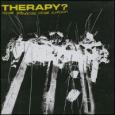
SOUNDTRACK: THERAPY?-Never Apologise Never Explain (2004).

This album is the prior release to One Cure Fits All. It’s not true that Therapy? works on a harsh release/melodic release kind of schedule, although judging by these two discs it sure seems that way.  Never Apologise begins with a blistering, noisy “Rise Up.”  The really notable difference with this disc and other Therapy? releases is the amount of noise in the track. One of Therapy?’s most notable sounds has been a guitar that is so clean it sounds almost unreal.

This disc is far more sludgy (and seems even more angry), witness: “Die Like a Motherfucker.”

The whole disc is fairly short (under 40 minutes), very fast, and in relative Therapy? terms, lyrically not very interesting.  Consider this a solid rawk album.  And, again, one that is not available in the States.

[READ: April 29, 2010] Metrophilias

Brendan Connell’s new book is a short story collection.  And the short stories are indeed very short.  The longest one is 4 pages; most are 2.  There are 36 stories in all and each is named after a city.

I love the title of the book.  Metrophilias.  Technically, what? City love?  Love in a major city?  [Of course the prefix metro- means “mother” so I guess the title is literally motherlove, but that’s not how it’s intended].  And so each short story shows a snapshot of an individual in love in that city.

Each city is represented by at least a small nod that locates it, whether it is a street name or a building, or as in many cases, by an entire culture coming to the fore.  As such, some cities are far more identifiable as cities, and yet the content of the stories is so individualized that the city itself is (in many cases) irrelevant.  Of course, some of them could only be set where they are.  But before I get too obsessed with that aspect of the stories, I should move on to the people on the stories. (more…)

Read Full Post »

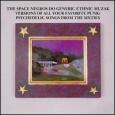
SOUNDTRACKTHE SPACE NEGROS Do Generic Ethnic Muzak Versions of All Your Favorite Punk/Psychedelic Songs from the Sixties (1987).

I stumbled upon this CD again when I was looking for a Sparklehorse disc (alphabetical you see).  I originally discovered this album when I was a DJ in college and the absurdity of the title instantly grabbed me.

And never has a title so accurately described the music within (except for “the space negros” part which is just weird).  Anyhow, the disc is indeed a collection of generic ethnic muzak recordings.  But it predates that late 90’s “ironic” muzaky recordings of hipster songs.

Nevertheless, it is muzaky background versions of songs from the sixties (and a few originals).  The difference comes in the instrumentation: zithers, harpsichords, clarinets, autoharp, etc.  In other words, this isn’t a guy making cheesy Casio recordings of classic songs.  This is a collection of musicians reinterpreting songs for fun (and presumably to get high to?).

The most noteworthy songs for me are “Silas Stingy/Boris the Spider” medley and The Stooges’ “We Will Fall.”  In fact, I didn’t recognize any of the other songs on the disc (the 13th Floor Elevators and The Electric Prunes are the only bands that I recognize aside from The Who and The Stooges).

So, this is clearly a labor of love.  Whether or not you will love it depends on your tolerance for trippy muzaky renditions of songs that sound like they’re from an Indian restaurant/hash shop circa 1964 (that exists on the moon?).  The CD reissue includes thirty more minutes of tunes which are all just listed as More Generic Muzak (no covers here).   It’s strange that these more nebulous bonus tracks really tend to show off how good the rest of the disc is.  Sure in part that’s because the other tracks are actual songs, but it also shows how well the weird musical approach to these songs works when it is focused with a good starting point.

The Space Negros (headed by Erik Lindgren) made several discs, but it’s hard to find a lot of information about them online.  Even their own website is surprisingly devoid of information (although you can buy the disc!)

[READ: April 19, 2010] “Prefiguration of Lalo Curo”

Even when I try to stop reading Bolaño, the stories keep arriving in my mailbox.  This story (to be released in his forthcoming story collection The Return) looks at the history of Lalo Curo.  For those of us reading 2666, Lalo Curo figures prominently in The Part About the Crimes.  And in 2666 his history is given.  So this short story is a bit confusing within the canon of Bolaño.  2666

In this one, Lalo’s mother, rather than being raped and impregnated as a young girl (as had all of her mother’s mothers) was a porn star.  Lalo was born Olegario Cura (surname Cura (The Priest) because his father was a priest).  And, as with all my favorite Bolaño stories, there’s all kinds of fun questions regarding narrator and intended reader.  Lalo’s mother “Connie Sánchez was her name, and if you weren’t so young and innocent it would ring a bell” along with her sister and friend were all stars in a series of porn movies.  The man behind the movies was a German [another thing that recurs in Bolaño] named Helmut Bittrich.  Helmut treated them well, and the whole production company felt like a (weird, certainly) family.  In fact, Connie made films even when she was pregnant with Lalo (lacto-porn!).

Connie had tried legitimate theater (even Broadway!), but eventually, her career went towards porn.  The bulk of the story is given over to (graphic) descriptions of all of her films.  But the most interesting section is about Bittrich’s understanding of “the sadness of the phallus.”  After all those graphic scenes we get this remarkably poetic moment:

he’s naked from the waist down, his penis hangs flaccid and dripping. Behind the actor, a landscape unfolds: mountains, ravines, rivers, forests, towering clouds, a city, perhaps a volcano, a desert.

Pajarito Gómez is the male actor described above.  He is the primary male in all of the porn films.  He wasn’t well endowed, but he had a special kind of presence on screen.  As the story ends, Lalo goes in search of Gómez and finds him easily. They share a moment, watching movies and reconstructing the past.

It’s an interesting story, one that fully fits within the Bolaño landscape.  Bolaño is pretty obsessed with porn, and this story is obviously no exception.  It may not be the best introduction to Bolaño’s work, and yet in many ways, it’s pretty much Bolaño in a nutshell.

For ease of searching I include: Bolano, Sanchez, Gomez

Read Full Post »

SOUNDTRACK: THE DEAD MILKMEN-Soul Rotation (1992).

And lo, the Milkmen grow up.

This disc is not funny (well maybe, a little funny); mostly it is  “thoughtful” (and sometimes absurd).  But what is most striking about it is how mature (mellow) it is.  For this is the first album by The Dead Milkmen on Hollywood Records (a subsidiary of Disney).  This combination raises far more questions than is worth looking at.  But suffice it to say that even though this disc is the Milkmen, its a very different Milkmen.

The most obvious difference is that the majority (10 out of 13) of the songs are sung by the artist formerly known as Joe Jack Talcum, now known as Butterfly Fairweather (perhaps Hollywood knew that “”Punk Rock Girl” was their big hit?).  Past DM records were mostly sung by Rodney Anonymous (who goes by H.P. Lovecraft on this disc).  And his were the heavier, weirder, funnier, absurdist tracks, for the most part.  So, when the first four songs here are sung by Butterfly, you know something different is afoot.  Oh, there’s horns on the disc as well!

The disc feels like a pretty typical alt-rock band from the 90s.  But it’s missing the sass, it’s missing the vulgarity.  Basically, it’s kind of dull.

That’s not to say there aren’t good songs on here, because there are.  “If I Had a Gun” is a great screamy Butterfly song, and “Wonderfully Colored Plastic War Toys” is full of Lovecraft’s snark. As is “The Conspiracy Song” a lengthy rant of absurdity.

The rest of the songs drift between mellow and alt-rock rockers.  And it works as a product of the alt rock 90s.  It’s just not much of a DM album.

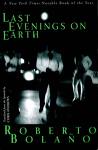
[READ: April 8, 2010] Last Evenings on Earth

I have been reading Bolaño’s short stories for a while now.  And so I have read a couple of the stories in this collection already. The stories in this collection were taken from his two Spanish collections of short stories: Llamadas telefônicas (1997) and Putas aseinas (2001).  And I have looked at about a dozen sources but I can’t find which stories came from which original collection (I like  to know these hings).  I can’t even find a table of contents for the original books.  Anyone want to help out?

I enjoyed these stories more than I expected to.  I have read some of his stories in The New Yorker and elsewhere, and I’ve been okay with them, but this collection blew me away.  Whether it’s being immersed in his writings or just having them all in one place, I was thrilled by this book.

There so many delightful little things that he does in his stories that I find charming or funny or something.  Like that his narrators are usually two or three people removed from the details.  Or if they’re not, they act like its been so long they doesn’t need to get all the details right:  “U insults and challenges him, hits the table (or maybe the wall) with his fist” (“Days of 1978”).

I also get a kick out of all the stories with the protagonist named B.  Which seems a not so subtle way of saying he’s the narrator (even though I ‘m sure these things never happened to him quite like it says (despite all the biographical consistencies with his own life).

The opening story “Sensini” has the narrator working as a night watchman at a campground (much like Enric in The Skating Rink…a bit of biography perhaps?).  A number of his stories are simply biographies of interesting characters (something he went to extremes with in Nazi Litearture in the Americas): “Henri Simon LePrince” a failed writer in Post-WWII France.  “Enrique Martin” a delightfully twisted story about jealousy (aren’t they all, though?) and acting impulsively and foolishly (aren’t they all though?).  This one featured  a riddle that I’m not even sure we’re meant to get:

3860+429777-469993?+51179-588904+966-39146+498207853

which the narrator thinks is a word puzzle. (more…)

Read Full Post »

SOUNDTRACK: THE DEAD MILKMEN-Bucky Fellini (1987).

C’mon, I’m the walrus, damnit.

Bucky Fellini ups the ante from Eat Your Paisley in that the band sounds really accomplished at this point.  The songs are still silly, but they’re not quite as jokey (except for the hit single, but more on that in a second). There’s even lap steel guitar, violin and backing vocals!

Dave Blood’s bass is really something of a force at this point, propelling songs with interesting riffs.  Rodney  “Cosloy” Anonymous sounds great.  And, Joe Jack Talcum gets quite a number of songs to sing: the mellow (and very twisted) “Watching Scotty Die” and the more rocking “Rocketship.”

“Big Time Operator” is a supremely silly song based on a very simple blues riff.  It features the first (utterly wretched) DM guitar solo (look out Stevie Ray Vaughn!) and even showcases a “humming” solo from Rodney (just me!).  While  on the other end of the spectrum, “Surfin’ Cow” is mostly instrumental which is catchy and full of surprising intricacy.

“Instant Club Hit (You’ll Dance to Anything)” was indeed a club hit.  It’s snarky and silly (complete with a drum machine) and it name-checks some of the most prominent college radio bands of the time.  You could easily have built a good collection of British college rock from their list of who you’ll dance to. (instead of giving your money to a decent American artist like himself).

The Dead Milkmen keep getting better and better.  They’re still funny, but they’ve proven themselves to be far more than a novelty act.  Blow it out your hairdoo cause you work at Hardees.

[READ: April 1, 2010] Nazi Literature in America

I’ve read a lot of books that are, shall I say, weird.  But this one is definitely the most unusual when I think:  what would possess a person to write it?

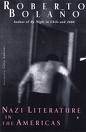
Nazi Literature in the Americas is written as an encyclopedia of Nazis writers who have lived in North, Central and South America.  Except that all of the writers are fake.  So, essentially Bolaño has invented 30 characters, and created rich, fully detailed biographies about all of them.

Some of them are very short (a couple of pages) while a few are over ten pages long, with details of books/poems published, critical reception and even untimely deaths.   The biographies are grouped according to categories (The Mendiluce Clan; Itinerant Heroes or the Fragility of Mirrors, Forerunners and Figures of the Anti-Enlightenment; Poètes Maudis; Wandering Women of Letters; Two Germans at the End of the earth; Speculative and Science Fiction; Magicians, Mercenaries and Miserable Creatures; The Many Masks of Max Mirebalais; North American Poets; The Aryan Brotherhood; The Fabulous Schiaffino Boys; The Infamous Ramírez Hoffman).

And although they are not chronological, Luz Mendiluce (whose bio I read separately) features prominently as a constant “reference point” and creator of one of the prominent Nazi publishing houses.  She had created a publishing empire where Nazi works were spread throughout the continent, and it seems that everyone had a title published by her company Fourth Reich.

What’s so weird about the book is that the people are fake, everything about them is fake (although they are placed firmly within history) and yet their stories are still compelling.  Bolaño has employed a mildly sympathetic tone to these people.  Not sympathizing with the Nazi aspect, but sympathizing with them as humans.

There were one or two who I didn’t really enjoy.  And I admit that I enjoyed the North Americans more; since I know more about North than South America, the facts surrounding these authors resonated more.  But I thoroughly enjoyed most of these biographies.

Of course, just when you think the book is all the same, the final biography changes everything.  In this one, Bolaño himself appears as the writer of the book.  He writes about Ramírez Hoffman in the first person, mentioning himself by name and getting personally involved in the story of this final, skywriting author.  It completely subverts the work before it and leaves you more confused than when you started (although a lot happier for having read it).

The final section of the book is an Epilogue foe Monsters.  It provides a brief biography for all of the secondary characters mentioned in the main body.  It also details the publishing houses and magazines, and finally lists  a bibliography of all books published.  The amount of detail that Bolaño created here is staggering.

But aside from all the Nazism, the book can be quite funny.  Like the conclusion for Luz Mendiluce Thompson, which ends with her driving a car into a gas station.  The final line: “The explosion was considerable.”

It’s tempting to say that this “novel” is not representative of Bolaño’s writing, but I think that’s false.  From what I’ve read so far, Bolaño doesn’t conform to any style in his books: each book is designed differently.  But like this one, they all deal with South America, with violence, with politics and are filled with humor.  So, yes, I guess this is pretty representative.

Oh, and the translation by Chris Andrews is, once again, fantastic.

For ease of searching I include: Bolano

Read Full Post »

SOUNDTRACK: VIC CHESNUTT-At the Cut [CST060] (2009).

Vic Chesnutt died in December.  I have limited exposure to him, although I really enjoyed his previous Constellation release North Star Deserter.

This release (his second to last) shows him playing with much the same line up as North Star.  And it is just as harrowing and passionate as the other.

It opens with the fantastic “Coward” in which, stating how courageous it can be to be a coward her proudly sings “I am a Coward!”.  This track is one of the rocking ones on the disc, which is split pretty evenly between cacophonous rockers and slow moody acoustic pieces.  Another great rocker is “Chinaberry Tree.”  The lyrics are simple and the chorus is just the words Chinaberry Tree, but it is fantastic.

My preferences run to faster music, so I enjoy his noisier tracks to the simpler, acoustic ones.  And yet, lyrically, his songs are so moving that I easily get sucked into the narratives.  The most notable song on the disc is “Flirted with You All My Life” which is about death, specifically about his past suicide attempts.  It’s really moving.  And even the seemingly simple “Granny” is a well-written mood piece.

Chesnutt had all kind of physical problems (when he was 18 he was in a car accident and had been mostly paralyzed) and he had been in pain most of life.  It’s a shame he felt compelled to end his life, but we still have his music to enjoy.

[READ: March 27, 2010] Fever Chart

About half way through this first-person book, the narrator has a mental breakdown and tries to bite his hand off.  That should tell you right off the bat whether or not you want to read the book.  (Add to that that the narrator also has terrible bowel problems).

I had received an excerpt from McSweeney’s over the summer, and of all three books in the sampler, I enjoyed this one the most.  Little did I know how utterly surreal the story would get once that excerpt was over!

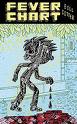
The cover of the book shows a man walking down the street with blood dripping from his hand.  This seemed like an odd choice to me.  However, for the bulk for the story, the narrator seems to be walking down streets with blood dripping from his hand (the one he eventually tries to bite off) so it perfectly encapsulates the tone of the book.

The story opens in the middle of a series of events from the narrator’s past (the first few sections are written in a wonderfully disjointed way that keeps the reader off balance).  Jerome Coe is currently living in an Apartment in Boston.  It has no heat.  His toilet is frozen solid and he is sleeping between his mattress and box spring to keep warm.  After ages of complaints to his landlord, one day the heat kicks on.  Full blast.  And Jerome cannot turn it off.  Soon, wallpaper is peeling of the walls and steam is flowing from his windows.  He is naked in his apartment and is preparing to run outside into the freezing weather just to escape the heat.

While he is standing outside, half-naked, a car pulls up and the driver, a woman named Tommy, asks him to jump in. (more…)

Read Full Post »

SOUNDTRACK: BLUE ÖYSTER CULT-compilations and live releases (1978-2010).

For a band that had basically two hits (“Don’t Fear the Reaper” and “Burnin’ for You”) and maybe a half a dozen other songs that people might have heard of, BOC has an astonishing number of “greatest hits” collections.

Starting in 1987 we got Career of Evil: The Metal Years (1987), Don’t Fear the Reaper (1989), On Flame with Rock n’ Roll (1990), Cult Classic (which is actually the band re-recording their old tracks (!)) (1994), and the two cd collection Workshop of the Telescopes (1995).  There’s even Singles Collection, (2005) which is a collection of their European singles & Bsides.

This doesn’t include any of the “budget price” collections: E.T.I. Revisited, Tattoo Vampire, Super Hits, Then and Now, The Essential, Are You Ready To Rock?, Shooting Shark, Best of, and the 2010 release: Playlist: The Very Best of).

The lesson is that you evidently won’t lose money making a BOC collection.

I don’t know that any of these collections are any better than the others.

The 2 CD one is for completists, but for the most part you’re going to get the same basic tracks on all of them.

And, although none of them have “Monsters” for the average person looking for some BOC, any disc is a good one.

Regardless of the number of hits they had, BOC was tremendous live.  And, as a result, there have also been a ton of live records released.  Initially the band (like Rush) released a live album after every three studio albums. On Your Feet or On Your Knees (1975) Some Enchanted Evening (1978) and Extraterrestrial Live (1982) were the “real releases.”

Then, in 1994 we got Live 1976 as both CD and DVD (which spares us nothing, including Eric Bloom’s lengthy harangue about the unfairness of…the speed limit).  It’s the most raw and unpolished on live sets.  2002 saw the release of A Long Day’s Night, a recording of a 2002 concert (also on DVD) which had Eric Bloom, Buck Dharma an Allan Lanier reunited.

They also have a number of might-be real live releases (fans debate the legitimacy of many of these).  Picking a concert disc is tough if only because it depends on the era you like.  ETLive is regarded as the best “real” live disc, although the reissued double disc set of Some Enchanted Evening is hard to pass up.  Likewise, the 2002 recording is a good overview of their career, and includes some of their more recent work.

If you consider live albums best of’s (which many people do) I think it’s far to say that BOC has more best of’s than original discs.  Fascinating.  Many BOC fans believe that if they buy all the best of discs, it will convince Columbia to finally reissue the rest of the original discs (and there are a number of worthy contenders!) in deluxe packages.  I don’t know if it will work, but I applaud the effort.

[READ: October 2009-February 2010] State By State

This is a big book. And, since it’s a collection essays, it’s not really the kind of big book that you read straight through.  It’s a perfect dip in book.  And that’s why it took me so long to get through.

I would love to spend a huge amount of time devoting a post to each essay in the book.  But, well, there’s 51 (including D.C.) and quite a few of them I read so long ago I couldn’t say anything meaningful about.  But I will summarize or at least give a sentence about each essay, because they’re all so different.

I’ll also say that I read the Introduction and Preface last (which may have been a mistake, but whatever).  The Preface reveals that what I took to be a flaw in the book was actually intentional.  But let me back up and set up the book better.

The catalyst for the book is the WPA American Guide Series and sort of Steinbeck’s Travels with Charley.  The WPA Guides were written in the 1930s as part of the Works Progress Administration.  48 guide books were written, one for each state.  Some famous writers wrote the books, but they were ultimately edited (and many say watered down) by a committee.  I haven’t read any of them, but am quite interested in them (and am looking to get the New Jersey one).  Each guide was multiple hundreds of pages (the New Jersey one is over 800).

State By State is written in the spirit of that series, except the whole book is 500 pages (which is about 10 pages per state, give or take).  And, once again, famous writers were asked to contribute (no committee edited this book, though).  I’ve included the entire list of authors at the end of the post, for quick access.

So I started the book with New Jersey, of course.  I didn’t realize who Anthony Bourdain was until I looked him up in the contributor’s list (I’m sure he is thrilled to hear that).  And his contribution was simultaneously exciting and disappointing,.  Exciting because he and I had quite similar upbringings: he grew up in North Jersey (although in the wealitheir county next to mine) and had similar (although, again, more wealthy) experiences. The disappointing thing for me was that Bourdain fled the state  for New York City (and, as I now know, untold wealth and fame (except by me))  I felt that his fleeing the state, while something many people aspire to, is not really representative of the residents of the state as a whole.

And that dissatisfaction is what I thought of as the flaw of the book (until I read the Preface).  In the Preface, Matt Weiland explains that they asked all different authors to write about states.  They asked some natives, they asked some moved-ins, they asked some temporary residents and they asked a couple of people to go to a state for the first time.  In reality, this decision makes for a very diverse and highly entertaining reading.  In my idealized world, I feel like it’s disingenuous to have people who just stop in to give their impression of an area.  But hey, that’s not the kind of book they wanted to compile, and I did enjoy what they gave us, so idealism be damned.

For most of the book, whenever I read an essay by someone who wasn’t a native or a resident of a state, I assumed that there weren’t any famous writers from that state.  I’ve no idea if that played into anything or not.  From what I gather, they had a list of authors, and a list of states (I was delighted to read that three people wanted to write about New Jersey-if the other two writers ever decided to put 1,000 words  to paper, I’d love to read them (hey editors, how about State by State Bonus Features online, including any extra essays that people may have wanted to write).

From New Jersey, I proceeded alphabetically.  And, I have to say that I’m a little glad I did.  I say this because the first few states in the book come across as rather negative and kind of unpleasant.  Alabama (written by George Packer) comes across as downtrodden, like a place you’d really have to love to live there.  Even Alaska, which ended up being a very cool story, felt like a veil of oppression resided over the state (or at  least the part of the state that Paul Greenberg wrote bout.)  But what I liked about this essay and the book in general was that the authors often focused on unexpected or little known aspects of each state.  So the Alaska essay focused on Native fisherman and the salmon industry.  Obviously it doesn’t do justice to the rest of that enormous state,  but that’s not what the book is about.

The book is meant to be a personal account of the author’s experiences in the state. (more…)

Read Full Post »

« Newer Posts - Older Posts »