Feeds:
Posts
Comments

Archive for the ‘Funny (strange)’ Category

kawaiiSOUNDTRACK: BOB ATCHER AND THE DINNING SISTERS-“Christmas Island” (1950).

xmascocktailThere is something so charming and wonderful about white people co-opting Hawaiian music in the 50s.  I know fully well that there is nothing ‘authentic” about the whole AH-LOH-HA-AY business and that they have made it smooth and “sexy” for “bachelor pads” and all of that.  I know that I should be offended on everyone’s behalf.  And yet I can’t be.

I find bachelor pad kitsch to be fun (Esquivel’s Christmas Album is a perennial favorite), and so I was delighted to be introduced to this song from the 2007 NPR Holiday show.  I actually don’t know anything about Bob Atcher or the Dinning Sisters, but this song is a delightful trip through faux Hawaiian music–slide guitars and a very hula-feeling rhythm.

It even features Santa arriving on a canoe.  Yup, the whole simplification of Hawaiian/island culture is in poor taste, but man, it’s such a swinging and trippy take on a Christmas song.  And I’m sure no islanders were hurt in the making of the recording.  Aloha-ay.

[READ: December 15, 2013] Kawaii!

I’m fascinated by manga and the whole, as the subtitle says, Japanese culture of “cute.”  I don’t really get it.  I mean, I get it, that cute things are cute, but the whole cultural love of cute is so peculiar to me–especially when reading this book and seeing that it is a cultural explosion of cuteness.  This book was a great introduction to so many different aspects of this culture. (more…)

Read Full Post »

bomarsSOUNDTRACK: SIGUR RÓS-“Ný batterí” (2000).

nyThe single opens with “Rafmagnið búið” a kind of brass introductory piece.  There’s lots of horns building slowly, growing louder but not really playing a melody.  By the end of five minutes, it segues into “Ný batterí” which opens with horns as well.  Then the bass comes in, a slow, deep rumble of simple melody.  After 4 and a  half minutes, the drums are a powerful counterpoint to the sweet melody.

“Bíum bíum bambaló” is a slow piece (aren’t they all) that is mostly percussion.  Apparently it is an Icelandic lullaby.  The final track, “Dánarfregnir og jarðarfarir” was a theme used for death announcements on Icelandic radio.  I love the way it builds from a simple melody into a full rock band version and then back again.  It’s very dramatic.

Both tracks were used in the film Angels of the Universe (and appear on the soundtrack).

That certainly makes this single less interesting than the first one (although I’m not sure that the soundtrack was readily available at the time).

[READ: December 1, 2013] Breakfast on Mars

This is a collection of 38 essays (and an introduction by Margaret Cho).  It also includes an introduction geared toward teachers–an appeal that essays do not need to be dull or, worse yet, scary.  The editors encourage teachers to share these essays with students so they get a feel for what it’s like to write compelling personal nonfiction.  The introduction proper gives a brief history of the essay and then talks about the kind of fun and funny (and serious) essays that are included here.

This was a largely fun and largely interesting collection of essays.  When I grabbed it from the library I didn’t realize it was essays (I was intrigued by the title and then looked at the author list and immediately brought it home).  I know it says essays on the cover, but I chose to ignore that apparently.  When Sarah saw the authors (she knows more of them than I do) she had to read it first.  This proved to be a great counterpoint to the very large novel that I was reading at the same time.

The essays each take on different topics.  And what I liked was that before each essay, they include the question that inspired the essay.  I have included the questions here. (more…)

Read Full Post »

[ATTENDED: November 14, 2013] Much Ado About Nothing

much adoDespite all of my reading, I am fairly ignorant of Shakespeare. I’ve read or seen most of the big ones, but I don’t know a lot of his works first hand.  As a young reader I realized that reading Shakespeare was hard—as, really, any play with dozens of characters tends to be.  It’s not easy to keep character straight when there are no descriptors about them.  So I more or less gave up on reading Shakespeare and decided I would watch him when I could.

When the Princeton University theater offered us tickets to see Much Ado About Nothing, it seemed a great opportunity to brush up.

This was a student production, and I have to complement all of the students on their wonderful performances.  They never broke characters, and their Shakespearean dialogue was flawless (as far as I know).  What I found interesting was that it took about fifteen minutes before I was absorbed in the dialogue and understood, well, about 45% of it.  Well, maybe 60%.  They did speak a little fast sometimes.

What was incredibly helpful about the dialogue was…the actors.  Duh.  But really, the language comes to life when you see people actually performing the lines (making Shakespeare’s bawdy jokes that much more bawdy).  And while some of the performances seemed almost over the top, I have little doubt that that is how it was performed back in the day—why would they go for subtle when there’s jokes about sex? (more…)

Read Full Post »

witmisSOUNDTRACK: NEIL HALSTED-“Wittgenstein’s Arm” (2012).

neil-halstead-palindrome-hunches-450Halsted was a founder of the band Slowdive, who I knew somewhat.  I don’t know anything of his solo work, although his name rang a little familiar.

This is a very pretty, slow acoustic ballad.  Halsted’s voice is whispery and with proper folk inflections. The chorus has a very catchy melody.  And yet the lyrics are really dark and sad.

And while there is a mention of an arm in the song, there’s no mention of Wittgenstein.

You can check out the video here:

[READ: November 3, 2013] Wittgenstein’s Mistress p. 181-end

This peculiar book draws to a close in much the same way that it started. There are a few interesting revelations or, if not revelations, then perhaps ponderables as to the nature of just what our narrator (who is apparently named Helen) is doing.

As this last section opens, she is revisiting some more of the things that have been on her mind for the book—the waterlogged atlas that lies flat on the shelf and that blasted arthritic should/ankle  .

I have been wondering about her constant references to her period.  In addition to simply being something that happens to her which she is recording, I have to wonder if it is a nod to her fertility and the fact that since she is the last person alive she will never bear children.  On a slightly related note, I also have to wonder if her focus on rape means she was once raped.  It’s not necessarily the case of course, but there is a lot of it in the book, like this next mention: (more…)

Read Full Post »

witmis4SOUNDTRACK: PANIC-Requiem for Martin Heidegger (1978).

13+LP+Hoes++VoorkantPanic was a Dutch punk band.  Their album 13 came out in 1978 and “Requiem for Martin Heidegger” was the final track.  I love the album cover (and no I had never heard of this band either).

The lyrics are wonderfully simple (and no you won’t learn a thing about the man) with the completely singable chorus of “Hi-Degger, Hi-Degger, Hi-Degger, Hi-Degger, Hi!”

There are some other lyrics (including ein, zwei, drei, vier) and “Is he in heaven, is he in hell, where has he gone?  no one can tell.”

There’s some introductory chatter which I think is in German, but may be in Dutch.  But that’s all irrelevant, because this is three minutes of classic 70s punk.  And the video is a hoot too.

[READ: October 30, 2013] Wittgenstein’s Mistress p. 120-180

Although I read the first half of this book rather quickly, I took some time off before reading this section.  The good news is that this book does not require constant attention.  The bad news is that because there are so many details in the book (whether “relevant” or not) it’s easy to forget if she has talked about the different pieces before.  And that is kind of the point from her a well, since she constantly questions whether she has talked about something or not.

I’m breaking from my normal summary for a minute because I wanted to bring up something that struck me as I was reading this.  Several times throughout the book I found myself searching the web for ideas and facts that she mentions.  And it struck me that, while yes, in her world, the internet wouldn’t be working anyhow—there’s no electricity even—but she would not even have the concept of being able answer her questions with a few clicks.  This book wasn’t written that long ago, but when it was, the internet as we know it didn’t exist.  So our narrator does not know that she could have answered all of her questions in just seconds.  If this book was written now, it might even be seen as a “point” that the world no longer has such easy access to information.  But that is not an issue in this book.  Rather, our narrator simply knows that unless she is willing to dig through boxes or really wrack her brain to be able to remember where she found the information (and we know that’s not going to be successful), she simply won’t “know” what she knows.  And it’s interesting to imagine what it was like to read this book back in the 1980s without being able to quickly confirm  that indeed Wittgenstein said this or Heidegger said that or even that any of the artists she mentions really did what she says.   And I find that really fascinating.

Vaguely connected to this idea is her wondering about some details of the Savona soccer jerseys and then saying “One is scarcely about to return to Savona to check on this, however.” (122). (more…)

Read Full Post »

witmis3SOUNDTRACK: TOULOUSE LAUTREC-“Yesman” (2013).

heroesToulouse Lautrec are an alternative rock band from Romania.  Once again, I would not have ever heard of them had I not looked fora song about Lautrec (since he is mentioned in this section of the reading).

Toulouse Lautrec have two albums out, Heroes and their new one Extraordinar. They sing in both Romanian and English and this song (which is the first thing that came up on my search) is entirely in English.

It starts out with some very cool guitar riffs (very math rock–I actually considered it might be an instrumental).  Even the bass is doing something interesting behind the guitars.  Then about 50 seconds in the vocals begin.  And the singer has an almost American twang to him.

The chorus is a simple one, with ooh hoo hoo hoos.  But the real fun is at the end of each verse–the I say no I Say no and I say yes I say yes.

I listened to this song a few times and really liked it a lot.  It’s simple but solid alt-rock.  Then I found their website and watched a few more of their videos.  I really like the sound that they get–kind of buzzy guitars but otherwise very clean.

Check out the video for Yesman

and their site (which is in Romanian, but Google Translate will help you navigate)

[READ: October 20, 2013] Wittgenstein’s Mistress p. 61-120

This book is proving to be far less daunting and far more loose and fun than I anticipated.  As you can see by my “read” date, I finished this almost two weeks ahead of time.  In part it’s easy because unless I am gravely mistaken, there’s nothing really to “remember” about the story.  There are details and I think they are ponderable, but there’s nothing that seems to really impact the story. It’s more a series of ideas.

It’s really quite an audacious piece of writing.

Wittgenstein gets his first mention on page 61

“Once Bertrand Russell took his pupil Ludwig Wittgenstein to watch Alfred North Whitehead row, at Cambridge.  Wittgenstein became very angry with Bertrand Russell for having wasted his day” [61].

There are some meaty existential issues brought up like

“Surely one cannot type a sentence saying that one is not thinking about something without thinking about he very thing that one says one in not thinking about” [63]. (more…)

Read Full Post »

witmis2SOUNDTRACK: CÓDIGA DE GUERRA-“Wittgenstein Song” (2013).

codigoCódiga de Guerra is from Hidalgo in Mexico.  They have one album out (called Peyote).  I am having a devil of a time finding anything out about them.  You can stream the album on YouTube and you can even buy it from iTunes, but I can’t get any kind of band home page.

It should be apparent that I’d never heard of them before I saw they had a song called “Wittgenstein” and so here they are.

They sing entirely in Spanish, so I don’t really know what this song is about, but i really like it.  Indeed I like the whole album.  They have an indie rock feel–buzzy guitars and good melodies.  Some of the early songs on the album are even kind of mellow which made me think of R.E.M. for some reason.

“Wittgenstein” is the heaviest song on the album.  It opens with some echoed guitars (not unlike Kiss’ “Black Diamond”) but when the other guitars kick in, it is much louder (not heavy heavy, but louder).  The chorus gets kind of heavy again, but the song fades out entirely at around two minutes.  Then a buzzy bass comes back in and the echoed guitar plays the intro and the song starts again.  I heard the word logico in there so it may indeed be all about Wittgenstein.

Check out the song

or the whole album

[READ: October 16, 2013] Wittgenstein’s Mistress p. 1-60

Typically for a group read like this (especially the longer, harder books) I like to be a kind of touchstone–noting significant things that happen and trying to wrap my head around the book by summarizing it, without really speculating wildly about what will happen.  Well, Wittgenstein’s Mistress seems to studiously resist that sort of approach.  I am not typically a “solve it” kind of reader.  I don’t usually try to figure things out ahead of time.  If the book is well written, I just like to let it flow over me so I can think about it afterwards.

But this book more or less demands you to try to figure out what is going on right from the get go.

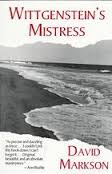
The cover image above shows the opening sentence:

“In the beginning sometimes I left messages in the streets.  Somebody is living in the Louvre, certain of the messages would say. Or in the National Gallery.”

followed soon by

“Nobody came , of course.  Eventually I stopped leaving the messages.”

Weird, right?  And then comes:

“I have no idea how long ago it was when I was doing that. If I was forced to guess, I believe I would guess ten years.”

Whoa.  And then the kicker:

“And of course, I was quite out of my mind for a certain period too, back then.” (more…)

Read Full Post »

corin SOUNDTRACK: THE DISMEMBERMENT PLAN-“No One’s Saying Nothing” (2013).

IDismembermentPlan_CVR-a71cdf7d3b8dde6270c3a01bb56278949eddb5fa-s1 thought I knew The Dismemberment Plan, but I must have them confused with someone else, because this song doesn’t sound anything like what a band called The Dismemberment Plan ought to sound like (which is noisy and chaotic and probably death metal).  This song has big vocals, organ and piano.  Nevertheless, it is rather raucous and is quite fun (and has what sounds like a drill sound effect in the beginning and middle).

Lyrically, the song is odd–“If you press the space bar enough, cocaine comes out.  I really like this computer.”

But it has a very fun devil-may-care, throw in everything attitude that I really like it.  The entire album was streaming on NPR, and I’m looking forward to hearing more from them–including their back catalog work, to see if they ever sounded like what I thought they sounded like.

[READ: October 1, 2013] One Hundred Apocalypses and Other Apocalypses

I was excited to get this book because I thought the title was quite intriguing (and the crazy way the cover is cut out was also interesting).

There are four “stories” in the book.  The first three are about twenty pages each while the fourth is over 100 and is comprised of the titular 100 apocalypses (I didn’t count them).

“Eyes of Dogs”
This story contained marginalia (which is sort of like footnotes but not attached to anything specific). In this story a solider meets a witch and she tells him how to get money—climb down a hole and encounter three dogs.  He must wink at the first, blink at the second and hold his eyes closed for the third.  The story seems to be going along sensibly like a fairy tale but then it grows introspective and stops.  I was disappointed in this one.

“Madmen”
This story was utterly bizarre and yet by the middle of the story the bizarreness was explained and by the end I enjoyed it very much.  The premise of this story is that when children grow old they are given a madman to take care of (it is told matter of factly which makes you have to wonder if madman is code for something else.  When boys reach a certain age and when girl;s have their first period (which is an unfair division of genders) they get to go to the asylum and pick which madman (or woman) they want to bring home and care for.  The bulk of the story is at the asylum with the girl “interviewing” the candidates and her mother being mad at her choices.  Ultimately the story turns onto a nice moment between the girl and her dad, who may or may not have married his own madman.  As I said very weird, but satisfying.

“Godzilla versus the Smog Monster”
This was the most “real” of the four stories and it was my favorite.  A fourteen year old boy is watching “Godzilla vs the Smog Monster.”  He found the unlabelled video of it in his father’s sweatshirt drawer and assumed it was porn.  He’s bummed that it turns out to be this Godzilla movie.  In a parallel story, when the boy goes to school his class is watching live footage of California burning—and this burning is uncontainable.  The whole state is slowly engulfed in flames.  This fire, which seems to be some kind of attack obviously changes the minds of everyone in the story, including Sara, a girl who Peter thinks is pretty but who never talks to him.  But when she crashes her car in front of his house, he helps her and they go for a ride to a cave.  Images of the smog monster crop up in interesting ways.  Things get weird and less tangible, but because the beginning was so real it made the ending okay.

“A Hundred Apocalypses”
So this selection disappointed me because it proved to be 100 (I assume) flash fiction pieces.  And I have more or less come down against flash fiction these days.  Especially the kinds of stories that make an interesting “sketch” but aren’t really stories The other problem is that all 100 seemed to be about “apocalypses” which is a useless words when tossed around so much and which loses all meaning when there are 100 that seem to be about actual apocalypses.  Or something.  I also just learned that apocalypse means un-covering or revelation, not really the end of the world, but whatever.

There were probably 6 out of the hundred that I really enjoyed.  Sadly, I didn’t mark them and I don’t remember which ones they were.  The rest were okay or worse.

I am ready for flash fiction to go away.  And I fear that my beloved McSweeney’s is one of the prime generators of the genre, so perhaps they could knock it off for a bit.

Read Full Post »

lp8.1SOUNDTRACK: TYPHOON-“Dreams of Cannibalism” (2013).

typhoonNPR was steaming this album for a while.  Now they’re giving away this song.

Typhoon is yet another band that has a crazy amount of people in it (between 12 and fourteen) and they have a vast array of instruments in play at any one time (Horns, violins, xylophones, electric guitars and mandolins for example).

At the same time, Singer Kyle Morton’s vocals are distinctive enough and are used like an instrument as well as to deliver lyrics.  This gives them quite a unique sound.

The song opens with an array of horns slowly building to a simple guitar melody.  The verses are somewhat quiet with occasional punctuations of band (and great backing vocals).  But as the song progresses, more instruments kick in (horns adding a melody line).  I really like the way the end of the song shifts direction totally, bringing in a complex instrumental section with interesting time shifts and even better backing vocals..

I enjoyed the whole album while it was streaming.  And while I can’t say that this song stands out more than the other songs, (I think “Artificial Light” is probably the best,) it represents the sound of the band pretty well.

[READ: September 2013] Lucky Peach Issue 8

I haven’t been reviewing Lucky Peach issues in their entirety because they are mostly about food and cooking and recipes and I don’t really have anything to say about that (I enjoy the articles a lot, but I don’t need to comment on them).

But I wanted to bring special attention to this issue because of the way it is presented.  This is the Gender Issue.  It has two covers (see the “female” cover tomorrow) and the magazine must be flipped over to read the different genders.

It’s not often that I think of food and gender as being connected, but there are some really interesting articles in here that talk about not only food itself, but about the people who prepare it.  Like the fact that most big name chefs are men even though cooking has traditionally been “women’s work.”

The women’s side of the magazine has these interesting articles: (more…)

Read Full Post »

laraSOUNDTRACK: VOIVOD-War and Pain (1984).

warandIt was easy to know that Voivod were going to be an unusual band.  Their name is crazy.  All the members had nicknames like Piggy, Blacky, Snake, and, confusingly, Away.  And they were French Canadian, which meant that their singer’s first language wasn’t English–I love the way he stresses things in his vocals especially on later albums, and he had the guttural French that sounds like a cookie monster vocalist even when he is just speaking.

Later on, their prog and psychedelic leanings would come out more, but on their debut, they were just a noisy, screamy pounding metal band.  And this debut has typically bad mid 80s metal production to top it off.

In 2004 the album was remastered with bonus tracks, a full live concert and a CD ROM with all kinds of goodies.  I originally thought the remaster didn’t sound that good, but there is definitely some clarity that the remaster brings.  It allows you to hear a lot of the subtleties (and there are some) that were lost in the original.

There are hints at the kind of weird sounding noises the band would make on future albums, but this is mostly just fast, pounding music.  I’d have liked them to re-record this stuff before Piggy died, just to see what a proper recording studio could do with these earlier songs.

Of course, now that I have listenedto it again with better equipment, I’m changing my assessment somewhat.  Despite the very heavy nature of the songs there are some very cool sequences in here.  They are nothing compared to the complexities that the band would undertake in just a few short years, but there are some really interesting things underway and the remaster definitely highlights them a little better. It still sounds pretty bad 9especially compared to their later records), but hey, they only spent $2,000 and recorded it in a studio where the engineer had never heard a metal band before.

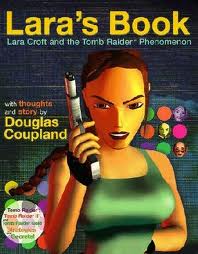
[READ: August 23, 2013] Lara’s Book

I have known of this book since it came out in 1998.  I was a huge fan of Douglas Coupland and yet I had zero interest in Lara Croft or Tomb Raider. So I simply ignored this book.  But because I’m being all completist with this blog, it was time to bite the bullet and see what this piece of nonsense was all about.

And it is just as weird and creepy as I feared.

There are several sections to the book, most of which are written by Coupland.  I will admit right up front that I did not read the strategies and secrets from Kip Ward–sorry Kip, it seemed like fun but between the crazy fonts and layout and the fact that I will never play the game it just seemed like too much. (more…)

Read Full Post »

« Newer Posts - Older Posts »