Feeds:
Posts
Comments

Archive for the ‘Funny (ha ha)’ Category

blackSOUNDTRACK: SONIC YOUTH-SYR 4: Goodbye 20th Century (1999).

syr4This SYR recording consists of Sonic Youth’s interpretations of 20th century composers’ works.  Some of the composers are obscure, but a few are more or less household names: John Cage, Yoko Ono, maybe Steve Reich.  I knew a few of these composers from Kronos Quartet, but for the most part the pieces are all new to me.  Since I don’t know the original pieces I have no idea how faithful they are.

The most fascinating thing about the disc is the CD-ROM video of “Piano Piece #13 (Carpenter’s Piece)” which shows the band performing.  The “song” is literally the band nailing the keys of a piano down.

There are a number of guests on the CD, including the first (I think) performance by Coco Haley Gordon Moore (on the 17 second “Voice Piece for Soprano”).  And, the liner notes are all in English.

This is the longest SYR disc (at over an hour and a half) and it is a fascinating mix of noises and sounds and screams and spoken bits (okay okay okay okay okay okay okay).

This is not for everyone, not even the average Sonic Youth fan.  There’s absolutely nothing in the way of “songs” here.  The abstractness of the disc is palpable.  And, clearly, just knowing that one of the pieces is a bunch of people nailing keys of a piano, you get a fair idea of the breadth of “music” that the disc covers.

[RE-READ August 19th] J.O.I. Filmography

Before reading this week’s section, I had noticed that many people on Infinite Summer (and elsewhere) have discussed James’ films and how they relate to incidents in the overall story.  So, I decided to go back and re-read his filmography Endnote, just to see what else I could learn.

In general, with more background, the Endnote is much more interesting. The first batch of films are more amusing to read about just to see the emphasis on pain and disfigurement.  We also see that he had been using students and teachers from E.T.A. in his films for a while.

We have had an in-depth look at some of these earlier films: The Medusa v. The Odalisque; Homo Duplex, The Joke, The ONANtiad (which the endnote describes as unfunny).  But the ones we haven’t seen show distinct commentary about the state of the country since the Reconfiguration (it’s clear that J.O.I. was against it).  The American Century As Seen Through a Brick deals with anti-O.N.A.N. riots; The Universe Lashes Out is about the evacuation of New Hampshire during the Reconfiguration; Poultry in Motion concerns the toxification of Thanksgiving Turkeys; and No Troy is about miscalibrated Waste Displacement Units that crashed into Troy, NY (which was mentioned in the scene about people looking for entertainment outside of their living rooms).

[Unrelated to the story, on page 990 of my paperback IJ (with forward by Dave Eggers) every italicized word contains a superscript 1 after it (indicating, what? more footnotes?) It is an astonishingly weird glitch/typo and I can’t believe that it wasn’t spotted before going to print as it makes the titles actually harder to read.] (more…)

Read Full Post »

ny1It took me going to Seattle to learn about The New Yorker magazine.  I was visiting my friend Rob and he was really surprised that I didn’t read the magazine all the time (my reading always seems to surprise people, see The Believer.)

Upon my first read of the magazine, I was surprised to see that the first twenty pages or so are taken up with upcoming shows: films, concerts, sports, everything.  I actually wondered how much content would be left after all that small print.

Since then I have learned that Sasha Frere-Jones writes columns in here quite ofuiten.  For reasons known only to my head, I was convinced that Sasha was a black woman.  Little did I realize that he is not.  And that he was in a band that I have a CD of called Ui.  He is an excellent resource for all things music, whether I like the artist he’s talking about or not.  Some entries are here.  This audio entry about Auto-Tune is simply fantastic.

But of course, there’s a lot of content.  And the first thing you get are letters.  I don’t think I have EVER looked at the letters section. (more…)

Read Full Post »

vol3SOUNDTRACK: SONIC YOUTH-SYR 3: Invito Al Ĉielo (1998).

syr3This SYR release adds Jim O’Rourke to the mix (O’Rourke played with with them on A Thousand Leaves too).  I’ve always been aware of O’Rourke but I’ve never really listened to any of the bands that he’s been associated with (and there’s a lot).  So, I’m not sure what his actual contributions are, but he seems to be pushing the SY members into a much more noisy/abstract direction.  (A few samples of Gastr Del Sol shows them to be pretty out there, so perhaps pushing SY in a direction that was not too far from where they’d go on their own.  And, I rather liked the Gastr stuff, too).

The EP is nearly an hour with 2 songs over 20 minutes long.  And, the most fascinating parts come from the most unexpected places: Kim plays trupmet!  There’s keybaords!  And all of the text is in Esperanto.

This disc doesn’t diverge too much from the first two…it’s noisy and discordant and full of lots of experimentation.  There’s some good stuff on here, but there’s also a lot of it.

[READ August 9, 2009] Scott Pilgrim & The Infinite Sadness

Things get pretty intense in Vol 3 of this series.  We get an in-depth look ant Envy Adams, Scott’s first girlfriend and lead singer of The Clash at Demonhead.  TCaD have asked Scott’s band Sex Bob-omb to open for them, but there are clearly underlying reasons behind this.

One of them is that another of Ramona’s evil ex-boyfriends is the bassist in the band.  And, another more narratively interesting reason is to give a peek into Scott’s past.  We learn that Envy was a rather shy young girl, until she slowly grew out of her shell (and changed her name to Envy), and then became the extroverted lead singer.

Todd Ingram, the evil-ex is a vegan.  (more…)

Read Full Post »

ij9SOUNDTRACK: SONIC YOUTH: A Thousand Leaves (1998).

1000This CD actually ties to the book because the crossed out title on the CD is “mille feuille” and the first song is called “Contre le Sexism.”

This opening song is weird and lets you know that this disc is not going to be a friendly listen.  Over some feedback and scratchy noise, Kim whispers and hollers, most notably that “it’s just a kitten.”  But just when you think that the disc is going to be a crazy noise experiment, the next track “Sunday” proves to be another one of Thurston’s supremely catchy singles.

The back and forth continues with Kim’s abrasive “Female Mechanic Now on Duty” and Thurston’s delicate “Wildflower Soul.”  But the pattern is broken with Lee’s spoken-word over simple guitar lines piece, “Hoarfrost.”  It lacks Lee’s usual catchiness, although his later song “Karen Koltrane” more than makes up for it.  Then Kim surprises us by giving us the catchy “French Tickler.”

To me, “Hits of Sunshine” is the centerpiece (literally and metaphorically) of the disc.  It’s 11 minutes long and ranges through the main stylistic feelings of the disc.

The whole disc is over 70 minutes long and it feels meandering.  This is not to say that it has no focus, it’s just not full of pop gems.  And yet for all of its wandering, it hasn’t lost the tunes.  Mixed reviews abound for this disc with everything from 1 to 4 stars coming from the pros.  And, I think depending on my mood, my overall rating could be just as diverse.

I admit that at the time I was starting to lose my adoration for the band.  These longer, more abstract pieces were less enticing than the noise of yore.  But now that I’m a bit older, I can appreciate what they were doing.

[READ: Week of August 17] Infinite Jest (to page 651)

I was planning on starting this week’s write up with a bit about J.O.I’s filmography, which I delved back into and found some fascinating information.  But this week’s write up is pretty long already, so I’m going to do a mid-week (but still spoiler line approved) retrurn to the filmography shortly.

So until then, let’s get back to the book:

This week’s reading gets off to some detailed viewing of the Incandenza men’s psyches before launching into an adrenaline fueled rush.

Mario is still freaked out about Madame Psychosis not being on the air.  He’s not sleeping well at all, and when the insomnia hits him, he goes for walks (even though he knows, and is worried about, how much it freaks out the Moms).

Mario is slowly turning into the absolute heart of the book.  He absolutely and without question loves Hal, and he is concerned for him because he’s been acting differently lately (Mario himself never changes).  He also prays nightly, and in a serious way, talks to God (although he doesn’t expect any one to answer…he’s not crazy).  And, in a very touching scene, which seems to resonate so well with late 1990s America, he is troubled that no one can talk about things sincerely without it being ironic.  (Pemulis wants to set up a prayer hotline for atheists that would just ring and ring). (more…)

Read Full Post »

scott2SOUNDTRACK: SONIC YOUTH-SYR 2: Slaapkamers Met Slagroom (1997).

syr2The second SYR release is like the other side of the coin from SYR1.  The premise is the same, the players are the same, but the result is rather different.

The first track is nearly as long as the previous disc (17 + minutes) and it seems to run through a variety of song styles (including noise experiments) before settling down into a noisy improv.  The third track features the first “vocals” on these discs–rather unsettling sounds that Kim spits out.  (Online lyrics pages say that there are actual words here so I’ll take their word for it; I just like to think of them as vocal stylings).

While SYR1 was a smoother listen, this one is more jagged.  Not quite the noisefest they are capable of but not exactly easy listening either.

For this disc all of the titles, liner notes etc. are in Dutch.  (SYR1 was in French).  Each volume in the series is in a different language.

[READ: August 9, 2009] Scott Pilgrim Vs The World

The second volume of the series, (and the one the film is named after) continues the exciting saga of Scott Pilgrim and his band Sex Bob-omb.

This second volume introduces us to The Clash at Demonhead, the band that Scott’s ex-girlfriend took to stardom, after they kicked Scott out of the band, of course.

But before we get to the Knives Chu’s new favorite band,we learn about the origins of her former favorite band: Sex Bob-omb.  We see how Scott and Kim first met and why she acts so strangely around him.

But more importantly, plotwise, we get to meet Ramona’s second evil ex-boyfriend, Lucas Lee.  He is a broody actor who also just happens to be in Toronto filming a new picture.  And fight they do.

But they’re not the only ones who do battle in this volume.  There’s a rip-roaring battle scene between Knives and Ramona that takes place in the beautiful Toronto Reference Library.

But the book is more than fighting and music: there’s a cooking lesson for making vegan shepherd’s pie.  Veganism will loom large in Vol 3!   And there’s even more fun asides (with captions and comments about various characters) in this volume.  I especially enjoyed the ones that give the characters’ states of mind.

While the first volume was certainly fun, it feels like he is having even more fun with volume two.  It’s a very fun series, and the books are very fast reads (for better or worse…often worse.)

Read Full Post »

ij8SOUNDTRACK: SONIC YOUTH-Experimental Jet Set, Trash & No Star (1994).

ejstns“Bull in the Heather” is one of my favorite Sonic Youth songs.  I love everything about it (even if I haven’t got a clue what it’s about): the simple opening, the switch to harmonics, and, my favorite part, the drum break that leads to the chorus (who ever heard of getting a drum break stuck in your head?).

There’s a lot to speak for this disc even though it seems to be overlooked (as the empty spot between Dirty and Washing Machine).  Take the absolute variety of textures, and the almost surreal mixtures of styles within (short) songs (like “Bone” which opens with super fast paced drumming and howls from Kim and then breaks into a very mellow (and catchy) chorus).

For sheer variety: the disc opens with an acoustic guitar strummer by Thurston (“Winner’s Blues”), and then, after the single “Bull in the Heather,” there’s the 2 minute noise-fest “Starfield Road.”  This is followed by the cool and catchy “Skink,” which is like Kim’s version of the slinky and cool “Self-Obsessed and Sexxee.”  This is definitely Kim’s disc, she sings about half of the songs, and shows a great variety of styles here.

“Androgynous Mind” is one of those weird songs that has a wonderfully catchy vocal line but where the music is pretty much abstract nonsense.  And speaking of catchy, this disc continues with SY’s notion of sing along choruses (even if what you’re singing doesn’t make a lot of sense (“Screaming Skull” fits that bill perfectly)).  And then “Quest for the Cup” does a 90 degree turn after the intro.  All of these shifts and changes occur in less than half an hour.

The last 20 minutes or so settle the disc down somewhat (except for the brief “In the Mind of the Bourgeois Reader,” but the 7 minute closer “Sweet Shine” ends the disc on a mellow note.

This is also the last SY disc produced by Butch Vig.  Vig’s production is often described as clean. But Vig doesn’t clean up the noise that SY makes, he just makes it, I guess, crisper would be a better word.  Compare the way that Garbage’s “Vow” opens with a big grand noise and then stops dead after a few seconds.  Vig seems to be a master of controlling noise to make it stand out more.  And in that respect, his technique really shines through on this disc…it feels almost mechanical in its precision.

From this point forward, Sonic Youth would break away from this style of music into a freer and looser almost jazz feel, so even if the album title doesn’t make literal sense, it describes the disc quite well.

[READ: Week of August 10] Infinite Jest (to page 589)

Last week, showed Gately’s car speeding through Cambridge.  He runs over a discarded cup which we follow as it sails down the street and hits the Antitoi’s door.  It was very cinematic.  Discussions abound about whether IJ could (or should) be filmed.  I’m not going to add to that discussion but I did want to mention what I see as the filmic way the book written.

In many movies you are introduced almost casually to many of the protagonists, seeing them in their most typical place of employment or hang-out spot or some such thing.  And in films, it doesn’t seem that weird to get a two minute or even 30 second establishing shot of character A before jump cutting to character B.

And that’s how IJ starts, with all of these jump cuts, establishing shots, of characters.  Clenette’s scene is hard to read, but if you saw it in a movie, you’d say, okay that’s her character.  And, for the most part you would expect her to reappear later in the movie. I’m not sure what anyone expects to happen in IJ, so who knows what we think the Clenette scene is about, but realistically, the character has to come back, even if what she said didn’t make any sense at the time.

And as movies go, so does the book, cutting back and forth between scenes building the stories along as they inevitably intertwine.

It’s also not unheard of to have what seems like it may be the end of the chronological story appear first (we haven’t seen any return to the Year of Glad yet).

And so, yes I will say a thing about the filmic possibilities of  this book.  Sure the book is long, and yet so much of the book is description, stuff that in a movie can be done with an establishing shot, even a slow one.  The whole Joelle/overdose scene which covers so many pages could be filmed rather quickly.  So could Eschaton. The question of course is how much would be lost in translation.  And that I can’t answer (although I expect quite a lot).

Be a hell of a film, though.

ijdot

So, in a few places, especially on Infinite Tasks, people have been mentioning some crucial information that happens on Page 17.   I felt bad that I didn’t recall anything that happened on page 17, so I went back and re-read this section (and how weird is it to re-read parts of a book that you haven’t even finished yet?)

And so Page 17 feels like a major spoiler!  It feels like so much is given away!  It feels like such an essential part of the story that it’s amazing how it’s sort of tossed off in a hallucinatory sequence.

I think of John N.R. Wayne who would have won this year’s WhataBurger, standing watch in a mask as Donald Gately and I dig up my father’s head.  There’s very little doubt that Wayne would have won.

Wow.  So much packed into those two sentences!  Holy cow.

And, the end of that sequence has an orderly ask Hal, “so, yo, then man what’s your story?”

Is that the device that sets up that Hal is telling this whole book?  I just blew my mind.

ijdot

This week’s reading begins with the aftermath of The Escahton debacle.  Or the precursor to the aftermath, anyway.  And it features the color blue. A lot.

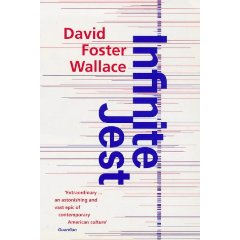
It also gets to a question I’ve been puzzling about for sometime: why isclouds every IJ book jacket/promotional material designed in a sort of cloud motif. Well, in the section we lean that Uncle Charles’ office is decked out in an unsettling cloud wallpaper (which is coincidentally the same wallpaper as Hal’s dentist).  It has only appeared briefly so far, so it seems odd that it would take on such an iconic feel.  But we’ll see if it comes back.

(more…)

Read Full Post »

nySOUNDTRACK: SONIC YOUTH-Dirty (1991).

dirtyI think of Dirty as a pretty commercial album.  I mean, it’s got Butch Vig as a producer for crying out loud.  And, it has three singles released from it.

The lead off track “100%,” and track three “Theresa’s Sound World” are as catchy as anything.

And of course, Lee’s “Wish Fulfillment” is just an amazing track, and is certainly a nod to a more poppy sound.  But it is “Sugar Kane” that strikes me as their most commercial attempt yet. Of course, saying all this, one must remember that Daydream Nation & even Sister had tracks that were short and catchy.  Dirty almost feels like a condensation of that sound.

“Orange Rolls, Angel’s Spit” is one of those songs that mixes catchy sections and utter noise so successfully.  And “Youth Aginst Fascism” has a wonderfully catchy vocal line but it is backed by the squeakiest most unmusical guitars on the record (and has the memorable “I Believe Anita Hill” line).

But despite all that, there’s also two completely un-Sonic Youth songs on the disc: “Nic Fit” is a one minute hardcore punk blast while “Creme Brulee” is a solo guitar (a sort of out-of-tune, cheapo amp effect) strumalong sung by Kim.  Kim also gets “Drunken Butterfly” which is certainly not easy listening, (although the mocking of The Door’s lyrics is pretty funny).  And “Shoot,” which is one of Kim’s menacing spoken-wordish pieces that changes the overall temperament of the disc.

But, yea, there’s no denying that this is a commercial album. It features some of their catchiest and easiest-listening tracks.  And yet, the disc is certainly done on SY’s terms.  For even if they did make it onto the Billboard charts (#83), they certainly never got played on Top 40 radio.

[READ: August 6, 2009] “War Dances”

I wasn’t sure if I was going to read this short story or not.  But then this story is broken down into multiple small sections and the heading on the first was My Kafka Baggage. Now, I like Kafka, but Kafka can also be an “lazy” indicator for “weird stuff ahead”.   Nevertheless, I read the opening and I was intrigued. By the end of that section I was hooked.

And even though I felt the second section wrapped up things really nicely (it wraps up a story about the narrator’s father, but not the whole story itself), I pressed on.

All of this sounds like it’s not a strong vote of confidence for this story, but that’s far from the truth. The story was fantastic. I couldn’t get enough right up until the end, which was very satisfying.

The story concerns a forty year old Native American Indian guy. He has two kids and his wife is away in Rome on vacation. When his kids start clamoring for food, he realizes that he can’t hear them very well.  And sure enough, when he goes to the doctor, his hearing has suddenly dropped to about 30% of his normal ability. (more…)

Read Full Post »

nySOUNDTRACK: SONIC YOUTH-Goo (1990).

gooI’m not sure exactly why this Sonic Youth album was the first one I really got into.  I assume it’s because I was working at the radio station and probably got a bit of hype about their switch to DGC records.

And, say what you will about DGC being a major label, DG had some really great taste at the dawn of that label.

Goo and Dirty are sort of lumped into a kind of sellout phase for SY.  But  Goo is certainly harsher than Daydream Nation, and yet it also seems to flirt with the mainstream (with Chuck D appearing on it, and “Goo” having something resembling a sing-along chorus”).

Yet “Mary-Christ”  has a crazy background vocal section.  Kool Thing, the one with Chuck D, has a catchy enough chorus but the squealing guitars are very harsh.

Lee’s “Mote” is probably the catchiest song on the disc, although really the middle section has these sort of smooth songs like “Mote” and “Disappearer.”  But with “Mildred Pierce,” you get the scariest , most abrasive ending to a song you can imagine (and from what starts as a really pretty instrumental too).  And “Scooter and Jinx” is pretty much just a minute full of noise.

While 1991 may have been the year that punk broke, it’s Goo, complete with its Raymond Pettibon cover that sent punk, kicking and screaming, mostly screaming, into the mainstream.  All ready for Nirvana to smash the door wide open.

I just looked up Raymond Pettibon and learned that he is Greg Ginn’s brother.  Ginn founded Black Flag and of course Pettibon (whose real name is also Ginn) did virtually all the artwork.  I would even daresay that it was Black Flag that propelled Pettibon into underground fame…  he even outlasted the band that gave him his fame.  Wow, thanks Wikipedia.

[READ: July 5, 2009] “A Guide to Summer Sun Protection”

I don’t normally mention the Shouts & Murmurs one-page items from the New Yorker, but since Zev Borow is in pretty much all the McSweeney’s I’ve been reading, I thought I’d bring him up again. (more…)

Read Full Post »

ij7SOUNDTRACK: VOIVOD-Nothingface (1989).

nothingfaceIn light of Marathe and the Antitois, and Quebec separatists everywhere, I figured I’d mention my favorite CD by a rocking Quebecker band.  When Voivod started they were a rumbling thrash band.  They put out an album with the wonderful title of RRRÖÖÖAAARRR.  They were very fast, very loud, and their singer had a really peculiar delivery style.  I later learned that this was because he’s a Quebecker and French is his first language.  Since he sings in English, his stresses and emphases are off-kilter, (and the guitarist seems to play to this particular feature, so the music is off-kilter as well) making for a very surreal experience.

They were probably my first inroduction to really cool French names.  Because even though they had stage names (Piggy, Blacky, Snake, and my personal favorite: Away) their real names were foreign and cool like Denis D’Amour and Jean-Yves Theriault.

Nothingface is the pinnacle of their prog-creative energies.  It is a fantastic progressive-rock/heavy metal hybrid.  There are fascinating time-changes, with cool atmospheric aspects that counterpoint the heavy sections.  And the overall theme of the album is technology gone awry.

On their previous records, melody was not really evident.  And it’ hard to believe that a disc that is so full of time changes could still be melodious.  Yet the bridge of “Nothingface” is quite pretty, which, again, counterbalances the weird chord structures of the solo section.  There’s even an awesome cover of Pink Floyd’s “Astronomy Domine” that adds some cool metal guitars to an already trippy song  The Floyd version is spacey and psychedelic.  Voivod add an element of menace to the song.  Very cool.

And then there’s a song like “Missing Sequences” which has 4 different sections in the span of less than two minutes.  An opening that is slow and spacey, interrupted by a loud “Now!” which brings to a weirdly chorused verse that morphs into a rough staccato bridge followed by a speedy guitar break and then yet another verse style.  By the time we hit the 2:30 mark, the song breaks down into a bass-only sequence.  And then it mostly repeats itself. That is, until the ending minute which is something new entirely.  It sounds impossible on paper and yet it is done seamlessly and is one of my favorite tracks on the disc.

There’s also the weirdly propelling and compelling “ground and rock and sand come crumble tumble down” sequence of “Pre-Ignition” that throws a cool catchy riff in the midst of a fast charging song.  And “Into My Hypercube” has some fantastic riffs, including another really cool bass-only section.

And the whole album works great with headphones.

In the 1990s, metal bands experimented with lots of different genres and effects, but it was this 1989 release that really highlighted what kind of fantastic music you could make within the strictures of heavy metal.  Voivod makes some pretty unusual sounds with their instruments (guitar most of all), and the album can be a challenge, especially if you like you music light and easy), but for me, this is one of the best discs around.

[READ: Week of August 2] Infinite Jest (to page 508)

50% through.
Halfway House, er, I mean Half Way Home.
Thoughts:

The rewards are coming quickly now.  There seems to be a payoff every few pages.  I am totally loving this book and the environment it has created.

Since the Boston Marathon is mentioned in the book, I’ll say that we are currently at the 14 or so mile point (downtown Wellesley).  Congratulations, you have just made it through “Screech Tunnel.”  [See the Boston Marathon route here.]

ij

I’ve been going on and on about chronological years and when exactly Subsidized years started.  I even quoted other people who had calculated the actual year that Subsidized time was set up.

And, of course, all this time, all we had to do was to look at the NAME of the Year of Yushityu 2007 Mimetic-Resolution-Cartridge….  As this clever thread shows, others figured out pretty early in the reading that the 2007 in the year was a pretty big clue as to what year Subsidized Time began.

(Presumably non O.N.A.N. countries do not follow Subsidized Time?  And the, again, presumably Japanese made Yushitsu is on numerical-year-time.  Or is that a thread that has already been discussed already?).

I am pretty embarrassed to have realized this at this late a date, and I’m delighted that everyone let me figure it out for myself (and that no one was cruel enough to rub it in.)

Now if you wanted to argue against the Yushityu 2007 as a dead giveaway to the year, you could say that, for instance, Microsoft Products don’t always indicate the year that they came out.  But for confirmation of Yushityu, we can use a perpetual calendar.

We learned that November 7th is the the day of the exam that Schacht is taking.  This is a Saturday class.  The perpetual calendar show that Nov 7th falls on a  Saturday in 2009.  Therefore YDAU=2007.   I’ve been trying to use all this logic to puzzle this information out, and here the author basically just TELLS us it from–well, not the get go exactly–but from a pretty early point.

All of this self-flagellation is also because of my own lack of clock-watching in the book.  I have somewhat obtusely not been following the chronological dates very carefully.  It was only when I consciously realized that Marathe and Steeply are having their mountainside chat in April/May of the YDAU when all of the events at E.T.A. and Ennet House are taking place in November that it dawned on me that the time line was not only present, it was pretty important.

So, I spent some time crafting a general timeline of events–something I haven’t seen anywhere else, (but then I haven’t actively been looking for it because I don’t want to get Spoiled).   So at the end of this post I’m going to put my timeline of events thus far. I’ll see how important it is to update it in future posts.

But now on to the book:

This week’s reading jumped back and forth between topics a bit more frequently. (more…)

Read Full Post »

nySOUNDTRACK: Living with Music: A  Playlist by Joshua Ferris (New York Times September 19 2007).

ferrisWhile searching for Joshua Ferris (see below) I came across this playlist from The New York Times.  While I don’t agree with everything on the list, indeed, I haven’t heard of about half of the songs, I was delighted by several of his selections: Neutral Milk Hotel, Pearl Jam, and of course, Godspeed! You Black Emperor.  I also really enjoy the unusual Pink Floyd selection, too (Meddle being a favorite album of mine).

What I enjoy most about the list is that he tacks on a book that you might read that somehow ties to the song (I don’t know what the specifics are as I have yet to read any other “Living with Music” Playlists).  But it reminds me of an inverse of this very blog.

The article is available here.

[READ: August 3, 2009] “The Valetudinarian”

I knew the name Joshua Ferris sounded familiar, but couldn’t remember exactly why. Then I remembered that he wrote Then We Came to the End which I liked quite a bit. So I looked him up and found out that in addition to that novel, he’s only had a few short stories published in total. And now I’ve read two out of the seven. In terms of ratio of books read, that practically makes him my favorite author!

I should have looked up the definition of the title of this one: valetudinarian
which basically means invalid. (more…)

Read Full Post »

« Newer Posts - Older Posts »