Feeds:
Posts
Comments

Archive for the ‘Funny (ha ha)’ Category

SOUNDTRACK: BIG BLACK-Kerosene [live] (1990).
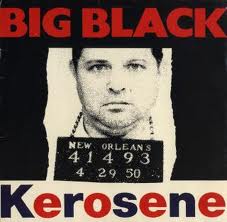
It never occurs to me to go looking for live versions of songs online, even though there are clearly  thousands of songs I would like. So, I wait for them to come to me.  My friend Andrew posted a video of this song.  And it’s the first time I’ve seen Big Black live.

I’ve liked Big Black for a while (I got into them after they broke up). It’s not pleasant music by anyone’s standards, but there’s something visceral and unsettling about the lyrics and about Steve Albini’s guitar sound that I really enjoy.

I’ve seen pictures of Albini before, but I’ve never seen him in action, and I have to say, I can’t believe a guy as skinny and frankly, nerdy, as him is making sounds like this (although I can see someone like him being this angry).  Watching him in this video is pretty great.  He’s got huge glasses, his t-shirt is tucked into his pants–no that’s not right, it’s tucked into his guitar strap…how is he holding his guitar up??– and then he plays this guitar that sounds like, what…glass, needles, pins, shards of something, certainly.

And just when you think that the song is only noise, this fantastic bassline kicks in.  The riff is outstanding: it’s heavy and propulsive and balances the sharpness of the guitar perfectly.  In this version, about midway through the song he seems to be walking out into the crowd, and they sort of hold him up or push him back on stage, while he’s playing.  And at the end, of course, he destroys the guitar.

Lyrically, it’s as disturbing as anything Albini has written, but man is it cathartic.   And this live version is even more stark and brutal than the studio version.

[READ: June 2010 & October 12, 2010] “Extreme Solitude”

After reading “The Oracular Vulva,” I decided to re-read this, his recently published story.  When this story came out in June, I heard that to some readers the main character reminded them of David Foster Wallace, and they speculated about whether or not this story was inspired by or a tribute to him.  Unfortunately, I read that analysis before I read the story and it automatically influenced my reading (which if you haven’t read it I have now done to you, sorry).

I’m not in any way convinced that it is about him, although there are many similarities–size, athleticism, chewing tobacco, intelligence, semiotics.  But since I know nothing about DFW personally and I don’t know if Eugenides does either, I won’t pursue that line any further.  I will say that I didn’t find that train of thought terribly distracting while reading, though.

Anyhow, this story is about a senior in college named Madeline.  Madeline was a good student and a good girl.  She had dated some, but never had any crazy affairs (and was a bit uncomfortable when her roommate proudly wore (or displayed) her diaphragm–the joke about wearing it to an event is particularly funny).

By her senior year, after breaking of a long relationship with Barry, Madeleine was prepared to settle into her major: English.  She was excited to read and to read a lot (it was her passion as well as her major).  She also decided to sign up for a Semiotics class, which is where she met Leonard.

The description of the semiotics class is wonderful, from the pretentious students to the insanity of the class assignments–from Lyotard to Derrida and everyone in between, authors that I loved in college but since leaving academia I find so convoluted as to be kind of silly. I adored the sentence: “(Could “the access to pluridimensionality and to a delinearized temporality” really be a subject [of a sentence]?)” (more…)

Read Full Post »

[LISTENED TO: End of October 2010] Brief Interviews with Hideous Men

There are three options for listening to Brief Interviews.

The first version is the original audio cassette which is read entirely by DFW (1999).  It’s out of print but you can download the audio for free at the David Foster Wallace Audio Project. The second version is the newly released audio book that coincides with John Krasinski’s film (2009).  This CD features some of the readings by DFW although most of the actual interviews are read by the actors from the film (see below for all details).  The third option is a collection of staged readings which were created by The Howling Fantods Brief Interviews Project.  They are available at the site and at the David Foster Wallace Audio Project.  [UPDATE Nov. 8: For the sake of accuracy, I wanted to state that George Carr is responsible for all of the work down for these recordings.  The Howling Fantods site simply hosted the results].

None of these recordings include all of the stories from the book.  Although the stories that they do include are unedited (this is officially listed as “unedited selections from the book”).  The stories that are not included in any of these recordings are:  creepy organ music

  • “The Depressed Person”  [this would have been a tour de force to read]
  • “The Devil Is a Busy Man”
  • “Think”
  • “Signifying Nothing”
  • Datum Centurio” [I can’t imagine trying to read this out loud]
  • “Octet”
  • “Adult World (I)”
  • “Adult World (II)” [I would have liked to hear how these were handled]
  • “The Devil Is a Busy Man”
  • “Church Not Made with Hands”
  • “Yet Another Example of the Porousness of Certain Borders (XI)”
  • “Tri-Stan: I Sold Sissee Nar to Ecko” [this is my least favorite bit of DFW work and I would have really liked to have heard it read aloud to see if I could get anything more out of it].
  • “On His Deathbed, Holding Your Hand, the Acclaimed New Young Off-Broadway Playwright’s Father Begs a Boon” (more…)

Read Full Post »

SOUNDTRACK: RUSH-“BU2B” (2010).

I’m a little freaked out that Rush has a song that is just initials (it’s so text message-y).  And, listening to the lyrics tells me that the 2 is for “to.”  That is no way for 50-some year-old men to behave!

Of course, neither is the pounding heavy song that is “Bu2B.”  Like “Caravan,” the song opens with a dark and dirty riff.  The song is not as complex as “Caravan” although it also features a quieter section.  After the verse, the quiet bridge comes as a more natural progression (and it, too has some strong bass stuff going on).

What’s fascinating about the song is that despite its heaviness, it is layered with some really delicate keyboards that plink along the top of the sections.  It showcases both sides of Rush in one track.  And lyrically it’s quite dark as well.

These two early release songs have me really excited for the new album, Clockwork Angels, due out in 2011.

[READ: October 11, 2010] “The Oracular Vulva”

Jeffrey Eugenides was the next writer in the 1999 New Yorker 20 Under 4o issue.

I really enjoyed Eugenides’ The Virgin Suicides, and I regard him highly as a writer (even though I haven’t read very much else by him).  About midway through reading this story I realized it must be an excerpt from Middlesex (which I haven’t read, but hope to one of these days).   The bad thing about realizing this is that it impacted my reading of the end, making it kind of hard to assess the story as a story (which, I realize it isn’t, so maybe it’s moot anyhow).

This excerpt focuses on Dr. Peter Luce (the famous sexologist).  The title of the story certainly implies a degree of sexology, right?  I was surprised however, that the story opens with the doctor in a jungle, studying the Dawat tribe.  Luce, a very comfortable middle class sexologist is miserable out in the jungle, with crazy animal sounds, oppressive heat and, worst of all, little children trying to pull down his pants.

The doctor is studying this tribe because they have very specific gender roles–so specific, that the men and women are not permitted to interact with each other at all, except for once a month for three minutes, for procreation.  So, for sexual outlet, the men engage in oral sex with each other (semen being a very important thing for the young men to consume).  Yet no matter how progressive Dr Luce is, he simply can’t deal with the thought of this young boy, who is trying to do his culture’s most honorable thing.  (more…)

Read Full Post »

SOUNDTRACK: BROKEN BELLS-Broken Bells (2010).

When I first played this disc I was really disappointed by it.  I’ve grown to expect crazy magic from Danger Mouse, and I assumed that this collaboration with James Mercer of The Shins would be crazy awesome.  But it seemed very mellow to me.  Mellow in a way that just kind of sat there.  So I put it aside for a while.

Then I listened to it again a little later and I found that I really liked it this time.  In fact, it rapidly grew into one of my favorite releases of 2010.

The disc is a wonderfully paced mixture of acoustic guitars, interesting keyboard sounds and, often, downright bizarre electronic choices (subtle, yet bizarre).  The weird sounds that open the disc, a kind of backwards keyboard, are disorienting but also very catchy.  And the song itself is instantly familiar.  It’s followed by “Vaporize” a simple acoustic number that bursts out with some great organ and (very) distorted drums.  It also features a fascinating horn solo!

“Your Head is on Fire” settles things down a bit with a mellow track which, after some cool introduction, sounds like a  pretty typical sounding Shins track (ie, very nice indeed–and more on this in a moment).

“The Ghost Inside” feels like a ubiquitous single.  I’m not sure if it is or if it’s just so catchy (with dancey bits and hand claps and a great falsetto) that it should be everywhere.  “Sailing to Nowhere” reminds me, I think, of Air.  And the great weird drums/cymbals that punctuate each verse are weird and cool.

One of the best songs is “Mongrel Heart” it opens with a western-inspired sound, but quickly shifts to a quiet verse.  The bridge picks up the electronics to add a sinister air (and all of this is accompanied by nice backing vocals, too).  But it’s the mid section of the song that’s really a surprise: it suddenly breaks into a Western movie soundtrack (ala Morricone) with a lone trumpet playing a melancholy solo.  And this surprise is, paradoxically, somewhat typical of the disc: lots of songs have quirky surprises in them, which is pretty cool.

Having said all this, there are a few tracks where it feels like the two aren’t so much collaborating as just playing with each other.  And that may have been my initial disappointment.  I was expecting a great work from a combined powerhouse, and I think what we get is two artists writing great stuff while seemingly respecting each other too much to step on each others toes.

There is another Broken Bells disc in the works.  And I have to assume that they’ll feel more comfortable with each other and simply knock our socks off next time.  But in the meantime we have this really wonderful disc to enjoy.

[READ: October 21, 2010] The Broom of the System

It dawned on me sometime last summer that I had never read DFW’s first novel.  I bought it not long after reading Infinite Jest and then for some reason, never read it.  And by around this time I had a not very convincing reason for not reading it.  DFW seemed to dismiss his “earlier work” as not very good.  I now assume that he’s referring to his pre-Broom writings, but I was a little nervous that maybe this book was just not very good.

Well I need not have worried.

It’s hard not to talk about this book in the context of his other books, but I’m going to try.  Broom is set in the (then) future of 1990.  But the past of the book is not the same past that we inhabited.  While the world that we know is not radically different, there is one huge difference in the United States: the Great Ohio Desert.  The scene in which the desert comes about (in 1972) is one of the many outstanding set pieces of the book, so I’ll refrain from revealing the details of it.  Suffice it to say that the desert is important for many reasons in the book, and its origin is fascinating and rather funny. (more…)

Read Full Post »

[LISTENED TO: October 20, 2010] Readings

This (all too brief) collection of readings by David Foster Wallace includes several excerpts and a few shorter pieces.  I’ve noticed that there seem to be more and more videos (audios) of DFW reading on YouTube.  If I had time I would try to gather all of these videos (or even just try to watch them), but for now, I’ll stick with what’s at the David Foster Wallace Audio Project.

The Consider the Lobster reading is an excerpt from”The View from Mrs. Thompson’s”.  I’d never heard him read this piece before and it is a fascinating look at the events of 9/11/01 from Bloomington, Indiana.  I haven’t read the piece in a few years and it was quite affecting to hear him read it aloud.  The introduction was also interesting because he mentions that this is the quickest piece he has ever written (I wonder how many drafts he was able to do in that short period). (more…)

Read Full Post »

SOUNDTRACK: SUPERCHUNK Hello Hawk (1999).

Hello Hawk is another of my favorite Superchunk songs (and it’s vastly different from “Hyper Enough”).  It opens with some really interesting guitar noodling.  And then after a bridge that promises a noisy chorus, the chorus backs down into another gentle section (followed by the loud and heavy post chorus…a neat trick).  This song is also laden with strings (!).  And it’s catchy as heck.

The second song, “Sexy Ankles” sounds (recording style-wise) like early 60s rock and roll.  It’s quite odd for Superchunk, although it rocks nicely at the end.

The final three tracks are acoustic version of songs from the Come Pick Me Up album.  The paradox: as the original songs grow less heavy and rocking, these acoustic versions become less dramatic as interpretations of them.  And yet, since the originals are growing more complex, these acoustic versions sound even better than previous acoustic versions of their older songs.

[READ: October 10, 2010] “Party of One”

Antonya Nelson is another of the 1999 New Yorker 20 Under 40 writers.  I’d never heard of her before seeing this story, but I enjoyed it enough to want to check out more of her stuff.  This is the story of a broken love affair.  And yet it has so many different angles, and so many wonderful observations (and disarming frankness), that it struck me as a wonderfully original and enjoyable story.  Even the way she used the title was clever.

First the breakup.  It is not the main character who is breaking up, but rather her sister.  The main character is meeting her sister’s lover, who is married.   He is getting cold feet and her sister is despondent.  What is wonderfully twisted about the story is that the sister has a had a previous affair with a married man and when that affair ended, she tried to kill herself.  I hate to reveal this tasty piece of information, but it really highlights the interesting angles of this story–the affair was with her the narrator’s husband.  [Woah]. (more…)

Read Full Post »

While I was looking around for Jonathan Franzen pieces in the New Yorker, I stumbled upon the first 20 Under 40 collection from 1999.  Since I had received so much enjoyment from the 2010 version, I decided to read all of the 1999 stories as well.  It was interesting to see how many of the authors I knew (and knew well), how many I had heard of but hadn’t read, and how many were completely off my radar.

I initially thought that they had published all 20 authors in this one issue, but there are five stories (including Franzen’s) that were just excerpted rather than published in full.  And I will track down and read those five in their entirety.  But otherwise, that’s a lot of fiction in one magazine (a few of the stories were quite short).  And it features a cover by Chris Ware!

So here’s the list from 1999.

**George Saunders-“I Can Speak™”
**David Foster Wallace-“Asset”
*Sherman Alexie-“The Toughest Indian in the World”
*Rick Moody-
“Hawaiian Night”
*A.M. Homes-
“Raft in Water, Floating”
Allegra Goodman-
“The Local Production of Cinderella”
*William T. Vollmann-
“The Saviors”
Antonya Nelson
-“Party of One”
Chang-rae Lee-
“The Volunteers”
*Michael Chabon-
“The Hofzinser Club” [excerpt]
Ethan Canin-
“Vins Fins” [excerpt]
*Donald Antrim-
“An Actor Prepares”
Tony Earley-
“The Wide Sea”
*Jeffrey Eugenides-
“The Oracular Vulva”
*Junot Diaz-
“Otra Vida, Otra Vez”
*Jonathan Franzen-
“The Failure” [excerpt]
***Edwidge Danticat-
“The Book of the Dead”
*Jhumpa Lahiri-
“The Third and Final Continent”
*Nathan Englander-
“Peep Show” [excerpt]
Matthew Klam-
“Issues I Dealt with in Therapy” [excerpt] (more…)

Read Full Post »

SOUNDTRACK: THE DUCKWORTH-LEWIS METHOD-The Duckworth Lewis Method (2009).

This is a CD released by the combined forces of Neil Hannon of The Divine Comedy and Thomas Walsh of Pugwash.  And if that weren’t enough of a sales pitch, the title of the band is a method of calculating cricket scores!  And even more…in concordance with that, this CD is largely about cricket.  Huzzah!  Buncha sellouts.

I don’t know a thing about cricket, but I know about great orchestral pop, and this disc has it in spades.  Some of the more obvious cricket songs are even understandable to non cricketers (the themes of “Jiggery Pokery” are familiar to anyone who has failed in a sport–and musically it sounds like a silent film soundtrack).

“The Age of Revolution” begins with an olde-fashioned soundtrack as well (jazz swing, including tap dancing) but quickly jumps into a dancey discoey verse (the two soundtracks blend surprisingly well in the chorus).  And the revolution?  Well, it has something to do with cricket.  Next, “Gentlemen and Players” is a wonderfully Divine Comedy-esque track complete with harpsichords.

“The Sweet Spot” is another discoey dancey track with some funky bass work (and innuendo whispered vocals).  And “Rain Stops Play” is a fun musical interlude.

“Mason on the Boundary” is the first track that seems distinctly Pugwash-y.  Hannon and Walsh have similar singing styles, and I find it hard to know who is who sometimes.  But this track is clearly Walsh’s and it’s very nice indeed.  Similarly, “Flatten the Hay” has that distinct Pugwash XTC/Beach Boys vibe and it’s quite good.

“The Nighwatchman” is also a very DC type song (it even sounds a bit like “The Frog Princess” but pulls away before being a repeat of that great single by introducing some very 70s sounding strings).  The rest of the disc follows in this same wonderfully orchestrated pop feel.  This a great record that, as far as obscure bands that get no statewide attention go, is top notch.

Oh, an it’s even more fun with headphones!

[READ: October 9, 2010] Skippy Dies

Wow, there’s a lot going on in this book.  It’s exhausting just trying to think of all the topics covered: boarding school life, failed romance (two big ones), life as a teacher, the appeal of pop singer Bethani, the Catholic priest sex scandal, drugs of all kinds, sneaking into a girls’ school, World War I, institutional cover ups, M-theory–which is pretty much the entire universe, and donuts.

But let’s start at the beginning.  Yes.  Skippy dies.  In the first couple of pages.  And what’s fascinating about this is that we don’t care.  I mean, in the scene where he dies, he’s not even the major character.  But then Skippy turns out to be more or less the glue of the book once the story proper begins.

Skippy resides at Seabrook school in Dublin (the best, most prestigious Christian academy in the country–sorry Gonzaga).   His roommate is Ruprecht (perhaps the strangest major character name I’ve read in a long time).  Ruprecht is a large boy who is incredibly smart (he will single-handedly raise the school’s average on the year’s final exams).  He is a computer geek who is obsessed with aliens and SETI.  And he hopes to be able to communicate with the other world by using techniques suggested in M-Theory.  The book does an admirable job explaining M-theory and string theory.  I’m not going to take up space here, but there’s a fine description at Wikipedia (or, if you don’t like Wikipedia, here’s an academic explanation that is written for the lay person).

Anyhow, Skippy and Ruprecht are two of a few dozen boys who reside full time at the school.  (Most of the other kids are day students).  And they have a cadre of half a dozen friends that they hang out with who make jokes at each other’s expense.  It’s a very realistically written entourage.  Mario is Italian and claims to have had sex with many many women (thanks to his lucky condom which he has had for three years).  Dennis is the ballbreaker.  He’s the abusive one (but by most standards, he’s not a bad guy).  And a few other hangers on.

This story of dorm life is a good one.  The boys are funny, their stories believable, even if they are all eccentric in their own way.  And then, one day, Skippy sees a girl playing frisbee at the girls’ school across the way (Ruprecht has a telescope which he uses for the stars, while eveyrone else uses it for the girls’ school).  And Skippy winds up becoming rather obsessed with the unknown “frisbee girl.”

This girls’ school plays a part in the story in another way too.  Carl and Barry are the Seabrook’s thugs.  When Barry hits upon the idea of selling ADD meds to the locals (as diet pills), it’s the girls’ school that he mostly preys on.  For yes, this story is also about drugs. (more…)

Read Full Post »

SOUNDTRACK: SUPERCHUNK-Mower (1993).

It was a robin’s egg and it was blue. Such is the oft-repeated line in the title track. It’s another great single from Superchunk:  poppy and cool and fun to bounce around to.

The second song, “On the Mouth” is a much faster, more punk track, apparently about frustrated love.

The final track is a live version of the song “Fishing.”  It’s one of the few live Superchunk tracks that I’ve heard (and it lasts over 5 minutes!).  It’s full of feedback squalls and lots of noise.  When the drums eventually kick in, it’s a fast-paced thundering experience.  The squealing guitar (and feedbacking outro) leads me to suspect that their lives shows were even more energetic than their albums.

[READ: October 4, 2010] “The Warm Fuzzies”

I have The Children’s Hospital from Adrian which I’ve been meaning to read for ages, but so many other things get in the way.  I have read a few of his short stories in McSweeney’s and the New Yorker. Adrian’s story was the final one of the 20 Under 40 stories in this year’s New Yorker list.

I felt this story was a little clunky at first.  I had a hard time keeping the story straight. And yet, once it settled down I found it really engaging and rather fascinating.

The story is about the Carter Family.  Not that Carter family, but another singing Carter Family. One day both mother and father Carter woke up and decided to stop being just the Carters; they decided to devote their life to Jesus in song.  And so, as it opens, we see The Carter Family practicing another one of their four chord songs.

In this particular practice, a new kid is playing the tambourine.   This new kid is, like all of the other new kids, a foster child and black.  This new foster child is named Paul, although he tells them all his name is Peabo.

The confusing thing in the beginning was just getting the hang of who all the family members were.  But once they were settled in, it was very easy to keep straight, and more importantly, to get hooked into the story.  We get a brief look at the family before music enter their lives, and we see how the children treat each other.  Each new foster child brings something new to the sound. And Paul/Peabo brings a bit of unexpected flair to their rather tepid music.  But the only one who seems to notice is Molly.  And really, this is Molly’s story. (more…)

Read Full Post »

SOUNDTRACK: THE VIOLET ARCHERS-Victoria, BC, October 2005 (2005).

This live bootleg comes from the Rheostatics Live website.  If The Violet Archers were to become a huge internationally famous band (which, let’s face it, they’re not), this would be an awesome bootleg to have.  It’s from a show before their first album was released, and, if the stage banter is to be believed, before they’d even thought of a name for the band.  (There’s a joke that they wanted to call themselves The Gay Apparel, which is awesome).

Indeed, I assume that this show was recorded in 2004, not 2005 as listed online.

So, this show seems like it’s recorded in front of about 20 people.  The recording quality isn’t ideal (the drums sound pretty dreadful) but it conveys the spirit of the show very well.

The first two songs are just Tim and his acoustic guitar (“Simple” sounds great in this context although “All the Good” works better as a band number).  Then the band comes on.  Ida Nilsen is not with them yet, but the band sounds great together and the songs are fully formed (the album is said to be coming out in the next spring).

It’s a great show and Tim Vesely sounds a lot more like he did with the Rheostatics than he does on the regular album.  I guess the live setting brings out the old voice from Tim.  And I would be remiss if I didn’t mention the guitarist with the great name: Yawd Sylvester.  Outstanding!

[READ: September 28, 2010] “Imperial Bedroom”

This piece is about privacy. It was written 12 years ago, when the fear of the loss of privacy was in its infancy.  And Franzen makes a very convincing case that we were (and I assume still are) overreacting in a big way to fears of privacy loss.

He opens by noting that the panic about privacy is all the rage, excepted that the public doesn’t seem to be genuinely alarmed.   He sets his argument on the backdrop of the Clinton/Lewisnky Starr Report. And what he bemoans is that this most private of information is coming out of the most public of offices (and the most imperial of bedrooms).  [With the valid corollary–who is ever going to run for office if this kind of shit is going to be made public on such a grand scale?]

He gives us a basic history if the “right to privacy” which he says legally is a tough concept.  Because whatever you call the various forms of invasion of privacy, legally they often fall into other areas–trespass, defamation or theft.  What’s left is emotional distress, which is always a nebulous concept. (more…)

Read Full Post »

« Newer Posts - Older Posts »