Feeds:
Posts
Comments

Archive for the ‘Foreign Books’ Category

karl2SOUNDTRACK: BRASS BED-Tiny Desk Concert #339 (February 24, 2014).

brass bedI expected Brass Bed to be a goofy band because of the snapshot image of them singing into toy microphones.  I was initially disappointed by how normal they were, but I was soon won over by their interesting floating sound. They have this overall trippy underwater vibe (which seems to be accomplished by a bowed slide guitar). This is especially notable on “Yellow Bursts of Age” their best song in the set.  Later the guitar solo is echoey and also underwatery. It’s a very wild sound for a fairly simple song.

They tell a funny story about being from Louisiana and encountering Washington DC snow and (of course) not having an ice scraper (although they did have bag of sand).

“Cold Chicory” is an upbeat sounding song musically although it is kind of a bummer lyrically, but again there’s the great sound of the bow on the slide guitar and the echoey lead guitar. “Please Don’t Go” is a slow song—with more interesting effects from singing into that slide guitar.

The plastic mikes do come out in the last song “Have to be Fine” in which they sing into the echoey mikes for the intro (with very nice harmonies).  They sing the intro for about a minute, and then the slide guitar player takes lead vocals on this simple but pretty song (I don’t know any of their names).

At the end, the NPR folks gave them an honorary NPR ice scraper.

[READ: June 24, 2014] My Struggle Book Three

boyhoodI read an excerpt of Book Three just a few weeks ago.  And in the post about it I said I wouldn’t be reading this book for quite some time.  But then the book unexpectedly came across my desk and I couldn’t resist grabbing it while it was here.  So it appears that I will now have to wait well over a year before Book 4 (which is, I think about 1,000 pages–yipes).  I also see that Book Three is fully called “Boyhood Island” in Britain.

At the end of Book Two, Karl Ove was more or less caught up to the present–writing about what he was then up to (with a few years gap, of course).  So it makes sense that this book is about his childhood–showing us how he came to be the man he is.

The book, amusingly enough, starts off with memories that he cannot possibly remember, and he even says as much.  He is using memories of his parents and piecing together pictures from when he was an infant.  In 1970, (Karl Ove was born in 1968) his family moved to the island of Tromøy tromo(and check out the idyllic picture that Wikipedia had).  This is where Karl Ove spent his (rather traumatic) formative years.  Their island is small, so he knows everyone in his school, but there are some amenities around like the Fina station and the B-Max, and there’s lots of soccer to be played and bikes to be ridden.

Things seem normal at first–he runs and plays with his friends, there is ample green space to run around in, and they have boats to sail on.  And we meet two of Karl Ove’s earliest friends: Geir and Trond (so many people are named in the book, I’m very curious to know if any of them remember him).  In an early scene they chase the end of a rainbow looking for a pot of gold (and have a discussion about what happens to it when the rainbow vanishes (the boys even play a prank on Karl Ove that they actually found the pot,a dn while he doesn’t initially fall for it, he is compelled to go back and they tease him).

But the looming figure here and throughout the book is Karl Ove’s father, who, at least according to Karl Ove’s memory, is pretty much a monstrous dick.  He is demanding and exacting, unforgiving and seemingly uncaring.  He is either bipolar or a drunk, jumping from goofy to outright rage in a mater of seconds.  Karl Ove and his brother Yngve fear him unconditionally and, by the end of the book they both seem to hate him.  The scene where their dad tries and fails to teach Karl Ove to swim is heartbreaking, especially when the dad goes home and tells their mom right in front of him “He’s frightened of water.”  There are dozens of instances of fear and intimidation (often accompanied by a wrenching of Karl Ove’s ear).  Like when Karl Ove turns on the TV for his grandparents (he wasn’t allowed to touch the TV but he wanted to do something nice for them).  After a few minutes, the TV fizzed out and, naturally, he was blamed for it and sent to bed without supper (after some minor physical abuse). (more…)

Read Full Post »

CV1_TNY_02_17_14Columbo_spine.inddSOUNDTRACK: THE ALLER VÆRSTE!-Materialtretthet (1980).

matThe Aller Værste! were a Norwegian new waves/punk band with elements of ska thrown in.  I only know of them because of this story, but I decided to check out some of their stuff since it is so relevant to the story.

This was their debut album, which has been ranked as the number 6 best Norwegian album of all time (by Morgenbladet, a Norwegian weekly newspaper).  The album opens with lounge piano and trombone before breaking into a ska-inflected “Du sklei meg så nær innpå livet.”  Lead singer Chris Erichsen sings in some unusually deep voices (some of which seem comical) in “Dødelige drifter.”  “Døgnflue” is a two-minute punk blast with a loud Farfisa organ running throughout.

“Bare du som passer på” has a distinctly Clash feel in the vocals.  “For dem betyr det lite” is powered by that organ sound, while “Bare en vanlig fyr” is very guitar heavy (and may have a different singer).  This is probably my favorite song on the album, there’s some great sections in it.

This sound of punk sensibility with a prominent organ (an vocals in Norwegian) really make The Aller Værste! stand out in 80s rock.  “Må ha deg” has some interesting backing vocals and sounds like a Clash inspired ska song (with more crazy vocals).  It has a slow instrumental section with a twangy guitar solo.

“Igjen” is 90 seconds of punk (but not very harsh punk).  The next few songs are all about 3 and a half minutes long.  “Bare ikke nok” has call and response vocals and an unexpected beat.  “Hong Kong” slows the sound down, with a prominent bass riff.  “De invalide” is an upbeat song with horns.  “Hekt” has some dissonant guitar over almost funky bass and a serious breakdown at the end.  “Discodrøv” has very fast drums as it opens, but it turns into a rollicking song with disco bass and big horns.

“Oppvekst” follows those horns with some fast (ska-like) guitars.  “Materialtretthet” opens with some great, wild bass and continues wit a very fast-paced song.  This is another favorite (it’s interesting that the title track is also one of the shorter songs on the record).  “Menneskelig svikt” sounds quite raw, with echoey distant guitars and vocals.  “Blank” is the final song on the album (reissues have added more tracks).  It has a distant echoey harmonica acting as a melancholy sound behind the vocals.

I hope that Karl Ove’s book somehow gets this disc in print, I’d like to listen to it on more than YouTube.

There’s a live version of the song mentioned at the end of the story here:

[READ: June 11, 2014] “Come Together”

I know that this is an excerpt form the third part of My Struggle which I plan to read in say six or eight months.  But I decided to read it anyway in part because I was intrigued by the cover picture, which is of a record sleeve with a man on a bicycle and the wheel is the inner label of an album.  That, coupled with the title “Come Together” made it pretty apparent that this would be about music.   And so it was.

As I said, this is excerpted from Karl Ove’s third book in the My Struggle series, which is called Boyhood.  I’m intrigued that this book is set in his teenage years since the first two were set much later–it actually felt like Book 2 caught us up to the present).  At any rate, this is one small section (chock full of details) about being young and being in love with music and with girls. (more…)

Read Full Post »

flies2SOUNDTRACK: CIAN NUGENT-Tiny Desk Concert #353 (May 3, 2014).

cianCian Nugent is from Dublin.  In this Tiny Desk Concert, he plays two guitars, including a crappy no name electric guitar with a great raw sound.  For the first song, he plays a pretty acoustic guitar instrumental called “Grass Above My Head.”   It has a slow melody that turns into a ragtime jaunt over the course of 6 and half minutes.

The next two songs are on that electric guitar and are both rather different (he says the songs comes from “incoherent range of the mess that is my musical career”).  Before playing “Hire Purchase” he tells a very funny story about getting a pencil from a garage (and that he uses it to keep his string from detuning–does that work?).  This is an electric guitar instrumental, bluesy and mellow with some great riffs.

The final song, “Nightlife” has words.  It’s a simple blues song. Nugent has a nice delicate voice.  I’m not a big fan of bluesy songs, but he does a great job with this and the other two styles.

He also wrote a song called “My War Blues” which is variations on a Black Flag song (I don’t recognize the original in his version, myself).  But you can hear that here.

[READ: June 4, 2014] King of the Flies 2. The Origin of the World

This book picks up right where Book 1 left off.  This edition was also translated only by Helge Dascher although it says she had help from Dag Dascher and Kim Thomspon (I didn’t notice any change in quality).

As this book starts, Eric’s mother is making serious advances with Francis–the man whom she just met but who she is already calling her fiance.  Eric fantasizes about killing him (his dream sequence mother says this is the 13th time he has killed Francis).  Marie and Eric are still together and, through a strange series of events, Ringo is asking Eric to hold on to a cool looking elephant bowling bag.

By the end of this first story, Eric has saved Becker from drowning.  And yet neither Becker nor Karine bothers to thank him.  Indeed, Karine seems even more angry at him.  But this blow off makes Eric want Karine even more.

In a later story we finally meet Karine’s family who are just as freaked out about her “dating” this old guy.  And, by the end of the story Becker has a heart attack and dies.  When she returns home after the funeral she sees Eric and she confides in him that she is pregnant.

The newest development in the book comes in the next story in which we learn that Damien is a ghost and that he visits everyone that he knew.  Some people who are receptive to seeing him can actually talk with him.  He’s obviously pissed about Eric and Sal, but he has come to terms with a lot of things.  He even forgives the man who killed him (by accident).  He also winds up meeting ghost Becker at some point. (more…)

Read Full Post »

flies1SOUNDTRACK: PUBLIC SERVICE BROADCASTING-Tiny Desk Concert #354 (May 5, 2014).

indexI heard about Public Service Broadcasting via NPR and I loved their song “Spitfire,” a rocking instrumental with interesting samples scattered throughout.  Well, it turns out that live, the rock just as hard.  Even though there’s only two of them.  There’s J. Willgoose, Esq. on guitar, banjo and electronics and Wrigglesworth on drums. The samples come from British public-service films from roughly the 1940s through the 1960s.

Watching this video, I was stunned at just how much Willgoose is doing, and just how much noise these two guys can make.  There’s even a video going on behind them.   The only problem here was that the samples were not loud enough.

 “Signal 30” opens with samples and samples and then a rocking guitar and solid drums. It amazing watching Willgoose do some many different things while playing the guitar. The change of tone at the middle of the song is great and I love watching him just bang the guitar to keep the notes going (while he is playing the keyboard).

 After the song, there is a sample of “Thank you very much” in an arch British voice (the duo don’t speak during the show).   “Spitfire” also sounds great hear–the song is surprisingly complex for an instrumental, and for what seems like it might be a novelty band, the song is really solid.  After this song, Willgoose had to fetch something and the talking sample said “talk amongst yourselves!” The final track “Everest” has a very catchy riff and some really great drumming.  But I love most watching Willgoose play the guitar with one hand and play a solo on the keyboard with the other.

This is definitely a band to check out live.

[READ: June 4, 2014] King of the Flies 1. Hallorave

Hallorave is a dark, violent, sexual comic series written by Pirus and drawn by Mezzo.  Both artists are French and have worked together before.  This book was translated by Helge Dascher and John Kadlecek (and it was translated very well–I didn’t realize it wasn’t American until they started talking about Euros sometime in the middle of the book.

So this is actually a series of short stories narrated by different people.  They seem unrelated, but after a couple of stories, you see the connections.  And there proves to be a core collection of characters all living in this suburb (the location is really irrelevant).

The first story starts with Eric (who proves to be the main protagonist) drinking, reading magazines and sitting on a couch on the (dried up and dead) lawn of his mother’s house.  He is also jealous of his best friend Damien because he is very hot for Damien’s girlfriend Sal.

That first story introduces us to a visual that will run through the book: Eric sitting with a giant fly head on.  The three are going to a Hallorave for Halloween.  Eric is King of the Flies, Sal has a giant cat’s head on and Damien is a skeleton.  By the end of the party, they are all high (you can seem them feeding each other drugs in the picture below).  Eric pledged his love to Sal in front of Damien, and Damien is in a foul mood.  He gets in a fight with some other party goers. By the end of the short story, Eric and Sal are having sex (with their costume heads on) and Damien has been hit by a car and killed.  That’s the kind of stories we’re getting here. (more…)

Read Full Post »

karlove1SOUNDTRACKWHITEHORSE-“Pins and Needles” and Kickstarter campaign (2014).

photo-mainI really enjoyed seeing Whitehorse live.  I would absolutely see them live again.  I was delighted then that their album was also fantastic (I didn’t think it could match their live show…and it doesn’t but it is great in a different way).  In a very short time I became a big fan of the band.

THey havea  new song, “Pins and Needles” and a Kickstarter campaign.  The song begins with Melissa McClelland’s voice singing in it beautiful way–there’s guitar in the right ear and bass in the left ear.  Then Luke Doucet comes in for verse two.  And when their voices fill the bridge it feels so complete.  Until they get to the chorus when they push it even further and it sounds amazing.

  They sing so well together.  Her voice has a slight country twang, and his is a low baritone.  Their harmonies are superb as they sing the compelling chorus: “Fake Your Death and I’ll Fake Mine”

Lyrics are certainly interesting for the band.  How many times do you hear a woman singing a line like: “I’m the villain in this piece  And back when I was a thief, I broke hearts like they were teeth.”

I love this song.  And it may or may not end up on the new album for which there is a Kickstarter campaign.

And I’m in.  I’m a little unclear about exactly what they aim to do with the money they raise.  They say quite plainly that there will be an album regardless of whether they raise the funds.  And their label, Six Shooter, is totally behind the band.

Rather seems to be a way to raise some money and some attention for the band.  And, apparently it will give fans a glimpse of the album as it is being made–a sort of behind the scenes featurette that comes before the disc itself.  The prizes are varied and moderate–from a download, to the CD, to a T shirt, to sheet music (all for reasonable donations), all the way to the grand prize–for $8,000 they will play a private show for you.

I’m in for a CD, and I’m happy to pay regular ticket price when they come around again.

Check out the Kickstarter campaign for more details where you can also hear “Pins and Needles.”

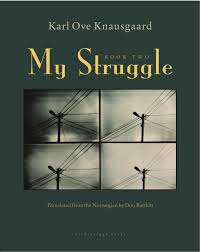
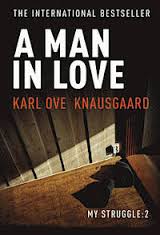
[READ: April 24, 2014] My Struggle Book Two

maninloveI read an excerpt of Book Two in Harper’s well over a year ago So when I got to that section again (it’s the end of the book) I was trying to remember why it sounded so familiar–an accident during a soccer match that leaves Karl Ove with a broken collarbone and an unhappy girlfriend (who will be looking after three kids without him), and then I remembered the excerpt that started it all.

The translation of Book Two by Don Bartlett is fantastic, just as in the first book–I can only assume the original Norwegian is just as compelling.  Book one was 430 pages and now book two was 573, so I’m in to Karl Ove’s life for 1003 pages, and there’s four more books due (Book Three comes out next month).

As I mentioned for Book One, this series has caused some controversy because it is given the same title as Hitler’s Mein Kampf (Min Kamp in Norwegian), and also because he says some pretty mean stuff about people who are still alive.  Book One was about the death of his father.  It was pretty dark.  Book Two is about his first daughter and about falling in love with Linda, his children’s mom (although not yet his wife).  And it is also pretty dark.

I was trying to figure out why I like this series so much.  Not a lot happens, Karl Ove is not a very nice person and he seems to be pissed off most of the time.  And I think what I realized is that I share a lot of opinions as him, but he takes everything to the extreme.  And he is kind of an asshole.  I mean, anyone who writes a six part autobiography called “My Struggle” (okay, really it’s called My Head) is kind of an asshole.  But so when I see things that I would only think in my deepest recesses of my mind printed on a page, it’s strangely visceral to me.  I realize this means that I’m kind of an asshole too, but the key difference is that I don’t act on the things that I think, nor do I write 4,000 pages about them.

I told Sarah that she might laugh at some of the opinions that he lists but that she would not enjoy reading the books.  Indeed, this book, this series, is not for many, I’m sure.  But to me there is something strangely engaging about him and his strange life and his writing style.  And I really flew through this book, finishing it in about a week.

So this book begins (started in July 2008) with Karl Ove being pissed off.  He talks about finishing the first part of the novel (which I have to assume is Book One, given when this was written and how this book ends) just last month (in other words he is really churning this stuff out!).  He and Linda have been fighting (as the book opens they have three children, Vanja, Heidi and John–it’s also hard to believe that his children are young enough to not really know much about this series). The tension is high between them–glares, comments, nasty sniping.  Karl Ove says that he is afraid to say things around her because he knows how she’ll react.  But at the same time, some of things he desires are simply not defensible in a relationship or when you are parent.  And the main conflict seems to be that Karl Ove is selfish and Linda is (at least according to him) mildly suicidal and possibly bipolar).  And mind you, at the time of his writing this, I think they are still together….  (I could look that up, but it seems kind of fun not exactly knowing). (more…)

Read Full Post »

polinaSOUNDTRACK: SOFA-Grey [CST002] (1997).

greyIt’s not nice to compare bands to other bands, because it seems like they are copying the original. But since I just mentioned Slint the other day, I thought it worthwhile to mention Sofa today. They have similar sensibilities—noisy guitars, spoken/screamed vocals and a decidedly quiet feel.

I love the way this disc opens with the song “On/Off”—it has a simple bass with syncopated drums. And then the buizziest buzz saw guitar thrown in counterpoint notes. And then the singer comes in, sounding like Joy Division never went away.  The song builds into a cool noise and then backs off again. But song two, “CH. 2 Chi.” changes everything—a blistering punk song with super fast chaotic drums and fast vocals. The guitars are again punctuating rather than keeping melody. And when it plays the two high chords it adds incredible tension. “Monotone” begins a simple song of two notes (and some great noisy guitars). The vocals are less Joy Divison and more spoken punk. But each verse adds something new to the music, which gets more complex. “Current” has a more conventional post-rock sound—buzzy guitars and quiet vocals. It’s a good calming moment.

“80 000” has a slow menacing vibe. It builds a few times into some really noisy chaotic sections, where the guitars are willfully out of tune—and all the while the spoken word lyrics are quiet enough to make you lean in closer. “Red Lake” is another slow number (they could maybe have used a faster one by this point), but I really like the riff and the way the guitars play off of it. And there’s an actual hummable chorus too.

The fast noise comes back on “Comma” with a frenetic guitar line and pummeling bass. Even the stop/start of the chorus are frenetic. And when the song occasionally slows down, the guitars still punctuate with astonishing noise. “The Fence” opens with a cool bass riff and simple but interesting drums. “Travel” is a slow song that opens with just guitar notes and spoken/sung lyrics. I don’t care for these more atmospheric songs (especially when they push 6 minutes) but the band does it well. “Stress” follows this. This is the shortest song on the disc just under 3 minutes of furious mayhem. “Medicine Hat” ends the disc with another slower song, but this one has a lot of interesting components, like the bass and guitar line that interweaves throughout the song.

This was Constellation Records second release (Ian, who plays guitar, co-founded Constellation).  Sofa broke up around the time of this release, which is a shame as it was a good one. I’d like to hear more from them (they have some earlier records with unknown availability).

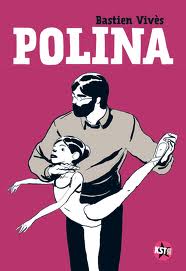
[READ: April 5, 2014] Polina

This was a simple and enjoyable graphic novel about a young ballerina who grows up in the world of ballet.  (I admit I was attracted to the title because I thought it might be about Olympic figure skater Polina Edmunds who I remembered primarily because the name Polina which was unusual to me–it is not about her).

It is a bout a fictional ballet dancer.  When we first meet young Polina, she looks so tiny in the back seat of the car as she is driven to class.  And her teacher, Mr Bojinsky looks like such a large man next to her–with his full beard and large hands.  He is an intimidating figure and all of the girls are afraid of him.  And yet, it is an honor to be even considered by him.

So when Polina unexpectedly gets chosen for his class, she is elated and fearful at the same time.  At first Bojinsky seems really mean and the way his hand more or less covers her whole chest as he gets her into place portended all kinds of things.  But rest assured, and perhaps this is a spoiler, but if is, it is one that I would like to know–nothing bad like that happens to Polina.  Phew. She is not molested, or raped or left dying in an alley. It’s not that kind of story.  Rather, it is the story of a young girl trying to make it as a dancer. (more…)

Read Full Post »

endofloveSOUNDTRACK: BECK/RECORD CLUB-LEONARD COHEN: Songs of Leonard Cohen (2010).

leonardcohenI won’t say anything because no one ever listens to me anyway. I might as well be a Leonard Cohen record.

-Neil from The Young Ones.

This second recording from Beck’s Record Club is, indeed, a Leonard Cohen record.  I like Cohen and have a bunch of his stuff.  Although he’s never been a huge favorite, I find his songwriting to be top notch.  And, since his arrangements are usually pretty sparse, it’s easy to cover his songs in a myriad of ways, which these artists certainly do.

But just to catch you up to speed about this whole Record club business:

According to the Beck/Record Club website:

Record Club is an informal meeting of various musicians to record an album in a day. The album chosen to be reinterpreted is used as a framework. Nothing is rehearsed or arranged ahead of time. A track is put up here once a week. As you will hear, some of the songs are rough renditions, often first takes that document what happened over the course of a day as opposed to a polished rendering. There is no intention to ‘add to’ the original work or attempt to recreate the power of the original recording. Only to play music and document what happens. And those who aren’t familiar with the albums in question will hopefully look for the songs in their definitive versions.

Introducing this second recording, Beck explains:

This time around the group includes Devendra Banhart, Ben, Andrew and Will from MGMT, Andrew from Wolfmother, Binki from Little Joy, and Brian and Bram returning from the first Record Club.  ‘Songs Of Leonard Cohen’ by Leonard Cohen was chosen by Andrew from MGMT. For those interested, our close second choice was Ace Of Base, which we’ll keep on the list for next time.

So, here we have Cohen’s debut.  I own it and am familiar with about half of the songs, but I didn’t want to listen to it before hearing their covers.  And so, the track listing and comments:

Suzanne (4:54)–A classic song, here given respectful treatment.  And yet they’re not afraid to play around with it, so they give it a dance beat and group vocals, all of which sound great.
Master Song (6:37).  I don’t know this song, and I don’t recognize it from this cover which is perhaps the greatest twist of a Leonard Cohen song ever. They sample Metallica’s “Master!” every time they sing the chorus.  The song is done as a rap with the voices pitched differently in every verse, there’s also a great funky bass throughout.  I assume the lyrics are the original, but I’m not sure.  The only problem with it is that it goes on for way too long.  But otherwise this is what record Club is about–having fun experimenting with songs.
Winter Lady (2:46). This is done as a pretty folk song, the way Leonard intended.
Stranger Song (5:26). This song is also dancey (with MGMT, that makes sense).  It has big drums and cool harmonies.
Sisters Of Mercy (4:36).  This is also pretty, done on an acoustic guitar with multiple singers taking turns.
So Long, Marianne (6:54).  This is also pretty faithful (of another classic).  There’s a group chorus which again sounds great.  The one difference is buzzy guitar solo.
Hey, That’s No Way To Say Goodbye (4:27).  This has a cheap Casio vibe, yet it still sounds good.  Beck sings and the whole things is quite nice.
Stories Of The Street (5:06).  The songs starts with a simple bass and xylophone, but it gradually builds into a full band song which sounds great.
Teachers (4:04).  This is an insane punk version of the song.  It is super fast with a crazy guitar section and shouted vocals.  It shows just how adaptable Cohen’s music is
One Of Us Cannot Be Wrong (5:42).  This is a pretty, slow version of this song with keyboards as the main instrument.  It’s a very nice song until it nears then end when the singer just starts screaming and going nutty  Which is okay, but that goes on for too long at the end.

So overall, this is a very enjoyable collection of covers.  The faithful ones sound wonderful and the silly songs are, yes, silly, but they are not just tossed off (except maybe Master Song.  This must have been a lot of fun to record.

[READ: March 14, 2014] The End of Love

The End of Love is four long short stories.  Each one is about the end of a relationship.  Even though I enjoyed all four stories quite a lot, the book was a lot slower to read than I would have anticipated from its scant 163 pages.  And surprisingly, the stories weren’t sad or mopey–rather, they looked at the relationships via a slightly distant narrator who was engaged and engaging.

I have been reading a lot of Latin American writers, but this book, which was written in Spanish and translated by Katherine Silver, was written by a Spanish writer.  So that’s a little bit different in feel.

“We Were Surrounded By Palm Trees”
This story is not set in Spain. It is set on an island in the Indian Ocean off the coast of Africa.  It is about a man and his girlfriend, named Marta.  They have gone to this remote island for some secluded time alone.  But it turns out that they have to share the small boat (and therefore the small island) with another couple.  Christine and Paul are a German couple who are not outgoing and friendly as the narrator fears (he doesn’t want to spent his romantic vacation with those two), but are cordial and looking to share some of the troubles of their vacation.  One such trouble is meeting with the village elder and the chief, which Paul offers to do.

The details of the island were a little unclear to me.  I think that is somewhat intentional, but there is some confusion about the nature of the power structure on the island and what exactly people get up to there.  So when Christine goes missing, Marta is instantly concerned.  And then when Paul and Christine don’t turn up for dinner, they decide to go and find them.  Christie and Paul are involved in something that I found a bit confusing, but which involved elders of the island.

As the story draws to a close and there is yet more confusion as to where the Germans are, Marta and the narrators are at odds with each other about what to do.  And the strain begins to form between them.   Even though the details of what happened with Paul and Christine are vague, the details of Marta and the narrator are very powerful and really tell the story.  It was wonderful. (more…)

Read Full Post »

nola3SOUNDTRACK: BECK-The Information (2006).

infoAfter Guero, Beck released Guerolito, a remix album.  I’ve basically given up on remix albums, so I don’t know anything about that one.

His next proper album was The Information which I have recently read was recorded at the same time as Guero. I remember when it came out that it had a whole bunch of stickers that you could put all over the cover (which was made like graph paper) so that each cover could be personalized.  Sadly I remembered that more than the music.  I hadn’t listened to the album in a long time either.  So when I played it the other day, after the first song I was afraid I didn’t remember any of it.

And even after a few listens, that first song, “Elevator Music” just never grabbed me.  Then came “Think I’m in Love” which was a reasonably big hit (surprisingly, not the first single from the album).  It’s what you expect from Beck–a cool bassline, catchy vocals and a great melody.  This one is a mid-paced song, but the chorus has a lot of bounce.  The next song, “Cellphone’s Dead” sounds a bit like “Hell Yes” with that watery staccato funky bass.  It’s definitely a fun song, and there’s a “sample” that I have to wonder if it’s not a sample at all–a neat idea to have something that sounds like sample but actually not be one).

“Strange Apparition” is a folkie song.  And this is the first song which made me realize what’s wrong with the album.  The sound quality of the whole disc is really flat.  It’s very sleek and smooth, so even though there’s some great guitars on this track, it’s the same loudness as the vocals.  And the drums are kind of lost in the mix too, it renders it really bland.  Which is shocking coming from Beck.  It’s also a shame because with a better mix this would be a great song.  Same with “Soldier Jane.”  The bass line is really fun, but it just gets lost in the muddle of everything else–which is not to say it sounds muddied, it’s just all the same.  “Nausea” was the first single from the album and I can see why–it’s funky and bouncy and has a catchy chorus an a cool bass.  But then it slowly dawns that this is basically a slightly less successful version of “Black Tambourine.”

“New Round” sounds pretty different for a Beck song–there’s layered waves of vocals and a lot of different sounds going on, including an interesting piano.  And I want to like it more, but it also seems to get lost in the washes of sound.  “Dark Star” rises above the washes with its slow and sultry sound.  It’s got a very cool 70s bass sound.  I wish there were a few more peaks on the song, but then it probably wouldn’t be so spacey.  “We Dance Alone” has some great sounds as well–again, that bass is very cool, but it just feels too smooth.

“No Complaints” brings back Beck’s old slightly out of tune guitar sound.  It stands out in this muddy middle of the album and is definitely a highlight.  “1000 BPM” is one of Beck’s weird skittery songs. There’s wild sounds and a seemingly improvised rap.  This would have probably sounded great on Odelay, but it feels odd to me here.  “Motorcade” has more acoustic guitar but by the time the chorus comes in, the only melody is on Beck’s vocals, while the strange music is almost a distraction from the melody.  There’s some cool sounds in “The Information” which is certainly an enjoyable song (and a lengthy end section of weird trippy vocals that foreshadows the very long bonus track).  “Movie Theme” opens with keyboards.  It’s nice, but just sort of meandering.

Which leads to the 10 minute final track “The Horrible Fanfare/Landslide/Exoskeleton.”  This is sort of a recap of the whole album, with samples from different songs, long drawn out instrumental passages and dialogue.  There’s some interesting riffs, especially in the middle section (about 3 minutes in).  The third section of the song is dialogue between Dave Eggers and Spike Jonze, talking about space and other things.  One wonders where Beck got this or if he just asked them to talk for the record.  It’s a weird ending and feels like a bonus track but actually isn’t.

There’s a bonus version of the disc which I do not have.  It has some more songs and a DVD.

So overall this is the first Beck CD that I just didn’t love, especially coming on the heels of the excellent Guero. There’s definitely some good songs here, I just want it to be crisper.

[READ: March 14, 2014] Nolas’ Worlds #3

Nola’s World concludes with this book, which was also translated by Erica Olson Jeffrey and Carol Klio Burrell.

I loved the first two books of this series quiet a lot, but felt like the third one fell a little flat.  The ending felt like it was solved too quickly especially after the hugely lengthy set up.

The first nearly 50 pages are all a way to lead up to the ferrets finally meeting Damiano and Ines (with the inevitable we-can’t-tell-you-everything delays.  Then we finally get the explanation that Alta Donna is a town between the Human World and the Land of Stories.  Since Damiano and Ines escaped from the Land of Stories, they have messed everything up.  We learn all about how the ferrets control Alta Donna (the details of this are quite neat).

But the big thing missing from all of this is Pumpkin.  And Nola knows it, too. (more…)

Read Full Post »

univSOUNDTRACK: BECK-Mutations (1998).

mutationsThis is the first album that shows a wholly different side to Beck. It is pretty much an entirely traditional album.  There’s no samples, just consistently strong songwriting.  The overall feel is mellow and it comes as quite a shock after the chaos of Odelay!

Although the album has a very consistent vibe, it’s not all samey.  There’s a lot of different instrumentation like the harpsichord on “Lazy Flies,” and the old-timey piano and slide guitar on “Canceled Check” which has a very country feel.  It’s not all simple and normal though, as “Check” ends with a strange musical breakdown that keeps it from being a smooth song.  “We Live Again” is a very mellow track with Beck singing sweetly over the waves of music.

As befits the name “Tropicalia” has a very tropical feel, it’s totally danceable and was a very wise choice as a sample.  “Dead Melodies” has a classical music feel (with vocals of course).  “Bottle of Blues” is, unsurprisingly, a somewhat rowdy blues song.  “O Maria” is a slow but upbeat piano song that also feels old timey.  “Sing It Again” has a melody that is similar to “Norwegian Wood,” but the song is nothing like that Beatles classic.  This is gently sung and played acoustic guitar number.  And “Static” is a quiet disc ender.

This disc also feature a “bonus” track, and this is the first one that is actually enjoyable.  It is a fleshed out song (and a good one at that). It is comparatively rambunctious and noisy and quite different from anything else on the disc.  It’s called “Diamond Bollocks” and has a great bass line and cool backing vocals.  This song could easily have been a hit if it weren’t tucked away at the end of the disc.  (Well, and there are some weird moments to, but overall, easily a hit).

Despite all that Beck is known for his crazy songs and samples, Mutations is an extremely cohesive record with enough diversity to keep it from ever getting dull.  It’s a great record and is somewhat overlooked in his catalog.

[READ: March 16, 2014] The Unknown University

This is a collection of almost all of Roberto Bolaño’s poetry.  Some (but not all) of the poems from his collection The Romantic Dogs are included here, although some of those are apparently modified a little.  It also includes what was earlier released as Antwerp but is here called “People Walking Away.”  (I found Antwerp and “People” to be quite unusual and would never remember what is the same in the two.  But translator Laura Healy says that she more or less uses Natasha Wimmer’s translation of Antwerp for the parts that are the same (a task which must have been harder than it sounds if the two pieces weren’t exactly the same).

This book is 830 pages with facing pages of Spanish and English.  According to the publisher’s note, this collection was found on Bolaño’s computer as is—a collection of all of his poems from throughout his career.

Most of the early poems were written when Bolaño was young (in his 20s).  Even at such a young age, he writes powerfully.  Not all of his poems are great of course (how could they be when there are so many) but there are dozens and dozens of poems that I thought were fantastic.  I’m going to include some below, but I also wanted to get some criticisms out of the way too.

He tends to revisit ideas quite a lot, which is normal for a poet, but it seems weird to revisit an idea in subsequent poems (especially when the poems are just a few lines long each).  It almost feels like he fixated on a subject and thought of a number of ways to work with it and rather than make one long poem, he made several short ones.  Like this strange occurrence: (more…)

Read Full Post »

nola2SOUNDTRACK: BECK-Odelay! (1996)

220px-OdelayAfter the success of Mellow Gold (and those other releases) we didn’t hear from Beck for a while (there’s a joke about the title of this record referring to the delays in production).

Beck quickly went from one hit wonder to wunderkind with this release which had 5 singles and is generally considered a masterpiece of the 1990s.

I haven’t listened to it in a long time, and I was surprised to hear that “Where’s It’s At” is not the lead track (it’s actually #8).  Rather it’s “Devil’s Haircut” that opens the disc.  And it still sounds fresh and fun (and, it must be said, rather weird–the guitar solo and that screaming at the end are not typical “single” material.  “Hotwax” returns Beck to his folkier roots.  Although it is folk done Beck-style, with funk keyboards and rapped lyrics.  There’s a ton of interesting styles of music in the background (old timey pianos, distorted guitars, even a weird little trippy ending).  While not trying to ape “Loser” at all, there are even lyrics in Spanish.  It’s a simple song that might have been a hit if there weren’t so many other hit-worthy songs on the disc.  “Lord Only Knows” is a fairly conventional song, catchy and simple.

“The New Pollution” was another single.  It’s also pretty unusual for a single–the opening samples (it must be a sample, even though I don’t see credits for it) an old sounding do do, do do do vocal line, (the listed sample is the sax solo from Joe Thomas’ “Venus.”  It’s so hard to know what’s original and what’s sampled with Beck.  “Derelict” is a slow, unusual song which I quite like, although I can see it being the first song on the disc that people didn’t love.  The backing music sounds like it’s played on an old music box.

“Novacane” is a funky rap-style track.  It’s noisy but fun and has some great samples.  “Jack-Ass” was another single.  I especially like this song.  It’s a slow and fairly conventional song with s simple melody and Beck’s mellow vocals–it cuts through the clutter of Beck’s usual cacophony and shows that he can do simple as well (and hints at Mutations).  Even if he does throw in the donkey sounds at the end.  And then there’s 2 turntables and a microphone.

“Minus” has a big noisy bass and guitar–a punk song, if you will.  “Sissyneck” has a great whistling opening which comes from “The Moog and Me” by Dick Hyman.  I really enjoy this country-infused number (it’s strange that I enjoy the less weird songs more, given that the other singles were so much bigger) .  “Readymade” is a slow meandering song with some interesting elements, although it’s probably my least favorite song on the disc.  Especially since it’s followed by the raucous “High 5 (Rock the Catskills), which has some great samples (including Shubert), a noisy chorus (“rocking the plastic like a man from a casket”) and (apparently) a recreation of some old rap (I love the “Ooh, La La Sassoon” and “Sergio Valenti” call outs).

The disc ends with “Ramshackle” a simple folk song that feel slightly out of tune.  It’s a mellow end to this all over the place disc (well, aside from the obligatory “bonus” track which is less than a minute of repeated noise).  Although it is well-known for its sampling and pop creations, it also shows the real diversity of Beck’s songwriting.

Check out the Moog and Me, which has Dick Hyman playing the Moog synthesizer and whistling along.

[READ: March 9, 2014] Nolas’ Worlds #2

Nola’s World is a three-part graphic novel series.  I just noticed in this book that it was originally (in French) called Alta Donna.  This book was translated very naturally by Erica Olson Jeffrey and Carol Klio Burrell.

The book picks up right where book one left off.  Nola is wondering why, after the crazy events at the end book one (which involve a roller coaster and aliens) Damiano hasn’t called or texted her and Pumpkin can’t remember anything that happened.

I felt like the beginning of the book was a little too pre-teen angsty for me, but it quickly snapped out of it and moved on the to fun and weirdness that this series presents in spades. We basically learn that Damiano and Inez are avoiding Nola because she can’t know their secret.  We also learn (and I guess we knew this already but I missed it) that the man controlling the aliens at the end of book one is Nola’s father. –WHAT??! (more…)

Read Full Post »

« Newer Posts - Older Posts »