Feeds:
Posts
Comments

Archive for the ‘Food’ Category

SOUNDTRACK: METRIC-Live It Out (2005).
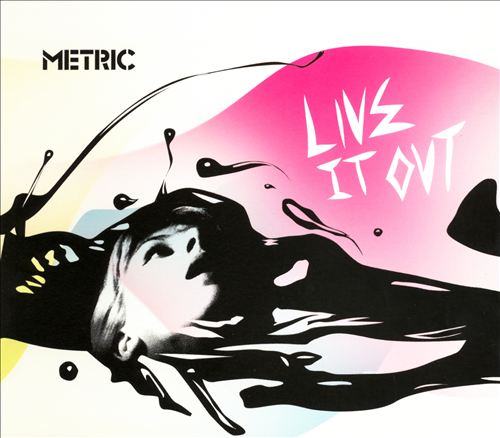
I enjoyed Metric’s Fantasies album so much that I bought their previous album (an album that I had written down as worth checking out about 5 years ago).  At first I was a little disappointed–the album doesn’t have the glow (or perhaps sheen or polish) of Fantasies.  Normally I prefer raw to polished, but it’s surprising to go the other way sometimes.  And after a couple more listens I really started to appreciate this album’s rawness.

The guitars are loud and pushy.  There are keyboards that dominate some songs, but they never make the songs poppy.  And Emily Haines’ voice sounds great.  The opener “Empty” has a lot of quiet sections, but the guitars really just burst forth.  It’s 6 minutes long but that’s mostly through a long intro and outro.  The rest of the songs stick firmly in the 3-4 minute range.  “Glass Ceiling” has a cool stuttering riff and a kind of awkward bridge–these first two songs kind of resist admittance (the piano/guitar solo is certainly a weird combination–which I like now of course).  “Handshakes” shows their more commercial side–a slick kind of guitar riff with Haines’ more aggressive vocals.  True the siren sound may turn off some, but it’s certainly a signature.  “Too Little Too Late” is a slow sultry number, but even more sultry is the sleazy-feeling (no doubt because of the keyboards) “Poster of a Girl.”  In addition to a cool spoken word section in French (the whole song is bilingual), we get the English lines “Coming in your pants/For the off chance/With a…poster of a girl.”

“Monster Hospital” is a fun punk blast that is still a live favorite for the band.  “Patriarch on a Vespa” has another rough riff with some cool bass.  It also features some disconcerting singing (ahahs that sound more than a little spooky).  “The Police and the Private” is one of the cool songs with easily singable but easily confusable lyrics.  While “Ending Start” has some great guitar riffs near the end.   “Live It Out” ends the disc with a staccato punk number.  It’s a perfect summation of Metric before they got more commercial.  And it’s a great addition for fans of the band.

[READ: July 8, 2012] The Big Meal

This play came as a supplement with Lucky Peach issue #4.

I have often maintained that it is much better to see a play than to read one.  Not a daring opinion, by any stretch. I have taken that to something of an extreme however, which means that I pretty much never read plays.  This has severely limited by Shakespeare intact, naturally.  It also means that a lot of great works are lost to me.

I’m using that information by way of introduction, not because I think this play compares to Shakespeare, but because this is one of a few plays that I have read recently that I’ve really enjoyed.  So I’m retracting some of my earlier thoughts about reading plays.  True, some plays with multiple characters can be confusing to keep straight (since defining characteristics are not given).  But in shorter plays or plays with not too many characters, it’s not so hard to read them.  And in fact, it can be a quick and enjoyable read.

Although this play complicates things immensely because of its (very cool) setup.  The setup is described in the introduction to the play: “The actors play multiple generations of one family…as they glide through time.  As the characters age, their “essences” pass from younger to older actors.”  So, the story takes places over a few generations of time.  There are eight actors.  Each actor plays multiple roles.  These roles correspond to the characters at certain ages.  So, for example, the youngest actor plays Character A as a child; the adolescent actor plays Character A as an older child; the middle-aged actor plays Character A as a middle-aged person, etc.   So that’s a little confusing (although I’ll bet it makes sense seeing it live).  What I like though is that this “gimmick” is not so much a gimmick at all, but a real indication of how we turn into our parents and an indication of how quickly time passes in this play. (more…)

Read Full Post »

SOUNDTRACK: SIX ORGANS OF ADMITTANCE-“Even If You Knew” (2012).

Lars from NPR’s All Things Considered picked this as his summer music preview song.  I don’t know a thing about Six Organs of Admittance, but their discussion of this song makes it seem like this is atypical for the band (which has a massive output).  Evidently they’re usually more droney sounding. But man, this song is pummeling and wonderful.

It’s seven minutes long and opens with a simple, plodding heavy bass riff.  The vocals are kind of whispered and strained.  But then comes the guitar solo–a raging piece of distortion that complements the bass.  And that’s just the first three minutes.

The second half of the song features a quieter section–the bass is quieter, while the guitar noodles around and the vocals play over the rhythm.  The song slowly builds again, and by the last minute or so there’s another fierce guitar solo. Until the song is exhausted by the final distorted notes.

This is some beautiful noise.  And, no I have no idea what the band’s name means.

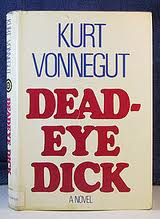
[READ: June 27, 2012] Deadeye Dick

Deadeye Dick is the last Vonnegut book that I was completely unfamiliar with.  I had no idea what it would be about.  So I didn’t realize until very late in the book, and then I looked online and confirmed that this book is set in the same location as Breakfast of Champions, Midland City, Ohio.  Indeed, some of the same characters appear in this book as appeared in that book.  But more about that later.

Vonnegut is not known for his happy books.  Misanthropy is pretty rampant in his pages.  But this book is one of his bleakest books yet.  The story concerns the Waltz family–Rudy (the protagonist) and his brother Felix are the only children of Otto and Emma Waltz.  Pretty early in the story we learn that Rudy is a double murderer.  Yipes!

As with most Vonnegut stories, this one is told in a convoluted and non-linear fashion.  He foreshadows (and really just casually mentions) a lot of crazy things that are going to happen in the book.  Like the fact that Midland City is going to be devastated by a neutron bomb.  In fact, his preface (like with many of his prefaces) tells us a lot about what’s in the book and who the characters are based on and the fact that there is a neutron bomb (but the reality of a neutron bomb is different from what he says).  There is something about knowing this information ahead of time that impacts the way you read the story.  Whether you think maybe he’s not telling the truth about what will happen (can the narrator really be a double murderer?) or maybe somehow the foreshadowing makes it even worse when it actually happens–the revelations are perhaps more deliberate.  But the style–a recursive style in which he says what happens and then he goes back and fills in the details, makes the events that much more powerful.

The funny thing about this story is that a lot happens to the characters in the beginning of the story and then not too much happens to them after that.  But that early stuff is pretty exciting and it has an impact all the way through. (more…)

Read Full Post »

SOUNDTRACK: PHISH-“In the Aeroplane Over the Sea” (2010).

My friend Jay sent me this clip of Phish covering Neutral Milk Hotel’s wonderful song.  He was at the show and sent me a link  to the YouTube video.

The original of this song is wonderful–always sounding like it’s going to collapse in on itself but never actually doing so.  It is full of angst and emotion and after the first listen, where you say, “is he really going to sing the whole thing like this?” you are totally hooked.

The Phish version evens a lot of that angst out.  It’s a strange thing to say about Phish, but they make this song far more commercial.  They turn it into a pretty ballad.  And that’s kind of a shame since the original is so iconic.

In Phish’s defense, this is part of one of their sets (they unveiled a new cover on every day of the tour), and it’s not like they are trying to record a definitive version of it or anything.  So they make it into a Phish song–with a long solo and everything.  And the solo sounds like a total Trey solo.  I’m not sure what songs surrounded this one, but it sounds like it fit perfectly into their set.

As the folks at Stereogum say, “If you’ve always felt “Aeroplane” needed more guitar solo, this is your lucky day.”  For me what it did was make me want to listen to the original–and that’s never a bad thing.

[READ: June 5, 2012] “Quests”

This essay opens up with a history lesson.  In the early nineties, Pizza Hut sponsored the Book It! program to promote reading.  For every ten books you read you got a free pizza.  Well, it turns out that they either still do this or they do it in a modified form because my son has been getting these free pizza coupons all year.  Of course, we live in New Jersey, where the pizza is plentiful and delicious (there are at least 4 excellent pizza places within ten minutes of our house).  And you’d be a fool to eat Pizza Hut, even if it is free.  My son is pretty bummed about this, because of course he wants to redeem his prize.  And I suppose one day we’ll let him do it, but it would painful.  I actually don’t even know where a Pizza Hut is by us.

But that’s got nothing to do with Russell’s essay.  She realizes the truism that there is no greater pleasure than reading for pizza.  Because it’s not just reading for escape and fantasy, now you’re a breadwinner. Literally.  Russell’s genre of choice was fantasy (Terry Brooks in particular–I love that she realizes later in life that he took his ideas from Dresden and Hiroshima and how it blew her mind). (more…)

Read Full Post »

SOUNDTRACK: THE GREAT GAMBLE-Book One (2012).

My friend Matt has worked at a school in Pennsylvania for years. He wrote to tell me that a few kids who graduated from his school had formed a band and have released a CD.  It’s streaming (and downloadable) on bandcamp at their site.

I have lots of friends in bands, and I’ve listened to lots of demos, so I wasn’t expecting very much.  But the first thing I noticed when I listened was how good this sounds–professional and, yes, like a “real” album.  This isn’t just a bunch of guys jamming in their garage.  What makes this even more striking is that the music is heavy progressive metal–not something you just whip out in a quick take.  This is complicated, interesting music.  I’m hearing a kind of Dream Theater meets King’s X vibe going on.  And man, it’s really good.

This is multi-step heavy rock (complete with a synth player/violinist!). The only song that is less than 9 minutes is the 90 second introduction called “The Marketplace.”  Otherwise, we’ve got three songs over ten minutes and one over 16!  Who even knew young bands did stuff like this anymore?

Al Joseph plays lead guitar and sings lead vocals.  His guitar speed is very impressive and his vocals sound not unlike Dug Pinnick from King’s X (noticeable on the opening track, especially) .  Matt Weaver plays violin and keyboards.  The keyboards offer more than just a fuller sound.  On “Release the Kraken” they provide some cool sci-fi sound effects.  At about five minutes in, “Release the Kraken” slows down to a quiet middle section that really showcases Steve Michael’s drums.  And then comes the blistering guitar solo.  It’s followed quickly but a slight diversion and then a wholly different style of solo.  It’s really something.

If “Release the Kraken” wasn’t a good enough prog rock title, how bout “Legends of the Symmetria.”  This one has a very Dream Theater feel for the opening.  But the vocals sound very different–dual vocals with great low harmony.  There’s a cool pre-chorus (I guess) at about 3 minutes.  This song is definitely a heavy one.  At about 4 minutes, the song slows down into a pretty classical guitar section,where Chris Joseph on plays bass gets to show off a bit (although he seems to be the most understated of the 4 players).  There’s some great drumming at the end of the song, too.

“The Ghost of Three Reflections” is a slow builder of a song.  There’s some quiet parts (with beautiful harmonies) and a guitar solo that sounds clear and perfect (I’m hyping the production so much because it sounds so good).  The guitar solo section in this one strikes me as something that might suit two guitarists better–maybe two more different styles of soloing, but he pulls it off well, especially when by the end, he has shifted to a very different style, and the music changes along with it).  I love the bass section at the 8 minute mark, which reminds me of something Rush might have done back in the mid 70s.  The song kind of merges into “Breach At Fort Mycenae” which opens with the same kind of staggered sound as the end of the previous song.  The violin gets an airing in the middle of this song and it’s a cool treat.  I could definitely use more violin in these songs, although maybe little bits are a treat.  There’s a few times when I don’t like the production choices–maybe there needs to be a bit more music behind some of these solos so it doesn’t just sound like two players soloing against each other.

The disc ends with the big one, the sixteen minute, “The Sleepwalker Pt. 1 – Tears of Dagon” [I love that it’s a Part One and it’s 16 minutes long].  When the vocals kick in at about 3 minutes, the harmonies are gorgeous.  I love the bass guitar break at 5 minutes.  Although there’s something about the keyboard sound that I don’t like–maybe they’re not big enough?  But I love the crazy guitar solo at the 9 minute mark of this track (I’m a sucker for dissonant scales).

This is an amazing debut CD and I hope these guys go far (they’re going from Scranton to Boston for school, but I hope they can go further than that).  They are tight as a drum, stopping and starting perfectly, keeping all of the rhythms and time changes perfectly.  They really have done their prog rock homework.  The only gripe is as I’ve said, some sections don’t feel “big” enough.  If you’re going to write a 16 minute song, you don’t want sections that sound small–you want your backing guitars or bass guitars to be a little louder so it sounds like the song is still going.  But other than that, there’s not much room for improvement.

I downloaded their CD, (and yes, I paid for it…that will help with college, eh?).  But my real complaint is that on the computer, the album cover is awesome–if you look at it from an angle, there’s a whole scene behind the large logo (try it, it works here too).  But when you print it out, you lose all of that.  The images are there, but the effect is gone.  This is a band that calls out for full color packaging and maybe even a gatefold sleeve!  (The bottom of the cover says Ο υπνoβάτης which means The Sleepwalker).

Good jobs guys!  You’ve done NEPA proud!

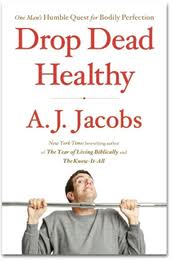
[READ: May 15, 2012] Drop Dead Healthy

Sarah got me this latest A.J. Jacobs book for my birthday.  At first I didn’t think I wanted to read it because I feared what a book all about being in good shape would be—nagging, obnoxious, making me feel bad about my vices. But I should have leaned from all of my A.J. Jacobs experience that he is completely NOT about that.

Jacobs occasionally enters into preposterous forays of Self-Improvement.  In the first book of his I read, The  Guinea Pig Diaries, he tried various weird experiments to see what it was like to be a woman, radically honest, a unitasker, etc.  His other books have been about self-improvement.  He read the encyclopedia from A-Z, he did a year trying to live like out of the bible (I will get to these eventually).  In this book, he is on a quest to be the healthiest person in the world.

It’s an impossible task.  And, frankly, a foolish one.  But he decides he will take two years and focus on individual parts of his body one month at a time.  I’m going say right up front I feared that this book would make me feel bad about all the things I don’t do for myself.   But well, a) Jacobs is a funny writer, so at least you’re laughing.  b) Jacobs is either in bad shape or plays up his badshapedness so that the average person doesn’t feel too bad off.  c) He is so over the top in his quest that no one would ever think about doing all of the things, but we can take what he learned and apply little bits to ourselves.  What is nice is that he tries to get two if not balanced opinions then perhaps fringe opinions to balance out–trying one extreme then another to see which work.

He Breaks His Categories Down thusly: stomach (eating right, the perfect food), the heart, the ears (the quest for quiet), the butt (avoiding sitting too much), the immune system (germs), genitals, nervous system, lower intestine (better bowels), adrenal gland (lowering stress), brain, endocrine system (removing toxins), teeth, feet, lungs, skin, inside of the eyelid (sleep), bladder, gonads, nose, hands, back, eyes, and skull.  Each category is designed to be a month-long workout of that organ/item–some things he keeps doing after the month is over making his workout regime something like 5 hours a day.  And at the beginning of each month he lists the stats for what he accomplished.

I’m not going to talk about all of his body parts, but I will mention a few that i enjoyed the most. (more…)

Read Full Post »

SOUNDTRACK: CIAN NUGENT-“My War Blues” (2012).

I’ve never heard of Cian Nugent before (pronounced KEE-en).  He’s an Irish guitarist (his guitar playing reminds me of José González).  And this is a cover (but not really) of Black Flag’s “My War.”  What it really is is a solo acoustic guitar workout that is inspired by the riff of “My War” (there’s no vocals).  I love Black Flag and I can say that if I didn’t know that bit of information, I would never have guessed a connection.  But having said that, this song is an inspired workout.

He plays some wonderfully dissonant slow notes as the song opens.  From there, it picks up speed as Cian tests out some new variations.  And then he gets into the solo section, sounding like an inspired Richard Thompson, he plays one of he meanest acoustic guitar solos I’ve heard in ages.  At times angry, at times jaunty, and all the while keeping the beat on the low strings.

I’m going to have to check out more by this guy.

To hear this track, check out NPR.  You’re one of them.

[READ: May 15, 2012] “First Atlanta and Then the World”

This article comes from the archives, one of three monthly suggestions from my work that I enjoy checking out.  It’s a brief history of the rise of Coca-Cola from small idea to global behemoth.  But, and here’s the kicker, it comes from a local publication: The Georgia Historical Quarterly, so there is no (real) politicking in the article.  There’s nothing about global hegemony, there’s nothing about high fructose corn syrup and nothing about obesity (it was written in 1987, back in less politicized days).  And I have to say, this made it more fun to read.  Not because I have any vested interest in promoting the worlds’ most recognized brand, but because the Coca-Cola story is pretty fascinating.  And it’s interesting to read it from a local perspective.

I don’t know how scholarly The Georgia Historical Quarterly is (since it’s on JSTOR I know it has certain aspects of scholarship—it’s not just a booster for Georgia), but the tone of this article is very light, very fun.  It makes for an interesting read. (more…)

Read Full Post »

SOUNDTRACK: RUSH on Archer (2011-2012).

Not really a soundtrack, but I wanted to mention some of the Rush references in Archer.

I was really hoping to use the Rush in Cleveland DVD as my Soundtrack, but I haven’t finished it yet.  And yes, I am padding this out a bit so that the pictures fit nicely.

Cobra Cobra Cobra (that’s a joke to the book below).

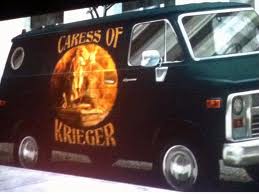
The Archer guys like Rush and they put nods to Rush in occasional episodes–usually through mad-scientist (I want to call him The Professor), Krieger.  Here’s three of Krieger’s vans.

I love the detail that went into “Vanispheres.”  Since Krieger always wears a lab coat, it’s a wonderful detail to have him wearing it as the nude man.  And, of course to have him as both the nude man and the clothed man is perfect.

Since it’s my favorite obscure Rush album, the Caress of Krieger van just cracks me up the most.

And just to add to the fun here’s a video of Krieger’s Neil Peart-like drum set

It’s pronounced “Why Why Zed.”

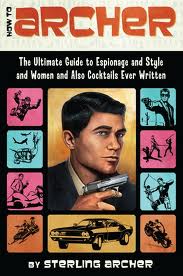
[READ:May 9, 2012] How to Archer

Although the Archie Meets Kiss comic proved to not be the joy I’d hoped, How to Archer easily made up for it.  I love Archer, it is one of my top ten shows ever, I think.  And this book is basically a print version of the show.

It’s designed as a how-to manual written by Sterling Archer himself.  He gives you tips on how to become the world’s best secret agent.  He teaches you how to dress (the details about buying shoes are amazing), how to drink (he provides cocktail recipes and his own opinion of subpar drinks), how to eat (a recipe for Eggs Woodhouse that sounds divine) and even a secret to gambling!

The fact that Archer is an abrasive, cocky, sexist, racist dick only makes the book that much funnier.

If you haven’t seen Archer (on FX), it’s a cartoon about a spy.  His mother, Malory, owns the spy agency and they have a very contentious relationship.  (The fact that his full name is Sterling Malory Archer should be just one clue to that).  Malory gets the introduction to the book, which is pretty darn funny as well. (more…)

Read Full Post »

SOUNDTRACK: REAL ESTATE-Tiny Desk Concert #202 (March 12, 2012).

I enjoyed some Real Estate songs, but i never listened to their whole albums.  I thought this Tiny Desk show would give me more sonic information about them.

This three song set is very pleasing.  The music is soft and nonabrasive, with a very smooth feel (as you can see they are dressed in sweaters and cardigans, so this is not really a shock).  It’s poppy without having any real hooks.  They remind me of a less catchy Guster or a less dramatic Smiths (“Green Aisles,” especially for the bass and guitar solo) or gentler Death Cab for Cutie (“Municipality”).

There’s nothing to radically distinguish these three songs (radical is not a word that would apply to Real Estate), although “Green Aisles” has a few more dynamic moments (mostly from the change in drum patterns).

This review sounds like I didn’t like the set, but that’s not true.  As I said, it’s very pleasant.  And sometimes pleasant is what you want.

You can hear it here.

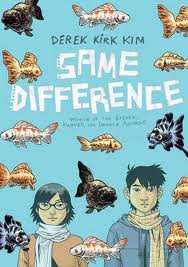
[READ: March 11, 2012] Same Difference

First Second continues to publish some of the most beautiful and thought-provoking graphic novels around.  This is a republication of a story that first appeared in a collection (and proceeded to win an Eisner, Harvey and Ignatz Award).

The story is about Simon and his close friend Nancy.  It opens with them in a Vietnamese Restaurant in Oakland, CA.  The first scene of the book is wonderfully drawn–we look in on the characters through a fish tank–fish are practically littering the panels–it’s very cool.

The two of them are with their friend Ian and they are shooting the breeze, talking nonsense.  And then Simon sees a woman that he knew from high school.  She is sitting at the bus stop and Simon wants to, but can’t, talk to her.  Her name is Irene, she seems sad, eyes downcast looking at the ground.  And then Simon reveals that she is blind.

In high school, he and Irene were very close.  He helped her out, described films to her in class, and “rescued” her from bullies.  And then she invited him to a Sadie Hawkins dance.  He doesn’t like her that way, so he lied to get out of it.  She never found out about the lies, but it has haunted him for the last seven years.

Later, Nancy figured out the truth of the matter, and even though we the readers probably guessed it as well, it still hit hard when it was spoken aloud. (more…)

Read Full Post »

SOUNDTRACKTV ON THE RADIO-New Health Rock (2004).

I was not aware that this EP existed (I guess technically it’s a single).  It came out after their original EP but before their first full-length.

The title track is a rocking number with all kinds of cool keyboard noises strewn about.  This is clearly early template TV on the Radio.  “The Wrong Way” will appear on Desperate Youth, Blood Thirsty Babes and it shows a new noisy sound for the band–lots of horns and a reluctance to allow silence appear, there’s sound filling up every space.  The final song, “Modern Romance” feels like a B-side.  It is kind of slow and meandering.  There are a few interesting sonic bits but mostly they are overshadowed by a kind of monotony.

Not essential listening for the TV on the Radio fan.

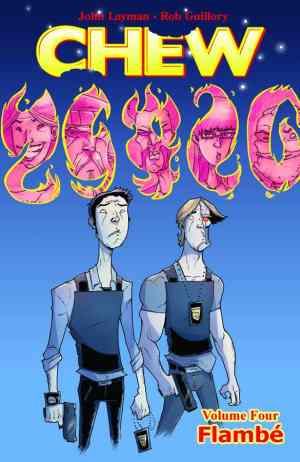
[READ: December 29, 2011] Chew: Volume Four

It was delightful to get volume four of this series so quickly after finishing volume three!

As with previous issues, this one starts out with a quirky opening.  A series of shots of a chicken restaurant (Mother Clucker’s) thirty-five years ago, then twenty-five, then fifteen and then five (nice clientele drawings over the years).  And then finally we see it today, after the ban on chicken–a wasteland.

But this story introduces an entirely new element (which goes through the arc of the book.  Lights from (presumably) an alien life form fill the skies.  They spell out words in a language that absolutely no one can understand.  And it is so vexing that money is taken away from the FDA (the people who are fighting the chicken war) and put into NASA.

This first chapter also introduces a new kind of character: a man who is voresophic–if he is eating he is unbelievably intelligent. Of course, if this was your gift, how long would you be able to stay slim?

Chapter Two jumps us right into a NASA space station.  Just as it explodes.  A quick cut to a school (where Tony Chu’s estranged daughter goes) reveals a more down to earth problem.  Since the letters have appeared in the sky people have been acting weird.  And one technologically savvy boy, who has been picked on most of his school life is looking for revenge.  But is he responsible for the space station explosion as well?

Chapter three is wonderful for a couple of reasons.  First, Chu and John Colby are getting assigned increasingly dangerous missions (because their boss wants them dead).  It culminates in a hilarious scene at the USDA (a furious female army). Chu and Colby are the last resort.  If everyone else fails, they have a fall back so dangerous that it is classified.

Chapter four is amazing for opening with a series of scenes that are gruesome and awful and, as the narrator boxes keep repeating, never actually happen.  And that is because Tony Chu has been assigned to work with his twin sister Toni Chu–NASA bigwig and (unknown to anyone else, fellow Cibopath–she doesn’t tell anyone so she’s not treated like a freak like her brother).  It’s great to see the two of them work their magic.  And while I wouldn’t want it to replace the Chu/Colby team, it would be fun to see future pairings of these two.

Chapter five (this is the first book with five chapters!) opens with a wonderfully long sequence of Agent Mason Savoy (he never went away, he’s always in the background) sampling something amazing.  And we get several wordless pages of him processing what he has just ingested.

But the more amazing thing is that suddenly the letters in the sky simply disappear.  And there seems to be a cult leader who predicted this, right down to the minute.  The cult leader ingested scads and scads of gallsaberries when she was adrift at sea and it led her to the Truth.  And she has lots of followers who are willing to drink her Kool-Aid.

The book ends with two wonderful cliffhangers.  The first one is (mild spoiler, but not really since it will be dealt with in the next book) that their actions lead Chu and Colby to get fired.  The second one is that Mason Savoy has learned a special secret about one of Tony Chu’s relatives (remember we saw them all in that cool scene from the last book?).  And he takes advantage of that knowledge.

The series isn’t over by a long shot.  Awesome.

A couple other things, first off–welcome back Poyo!  I loved the faux story they created about his background and then the negation of said story.  Also, this books reintroduces the vampires that were mentioned early in the story and then kind of hidden.  I love when stories pick up threads like this.  And a final quick nod to all of the excellent little jokes in the margins of the pictures.  I read them all and I love them…keep them up!

For ease of searching I include: flambe

Read Full Post »

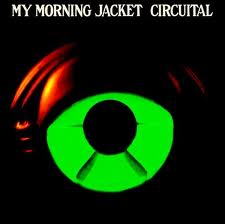
SOUNDTRACK: MY MORNING JACKET-Circuital (2011).

I have really gotten into My Morning Jacket with their last couple of albums.  I know that they are quite different from their earlier releases, so I’m not quite as surprised by the diversity that’s on them.  With each release, they keep exploring new territory, although it’s all held together nicely by Jim James’ (or Yim Yames’) amazing voice.

The first half of the disc is much more wild than the second half, with longer songs, and more unusual textures.  The second half slows things down and feels almost, but not quite, acoustic.

“Victory Dance” is a slinky song and a cool intro to the disc.  It’s quickly followed by “Circuital,” a 7 minute long epic with two distinct parts.  The first is a kind of quiet echoey introduction, but when the guitars roar in at around 2:30, it turns into a big anthemy song…very ctahcy

“The Day is Coming” opens like a 70s AM radio song, with lots of da da das.  It’s a mellow song, the kind of song the MMJ flesh out with wonderful vocals so it never gets dull.

“Wonderful” is a simply beautiful song.  A gentle ballad about feeling wonderful.  I just found out that this song was originally intended for The Muppet Movie.  It would have been perfect.  Of course, the band are on the soundtrack doing a cover, so I guess that’s kinda close.

“Outta My System” is another catchy little number, also reminiscent of 70s AM radio, although it’s all about doing bad things as a youth and getting them out of your system.  Musically it would also work very well for the Muppets, but I suspect lyrically it might be a bit outré for the movie (granted I haven’t actually seen it so I can’t say for sure).

All the recent MMJ albums have one crazy track and on this one it’s “Holdin’ on to Black Metal.”  So the title is pretty unexpected but it’s nowhere near as unexpected as the content of the song.  It is complete with a children’s chorus and what sounds like horns, although I suspect they are keyboards.  It’s full of blasts of sound and woah woah ohs.  It’s crazy.  I love it.  Much like I love the crazy song, “Highly Suspicious”  from the previous album.  And I just found out that this song is more or less a cover (although with different words of “E-Saew Tam Punha Huajai” by Kwan Jai & Kwan Jit Sriprajan from the album Siamese Soul: Thai Spectacular 1960s-80s Volume 2.  More on that tomorrow.

  After that bizarre track, the album really settles down into an easy groove.  “First Light is a pretty traditional, simple song.  It also has lots of horns.  “You Wanna Freak Out” is also unexpected for the title, as it’s a pretty straightforward rocker. “Slow Slow Tune” doesn not belie its title.  It has a kind of 70s Pink Floyd feel and continues the more mellow second half od the disc.  The disc ends with “Movin’ Away” a slow, piano ballad.

  Although the album has a very comfortable, familiar feel, MMJ have little tricks (great soaring guitars and, again, James’ voice) to make it rise above the ordinary.  It’s great disc that warrants multiple listens.

[READ: January 28, 2012] How I Became a Nun

I didn’t love Aira’s Ghosts because it was too ephemeral for me (as befitting a book called Ghosts, right?).  How I Became a Nun is the exact opposite: a terrifically visceral story that is straightforward and easy to follow, except for perhaps two things.

The first thing is something that’s mentioned on the back of the book (so I’m not threatening a spoiler here).  The main character is named César.  Whenever someone talks to him, they address him as César or boy or him.  And yet, the whole book is written from the point of view of young César, and César describes himself as a girl.  In the fourth paragraph, the narrator states, “I was a devoted daughter.”  And yet, shortly thereafter, another character says about the narrator, “Is it my fault if the boy didn’t like it?”

This goes on throughout the story–not a lot–but enough to keep it in your mind.

The second thing is the ending.  Which I don’t want to spoil.

So what is this wonderfully titled story about?  Well, six-year old César begins, “My story, the story of ‘how I became a nun’ began very early in my life.”  The opening chapter tells the story of César’s first experience with ice-cream.

It is a wonderful chapter, with César’s father promising the wondrous delights of ice cream and taking them both out for a cone.  César’s father enjoys his cone very much, but César, although instantly in love with the pink strawberry color is instantly disgusted by the taste. He even retches a little bit. (more…)

Read Full Post »

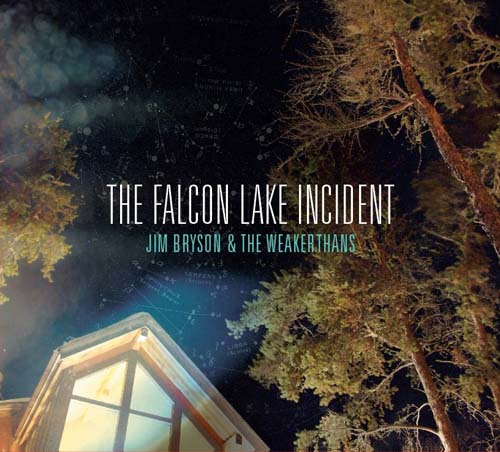
SOUNDTRACK: JIM BRYSON & THE WEAKERTHANS-The Falcon Lake Incident (2010).

I don’t know who Jim Bryson is (he’s a Canadian folk singer, duh), but I do know The Weakerthans.  And since this CD is always listed in The Weakerthans’ discography, I thought it was worth investigating.

All of the songs have a Weakerthans feel, there is no question (I mean, they play all the music).  And while I like the album quite a lot, I feel like without John K. Samson’s voice, the disc is missing something.  Nevertheless, the album is a wonderful folky album, a great mix of upbeat and slow tracks.

“Metal Girls” is a wonderful upbeat folk rocker.  It’s incredibly catchy.  “Fell Off the Dock” is a much slower, sadder song with the final repeated line, “everybody loved it here, but you.”  “Wild Folk” ups the tempo again.  “Constellation” is another slow song, this one with beautiful harmonies.

“Freeways in the Frontyard” has even better harmonies, from Jill Barber–a kind of minor key harmony that works very well.  “Up All Night” is another more uptempo track that could easily be an adult alternative hit.  “Kissing Cousins” is a slight track that seems like it should be funny but isn’t really.  “Decidedly” is one of my favorite tracks on the disc.  It’s boppy with a fun chorus: “Why would you ever grow leaves just to watch ’em fall off again.”

The first and last tracks feel more like filler or intro/outro than real songs.  But that’s okay.  It’s a tidy little album of very pretty songs.  And the tempo changes keep everything interesting for half an hour or so.  You can’t complain about that.

And in case you were wondering, the Falcon Lake Incident is a reported UFO encounter near Falcon Lake, Manitoba, Canada claimed to have occurred on May 20, 1967 (thanks Wikipedia).

[READ: January 19, 2012] “Happy New Year”

Of course, I wish I had read this article earlier in the month, but then I only found out about it a couple of days ago.

This is an article (I assume from the editor of The Lotus Magazine) which bemoans the loss of the New Year’s Day tradition of going to (pretty much) anyone’s house for meals and snacks and drinks and good times.

The article states that it may have been about 35 years ago (circa the 1880s) that the Dutch custom was abandoned.  Before then, people in New York City would throw open their doors and it was:

a breach of etiquette to omit any acquaintance in these annual calls, when old friendships were renewed and family differences amicably settled.  A hearty welcome was extended even to strangers of presentable appearance.

Indeed, it seems that certain houses were known for:

particular forms of entertainment.  At one was eggnog; at another, rum punch; at this one, pickled oysters; at that, boned turkey, or marvelous chocolate, or perfect Mocha coffee, or, for the connoisseur a drop of old madeira, as soft as rainwater and as delicate in flavor as the texture of the glass from which it was sipped. (more…)

Read Full Post »

« Newer Posts - Older Posts »