 SOUNDTRACK: MY MORNING JACKET-Circuital (2011).
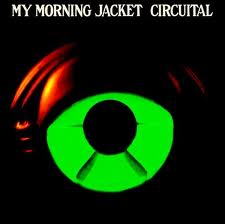 I have really gotten into My Morning Jacket with their last couple of albums. I know that they are quite different from their earlier releases, so I’m not quite as surprised by the diversity that’s on them. With each release, they keep exploring new territory, although it’s all held together nicely by Jim James’ (or Yim Yames’) amazing voice.
The first half of the disc is much more wild than the second half, with longer songs, and more unusual textures. The second half slows things down and feels almost, but not quite, acoustic.
“Victory Dance” is a slinky song and a cool intro to the disc. It’s quickly followed by “Circuital,” a 7 minute long epic with two distinct parts. The first is a kind of quiet echoey introduction, but when the guitars roar in at around 2:30, it turns into a big anthemy song…very ctahcy
“The Day is Coming” opens like a 70s AM radio song, with lots of da da das. It’s a mellow song, the kind of song the MMJ flesh out with wonderful vocals so it never gets dull.
“Wonderful” is a simply beautiful song. A gentle ballad about feeling wonderful. I just found out that this song was originally intended for The Muppet Movie. It would have been perfect. Of course, the band are on the soundtrack doing a cover, so I guess that’s kinda close.
“Outta My System” is another catchy little number, also reminiscent of 70s AM radio, although it’s all about doing bad things as a youth and getting them out of your system. Musically it would also work very well for the Muppets, but I suspect lyrically it might be a bit outré for the movie (granted I haven’t actually seen it so I can’t say for sure).
All the recent MMJ albums have one crazy track and on this one it’s “Holdin’ on to Black Metal.” So the title is pretty unexpected but it’s nowhere near as unexpected as the content of the song. It is complete with a children’s chorus and what sounds like horns, although I suspect they are keyboards. It’s full of blasts of sound and woah woah ohs. It’s crazy. I love it. Much like I love the crazy song, “Highly Suspicious” from the previous album. And I just found out that this song is more or less a cover (although with different words of “E-Saew Tam Punha Huajai” by Kwan Jai & Kwan Jit Sriprajan from the album Siamese Soul: Thai Spectacular 1960s-80s Volume 2. More on that tomorrow.
After that bizarre track, the album really settles down into an easy groove. “First Light is a pretty traditional, simple song. It also has lots of horns. “You Wanna Freak Out” is also unexpected for the title, as it’s a pretty straightforward rocker. “Slow Slow Tune” doesn not belie its title. It has a kind of 70s Pink Floyd feel and continues the more mellow second half od the disc. The disc ends with “Movin’ Away” a slow, piano ballad.
Although the album has a very comfortable, familiar feel, MMJ have little tricks (great soaring guitars and, again, James’ voice) to make it rise above the ordinary. It’s great disc that warrants multiple listens.
[READ: January 28, 2012] How I Became a Nun
I didn’t love Aira’s Ghosts because it was too ephemeral for me (as befitting a book called Ghosts, right?). How I Became a Nun is the exact opposite: a terrifically visceral story that is straightforward and easy to follow, except for perhaps two things.
The first thing is something that’s mentioned on the back of the book (so I’m not threatening a spoiler here). The main character is named César. Whenever someone talks to him, they address him as César or boy or him. And yet, the whole book is written from the point of view of young César, and César describes himself as a girl. In the fourth paragraph, the narrator states, “I was a devoted daughter.” And yet, shortly thereafter, another character says about the narrator, “Is it my fault if the boy didn’t like it?”
This goes on throughout the story–not a lot–but enough to keep it in your mind.
The second thing is the ending. Which I don’t want to spoil.
So what is this wonderfully titled story about? Well, six-year old César begins, “My story, the story of ‘how I became a nun’ began very early in my life.” The opening chapter tells the story of César’s first experience with ice-cream.
It is a wonderful chapter, with César’s father promising the wondrous delights of ice cream and taking them both out for a cone. César’s father enjoys his cone very much, but César, although instantly in love with the pink strawberry color is instantly disgusted by the taste. He even retches a little bit.
What on earth could this be about? What kind of strange child is this? César’s father is very angry about this, as once assumes any father might be. But César’s father goes pretty far in his anger. He begins calling César a moron, and then, worse yet, he forces César to eat the rest of the ice cream, despite the child’s tears and protestations.
This painful scene continues, waiting for resolution through the chapter. And in Chapter Two, we learn what really happened. It’s not a matter of taste, it was a matter of the ice cream. And when César’s father finally tries it and is similarly disgusted he goes to complain. If you thought César’s father was hotheaded with César, that’s nothing compared to what happens with the ice cream vendor.
When we realize what happened to the ice cream (I won’t spoil it), the story goes from a “what is up with this kid” to a “wow, this is horrible.” And the shift is handled wonderfully.
César winds up in the hospital for a time and ends up missing school for three months. When César gets back to school finally, it become readily apparent that all of the children know how to read but César can’t make heads or tails of anything (in this regard the story’s hallucinogenic quality becomes more pronounced). César’s ultimate revelation comes when a wonderfully obscene phrase is written on the bathroom wall.
He transcribes it into his journal (he remembers the characters even though he doesn’t understand them). And when he shows them off to his mother, all hell breaks loose. To the point where even his teacher won’t talk to him anymore. [I said the story was easy to follow, I didn’t say it was entirely logical].
This is pretty close to the end of the story. There are a few small episodes that enhance the strange nature of César’s relationship to the world. Although the story is quite easy to follow, there are a couple of moments when you wonder, “really?” As for the ending, you have to get over the massive disconnect of the title. We never actually find out how (or if) he became a nun. Indeed, the story is entirely set during César’s sixth year.
The story is surprisingly visceral, and really quite dark (of course, Ghosts was dark at its core as well). The title is still a puzzle, but I really enjoyed this book. And at 116 pages, it’s hard not to finish in one sitting. In fact, I found it so engaging, I really flew right through it.
The translation by Chris Andrews is excellent. I often wonder when there’s something like a big section about cursing (the boys fight in school when they insult each others’ mothers) if there are idioms to worry about. Andrews makes that section completely understandable and, I assume, it remains faithful to the original as well.
As I said, I really enjoyed this book. It’s certainly strange, but it’s really compelling. (If you can handle a dark story, of course).
For ease of searching I include: Cesar Aira, outre


Leave a Reply