Feeds:
Posts
Comments

Archive for the ‘Festivals’ Category

SOUNDTRACK: SOCCER MOMMY-“Wildflowers” NPR’S SOUTH X LULLABY (March 26, 2018).

I was supposed to see Soccer Mommy open for Phoebe Bridgers.  But I got sick on the way to the show and missed the whole thing.  Boo!  Since then I’ve been hearing more and more about Soccer Mommy.

This song, “Wildflowers” reminds me a lot of folkie alt songs from the 1990s.  There’s something about the kind of slackerish delivery of her vocals.

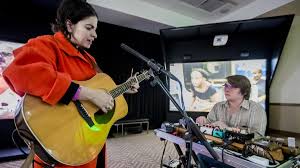
Our South X Lullaby with Soccer Mommy took us … to my favorite store in all of Austin, Texas: Uncommon Objects, a self-described “one-of-a-kind emporium of transcendent junk” or “your eccentric uncle’s attic on steroids.”

The song from the Switzerland-born, Nashville-raised artist’s album Clean which was released earlier this month is, as I hear it, about finding your place in the world — to discover who you are and to blossom.

“Wildflowers don’t grow in the city
I dreamt the sidewalk broke in two
The earth was calling to me”

I also like the way her chords are largely unexpected.  She plays a lot of chords high on the neck (but without a capo).  The melody that she plays (while playing the chords, which is cool) is also nicely compelling.

I don’t know if she is all folkie, but I’d like to check out more by her and now I’m even more bummed that I didn’t make the show.

There are 24 different antique sellers under the single, Uncommon Objects roof, and for Sophie Allison, aka Soccer Mommy, we found the perfect setting for her song “Wildflowers.” It was, in fact, filled with objects related to blooming flowers.

[READ: January 9, 2018] “The Year of the Frog”

This story was by turns confusing, infuriating, too long and then really interesting.

It begins with the narrator, a young girl, describing their horse, Sweet Macho.  The horse was a former racehorse who carried himself with ceremony.  Their mother’s boyfriend, known inexplicably as The Frog, is delighted.  Horses?  Why didn’t you say you had horses?  The narrator chuckles because the other animal, Gert, isn’t really a horse, she’s a Shetland Pony.

They had a real father but all they knew about him was “he’d been a son of a bitch, he’d worked in the fields and he’d once screamed like a woman when a bee got in the house.”

Their mother was an excellent horsewoman.  However, she had no time for the horses because she took care of three rich widows–she kept their gloomy houses clean.  Thus, neither creature had been ridden in years.  When he asks to ride, she says forget it Sweet Macho would throw you in a second. (more…)

Read Full Post »

CV1_TNY_06_08_15_09.inddSOUNDTRACK: LUCY DACUS-“Historians” NPR’S SOUTH X LULLABY (March 21, 2018).

I’m looking forward to seeing Lucy Dacus live in a few weeks.  Her music is often spare but grows very intense.  For this particular song it is just her and her guitarist who is creating textures and sounds as Lucy sings clearly and starkly.  She plays the (almost) title track from her new album Historian.

The idea behind our South X Lullaby series was to offer intimate moments with musicians as an antidote to the commotion and deluge that is the SXSW music festival. When we met Lucy Dacus for her Lullaby and found out she’d perform “Historians,” a most somber song from her deeply personal and triumphant album Historian, it felt just right. It’s a song of reflection, the story of two intertwined partners and the way they document one another’s lives and preserve each other’s memories.

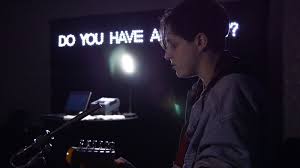
With simple but compelling swirls of sound, Dacus begins singing clearly with a bit of softness on the edges of her words.  It’s fascinating to watch her face illuminated by the video around her (the same video that Stella Donnelly performed in front of).

The song is warm despite the sadness inherent in it.

The setting for this performance, by Lucy Dacus and guitarist Jacob Blizard, is an interactive art installation by the multidisciplinary Israeli artist Ronen Sharabani that’s part of the SXSW Art Program. This work, titled “Conductors and Resistance,” explores human-machine interaction in our ever-evolving technological world. The images projected behind Lucy and Jacob are two coffee cups, one empty and one that’s been almost drained, both tangled in and tugged at by a complex series of wires, representing what I think is human communication and miscommunication.  This is just one of three walls onto which images are projected in this installation — you can see another wall behind Stella Donnelly in her South X Lullaby video.

[READ: April 13, 2016] “The Magic Mountain”

Back in June of 2009, The New Yorker had their annual summer fiction issue.  Included in that issue were three short essays under the heading of “Summer Reading.”  I knew all three authors, so I decided to include them here.

This essay was about Aleksander Hemon’s childhood in Sarajevo.

He says that (not unlike Angell) his family had a cabin on the mountain called Jahorina.  His family would spend winter breaks there skiing and partying.  His parents thought it was heaven up there.  But he and his sister hated to go there in the summer. (more…)

Read Full Post »

CV1_TNY_06_08_15_09.inddSOUNDTRACK: KEVIN MORBY & KATIE CRUTCHFIELD-“Downtown’s Lights” NPR’S SOUTH X LULLABY (March 20, 2018).

I don’t know if Bob Boilen ever explained how he starte dto get people doing South X Lullabies, but here he explains why he started doing them:

In the midst of all the chaos that is Austin, Texas during the SXSW Music Festival, we seek moments of calm. And so one night, as the week was nearing its end, we made our way to the courtyard of St. David’s Episcopal Church, just a few blocks from the thousands of festival participants and onlookers. There we found a trickling garden-side waterfall, where Katie Crutchfield and Kevin Morby performed “Downtown’s Lights,” from Kevin Morby’s recent album, City Music.

I don’t know Kevin Morby.  I’ve heard of him, but aside from a Tiny Desk Concert, I’ve never explored his music.

“Downtown’s Lights” is a simple folk song.  He’s got a bit of a Bob Dylan delivery in what feels like a very deliberate folk song.  Katie Crutchfield is Waxahatchee who I’m excited to see in a few weeks.  Waxahatchee has been really rocking out the last few albums, so this folk song (and her Southern accent) stand out somewhat.

Their voices work nicely together, and that moment when you hear someone yelling, it almost sounds like a wolf howling.

“Downtown’s Lights” is a song of comfort and prayer for someone who is down and out in the city, and this version, with Katie singing — and the sounds of the city echoing in the background — is wistful and peacefully perfect.

[READ: April 13, 2016] “Two Emmas”

Back in June of 2009, The New Yorker had their annual summer fiction issue.  Included in that issue were three short essays under the heading of “Summer Reading.”  I knew all three authors, so I decided to include them here.

This essay was about Roger Angell’s summer home in Maine.

He says that on late February nights his mind often returns to his family’s cottage in Maine and the books that are on its shelves.

Those books have been there for as long as he can remember, and have been read and re-read every summer.  The list is interesting:

Good Behaviour [Molly Keane], Endurance [Alfred Lansing], Framley Parsonage [Anthony Trollope], Get Shorty [Elmore Leonard], Daisy Miller [Henry James], Dracula [Bram Stoker], Butterfield 8 [John O’Hara], Goodbye to All That [Robert Graves], Why Did I Ever [Mary Robison], Oblomov [Ivan Goncharov], The Heart of the Matter [Graham Greene], Sailing Days on the Penobscot [George Savary Wasson], The Moonstone [Wilkie Collins], Possession [A. S. Byatt], Morte d’Urban [J. F. Powers], Quartet [Jean Rhys], Emma [Jane Austen] and dozens more. [I have to chime in and say that this sounds heavenly].

He says that fat books like Martin Chuzzlewit [Charles Dickens], Orley Farm [Anthony Trollope] and the Forsythe Saga [John Galsworthy] were saved for a tedious week of Down East fog. (more…)

Read Full Post »

CV1_TNY_06_08_15_09.inddSOUNDTRACK: SOUNDTRACK: STELLA DONNELLY-“Talking” NPR’S SOUTH X LULLABY (March 19, 2018).

The South X Lullaby is a really fun way to get to know a new (or familiar, but mostly new) artist in an intimate live setting.  I had heard one of Stella Donnelly’s songs before, but this Lullaby presented her by herself (with a very cool backdrop) with an amazingly clear recording of her voice and guitar.

Stella Donnelly has only one EP to her name, but that’s been enough to make her sharp wit come through in sweet, quiet songs that rage loudly. The Australian singer-songwriter’s Thrush Metal EP was recently reissued in the U.S. with a bonus track, “Talking,” which she performs here surrounded by video of wires, a weaving machine and woolen yarns.

Her voice is clear with big open vowels (you can kind of hear the Australian accent, but it’s somewhat indeterminate).  Despite it being just her electric guitar, she plays a in a couple of slightly different styles throughout the song which adds a lot of texture to the piece.

For the end of the song she really unleashes her voice even as the guitar doesn’t alter all that much.  It’s pretty intense.

I wish you could see the art installation a bit more (I realize this is a video for her, but the installation is pretty neat).  At least they hold the pull-back screen at the end a little long so you can see what’s going on.

Donnelly played “Talking” in Conductors and Resistance, an art installation by the Israeli artist Ronen Sharabani that’s on display as part of the SXSW Art Program. Like Donnelly’s direct and feminist folk songs, Sharabani confronts the viewer to increase action in areas of high resistance, the only way to ensure a strong reaction.

[READ: April 13, 2016] “A Soldier Home”

Back in June of 2009, The New Yorker had their annual summer fiction issue.  Included in that issue were three short essays under the heading of “Summer Reading.”  I knew all three authors, so I decided to include them here.

This essay was about Yiyun Li’s growing up in China.

And I was astonished by the first line: “The summer after my year of involuntary service in the Chinese army….”  I didn’t know that women were made to be in it.  She says that after that summer, she read Hemingway compulsively. (more…)

Read Full Post »

CV1_TNY_06_08_15_09.indd

SOUNDTRACK: MAX RICHTER-“Dream 3 (In The Midst Of My Life)” from Sleep– NPR’S SOUTH X LULLABY (March 17, 2018).

This piece is remarkable.  And the except provided here (all 8 minutes of it) is but a teeny fraction of the entire 8 hour work.

I had heard about this piece on Echoes a few months ago and was very interested in it, but figured there was no way I’d hear it.  I never imagined anyone would hear it quite like this:

Right at the start of the 2018 SXSW Music Festival, Max Richter’s eight-hour composition Sleep was performed overnight to an audience tucked into 150 beds. They — the audience, not the tireless group of musicians who performed the piece — slept, dreamed and sometimes snored through this trance-inducing experience.

Richter has described this piece: “Really, what I wanted to do is provide a landscape or a musical place where people could fall asleep.”

In the video here, you’ll see Richter himself on keyboards and electronics, along with the ACME string ensemble and soprano vocalist Grace Davidson.

What I loved about the story of this piece is not that it is a piece to sleep to exactly but that it is based around the neuroscience of sleep.  He says, “Sleep is an attempt to see how that space when your conscious mind is on holiday can be a place for music to live.”

It’s wonderful and I would love to sleep to it some night.

[READ: April 13, 2016] “Old Wounds”

I thought that I had read more by Edna O’Brien but it appears that I’ve read hardly anything by her.

This story was an interesting look at Irish stubborness and the way families can hate each other over small things (or even big things).

The narrator explains that her family had a falling out and for several years there was no communication at all between them.  Even when they attended funerals they did not acknowledge each other.

Finally all of the older people had died off and it was just her and her cousin Edward (both past middle age) they met and put aside the hostilities. They even visited the family graveyard together.  The graveyard was on an island a short boat ride from Edward’s house. (more…)

Read Full Post »

SOUNDTRACK: BECCA MANCARI-“Dirty Dishes” NPR’S SOUTH X LULLABY (March 15, 2018).

Becca Mancari plays a pretty acosutic guitar melody while Blake’s effects-laden pedal steel guitar soars and echoes around her.

I don’t know the original, but according to the blurb, “Mancari removes the clicking pulse of the studio version to underline the song’s lonely atmospherics.”

The song is simple–one that speaks to a relationship: “‘I can’t face myself,’ Mancari repeats the line like a broken admission spoken through a pinhole camera, a whispered truth so potent it can’t be looked right in the eye. “

At 2:41, the guitarist hits a great effect that turns the soaring pedal steel guitar into a buzzy rocking guitar solo while Becca strums on.  It’s a great interlude that really sells this song.

I also love that the final 30 seconds is just the sound of the guitar(s) fading out.

There are moments in this video where the Nashville-based singer-songwriter turns away from the many faces of the Life Underground installation by Hervé Cohen, which is part of the SXSW Art Program and supported by the Cultural Services of the French Embassy in the United States. What’s being projected onto the screens in the room are interviews with subway passengers from around the world who share their stories and dreams. The installation’s notion is that empathy often comes by just asking a few questions, which, maybe for “Dirty Dishes,” is just too damn hard right now.

[READ: April 12, 2016] “The Tiger’s Wife”

Téa Obreht took the literary world by storm with her debut novel The Tiger’s Wife.  I’ve had a copy of it on my bedside I guess now for 8 years.  I’ve been meaning to read it but other things always jump in first.

So finally I got around to reading this excerpt from the novel.

The excerpt is, I assume, the first few sections of the novel since they are numbered and begin with 1.

The first part is called The Tiger and it talks all about the titular tiger.  The tiger was in a zoo (or a circus) in 1941 when the Germans began bombing the city for three straight days.

The tiger should have died in the concussion and rubble, but he managed to escape and wandered to the village. (more…)

Read Full Post »

SOUNDTRACK: NATALIE PRASS-“Short Court Style” NPR’S SOUTH X LULLABY (March 14, 2018).

I did not enjoy this Lullaby at all.  Prass’ voice is very conventionally poppy and the synth sounds were really cheesy.  I would without question turn this off it was on the radio.

Evidently the original has “a laid-back disco cool and bouncing bassline groove” but then Prass

shows up to her South X Lullaby session with keyboardist Jacob Ungerleider, slows down the tempo just a mood lighting dimmer and turns the song’s breezy funk into the soft murmurs of late-night devotion.

Still doesn’t make me like it.

This version of “Short Court Style” was filmed in an interactive art installation by Caitlin Pickall called FEAST, which is part of the SXSW Art Program and was created as part of the Laboratory Artist Residency program in Spokane, Wash. Prass and Ungerlieder sit at a dinner table set with plates and towers of wine glasses, onto which images and patterns are projected. The projections are triggered by the movements of guests at the table, so the experience changes every time someone sits down.

[READ: March 15, 2018] “No More Maybe”

This story looks at immigrants in the land of trump’s america.  But it also looks at how in-laws can drive us crazy.

The narrator’s in-laws have come to visit them because she is pregnant.

Her mother-in-law has been very busy taking advantage of all that America has to offer (cheaply): blueberries, the clean air, the stars, and English-language classes (which are expensive in China).

She is puzzled by them being free: “America is a capitalist country….  What about so-called ‘invisible hand’s” (She learned about that phrase two days earlier).  The woman is confident (she is a volleyball coach) and is not shy about expressing herself. (more…)

Read Full Post »

SOUNDTRACK: MAL BLUM-“See Me” NPR’S SOUTH X LULLABY (March 13, 2018).

I feel like I was pretty lucky to see Mal Blum just days before they went to SXSW and made a Lullaby.

Without the band, Mal sings more quietly which certainly lets you hear the words more clearly–and Mal is a gifted lyricist.  But Mal also writes catchy tunes.

I love that the verses are quiet and muted, but there’s loud strumming in between.

And as the song nears the end, the intensity ratchets up for a line of “why can;t they see me?”  …before the quiet conclusion: “I was right there.”

Mal performs in front of the Future of Secrets art installation.

The Future of Secrets was conceived by Sarah W. Newman in collaboration with Jessica Yurkofsky, Rachel Kalmar and metaLAB at Harvard. The installation, which is part of the SXSW Art Program, asks those attending to anonymously type a secret into a laptop and in exchange someone else’s secret is given to you. Those secrets are then projected on a wall, which is the backdrop for this video.

“‘See Me’ is an unreleased song that will be on our next record (sometime next year),” Blum tells NPR. “It’s about the disparity between how one sees oneself, or the struggle of being seen as we are, versus how others view us, which can result in an unintentional hidden self or a perpetual feeling of invisibility. Being transgender informed the song, but it’s not exclusively about that.”

[READ: September 10, 2017] “An Education”

This is a short piece about two girls in school  I assume it is set in Hungary as it is translated from the Hungarian by Len Rix.

The narrator said she was always a hard-working child filled with self-discipline.  But her parents never understood that she did it all for herself–not for them or to make anyone else happy.  Her father was the school principal and was absolutely proud of her–she was hardworking and punctilious like he was.

Her mother, on the other hand, was clearly more loving to her sister Blanka–when she lost her temper with Blanka “there was something frenzied and indiscriminate about the way she pummeled her.”  Her father tried to push her very hard to make her learn more.  Her father was far more proud of the narrator than Blanka, but “no one was ever as proud of me as Blanka [was].” (more…)

Read Full Post »

SOUNDTRACK: BIDINIBAND-Call the Office, London, ON (April 18, 2008).

Dave Bidini played some solo shows in 2007 but by 2008 he had cobbled together a band: Bidiniband.  The band includes Dave, Paul Linklater, on lead guitar, former Rheo Don Kerr on drums and Doug Friesen on bass.

I’m not sure when they started playing together, but this is the first live show at Rheostatics Live.  The set list hasn’t changed much since his solo shows, but the songs sound really different with the full band.

Some of Dave’s solo work is about telling real life stories of unsung people.  They

re usually really interesting the first one or two times you hear them, but they kind of lose their power after multiple listens.  So “Zeke Roberts” and “The Land is Wild” (except for the fantastic chorus) wear out their welcome a bit.  But again, it’s a nice change to hear them with the full band.

“Fat” is interesting to hear with other musicians.  The ending isn’t quite as wild as with the band but these guys chant the “everyone’s a robot” with great energy.  After the song Dave says “Good  night everybody” to much laughter.  For the next song he says, “This is basically the same song but with a more ironic joke.  The irony is not in the tuning or lack thereof.”

Someone says, “You guys and your new strings. I haven’t changed my strings in like two years.”  “I thought t would be cool, you know, on a new tour.”

“This Song Ain’t Any Good” has a very different delivery than the folksier style that I’m used to.  He asks the band, “You want to do it sad, what did you mean?” They do the chorus in a kind of repeated downbeat “singalong.”

Thanks to Andy and The Two Minute Miracles for playing tonight.  We’re gonna do another song based in our country: “The Moncton Hellraisers.”  It has a rather country flair to it.

Someone shouts, “Do a hockey song.”  Dave says, “I think you’re out of luck tonight  Oh, no there’s a longer one later tonight….we’re making you wait for it.”

I love the jazzy opening of “Memorial Day.”  But even better is the full band rock of “Terrorize Me Now.”  Who ever in the band is screaming “And then we killed again,” is totally intense.

Dave asks, “Could anyone deliver a water to the stage, or I could put my guitar down…  From off stage: “only whiskey and cold coffee!”  “cold cuts?”

This next song is gonna feature Dog Paul’s on double bass for a song about cannibalism and Canadian rock.  “Desert Island Poem” features the line   “Rheostatics eat their drummer who would cook and season the body?”

Dave once described the song: “Yeah, and that’s sort of a true story in a way. I mean not the cannibalism part. But one time the Rheos were stranded in Drumheller [Alberta] and we were listening to the radio and we heard this story about that plane that crashed in Alaska. And we began to wonder what would happen to us if we never got out of Drumheller.”

For “The List”, the replaced Zack Warner with Sass Jordan (a Canadian singer) which features the line “you say I suck but it’s that suckdom of which I’m proud.”  Some one shouts, “that’s a fucking song that needed to be written.”  Dave says he has one more verse but he can’t remember who its about.

“The Continuing Story of Canadiana and Canadiandy” has a cool slide guitar solo in the middle of the folk.  Dave, “That’s from back in the day where all the Canadian folk singers looked like Jesus.  Those nice sweaters on, a nice beard.”  Mitsou?  “When I think of Canadian folk I think of Mitsou too, ironically.”

Someone in the band proposes the “Top five Canadian folk albums: Summer Side of Life, Old Dan’s Records,”  Dave notes: “That’s two from Gordon Lightfoot are you allowed to pick two from the same artist?” “And The Way I Feel.” Dave: “You’re just doing Gordon Lightfoot.”  “That’s what I’m trying to say, dude. “I’m getting your drift that you like the Gord.”  “Gordon never looked like Jesus did.” “No, he looked more like Bruno Gerussi.”

“Is everybody ready for a long death ballad?  You look like the kind of crowd who would like a long death ballad.”  Someone in the crowd shouts: “kill us, kill us Dave.”

We haven’t performed this song successfully ever life.  “Zeke” sounds better with the guitar sliding up and down and in the middle when there’s a few complex moments  and the band really takes off.  But there’s all kinds of flubs at the end.  Dave says, “you’re too kind.  That was the best first half we’ve done for sure.”

They play “My First Rock Show” at a slower pace.  “A bit of banjo for this, Paul?”  After the swan dive, there’s some crazy feedback and effects manipulation and then Dave starts singing “Happy Jack.”

They finish “Rock Show” and then begin with “Won’t Get Fooled Again,” and then Slade’s “Run Run Away.” (did that song have a chorus?).  And then it shifts to Bidini’s “Pornography.”

“Rock Intro?  Is it a rock intro nigh?” “Progtro.”  Someone says something about YouTube.  Dave says “Whats YouTube. They’re an Irish rock band, right?”  There’s great noisy opening to “The Land is Wild.”  It quiets down but sounds great with the full band.  I like the lead guitar line that runs through the song.  During the slow part, the person who mentioned Gordon Lightfoot sings “Ode to Big Blue” as the song gets bigger and noisier.

It segues into a really fast version of Rheostatics’ “Earth.”  Its rocks.  “Don Kerr on the drums everybody.”  And then a romping “Horses.”  Midway through the song he starts reciting the lines to “Once in a Lifetime” by Talking Heads and then some of “Another Brick in the Wall. Pt 2.”  He also throws n the “facts” portion of Talking Heads’ “Cross-eyed and Painless.”

This all segues into a stomping, guitar-light version of “Life During Wartime.”  Dave starts singing lines from “One Thing Leads to Another” (“one gun leads to another”), “Relax Don’t Do It”  then “When Two Tribes go to war, war is something you can’t ignore.”

As the song ends Dave thanks everyone for coming: “a small but mighty crowd for a small but mighty band.”  Then he introduces the band: Douglas Friesen from Manitoba, Paul Linklater from Manitoba, Dave born and raised in Etobicoke, Ontario.  Donald S. Kerr from Mississauga, Ontario.

As they finish, the crowd is screaming screaming for an encore with one guy even telling him not to put their instruments down.  But there is no encore.

[READ: April 15, 2017] Writing Gordon Lightfoot

The title of this book is unusual–it’s hard to even figure out what it means (until you read the book), but it’s also deceptive.

The title means writing to Gordon Lightfoot.  Bidini is basically writing Lightfoot a series of letters. But it is far more than that.  In fact the scope of the book is really the Mariposa musical festival that took place in Toronto in 1972.  Lightfoot appeared (along with many other folk luminaries).  Interspersed with his documentation oft he festival (he was too young to go so it’s all research) are his letters to Lightfoot.

The reason he is writing letters to Lightfoot in a book is because Bidini believes that Lightfoot won’t speak to him.

His band Rheostatics, recorded a cover of his “Wreck of the Edmund Fitzgerald.”  It was one of their big songs when they were first starting out.  And then, as a brash young kid, Bidini once said that it was actually based on an old Irish melody and that it really wasn’t Lightfoot’s song anyway.  Yipes.

So, assuming that Lightfoot will never talk to him (I wonder if he actually tried), he decides to write letters.  But the letters aren’t “hi how are you” letters, they are a biography of Lightfoot’s life as written by a fellow musician.  He bases most of his notes on things that were in other biographies and he says he makes a lot of it up too.

So it’s an unusual book in many ways. (more…)

Read Full Post »

SOUNDTRACK: JOHN PAUL WHITE-Live at the Newport Folk Festival (July 29, 2017).

I don’t really know all that much about John Paul White, except that he was in the fabulous duo The Civil Wars, and that he writes intelligent but downbeat folk music.

For indeed, his songs are not cheery by any stretch.  But they are very pretty.

I know the first song, “Black Leaf,” from his Tiny Desk Concert.  I loved it then and I love it now. After the song, he asks, “How are you?  Are you well?  You should be well.  No one should be complaining, least of all me in this black suit.”

And, despite his tone, he is not above making jokes with his audience.  Like when he introduces the second song, “Martyr,” he says, “We’ll be doing  while lot of death metal covers. I figured this would be the place. This song is by a band called Sepultura.”  [Nervous titters from the crowd before he starts playing a pretty JPW song that sounds not unlike a contemporary Barenaked Ladies song, especially his delivery of it].

“The Once and Future Queen,” is a slow, quiet song with a big chorus full of pretty harmonies.  When it ends, he says:

I guess it’s probably my duty to warn you….  You came to a folk festival so you probably weren’t looking for happy songs anyway…  If you came to this set looking to be cheered up, you’re screwed.  Let’s get that out of the way.

I loved “Hate the Way You Love Me,” during the Tiny Desk Concert, but when the backing singers accompany him on the chorus and the gorgeous fiddle from Kelli Jones fills the song, it’s really wonderful.

He jokes, “Glad you’re enjoying the death metal.  I didn’t think it would go over as well as it has.”  But he then plays “Fight for You,” a fairly rocking song–with some rocking distortion on his guitar and a snarl in his voice (and a pretty heavy chorus).

I tend to think of JPW as kind of a mellow singer with a great voice, but he really lets loose in the middle of “Hope I Die.”  In addition to a really powerful singing section, there’s a pretty wild solo going on (violin or guitar or both).  He introduces Adam Morrow over here on the guitar, so I assume he had something to do with it.

He says, “I’m not gonna pretend that all of you have any idea who I am.” [cheers]  He jokes, “That’s called fishing for a compliment.”  But he continues,

To those of you who do I apologize.  It’s been awhile.  it took a lot to get me out of the house.  I was incredibly happy sleeping in my bed and going to dance recitals and football games and the lot. And then these melodies started coming back in my head.  And if I gave into it I’d be back out here doing this.  I and I didn’t want that at all.  No.  No offense, but I didn’t want of see any of your faces.  But once I wrote these songs I wondered if people would connect with them…  and I still doesn’t know why I did that.  So thank you.

In introducing the slow ballad “I’ve Been Over This Before,” he says “This is one of the first songs that came to me. I was obviously listening to a lot of old country music, because that’s where it all starts for me.”

He continues, “I promise you I won’t bore you with song meanings because most of the time I have no idea what they mean most of the time.  But this one is personal for me.”  He says “Simple Song” is indicative of the folk spirit of telling stories and passing them down to further generations.

This came from my grandmother.  When my grandfather passed away he was battling many demons that everyone was having to battle alongside him.  She was raising 14 kids because of those demons.  So… I thought he was perfect, I though that he was always happy, but that was not true and when he passes away, she didn’t cry.  I asked her why  and she said ‘I cried so much for your grandfather when he was on this earth, there’s no way I’m gonna cry for him now that he’s better off.’  And so I thought, ‘Number 1, I want to punch you  in the face.  And then 2 much later in life, that that is a song waiting to happen.’  So this will also cheer you up.

The song and sentiment are beautiful with plaintive lap steel guitar: “I will remember I will remember I will remember you… but I will cry for you no more.”

He continues, “So it’s said that festival crowds… this quiet does not happen.  This is beautiful I really do appreciate it.  I’m a very dynamic performer and I need this kind of environment so…  Festivals scare the shit out of me.  I have to thank you from the bottom of my heart.  This is an unbelievable atmosphere to play in.

before the final song, the rocking “What’s So,” which I also know from Tiny Desk, he says “This is the first time Newport for all of my band so they’re geeking out pretty hard.”  In addition to Jones and Morrow, there’s Reed Watson on drums and Matt Green on bass.

“I need more band members so I have time to tune.”

“What’s So” has an aching descending chorus line that is just terrific.

I really like John Paul White’s music and I’d love to see him live in a quiet sit down club..

[READ: June 24, 2017] “It’s a Summer Day”

I know Andrew Sean Greer from a few McSweeney’s books.

This was a simple story but told in a really cool style.  It concerns Arthur Less, a writer, who has been called to an international conference where he is in the running to win a prize.  But the prize is minor and no one–not he nor his agent–thinks he has a chance.  In fact, the only reason he went was to get out of going to a wedding of an old flame, Freddy.

Freddy had once given him advice about international flights: “They serve you dinner, you take your sleeping pill, they serve you breakfast, you’re there.”

I love the narrator’s voice in this story.

He had been to Italy before. Once when he was 12.  And the second time with Robert Brownburn (Yes, that Robert Brownburn, the famous poet).  They had been dating for a while and were at a good point in their relationship.

He did as instructed with the pills, but woke up in the middle of the night–only two hours having passed!  He takes out another pill and then it’s time for breakfast.  He is in a fog and the first few pages are an amusing comedy of him possibly going the wrong way.  He barely makes his local flight (and is shocked to see ashtrays in the airplane seats–charming or frightening?) And then… was it a mistake to get in the car marked for Sr. Ess?  The driver speaks no English and it sure looks like he is heading in the wrong direction. (more…)

Read Full Post »

« Newer Posts - Older Posts »