Feeds:
Posts
Comments

Archive for the ‘Fears’ Category

1997SOUNDTRACK:LOS HACHEROS-Tiny Desk Concert #546 (July 5, 2016).

hacherosLos Hacheros play “Afro-Caribbean music that provides the source material for modern salsa and all of its permutations.”

This music swings and bounces and with such simple instrumentation: an upright bass and a guitar.  With the main melodies constructed by the trombone and vocal (the trombonist doubles on violin).  But the rest of the band is there for percussion–cowbells, shakers and the conga.

The band plays three songs all sung in Spanish.  It’s fun to watch them get into the groove and begin to sway in unison to the music.

“Baila Con Los Hacheros” features a violin solo that is pretty intense “Papote’s Guajira” features an acoustic guitar solo that is complex and fun to watch. It also has a lengthy flute solo (the violinist also plays the flute!). “Bambulaye” features NPR’s own Felix Contreras on congas–he gets a solo–apparently he has been playing in bands for years.  What a nice surprise.

[READ: November 3, 2016] The Complete Peanuts 1997-1998

This is the second to last book of collected strips from Schulz.  Rerun features quite prominently and Linus has faded somewhat.  Snoopy is no longer playing characters (except for the soldier..always soldiers) and Charlie is still pining for things he won’t get.

1997 opens with Charlie showing Linus his autographed Joe Shlabotnik baseball.  But Linus thinks it’s a forgery.  Cue a week of strips about an autograph forger (who tries to hire Charlie as his accomplice).  I love that Schulz went on strange little tangents like this, but I always feel like he doesn’t follow through with these funny ideas. The whole premise of this just ends never to be heard from again.

And then in a surprise to me, Snoopy starts acting like a Revolutionary War patriot standing guard at Valley Forge.  He seems to have given up on WWI and gone back in time to a far less dramatic role–he mostly just stands around in the cold.  Strips about that occur from time to tome with him talking to General Washington.  The last one is in December 1998 where he realizes he is only guarding snow. (more…)

Read Full Post »

fakeSOUNDTRACK: MATANA ROBERTS-Coin Coin: Chapter 3 Mississippi Moonchile [CST110] (2015).

cst110cover_258x242I felt like the first Coin Coin disc was way too long, so imagine my surprise to discover that the whole Coin Coin series is planned as a 12 chapter collection!

Unlike the previous 2 chapters, this album was created entirely by Roberts.  She is credited with playing saxophone, Korg Monotron and a 1900s upright piano.  But like the others, the tracks bleed into each other and seem to end indiscriminately.

This disc also quotes from The Star Spangled Banner, Beautiful Dreamer, The Pledge of Allegiance, My Country ‘Tis of Thee, Lift Every Voice and Sing and All the Pretty Horses.  As well as samples from Malcolm X and a field recording of a travel through Mississippi, Louisiana Tennessee and NYC.

The first song, “All is Written” is 10 minutes long.  She sings quietly and starkly (voice breaking) while spoken words overlap behind her voice (and the saxophone and drones).  Her singing is at times pained and strained—aching with the truth of her words.  As “The Good Book” begins, the spoken word continues but the main sound is an industrial throbbing.  Near the end, a new metallic sound comes screeching in and then resolves into a kind of drone while angelic voices takes over for song three, “Clothed to the Land, Worn by the Sea” which is more pleasant.

“Dreamer of Dreams” resumes some spoken word and synth noises while two overlapping tracks of sax solos play.  “Always Say Your Name” has some more drones and a wild sax solo.  “Nema Nema Nema” experiments with analog synth noises while she sings a pretty melody with other voices circulating behind her.  “A Single Man o’War” has a high pitched drone. which is accompanied by several three note chants.

“As Years Roll By” is spoken words, with drone and church bells.   And lots of “Amens.”  “This Land is Yours” has lots of voices speaking and overlapping.  It ends with someone singing “come away with me come away,” which segues into “Come Away” with a noisy background and spoken voices talking about Zanzibar.  Then there is a keening, pained voice singing the middle. “JP” is a speech about he slave trade.

Although this album is difficult, it is more manageable than her other releases in this series.  But manageability clearly isn’t her plan, she is making a statement and it is exciting and frightening to listen to.

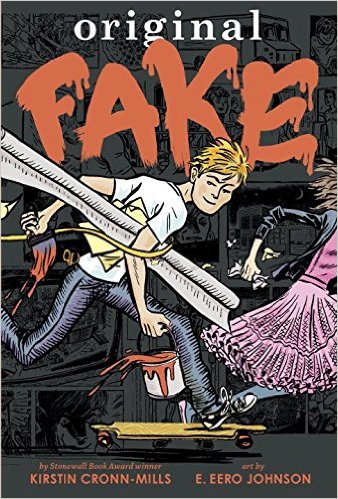
[READ: August 10, 2016] Original Fake

You should never judge a book by its cover.  But I really liked the cover of this book a lot.  And the title was intriguing, so I grabbed it off the new book shelf.

And what a great, fun story it was.

The book opens with Frankie sneaking into his school at 6:30 AM.  No one else is there except maybe the janitor.  He is sneaking into the school to do a small amount of vandalism. But the vandalism is not your typical vandalism.  On the school hallway is a mural that is currently being painted.  Frankie is an artist but he was not asked to paint the mural (no one really knows he does art).  The mural is a of a lake and farm fields and all that.  And he has decided to tag the mural.  He has painted a water-skiing abominable snowman giving the hang loose sign in the corner of the lake.  “He’s maybe six inches tall, and I kind of put him close to a rock so he’d blend in, but if you get close, its pretty obvious he doesn’t belong. He’s completely amazing.”

Amid the telling of the scene is a drawing of Frankie painting the snowman–this book is full of illustrations by Johnson.  Most of the illustrations complement the story but a couple actually tell the story, too. (more…)

Read Full Post »

sky  SOUNDTRACK: MITSKI-Tiny Desk Concert #467 (August 31, 2015).

mitskSome recent Tiny Desk Concerts have been running long, but Mitski Miyawaki plays 3 songs in 8 minutes.

Her songs are simple—three chords at most.   And she is unaccompanied here (her recorded versions are much more fleshed out)–just her voice and her electric guitar.  But it’s the intensity of her lyrics and her delivery that really dominate the show.

“Townie” is the most rocking song  The way her voice rises and almost breaks as she sings “I’ve tried sharing and I’ve tried caring and I’ve tried putting out” is really heartbreaking.  And the follow-up “but the boys keep coming on for more, more, more.” It’s all of 2 minute long but it packs a punch.

“Class of 2013”  is almost a capella.  She plays a chord and lets it fade away while she sings.

Mom, am I still young? / Can I dream for a few months more? / Mom is it alright if I stay for a year or two…and I’ll leave once I can figure out how to pay for my own life too.

Interestingly, se plays an open-stringed guitar (it must be a special tuning).  One loud chord that rings and fades.  Even in the most unsettling moment, when she plays a chord and then screams the lyrics into the pick-up of her guitar–giving it a far-away and tinny quality as the chord echoes to a close.

The final song “Last Words Of A Shooting Star” has some simple opens string finger picking (again, must be an alternate tuning).  As she sings quietly she seems to be exposing every ounce of herself.

One would be concerned for her psyche and yet she seems pretty happy and smiling when the show is over.

[READ: October 19, 2016] Understanding the Sky

This book is a long-format version of a short article/essay/something-else-entirely that was published in Afar in 2015.

This book reminds me of the publication of David Foster Wallace’s This is Water in that it is a brief essay/story spread out over hundreds of pages.  Most often with one line per page.  The difference between this and Water is that Water felt like a weird cash grab and this feels like a chance to show off more of Egger’s photos (there are not many in the article).

There is a photo on each page–most often with text–but sometimes without.  And it works rather well.

The narrative is structured as a dialogue–each “person” is on a facing page, so the right page answers the left page.  And it is done in a kind of removed third person.  Thus it begins: “Who is this man?”  “He wants to fly.”  In this opening section the pictures are presented very thin–less than an inch wide in total but stretching from top to bottom of page in the center of the spread. (more…)

Read Full Post »

olymmp SOUNDTRACK: WATKINS FAMILY HOUR-Tiny Desk Concert #471 (September 18, 2015).

wfhThe Watkins Family Hour began a dozen or so years ago as a way for a group of friends to get together and play old and new tunes. For Sean and Sara Watkins, it served as a monthly bit of magic: a musical variety show filled with extraordinary talent in the world of folk, bluegrass and beyond at L.A.’s famous Largo.

Sara and Sean Watkins took this fun on the road, with pianist Benmont Tench, drummer Don Heffington and bassist Sebastian Steinberg, and they made a stop at the Tiny Desk. They even brought along Fiona Apple to sing on “In the Pines” the old blues song.

The first song “Steal Your Heart Away” is sung by Sara (with violin melodies between verses) and Sean (on guitar).  It’s a bouncy folk song with a lovely piano added (which seems to move it out of the folk style a bit).  It’s a really catchy song with a great melody.

For “In the Pines” Fiona Apple sneaks out from behind the desk to sing.  Sean jokes that there’s some howling moments in this song and Fiona (who seems pretty nervous) jokes that she gets to be a dog.  I don’t know that I would have recognized Fiona’s voice as she puts on an accent and whoops (And Sean is a pretty good whoop-er, too).

The final song is “Hop High” another old song written by the hills–burbled up from the ground.   Sara and Sean take lead again on this slow brooding song.  Well, slow and brooding for the first verse, as the rest of the song takes off with Sara singing in her best gravelly voice the verse and Sean Sara and Fiona singing the chorus.

It’s a fun set full of great bluegrass-ish music

[READ: Summer 2015] Olympians 7-8

Last summer I read the first six book in the Olympians series. I’m not sure how many books he has planned for this series, although I see that he has another book planned for 2017.

Since I like what I wrote about the series for my previous post, I’m going to keep that here and then talk about each book.

George O’Connor is a massive geek and Greek scholar.  He has done lots of research for these books, including going to Greece and visiting sites and antiquities as well as comparing all manner of ancient stories to compile the most interesting pieces. He explains that since these stories were orally passed down, they were modified over the years.  He doesn’t change the myths, he merely picks the story lines that are most interesting to him.  And then he adds a lot of humorous modern touches (and dialogue) which keep it from being at all stuffy.

O Connor’s drawing style is also inspired by superhero comics, so his stories are presented in a way that seems much more like a super hero than a classical hero, which is also kind of fun.

Each book ends with an author’s note which is hugely informative and gives plenty of context.  It also has a bibliography, but more importantly, it has a list of notes about certain panels.  Do not skip these notes!  In addition to providing a lot of insight into the myths of the characters themselves, there are a lot of funny comments like “Greeks raced in the nude (point and laugh)” which really bring new depths to the stories. (more…)

Read Full Post »

coin2 hiddenSOUNDTRACK: MATANA ROBERTS-Coin Coin: Chapter 2 Mississippi Moonchile [CST098] (2013).

The first chapter of this series was a sprawling disc of free-form jazz and spoken word.  It was interesting and strange with a powerful message (not always elegantly delivered).  It felt too long, but I think it was done live which would make it more understandable as a long presentation.

Chapter 2 is quite different.  It is much shorter, but it has 18 tracks that flow seamlessly (and often without apparent logic) into each other.  Most of the songs are quite short as well.

“invocation” is a sultry jazz number (Matana Roberts plays saxophone).  There’s also piano, trumpet, double bass and drums.  One thing that I didn’t like about the first chapter was Robert’s “poetry slam” deliver of her spoken words.  This album more or less erases that all together with the inclusion of Jeremiah Abiah on “operatic tenor vocals.”  I don’t know what he’s saying (if anything) most of the time, but his voice soars above the jazzy din.

“humility draws down blue” starts in the middle of a trumpet solo and lasts for a minute and a half.  “all nations” is only 8 seconds long and seems to coincide with a vocal line from Abiah.  “twelve sighed” settles things down some.

The first real change comes with “river ruby dues,” which opens with a gentle piano motif, and Abiah’s vocals.  Roberts’ sax solo plays throughout.  There are somewhat recognizable motifs played throughout the album.  I was sure I heard parts of “Pop Goes the Weasel.”

“amma jerusalem school” also opens with a new melody–a four note sax line–without a doubt the prettiest melody of the disc.  About mid-way through the song, Roberts begins speaking/reciting.  There’s a lot going on in her saga.  When that ends, more instrumentals continue and “responsory” has a lovely falsetto singing section.

This half of the album has been fairly conventional jazz: rather pretty with some nice melodies—far more conventional than Chapter 1.

Although by “the labor of their lips,” things have become a bit more avant-garde.  But even that doesn’t last too long and by “was the sacred day,” a pretty melody has resumed and more spoken word comes in, this time in stream of consciousness.  It’s a story of childhood with some happy and some sad details including: “they didn’t like black people at the hospital. you could use a room but no nurses would attend to you.” and the story of a woman getting whipped for not saying ‘sir.’   Interspersed through this tale is a sung line “I sing because I’m happy I sing because I’m free.”

‘woman red racked’ features Robert’s singing voice—pretty and pained—with some nice, deep backing voices accompanying.  Interestingly, this vocal part ends with them singing “Amen,” but the song is not over… a sax solo emerges from this and plays a kind of wild section with Abiah’s vocals until the end.

“thanks be you” is a spoken piece, a story told to a child about the past “there are some things I just can’t tell you about” which references a lot of childhood songs.  It ends with the repeated refrain “Mississippi is a beautiful place.”

This disc is only 48 minutes and it feels just about the right length,  “benediction” ends the disc with a quietly sung song with another singer accompanying her: their voices sound great together.

As with the first one, the narrative is a little unclear.  The main thrust of the story is obvious and effective, but it would be hard to diagram the story.  Nonetheless, her use of jazz and traditional sources (“red ruby dues,” “woman red racked” and “benediction” are based on traditional American folk songs), make for an evocative look into slavery from the point of view of one family.

[READ: March 20. 2016] Hidden

Having recently read the Resistance trilogy I am much more aware of France’s role in WWII.  But that could never have prepared me for this children’s book about the Holocaust.  (written by Loïc Dauvillier, translated from the French by Alexis Siegel with illustrations by Marc Lizano and Greg Salsedo).

The book opens on a little girl.  She wakes up in bed and hears her grandmother crying.  When she asks what’s wrong her grandmother tells her about the “nightmare she was having.”

And that nightmare is her story as a young Jewish girl in occupied France and how her life was brutally upended.  This is all told with fairly cute little characters with oversized heads.

I’ve never heard this story from the point of view of a child before.  Her grandmother was a little girl going to school.  She and her friends did everything that you’d expect little kids to do and the story starts out very sweetly.  Then one day she comes home and her father says that they must all be sheriffs–wear the yellow star on their lapel.  Once they stray doing that, she is effectively shunned.  But she has no idea why–why does everyone hate the sheriff? (more…)

Read Full Post »
jerusalemSOUNDTRACK: JERUSALEM IN MY HEART-If He Dies, If If If If If If [CST114] (2015).

ififif Since 2005, Jerusalem In My Heart has been Radwan Ghazi Moumneh (all music) and Charles-Andre Coderre (all visuals).  This is only their second album, however, because they were always more of a live band.

Obviously there’s no real visual component to the record.

Since I don’t know all that much about this band, I rely on the Constellation records website for my information.  Thus:

Moumneh expands his compositional palette on If He Dies, If If If If If If, exploring new deconstructions and juxtapositions of both traditional and popular Arab musical currents, with an album that oscillates between powerfully emotive vocal tunes and instrumental works that primarily make use of Radwan’s expressive acoustic playing on buzuk as a point of departure.

The album’s first song “Al Affaq, Lau Mat, Lau Lau Lau Lau Lau Lau (The Hypocrite, If He Dies, If If If If If If)” opens the disc with a short piece of processed vocals.  The Arabic traditional voice is mildly auto-tuned which sounds kind of cool.  [FROM CST: One of Moumneh’s finest melismatic a cappella vocal performances].

Track 2, “A Granular Buzuk” is a 7-minute instrumental piece of Moumneh on buzuk with pulsing electronic background music.  [CST: the buzuk is processed, re-sampled and otherwise disrupted through Radwan’s real-time custom signal patches]. As with a lot of this record, pretty instrumental passages are interrupted and taken over by noise—this time a kind of mechanical scratching.  It ends with some quietly ringing percussion as the electronics all slowly drift away.

“7ebr El 3oyoun (Ink From The Eyes)” is a vocal track with an electronic drone.  It sounds traditional and mournful, but about 3 minutes in, a drum and buzuk keeps time and the song grows a bit more upbeat.  [CST: languidly plaintive vocals set against a gradually accelerating riff underpinned by hand percussion].

“Qala Li Kafa Kafa Kafa Kafa Kafa Kafa (To Me He Said Enough Enough Enough Enough Enough Enough)” has incredibly loud static with a buzuk playing in the background.   After a minute and a half the static drops away and the background is filled with a quiet pulsing kind of static.  You can finally hear the instrument being played in all its glory.  [CST: a scabrous white noise intervention wherein the entire audio mix is fed through a contact mic placed in Radwan’s mouth].

“Lau Ridyou Bil Hijaz (What If The Hijaz Was Enough?)” is mostly synth–again an old sound with metronymic electronic percussion and quiet vocals. It’s all kind of muffled and very retro.  [CST: Moumneh continues to channel his love for Arabic pop and Casio/cassette culture with this silky lo-fi dance].

“Ta3mani; Ta3meitu (He Fed Me; I Fed Him)” is a faster piece.  Echoed vocals and drones rest behind a fast buzuk melody.  [CST: he pays homage to the until-recently-exiled Kurdish poet and singer Sivan Perwer on this traditional-minded, unadorned folk tune].

“Ah Ya Mal El Sham (Oh The Money of Syria)” opens with a loud vocal and a flute mirroring the voice.  It runs for seven-minutes and ends quietly.  [CST: a tour-de-force drone piece built from Bansuri flute (performed by guest player Dave Gossage)].

The disc ends with “2asmar Sa7ar (The Brown One Cast A Spell),” a fast buzuk solo played over the relaxing sounds of oceans waves.  It has a cool melody and runs quickly and then calmly for some five-minutes before the disc ends with more waves lapping against the shore.  [CST delicate acoustic number set against the sound of waves recorded on a beach in Lebanon].

As with the previous record, song titles employ the transliterative characters used in Arabic phone texting, which I think is pretty cool.

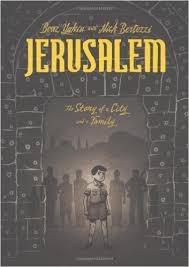
[READ: March 30, 2016] Jerusalem

With a title and subtitle like that you know this isn’t going to be a fun and lighthearted story.  And it is not.  The introduction explains how this is the story of a family, but it is more about the land and the strife that has been there for generations.

A lengthy history of Jerusalem is given, but for the purposes of this story the most recent action is the 1929 dispute over prayer rights which led to riots.  And then the British imposed the White Paper of 1939 which blocked Jewish immigration and was in place as the Nazis were riding to power. This led many Palestinian Jews to regard the British as hostile. And yet many Palestinian Jews joined the British army to fight the Nazis in Italy and the Middle East.  At the same time there were underground forces of Palestinian Jews who were attacking the British.

The action of this story takes place in 1945.

There is also a history of the Halaby family about whom this story is concerned.  Yakov Halaby was born after a series of girls were born in his family.  His father vowed that if they had another son they would move to Jerusalem.  After Izak was born they did so.  But Yakov was jealous from the start.  And he made Izak’s life miserable.  Eventually Izak left and married an Egyptian woman and they both moved back to Jerusalem. (more…)

Read Full Post »

[LISTENED TO: August 2016] The Penderwicks in Spring

pend-springWe have loved the Penderwick books.  But I remember that when this came out, Sarah read it and was disappointed. Not in the quality of the book, but because the story has moved on.  This book is set about five years after the action of the previous book.

I totally get Birdsall’s desire to write about Batty rather than her older sisters–to move on from what she has written about for three books.  In the previous book Rosalind was more or less absent, so Birdsall is not afraid to progress with her characters.  But those characters are so great, that to have them largely absent from the story was so frustrating!  I missed them all (So I guess she could take that as a compliment).

Of course, the “new” characters are fun, too.  The book is mostly about Batty, but her younger half-brother Ben is older and quite a character (and he gets to show us things from his point of view–the only boy in a family of strong Penderwick girls).  And Batty’s father and stepmother have had a new baby, Lydia, who is just climbing out of her crib and is quite a handful. (more…)

Read Full Post »

imperiumSOUNDTRACK: PAT BENATAR & NEIL GIRALDO-Tiny Desk Concert #407 (November 24, 2014).

benatarI never liked Pat Benatar.  Back in the day she was all over MTV (and even in Fast Time at Ridgemont High) and I just didn’t like her.  I’m not sure why, although I was particularly bitter about “Hell is for Children” (being a child myself).  Of course, I still know all of her singles really well.

But I haven’t thought about her in probably a decade.  And then  around 2014 that she was playing with Neil Giraldo in some kind of acoustic tour.  I recognized his name but didn’t know they were married or anything like that.

And so here they are doing a Tiny Desk Concert–all acoustic–with him playing guitar and contributing backing vocals.  Over the decades, Benatar’s voice has changed a bit–she sounds gruffer and it really suits her. (more…)

Read Full Post »

overpoSOUNDTRACK: J. MASCIS-Tiny Desk Concert #406 (November 22, 2014).

mascisJ. Mascis is best known as a wailing guitarist who plays in front of a wall of speakers with Dinosaur Jr.  But for this Tiny Desk Concert he busts out an acoustic guitar and plays some songs from his solo album (as well as an old Dino classic).

“Stumble” is sung in Mascis’ delicate falsetto.  They zoom in on him singing and its amazing how he doesn’t seem to be straining in any way doing this really high voice.  After all the falsetto, his saying “Thanks” in a deep voice is really kind of funny.

For the second song, he busts out the classic “Little Fury Thing.”  This acoustic version sounds really good–so simple and clean.  The original is great burst of loud rocking and it’s amazing that the song can sound so good stripped down. His voice is much deeper for this song .  I love at the end how he plays the strings really really fast but continues to swing in his most languid style.

The third song is actually two songs.  He switches guitars (and is apparently using sheet music) to play “Drifter/Heal the Star.”  The first part is a lengthy, really pretty instrumental.  For all of Mascis’ noise and rocking out, he knows how to write beautiful, lovely melodies.  The main melody is played on the high strings alternating some great strumming on the low strings for the “chorus.”   I could listen to this for ages.

The song segues into “Heal the Star” which sounds very Mascis–his most Mascis voice and strumming style.  Although for the chorus he’s back to the falsetto vocals again.  The solo a the end is great as he plays chords on the lowers strings while soloing ion the high strings (there must be a different tuning to make this sound so good).

I saw Dinosaur Jr a couple of months ago and I’m going to see them in November again.  I love Mascis’ loudness, but it’s wonderful to hear him play these quiet pieces too.

[READ: April 1, 2016] Overpowered!

I loved the premise of this book right from the start.  I mean, the cover alone is great, and flipping through it, there are some wonderful images of men with great mustaches in turbans doing all manner of hypnosis to people.  What I didn’t expect (but probably should have if I’d read his bio on the back) is that Green himself is a practicing hypnotherapist (in addition to being an actor and performer who has created such characters as “US Country music star Tina C and pensioner rap star Ida Barr.”

It turns out that Green has been interested in hypnosis for a long time.  He learned how to do it and then wanted to set the record straight for what hypnosis actually is as opposed to what we believe it is.

So this proves to be a thorough (and very funny) history of hypnosis through the years.   He says the book is called “Overpowered” because “I’m fascinated by the delight human beings derive from the idea of being taken over.  Being conscious may be beneficial, but it is also hard work.” (more…)

Read Full Post »

2008_05_12SOUNDTRACK: QUETZAL-Tiny Desk Concert #378 (August 2, 2014).

tzalQuetzal are a band from Southern California who have been performing in the Chicano scene for about 20 years.

Guitarist Quetzal Flores plays the Mexican jarana for both rhythm and melody, violinist Rocio Marron adds blues licks into Mexican folk runs and bassist Juan Perez provides a nimble and melodic bottom end.  And then there’s lead singer Martha Gonzalez who has a great voice and is quite the activist.

The first song, “Palomo Vagabundo” is pretty and sad.  The song means vagabond Pigeon and is a story about a beaten up pigeon who still tries to find love.  Quetzal says the whole album is about life of urban animals and how we relate to them.

They introduce the second song “Tragafuegor” which is about a fire breather they saw in Mexico.  He was putting himself in harm’s way to make some change but also shining light on reality.  This is a faster, livelier song with Gonzalez dancing on a box–like Saintseneca.  The dancing rhythms, the great violin and the cool robust bass really make this song stand out.  About the stomp box, this is a tarica from Veracruz, Mexico.  Quetzal explains that Martha is a percussionist by trade as well as a professor as Scripps College in Pomona.

The final song, “Todo Lo Que Tengo” is a beautiful ballad.  Again Martha’s voice soars above the music.

It’s always fascinating to “discover” a band who has been around for 20 years.

[READ: February 23, 2016] “A Man Like Him”

This is in unusual story in that the main character is a man who is obsessed with a story in a magazine.  Teacher Fei is an older man, unmarried and now living with his elderly mother.  She needs his care and he doesn’t mind giving it to her.

The story that he has become fixated on is about a nineteen year old girl who is set out to publicly humiliate her father.  The girl’s mother and father divorced three years ago.  And once the girl turned eighteen she sued her father, suspecting that another woman had seduced hm away from her mother.  She said that he should be punished for abandoning his family and for the immoral act of taking a mistress.

She had also created a website to humiliate the man.  She wanted him to lose his job, his freedom and his mistress. And this angered Teacher Fei (who didn’t know any of them) to distraction. (more…)

Read Full Post »

« Newer Posts - Older Posts »