Feeds:
Posts
Comments

Archive for the ‘Essays’ Category

6616 SOUNDTRACK: PATRICK WATSON-Tiny Desk Concert #221  (May 31, 2012).

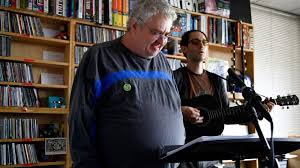
pat-watsPatrick Watson is a Montreal-based singer songwriter with whom I was unfamiliar.  But he has received many accolades, including being nominated for the Polaris prize many times (and winning once).  It turns out that Bob Boilen also really likes him a lot. And I can see why.

Watson and his band make sounds that are quite unexpected (but are still melodic and pretty).  The first song “Adventures In Your Own Backyard” itself is amazing the way it unfolds.  The first sounds we hear are the drummer using a violin bow on Boilen’s Emmy statue (which I’m sure Bob was genuinely delighted by).  There’s two acoustic guitars and the violinist’s beautiful ooohs.  About one minute in, there’s a big drum sound as the drummer starts playing snare and bass.  And then the acoustic guitar is is put through some kind of filter to give it a very electric sound.  Once you get used to the acoustic guitar sounding electric and the electric guitar sounding acoustic, the violin comes in (sounding like a violin).  And then there’s backing vocals oohing until Watson comes back with more vocals, but this time through a microphone that is hugely distorted and mechanical-sounding (he and the violinist shared oohing duties and their voices get processed together).  All of this sounds like chaos and yet the melody is catchy and constant (and yes, the song ends with the drummer bowing that Emmy one more time).

Watson explains that for “Words In The Fire” the band was “nine hours north of nowhere” north of Quebec with these kids who invited them to a campfire party.  They had nowhere else to be so they went.   The kids requested a Bob Marley song, but they didn’t know any.  So they wrote this song.  For the start, it’s just Watson singing with the acoustic guitar.  Midway through the song, the percussionist plays a saw, giving it an eerie quality.  Despite the craziness of the first song, this song is delicate and pretty and Watson’s voice is high and sweet as well.

“Into Giants” opens with some lovely guitar intros and lots of harmonies.  This song is especially fun to watch because the five of them are all squeezed in behind the desk and seem more crammed than before.  Watson even has to move out of the way to let the violinist take her solo.  The whole band sings in a big folksy chorus “started as lovers don’t know where it’s gonna end” with appropriately big bass drum sounds.  The song seems like it’s going to end with Watson’s oooohing, but with a minute left, the song picks up again, with Watson playing a cool riff on the keyboard.  He even gets out that distorted mic again to build the song back up.

I love watching a Tiny Desk by someone I don’t know and immediately falling for a band.

[READ: January 12, 2017] “The Book”

The June 6 & 13, 2016 issue of the New Yorker was the Fiction Issue.  It also contained five one page reflections about “Childhood Reading.” 

Matar’s story is quite different from the others.  He says that his earliest memory of books is being read to, not actually reading.  Many of the classics were read to him: One Thousand and One Nights, and the Arabic literary renaissance of the twentieth century.   But there were hardly any books for children in the house.

He says that during his life he has had a passionate affair with books in English and Arabic.  And he makes this wonderfully succinct comment about youthful reading: some books were “undeserving of my youthful fervor, a few … I encountered at the wrong moment, [but there were] plenty of others that still light up rooms inside me.”

But, for him the book that affected him the most if one that he hasn’t read.  He doesn’t even know the title or author. (more…)

Read Full Post »

6616 SOUNDTRACK: DANIEL JOHNSTON-Tiny Desk Concert #224 (June 11, 2012).

danDaniel Johnston makes me uncomfortable.  I find his music to be simple and his voice isn’t very good.  And yet he is beloved by so many other people.  The fact that he is schizophrenic makes me worried that there’s some kind of exploitation going on.  But who knows.  He has had rather a lot of (relative) success.

The blurb tells us

Johnston has been diagnosed with bipolar disorder and schizophrenia, and he’s been institutionalized, but these days he travels and performs. It’s amazing to see and hear a spark of candor in what he does, all while he’s shaking like a scared child. There’s an odd sort of curiosity to watching Johnston perform, but it’s easy to root for him: He’s endearing and sloppy and unmistakably talented.

He and his guitarist Friend McFriendstein (actually Shai Halperin who plays under the name Sweet Lights) play four songs.

“Mean Girls Give Pleasure” is a pretty funny fast romp.  “Sense of Humor” is a slower song.

Between songs, they show off Johnston’s book Space Ducks.  There’s an iPad app and video game which is “Much beter than checking out Starbucks on yelp.”

“American Dream” is a clever song that’s full of monsters as metaphors.  “True Love Will Find You In The End” is a pretty, uplifting song.

His songs are short and unadorned, and surprisingly catchy.  But I don’t think I’d ever listen to him intentionally.

[READ: January 12, 2017] “Uninhabited”

The June 6 & 13, 2016 issue of the New Yorker was the Fiction Issue.  It also contained five one page reflections about “Childhood Reading.” 

Young says that when he was in fifth grade he read Robinson Crusoe (not the abridged version) in one weekend.  But he wasn’t showing off.  He saw an image or cartoon of the book and picked it for a book report not realizing how massive the actual book was.  He delayed until Friday for a report due Monday and thus had to cram in an entire novel.  He did the same thing with Gulliver’s Travels, “Who knew Gulliver met more than just Lilliputians?”

But he says that these masterpieces didn’t seem that different from non-fictional travelogues like Thirty Seconds Over Tokyo, the gory account of the U.S. bombing of Japan.

Crusoe is apt because he says he felt shipwrecked when they moved from New York to Topeka, Kansas.  (more…)

Read Full Post »

6616 SOUNDTRACK: YANN TIERSEN-Tiny Desk Concert #219 (May 21, 2012).

yannYann Tiersen scored the soundtrack to Amélie.  But he also writes and sings lovely chamber-pop music.

The first song “The Gutter”  opens with Tiersen playing a swirling violin melody accompanied by an acoustic guitar, a ukulele and keys.  Tiersen doesn’t sing, but the lead singer’s voice is yearning and delightfully accented as well.  (No names are given for the rest of the band).  I liked the way the song built in intensity even while his voice retained that quiet style of singing.

For the second song, “Monuments” everyone switches around.  Tiersen plays a lead 12 string acoustic guitar, the ukulele player is on keys and all four sing harmony lead.  You can tell that Tiersen is not American because of the way the word “Monuments” is sung “all monYOUments…” which adds an exotic flavor to the song.  The delicate keyboard sounds float nicely over the acoustic guitars.

They stay with this lineup for “Tribulations.”  The singer from the first song and the acoustic guitarist sing lead.  And everyone else joins on harmony.  “The Trial” opens with the four singing a beautiful “ooh” in harmony.  Then the other three sing a complex backing vocal while Tiersen sings lead.

There’s some really lovely melodies in this concert.

[READ: January 12, 2017] “Where is Luckily”

The June 6 & 13, 2016 issue of the New Yorker was the Fiction Issue.  It also contained five one page reflections about “Childhood Reading.” 

Having a child is like rereading your own childhood.

Galchen has a young daughter and that daughter has a some favorite stories.  One is a Moomin (which I love), another is a Piggy & Gerald.  Galchen says that if you read children’s book enough times, “they start to seem like Shakespeare.”

But she says that her daughter doesn’t read in a linear fashion.  “What happens next” doesn’t seem to cross her mind.  She reads them more like eternal landscapes: “In that sense, nothing is happening, and she reads for that nothing.” (more…)

Read Full Post »

6616 SOUNDTRACK: CHUCK BROWN-Tiny Desk Concert #217 (May 16, 2012).

chuckI’m puzzled by a few things with this Tiny Desk Concert.  The first is a note that This story originally ran on Sept. 28, 2010.  The second is the note that Chuck Brown, the Godfather of Go-Go music, died Wednesday. In 2010, he brought his full band to the NPR Music office — and put on a party like no one else.

That isn’t confusing in itself, but I have to wonder why it took them two years to air this concert, which is quite a fun rave up.  Are there other shows they didn’t air?

Okay, so I had no idea who Chuck Brown was.  And the blurb anticipated that

The name Chuck Brown might not mean a whole lot to people outside the Washington, D.C., area. … In D.C., Brown is widely known, even revered, as the Godfather of Go-Go, a title he’s held since the late ’70s. Though he started out as a jazz guitarist, Brown invented go-go, a style that incorporates funk, jazz, R&B, hip-hop and dancehall, and has mostly stuck with it ever since.

So, Go-Go, huh?  I never heard of that either.

No one in D.C. can really explain why go-go hasn’t traveled beyond the city’s environs — we love it here, it’s all over our commercial R&B and hip-hop radio stations and, at least when I was in high school, a go-go in a school’s gym was the most packed party of the weekend. Chuck Brown is a local hero. A few days after he played our offices, Brown and his whole band played at the Redskins’ stadium for the halftime show.  So to have Brown play a corner of our office — not a 90,000-capacity football stadium — was like a dream come true for a lot of NPR staffers. Sweat started pouring immediately, between the 11 musicians (that’s congas and a stripped-down kit; saxophone, trumpet and trombone; two backup singers and a rapper) and all the go-go-heads in our building.

Brown played four songs for about 25 minutes.

Go-go is mostly about the groove, though, and Chuck Brown just settles in and leans back. He showed up looking like a million bucks in a vest, Dior shades and his signature hat, and then he did what he does best — get the crowd on his side and hand its members something to dance to.

Go-go is based on a syncopated beat and the use of congas in addition to drums.  So “Senorita” is like a combination of reggae salsa and 50s singing (I can’t help but think he sounds like Frank Zappa when Zappa does his rather funny voice).  The song is slow but smoldering and fun to sing along to.  There’s a Santana guitar vibe too.

“Chuck Baby” is the hip hop element of his music.  His rapper is not very inspiring though.  She seems a little stiff.  And the song is a little flat when he’s doing the call and response–he sounds cool and seductive and they sound more bored than “naughty.”

Before the third song everyone starts chanting “wind me up chuck!” which he lets everyone know www.windmeupchuck.com is his website. “Wind Me Up!” / “Bustin’ Loose” starts with lots of call and response.  “Bustin’ Loose,” is a funky song with very James Brown accents and everyone singing the refrain: “Gimmethebridgenow, gimmethebridgenow.”  The song has been a hit in D.C. since 1979.  The backing vocalist on this song feels a bit looser (apparent as she sings “I feel like bustin’ loose).

The crowd was yelling out requests, too: “Chuck Baby” and “Run Joe,” a go-go cover of the Louis Jordan song.  “Run Joe” / “It Don’t Mean A Thing.”  “Run Joe” has a Jamaican flair “Policeman is on the premises.  What is he doin’ here?”  His guitar playing is really inspired throughout the set, but especially at the end of this song.   He does a lot of playing the same melody as he sings.  The song segues into a version of “It Don’t Mean a Thing” in which he slips in “It don’t mean a thing if it ain’t got that go-go swing.”

This set was really a party.  And Brown was just full of energy.

[READ: January 12, 2017] “Surrendering”

The June 6 & 13, 2016 issue of the New Yorker was the Fiction Issue.  It also contained five one page reflections about “Childhood Reading.” 

This reflection beings with Vuong explaining that his family moved to the U.S. from Vietnam when he was two.  He was an ESL student from a family of illiterate rice farmers who saw reading as snobby.

When he entered kindergarten, he found himself immersed in a new language.  He quickly became fluent in speech but not in the written word.  In fourth grade his class was given an assignment to write a poem in honor of National Poetry Month.  Normally his poor writing skills would mean that he was excused from such assignments.  He would spend time copying sentences out of books in the classroom.  But this time he decided to be ambitious and write a poem. (more…)

Read Full Post »

6916SOUNDTRACK: MARGARET GLASPY-Tiny Desk Concert #560 (August 22, 2016).

margaretI really love Glaspy’s 2016 album Emotions & Math.  Her lyrics are sharp, her voice is unusual and mesmerizing and her guitar licks are simple but just chock full of hooks.  What’s not to like?

This Tiny Desk sees her playing songs from that album. Her band is just a bassist, a drummer and her on guitar and voice.

“Emotions & Math” starts off quietly with just bass and drums while she sings in that unique way of hers.  Then the guitar comes in–it’s nothing fancy, but it plays off the bass notes in a very cool way.  And it’s super catchy too.

“Love Like This” opens with a cool bass and drums rhythm–bouncy and tribal.  And when her guitar comes in, it’s with a ripping couple of chords before disappearing again.  Once again, the bass is rumbling along with her chords accenting in a neat way.

“You and I” bounces along with some low chords and bass and Glaspy’s most growly vocals. This song features the first “solo” which is really just the notes of the chords played, but it really stands out among the deep notes.  And once again, the whole business is really catchy.

“Somebody to Anybody” is just her singing and playing guitar.  Although it feels a little quiet without the rhythm section, she fills in more guitar parts on this song and it feels quite full.  And the chorus is, that word again, very catchy.

It was this Tiny Desk that sold me on getting her album, and I’m glad I did.

[READ: March 17, 2016] “The Running Novelist”

This essay appeared in the Summer Fiction issue of the New Yorker.  Since I really like Murakami, and hope to read more of him one of the days, I’m going to include this essay because it is as surprising as some of his fiction.

This is the story of how he became a runner and how he became a novelist.

He had been the owner of a small jazz club (which I feel he has written about in one of his stories).  It stayed open late and was a novelty in Tokyo at the time.  He had a niche audience and while many people didn’t like the place, he had a steady clientele.

His friends said it would never work, but he didn’t listen and he became quietly successful.  He was there in the morning and worked late at night.  And once he made a profit he hired people to help him out. (more…)

Read Full Post »

slowreadSOUNDTRACK: DIRTY THREE-Tiny Desk Concert #245 (October 15, 2012).
dirty-3For a Murakami collection I should really have picked a jazz Tiny Desk Concert.  But none jumped out at my on my list.  So I decided to do something that might be jazzy in spirit, even if it is nothing like jazz at all.

Dirty Three are a three-piece band which consists of violinist Warren Ellis (who works closely with Nick Cave), drummer Jim White (who I had the pleasure of seeing live with Xylouris White), and guitarist Mick Turner (who has released a string of gorgeous instrumental solo albums and worked a lot with Will Oldham).

I’ve liked Dirty Three for years, although I kind of lost touch with them back around 2000.  So it was fun to see that they are still working.  (They’ve released all of 3 albums since 2000).

Jim White plays an eccentric but very cool style of drum–it always feels improvised and random, and maybe it is, but it’s never “wrong.”  Turner is the only one who is keeping the song, shall we say, “stable.”  He’s got the rhythm and melody both with his strumming.  And Ellis is all over the place with melody lines and bowing.

For this Tiny Desk, they play three songs.  Their music is ostensibly instrumental although Warren Ellis is not above shouting and yelling and keening when appropriate.

The first two songs are from their 2012 album and the last one is from Ocean Songs.

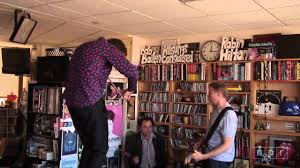
“Rain Song” opens with Ellis strumming the violin while Turner plays slightly different chords.  Then Ellis takes off on a series of spiralling violin rolls.  As always, White is back there waving his arms around with the loosest grip on drumsticks I’ve ever seen.  He plays brushes on this song but the drums are far from quiet.  Meanwhile Ellis is soloing away, yelling where appropriate and doing high kicks when White hits the cymbals.   As the song comes to an end, White is going nuts on the drums and Ellis takes off his jacket (revealing a wonderful purple shirt) .  He starts screaming wildly as he physically gets into his violin playing.

“The Pier” is about realizing that it’s the rest of the world that is driving you crazy.  It’s about “trying to undermine Facebook and realize a new way of communicating with people beyond the internet.”  It’ about… are you ready Mick?  Okay.  “The Pier” is a slower song with some plucked violin.  Ellis climbs up on the desk and dances around as he plays.  This one feels a but more controlled but in no way staid.

For “Last Horse in the Sand,” white switches to mallets and adds a tambourine to his cymbal.  It’s really interesting to watch White play around with things–moving his gear around as he plays.  He switches sticks and seems to be not even paying attention, but without ever really losing momentum or timing.  For this song, Ellis and Turner are the mellow ones while White is just all over the place with his amazing drumming.

I haven’t said anything about Turner because he is really the grounding of the band, while the other two are taking flights of fancy.

This is a wild and untamed set and it’s a lot of fun.  It’s also amusing to watch the audience witnessing this seeming chaos.

[READ: December 16, 2016] Slow Reader Vol. 1

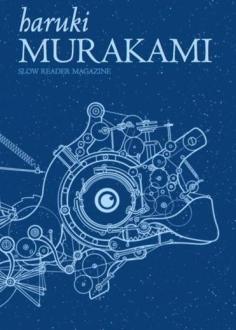
Madras Press had released 16 small books, which I enjoyed reading quite a lot.  I have posted about some and will post about more in the new year.  But word is that they have given up on the small books and have switched their attention to a new magazine/journal called Slow Reader.  The first issue came out this month and it collects stories, essays, poems, illustrations, and other things that center around novelist Haruki Murakami.

Support this small press!  You can order this issue directly (and name your price, although I think the asking price is $6).

From an article elsewhere I’ve learned that future issues will cluster around M.F.K. Fisher, Kazuo Ishiguro, and Patricia Highsmith.

This issue contains essays, fiction and illustrations, some dating back as far as 2000.

CHIP KIDD-cover illustration (wind-up bird)
Chip Kidd is awesome

GRANT SNIDER-Murakami Bingo Board
This bingo is hilariously apt–covering most of the bases of Murakami’s writing: cats, jazz, running, and even a Chip Kidd cover.

JESSE BALL-Sheep Man
A line drawing of a sheep standing upright with the caption “The sheep man’s peculiar tail was never visible to me.”

HARRIET LEE-MERRION-Diner illustration
A nice line drawing of a corner diner

KAREN MURPHY-Sputnik and two moon illustrations
Two simple drawings of Sputnik and two moons.

BEIDI GUO-Hard Boiled Wonderland and the End of the World map
A cool map of the locations of the novel.

DINA AVILA–Murakami Tasting Menu at Nodoguro in Portland, OR
I don’t really get if the menu items are related to the stories but it’s a neat idea that there are foods named after his works. But why are so many called IQ84?

EUGENIA BURCHI–IQ84 menus
A drawing of foods with what I think are character names (I haven’t read the novel yet).

FABIO VALESINI-train illustrations taken from the book trailer for Colorless Tsukuru Tazaki and His Years of Pilgrimage
No idea what the original context is, but it’s a neat, clean drawing of a train station.

JEFFREY BROWN-“In Conversation” What Jeffrey Brown Thinks About
The first piece is an amusing cartoon in which Brown scores a job at an indie bookstore by mentioning Murakami.  The little blurb says that it is an only slightly exaggerated account. There’s also a later picture by Brown of Murakami’s face posted on a bulletin board (with a lost cat flier), that’s really great.

DANIEL HANDLER-“I Love Murakami”
Handler begins his piece by apologizing to dozens of authors before saying that Murakami is our greatest living practitioner of fiction.  He mentions a few books but heaps a ton of praise on Wind Up Bird Chronicles and mentions his excitement at  finally getting Norwegian Wood in English (it had been untranslated for many years).  He wrote this essay in 2000.

YOKO OGAWA-“On Murakami’s “The Last Lawn of the Afternoon” [Translated from the Japanese by Stephen Snyder]
Ogawa writes about a house in her neighborhood which has a lawn that she finds unsettling–it’s perfectly manicured and a pale, cool shade of green.  She is reminded of the Murakami story in which a boy mows a woman’s lawn and she asks him an unexpected question.  Ogawa imagines a woman in that home asking the same kinds of questions.

ETGAR KERET-“What Do We Have in Our Pockets?”
This was inspired by Murakami’s story “On Seeing the 100% Perfect Girl One Beautiful April Morning.”  This story is about a man whose pockets are always bulging with unusual items.  People often say to him, “What the fuck do you have in your pockets?”  And his answer is that he carries things that he imagines the perfect woman needing–a stamp or a toothpick.  It is a wonderfully charming story.

RIVKA GALCHEN-“The Monkey Did It”
Of all of the items in this collection, this is  the only piece I’d read before.  I remembered parts of it (particularly the excerpts from “A Shinagawa Monkey,” and her talking about Colorless Tsukuru Tazaki.  I also recalled her saying that she liked his short stories better than his novels, but that she was perhaps wrong in thinking that.  The one thing I didn’t pick up on last time was that in the beginning of the essay she writes about Toricelli’s Trumpet or Gabriel’s Horn–an item with finite volume but infinite surface area.  She says this perfect describes Murakami’s work.  And I love that she ties it to translator Philip Gabriel who is a gentle and modest translator–perfect for the watery novel.

TESS GALLAGHER-“Murakami and Carver Meet at Sky House”
Before he had written any substantial works, Murakami translated Raymond Carver’s works into Japanese.  Ray was excited and bemused that Haruki and his wife Yoko would travel from Japan to meet with him.  This essay tells us that the following poem came about as Ray tried to imagine how his poems could possibly be appreciated in Japan.  Murakami told him how both the Japanese and American people of the 1980s were experiencing humiliation at being unable to make a decent living.  Gallagher says that if they were to meet today Ray would be awkward about Haruki’s stature.  But he would have loved knowing that Murakami had translated everything he had written.

RAYMOND CARVER-“The Projectile”
This poem is wonderful. It begins with Carver speaking about his meeting with Murakami and then flashing back to when he was 16 and was hit with an ice ball.  It was thrown from someone in the street through a small crack in the window of the car he was riding in–a chance in a million.

RICHARD POWERS-“The Global Distributed Self-Mirroring Subterranean Neurological Soul-Sharing Picture Show”
This is the most abstract and “intellectual” of the essays here.  It speaks of a team of neuroscientists discovering a lucky accident–that neurons in the brain fire when someone else makes a motion that we recognize.  Similarly, in Murakami–representation is the beginning of reality.  He speaks of the parallel narratives in Hard Boiled Wonderland.  He wonders at the universality of dreams and ideas in Murakami.  “But if his own stories are steeped in the endless weirdness hiding just inside everyday life, how then to account for Murakami’s astonishing popularity throughout the world?”

MARY MORRIS-“The Interpreter”
I loved this story.  An American business woman is giving a series of lectures in Japan.  She is assigned a translator who goes with her nearly everywhere.  She is a little annoyed that he is always there, but he is very respectful of her and only speaks when spoken to.  She assumes he is translating her speeches correctly, but during one, the audience laughs where there was nothing funny.  She doesn’t want to disrespect him, but she can’t imagine what he said to them.  In the next one, they are practically doubled over with laughter at what he says.  Finally she has to confront him about it.  He reveals astonishing insights into her personal life.  And the next day he is called away–just as she has begun to feel close to him.

In the author’s note, she says that the she was at an writer’s meeting in Princeton (where she teaches) and Murakami was there eating with them. He was by himself, and she talked to him because she was a fan of his work.  She relates a story of holding up a sign for him when he ran the New York City Marathon.  She says that the part about the translator and his family (which I didn’t mention) is from an actual translator she met in Japan.

AIMEE BENDER-“Spelunking with Murakami”
Bender speaks of trusting Murakami.  She says when the cat started speaking in one of his books, she began to mistrust him.  Nevertheless, she says, she loves a lot of writers but only trusts a few of them.  She’s not trusting Murakami’s honesty or his ability to make her smarter.  Rather, she trusts him like a man with a torch in a cave–someone who is willing to explore–and to be in front leading the way.

SUMANTH PRABHAKER-Editor’s Note
Prabhaker would like to ask the world’s philosophers why some things seem to happen to us in a random fashion.

Read Full Post »

sky  SOUNDTRACK: MITSKI-Tiny Desk Concert #467 (August 31, 2015).

mitskSome recent Tiny Desk Concerts have been running long, but Mitski Miyawaki plays 3 songs in 8 minutes.

Her songs are simple—three chords at most.   And she is unaccompanied here (her recorded versions are much more fleshed out)–just her voice and her electric guitar.  But it’s the intensity of her lyrics and her delivery that really dominate the show.

“Townie” is the most rocking song  The way her voice rises and almost breaks as she sings “I’ve tried sharing and I’ve tried caring and I’ve tried putting out” is really heartbreaking.  And the follow-up “but the boys keep coming on for more, more, more.” It’s all of 2 minute long but it packs a punch.

“Class of 2013”  is almost a capella.  She plays a chord and lets it fade away while she sings.

Mom, am I still young? / Can I dream for a few months more? / Mom is it alright if I stay for a year or two…and I’ll leave once I can figure out how to pay for my own life too.

Interestingly, se plays an open-stringed guitar (it must be a special tuning).  One loud chord that rings and fades.  Even in the most unsettling moment, when she plays a chord and then screams the lyrics into the pick-up of her guitar–giving it a far-away and tinny quality as the chord echoes to a close.

The final song “Last Words Of A Shooting Star” has some simple opens string finger picking (again, must be an alternate tuning).  As she sings quietly she seems to be exposing every ounce of herself.

One would be concerned for her psyche and yet she seems pretty happy and smiling when the show is over.

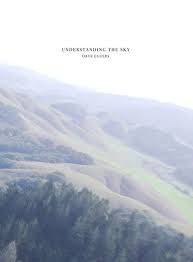
[READ: October 19, 2016] Understanding the Sky

This book is a long-format version of a short article/essay/something-else-entirely that was published in Afar in 2015.

This book reminds me of the publication of David Foster Wallace’s This is Water in that it is a brief essay/story spread out over hundreds of pages.  Most often with one line per page.  The difference between this and Water is that Water felt like a weird cash grab and this feels like a chance to show off more of Egger’s photos (there are not many in the article).

There is a photo on each page–most often with text–but sometimes without.  And it works rather well.

The narrative is structured as a dialogue–each “person” is on a facing page, so the right page answers the left page.  And it is done in a kind of removed third person.  Thus it begins: “Who is this man?”  “He wants to fly.”  In this opening section the pictures are presented very thin–less than an inch wide in total but stretching from top to bottom of page in the center of the spread. (more…)

Read Full Post »

dfwreadSOUNDTRACK: CHRISTIAN SCOTT aTUNDE ADJUAH-Tiny Desk Concert #477 (October 9, 2015).

aacsChristian Scott aTunde Adjuah and his septet play what he calls stretch music: “the particular type of jazz fusion he’s up to: something more seamless than a simple collision of genre signifiers.”

They note that even his appearance stretches traditional jazz: “You may note that he showed up in a Joy Division sleeveless T-shirt and gold chain.” It’s sleek and clearly modern, awash in guitar riffs, but also bold and emotionally naked.

Christian Scott aTunde Adjuah (not sure how to abbreviate that) is a trumpeter and he can hit some loud powerful and long –held notes.   It’s funny that when he bends over the trumpet grows quieter—those ic really are direction-based.

For the first song “TWIN” he does some impressive soloing over a simple and cool beat—piano and delicate guitar riffs (there’s also an upright bass and drummer).   After his lengthy solo there’s a flute solo that also works perfectly (if less dramatically) with the background music.  (Christian plays tambourine during her solo).  He says that this song is about being a twin.  His brother, Kyle Scott is a film director and for whom Christians scores the music.  Christian also explains that he comes from an African-American and Native-American background and that this song has rhythms as a sort of history of his family that touches on Mali, Senegal Gambia and The Ivory Coast and makes its way to the Caribbean, Cuba and into New Orleans.

He’s pleased to play the Tiny Desk Concert for an audience that appreciates “Music that has nutritional value.”

For the second song, “West of the West” he brings on a young alto-saxophonist who plays with his drummer in a different band. The song opens with a rocking electric guitar solo and then the jazzy band kicks in behind it.  The instrumental features a couple of solos by the saxophonist, the pianist and the bassist.

“K.K.P.D.” is a dramatic song for which he gives a lengthy back story.  Many years ago in his home of New Orleans, he was stopped by New Orleans police late at night for no reason other than to harass and intimidate him.  he was coming back from a gig.  He resisted and was in a serious situation and was seriously threatened—the story is long and very affecting, especially given how articulate (I know, terrible word, but true) and calm he is about retelling this horrifying story.  His pride almost made him do something ill-advised, but instead he channeled that pent-up frustration into a piece of music whose long-form title is “Ku Klux Police Department.”

He adds that we see things on TV about inner cities or the ninth ward and we believe them to be true.  Like that the neighborhood is happy that the police are clearing out the youth there.  We begin to think that the narrative is true, although the people who live there can tell you otherwise.  Despite the title and the origin, the is song is designed to reach a consensus to move forward –not to build derision or hate.  He says that we have to start working on that now, because if it doesn’t start now then our children will continue to inherit this situation.

It opens with a noisy guitar wash and fast drums.  It’s quite noisy and chaotic although it resolves very nicely into an almost sweet piano-based song with slow horns.  The middle of the song ramps up with some intense soloing from Christian.  I love how that segues into a very different section with an electronic drum and delicate piano.  Chritsian’s next solo is much more optimistic.  The final section is just wonderfully catchy.

When he introduces the band, he points out just how young some of his newest members are: Drummer Corey Fonville (another new member) used a djembe as a bass drum, and also brought a MIDI pad so he could emulate the sound of a drum machine; Lawrence Fields, piano; Kris Funn, bass; Dominic Minix , guitar (21 years old); Braxton Cook, saxophone (24 years-old) and Elena Pinderhughes, flute: 20 years old!

I don’t listen to a ton of jazz, but I really liked this Tiny Desk Concert a lot.

[READ: July-October 2016] The David Foster Wallace Reader

I’ve had this book since Sarah bought it for me for Christmas in 2014.  I haven’t been in a huge hurry to read it because I have read almost everything in it already.  And some of that I have even read recently.  But this summer I decided to read some of my bigger books, so this was a good time as any.

One of the fascinating things about reading this book is the excerpting in the fiction section.  I have never really read excerpts from DFWs longer books before.  And once you decontextualize the parts, you can really appreciate them for themselves rather than as a means to the end of the story.  This is especially true of the excerpts from Broom of the System and Infinite Jest.  But also just reading some of these sections as a short story makes for an interesting experience.

It was also very interesting to read the non-fiction all together like that.  These pieces come from difference anthologies, but they have thematic similarities  So, placing them together like that allows for really comparing the stories.

And of course, the selling point for most DFW fans is the teaching materials in the center of the book–an opportunity to look into the man’s mind at work shaping younger minds.

I have written about virtually everything in this book already (title links refer back to previous posts), so mostly these are thoughts about the pieces themselves and not a part of a whole. (more…)

Read Full Post »

harpjulySOUNDTRACK: JERUSALEM IN MY HEART-Mo7it Al-Mo7it [CST093] (2013)

mo7So just what is Jerusalem in My Heart?  According to the Constellation records website:

Jerusalem In My Heart (JIMH) has been a live audio-visual happening since 2005, with Montréal-based producer and musician Radwan Ghazi Moumneh at its core. Moumneh is a Lebanese national who has spent a large part of his adult life in Canada.  Moumneh is also active in the Beirut and Lebanese experimental music scenes, where he spends a few months every year.

but more specifically, what does it sound like?

Jerusalem In My Heart (JIMH) is a project of contemporary Arabic and electronic music interwoven with 16mm film projections and light-based (de)constructions of space, exploring a relationship between music, visuals, projections and audience.  …   [The album blends] melismatic singing in classic Arabic styles and electronic compositions with contemporary electronic production. …  Moumneh’s voice has become a powerfully authentic instrument, [along with Saturated synths and the overdriven signals of Moumneh’s acoustic buzuk and zurna].

And what’s up with the title of the record?

The numeral 7 is pronounced like an h; all titles on the album are rendered in contemporary colloquial “mobile” Arabic (the transliterative characters used in Arabic phone texting).

Alright, now that that’s out of the way, the album begins with “Koll lil-mali7ati fi al-khimar al-aswadi (Speak of the Woman in the Black Robe)” which opens with an echoed voice that reminds me of the way a dance track might start.  But it quickly becomes clear that the singer is sing in Arabic and in a somewhat traditional manner (but with an echoed effect on the voice).  I don’t really know how Arabic music might be sung, but this is what it sounds like to me.  By the end of the track, some keyboards are added, echoing to the end.

The second track, “3andalib al-furat (Nightingale of the Euphrates)” is a 9-minute instrumental.  It opened with acoustic stringed instruments Dina Cindric playing the Rast Virginal on the banks of Al-Furat.  It is a beautiful piece, recorded outdoors with the sounds of birds and other animals contributing.  It never grows louder than these instruments.

And then this acoustic and mellow piece jumps into the very electronic sounding third song, “Yudaghdegh al-ra3ey wala al-ghanam (He titillates the shepherd, but not the sheep…).”   The opening riff is very late 70s Tangerine Dream-sounding.  I expected a lengthy instrumental, so I was very surprised when the female vocalist (I assume Malena Szlam Salazar) began singing in tradition Arabic style.  It’s a great mix.  Especially at the end as her voice gets more processed.

Track four, “3anzah jarbanah (Sick, Diseased Goat)” is a mostly a capella vocal song with Moumneh singing in his mournful keening voice.  He sounds pained as his voice has a slight echo to it.  After about three minutes a distorted keyboard plays behind the voice.  It has a distinctly 1980s sci-fi vibe.

“Ya dam3et el-ein 3 (Oh Tear of the Eye 3)”  is 5 minute-instrumental which I believe is done mostly by Sarah Pagé playing the Bayat Harp on the banks of Dajla.  Again birds are heard throughout.  These instrumentals are just lovely.

“Ko7l el-ein, 3oumian el-ein (Eyeliner of the Eye, Blindness of the Eye)” has a kind of solo opening on what I assume is the buzuk.  It’s fast and a little wild by the end with an electronic sounding synth line running in the background that more or less takes over the song.  The final track is ” Amanem (Amanem)” which has Moumneh’s vocals and a keyboard drone behind it.  It’s a rather mournful and spooky  vocal style and sounds likes he as about to cry.

Since I don’t really know what the album is about, the ending seems like kind of a downer.  But since I am exposed to practically no contemporary Arabic music, I found this to be a really interesting listen, and I wonder if it is in any way representative of contemporary Arabic music.

[READ: August 22, 2016] “My Holy Land Vacation”

I read this more of Bissell, not because of the contents, as I like Bissell quite a bit.  But I found myself strangely engrossed by this story of traveling to Israel with a busload of Conservatives.

Bissell says that he enjoys listening to right-wing radio.  He names a few hosts who I don’t know and then ends with Dennis Prager.  I don’t know him either, but he is the impetus for this article so there ya go.  Bissell describes him as the “patriarch trying to keep the conversation moderately high-minded” which sounds pretty good.

Prager is Jewish and his audience is largely Christian.  And in the summer he organized a Stand with Israel tour.  For about $5,000 you could go on an all-inclusive guided tour across the world’ holiest and most contested land.

Bissell provides some context that the religious right hasn’t always been fans of Israel.  Indeed my recollection is that the Christian right was very antisemitic.  But by 2002 conservatives were vested in the cause because of some common beliefs like forbidding abortion and being suspicious of Muslims.

When Bissell first saw Prager in person he admits to the man’s charisma.  Bissell talks about what is known as the Israel Test which is summed up “if you ever find fault with Israel, you’re horrible.”  Prager believes that all American parents should send their children to Israel between high school and college to let their moral compass be righted again.

As for the trip itself–the food is plentiful everywhere–embarrassingly so.  He doesn’t like many of the people on the trip.  And he and his wife have to remember to not act like New York liberals.  But the one thing that Tom and his wife (and the people he has grown to like on the bus) can agree on is that their guide David is “the tour guide to have while Standing with Israel.”

Bissell is pleased to hear that the locals are pretty even-handed about a lot of things, always trying to explain up how most of the citizenry–both Israelis and Palestinians want peace.  But the travelers are appalled at this even handedness.  They want partisanship.  A woman yells that there no way that Israelis are teaching their children to hate.  A soldier–a man who lives here–responds to her that he knows Israeli families who do raise their children to hate Palestinians.  She responds, “Respectfully, no.  Respectfully, no.”

Later when they go to Nazareth, their tour guide explains that Nazareth has pretty much always been Arab territory–they didn’t take it from the Israelis, but no one appears satisfied with this answer.

Eventually they go to a settlement and meet self-described “Israeli rednecks.”  The man was born in Cleveland and moved to Israel in 1961.  He is a rabble-rouser and makes Bissell uncomfortable.  Bissell has to leave the room during the man’s excoriations.  When he steps outside, he meets Pastor Marty who is also appalled at the belligerence.  Marty blames talk radio in general and wonders when the last time “anyone was forced to have a civil discussion with someone who thought differently.”

But the real crisis is aboard Bus Five–Bissell’s bus–because their beloved tour guide has been fired because of complaints.  And a whole section talks about the bus’ reaction to this.  They even form factions who want to Stand Up for Dave, and the de facto leader begins trying to find out who is for or against Dave.  The section is pretty fun and strangely exciting.

But the final section grows much more serous.  They visit Yad Vashem, Jerusalem’s Holocaust Memorial.

Soon the rest of the bus and its occupants are forgotten and Bissell simply thinks about this memorial and the thousands of dead.  And then he thinks of his own family–he and his wife left their relatively new-born daughter home with grandparents.

I expected that this essay would be full of some crazy people spouting crazy things.  And to an extent it was, but what I like about Bissell’s writing is how empathetic he is and how he can really convey different perspectives while retaining his own individuality.  The essay also  contained a lot of interesting information and had a surprisingly emotional ending–one that is far removed from right-wing radio..

Read Full Post »

c28SOUNDTRACK: HISS TRACKS-Shortwave Nights [CST104] (2014).

hissThe Hiss Tracks album begins with a rumbling roiling and yes a kind of hissing sound.  There was a moment of concern that this would be literally 40 minutes of static . But no, there are some interesting electronic blips and phrases amidst he roiling rumble.

Some context about this band from the Constellation site:

Hiss Tracts is an ongoing collaboration between “sound sculptors” David Bryant and Kevin Doria. Both players are known for their work within various strains of drone-inflected and experimental music: Bryant as a member of Godspeed You! Black Emperor and Set Fire To Flames, Doria as a member of Growing and for his solo work as Total Life.

Hiss Tracts opens new collaborative, procedural and narrative pathways for these fine musicians to continue exploring soundscape-based composition and production. Both are guitar players, and the electric guitar figures as both recognizable and unrecognizable source instrument on Shortwave Nights, but the deployment of a wide range of additional analog sources and signals ensures that there is no confusing this for a guitar-based drone, noise or post-rock record.

So there you have it.  Once the rumble of that first song, ‘…shortwave nights,” dissipates there are some ringing guitar sounds quietly repeating amid a low static and other sounds.   The song ends with some dissonant guitar notes.  It’s eight minutes in total and has the feeling of an ambient soundtrack, but not a relaxing one or of background music.

“half-speed addict starts with broken wollensak” does indeed begin slowly, at about half-speed, with more rumbling sounds.  The song speeds up at the end, with muffled sounds keeping a very fast pace and a keyboard note rings out as the song finishes.  “slowed rugs” has a kind of one note drone while some vibrating drones continue over it—it’s a gentle electronic sound manipulation.   The oscillating notes fold in on themselves and mutate into some thing else.  As the song nears its end, a repeated series of unusual notes seems to rise from the din.

“drake motel / “9 gold cadillacs”” is a one minute interstitial that opens and closes with someone playing a harmonica.  The player offers it to someone else and then the rest is a series of statements from an unnamed person:

I would never put my mouth on something that you had put your mouth on.
The more you love people the worse they treat you I am so tired of it.
My daddy spent million of dollars trying to by a friend and he died without one.
You can give a sumbitch a million dollars cash tax-free and tomorrow they wouldn’t give you a cracker if you were starving to death.  That is a bible prophecy.

“windpipe gtrs.” sounds like a bunch of didgeridoos trying to overtake each other.  “halo getters” is an ominous piece, with more of that rumbling static and some portentous chords over the top.  The five-minute song doesn’t change much although about a minute in some guitars ring out sounding very outer spacey.  The song repeats and eventually warbles to and end which somehow feels warmer than the rest, like little explosions of quiet sound which almost sound like car horns.

“for the transient projectionist” opens with ringing bells/gongs.  After a few minutes of this peaceful sound, some music bubbles up—waves of warm keyboards and washes of mild static.  It seems to have a natural progression before ending.

“ahhh-weee dictaphone” is a 41 second interstitial of what sounds like vocal goofing around.  “test recording at trembling city” has mechanical ringing tones coming on in waves.  The song builds in intensity as it sounds almost like a high-speed-something about to crash, or a siren going off.  It is rather unsettling.  “beijing bullhorn / dopplered light” is mostly staticy radio and voices muttering under some gentle washes of chords.   It is a relatively pretty ending to a somewhat unsettling disc.

The instruments included on the disc include: guitar, tape machine, piano, mellotron, portasound, bowls, field recordings, oscillators, sampler, synthesizer

This is a pretty esoteric disc that many people won’t enjoy, but if you like experimental ambient textures, it’s worth a listen.

[READ: March 10, 2016]  “Undecided”

After last night’s debate, in which evidently there are some 36% of the population undecided about whom to vote for, here’s a political piece from the 2008 election.  What I especially loved about this one was just how relevant it all seemed 8 years later.  The “undecided” voters aren’t getting as much airtime yet, but one wonders how poll numbers can shift when the candidates are so radially different.  I recall in the 2008 election how people seemed genuinely undecided about the two candidates and Sedaris (and myself and many others) just ask: HUH?.

Sedaris notes how the undecideds get interviewed about being undecided and they all look “very happy to be on TV.” And oh dear, they just can’t make up their minds.

“I look at these people and can’t quite believe that they exist.  Are they professional actors? I wonder or are they simply laymen who want a lot of attention?”

And then he says to imagine their perspective as if you were on an airplane.  The attendant brings the food cart over and in what may have been the most apt analogy:

Can I interest you in the chicken? she asks.  Or would you prefer the platter of shit with bits of broken glass in it?

To follow through he says that being undecided is to “pause for a moment and then ask how the chicken is cooked.” (more…)

Read Full Post »

« Newer Posts - Older Posts »