Feeds:
Posts
Comments

Archive for the ‘Essays’ Category

SOUNDTRACK: MARGARET GLASPY-Live at the Newport Folk Festival (July 30, 2017).

Every year, NPR goes to the Newport Folk Festival so we don’t have to.  A little while afterwards, they post some streams of the shows (you used to be able to download them, but now it’s just a stream).  Here’s a link to the Margaret Glaspy set; stream it while it’s still active.

Margaret Glaspy has been making music professionally since 2010, but she released her solo debut last year and it’s really good.  She plays a rocking guitar, although she seems to play a lot on the higher strings.  Her sound isn’t tinny, but it’s a much more treble than bass.  But she’s got a two piece backing band to pick up and complement the low end.

She also has a unique vocal delivery style.  She enunciates words with a strange inflection–I never would have guessed that she is from California.  And it’s that unique sound that I think makes her lyrics that much more interesting.  She’s also not afraid to throw in a curse or a graphic description in her lyrics.

Glaspy played 13 songs in total.  10 of the 12 songs from her record, two new ones and a Lucinda Williams cover.

She doesn’t speak much, she just gets right to the music, playing the first five songs faithfully to the record with just enough grace notes to make it stand out.  But she seems to let it all hang out by the time she gets to “Situation” which has a much louder, rougher guitar sound–she really lets loose and it sounds great.

She introduces the band Daniel Ryan on the bass and Tim Kuhl on the drums and then she starts the slower “Black is Blue.” I hadn’t noticed before but at times her delivery is kind of like Laura Marling’s in this song.  “You Don’t Want Me” has a spoken word section and her delivery once again reminds me of Marling’s.  They certainly don’t sound alike, but there is something similar in the style–that would be an awesome double bill.

She might explain her lack of talking when she says, “This is my first time at Newport and I don’t take it lightly.  So thank you so much for having me.”

The NPR blurb also sees a lot of strength at the end of her set, so I’ll let them sum up

She says she’s “Got some new songs for you:”

a slow-burner called “Mother/Father” and another that doesn’t yet have a title [the chorus: life was better before we were together].  A late-set highlight was “Memory Street,” which boiled over into a seething solo before a final verse that had Glaspy repeating a disjointed phrase over and over, to the point of uneasiness [it is quite long, she sings the words “Times I” with an appropriate skipping sounding drum click for over 20 seconds]— a compelling imitation of the skipping record her lyrics invoked.

She plays a cover of Lucinda Williamss’ “The Fruits of my Labor.” and then ends with “You And I” and that catchy circular guitar riff that is so wonderful and original.

Glaspy has been on my list of people to see live and I hope she comes back this way after she tours around for a while.

[READ: June 20, 2017] “The Work You Do, The Person You Are”

This issue has a section of essays called “On the Job,” with essays about working written by several different authors.

Toni Morrison (it’s hard to think of her as doing something “before” being an author) speaks of working for Her, in the 1940s in a house that had all kinds of things that she had never seen before: a hoover vacuum cleaner or an iron not heated by a fire.

She gave half of her earnings to her mother–which meant she was helping pay the rent, which made her feel good. But she also got some money to squander of junk. (more…)

Read Full Post »

SOUNDTRACK: PINEGROVE-Live at the Newport Folk Festival (July 30, 2017).

Every year, NPR goes to the Newport Folk Festival so we don’t have to.  A little while afterwards, they post some streams of the shows (you used to be able to download them, but now it’s just a stream).  Here’s a link to the Pinegrove set; stream it while it’s still active.

I was pretty excited to hear what Pinegrove did at a big venue like this.  And, true to form, they sound great and are kind and generous to the people helping them out as well as all the fans who are there: “thanks for taking a chance on us.”

What’s particularly fun about Pinegrove is that their songs are mostly pretty short–but they feel fully complete.  But that means you can get 11 songs in a 45 minute set.

The band is in the process of writing and recording new music but this set is all older stuff (1/2 from Cardinal and the rest older).  But this is such a clear recording (with occasionally pops from the bass), that it’s great to be able to hear these songs live and to hear what they do differently with them.

The first song, “Old Friends,” Evan Stephens Hall seems a little less voice-cracking than usual (as if he’s trying to sing pretty for the Festival), but when he gets into the middle of “Aphasia” he sings “But if I don’t have you by me then I’ll go underground” with reckless abandon and the crowd goes nuts.

To me the most notable difference in these songs is the louder harmony vocals of Nandi Rose Plunkett.  And they sound terrific (Plunkett has her own band Half Waif who I’ve been interested in seeing, although i hope it doesn’t distract her from Pinegrove).

They run through several of the songs and they all sound great–the band really transcends when they play live. (and the rabid fans certainly help).

He introduces the band and has a problem getting Plunkett’s name out (I’ve got an avocado in my mouth).  Then he runs through everyone else: Samuel Skinner on guitar, Joshua Fairbanks Marre on the guitar and vocals, Adan Carlo on the bass guitar, Zachary Levine on the drum kit and vocals (he gets a big response).  And then they introduce Lincoln their newly acquired trusty stuffed sloth.

They dedicate “Angelina” to Lincoln, (he ends by saying “just a tiny little song”)

Okay we’re gonna quickly play two more songs.  After a quick “The Metronome” Hall introduces the final song by saying

Most of these songs are about love whether it be romantic, platonic, or familial and when they began they were about how to love the people we knew the best we could, but a more important initiative is loving the people we don’t know as well as we can.  It’s a localized sentiment but also a very public sentiment.

This works as a wonderful introduction to “New Friends” which sounds tremendous with all of the harmony vocals firing on all cylinders.

[READ: June 20, 2017] “Brush Clearing with the Teen-Age Boys in Arkansas”

This issue has a section of essays called “On the Job,” with essays about working written by several different authors.

Richard Ford writes of working in the summer of 1967.  He worked for the Neighborhood Youth Corps in Little Rock.  It was not a job he wanted, just one he could get.  He had always had jobs and wasn’t about to not have one during the summer while living with his mother.

So he enrolled in this program which “summons images of clean cut boys standing at attention, but was really about low income (black) kids getting work experience.”  And he realizes now it was designed to keep them in school and out of the State’s hair. (more…)

Read Full Post »

SOUNDTRACK: MAGGIE ROGERS-Tiny Desk Concert #642 (August 7, 2017).

I had been hearing Maggie Rogers’ name on WXPN and have liked “Alaska” which they’ve been playing.  But I didn’t know much else about her.

But reading the blurb reminded me of where I had initially heard of her:

Maggie Rogers became a viral star on the strength of a video in which Pharrell Williams raves about a demo of what’s become her signature song, “Alaska.” Since then, Rogers has signed a label deal, toured extensively and released a sweetly approachable, inventively arranged EP called Now That The Light Is Fading.

For her Tiny Desk debut, Rogers performed all three of the EP’s best-known songs, opening with the recent singles “On + Off” and “Dog Years,” the latter of which she calls “a song for all the pups.” Then, after dismissing her band, she treated us to a few warm words about public radio before introducing “Alaska.”

Maggie has an interesting voice that sounds similar to someone (it’ll come to me), but with a slight country twang.  It seems like she could easily fall into the country umbrella but her songwriting goes in a slightly different direction.  (I’m also astonished that she looks to be about 18).

She plays three songs (there are 5 on her EP),

“On+Off” starts with a piano intro and Maggie singing. When the middle section kicks in and she plays guitar there a much louder sound. It’s quite catchy.  I really like the delivery of the “Ooohs” that she adds.  There’s something about the way she does it that sounds very cool.

“Dog Years” is a slower, slightly more country-sounding song, but again the “ooohs” won me over.  This time the ooohs are harmonized by her band and it sounds even better.  She also demonstrated some wonderful high notes.

Her band leaves for the final song which she starts by telling everyone that “public radio has been a part of her musical discovery–since she used an NPR compilation to DJ her middle school recess.”  She’s very sweet.

Th final song is “Alaska” which she says is a song about coming back into your body.  It has a really pretty chorus–once again, her voice soaring to lovely high notes.  I prefer the recorded version to this solo version, but she sounds great by herself as well.

[READ: June 27, 2017] “Crossing the River No Name”

I was a little concerned about this story because it was set in Khost, Afghanistan and I thought it was going to be an intense war story–and war stories, like sports stories, pretty much end one of two ways.

So it begins on a rainy night in March 2009.  The narrator and his patrol are sent to interrupt a group of Taliban.  They reached a river and Hal, the leader, called on the best swimmers to swim across and set up the guide rope.  They made it across and secured the line.  The rest of the patrol got across but when it was the narrator and Hals’ turn they hit trouble.

Hal was afraid of the water.  He’d joined the Navy to get over that fear and it worked.  Most of the time.  He knew of one other example when Hal had had a brief freak out.  But this was the second one.  The river grew darker and they were pulled under. (more…)

Read Full Post »

SOUNDTRACK: RHEOSTATICS: Bathurst Street Theatre, Toronto ON (October 7, 1994).

This is the full 36 song version audience recording of the CBC Hot Ticket Show.  The radio version was truncated (and sounds great).  But this version sounds quite good as well.  Notes:

“Song Of Flight” has been duplicated in 2 channels so doesn’t sound particularly good but the rest of the show sounds fine. A bit of chatter from time to time from people near the recorder. The 11 minute “Dope Fiends” in particular is pretty awesome.

This is the show they mentioned they’d be playing after their return from England (no recordings from England).  This show is also nearly 3 hours and 36 songs.

There’s also a video of the show (below) which has a different audio.  It is so interesting to finally see them playing these songs–I had many visual revelations watching this after seeing and imagining these shows for so long).

“Song of Flight” does sound crazy echoey.   The video version’s audio is clean.  I love watching Martin playing the great soaring notes and Dave playing the chords.  The sound cleans up nicely for “California Dreamline.”  I never knew Dave played the high notes during the verse or the wild notes during “disillusioned porpoise.”  It’s also amazing how bouncy and animated Dave is.

“Soul Glue” sounds good.  In the introduction to “Michael Jackson,” after Martin plays the “Sweet Child O’ Mine” riff, Dave says “Thank you Saul.”  On the audio version, you can hear someone in the crowd ask, What did he say?  A guy explains the premise of the song but misses the Slash joke.  The end of the song (just the voices) is really long and sounds great.  I see it’s just Tim and Martin.

Tim apologies for the show starting half an hour late, but they suggest it was a bonus half hour for “conversations and such.”

Then Dave says, “people talk about us having three record out but no we have 4.”  He mentions Greatest Hits and someone shouts Wendell Clark.  He hears it as “Do you miss Wendell?  Sure.”  Then Martin says, “he’s fishtailin.  That’s a segue.”  “Me and Stupid” is fast and rocking.

Dave introduces “Tim Mech our road manager who did the “Legal Age Life” guitar solo.  He says Tim drove 16 hours consecutive from Thunder Bay to Toronto to get us back to our families and our pets and our loved ones.  Then he drove to Washington DC for Danny Gatton’s funeral (a musician I don’t know).

Clark makes a segue that a van is like a car, you scratch your arm and you go like this….  Cough cough.  You go like this….  (supposed to be a segue for Martin to start “Torque Torque.”  He missed it.  For this song Bidini is on bass, Tim is on acoustic guitar, Martin on a big old-fashioned guitar.  After the song, he says, “Say goodbye to that guitar,” and switches back to his Steinberger.

Dave asks, “You remember the knob who played air drums at our last concert…here he is.”  This is an introduction to “Mike” who is not seen.

It’s the same instrument configuration for “Introducing Happiness.”

Then there’s a discussion of Martin getting athlete’s foot in Cork—it was the highlight of our trip to Cork.

Martin has some trouble with his acoustic guitar and his shirt.  He tells about Oprah Winfrey interviewing a guy who gaff taped everything in his house.  His wife was so embarrassed.  Clark, in watching Martin’s shirt get fixed with tape says, “For those of you who want to know the secret of life by a roll of gaff tape–it’ll fix your car, your clothes, your guitar.

I was intrigued to see that the fun parts of “In This Town” were played by Dave, while Martin plays acoustic.

For “Take Me In Your Hand,” Tim goes to the drums and Clark comes up front.  He dances a little jig and sings harmony.  Bidini plays bass.

When you see what the gaff tape has done to his shirt Bidini says, “Martin has affected an exclamation mark on his thing.  “The first time Rheostatics played at The Edge in 1980, I went to Albion Mall and got them to press on an exclamation mark on a red shirt and my dad bought me blue velvety pants.  I looked like a clown, but an excited clown!”  He thanks Martin for recalling that evening.  He says “Everything old is new wave again…except Canadian folk rock.”

Martin makes up a song  “Everything old is new wave again.”  They play around it a few times and then he says, “Okay, it’s not that funny.”

For “King of the Past,” Dave is on acoustic guitar while Tim plays the opening high notes on his bass.  Martin plays the great opening effects.

When they play “Queer,” there’s no ending section because it segues right into “Full Moon Over Russia,” which has Dave and Martin talking to each other with their guitars (vocals and guitar playing the same note) “You seem very confused!”  “What?!”

Tim grabs the accordion, Dave is on bass for “What’s Going On.”  Martin has a little lyric problem, but when Clark asks if he’s starting again, he just presses on.  Towards the end, there’s a cool jam with Dave on bass an Martin on guitar facing each other and challenging each other to play better.  It’s pretty great.

After the song, Martin says, “A nightmare of mine has come true, my shirt’s falling off.”

This is probably my favorite version of “Row.”  As the song heads to the end, there’s a lengthy drum part that builds and builds.  It nearly takes over the song.  Martin starts playing louder and louder and the whole time, Tim maintains his consistent playing.  It hits an amazing climax.  It’s a bit too loud in the recording but must have been very cool live.

I never realized that Tim played acoustic guitar and Dave played bass on “Claire.”  The band jams with Martin making interesting sounds.  They play Monstrous Hummingbirds which segues into “One More Colour” and then, half a dozen songs later, they finish up “Queer.”  So cool.

“Dope Fiends” runs nearly 11 minutes long and is pretty fantastic.  In the middle there’s even a didgeridoo (the video confirms that it is!).  They thank the didgeridoo player but I can’t hear his name.  Martin is making whale sounds on the guitar, there’s a lengthy drum solo and more of Martin’s guitar solo.  And even after a quick return to the song before the ending, Tim starts funking it up and Martin gets a little more wailing in.  It’s one of the most unusual jams the band has done.

When that ends, one of them says “We scheduled 20 songs and figured we’d be done by 12: 30 and we’re now an hour and a half ahead of schedule.  [How?] So we’ll play one more, take a 5 minute break so people can stretch their feet and have a smoke and then we’ll play a second set.   But they waste no time getting to that smoke with a blistering “R.D.A.”

They come back from the break and “Digital Beach” opens slowly (Martin has a new shirt and an acoustic guitar).  It segues into a rocking “Self Serve Gas Station.”

After some banter about the game Risk and people who play it on a board versus people who play it on the computer, they play “Headless One,” a song I haven’t heard them play in a long time.  For “Legal Age Life,” it’s like a fun folk party.  Dave Clark comes up to sing and do a whistle solo.  Bidini is on acoustic guitar.  And near the end Tim gets to rhyme the line “We ain’t got nothing funny to say no more.”  Then he’s back up front with the acoustic guitar for “Palomar.”

They play a lovely “Northern Wish” and then comes the wonderfully weird “Artenings Made of Gold.”  The middle section is sung more and more like a children’s song–almost baby voices.  I think they even sing “Davy is one, Timmy is two.”

The “digging a hole” section once again sounds like Frank Zappa.  And when they get to the Uncle Henry section about the Maple Leafs, they pause and Dave says “could you please rise” and then they sing it like a barbershop quartet.  It is such a shame that the video cuts off during this song.  The very end has the band do another vocal harmony sans microphone?  Bidini says, “A little tribute to Moxy Fruvous.”

Digging  a hole sound like Zappa again.. maple leafs   could you please rise?     Then they “do it again” guitars off for the audience to sing the ned end

They play a boppy “Alomar” which segues somewhat surprisingly into “Onilley’s Strange Dream.”

People start shouting out requests and then someone shouts “play whatever you want!”  A person shouts “Saskatchewan” and Dave says “Carte Blanche? we stopped playing that years ago.”  When another person requests “Saskatchewan,” Dave says “That was Sakstachewan…part 2.”  Dave says they’re going to play two more songs (they actually play 7 more).

Dave talks about the Green Sprouts Music Club and how people have joined from all over the world: Pakistan Australia, Thailand, Africa, Eurasia and Foxtrap, Newfoundland (he says people from Foxtrap are there tonight).

There’s some raging rocking during the middle of “When Winter Comes” but overall the main part is kind of slow.  The “blue Canadian winter” is practically whispered.

There are more and more shouts for “Horses,” but they play a great “Shaved Head” instead.  And then they play a very folkie “Bread Meat Peas and Rice.”  There’s some crazy falsetto singing and they even get the audience to sing in the falsetto.

And then they kind of fly through the end: “A quick no-nonsense” Record Body Count,” then a fast and hectic “Green Sprouts Theme” where Dave shouts “skip the bridge” and then… silence until Bridge and they rock on!

There’s a few notes of “You Are Very Star” and Martin says “This is sort of an anthem, this one,”  but they play a crazy fast “P.R.O.D.”  They play a verse and then segue back to the “Green Sprouts Theme” and then they play it slower and Dave says “I’m sleepy guys” and they start playing slower and slower saying “1 2 3 and 4” and it slowly segues into the lullaby “You Are Very Star.” People are still shouting requests and yes the guy who is still shouting for “Horses” should know better.  For Martin is playing a lovely acoustic guitar outro.

This is another great set and is, as far as I can tell the final show (at least on the website) with Dave Clark on drums.

[READ: June 20, 2017] “The Hardworking Immigrant Who Made Good”

This issue has a section of essays called “On the Job,” written by several different authors.

Sharma was going to Harvard law school, so he did what many of his fellow students did–he applied at banks for jobs. (more…)

Read Full Post »
SOUNDTRACK: ALDOUS HARDING-Tiny Desk Concert #640 (July 28, 2017).

Aldous Harding is a singer from New Zealand.  Her second album, Party, is full of deeply personal songs with memorable melodies and spare instrumentation.  Aldous Harding’s musical partner for the Tiny Desk is Jared Samuel Elioseff .

I was mesmerized by her performance right from the start.  Her voice is deep and sultry like Nico’s, and I imagined that she was French the way she enunciated.  There’s something about her face–she seems to be filled with what…? disdain? emotion?  as she sings these song.  She grits her teeth, protrudes her lower jaw, makes fascinating expressions all to convey her meanings.

The first song she performs,”Imagining My Man,” is about what she calls the “tender and frightening thoughts that come with being in love,” and what you witness while watching her are often painful, pensive expressions that are as important to the song as the notes being played.

I really like this song a lot–the simple melody, the fascinating delivery and the wonderful touch of a strange little zip sound after each singing of “all my life….”  The way she sings “if you get down” introduces yet another strange expression and an even stranger vocal delivery.  It all borders on comical, but she is not funny she is baring emotion.

In introducing “Blend” she gives Jared the guitar and says “I’m really sorry for what you’re about to see me do, but it’s all for the good of the song.”  And I genuinely can’t tell what she’s talking about.  She doesn’t do anything expect change the drum sound on the keyboard.  This song is whispered and the guitar plays gentle picked notes.

For the final song, “Horizon,” she takes away the guitar, stands up and says “thanks for watching” with a smile.  She stands singing the final song which I think is my favorite.  The expressions she uses as she delivers the first few lines is really intense–almost like a verbal threat:

I broke my neck dancing to the edge of the world, babe
my mouth is wet, don’t you forget it, don’t you lose me

The fact that she stands straight, dressed all in white–unmoving except for some hand gestures–just adds to the subtle intensity of her performance.

[READ: August 1, 2017] “Eric Duncan”

Philip Roth retired from writing in 2012, but that doesn’t mean that we can’t get more new material from him (although this isn’t exactly new, since it is from 2008).  This excerpt comes from remarks he gave at his 75th birthday celebration and will be collected in a forthcoming volume.

This is his recollection of the first things he ever wrote on his mothers Underwood typewriter.  In 1943, Philip’s mother was teaching him to type–white keys with black letters and number which “constituted all the apparatus necessary to write in English.”

He says that as soon as he mastered touch typing, he wrote his first title: “Storm Off Hatteras.”  But he says that instead of writing his own name, he wrote by Eric Duncan: “There’s little that can bestow more confidence and lend more authority than a name with two hard c’s in it.” (more…)

Read Full Post »

SOUNDTRACK: RHEOSTATICS-Ultrasound Showbar [2nd GSMW Matinee Day 3] (February 27, 1994).

Second annual Green Sprouts Music Week held at Ultrasound Showbar Feb 25-March 1 1994. Setlists for all shows were fairly similar in content focusing mainly on the 25-30 songs that they would use for consideration on Introducing Happiness which began recording the following week. Rare performances of Green Xmas, Floating and one of the earliest Desert Island Discs. This is the all ages Sunday afternoon show 3/5.

Sadly there was to be no celebratory party for the Canadian hockey team who lost the final match and took silver (they’d have to wait until 2002).

They’re going to play a lot of new songs and some old songs.  So they start with “Crescent Moon” from Greatest Hits (it’s so synthy!).  Midway through they seem to mess up and Dave says, “We know the new ones well we just don’t know the old ones very well.”

As the start “Green Xmas,” Dave Clark says, “I love Christmas Time so much so that I love playing this song even though it’s not Christmas.”  When the song is over there’s lots of talk about gum–I assume someone had some in the audience: Black Cat, Ton o Gum or Bubbalicious.  He asks what kind and they start talking about Dubble Bubble and how so many bad things happened to Pud (He could never win).  He contends that Ziggy ripped him off.

They get an organized snap going for Fishtailin’.  They play a verse and then hold it, Dave says “We usually play this song in A, Martin.”  However we will employ “capo technology.”

Clark says he enjoys playing that song because it reminds him of …Dave.  And all the good times they had…before the bad stuff happened (ha).  Clark describes how he met Dave when they were kids.  Bidini says he doesn’t remember the meeting and jokes “did you steal something off of me?”  Clark says Bidini’s aunt and uncle got the first in ground pool in the area and that’s where they met.  Bidini asks what he thought of him.  After shouting “Doofus,” Clark says, I thought “he would become a well kempt perhaps overspoken person.”  Bidini says he remembers being in his Delta 88 going for a drivers test in 1981 and picking up Clark and thinking “he has lips as big as mine–we can be square together.”

It’s a good segue into “Me and Stupid” (which they make family-friendly by singing “messed up” instead of fucked up).  For the fish chant at the end “pike, trout, bass, smelt,” Dave says they are the “four fish of the apocalypse.”

Dave apologizes that he “spit on you from afar but luckily I hit one of the Wooden Stars and I think that will bring me good luck in 1994.”  The Wooden Stars are the band that’s playing during the break.

Once again Tim says that “Introducing Happiness” is about having cats–not birthing cats, just discovering them.”

Clark says that they are “one of the laziest bands in rock.”  Bidini says they have inherited the mantle from Valdy.  Then he says I thought you meant “laid back.”   Clark says “I didn’t say lamest.”  But Bidini says that Valdy once paid The Woods Are Full of Cuckoos $1500 to open for them at the Port Credit Arena.  Clark says he wasn’t talking about Valdy, he wrote the Four Seasons.  Tim says he also sells really cheap groceries (I assume he’s joking about Aldi).

For “In This Town,” Martin asks for “Lots of reverb on the intro.”  Bidini says it’s like they’re in a cave.  Then there’s a great “Michael Jackson, ” followed by a rocking “RDA.”  A sloppy intro to “Soul Glue” is fixed and then the song starts for good.  Midway through Bidini tells them to do it nice and breezy, like Valdy would do it, and they make it very smooth.  “Zero angst, Tim.”  The gentle ending segues nicely into “Self Serve Gas Station.”

Clark tries to wax eloquent about the loss of sun, but he can’t get the words out.  So they encourage the kids to dance, which it sounds like they do.

They play the mellow “Row,” which features a really great solo from Martin in the middle.  After a discussion of new wave, they play the rapid, rather odd “The Woods Are Full of Cuckoos.”   They play “Floating” again–one of those songs that has never gotten official release.  It’s pretty cool with a few different parts that complicate the song.

They ask, “Any teenagers in the audience?  I heard that teenagers don’t like to be called teenagers what do they like to be called?”  Someone shouts “Young adults.”  They play “Jesus Was Once a Teenager Too.”

They ask that the lights to go up and they play a song/game called “Desert Island Picks.”  You say three albums you’d take with you if you were stranded on a desert island (in this case New Providence Island).  They walk around singing the folk song and then some people come up: it is really fun and very funny, a great good time is had by all.  They even bring up a little kid and he sings his three favorite things in the world.  When they ask another kid what school she goes to, she says  “uh…what?”  And someone shouts “Must be U of T!”

Someone had picked three Beatles albums, and Martin says “This is from our next album Let It Be…”  He sings “Jo Jo was a…” before beginning “Take Me in Your Hand” properly.  Then they play a lovely version of “Claire” and then a noisy messy sloppy verse of Neil Young’s “Farmer John,” which morphs into the crazy trilogy “Artenings Made of Gold/Cephallus Worm/Uncle Henry.”

Clark asks if they should play longer or shorter, and longer wins.  But he must take a five-minute bathroom break.  So Martin plays a gentle acoustic version of “Record Body Count,” which the crowd loves.   Then, “Oneilly’s Strange Dream” is introduced as “Saskatchewan Part 2”.  And then (despite some apparent crying from children) they play “Horses” (the moaning child actually sounds like a pretty good fit for this intense song).  There’s even a kid who sings the “Holy Mackinaw, Joe” part.  At the end, there’s kids doing the whole ending with them.

And then it’s a couple of covers: Jane Siberry’s “One More Colour” and a rocking rendition of Cheap Trick’s “Surrender.”  They leave the stage and there is a truly wild and rowdy encore cheer (banging things and lots of screaming).

Dave gives away a prize–nightgowns (?) from Sire Records–which Clark says he doesn’t want because he’s ashamed of being on a major label.  I’d love to see those.

It leads to a cool trippy version of “Dope Fiends,” and the end guitar section segues perfectly in to “Earth Monstrous Hummingbirds,” a version which doesn’t ever get really weird but which still sounds fantastic.

I can’t get over how cool it is that Rheostatics played matinee shows like this.  The show lasted over 2 hours, tickets were $6 and it was all kind-friendly.  That’s pretty awesome.

[READ: January 17, 2017] “The Curse”

This is an excerpt from Marías’ recent nonfiction book To Begin at the Beginning. It is a reflection on the art of writing fiction.

This brief section looks at how he writes; he doesn’t know how things are going to turn out when he begins–that would be boring for him.  And if he was bored, it would reflect in his writing and then his readers would be bored.

Just as we do what we do when we’re twenty without knowing that when we reach forty we may wish we had done something else, and just as when we’re forty we have no alternative but to abide by what we did when we were twenty, we can’t erase or amend anything, so I write what I write on page 5 of a novel with no idea if this will prove to have been a good idea when I reach page 200, and far from writing a second or third version, adapting page 5 to what I later find out will appear on page 200, I don’t change a word, I stand by what I wrote at the very beginning — tentatively and intuitively, accidentally or capriciously. Except that, unlike life — which is why life tends to be such a bad novelist — I try to ensure that what had no meaning at the beginning does have meaning at the end. I force myself to make necessary what was random and even superfluous, so that ultimately it’s neither random nor superfluous.

He cites an example.  When Marías’ Cuban great-grandfather was still a young man, he refused to help a beggar. The beggar put a curse on him: “You and your eldest son will both die before you are fifty, far from your homeland and without a grave.”  He wrote about this curse in his book Dark Back of Time. (more…)

Read Full Post »

SOUNDTRACK: TASH SULTANA-Tiny Desk Concert #610 (April 7, 2017).

Tash Sultana is a force of nature.  I’d heard her song “Jungle” a bunch of times on the radio before seeing this.  I thought it was interesting and kind of catchy with some cool guitar work.  But it never occurred to me that Sultana was doing the whole thing BY HERSELF!

For this Tiny Desk, she recreates that song (and two others) entirely by herself with loops and loops and effects and all kinds of good stuff.

As “Jungle” opens, Tash plays the guitar chords and loops them.  And then she plays the opening riff.  And loops it.  And then more riffs on top and loops them.  She creates a huge sound for about a minute and a half.  Then when all that sounds good, she starts playing the drum machine.

It’s so much fum watching her dance around her little area (barefoot, mind you) tapping pedals and setting effects on and off.  And when she starts soloing, she’s got a perpetually big smile on her face just really enjoying all of the work she;s doing and the sounds she’s making.

She finally starts singing and she’s got two microphones–the chorus gets the second microphone which has a processor and echo to totally change her sounds.

And then towards the end of the song she starts messing around with a solo and has all kinds of effects at hand for whichever part of the solo she’s doing, including a wild, ass-kicking, classic-rock style solo that all mellows out into  sweetly echoed section and a gentle guitar ending.  The song itself isn’t that complicated, but holy cow she packs so much into its 7 minutes.

So who the hell is Tash Sultana?

This 21-year-old Maltese-Australian got a guitar from her grandfather when she was three, she says, and has played it every day since. It’s astonishing to watch Sultana’s fluidity on her instrument, like a natural extension of her body. (She also plays bass, saxophone, trumpet, flute and more, but kept it “simple” at the Tiny Desk.) I thought I had a lot of energy — watching her bounce from guitar to drum machine to two separate microphones — and then hopping barefoot from looping pedal to effect pedal as she builds her songs was exhilarating and exhausting.

She says she wrote “Notion” when she was having a difficult time with myself… and someone else.

It opens with that her singing “oohs” into that processed mic and it sounds otherworldly.  And then again she jumps around from guitar to drum machine looping more and more.  Although it’s interesting that most of the song stays kind of mellow.  Her melody is very pretty and her voice is great.  The only trouble is it’s kind of hard to understand what she;s singing.  But its fun that she’s singing some of the song without playing anything else (it’s all being looped) and how intensely she sings it.

After playing the song for some 9 minutes, she hits some pedals and the just takes off on a wailing guitar solo.

“Blackbird” is very different–it’s all played on acoustic guitar.  There’s no looping.  She says she wrote this while in New Zealand.  She was wandering and got lost in a cave.

But acoustic doesn’t mean simple folk song.  She plays some great riffs with her right hand while hammering-on with her left hand. The part around 19:15 is just fascinating to watch.  She must have an alternate tuning as well because when she plays opens strings it sounds great (and it’s 12 string as well, so it sounds even more full).

After singing a few verses she plays an incredibly fast section.

There’s just so much going on, and I have no idea if all of that is part of the songs or if she’s just going off into her own world.

I was so impressed by this set that I just got tickets to her when she comes to the area in a few weeks.

[READ: January 31, 2017] “Mo Willems’s Funny Failures”

I have never really written about Mo Willems, even though my family loves his books (I’ve even got an autographed copy of one of them).

The Piggy and Gerald books are wonderful first readers (and are fun for adults too) and Pigeon is the best bad-tempered character around.

Since I like Rivka Galchen and post about just about everything she writes, I wanted to include this here.  It is a biographical essay based on a few interviews she had with Willems. (more…)

Read Full Post »

bythewaySOUNDTRACK: KAYHAN KALHOR-Tiny Desk Concert #203 (March 24, 2012).

kayhanWhy not continue February’s Resistance with an Iranian performer?

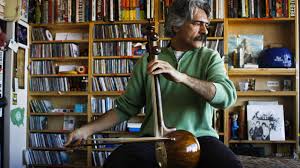
Kayhan Kalhor plays the kamencheh, a four-stringed fiddle-like instrument.  The piece he plays is a 12 minute improvisation.  It is otherworldly and unlike anything I’ve heard–although the blurb makes it sound like a fairly common instrument in his native country.  I don’t have much to say about the piece, so I’ll let the blurb do most of the talking:

For Persians, the New Year comes not in the dead of winter, but right at the vernal equinox. As spring renews the earth, people celebrate this fresh beginning as Nowruz, a joyous 12-day festival to celebrate beauty and abundance. We were lucky enough to have a master musician and composer from Iran, Kayhan Kalhor, visit us in time to celebrate with his gorgeous and deeply moving music.

As one of our interns observed during Kalhor’s mic check, Kalhor’s instrument does the dancing as he kneels with his legs folded beneath him. (This performance actually marks a Tiny Desk Concert first: having a musician perform on top of Bob Boilen’s desk, covered for the occasion by a rug, as Persian tradition dictates.) As Kalhor plays, his bowed, four-stringed kamencheh, a spiked fiddle, spins this way and that, swaying gracefully from side to side.

Before Kalhor played for us, I asked him what he was going to perform. He told me that it was to be an improvisation: “I don’t know yet where I’ll start, or where I’ll end up,” Kalhor said simply. That humble comment aside, Kalhor is a great master who embodies the core principles of this style of music: the ability to perform, entirely by heart, a huge amount of music composed over centuries — but then to take that tradition to new places through the art of improvisation. For us, he then proceeded to spin out a soulful, contemplative and beautifully moving improvisation in the mode of Nava.

The piece has been given the title: “Improvisation In Dastgah Nava.”

As the screen goes black, Kalhor asks: “Was this enough for you? I wanted to go on but I wasn’t sure how much time you had.”

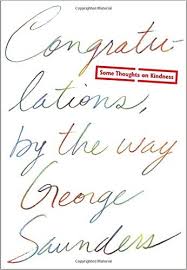
[READ: February 1, 2017] Congratulations, By the Way

Children’s books will commence shortly. But as hatred continues to spread in Washington, one more post on kindness.

Have you ever read George Saunders’ convocation speech at Syracuse University for the class of 2013?  It is stunning and moving and profound.  And yet at heart it is so simple–be kind.

This book, much like David Foster Wallace’s This is Water, is a padded-out book version of Saunders’ speech.  (With illustrations of stars by Chelsea Cardinal).  I am generally opposed to this sort of cash grab book ($14 list price for content that is freely available), but as with Wallace’s book, the speech is so great that any way it can get into people’s hands is a good thing.

There’s not much I can say about the speech, because it is all true and beautiful and doesn’t bear me summarizing.  But I wanted to compare the wisdom of this speech with our horrifying new President and his band of hate-spreaders.  As you read this and know it to be true, wonder what in the hell happened to the people currently running our country that they have fallen so far from the common decency of this speech.

I was thinking how we are taught as children not to lie (Trump lies daily, egregiously) to study hard (Trump is unqualified and none of his cabinet picks are qualified–half of them are downright simpletons), to be kind and obey the golden rule (Trump is literally harming / hurting / damaging / ostracizing / potentially killing people every day with his executive orders).  How did a wicked liar actually win?  Why aren’t the good guys coming to take him out?  I am prepared to RESIST, but it get harder every day with every evil thing he and his minions do.  And watching our spineless elected officials (on both sides, but especially Democrats who were pushed around for eight years) cave to this dictator’s dreams is the most disheartening thing I have ever experienced.

And so, it takes someone liked George Saunders to lift you up.  To believe that somehow this will all be made right.  And to espouse try to kindness where you can.  Because it sure isn’t coming from anyone elected.

The full content of the speech is below.  Read it all, it’s worth it.  Share it with everyone.

(more…)

Read Full Post »

manner SOUNDTRACK: BEN GIBBARD-Tiny Desk Concert #251 (November 19, 2012).

benBen Gibbard is the voice of Death Cab for Cutie.  His voice is instantly recognizable and his melodies are surprisingly catchy.

This Tiny Desk Concert (they say it’s number 250, but I count 251) is just him and his acoustic guitar.  I didn’t know he did solo work, but apparently he does (in addition to being in The Postal Service and All-Time Quarterback).

Gibbard just released a solo album, Former Lives, which he’s said is a repository for material that didn’t work as Death Cab for Cutie songs; from that record, only “Teardrop Windows” pops up in his Tiny Desk Concert. For the rest, he draws from Death Cab’s most recent album (“St. Peter’s Cathedral,” from Codes and Keys) and, of all places, last year’s Arthur soundtrack (“When the Sun Goes Down on Your Street”).

As mentioned he plays three songs and his voice is so warm and familiar I felt like I knew these songs even if I didn’t.

I knew “St. Peter’s Cathedral.” It is a lovely song with very little in the way of chord changes.  But the melody is gentle and pretty.  And the song appears to be entirely about this church.  Which is interesting because the second song is also about a building in Seattle.  “Teardrop Windows” is a surprisingly sad song about an inanimate object.  It’s written from the building’s point of view as he mourns that no one uses him anymore.  And such beautiful lyrics too:

Once built in boast as the tallest on the coast he was once the city’s only toast / In old postcards was positioned as the star, he was looked up to with fond regard / But in 1962 the Needle made its big debut and everybody forgot what it outgrew

The final song “When the Sun Goes Down on Your Street” was indeed for the Russel Brand movie Arthur.  Somehow I can’t picture those two together.  It’s a lovely song, too.

I prefer Gibbard’s more upbeat and fleshed out music, but it’s great to hear him stripped down as well.

[READ: January 2017] “My Writing Education: A Time Line,” “The Bravery of E.L. Doctorow,” “Remembering Updike,” and “Offloading for Mrs. Schwartz” 

I had been planning to have my entire month of February dedicated to children’s books.  I have a whole bunch that I read last year and never had an opportunity to post them.  So I thought why not make February all about children’s books.  But there is just too much bullshit going on in our country right now–so much hatred and ugliness–that I felt like I had to get this post full of good vibes out there before I fall completely into bad feelings myself. It;s important to show that adults can be kind and loving, despite what our leaders demonstrate.  Fortunately most children’s books are all about that too, so the them holds for February.

George Saunders is a wonderful writer, but he is also a very kind human being.  Despite his oftentimes funny, sarcastic humor, he is a great humanitarian and is always very generous with praise where it is warranted.

The other day I mentioned an interview with Saunders at the New York Times.  Amid a lot of talk with and about Saunders, there is this gem:

Junot Díaz described the Saunders’s effect to me this way: “There’s no one who has a better eye for the absurd and dehumanizing parameters of our current culture of capital. But then the other side is how the cool rigor of his fiction is counterbalanced by this enormous compassion. Just how capacious his moral vision is sometimes gets lost, because few people cut as hard or deep as Saunders does.”

These first three pieces are all examples of his love and respect for other writers–both for their skill and for their generosity.

“My Writing Education: A Time Line”

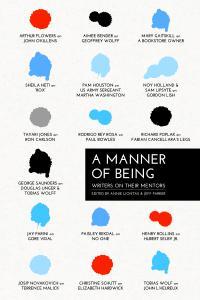
“My Writing Education” comes from a book called A Manner of Being: Writers on Their Mentors.  Saunders’ mentor was Tobias Wolff.  And for this essay, his admiration takes the form of a diary.  (more…)

Read Full Post »

6616 SOUNDTRACK: GLEN HANSARD-Tiny Desk Concert #225  (June 17, 2012).

glenWhat can I say about Glen Hansard that I haven’t said already—he’s a powerful singer and a great storyteller.  This is his second appearance on Tiny Desk (although his first solo) and his fourth or fifth concert on NPR.

With The Swell Season, they played for 34 minutes (a Tiny Desk Record).  And this Concert is no shortie either at nearly 22 minutes.

He’s playing songs from his solo album (on that same beat up guitar).   Although he is distinctly himself, without the band(s), he sounds a bit like Cat Stevens and sometimes like Van Morrison (and he looks like Gordon Lightfoot).

He sings rather quietly and then impressively loudly–powerful and passionate.  He is clearly into what he does.

“Love Don’t Leave Me Waiting” is rocking folk song (he throws a coda of RESPECT at the end) in which he really belts out a few parts.  He’s got a delightful “La la la” middle section, and the overall melody is great.

“Bird of Sorrow” is  much more mellow song.  It builds through some verses and allows him to belt out a few lines near the end.

“Come Way to the Water” has him on a 4 string tenor guitar.  Although it is quite clearly a Glen Hansard song, the guitar is much more timid sounding compared to his voice.  And it really does give the song a very different (darker) feeling.  In fact when it’s over, he says, “that was kind of depressing wasn’t it?”

“Lucia” is a “song he hasn’t finished yet” but he’s going to play it because “it’s a little bit happier.”  Although the lyrics are “Lucia, you’re letting me down again / Lucia, your heart’s not in it babe…. And if your heart’s not in it, then your heart’s not in it, babe.”  Not exactly a happy song.  But very pretty.

“The Song of Good Hope” is slower with no big powerful singing, but it’s really heartfelt and intense.

And as always, he is unfailingly polite and thanks everyone for listening.

My friend Jonathan says that he will always try to see Hansard live, and it seems like I should be doing the same next time he comes around.

[READ: January 12, 2017] “At Home in the Past”

The June 6 & 13, 2016 issue of the New Yorker was the Fiction Issue.  It also contained five one page reflections about “Childhood Reading.” 

As soon as I started reading this, I knew that Sarah would want to read it as well.  For although I have not, Sarah has read The Secret Garden, which is what Tessa Hadley is writing about here.

Tessa says that she didn’t own many books as a child–mostly she borrowed from the library.  But the ones she did own she read over and over and “some of them soaked in deep under my skin, composing my private mythology and shaping my mind.”

She says she had a Puffin paperback of Frances Hodgson Burnett’s The Secret Garden.  The cover picture of a dark-haired girl in a white coat standing among thorny bare rose bushes looks just like Mary Lennox is described in the book.

Although it was published in 1911, she felt no separation from the Edwardians.  She felt at home in the past and often preferred it to modernity, which seemed somehow inferior. (more…)

Read Full Post »

« Newer Posts - Older Posts »