Feeds:
Posts
Comments

Archive for the ‘Environmentalism’ Category

SOUNDTRACK: JANN ARDEN-“Could I Be Your Girl” (1994).

It’s fascinating to watch the video for this song now, since all I really know about what Jann Arden looks like is the author photo and her TV appearances since the 2000s.

She’s got long dark hair!

The song is pretty and I guess lyrically it’s pretty dark and poetic.  This lyrics is pretty surprising for a pop song

And I am ashesI am JesusI am preciousCould I be your girl?

I don’t really care for the “oh my lord” backing vocals, for the sound, not the words.

Indeed, the whole song feels kind of bland.  For a song that seems pretty dramatic, I want a little more from the song.  Maybe the production is too smooth?

It’s catchy though and I suppose in the 90s it was pretty remarkable.  But really it’s just not my style.

At the bottom of this post, you can see Jann Arden talking about this song and basically telling me that I’m an idiot.

[READ: February 2024] The Bittlemores

I’ve known about Jann Arden pretty exclusively from her appearances on Canadian TV (she has her own sitcom too which is pretty funny in the parts I’ve watched).  She was a perennial guest on the Rick Mercer Report which I loved.  She was always funny and game for something.

Her music, on the other hand, is serious and poppy.

I didn’t know what to expect from this novel, but I knew I wanted to support her first foray into fiction (I won’t be reading her memoirs which sound very sad).

And I have to say that this story shocked me from the start because the home life she conveys in this story is so horrible, so miserable, that I was fairly shocked at the things I read.  And yet, her tone is never heavy, so even the most unpleasant things (an old man drowning kittens) are delivered in a tone that makes you not want to throw the book across the room and say “I thought you loved animals, Jann!”

But she pulls no punches as the story starts: “Harp Bittlemore is a horrible man.”  The Bittlemore farm was once a thriving farm but it is now mostly dried up and useless.  It is in the middle of nowhere, miles from anything and even more miles from the nearest city.  There’s a couple of sad cows and pigs.  And there’s a young girl.

Margaret is the Bittlemore child.  She hates living with the Bittlemores.  They are mean and unloving.  And she wants to get even with them.  What does a girl with no agency do to get back at the adults around her?  She gets pregnant.  At 14.

This didn’t punish the adults as much as it punished her, of course.   And as soon as The Bittlemores found out she was pregnant, they locked her in the house–for five months.  Margaret had been going to school but the adults told everyone that she had been accepted to a school in France and that she would no longer be in the area for a while.

When Margaret has the baby–at home, with Mrs Bittlemore stitching her up, Margaret makes a bold decision.  She runs away.  She climbs out the window of her room (while in a ton of pain) leaving behind her baby, and flees up the road with no destination.  She meets a truck driver (female, thankfully) named Tizzy who has a soft spot for this poor girl in trouble and she takes her as far as her route is going. (more…)

Read Full Post »

SOUNDTRACK: hiatus

[READ: July 15, 2023] Algorithmic Reality

I received this book at work with a bunch of other graphic novels from NBM.  I liked the stuff they sent out–anti-corporate and promoting the underground.  And this book fits in with that ethic.

I don’t know David Sánchez’s work, but his style in this book reminds me of Chris Ware and Ted Rall.  Ware in particular because the characters look vaguely the same in every panel (on purpose) with minimal changes between panels.  Damian Bradfield is a British businessman (that’s pretty much all it says about him on the book) and he has written four tales of dystopian technology takeover.

In the first, a man goes to a store to buy a pair of shoes.  He doesn’t buy any but the employee follows him seemingly everywhere to make sure he doesn’t want them.  On the street.  In the grocery store (where the employee has photos of the sneakers).  Then he sees the employee in different outfits everywhere until finally the employee is in his house. The employee is never aggressive, just always there–like your ads on your phone. (more…)

Read Full Post »

SOUNDTRACK: hiatus

[READ: March 1, 2022] The Devil Made Me Do It

As South Africa entered the new millennium, things were progressing very slowly (and sometimes regressing).  And Zapiro was watching.

Homophobia was spreading throughout African nations.  There’s a banner that says Queens against Mugabe.  Zapiro ties it together nicely with a picture of Queen Elizabeth with a paper that says “Mugabe lambasts U.K.”

And an anti-rape ad (starring Charlize Theron) was banned because there was public outcry.  Which leads to a later strip in which children learn the rape message: it’s not bad to rape someone in your own family (A lenient sentence was given to a man who raped his daughter); rape is less offensive than an anti-rape ad that offends men; you can get away with rape if you are famous and hire a hotshot legal team.

Apartheid fallout was still happening.

There’s a an amusing picture of Apartheid Hell and the devil is showing all of the people there a video called No person shall be discriminated against on the basis of race, gender ethnic or social origin, culture, sexual orientation….”  Although clearly the powerful men aren’t all getting punished as we see Craig Williamson, a constant figure in these battles, telling the Amnesty Committee to sit, lie down and fetch his amnesty. (more…)

Read Full Post »

SOUNDTRACK: hiatus

[READ: February 20, 2022] Call Mr. Delivery

This is Zapiro’s fourth book and it’s the first time, I think, that he’s put himself into the cartoons.  And it seems like maybe the world is getting to him.

Although his first appearance is in the meta-joke:

“Only one tiny minority welcomes the formation of Louis Luyt’s new political party” : Cartoonists.

But later by March 1999 he is on a therapist’s couch.  The therapist asks “when did you first experience this feeling of uselessness.  Zapiro says “this week suddenly reality seemed weirder than anything I could come up with.” (And the world hasn’t even gotten to trump yet).

It’s the end of the Mandela era and his successors don’t seem to be shaping up very well.

Although Mandela gets one nice shoutout.  He parts the waters for the Lockerbie Breakthrough and Libya asks if anyone ever get blasé about this sort of thing.

The Truth and Reconciliation Commission’s Final Report had to have any negative mentions of F.W. DeKlerk removed.  And Desmond Tutu seems under attack from the left, right and centre (PAC, IFP, FF, ANC, NP, TRC). (more…)

Read Full Post »

SOUNDTRACK: hiatus

[READ: February 14, 2022] End of Part One

I’m not sure what the Part One is that this title refers to.  This book picks up where the last one left off and moves on into 1998.

It’s clear that Zapiro is still bitter about the Olympics, as the first cartoon is “For the first time the I.O.C. has awarded the Olympic Games to an African City” (the toon is dated 3004 A.D.

At some point it was imperative that I learn all of the political abbreviations.  And he has a good cartoon that summarizes them: (more…)

Read Full Post »

SOUNDTRACK: hiatus

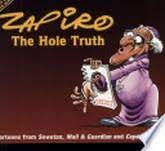
[READ: February 9, 2022] The Hole Truth

Nothing can make you feel ignorant like reading a book of cartoons.

This is a collection of South Africa-based cartoons that Zapiro wrote in 1996.  Who remembers what was going on twenty-five years ago?

Well, this book has an introduction from Archbishop Desmond Tutu (who appears a few times in cartoon form).  Tutu writes that Zapiro is there to skewer hypocrisy but that he has a desire to help the country into realizing their potential–even if it means gently nudging the people he supports when they mess up.

Every country has its share of corruption.  That’s the way of power.  A book like this makes it seem like there was nothing but corruption in South African (and with apartheid, that was likely the case).  Of course, the cartoonist assumes the reader knows what’s going on, so they don’t need to explain their cartoons.  If you don’t know what’s going on, well, you may not get the joke.  And then you feel stupid. (more…)

Read Full Post »

SOUNDTRACK: hiatus

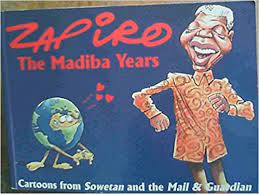
[READ: February 9, 2022] The Madiba Years

Having read some of the more recent Zapiro books, I was delighted to see that our library had most if not all of his previous books as well–one that cover pretty much from the start of the Mandela years.  Mandela even blurbed this book: “Very exciting ad quite accurate.”

So why is it called the Madiba years?  It doesn’t say in the book, so I had to look it up

The clan or family name represents a person’s ancestry. The meaning is deeper than a surname and is used as a sign of respect and affection. The origin of Madiba comes from a chief who ruled in the 18th century, according to the Nelson Mandela Foundation.  Madiba would be used in “an intimate context,” said Richard Pithouse, a politics professor at Rhodes University in South Africa. When Mandela entered school, a teacher gave him the name Nelson. It was customary for Africans to also give children English names back then.  But the wider public had also taken to referring to Mandela as Madiba.  “People would not tend to use that name if they didn’t have positive feelings for him,” Pithouse said.

So there you have it.

This collection opens in 1994 with leader Mangope of Bophuthatswana’s declaration that democracy would not be coming to his homeland (he was very wrong).  With the eyes of the world on South Africa, Election Day shows the shining face of Mandela, pictured as the rising sun over the garbage heap that was the un-democratic elections.

June sees the proposal of the Truth and Reconciliation Commission–to find out what really happened during Apartheid.  There’s also talk of Joe Tokyo, a figure who has been mentioned in other books.  I’m fascinated by his name. In this particular cartoons, his housing plan is described as a pie in the sky.

Things that could apply to any leader include a woman scrubbing the floor in the Prime Minister’s Office.  In 1956, the assistant says to the PM: “Delegation of women to see you.” Then in 1994, the same woman (now much older), the same comment.  This time the scrubber says, “And this time it better work.”

There’s a lot of pages about Winnie Mandela (full name: Winnie Madikizela-Mandela).  I’d heard of her but never really realized what all the fuss was about–she was Nelson’s wife, right?   Well, apparently after he was imprisoned (citing Wikipedia):

In the mid-1980s Madikizela-Mandela exerted a “reign of terror”, and was “at the centre of an orgy of violence” in Soweto, which led to condemnation by the anti-apartheid movement in South Africa, and a rebuke by the ANC in exile. The Truth and Reconciliation Commission (TRC) established by Nelson Mandela’s government to investigate human rights abuses found Madikizela-Mandela to have been “politically and morally accountable for the gross violations of human rights committed by the Mandela United Football Club”, her security detail.  Madikizela-Mandela endorsed the necklacing of alleged police informers and apartheid government collaborators, and her security detail carried out kidnapping, torture, and murder, most notoriously the killing of 14-year-old Stompie Sepei whose kidnapping she was convicted of.

Damn!  And apparently her totally horrific activities weighed on Mandela.

They divorced about two years after he was elected.  But even in 1996 there’s a cartoon of Mandela behind bars with 1962-1990 and then from 1990-1996, he is chained to Winnie.

The big question after the Apartheid government failed was what to do with the men leftover.  Could they just put them in a museum?  Boerassic park?  Apparently F.W. De Klerk had a lot of “amnesia”–couldn’t remember anything that happened before 1990.

And what about the 3,000 former government functionaries that acting president Pik Botha indemnified?  It sounds like the blanket indemnity was ripped off of them–hopefully that will happen to anyone in this country pardoned under our former leader.

I particularly like the one where all of the dominoes fall, knocking down all of the former bad leaders with de Klerk next–again, could be very relevant to our country if they can actually act on it. It’s depressing though that this de Klerk cartoon is in November 1995–so long after the election in April 1994.

But Mandela wasn’t perfect.  When it comes to South African arms sales, apparently he turned a blind eye to backdoor sales.  And his Assembly Chairperson Cyril Rhamaphosa was concerned that when he consulted the public, they seemed to be full of intolerance.  The leaders cut down a hangman’s noose, but there’s a large tree with “pro hanging public opinion.”

There’s also the great unsolved mysteries of the world like The Curse of Tutankhamen, Bigfoot, The Bermuda Triangle and South African foreign policy.

It’s not all politics–there’s some strips about rugby and Springbok, which I’m fascinated by.  And of course much celebration for South Africa in the football (soccer) world.

He also has a strip for National Crime Prevention week. It was suggested that prisons becomes places of education.  But Zapiro says they already are–the criminal leaves with his diploma in drugs, gangs, guns, and knives.  Maybe they just need to change the curriculum.

And the first of many anti pro-life cartoons.  This one has Dr. Claude Newbury saying there shall be no abortion under any circumstance.  Then there’s a lightning bolt with Newbury suddenly pregnant and unwanted babies all round him with god saying “Get real, Claude.”

Evidently the Boer separatists (Volkstaat) were trying to prevent a new South Africa from forming

The concept of a Volkstaat, also called a Boerestaat, is the set of proposals to establish self-determination for Afrikaners (Whites) in South Africa, either on federal principles or as a fully independent Boer/Afrikaner homeland.

Then he shows the trouble with the integration of primary schools as two black students.  The room full of students all look like H.F. Verwoerd (and old man with his nose in the air).  But the glimmer of hope comes when a little white girl takes off her Verwoerd mask and smiles the black students.

Bishop Desmond Tutu as part of the Truth and Reconciliation Committee is shown in a graveyard labelled Apartheid Crimes.  Tutu says, “God help is to remember that the people who did this are also your children.”  God says “lemme get back to you on that one.”

And then in May 1996 De Klerk says the new NP position is “We brought you democracy.”  This compares to the short attention span of the voter:  Western Cape voters oppressed by the Nats for 40 years and happily votes Nat today.

On to Olympics fever! We see that Cape Town is bidding for the Olympics in 2004.  There’s old man Uncle Sam with an Atlanta 1996 shirt tripping over hurdles of security and efficiency and asking Baby South Africa if he really wants to try this.

Then Mandela went to England and it was a big celebration with Nelson’s column having its own Nelson removed and the nearby lion statue saying “tough luck old chap there’s only one Nelson In London this week.

Speaking of London, there’s nothing like the Charles and Diana Royal Side Show to distract the world from real problems.

And remember mad cow disease?

Zapiro sets his sights on Mugabe.

Robert Gabriel Mugabe was a Zimbabwean revolutionary and politician who served as Prime Minister of Zimbabwe from 1980 to 1987 and then as President from 1987 to 2017.

Obviously Mugabe was a bad dude.  Zapiro shows Mugabe putting targets on the back of gays and lesbians in Zimbabwe, while wearing a button that says bigot and proud of it

There’s only one mention of Clinton in this book.  He looks like Tintin as he is in The Adventures of Clintin in Bosnia.  He waltzes in with a peace but there’s Snowy the dog “I’d feel a lot better if that piece of paper has a disarmament clause.”

Zapiro also introduces Netanyahu who will have Isareal aiming for peace (by firing missilesat the peace dove)–he sure nailed that one.

You can see more of his cartoons at https://www.dailymaverick.co.za/zapiro and at www.zapiro.com.

Read Full Post »

SOUNDTRACK: hiatus

[READ: January 15, 2021] The Prox Transmissions

I had recently seen Starset live and decided to check out lead singer Dustin Bates’ books (which I had gotten for my son for his birthday and I think he hasn’t read).

All of the CDs have a theme and the story of the Prox Transmissions is meant to tie into the album called Transmission.

My understanding was that the graphic novel was an adaptation of the novel.  I couldn’t find the novel in his room, but I did see the graphic novel, so I started with that (even though I’m sure it would have ben smarter to read the novel first).

The most impressive thing about this to me was that it was published by Marvel.  Not because I’m a Marvel fan boy but because I just assumed it was self published.  That being said, I think a thing or two was lost in the abridgement.

There are double crosses and possibly triple crosses and seemingly minor characters come to have major roles without a very satisfying explanation.  Basically it feels like a story that has has a lot removed (which it is).

The actual story line is pretty cool though. (more…)

Read Full Post »

SOUNDTRACK: mafmadmaf“Rapture” (SXSW Online 2021).

I never intend to go to SXSW–I find the whole thing a bit much.  But I also appreciate it for the way it gives unknown bands a place to showcase themselves. NPR featured a half dozen artists online this year with this note:

This year, the South by Southwest music festival that takes over Austin, Texas every spring happened online. Couch By Couchwest, as I like to call it, was an on-screen festival, with 289 acts performing roughly 15-minute pre-recorded sets across five days in March.

This list was curated by Bob Boilen.  He also notes:

 I didn’t enjoy hearing loud, brash music while sitting on a couch the way I would in a club filled with people and volume, so I found myself engaging in more reflective music instead.

I’m going in reverse order, so mafmadmaf is next.

mafmadmaf is a Chinese modular synthesizer artist. I’m not sure I ever saw his face onscreen, but it didn’t matter: This seductive and spellbinding set was perfect in my living room. Seeing his modular synthesizer and its many patch cables set up in a beautiful garden was more entertaining than simply watching some knob-turning on its own. Artfully done.

Anyone who knows Bob knows he loves modular synths.  I really have no sense of how they work, so this is all a mystery to me.  But I agree that the setting is wonderful.  And the music is very cool.

This piece is 13 minutes long and while it is mostly washes of synth sounds, there’s some melodies (synthesized sounds of water drops and chimes).

The song morphs in interesting ways, especially after 4 and a half minutes when the musicians enters the screen and you start to see him do something to his setup.  This adds new sounds and even a pulsing almost-beat.

At around ten minutes things slow way down.

[READ: July 15, 2021] Naturalist

I saw this book in the library and grabbed it because I love Jim Ottaviani’s work.  He has written and illustrated a number of non-fiction graphic novels and they have all been terrific.  I love his drawing style–very clean lines and excellent detail.  I also love his ability to compact big ideas into small digestible chunks.

But I had never heard of Edward O. Wilson, which, after reading this, surprises me. He is not only a Pulitzer prize winning author, an innovator in the field of biology and a writer of a massive book about ants, he is also controversial (as we see later on) and a devoted environmentalist.

The book opens with a young Wilson growing up in Alabama.  From when he was little he was obsessed with ants.  There were lots of fire ants where he grew up and there are few things more fascinating than fire ants (the book is chock full of all of the scientific names for all of these ants).

When he was still young, playing around in nature, he went fishing and when he pulled a fish out of the water its spines poked him in the eye giving him a traumatic cataract–he wound up with full sight in one eye only.   But this seemed to get him to focus more minutely on smaller things–ants.

Staring in fourth grade  his father was shuffled around the country a lot so Edward made his home in many places around the south, eventually settling in Florida.

There he met a friend who was obsessed with butterflies–they were two budding entomologists. (more…)

Read Full Post »

SOUNDTRACK: ART D’ECCO-“That’s Entertainment” (2021).

I saw Art D’ecco open a show a few years ago and I’ve become mildly obsessed with hi.  I’m delighted to see that he’s getting some promotion and success.

His new album In Standard Definition is a great synth pop retro dance infusion.  But in addition to that he has released two standalone covers.

This one, a cover of The Jam’s “That’s Entertainment” was a little concerning for me.  This song is one of my all time favorite songs and I’m always nervous when a song like this gets covered.

But Art D’ecco does a great job.  There’s acoustic guitars, a grooving bass line, cool harmony vocals and, best of all, he keeps the way the chorus offers the short “That’s” and the stretched out “en ter tain ment.”  He even does the falsetto note (of course).

But what’s most enlightening about is cover is D’ecco’s voice. He seems to be stretching out of his comfort zone a little and it really shows off how good a singer her really is.

[READ: April 21, 2021] Last Human

I’m not sure what got me on my recent Red Dwarf reading kick (finding out that they had just released a new series was certainly a spark).  I was sure I had read all of these books before and yet none of them were familiar to me at all.

The Grant Naylor team wrote two books and the second one ended on a cliffhanger.

Then for reasons I’m not willing to dig into, both Rob Grant and Doug Naylor each wrote a sequel to that book.  But neither book is like the other and they both go in very different directions.  Naylor’s book was really dark and very violent.  Grant’s was also dark and very violent, but in very different ways.

The previous book ended with an old Lister being sent to a planet where everything goes backwards so that he can de-age to about the same age he was when he was on the series.  They plan to meet him 36 years later at Niagara Falls.

In this book Naylor has the crew place Kochanski’s ashes on the planet Kochanski so she came back to life and she and Lister were able to live their lives backwards together for some thirty years.

But this book opens much further back–to the birth of the first humanoid. (more…)

Read Full Post »

Older Posts »