Feeds:
Posts
Comments

Archive for the ‘Death’ Category

decwalrusSOUNDTRACK: FIRST AID KIT Live at Newport Folk Festival July 28, 2012 (2012).

jacobs-folkfest-44I discovered First Aid Kit through NPR and I liked the two or three songs so much I bought their album, The Lion’s Roar.  And here’s a full set at Newport Folk Festival.

There’s three members of First Aid Kit, two sisters and a boy drummer all from Sweden.  I don’t know if coming from Sweden has any impact on their singing, but their voices are extraordinary  especially when they harmonize.  “Blue” is one of their great songs and it sounds amazing live.

They also do a stunning cover of Joan Baez’ “Diamonds & Rust,” and on their final track, “King of the World,” Conor Oberst gives a guest vocal (he’s on the album too).

Lyrically, the band is interesting too.  I love the premise of “Emmylou” and the phrasings in “The Lion’s Roar.”  In this show, they dedicate “Hard Believer” to Richard Dawkins, so the band are definitely not lightweights.

It’s a great set and a wonderful introduction to this compelling Swedish band.  I hope they get some more airplay in the States.  You can check it out here.

[READ: December 10, 2012] “Flesh and Numbers”

Stephen Marche publishes a lot of stories in The Walrus, and I find that I’m hit or miss about him.  And, indeed, I was even hit or miss about this story.  I feel that Marche is often trying to go for shock in his stories–and this one has two kinds of shock in it.

The first is that a husband pays his wife for a blow job.  (A bright red Canadian $50).  And later he starts paying her a $50 every time they have sex.  This all begins because she wants to buy a pair of boots that she deems too expensive.  The story kind of looks at the idea of prostitution and power roles in marriage, but only glancingly.

The story talks about their financial situation (they are both successful, although there is a marked discrepancy in who makes how much and how they divide up the bills).  But once this casual money-for-sex situation arises, she finds that she is enjoying the feeling of getting the money.  Indeed, since he always pays with a red 50, she stars getting mildly turned on whenever she sees them in her daily life.  They both find that they are having sex more and doing more interesting things in bed.  In fact, hen the new iPad comes out she offers anal sex as an option for more cash. (more…)

Read Full Post »

woesSOUNDTRACK: ATERCIOPELADOS-Live at Bumbershoot, September 5, 2010 (2010).

atercioA rock en Español band who have returned after a brief hiatus, Aterciopelados have changed a bit since their early more punk days.  Their last album Rio came out in 2008, I knew them back in the mid nineties.  This brief set (7 songs) at Bumbershoot showcases their more mellow tracks (there’s pan pipes) on “El Estuche.”  The Colombian band has always been political, but it seems like they are much more explicit about it on this record.  As singer Andrea Echeverri introduces a number of song, she talks about how they are “important” and are meant to bring attention to the troubles of Colombia.

“Ataque de Risa” has a wonderfully catchy melody (and I believe she says her daughter is singing with them on it).  The song “Bandera” (which means “Flag”) is pointedly directed at Arizona’s anti-immigrant law.  She introduces it as saying that all peoples are together under a rainbow flag.   It’s a more angry sound for Echeverri’s voice, but she does a great job.  Her voice is really impressive.  “Rompe Cabezas” has a rollicking chorus that’s a lot of fun and “Bolero Falaz” ends the set with a very cool and catchy song.

Here’s a video of El Estcuhe

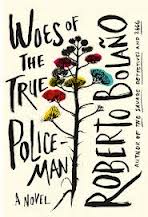
[READ: December 2, 2012] Woes of the True Policeman 

This is yet another unfinished novel from Roberto Bolaño.  Bolaño knew that he was dying and he created a lot of work in anticipation of his legacy.  The afterword of the novel says that they found all of the various parts of this novel in various locations among his work–hand written and computer drafted.  And they all mention this titles, so they are pretty certain about the order and that it is as finished as it could be.

Unlike some of his other posthumous releases, this one must be deemed pretty significant since it was published by Farrar, Straus and Giroux instead of New Directions (publisher of most of Roberto Bolaño’s other smaller works).

And really what it reads like is a kind of prelude to 2666.  For this is the same Amalfitano as in 2666.  But it is his story from before he moves to Sonora, Mexico–before all of the murders started.  Indeed, there are parts of 2666 which make Amalfitano’s past seem like it is unknown but this story fills in the gaps quite well.  One of the details in 2666 is that Amalfitano’s teaching contract had expired at the University of Barcelona, although this book gives the behind the scenes reason why it expired.

Bolaño has many many stories in which he explores the past of a character from a different story.  Typically, it is a novella in which a minor character from a bigger novel gets his or her own story told.  And that seems to be the case with this as well.

The story is set up in five sections (just like 2666).  Section I of this story (part of which was as excerpted in Harper’s recently) is called The Fall of the Berlin Wall and tells how Amalfitano, a professor, fell for a young poet named Padilla.  He wound up having an affair with him, which ended his career (I’m unclear whether it is because he is a student or because the affair was homosexual that the University wanted him out).  Amalfitano had never had homosexual desires before, and he was a proud husband and father, but he found that Padilla really affected him.

And so Amalfitano and Rosa, his daughter, moved to Sonora and the only school that would have him. (more…)

Read Full Post »

CV1_TNY_12_03_12Thiebaud.inddSOUNDTRACK: BEIRUT-Live at KEXP, October 3, 2007 (2007).  

beirutBeirut plays a fuller set here for KEXP than in the Tiny Desk concert.  They open with “Cherbourg” an accordion-based song that lurches along happily before the full band kicks in and begins rocking the song.   “Sunday Smile” feels very cinematic although when the martial beats begin the song takes quite a different sound.  “Cocek” opens with horns and accordion.  This is clearly not a typical rock set up at all, and it quickly turns into an awesomely shambolic dance instrumental.  My favorite track is “Forks and Knives (La Fete),” with it’s wonderful violin melody and falsetto’d lyrics.

NPR has given me a really great appreciation for this band.  They sound wonderful live.  I wonder if it translates well to studio albums?  You can hear this set here.

[READ: December 3, 2012] “Bear”

The December 3 issue of the New Yorker is The Food Issue.  Generally I don’t get that excited by this special issue, and this was no real exception.  But I wound up with some extra time so I delved into the four “Gut Course” articles in the magazine.

Gourevitch’s article is indeed about a bear.

He describes the “Summer of his twentieth year” (weird style there) in which he was in the mountains of Wyoming and got a job as an animal skinner.  He had no experience of skinning animals but he “moved through life with a dauntlessness born of cluelessness” (I like that) and he needed a job.

The place where he worked was a game-processing plant.  It was used primarily by tourists who killed for sport, so there was a lot of extra meat in the freezer. He and the other kid working there often liberated some frozen meat understanding that it would just get freezer-burned if they didn’t.  And then there came the bear. (more…)

Read Full Post »

CV1_TNY_12_03_12Thiebaud.inddSOUNDTRACK: BEIRUT-Tiny Desk Concert #159 (September 21, 2011).

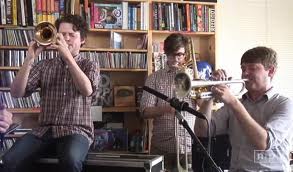
beirut tinyI don’t know a lot about Beirut.  NPR seems to like them and all I know about them comes from the shows NPR streamed.  This Tiny Desk concert is only 12 minutes long and the band doesn’t chat very much.  But they play three songs: “East Harlem,” “Santa Fe,” and “Serbian Cocek.”  This last song was meant as kind of a goof, a treat for the people who showed up (Beirut had just come back from Bonnaroo and were exhausted), but they allowed NPR to include it in the stream, which is a fun treat.

Beirut play a kind of jaunty horn-fueled eastern European-flavored music.  “Serbian Cocek” has a very tradition feel–an instrumental fueled by trumpets that’s very hard not to dance to.  They are certainly not to everyone’s cup of tea, but if you like some Europe in your rock, they are worth checking out.  Even if in this set they aren’t hitting the highest notes that they might otherwise hit.

[READ: December 1, 2012] “Literally”

This story runs a gamut of ideas in a very short span–death, race, marriage, public transportation, soft serve ice cream and the misuse of the word literally.

And perhaps there is too much crammed in here.  It’s not that the story suffers but by the time you get to the end of the story, the title seems irrelevant.   It refers to paragraph five in which Richard “liked to make his son smile by using his favorite word incorrectly.”  And then it’s not used again (unless you want  to argue that the end is somehow a literal moment, but I really don’t).

The story switches back and forth between Richard’s daughter Suzanne who works at the Dairy Queen and Richard’s son Danny, a smart alec kid who engages in the time honored tradition of mocking his sister (although she is completely oblivious to his taunts).  The story is also about Bonita, Richard’s housekeeper.

Every since his wife died (recently, in a car crash), Richard has become painfully aware of how much his wife did–even simple acts like communicating with Bonita.  Richard knows very little Spanish, while his wife was fluent.  His wife also helped out with Bonita’s son Isaac, who is “nervioso.”  So Bonita brings Isaac over most days.  Indeed, because of the districting, Richard and his wife agreed that Isaac and Bonita could claim that they lived with them, so Isaac could go to the better school.  Danny and Isaac get along very well, and often get absorbed in a game called “town” (which helps Isaac to relax). (more…)

Read Full Post »

SOUNDTRACK: THE ENGLISH BEAT Live at KEXP , March 8, 2007 (2007).

Afebkexpter enjoying the 2010 Bumbershoot concert I found this earlier in-studio show from The English Beat.  It’s amusing that it’s longer than the Bumbershoot concert (they play three of the same songs and eight in total).  This set introduces a few less “famous” tracks, like “Hands Off She’s Mine” and “Ranking Full Stop.”  They also play a “new” song called “Said We Would Never Die,” a sweet ballad in which he sounds a bit like Bob Mould singing.

When they play “Save It for Later,” they introduce the song with a verse from Pearl Jam’s “Better Man,” which must be a nod to Pearl Jam’s constant placement of “Save It for Later” in the jam session at the end of “Better Man” when they play it live.  The song ends with a lengthy sax solo.

Overall, this set is slightly less enjoyable for me than the Bumbershoot one.  The band adds a bit more jam into the set–the songs are longer and a bit more mellow feeling, which doesn’t work for ska.  But they all sound good and Dave Wakeling is very funny in his chats with the DJ.  He talks about his guitar being in the Rock n Roll Hall of Fame and the history of the ska movement.  How labels felt burnt that they missed the Sex Pistols and wanted to get whatever the next trend was.  This was interesting in that he talks about reggae and punk bands playing together on the same bill (before the skinheads went racist) and how the mellow reggae and the fast punk kept the dancefloor full if they alternated.  He also says that when they introduced the Beat Girl, it made the boys in the audience stop getting into  fights with each other and try to impress the girls.

As they head into their final song (“Tenderness”) Dave notes that “the first 27 years are the hardest.”  Hear if he’s right.

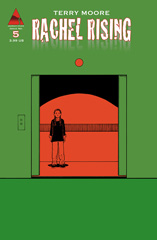
[READ: January 31, 2012] Rachel Rising 5-7

I have finally gotten around to reading some more Rachel Rising (it’s only been ten months), and I see that there are already several new issues out (I should get a subscription).

As I mentioned in the end of my review of the first four books, Terry Moore has gone to a really dark place with this series.  By the end of Book 7, my mouth was left agape, because I never thought that Terry would go quite so dark!

I like the way that Book 5 is more or less split in half with the first half being all about Rachel trying to fit back in with her friends (Jet reminds her of their pinkie swear to tell the truth about everything).  And yet there’s also Dr Siemen who states matter of factly (at the dinner table) that Rachel is the Angel of Death.

The second half of the book involves the little girl (she’s so cute with her pigtails).  A foster family is coming to take her for the night while the authorities try to figure out what happened to her house and family.  Moore goes dark right away with the man of the foster family showing his true colors, but the girl will have none of it.  And there’s a scene in an elevator which happens in movies, and yet in real life, I’ve never heard of an elevator door that doesn’t open when something gets stuck in it. (more…)

Read Full Post »

SOUNDTRACK: THE ENGLISH BEAT-Live at Bumbershoot, September 6, 2010 (2010).

I’ve always loved ska.  So to see that the (English) Beat were playing shows and playing them for download on KEXP was  a pretty grand thing.

I’m still trying to figure out if these short sets from Bumbershoot were KEXP-only shows (in which the band plays a brief set and then they play the actual show later), but I believe so. Anyhow, the band sounds great, singer Dave Wakeling is a great frontman, telling amusing stories about the songs and generally charming everyone (his singing voice still sounds great, too).

Wakeling has a nice little diatribe about Target.  It begins with him saying how he never was asked to be in a commercial before Target asked him for “Tenderness.”  And now it’s everywhere.  But he’s upset that Target supported the  anti-gay candidate in Minnesota.  He promises that if he ever gets the money from the ads, it will go to support the candidate’s opponent.  He also says that “Mirror in the Bathroom” was not about cocaine–they couldn’t afford it bcak then.

I’m not really sure who is in the band on this tour.  Ranking Roger is apparently running another English Beat band in the U.K.  Sigh.  But regardless, this was like a wonderful flashback to the long lost art of ska.  The set is a collection of highlights from their 80s career.  I mean look at all the great songs they wrote: “I’ll Take You There,” “I Confess,” “Save It for Later,” “Never You  Done That,” “Tenderness,” and “Mirror in the Bathroom.”

Listen for yourself here.

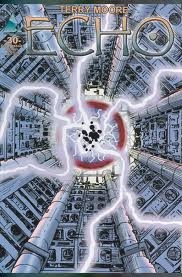
[READ: November 27, 2012] Echo #27-30

The problem with a comic book that comes out every six weeks (especially if you stopped going to the comic books store) is that it’s easily forgotten, no matter how much you like it (my rave of issues 25 and 26 leave me stunned that it has been almost two years since I last read the story).  But I recently went to my local shoppe and scored these last few issues (#30 even signed by Terry himself).  And I immediately got back into the story.

So as #27 picks up, we see that the climax is almost at hand.  Ivy, the hardened agent is growing younger and younger and is forgetting more.  Meanwhile, Julie is almost completely covered by the alloy and is now a giant.  And Annie is surfacing more and more in Julie (Annie is in the alloy’s DNA) which means Dillon is allowed a degree of closeness and closure.

#28 was awesome because it tied this universe back to the Strangers in Paradise world even more.  They are still using Tambi, the bodyguard, (from SiP) who worked for Darcy.  In this issue she interrogates another member of Darcy’s team (with the telltale tattoo).  By the end of the book Ivy is a mere child (the fact that Moore can draw this–keeping her Ivy and yet now looking like a little kid with such few lines is amazing). (more…)

Read Full Post »

SOUNDTRACK: ELFIN SADDLE-Wurld (2010).

Yesterday I mentioned the Wurld DVD.  Today I wanted to talk about the music.

There are three songs that come on the audio extras portion of he DVD: “Wurld Soundtrack (abridged),” “A River of Horses” and “A Tree in Dark Water/A Sinking Celebration.”  The “Wurld Soundtrack” is indeed the music from the film.  The abridged version is about 15 minutes long, while the movie is about 23.  I’m not sure what got cut or why it needed to get cut, but it’s a good reference to the movie–dark, a little creepy with moments of beautiful melody.

“A River of Horses” is dominated by a xylophone melody and a cool piano riff.  It has a loping quality that I really like.  It’s instrumental (and serves as one of the main themes of the DVD).  “A Tree in Dark Water” is a slower dirge-like piece which features Honda’s “Da Da Dee Da” vocals.  It more or less morphs into “A Sinking Celebration” which has a sound not unlike a carnival, but a very slow, almost sad carnival.  Both of these songs work as backing music for other aspects of the DVD–I’m not sure if they were songs first that they decided to use for the DVD or vice versa.

For the full Elfin Saddle experience, though, it’s worth watching the live show that comes on the DVD.  The show is a 7 song set that they performed before the opening of the Wurld exhibit in Montreal.  So yes, this show was performed Live at the Montreal Museum of Contemporary Art.  Nearly all of the songs come from their debut album Ringing for the Begin Again.

The band plays a kind of droney world music. And it has a very homemade feel–cobbled together, but brilliantly.  There’s an accordion, a bowed saw and a bunch of other percussive items–things that look like found metal.  There are two singers, Jordan McKenzie does most of the singing and he sings in a deep voice and sometimes in a higher voice that has a middle eastern feel.  Emi Honda is Japanese and that’s evident in her intonations, whether she is singing backing or lead vocals.  The band is also utterly multi-instrumental. McKenzie sings, plays accordion and xylophone at the same time (must be seen to be believed) while Honda switches from saw to ukulele to drums all in one song.  She also later bows cymbals for a very eerie sound.  Although they make most of the noise themselves, they are accompanied by a cellist and a double bass (which acts as a percussive time keeper).  Once they add a tuba, the song sounds much more klezmerish (although there are elements of klezmer throughout).

In the background of the show, on the projection screen, is the spinning wurld from their art exhibit.  The whole show is mesmerizing.  Songs include: “The Bringer,” “Sakura,” ” Muskeg Parade,” “Wind Songs,” “Garden,” ” The Procession,” ” The Ocean.”

[READ: October 15, 2012] Five Dials #25B

The issue continues the theme of the short story and Frank O’Connor.  It features a hugely long story by Nathan Englander and a couple more unusual short stories as well.  I enjoyed Part 2 of the Cork Issue more than Part I.

CRAIG TAYLOR-A Letter from the Editor: On Englander and Lists
In addition to introducing us to Nathan Englander and wondering if we’ve all read his award-winning book What We Talk About When We Talk About Anne Frank, Taylor talks about lists.  The staff was pooled for their opinions with the intent to make it seem like the staff was an individual with specific tastes in Books, Music, Movies, Food, etc. (more…)

Read Full Post »

SOUNDTRACKFOALS-Live on KEXP, May 30, 2008 (2008).

I really like Foals’ debut album, Antidotes and this short concert is all about that album.  They play four songs from the record and a fifth intro-type song called “XXXXX.”  The band sounds great, playing their complex rhythms perfectly.

“The French Open,” “Heavy Water” “Red Socks Pugie,” and “Electric Bloom” all sound remarkably similar to the record (not exactly, but amazingly close given the technical nature of the record).  The one distinguishing feature of this show is that the backing vocals are a little more prominent.  This actually gives the songs a slightly more ghostly sound.  Of course the angular math-rock of the album is still present in all of these cool songs.  The band is not very talkative, which is fine, since the music is what matters.

It’s interesting that the band says they prefer recording and creating to playing live.  They sound great live but you can definitely hear the joy they had in creating the record. The live session is here 

[READ: November 21, 2012] “Demeter”

Here’s another wonderful story from Maile Meloy.  In continuing with her excellent streak of simple stories about families (especially mothers and daughters), we have “Demeter” (I never know how to say that name).

This story differs from many of her other stories for a reason I can’t quite put my finger on.  It feels lighter somehow, although it’s not exactly a happy story.  Perhaps it’s that it seems so concerned with the weather and the elements, rather than the routines of the characters?  Whatever the case, the story is very much about the characters, specifically Demeter, a middle-aged mother of a thirteen year old daughter.

When Demeter and her husband divorced, she decided that the best custody arrangement would be that each parent received custody of Perry Mason (their nickname for their daughter because of her hard stare as a baby) for six months at a time.  On this particular day, Demeter is dropping off Perry Mason at her father’s for the next half a year. (more…)

Read Full Post »

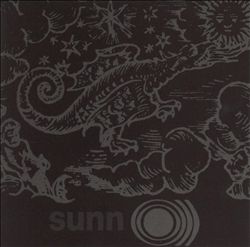
SOUNDTRACK: SUNN O)))-Flight of the Behemoth (2002).

I hadn’t really heard Sunn O))) until this record (which may not be typical as they collaborated with Merzbow on this one).  I knew that Sunn O))) played loud droney “music.”  And so it is here.  On “Mocking Solemnity” (9 minutes) and “Death Becomes You” (13 minutes) (which meld into each other seamlessly), the songs are mostly slow drones on electric guitar.  The chords are heavy and heavily distorted and they ring out for a few bars–not until the chords die naturally, there is a kind of pacing involved, but for a few bars until the chords are played again (often the same chord).  This is for those who thought Metal Machine Music was too complicated.

On paper this sounds unimpressive (or downright awful, depending) but in reality it is a very physical experience (if played loud enough).

The staticy noise of “Death” melds into track 3 “O))) Bow 1” which adds what sounds like radically modified piano playing a kind of melody.  It’s about 6 minutes and it really changes the tone of the record to suddenly add an atonal racket to the almost calming drone of the bass.  But by the middle of the song, the piano becomes what sounds like a chainsaw.  Merzbow mixed that track and  “O))) Bow 2” which is 13 minutes of the same slow pulsating noise.  It’s not exactly soothing.

The final track is “F.W.T.B.T.” a “remake” of “Metallica’s “For Whom the Bell Tolls.”  I can’t hear a thing that sounds like the original, but that’s what makes a cover interesting.  Although admittedly around the four and a half minute mark there’s some faster chords (for this band anyhow) that could be Metallica-like.  There are also drums (and vocals, although I have no idea what they are saying) on this ten-minute workout.

Not for the faint of heart (or fans of melody).

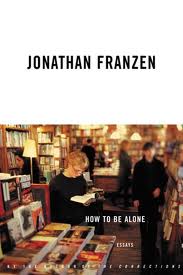
[READ: November 17, 2012] How to Be Alone

I read most of the articles in this book already.  But I read them over two years ago, so I thought it would be safe to wade into the world of Franzen again.  What I find most interesting about the title of this book is just how many of these articles are about being alone, wanting to be alone or feeling like you are alone.  Obviously that is by design but it seems surprising just how apt the title proved to be, especially given the variety of subjects  his father’s brain, being a novelist, the US Postal Service, New York City.

I’m not going to go into major detail about each article this time, although I am providing a link to the earlier review–my feelings didn’t really change about the pieces (except that from time to time I got a bit exhausted at his…whininess?  No, not that exactly…maybe his persecution complex.  But I will give a line summary about each one just to keep everyone up to speed.  The four pieces that I hadn’t read before I will give a few more words about.

One overall feeling is that when Franzen isn’t writing about the state of the novel (which he is very passionate about) his articles are well researched well documented which is kind of surprising given the state of panic he seems to be in the novel articles.  It’s also kind of funny how out of touch these articles seem (some are almost 20 years old and are kind of laughably outdated), but it’s also funny to see how poorly his predictions panned out.  The death of the novel is rather overrated (just see the success of his own Freedom.

So the book contains: (more…)

Read Full Post »

SOUNDTRACK: BELLE AND SEBASTIAN-Live at KEXP, April 13, 2006 (2006).

This four song set samples a broad swath of Belle & Sebastian’s career.  It takes place after The Life Pursuit‘s release, but they only play one song from it “To Be Myself Completely” (with Stevie on vocals).

It’s amazing how quiet and shy the band seems i the interviews (or is that bored and petulant) especially after being through the mad swings of success.  Indeed, the interviews are almost embarrassing how unresponsive the band is (but not rude unresponsive, just unresponsive).  Like “where did the soul influence on this album come from?”  “Probably black America.”  “Did the new producer have any influence on the soulfulness?”  “Not really.”

But they do let the music speak for them.  And they don’t just do the horn songs or the strings songs.  They play “She’s Losing It” from Tigermilk (with lots of horns–it sounds great), they play “A Century of Fakers” with strings (although the female vocals seem a little too subdued on this track).  They also play a rollicking cover of Badfinger’s “No Matter What.”  It’s a delightfully poppy song which I didn’t know but which Sarah did (and I thought was the Beatles, and the DJ guessed Paul McCartney wrote it–he didn’t).  It’s when discussing this song that the band finally gets animated, perhaps they just don’t want to talk about themselves.

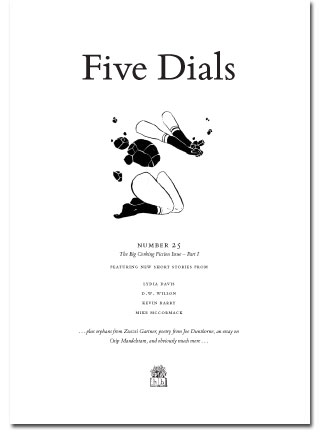
[READ: October 15, 2012] Five Dials #25

The issue is all about the short story.  Five stories from Lydia Davis, a short story contest from Zsuzsi Gardner, and a couple longer stories as well.   But there’s also some poetry and an essay.  And I fear I have to say I didn’t enjoy this issue as much as some of the other ones.  I love short stories, but I didn’t really love these very much.  And, the essay at the end was a lot of fury about very little.  I have to assume Part Two will simply kick ass.

CRAIG TAYLOR-A Letter from the Editors: On Orphans and Cork
Taylor name-checks the Cork International Short-Story Festival and mentions how this issue is a sort of tie in to the festival (and just how many writers wanted to be in this Cork issue).  Taylor says that many readers wanted more short stories in the Five Dials issues, and that Noel O’Regan, short story editor says that the short story is always alive–witness the great success of the Cork Festival.  Writers flock to it (and a hefty prize is given).  This issue is only Part I of the fiction issue because they simply had to break it into two parts. (more…)

Read Full Post »

« Newer Posts - Older Posts »