Feeds:
Posts
Comments

Archive for the ‘Death’ Category

dfwreadSOUNDTRACK: CHRISTIAN SCOTT aTUNDE ADJUAH-Tiny Desk Concert #477 (October 9, 2015).

aacsChristian Scott aTunde Adjuah and his septet play what he calls stretch music: “the particular type of jazz fusion he’s up to: something more seamless than a simple collision of genre signifiers.”

They note that even his appearance stretches traditional jazz: “You may note that he showed up in a Joy Division sleeveless T-shirt and gold chain.” It’s sleek and clearly modern, awash in guitar riffs, but also bold and emotionally naked.

Christian Scott aTunde Adjuah (not sure how to abbreviate that) is a trumpeter and he can hit some loud powerful and long –held notes.   It’s funny that when he bends over the trumpet grows quieter—those ic really are direction-based.

For the first song “TWIN” he does some impressive soloing over a simple and cool beat—piano and delicate guitar riffs (there’s also an upright bass and drummer).   After his lengthy solo there’s a flute solo that also works perfectly (if less dramatically) with the background music.  (Christian plays tambourine during her solo).  He says that this song is about being a twin.  His brother, Kyle Scott is a film director and for whom Christians scores the music.  Christian also explains that he comes from an African-American and Native-American background and that this song has rhythms as a sort of history of his family that touches on Mali, Senegal Gambia and The Ivory Coast and makes its way to the Caribbean, Cuba and into New Orleans.

He’s pleased to play the Tiny Desk Concert for an audience that appreciates “Music that has nutritional value.”

For the second song, “West of the West” he brings on a young alto-saxophonist who plays with his drummer in a different band. The song opens with a rocking electric guitar solo and then the jazzy band kicks in behind it.  The instrumental features a couple of solos by the saxophonist, the pianist and the bassist.

“K.K.P.D.” is a dramatic song for which he gives a lengthy back story.  Many years ago in his home of New Orleans, he was stopped by New Orleans police late at night for no reason other than to harass and intimidate him.  he was coming back from a gig.  He resisted and was in a serious situation and was seriously threatened—the story is long and very affecting, especially given how articulate (I know, terrible word, but true) and calm he is about retelling this horrifying story.  His pride almost made him do something ill-advised, but instead he channeled that pent-up frustration into a piece of music whose long-form title is “Ku Klux Police Department.”

He adds that we see things on TV about inner cities or the ninth ward and we believe them to be true.  Like that the neighborhood is happy that the police are clearing out the youth there.  We begin to think that the narrative is true, although the people who live there can tell you otherwise.  Despite the title and the origin, the is song is designed to reach a consensus to move forward –not to build derision or hate.  He says that we have to start working on that now, because if it doesn’t start now then our children will continue to inherit this situation.

It opens with a noisy guitar wash and fast drums.  It’s quite noisy and chaotic although it resolves very nicely into an almost sweet piano-based song with slow horns.  The middle of the song ramps up with some intense soloing from Christian.  I love how that segues into a very different section with an electronic drum and delicate piano.  Chritsian’s next solo is much more optimistic.  The final section is just wonderfully catchy.

When he introduces the band, he points out just how young some of his newest members are: Drummer Corey Fonville (another new member) used a djembe as a bass drum, and also brought a MIDI pad so he could emulate the sound of a drum machine; Lawrence Fields, piano; Kris Funn, bass; Dominic Minix , guitar (21 years old); Braxton Cook, saxophone (24 years-old) and Elena Pinderhughes, flute: 20 years old!

I don’t listen to a ton of jazz, but I really liked this Tiny Desk Concert a lot.

[READ: July-October 2016] The David Foster Wallace Reader

I’ve had this book since Sarah bought it for me for Christmas in 2014.  I haven’t been in a huge hurry to read it because I have read almost everything in it already.  And some of that I have even read recently.  But this summer I decided to read some of my bigger books, so this was a good time as any.

One of the fascinating things about reading this book is the excerpting in the fiction section.  I have never really read excerpts from DFWs longer books before.  And once you decontextualize the parts, you can really appreciate them for themselves rather than as a means to the end of the story.  This is especially true of the excerpts from Broom of the System and Infinite Jest.  But also just reading some of these sections as a short story makes for an interesting experience.

It was also very interesting to read the non-fiction all together like that.  These pieces come from difference anthologies, but they have thematic similarities  So, placing them together like that allows for really comparing the stories.

And of course, the selling point for most DFW fans is the teaching materials in the center of the book–an opportunity to look into the man’s mind at work shaping younger minds.

I have written about virtually everything in this book already (title links refer back to previous posts), so mostly these are thoughts about the pieces themselves and not a part of a whole. (more…)

Read Full Post »

olymmp SOUNDTRACK: WATKINS FAMILY HOUR-Tiny Desk Concert #471 (September 18, 2015).

wfhThe Watkins Family Hour began a dozen or so years ago as a way for a group of friends to get together and play old and new tunes. For Sean and Sara Watkins, it served as a monthly bit of magic: a musical variety show filled with extraordinary talent in the world of folk, bluegrass and beyond at L.A.’s famous Largo.

Sara and Sean Watkins took this fun on the road, with pianist Benmont Tench, drummer Don Heffington and bassist Sebastian Steinberg, and they made a stop at the Tiny Desk. They even brought along Fiona Apple to sing on “In the Pines” the old blues song.

The first song “Steal Your Heart Away” is sung by Sara (with violin melodies between verses) and Sean (on guitar).  It’s a bouncy folk song with a lovely piano added (which seems to move it out of the folk style a bit).  It’s a really catchy song with a great melody.

For “In the Pines” Fiona Apple sneaks out from behind the desk to sing.  Sean jokes that there’s some howling moments in this song and Fiona (who seems pretty nervous) jokes that she gets to be a dog.  I don’t know that I would have recognized Fiona’s voice as she puts on an accent and whoops (And Sean is a pretty good whoop-er, too).

The final song is “Hop High” another old song written by the hills–burbled up from the ground.   Sara and Sean take lead again on this slow brooding song.  Well, slow and brooding for the first verse, as the rest of the song takes off with Sara singing in her best gravelly voice the verse and Sean Sara and Fiona singing the chorus.

It’s a fun set full of great bluegrass-ish music

[READ: Summer 2015] Olympians 7-8

Last summer I read the first six book in the Olympians series. I’m not sure how many books he has planned for this series, although I see that he has another book planned for 2017.

Since I like what I wrote about the series for my previous post, I’m going to keep that here and then talk about each book.

George O’Connor is a massive geek and Greek scholar.  He has done lots of research for these books, including going to Greece and visiting sites and antiquities as well as comparing all manner of ancient stories to compile the most interesting pieces. He explains that since these stories were orally passed down, they were modified over the years.  He doesn’t change the myths, he merely picks the story lines that are most interesting to him.  And then he adds a lot of humorous modern touches (and dialogue) which keep it from being at all stuffy.

O Connor’s drawing style is also inspired by superhero comics, so his stories are presented in a way that seems much more like a super hero than a classical hero, which is also kind of fun.

Each book ends with an author’s note which is hugely informative and gives plenty of context.  It also has a bibliography, but more importantly, it has a list of notes about certain panels.  Do not skip these notes!  In addition to providing a lot of insight into the myths of the characters themselves, there are a lot of funny comments like “Greeks raced in the nude (point and laugh)” which really bring new depths to the stories. (more…)

Read Full Post »

black-daimons SOUNDTRACK: LAST EX-Last Ex [CST107] (2014).

last-exOne of the things I love about Constellation Records is that you often never know what you’re getting.  They used to very specifically release a certain kind of music, but they’re now just releasing interesting and exciting music.  But also, a band name can’t really tell you what to expect from this label.

So who knows what a band like Last Ex will sound like.  And how cool that their first few songs on this are so good.

The disc’s sides are split into Side X and Side XX.

“Hotel Blues” opens with some scattered drums and chords.  It has  vaguely early-Pink Floyd feel to it.  But around a minute in, the synths pick up a repetitive melody and the bass and drums kick in to give it a very Can or Kraftwerk vibe.  The song is fairly straightforward, but there are sprinklings of notes—sometimes slightly off and vibrated that add some very cool textures to this pulsing track. It’s really groovy and fun.  But it’s “Girl Seizure” that I find so strangely compelling.  Again, over simple repetitive drum and bass, the guitar (or keyboards) play warbling notes that are unsettling and yet enticing.  The song quiets to almost nothing and then resumes in much the same way—and you welcome that weird warble and its of Moog feeling.  At just under 3 minutes its just the right length.

“Flûte magique” slows things down with some simple arpeggios.  There’s not a lot to the song, but it is wonderfully soothing as the bass notes tick away and then the guitar notes rise higher and higher.  The song picks up speed as it goes along and leads to a middle section that’s almost stiffly funky, if that’s possible.  The ending gets a little louder as it thuds to a conclusion.

“It’s Not Chris” opens with some static and strange noises and some soaring keyboards.  About a minute and a half in a strange staccato organ melody comes in with a violin sound doing a kind of solo over the top.  It’s all a little strange but it drops out in the middle to a kind of sinister pulsing, and when the melody resumes, it seems strangely comfortable again.  The end of the song has some high-pitched violin notes that sound almost like a theremin.

“Resurrection Drive” is mostly drums and echoed surf guitar chords. After a minute or so some strings are added to the mix.  It’s only 2 minutes long but it introduces some interesting tension.

Side XX has a quieter feel overall.  “Nell’s Theme” opens with acoustic guitars playing a simple, pretty four-note melody.  The song slowly grows more complex as a violin is added to the song. With about 30 seconds remaining, everything drops away save for a mournful violin.

Thudding bass and picked notes echo through “Trop tard.”  It has a slow, spacey feel (like mid-period Pink Floyd).  A guitar is added and it speeds up some but still sounds of the era and then settles back down to a languid pace.  “Cape Fear” is less than 2 minutes of swirling outer space sounding synths—a creepy, lonely feeling.

“Cité d’or” has more slow pulsing rhythms and more echoing surf guitars and the whole thing feels rather tension filled.  Some squealing  feedback intersperses the surf guitar.   “Hotel Blues Returns” for 1:43.  It’s primarily the drumming pattern of “Hotel Blues” with some swirling synth noises (it’s good for headphones).  “Hotel Kiss” ends the disc with sirens and then a slow thudding drum and more noir guitars.  This could be used in a Twin Peaks scene.

So this album is an interesting mix of rocking songs with unsettling noises and mellower songs with cool synth effects.  It’s a great find.

[READ: September 24, 2016] The Black Diamond Detective Agency

I read this book a while ago, but I never posted about it.  And that gave me the opportunity to re-read it and, frankly, to enjoy it more.

This is the third book by Eddie Campbell that I have read.  I have found his stories to be complicated and hard to follow on first read.  They really demand a second and even a third read.  Part of it is that he writes complicated and somewhat intentionally convoluted narratives.  And part is because of his drawing style.

I love the cover of this book, how it is set up to look like an Old West placard: ORPHANS! MAYHEM! TERROR!  “In This the most recent offering from The First Second Quality line of Books.  An epic take of a newly industrialized America as revealed in words and pictures by the inimitable Mr Eddie Campbell.  Based upon  the manuscript of a Kinematographic play by Mr C. Gaby Mitchell.”

And its this last part that I missed when I first read it–that it was based on a screenplay.  And this book does resemble a screenplay.  However, I noted that in my other posts about Campbell that I’ve said of this book: I liked and didn’t like this book.  Well, which is it?

The story is incredibly complicated–with double and triple crosses.  And the visuals call for mistaken identity and hidden identity as well as new characters who all look vaguely the same–like pale photographs of turn of the century urban gangsters. But the story is really interesting. So I liked it, although I think I’d like to see it more as a film. (more…)

Read Full Post »

orcsSOUNDTRACK: AVEC LE SOLEIL DE SA BOUCHE-Zubberdust! [CST106] (2014).

cst106cover_258x242Avec le soleil sortant de sa bouche (With the sun out of his mouth–no translation for Zubberdust) is the creation of former Fly Pan Am bassist Jean-Sebastien Truchy.  With this album he has created a fascinating hybrid of near Krautrock repetitions with some King Crimson guitar lines and time signatures.  And interesting sung almost operatic male vocals.  Technically the disc has four songs, but songs 1 and 3 are extended suites broken into chapters.

“Face à l’instant” (Face Now parts I-IV) is the first suite.  This disc opens like Ministry–with an aggressive, fast, pounding guitar riff for 8 bars, a sharp pause and continuation of same.  After four measures of that, a quirky quiet instrumental takes over and at about a minute the heavy guitars return. Part 2 of the song starts with a funky, slightly off-kilter sounding guitar line and whistling.   About a minute into this secretion the song shifts to a quiet sequence of overlapping riffs and sounds.  About 5 minutes in, the voices start singing in wordless chants–it’s strangely catchy and slightly militaristic at the same time.  The song builds with voices until it climaxes with a stop.  Then a complex drumming pattern begins Part 3. The guitars lines resume and there are several vocals sections (I assume singing in French) that add a lot of tension to the song.  Midway through this part the song stops and that aggressive introductory guitar pummeling resumes, this time changing keys and not letting up.  New sounds and super heavy drumming are added as this brings part three to a climax.  Part 4 returns to quieter playing (and sounds a bit like Fly Pan Am in the way the guitar line as intersect.  The final section continues with the vocals and rhythms of the other three and then ends with some dramatic keyboard chords playing us out.

“Super pastiche fantastique” (Super fantastic pastiche) is the other suite.  It opens with some complex drumming and then several sequences of notes–guitar and synth that meld nicely.  Part 1 is just 3 minutes and by the end some electronic noises start overtaking the melodies.   Part 2 opens with the same melody but the electronics have been replaced by a wah-wahed guitar and more synth lines.  The song is complex and repetitive, with the only non-repeating part being the singer’s voice (no idea what he’s even saying).  The second half of part 2 (which is 7 minutes in total) ends with some sung vocals (not unlike David Byrne).  Part 3 is a 90 second interlude of very quick tinkling strings that are overwhelmed by noise and static and thudding drums.  The end of the track seems to be building up to part 4 which picks up the momentum into a great instrumental motif–intertwining guitars and electronics all with a cool bass line underneath.  After 2 and a half minutes the  song drops to drums and a funky guitar line with all kind of noises and static and voices working as transition to the cool bass line that comes in around 3 minutes.  As the song careens towards the end, the pace picks up and you can hear some intense screaming of vocals way in the distance.  The song cleans up and plays that great fast riff right up until the end when it abruptly ceases.

Tracks 2 and 4 are weird pastiches of sound. “Déja hier…” (Already yesterday…) is a four-minute song.  Interesting music plays very quietly in the background before it gets overwritten by conversation and static.  You can occasionally hear the song being played behind the noise, but it’s mostly just a weird kind of muffled noise.  “À partir de dorénavant” (From now) is similar.  You can hear a distant muddy drum and what sounds like la dinner party–tons of conversations going on at once.  It seems like the disc is going to end with 3 minutes of this, but a keyboard melody begins to slowly overtake the din.

The last minute or so is this interesting sci-f sounding synth line with warbling effects and an interesting, mellow bass.  Although it’s nowhere near as complicated as the rest of the album, it’s a cool way to end and almost feels like a segue into something else.

This album has a whole lot of styles and genres blended together into a (mostly) very cool mix of sounds.  I like it a lot, although I’ll probably skips tracks 2 and 4 most of the time.

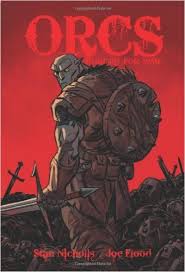
[READ: June 15, 2016] Orcs: Forged for War

This book was a little hard to learn about because Stan Nicholls has written several novels in the Orcs series.  So when you look up his books you get a confusing list of the series and other things.  This book is not part of the series, but it is part of the overall Orcs arc. It comes just before the First Blood Trilogy.

In the intro, Nicholls tells us lot more about his whole Orcs oeuvre.  He points out that unlike Tolkien (whom he loved) his Orcs are not mindless brutes. In fact, in his books, the orcs are the heroes and the humans are the ones who have along and messed things up.  He says that anyone unfamiliar with his orcs books should have no trouble following this book.

And that is true to a degree.  One thing that it behooves an author/artist to do is to make sure that everyone understands who all of the characters/races are in his/her book.  He does give a brief summary in the intro, but that doesn’t really help because there’s no visual guide.

Humans are divided into two camps.  The Manifold (Manis) pursue ancient pagan ways.  The Unity (Unis) are monotheistic.  They are both fanatics but the Unis have more bigotry and demagoguery.

This book opens with the Unis fighting the Manis.  And then the Orcs enter the fray but it’s not always clear whose side the Orcs on, if any. Regardless of which side they are on, they are willing to fight and kill whomever (there is much much bloodhsed and a shocking amount of vulgarity in the book). (more…)

Read Full Post »

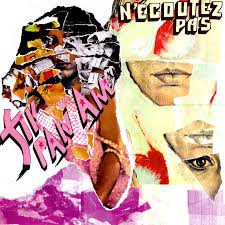
clowns SOUNDTRACK: LE FLY PAN AM: N’écoutez pas [CST031] (2004).

flypanam31N’écoutez pas (Do Not Listen) was the third and final full length album from Constellation’s Fly Pan Am (or in this case Le Fly Pan Am).  There are several short tracks on the disc as well as two 11 minutes songs

“Brûlez suivant, suivante!” (Burn Next, Next!) Opens the disc and hints that it’s going to be a standard rock album—4×4 drums and a dense buzzy electric guitar.  And even when the song proper starts, there’s chanted worded in French and some noisy guitar—its very far from the bass and funky glitchy stuff of previous albums.  The song has very conventional element—a drum break where one might clap along and what sounds like people singing lalalalalala, but all under a veneer of noise and decay that makes it anything but poppy.  There’s a deep voice speaking insistently in French and way in the background a person screaming.  So, really it’s rather unconventional, but within a relatively “normal” framework.  “Ex éleveurs de renards argentés” (Ex breeders silver foxes) is the noise of completely detuned guitars getting plucked and strummed for 30 seconds until a piano plays a chord and all else stops.  It seems like a song will begin but, no, more noises—industrial waves and cars honking takes over.  And then a cacophony of voices begins talking all over each other (including a couple in English).  It’s all over after about 2 minutes.

“Autant zig-zag” (As much zig-zag) is a totally apt name for this song.  This is the first 11 minute track.  After a minute or so introduction, the song comes in with a propulsive bass (not funky at all like the last album) and the song feels like it’s ready to rock.  And it does.  It keeps up this rhythm for a bit and then shifts to a new part with wordless vocals.  There’s even a call and response section with sung words and ooh ooohs as response.  The song shifts to a kind of pummeling section that continues for several minutes until the end.  It contains pretty much everything the band does.  “Buvez nos larmes de métal” (Drink our metal tears) is a noise collage with dramatic movie soundtrack type music played behind the static and distant voices and noises.

“Pas à pas step until” (Step by Step until) has a commanding one, two, three, pause, four, riff going on that is at once catchy and noisy.  The song proper comes in with whispered singing and a wild bass line.  Alexandre St-Onge contributes his wonderful chaos to this song which has some really catchy backing vocals in it

“…” opens side two with what sounds like a voice repeating Fly Pan Am over an over amidst the sound of someone else chewing.  It segues into “Très très ‘retro'” “Very Very ‘Retro’” is the other 11 minute song.  It has two guests, Dominique Petrin on vocals and Tim Heck on electronics.  The song opens with a high-pitched bass and some great counterpoint rhythms.   There’s more hidden vocals throughout the song  Around three minutes in, the bass gets funky.  This runs on for several minutes with some interesting sound effects thrown in until there’s a loud pop and silence.   And then another pop and organ music takes over.  At about 9 minute the song resumes the funky bass line. Again, the band has crammed a lot of stuff into this song.

“Vos rêves revers” (Your dreams setback) has a nice bass sound with some ringing guitar notes.  There’s whispered vocals that sing a melody of sorts.  It’s a fairly conventional song—catchy and bouncy with vocals and everything (true they are whispered and hushed vocals but they do follow a melody line).  At about 4 minutes (of 6), the songs crashes unto itself with the drums and the guitars seeming to fall apart

“Ce sale désir éfilé qui sortant de ma bouche” (This dirty tapered desire coming out of my mouth) has a deep echoing drum kick which keeps a beat.  In the distant background a keening voice kind of follows the melody.  The disc ends with “Le faux pas aimer vous souhaite d’être follement ami” (The false not love you madly want to be friend).  It’s a one minute song with sliding guitars and rock drums which propel this to as close to punk as the band has gotten.  There’s chanting and excitement and fun and then the whole song unravels after about 40 seconds at the end with a sloppy piano denouement.

And that was it from this avant-garde band. The members went on to make lots of other music, Jonathan Parant went on to form Feu Thérèse. Felix Morel has played drums with all kind of interesting bands including Et Sans.  Roger Tellier-Craig has been in Et Sans and Set Fire to Flames among others.  And Jean-Sebastian Truchy has played in several bands including Avec le soleil sortant de sa bouche.

[READ: February 6, 2016] City of Clowns

In the afterword to this book, Alarcón explains how it as written.  He lived in Lima, Peru for a year, teaching.  But while he was there, he had writer’s block.  So he moved to a farmhouse in the middle of America–pure solitude.  And there he wrote the story “City of Clowns” (which I read back in 2013 in the New Yorker) in English.  Sheila Alvarado talked to him about turning the book into a graphic novel.  And so it was completed (after much labor, he says) in a slightly condensed Spanish edition to be released in Spain.  And then, eventually, it was translated into English again, from the Spanish graphic novel.

Since the story really doesn’t change from the short story version, I’m going to put my original comments here:

It opens with Oscarcito going to the hospital because his father died the night before.  He finds his mother mopping floors because his father’s bill was unpaid.  And in that very first paragraph, she introduces her son to Carmela—the woman whom his father left them for.  She was mopping the floor with Oscarcito’s  mother.  He is confused and enraged by this.

His half brothers are also there.  He had never met them before, preferring to stay away from his father’s other life.  But he saw them in front of him and clearly saw that they were related to him.  But the most galling thing was that although he was the oldest of all the children, they were clearly the chosen children—after all, his father stayed with them.

Then we learn about his father’s life.  He was born in Cerro de Pasco and moved to Lima when his young family was still young.  He worked hard in semi-legitimate businesses and then brought his family to the city.  Young Oscarcito, age 8, loved it.  But his mother hated missing her family in Cerro de Pasco.  And now they were living with his father who was practically a stranger. His father worked hard and succeeded, but he was rarely home.

Between flashbacks to his father’s story we see that Oscarcito is now a reporter for the local newspaper and he has been asked to write about the clowns that are prevalent around the city.  Oscarcito is on a bus when a clown approaches.  The clown is pelted by water balloons but still manages to climb aboard the bus and peddle his wares—gaining a few coins for his “act.”  Oscarcito is not interested in the subject and puts it off.

So he travels to his mother’s house to see how she is doing, but a neighbor there tells him she has been living with Carmela since his father got sick.  His mother was embarrassed by this and asked the neighbor not to say anything to him.

His mother had been a cleaning lady since they moved to Lima.  She worked for the Azcártes, a wealthy local family who treated her very well and treated Oscarcito practically like their own son.  Oscar was even sent to a nice school where he was welcomed until they realized where he was from.  Gangs would steal anything from anyone, and were called Piranhas.  And that became Oscar’s nickname at school.  And soon he was made fun of by just about everyone, but especially by one boy.

A flashback then shows that Oscarcito went to work with his father doing construction on a few occasions—they worked very hard on expansions of people’s houses—working hard and working well and making good improvements.  But all the while, they were waiting patiently until they could rob them of all of their fine things.

So when he found his father was working for the father of the boy who made fun of him, he wanted in, and he stole the boy’s suit.

Finally, after putting off his article for ages, Oscarcito meets and interviews a clown.  And that clown tells him how he started and invites him along.  And Oscarcito does.  He finds that he likes the anonymity of the job.

All of the threads come to a head as the story reaches its close—where Oscar will confront his mother and deal with his newfound joy at being a clown.

The ending was very powerful and I enjoyed this story immensely.

There are few details from the original story that have been changed (and I amended my comments accordingly).

There is also an extra scene added of him dating a girl named Carla who walked on stilts.  There’s an erotic moment which is really interesting and which brings a whole new level of fascination to Oscar’s clown life.

Obviously the biggest change is Alvarado’s illustrations.  She does an excellent job recreating these scenes much as I imagined them.  I really  enjoyed the way she worked within the mens’ professions–putting words on bricks as his father was laying them, hanging papers up to dry with text on them, and using excellent distinctions of black and white to show the different settings in Oscar’s life.

The biggest change I think is the depiction of Oscar in his clown suit.  It’s nothing like I imagined and is all the better for it.  Alarcón says that now this is “its true and definitive form” of the book, and I imagine that this is what I will think of when I think of the story.

For ease of searching, I include: Daniel Alarcon.


Read Full Post »

coin2 hiddenSOUNDTRACK: MATANA ROBERTS-Coin Coin: Chapter 2 Mississippi Moonchile [CST098] (2013).

The first chapter of this series was a sprawling disc of free-form jazz and spoken word.  It was interesting and strange with a powerful message (not always elegantly delivered).  It felt too long, but I think it was done live which would make it more understandable as a long presentation.

Chapter 2 is quite different.  It is much shorter, but it has 18 tracks that flow seamlessly (and often without apparent logic) into each other.  Most of the songs are quite short as well.

“invocation” is a sultry jazz number (Matana Roberts plays saxophone).  There’s also piano, trumpet, double bass and drums.  One thing that I didn’t like about the first chapter was Robert’s “poetry slam” deliver of her spoken words.  This album more or less erases that all together with the inclusion of Jeremiah Abiah on “operatic tenor vocals.”  I don’t know what he’s saying (if anything) most of the time, but his voice soars above the jazzy din.

“humility draws down blue” starts in the middle of a trumpet solo and lasts for a minute and a half.  “all nations” is only 8 seconds long and seems to coincide with a vocal line from Abiah.  “twelve sighed” settles things down some.

The first real change comes with “river ruby dues,” which opens with a gentle piano motif, and Abiah’s vocals.  Roberts’ sax solo plays throughout.  There are somewhat recognizable motifs played throughout the album.  I was sure I heard parts of “Pop Goes the Weasel.”

“amma jerusalem school” also opens with a new melody–a four note sax line–without a doubt the prettiest melody of the disc.  About mid-way through the song, Roberts begins speaking/reciting.  There’s a lot going on in her saga.  When that ends, more instrumentals continue and “responsory” has a lovely falsetto singing section.

This half of the album has been fairly conventional jazz: rather pretty with some nice melodies—far more conventional than Chapter 1.

Although by “the labor of their lips,” things have become a bit more avant-garde.  But even that doesn’t last too long and by “was the sacred day,” a pretty melody has resumed and more spoken word comes in, this time in stream of consciousness.  It’s a story of childhood with some happy and some sad details including: “they didn’t like black people at the hospital. you could use a room but no nurses would attend to you.” and the story of a woman getting whipped for not saying ‘sir.’   Interspersed through this tale is a sung line “I sing because I’m happy I sing because I’m free.”

‘woman red racked’ features Robert’s singing voice—pretty and pained—with some nice, deep backing voices accompanying.  Interestingly, this vocal part ends with them singing “Amen,” but the song is not over… a sax solo emerges from this and plays a kind of wild section with Abiah’s vocals until the end.

“thanks be you” is a spoken piece, a story told to a child about the past “there are some things I just can’t tell you about” which references a lot of childhood songs.  It ends with the repeated refrain “Mississippi is a beautiful place.”

This disc is only 48 minutes and it feels just about the right length,  “benediction” ends the disc with a quietly sung song with another singer accompanying her: their voices sound great together.

As with the first one, the narrative is a little unclear.  The main thrust of the story is obvious and effective, but it would be hard to diagram the story.  Nonetheless, her use of jazz and traditional sources (“red ruby dues,” “woman red racked” and “benediction” are based on traditional American folk songs), make for an evocative look into slavery from the point of view of one family.

[READ: March 20. 2016] Hidden

Having recently read the Resistance trilogy I am much more aware of France’s role in WWII.  But that could never have prepared me for this children’s book about the Holocaust.  (written by Loïc Dauvillier, translated from the French by Alexis Siegel with illustrations by Marc Lizano and Greg Salsedo).

The book opens on a little girl.  She wakes up in bed and hears her grandmother crying.  When she asks what’s wrong her grandmother tells her about the “nightmare she was having.”

And that nightmare is her story as a young Jewish girl in occupied France and how her life was brutally upended.  This is all told with fairly cute little characters with oversized heads.

I’ve never heard this story from the point of view of a child before.  Her grandmother was a little girl going to school.  She and her friends did everything that you’d expect little kids to do and the story starts out very sweetly.  Then one day she comes home and her father says that they must all be sheriffs–wear the yellow star on their lapel.  Once they stray doing that, she is effectively shunned.  But she has no idea why–why does everyone hate the sheriff? (more…)

Read Full Post »

jerusalemSOUNDTRACK: JERUSALEM IN MY HEART-If He Dies, If If If If If If [CST114] (2015).

ififif Since 2005, Jerusalem In My Heart has been Radwan Ghazi Moumneh (all music) and Charles-Andre Coderre (all visuals).  This is only their second album, however, because they were always more of a live band.

Obviously there’s no real visual component to the record.

Since I don’t know all that much about this band, I rely on the Constellation records website for my information.  Thus:

Moumneh expands his compositional palette on If He Dies, If If If If If If, exploring new deconstructions and juxtapositions of both traditional and popular Arab musical currents, with an album that oscillates between powerfully emotive vocal tunes and instrumental works that primarily make use of Radwan’s expressive acoustic playing on buzuk as a point of departure.

The album’s first song “Al Affaq, Lau Mat, Lau Lau Lau Lau Lau Lau (The Hypocrite, If He Dies, If If If If If If)” opens the disc with a short piece of processed vocals.  The Arabic traditional voice is mildly auto-tuned which sounds kind of cool.  [FROM CST: One of Moumneh’s finest melismatic a cappella vocal performances].

Track 2, “A Granular Buzuk” is a 7-minute instrumental piece of Moumneh on buzuk with pulsing electronic background music.  [CST: the buzuk is processed, re-sampled and otherwise disrupted through Radwan’s real-time custom signal patches]. As with a lot of this record, pretty instrumental passages are interrupted and taken over by noise—this time a kind of mechanical scratching.  It ends with some quietly ringing percussion as the electronics all slowly drift away.

“7ebr El 3oyoun (Ink From The Eyes)” is a vocal track with an electronic drone.  It sounds traditional and mournful, but about 3 minutes in, a drum and buzuk keeps time and the song grows a bit more upbeat.  [CST: languidly plaintive vocals set against a gradually accelerating riff underpinned by hand percussion].

“Qala Li Kafa Kafa Kafa Kafa Kafa Kafa (To Me He Said Enough Enough Enough Enough Enough Enough)” has incredibly loud static with a buzuk playing in the background.   After a minute and a half the static drops away and the background is filled with a quiet pulsing kind of static.  You can finally hear the instrument being played in all its glory.  [CST: a scabrous white noise intervention wherein the entire audio mix is fed through a contact mic placed in Radwan’s mouth].

“Lau Ridyou Bil Hijaz (What If The Hijaz Was Enough?)” is mostly synth–again an old sound with metronymic electronic percussion and quiet vocals. It’s all kind of muffled and very retro.  [CST: Moumneh continues to channel his love for Arabic pop and Casio/cassette culture with this silky lo-fi dance].

“Ta3mani; Ta3meitu (He Fed Me; I Fed Him)” is a faster piece.  Echoed vocals and drones rest behind a fast buzuk melody.  [CST: he pays homage to the until-recently-exiled Kurdish poet and singer Sivan Perwer on this traditional-minded, unadorned folk tune].

“Ah Ya Mal El Sham (Oh The Money of Syria)” opens with a loud vocal and a flute mirroring the voice.  It runs for seven-minutes and ends quietly.  [CST: a tour-de-force drone piece built from Bansuri flute (performed by guest player Dave Gossage)].

The disc ends with “2asmar Sa7ar (The Brown One Cast A Spell),” a fast buzuk solo played over the relaxing sounds of oceans waves.  It has a cool melody and runs quickly and then calmly for some five-minutes before the disc ends with more waves lapping against the shore.  [CST delicate acoustic number set against the sound of waves recorded on a beach in Lebanon].

As with the previous record, song titles employ the transliterative characters used in Arabic phone texting, which I think is pretty cool.

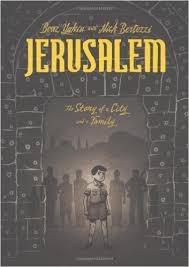
[READ: March 30, 2016] Jerusalem

With a title and subtitle like that you know this isn’t going to be a fun and lighthearted story.  And it is not.  The introduction explains how this is the story of a family, but it is more about the land and the strife that has been there for generations.

A lengthy history of Jerusalem is given, but for the purposes of this story the most recent action is the 1929 dispute over prayer rights which led to riots.  And then the British imposed the White Paper of 1939 which blocked Jewish immigration and was in place as the Nazis were riding to power. This led many Palestinian Jews to regard the British as hostile. And yet many Palestinian Jews joined the British army to fight the Nazis in Italy and the Middle East.  At the same time there were underground forces of Palestinian Jews who were attacking the British.

The action of this story takes place in 1945.

There is also a history of the Halaby family about whom this story is concerned.  Yakov Halaby was born after a series of girls were born in his family.  His father vowed that if they had another son they would move to Jerusalem.  After Izak was born they did so.  But Yakov was jealous from the start.  And he made Izak’s life miserable.  Eventually Izak left and married an Egyptian woman and they both moved back to Jerusalem. (more…)

Read Full Post »

[LISTENED TO: August 2016] The Penderwicks in Spring

pend-springWe have loved the Penderwick books.  But I remember that when this came out, Sarah read it and was disappointed. Not in the quality of the book, but because the story has moved on.  This book is set about five years after the action of the previous book.

I totally get Birdsall’s desire to write about Batty rather than her older sisters–to move on from what she has written about for three books.  In the previous book Rosalind was more or less absent, so Birdsall is not afraid to progress with her characters.  But those characters are so great, that to have them largely absent from the story was so frustrating!  I missed them all (So I guess she could take that as a compliment).

Of course, the “new” characters are fun, too.  The book is mostly about Batty, but her younger half-brother Ben is older and quite a character (and he gets to show us things from his point of view–the only boy in a family of strong Penderwick girls).  And Batty’s father and stepmother have had a new baby, Lydia, who is just climbing out of her crib and is quite a handful. (more…)

Read Full Post »

[LISTENED TO: August 2016] Neil Armstrong Is My Uncle & Other Lies Muscle Man McGinty Told Me

neilThe title of this book sounded weird and fun. So I grabbed it from the audio book collection at the library and we listened to it on the way home from vacation.

Set in Long Island (narrator Emily Bauer does some great Long Island accents for the adults (and a few kids) in the story), this is the story of a young girl, Tamara Ann Simpson (Tammy) growing up on Ramble Street in 1969 just a few weeks from the Moon Landing!

But that’s miles away.  Because it is summertime and all she can think about is kickball.  Well kickball and her friend Kebsie who took off all of a sudden one day without even saying goodbye.

Kebsie was Tammy’s best friend.  She lived in a foster home on Ramble Street.  They did everything together and even had a secret “arooo” signal.  They were BFs and even bought necklaces to prove it.  Kebsie was a straight shooter and took no crap from anyone.  And then one day, she was gone.  As we understand it, her mother returned and took Kebsie away to secret place because there was some kind of abuse in he family and they needed to be removed from everyone they knew. (more…)

Read Full Post »

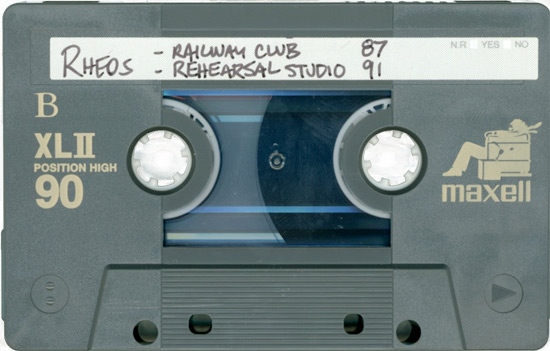
liofriends SOUNDTRACK: RHEOSTATICS-Railway Club, Vancouver, BC (November 1987).

RailwayClub87-PROD91It’s pretty impressive that this show (ostensibly from the same month as the previous show) has such a different setlist.  Between the two shows they play 22 songs and only four are repeated.  And this time five of the songs come from their debut album, Greatest Hits.

This tape begins with a recording of “Indian Arrow” by the 13 Engines.  It sounds very different from the other songs on the tape–the audience is very loud and you can hear a woman say “I wanna sing this one” (!).  I know this song from a Martin Tielli solo tour (and indeed, he sounds pretty much solo here–although there is a piano, too).

The rest of the tape all has the same audio quality but sounds different from the first song.  “Crescent Moon” begins mid-song (as if it was recorded over by “Indian Arrow”).   “Sad Sad World” is more upbeat than the title suggests with a “vocal solo” introduced with Dave and Tim chanting M-R-T-I-N in time with the music.  An upbeat “Ditch Pigs” leads to some silly banter during the guitar solo.  “Churches and Schools” sounds a lot like Talking Heads.  “Bridge Came Tumbling Down” is a Stompin’ Tom Connors song–they really had been playing him since forever.  Then they play a good version of “Higher and Higher” (from Greatest Hits).

It’s their last night in Vancouver, apparently which leads to a lengthy talk about he next song–a funky version of “Good on the Uptake” with lots of screaming at the end (from Tim).

The band plays the full version of “The Ballad of Wendell Clark” (with a some jokes about “Joel” whoever that is).  It’s rollicking and stomping and Martin starts playing “O Canada” as part of the solo.  Bidini stops the song and asks him to play it again, so Martin plays it on a good echoed effect (and Dave Clark shouts “alright Joel!”)  There’s some inappropriate jokes before Martin launches into a delicate version of The Beatles’ “Across the Universe-“-not the best version I’ve heard but still nice.

The final song is a romping stompin “PROD”–the only song The Rheostatics play in G#.  It has a fun shambolic end and it ends the set with them saying they’ll be back to play some Menudo tunes after a short break (which we never do hear).

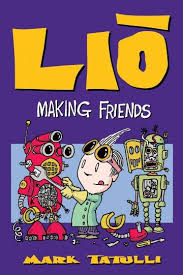
[READ: January 15, 2016] Making Friends

It’s unsettling to me that the Liō books come in different shapes.  This one is even hardcover!  The contents of these stories are not unsettling to me though, even if they are to some readers (looking online, you can find gripes).

Liō continues to be a strange kid who loves zombies and squids and spiders and playing pranks.  This is his latest book (and I just confirmed to see that he is still publishing daily, so a new book must be coming soon, right?).

Tatulli still has some great gags.  And this format book has some of the strips in color. (more…)

Read Full Post »

« Newer Posts - Older Posts »