Feeds:
Posts
Comments

Archive for the ‘Culture Shock’ Category

Harpersmaerch13

SOUNDTRACK: DEFTONES-“My Own Summer (Shove It)” single CD 1 (1998).

shoveitThis is a four track single (it’s out of chronological sequence, but it does follow the B-Sides release, so lighten up!).

Obviously, “My Own Summer” is awesome.

The other three tracks are live from Amsterdam.  The sound quality is not as great as I would like–Chino’s voice is mixed strangely and he seems to be “above” the music–almost like he is rapping to prerecorded music. It’s especially notable on “Lotion” which I don’t especially like here–it doesn’t really sound like the song so much as a guy talking over background.  It’s better on “Fireal-Swords,” but what’s most notable about the song is that in the middle of it, while the band are still playing, he talks to the crowd and asks them to be a little gentle to some guys (I can’t imagine the context) at least for the rest of this song, okay?

In the final song, “Bored” the band sounds great–and Chino’s vocals distortions are incredible (and incredible in how consistent they are–does he have pedals or something).  But in this case, in the middle of a verse, the band completely stops when Chino sees a kid on the ground.  He asks if the guy’s okay and you can hear the relief in his voice when you find out he’s just looking for his shoe.  So they bring the kid on stage and tease him a bit and then let him stage dive off as they pick up at the next chorus–from zero to ten –like nothing happened.  Cool.

It was very impressive to hear genuine concern from such a loud and screamy band.

[READ: March 5, 2013] “Deeper Winter”

This is a story about an illegal immigrant.  And what’s interesting about it is that there’s no “message” one way or the other about illegal immigrants.  Eduardo is just a guy looking for a job and a place to stay.

The story opens with Eduardo and his Uncle Luis at a Dodgers game.  Luis is telling him that he has to move out because he and his lady want to get married and have the place to themselves.  Eduardo understands, he knew the place was only temporary for him.  Luis feels bad, but he has already gotten in touch with a friend in Idaho who can get him a job and give him a place to stay.  He also gives Eduardo a down parka and a bus ticket.

Eduardo sets out on a quiet Sunday morning bus.  They stop briefly in Las Vegas and then they’re off to the north.  When the bus arrives, Miguel is there to pick him up.  Miguel’s mother is very excited to see Eduardo (Eduardo of the Angels she calls him).  She reveals that she and Luis were an item a long time ago and she thinks of Eduardo as family.  They give him his own room and tell him that he’ll be working with Miguel on a construction site–working for Johnny Danilo.

Eduardo is a quick study and learns the fine art of roofing so that when the job is finished (it’s a big job and takes awhile), Danilo lets him put on the finishing caps–something of a rite of passage.  There’s plenty of work upcoming, so Danilo invites Miguel and Eduardo to keep working for him.  Eduardo becomes friendly with Danilo and his son Leo.  Eduardo even shows Leo how to pitch like Fernando Valenzuela.  But one day when Eduardo returns home, Miguel and his mom have taken off–they left Eduardo’s things but cleared out everything else.  Eduardo has no one to turn to except Danilo. (more…)

Read Full Post »

CV1_TNY_01_14_13Mattotti.inddSOUNDTRACK: DEFTONES-Deftones (2003)

defTypically when a band has a self titled album in  the middle of their career a change is taking place–a re-imagining, perhaps or a return to roots.  Deftones is something of a return to roots.  Since I loved White Pony’s diversity so much that’s a little disappointing for me, and yet while there aren’t as many interesting sonic ideas, the songwriting is still top notch and there are some really catchy and clever ideas too.  The first song, “Hexagram” is a very heavy (and very screamy) song.  And although the guitars during the verse are bright and ringing (nods to alt rock) this song is all about being heavy (the vocals seems like Chino Moreno’s throat is literally shredding as he songs).  “Needles and Pins” has a cool complex drum patter (Abe Cunningham, fabulous) and the guitars (Stephen Carpenter, also fabulous) are staggered and interesting.  And when the bass really comes in on counterpoint (Chi Cheng, doing some amazing stuff on the bass), the song is far more complex than the screamed heavy chorus might indicate.

“Minerva” has all of the trappings of a hit–a big chorus in a major key, and great verses.  And yet, the song’s production is very claustrophobic (it kind of has a Tool feel).  That doesn’t detract from the song at all, but it’s interesting that they would take something that could have easily been huge and yet made it a little less user friendly.  “Good Morning Beautiful” has some really heavy guitars (especially in the chorus) but the vocals are kind of soaring here–more of that contrast adding up to something wonderful.

After the heavy onslaught of these songs, “Deathblow” slows things down.  The guitar and bass are slow and kind of stretched out(and sound great together).  They really let Chino’s voice show off.  “When Girls Telephone Boys” is a heavy blast from the start.  And like a lot of these songs the distortion might actually be a little too much–it kind of makes the song less pleasant than it might be–which is obviously intentional.  “Battle-axe” opens with a mellow guitar intro (not unlike Metallica’s “One”) but the verses immediately introduce the heavy guitars again.

And yet, just as this albums seems like it will be all heavy and relentless, the band throws in “Lucky You” a song with electronic trip hop drums and effects.  It is a creative song and quite interesting, it just seems so odd to throw this in almost all the way at the end of the disc.  It stays moody throughout with layers of vocals and guitars.  But “Bloody Cape” snaps you out of that with a pummeling guitar intro, although as with White Pony, the verses open up with some interesting guitar sounds making this song more than it seems at first.  But make no mistake, this is a punishing, pummeling song by the end.  “Anniversary of an Uninteresting Event” throws another curveball, though. It opens with a slow piano riff and stays as a slow ballad (complete with gentle percussion and washes of sound).

The disc ends with “Moana” probably the most conventional (which is not a bad thing) song on the record.  It doesn’t have the heavy downtuned riffs, just big guitars and Chino’s whispering voice.  So in some ways this album is a disappointment–especially coming after the experiments of White Pony.  And yet the album is not un-experimental it is simply experimenting within a much smaller genre pallete.  I’d read that it seemed like this album came before White Pony, and it does, as if they were stepping back from their crazier impulses.  But the quality of the songwriting is till strong.

[READ: February 28, 2013] “The Women”

I had started this story last month and then lost the magazine.  I thought that maybe I could pick up where I left off, but it turned out I only remembered the part about the two women, not the main character, so I had to start over again.

The story is about Cecilia Normanton who grew up in the 1908s with her father but didn’t know her mother.  Mr Normanton and his wife had a happy, laughter-filled marriage for two years and then she was gone (which in this case means she left–not that she died).  The first section of the story talks a lot about Cecilia in her daily life–she was very pretty for her age but also very naive and she was permitted a rather carefree life.

Until she was sent to boarding school.  Which she hated at first.  Then she grew to like it and her father was relieved about that.  The school is nice, she is well treated and she makes good friends   Although she hates being forced to go to the field hockey games–especially since her least favorite person is on the team (and the team never loses).

At one game, two older women are watching–Cecilia noticed them at one previous game as well.  She can’t figure out who they are–they’re not former students, they’re not for the other team, their presence is weird.  And at that game they almost interact when Cecilia drops her watch and the women narrowly avoid stepping on it, but really there is no connection.

Nevertheless, the narrative follows the women as they return from the game by train.  We learn about their lives and their history together–they used to work together and call each other by their last names.  (more…)

Read Full Post »

scarletSOUNDTRACK: ERIC CHENAUX-Guitar & Voice [CST088] (2012).

chenauxThis album is indeed just guitar & voice.  Chenaux is a performer who grows on me.  His music is incredibly slow and drawn out.  And I often find that his vocal melodies don’t always have much to do with the guitar parts he plays.  It feels like everything is improv.  And it’s unsettling at first.  As is the fact that half the songs are pretty ethereal songs with words and the other half is wild and chaotic guitar solos, in which the guitars sound like anything but guitars.

But when you actually listen to the lyrics (which aren’t always easy to follow, he sings them so languidly) they’re quite lovely.  Like, “With the clouds in the sky and the bags under my eyes I wrote your name a thousand times with an old flashlight last night.”  But the more notable thing is the guitar work.  In “Amazing Backgrounds,” he plays a simple, plucked acoustic guitar but the solo is a crazy electric guitar that is played backwards and sounds completely from outer space.  “Dull Lights (White or Grey)” is another beautiful piece with overdubbed guitars playing some great low bass sections while the other guitar plays pretty, high notes (an a cool wah wahed section too).

“Put in Music” sounds the most traditional–the vocal melody is pretty straightforward and his vocal actually has weight (it’s usually up in the ether somewhere).  And I think it works very well as a grounding for the album.  Although the guitar solo sounds like he’s playing more with the tuning pegs rather than bending the strings–it’s cool and disconcerting at the same time.  “However Wildly We Dream” is a very jazzy feeling song–upbeat finger plucking.  It’s the most conventional song and it really packs a wallop (a gentle, airy wallop but a wallop nonetheless).

The second track “Simple/Frontal” is an instrumental.  I assume it is all guitar but it sounds like slightly discordant violins playing against each other.  “Sliabh Aughty” is a nearly nine minute solo that sounds reversed and is a wild meandering piece (played over a constant drone).  It has an Irish feel, which makes sense as the Slieve Aughty (Irish: Sliabh Eachtaí) are a mountain range in the western part of Ireland.  “Le Nouveau Favori” is a short instrumental–two minutes with what sounds again like a bowed violin/drone.  And how can one not enjoy a piece called “Genitalia Domestique” another 2 minute droney instrumental. Chenaux definitely plays with sounds that don’t quite go together, often making an eerie collection of tunes.  Especially when they are compared against the pretty acoustic of the songs with words.

The final track is “Glitzing for Stephen Parkinson” and it continues with that weird bagpipe/organ drone that he pulls out of his guitar (I’d love to see him perform this stuff live–although how would he do the overdubs?)

The stuff takes a  few listens to get used to, and it’s certainly not for everyone, but the sounds he gets out of a guitar is truly amazing.

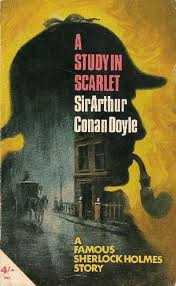
[READ: February 16, 2013] A Study in Scarlet

I mentioned recently that we have been watching a lot of Sherlock Holmes items.  So it seemed appropriate to read some of his stories as well.  I brought home a collection of the short stories not realizing that there were two novels written before the stories.  Sarah read the stories, but I held out for the debut novel.

The show Sherlock laid an amazing ground work for the books because the show (despite being set over 125 years after the books) is quite faithful to the stories.  Indeed, the way that Holmes and Watson meet is pretty much straight out of the book.  And, also indeed, the first episode took much of the story form this first book.  There were some very key changes to the story, ones that made the show very very different in the end, but the foundation is certainly there.  Interestingly, the way the murder is performed in the book (which we learn very very late in the story) proves to be the same methodology used in a different episode of Sherlock.  Two episodes from one book!

So in this book Watson opens it by giving a little backstory about himself and his quest to find cheap lodging in London (he’s back from the war in Afghanistan–a fascinating coincidence in terms of timeliness of wars) and he has blown through a lot of his stipend.  A mutual friend introduces Watson to Holmes and they agree to live together   I was a little concerned about the pace of the book at first, as it seemed like Watson was going to go into a lot about himself–but he doesn’t.  It’s a brief chapter that gets all the details out of the way.

Then we meet Holmes.  He explains his own eccentricities and how he is a consulting detective (Watson wondered why these people kept appearing and asking Hiolmes questions about who knew what).  And then finally we (the reader and Watson) are invited into a case.  A man was found murdered in a house.  There were no stab wounds, although there was blood.  The only other evidence was a word scratched in blood on the wall: Rache.

If you saw Sherlock this will sound familiar (except that the victim was a woman).  It deviates quite a bit from here (Rache is used in a very different way from the show, which I really liked), but Holmes recognizes the tobacco and is able to deduce a ton of things just from the surroundings.  He doesn’t tell the police right away, for fear that if the criminal knows the police know about him, he will flee).  And as the first half of the book draws to a close, the murderer is apprehended.

Imagine my surprise though when the next chapter opens up in the American Southwest.  All of a sudden the story has shifted utterly to a man and a girl trudging through the mountains,  lacking food and water and clearly near death   What?   (more…)

Read Full Post »

TintinLotusSOUNDTRACK: THE DOUBLECLICKS-“The Internet National Anthem” (2012).

inatThe Doubleclicks are a sister duo from Portland, Oregon.  They are nerdy and fun (perhaps we can think of them as non-accordion, female They Might be Giants?).  Take “The Internet National Anthem”,” a song  with a steady four/four beat, cellos and  a suitably anthemic chorus, that’s all about the internet.

I was introduced to this band from Kid’s Corner, although I feel that perhaps their songs aren’t really for kids (not that they’re inappropriate but they seem more sophisticated than a typical kids song.  Like this song has big words and it is quite funny.  Although in all honesty it’s not laugh out loud funny, just mildly funny.  It’s got the vibe of Garfunkel and Oates, but not the big guffaws.

Check out their albums here .

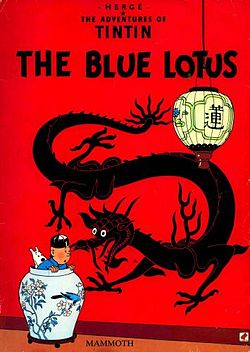
[READ: February 8, 2013] The Blue Lotus

This third (technically fifth) Tintin book is the continuation of Cigars of the Pharaoh.  One of the characters from Pharaoh returns in this book, despite the fact that it is set in China.  This book also continues with Hergé’s having it both way in terms of other races.  His drawings are caricaturey and depending on your sensibilities/appreciation for drawing skills/tolerance are either really racist or simply in poor taste (although it does seem to be that the bad characters of other races are the most offensive–the good people are less crazy).

But despite the visual insensitivity, there are several section where Hergé explicitly talks about tolerance and understanding between races.  Like when Tintin saves the young Chinese boy, Chang, who says he thought all white devils were wicked.  Tintin explains that white people believe stupid things about Chinese people too  (eating rotten eggs, tons of unwanted babies in their rivers, etc.).  Chang says “They must be crazy people in your country).  As it turns out (quoting Wikipedia ), “The Blue Lotus is a pivotal work in Hergé’s career, moving away from the stereotype and loosely connected stories and marking a new-found commitment to geographical and cultural accuracy. The book is also amongst the most highly regarded of the entire Tintin series, and was the 18th greatest book on Le Monde’s 100 Books of the Century list.”  It’s quite progressive for the 1930s.

The plotlines from the previous book are continued: there is the poison that makes you crazy, the Pharaoh’s logo shows up and there are Indian characters returning as well.  And by the end Thompson and Thompson, the twin policeman who complicate each others sentences and prove to be more bumbling than we originally thought arrive to capture Tintin (although they believe in Tintin’s goodness–they’re only following orders, you see). (more…)

Read Full Post »

McSweeney’s #13 (2006)

13SOUNDTRACKPARTS & LABOR-Stay Afraid (2006).

partslaborParts & Labor have changed t heir style over the years going from noisemakers who have a melody to being melodious noisemakers.  This album is one of their earlier releases when noise dominated.  Right from the opening you know the album is going to be a challenge.  The first song has pounding drums (electronics that sound like bagpipes) and heavy distorted shouty vocals.  By the end of the songs there is squealing feedback, punk speed drums and screaming distorted vocals (complete with space sound effects).  It’s an aggressive opening for sure.  Song two opens with a long low rumbling and then “Drastic Measures” proves to be another fast-paced song.

“A Pleasant Stay” is 5 minutes long (most of the rest of the album’s songs are about 3 minutes).  It continues in this fast framework, although it has a bit more open moments of just drums or just vocals.  The way the band plays with feedback in the last minute or so of the song  very cool.

“New Buildings” has a hardcore beat with a guitar part that sounds sped up.  “Death” is a thumping song (the drums are very loud on this disc), while “Timeline” is two minutes of squealing guitars.  “Stay Afraid” has a false start (although who knows why–how do these guys know if the feedback sounds are what  they wanted anyhow?).  The song ends with 30 seconds of sheer noise).  The album ends with the 5 minute “Changing of the Guard” a song not unlike the rest of the album–noisy with loud drumming and more noise.

The album is certainly challenging, it’s abrasive and off putting, but there;s surprising pleasures and melodies amidst the chaos.   Indeed, after a listen or two you start to really look forward to the hooks.  If you like this sort of thing, this album s a joy.  It’s also quite brief, so it never overstays its welcome.

[READ: April 15, 2011] McSweeney’s #13

I have been looking forward to reading this issue for quite some time.  Indeed, as soon as I received it I wanted to put aside time for it.  It only took eight years.  For this is the fabled comics issue.  Or as the cover puts it: Included with this paper: a free 264 page hardcover.  Because the cover is a fold-out poster–a gorgeous broadside done by Chris Ware called “God.”  And as with all Chris Ware stories, this is about life, the universe and everything.  On the flip side of the (seriously, really beautiful with gold foil and everything) Ware comic are the contributors’ list and a large drawing that is credited to LHOOQ which is the name of Marcel Duchamp’s art piece in which he put a mustache on the Mona Lisa.  It’s a kind of composite of the history of famous faces in art all done in a series of concentric squares.  It’s quite cool.

So, yes, this issue is all about comics.  There are a couple of essays, a couple of biographical sketches by Ware of artists that I assume many people don’t know and there’s a few unpublished pieces by famous mainstream artists.  But the bulk of the book is comprised of underground (and some who are not so underground anymore) artists showing of their goods.  It’s amazing how divergent the styles are for subject matter that is (for the most part) pretty similar: woe is me!  Angst fills these pages.  Whether it is the biographical angst of famous artists by Brunetti or the angst of not getting the girl (most of the others) or the angst of life (the remaining ones), there’s not a lot of joy here. Although there is a lot of humor.  A couple of these comics made it into the Best American Comics 2006.

There’s no letters this issue, which makes sense as the whole thing is Chris Ware’s baby.  But there are two special tiny books that fit nearly into the fold that the oversized cover makes.  There’s also two introductions.  One by Ira Glass (and yes I’d rather hear him say it but what can you do).  And the other by Ware.  Ware has advocated for underground comics forever and it’s cool that he has a forum for his ideas here.  I’m not sure I’ve ever read prose from him before. (more…)

Read Full Post »

cigarsSOUNDTRACK: THE BOARD OF EDUCATION-“Why is Dad So Mad?” (2012).

dadI heard this song on Kids Corner and I am frankly shocked that it didn’t make the top ten songs of the year (kids have no taste).  Why is dad so mad?  Because of what George Lucas has done to the Star Wars movies!   “Why does dad get so mad about Star Wars.  Mr Lucas what have you done?”

 The lyrics are so good I didn’t even really notice the music at first (check out: “and I wonder why it’s so bad that Greedo shoots first at Han.”  “He’s always excited when those yellow words come on, but by the end he’s mad about that new Ewok song.”

But the music is great too.  It has a kind of Ben Folds vibe (in the slow piano section) mixed with a little Ralph’s World, but the whole package is a wee bit heavier–the guitars are a  little distorted (but not very) and the pace is brisk and fun.

The song is also full of cool spacey sound effects (and a nice nod to the soundtrack).  The chorus is catchy and poppy.   A wonderful song.  I’m going to investigate The Board of Education a bit more.  In the meantime, check out Why is Dad So Mad?.

[READ: January 19, 2013] Cigars of the Pharoah

This second (technically fourth) Tintin book was a lot more focused than In America, which, although excellent, tended to ramble all over the country.

This book sees Tintin in the Mediterranean Sea on a cruise.  The action starts right away when a bumbling man named Dr Sarcophagus, an Egyptologist, crashes into Tintin saying that he lost his valuable papyrus.  The papyrus blows out to sea, but the Dr says, that indeed it wasn’t the valuable papyrus at all, which is safely in his coat.  It’s a weird moment, but we slowly learn that the Dr is more than a little absent minded.  Nevertheless, the papyrus has a map on it that he believes will lead to the undiscovered tomb of the Pharaoh Kih-Oskh (nice joke there).

I said that the last Tintin book wasn’t quite for kids and the same is true here.  Two men, Thompson and Thompson (more on them) accuse Tintin of smuggling opium and cocaine (again, did kids read this in the 30s?).  Thompson and Thompson are funny in that they look alike and when one says something the other twists the words slightly to radically alter their meaning while using most of the same words.  Anyhow, they “arrest” Tintin, but as in America, he escapes in an unlikely way and meets up with Dr Sarcophagus.

Tintin, Snowy and Sr Sarcophagus escape some violent deaths in a number of funny ways (like when the sheik who hates Westerners recognizes Tintin from his adventures (he even has a book–although in this later edition it is actually a book that came out after this one.

In another scene, Tintin rescues a woman who is being beaten, only to find out that he is actually on a film set.  Later, he winds up on a ship of smugglers, is forced to enlist in the Arabian army and is eventually made to face a firing squad. (more…)

Read Full Post »

tintin americaSOUNDTRACK: THE DIGGITY DUDES-“My Science Project” (2012).

diggityThe Diggity Dudes are getting a lot of airplay on Kids’ Corner on WXPN.  I like them in theory but I don’t really like the style of music they play–it’s a little too generic.  That being said, I do rather like the lyrics of this song.

It’s all about doing, yes, a science project.  “Measure twice or you’ll have a disaster.”  The problem is that the verses are done in a  rap style that’s not very good.  And the rhymes are awful.

I give them credit for writing about cool subjects for kids (like “To the Library” which I would have reviewed but they didn’t have it playing on their site).  But if they weren’t a kid’s band, I wouldn’t like them at all.  Despite that, I imagine they put on a great live show–they seem like they’d be a lot of fun.

[READ: Jauary 10, 2013] Tintin in America

I have known of Tintin for years (Sarah and I even have an inside joke about the boy journalist).  When we went to Brussels, we went to the art museum and saw the history of Hergé’s works (Hergé’s real name is Georges Prosper Remi) and the tons of souvenir Tintin things that are for sale. And yet I’d never read any of his stories.

I saw some in the library and decided to check out volume one.  Interestingly, this volume starts with Tintin in America. While reading it I quickly determined that this was not the first book in the series.  Indeed, America is the third book after Tintin in the Land of the Soviets and Tintin in the Congo (neither of these two are readily available in the US–the first because Hergé later felt it was too crude to redo for collections and the second because the depiction of Africans was deemed offensive).  So, most collections begin with this book (which is only a little odd because he is already well-known and the story seems to start in the middle because he dealt with some of these thugs in book 2).

But on to America. (more…)

Read Full Post »

[WATCHED: Summer 2012] Great Expectations

300px-Great_expectations_titlecardSometime after I read Great Expectations, PBS aired this BBC production.  I don’t know if it’s a movie or a mini series and I don;t really care, so I’m calling it a movie.  So I thought I’ll just wait until after I watch the movie and then write my post about both.  And now here were are, several months later.  Sigh.

Anyhow, this movie version of the book was outstanding.  One of the main criticisms leveled at movie versions of books is that your own imagination makes things far “more” than any film could.  For instance  monsters in your head are far more scary than any special effects could make them.  But the opposite was true here.  I never would have guessed that the people in the book could be so horrible, that the squalor could be so extreme and that the atmosphere could be so stifling–I assume years of good breeding made me forget just how bad things used to be

Part of the fault also belongs to Dickens–he was writing for a contemporary audience–for people who didn’t need to be told, for instance, how old Pip was (they would just know) or how old he would need to be to receive his inheritance.  The story was serialized in a magazine, so it was very current.  And so those of us with a great remove from daily life in 1850 don’t always get the details we need.  This is not to say that Dickens himself was not a master writer or an evocative picture creator.  He often includes lots of details they are very helpful, but some things are left out.  So the movie filled in gaps and details that I didn’t know, and they brought the book to life in a way that reading it alone didn’t.  Again, no disrespect to the book–it’s the same way that seeing Shakespeare is better than reading him).   (more…)

Read Full Post »

[ATTENDED: December 9, 2012] A John Waters Christmas

watersSarah and I were pretty excited to go see John Waters: gay icon, movie provocateur and all around oddball.  We had no idea what to expect from this show (his Christmas shows have apparently been around a long time although I have no idea how much it changes per year), but we knew it would be peculiar (and damned funny).

What we got was John Waters in a beautiful sparkly suit talking about seemingly whatever came into his mind (although I know from others that  the routine has the same elements in every show, so I it is not extemporaneous).  He had a podium and a bottle of water, but he used neither.  Instead, he walked around the stage, telling stories, telling jokes and being as filthy as he could.

Since this is a Christmas show, he talks a lot about the holiday (he really likes it, mostly because people give him presents), he talks a lot about sex (the more deviant the better), and he talks about himself.

We were surprised by the age range in the audience   Aside from a few young people (in punk garb), we were the youngest by far.  And while that certainly makes it seem like the older folks of the Branchburg area are much hipper (and dirtier) than I realized, it also makes some sense.  Waters definitely reached his most prolific peak quite some time ago.  And those earlier film were much raunchier than his more recently releases.  By now, Waters has settled in as kind of an outre celebrity but one who is more than happy taking part in pop culture (The Simpsons for instance–quite a long way from Divine eating poop).  We wondered if half of them knew what they were in for–but I didn’t hear any gasps, so I guess they did.  The older attendees could no doubt also appreciate a number of cultural references that were just too old for me. (more…)

Read Full Post »

11SOUNDTRACK: THE ANTLERS-Live at the Black Cat, Washington DC, May 11, 2009 (2009).

antlersI mentioned that I was uncertain about my appreciation of this band.  And I wondered how they would hold up to a longer show.  The answer is surprisingly well.  The sound quality of this set isn’t great–the levels seem way too loud (not sure if that’s the band or the recording) and I really can’t understand the words, but the music is very moody and evocative and I like it quite a lot.

This set comes from the album Hospice, which is a concept album about a person dying of bone cancer (with lyrics like “they told me that there was no saving you” and song titles like “Kettering”).  Earlier descriptions made me think the album was a major drag to listen to– I mean the subject alone is exhausting–but musically it’s a different story.  There’s lush strings and interesting guitars.  And, at least live, the band can make a holy racket.

I’m a little surprised by the number of keyboard errors in “Atrophy.”  I mean an occasional bum note is fine, but there’s a bunch in that track.  It’s very weird.  But that is made up for by the vocals which are angsty and impassioned, especially on the final song “Cold War.”  The NPR site has three tracks available for viewing and I must say that watching the band is more exciting than just listening to them.  But I have really gained an appreciation for The Antlers.

Check out the show here.

[READ: December 16, 2012] McSweeney’s #11

This crazy title for this Issue/Post comes because the cover and spine of the book are all text.  Indeed, the book is gorgeously bound in black leather(ish) with shiny gold print.  Each author gets a summary of his or her work and a note that he or she is free (see each story below).

I did not read Issue #10 yet because it came out as a thrilling paperback, and I’ve been putting it off for a reason even I can’t quite fathom.  I anticipate reading that one last.  Again, no idea why.  In some ways, Issue #11 picks up where Issue #9 left off.  There’s lots of text on the cover, there’s letters and everything else that makes it look like McSweeney’s.  But as I said this one seems more somehow.  It’s the hardcover.  And, it’s also the DVD that accompanies the book.  I have a hard time believing I’ve owned this book for almost ten years and never watched the DVD but I finally got around to it.  More on that soon.

This issue contains letters, fiction, non-fiction and a play that picks up from Issue #9 (more…)

Read Full Post »

« Newer Posts - Older Posts »