Feeds:
Posts
Comments

Archive for the ‘Culture Shock’ Category

youdont SOUNDTRACK: INSANE CLOWN POSSE-“Bang! Pow! Boom!” (2009).

icopSince I have posted about Phish already, it seemed like time to listen to an ICP song.  I admit that when their first album came out, they seemed goofy enough to check out their album.  I love a cartoony band that is going to “ruin America.”  But I had heard that their music was just too awful to enjoy ironically, so I never bothered with them (if I had been a few years younger, I probably would have embraced them wholly).  In the book below, Rabin says that their newer stuff is not only a ton better than their early stuff (which he admits is raw and pretty terrible) he says that it is quite poppy.

So I listened to a few of the songs that he mentions (and there are some funny lines), but I decided to focus on this one which Rabin describes as “a groovy throwback number that finds ecstasy in a bleak moral reckoning…finding the joy in the macabre and the celebration in the gothic.  Also, it’s catchy as fuck.”

That’s a highfalutin way of saying that they sing about blowing shit up.  Lyrically the song seems to be about ICP talking to their fans (in the harshest terms possible, which I guess is affection: “Cuz you’re the evilest pedophiles, rapists and abusers/All together we’ve got fifty thousand of you losers”).  It’s an insider tract and if you don’t like it or get it, well, you’re not supposed to.

But aside from the lyrics about rapists and all the cursing, this song could easily be a big hit.  It is, yes, catchy as fuck.

But I won’t be listening to more from them.

[READ: January 2, 2013] You Don’t Know Me But You Don’t Like Me

Every year my brother-in-law gets me cool and unusual books, most of which I’ve never heard of.  This year, he got me this book which I’d never heard of.  I was confused by the title (which is confusing).  The author’s name sounded familiar, but I wasn’t sure—until I saw the A.V. Club connection.  So, at first I thought this was going to be about going to interesting shows or basically having something to do with the A.V. Club.  But, as the subtitle says, this book is exclusively about Rabin’s travels following Phish for a summer and also going to some ICP Gatherings of the Juggalos.

The theme of the book is how most people have never heard the music of either band, but they have formed opinions not only of the bands, but their followers.  Rabin points out plenty of exceptions to the stereotypes, but you won’t be leaving this book thinking much more of the preexisting stereotypes than you already do.  Sure, some Phish heads are doctors, and some Juggalos are employable, but the majority are (despite his best efforts) what you think they are.  But one of the main messages that he seems to promote in the book is that each of these groups have created tribes around them.  And those who aren’t part of the tribe may scoff, but they secretly wish they could be having as much fun as the members of the tribes.  And that may in fact be true.

I’ve enjoyed Phish’s music for years, although I’ve never seen them live.  And as for ICP, I didn’t even realize they were still around—although that Workaholics episode should have clued me in.  Naturally these two bands could not be more polar opposite in terms of music and fanbase (although Rabin did encounter some crossover). So he sets out to show how he can enjoy both groups. (more…)

Read Full Post »

braindeadSOUNDTRACK: JIM WHITE-Tiny Desk Concert #8 (November 7, 2008).

jim whiteI didn’t know who Jim White was before this Tiny Desk Concert.  And I’m still not entirely sure who is he.  But he’s a gifted songwriter and storyteller.

Bob explains how he and Jim tried to work together for All Songs Considered, but that every time Bob asked Jim to do a 3 minute piece, he’d hand in a 15 minute piece.  And then somehow Jim would edit it into a 17 minute piece.  Jim admits that anything can set him off on a tangent (most of which are thoroughly engaging).  He also says that he writes songs not a bout “you” but about “me.”

So with him and a drum machine, he sings some really pretty songs.  “Jailbird” is a slow ballad that is quite beautiful.  I enjoyed that he played his harmonica solo without playing the guitar at the same time (I don’t know if the guitar was prerecorded or looped, I think prerecorded).

Then he gives a funny story about working with the guitarist for P.M. Dawn.  “Turquoise House” is a boppy little number about not fitting in.  It’s a wonderful song.  “Stranger Candy” is a darker song (full of lessons).  He says that it took him several tries to get the music right for this one.

There’s a fascinating story about a gift that Jim sent to Bob.  The story goes on about a racist incident in which his daughter rises above racism.

“Somewhere in the World” is a gentle ballad about finding the person you are waiting for.  I like it (except for that falsetto note at the end).  Then he talks about how for his old songs (like the previous one) he was kind of bummed.  But he has grown up and is happier.  And that has made his songwriting much more difficult.

The final song is called “A Town Called Amen.”  It’s another boppy little song, charming and sweet.  And Jim White seems about the sweetest, nicest musician in the world.

I came away from this Tiny Desk Concert really enjoying Jim White and wanting to hear more from him.

[READ: December 15, 2013] The Braindead Megaphone

This is Saunders’ first collection of essays and non-fiction.  At some point, I stated that I thought I would enjoy his non-fiction more than his fiction.  That is both true and not. I enjoyed his “reporting” essays (from GQ) quite a lot.  But I found his shorter, sillier pieces to be a but too much.  Nevertheless, he is an inquisitive reporter, looking for truth and traveling far and wide to find it (even braving the depths of FOX news). It’s a good collection and only slightly dated.

The Braindead Megaphone
This essay seemed a bit like a blunt instrument hitting a soft object.  Although 2007 is seven years ago, I feel like the subjects (dumb newscasters) were pretty soft even then.  However, it’s entirely possible that people who were apolitical or just simply not that interested in what obnoxious outlets like FOX were doing may not have been entirely aware that the Braindead Megaphone (ie. all news outlets) were not doing us any favors with their spouting of nonsense and being incurious about where stories are really news worthy or even accurate.  I imagine this is mostly just preaching to the converted.  I was a little worried that the whole book would be just as unsubtle, but that proved to be a foundless worry.  This is not to say that I didn’t agree with everything he said in this essay.  He was spot on.  And often he was pretty funny too. (more…)

Read Full Post »

fivedials_no30SOUNDTRACK: Random songs at the roller rink (December 29, 2013)

skateWe went rollerskating on Sunday and they played all kinds of pop hits.  They played “Dancing Queen” and “YMCA,” sure, but they also played a lot of recent big hits.  And I said to myself either I have grown more tolerant of pop songs or pop songs are simply better than they were in the 80s and 90s.

Because I thoroughly enjoyed hearing “Gangnam Style” (perhaps a pop song where you don’t know the words is really the way to go) and “What Does the Fox Say?” (or perhaps when the words are so preposterous).  “Blurred Lines” is incredibly catchy (although it would be better without the offensive lyrics).  I also enjoyed “Call Me Maybe” which is treacly sure, but the melody is super catchy and “Rolling in the Deep” because Adele kicks ass.

Of course when I looked at the list of #1 hits for 2013, I literally didn’t know any of them (except “Blurred Lines” and “Royals,”) so maybe pop is not what I think it is.  Maybe I just like YouTube sensations.

Ring-ding-ding-ding-dingeringeding!  Happy New Year.

[READ: December 27, 2013] Five Dials #30

I was surprised to get this issue of Five Dials just as I was reading the other recent ones.  It allowed me to finish up Five Dials and the year at around the same time.  This issue introduces a new graphics editor: Antonio de Luca and he really changes the look of the magazine.  (He also used to work for The Walrus).  Rather than pictures being centered in the page, they spread from one page to another (which works well online but less so if you print it out).  The illustrations are also much bolder.

This is a short issue (which I appreciated).  And it does what I especially like about Five Dials–focusing tightly on one thing, in this case Albert Camus, who I like but who I have not read much.  It’s his centenary and many things have been said about him, so what else is there to say?  They find two things worth saying.

CRAIG TAYLOR-A Letter from the Editor: On Tony, On Dean, On Camus, On Algiers
Taylor talks about the illustrations of the issue–they were spray painted on walls by an Algerian-French collective known as the Zoo Project.  The new editor took photos and then Photoshopped away the extraneous stuff to leave us with just the graphics–giving them a permanence that they would normally not have.  Taylor also says goodbye to Dean Allen, the outgoing art director.  Then he gets to the heart of this issue: Albert Camus and Algiers (where Camus is from).  Curtis Gillespie decided to go to Algiers to find out how much the people there know and love Camus (and he found it to be a much more difficult trip than he imagined). (more…)

Read Full Post »

hawk SOUNDTRACK: BAD RELIGION-Christmas Songs (2013).

brThere’s been plenty of press about this Bad Religion Christmas album.  Greg and Brett have been interviewed on NPR’s Weekend Edition.

So what is a Bad Religion fan to make of this disc?  Bad Religion has, as its name states, no tolerance for any religion, especially Christianity.  So what the hell?

Well, as anyone who has grown up in America knows, these songs are ubiquitous.  But more importantly, these songs are quite good.  So why not give a try at punking them up.  What I appreciate about his album is that the band plays these songs absolutely straight.  Whatever their beliefs, they do not mess with the songs.  (I have absolutely enjoyed mocking versions of these songs, and I have many many goofy versions of them, but Bad Religion has never been goofy, so they sound like real Bad Religions songs–lyrics aside).

And so we get fifteen minutes (seriously) of great respectful punk renditions of traditional religious and secular Christmas songs.  In true Bad Religion form, the songs barely make it over 2 minutes long, but the lyrics are completely understandable and their harmonies are outstanding.  (Bad Religion has always had great harmonies but they are used to wonderful effect here).  Their version of “Hark, The Herald Angels Sing” is amazing (even if I find it unsettling that some of his rhymes are weird (like that he pronounces it BethleHAIM to rhyme with proclaim).  The acapella opening is really impressive (Brett was in choir as a kid).  When the band hits the line where the drums play a counterpoint (for just one line), it’s really fantastic.  “O Come, All Ye Faithful” is just straight out punk.  “God Rest Ye Merry Gentlemen” features some great backing vocals.  The Ramones-feel of “White Christmas” is a weird touch, but their delivery is spot on.

“The Little Drummer Boy” (a song I’m not terribly fond of in general) is quite good in this rendition–especially after hearing Brett say how complicated the measures are in this song.  It’s hard to do a bad version of “Angels We Have Heard on High” when you can harmonize as well as this band does.  And their version is great (I love the backing vocals on this as well).  Theirs is certainly the most aggressive version of “O Come O Come Emmanuel” I’ve ever heard (and I rather like it).  And “What Child is This?” has a solid riff to start with (it’s interesting to hear it on the guitar).  And again, the chorus is stellar.

They finish off the album with a remix of “American Jesus” a very anti-religion song (and perhaps a palette cleanser).  I didn’t notice how it is a remix, but it still sounds good.

Of course if you don’t like punk, you won’t like this, but I was really impressed with the care they put into these renditions.

[READ: December 24, 2013] Bad Santas

This book looks at the history of Christmas, but specifically at the creatures who caused mayhem and violence during the long winter holidays.  Indeed, our “traditional” Christmas celebration is a relatively new construct (you will be shocked to see how new it actually is).

kallikantzaroi_free_christmas_by_gpapanto-d5or453In Greece, during the twelves days of Christmas, goblins called Kallikantzaoi would steal things, destroy property and even abduct children.  In Finland, an evil goat called Joulupukki would demand gifts and punish evil children (he has since been turned into basically Santa Claus.

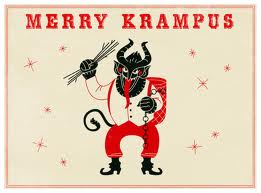
krampusAnd in parts of Italy and Germany, the witch Perchta would climb down the chimney.  But instead of giving presents to children, she would rip out their intestines and replace them with straw and stone.  (There’s a wonderful doll of Perchta here).  And anyone who has recently since the Grimm Christmas episode now knows of Krampus who is not only a real Christmas creature, (meaning Grimm didn’t make him up), he is still active and you can get Krampus cards.

(more…)

Read Full Post »

kawaiiSOUNDTRACK: BOB ATCHER AND THE DINNING SISTERS-“Christmas Island” (1950).

xmascocktailThere is something so charming and wonderful about white people co-opting Hawaiian music in the 50s.  I know fully well that there is nothing ‘authentic” about the whole AH-LOH-HA-AY business and that they have made it smooth and “sexy” for “bachelor pads” and all of that.  I know that I should be offended on everyone’s behalf.  And yet I can’t be.

I find bachelor pad kitsch to be fun (Esquivel’s Christmas Album is a perennial favorite), and so I was delighted to be introduced to this song from the 2007 NPR Holiday show.  I actually don’t know anything about Bob Atcher or the Dinning Sisters, but this song is a delightful trip through faux Hawaiian music–slide guitars and a very hula-feeling rhythm.

It even features Santa arriving on a canoe.  Yup, the whole simplification of Hawaiian/island culture is in poor taste, but man, it’s such a swinging and trippy take on a Christmas song.  And I’m sure no islanders were hurt in the making of the recording.  Aloha-ay.

[READ: December 15, 2013] Kawaii!

I’m fascinated by manga and the whole, as the subtitle says, Japanese culture of “cute.”  I don’t really get it.  I mean, I get it, that cute things are cute, but the whole cultural love of cute is so peculiar to me–especially when reading this book and seeing that it is a cultural explosion of cuteness.  This book was a great introduction to so many different aspects of this culture. (more…)

Read Full Post »

jan2006 SOUNDTRACK: KURT WAGNER-Tiny Desk Concert #6 (October 8, 2008).

kurtI have never been a big fan of Lambchop.  It’s just not my kind of music—a little too slow for me.  But I really enjoyed Kurt Wagner in this Tiny Desk performance.  His guitar playing I really beautiful (I loved how he hit the high note on Bob Dylan’s  “You’re a Big Girl Now.”  He plays three Lambchop songs and two covers.

Wagner is from Nashville, and he has an air of Southern propriety about him–apologizing for taking up everyone’s time at work.  He sounds great doing the Dylan song, which I suppose is no real surprise.  The first Lambchop song is a pretty ballad called “Slipped Dissolved and Loosed.”

He is a charming and funny guy, joking about a few things (like working in an office) and then discussing about one of his songs, “National Talk Like a Pirate Day” (which is not as funny as the title might suggest).  Another song is titled “Sharing a Gibson with Martin Luther King Jr.” (and Wagner waves a fan of MLK Jr. (from a funeral home-(?)) to start the song.

The final song is a Don Williams song called “I Believe in You.”  I’ve never heard of him (and neither had anyone else in the studio).  It’s a really enjoyable, sweet song, and there’s a funny moment when sirens go past and he comments that at least they are in tune.  I still don’t think I’ll be listening to a lot of Lambchop, but I really liked this Tiny Desk show.

[READ: October 8, 2013] “Improvised, Explosive, & Divisive”

Two years after writing about his trip to Vietnam, Bissell returned to another war zone.  This time going to Iraq to get embedded (I suppose that’s the technical term for what he did) with some Marines at Camp Taqaddum in Iraq (17 miles from Baghdad).  This was during the Iraq war (and the Bush presidency), after Mission Accomplished, when the military was searching for a strategy for what to do in the situation.

This article shows interviews with Marines and makes assessments about our then current plans (such as they were) for how to extricate ourselves from a seemingly hopeless situation.  After Mission Accomplished the war went from a “war” to “stability and support operations against an insurgent element” or what is called MOOTW (military operations other than war).  And Bissell acknowledges that it barely seems like any resembling war in Iraq where the soldiers are headquartered.  They cannot drink alcohol, have sex or view pornography (they are trying to remain respectful of their host country), but at the same time they play softball and go to the gym, wear Co-Ed Naked Camel Watching T-shirts and have a Baskin-Robbins ice cream stand.  Not to mention DVD, video game consoles and Coke for sale in the PX.

Some of the article is technical—a side of the fighting that most readers probably don’t know. Like that the troops must be fully protected (and the vehicles as well) just to travel the relatively short distance between camps. (more…)

Read Full Post »

mccarthySOUNDTRACK: PHISH-Undermind (2004).

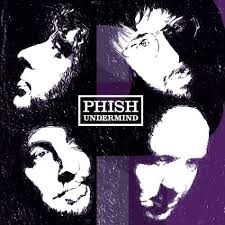
undermindAs I understand it, Phish fans didn’t like Undermind that much and yet I really liked it and still do.  Indeed, “Undermind” is one of my favorite new Phish songs, it’s clever and boppy and just really catchy.  The album has very Beatles vibe to it—a kind of echoey feel on all the songs.  And I have recently read that people interpret the cover design to be a nod to Let It Be (there are other connections made but I’m not going to go too deeply into that).

“Scents and Subtle Sounds” opens the album.  This is a brief intro–the full songs, which sounds different appears later on the disc (it’s 97 second here)).  It leads into “Undermind” which has a loose, slightly funky sound—one of their more fun songs on recent albums.  The album version has some big fat organ sounds on it which make it even cooler.

“The Connection” is another great poppy song—gorgeous harmonies and wonderful melody, and indeed it was their first real hit.  “A Song I Heard the Ocean Sing” is another great song, great backing vocals, an excellent melody and great alternating verse vocals from Mike.  It also has a great middle guitar section—it’s long and wild and reminiscent of Jimi Hendrix’ solos.  “Army of One” is sung by Page.  It is a big soaring song and it’s got a very upbeat sound.  “Crowd Control” is a very Beatleseque song.

“Maggie’s Revenge” is a noisy instrumental, with Trey’s guitars making all kind of squealing noise.  It’s weird and quite refreshing from Phish’s more recent fair.  “Nothing” picks up with the open and poppy sounds of earlier records and has more great harmonies.  It seems to fade out in the middle though—a song that could have been longer!  “Two Versions of Me” is another mid tempo song with great harmonies and  great chorus.  “Access Me” is a brief poppy song that feels a bit like filler, although it has a cool and interesting coda.  “Scents and Subtle Sounds” resumes

“Tomorrow’s Song” has a very African feel to it.  It is a simple repetitive rhythm that lasts for about 3 minutes before it fades out just like it faded in.  “Secret Smile” is a very pretty piano ballad.  It’s a little heavy handed with the strings, and at nearly 7 minutes it’s too long (especially the long coda), but the melody is certainly nice.  The album ends with “Grind,” a barbershop quartet track which shows just what kind of great harmonies they cool do.

Although it’s a mature sound, there’s enough weird stuff to let them show their funky side too.  The CD comes with a DVD called “Specimens of Beauty.”

[READ: October 8, 2013] C

I received a prepub version of this book back in 2010.  The cover and title were weird and I thought I’d like to read it.  And it sat on my shelf for two years.

And then Borders closed (bummer, their chai tea was the best!) and I saw a hardcover copy of the book for $1 so I bought it (I’m enough of a geek to want to see how prepubs and final copies are different.  In this case, the books appear identical except that in the last two dozen or so pages, there’s a section with ellipses.  In the prepub, they are single spaced but in the final book they are double spaced which throws off the line spacing.  So by the end of the book, the lines are about three lines different.  Fascinating huh?).

Anyhow, what on earth is a book called C about?

Well, it is a Bildungsroman or coming-of-age story.  By definition these stories focus on the psychological and moral growth of the protagonist from youth to adulthood.  Our protagonist is Serge Carrefax, even though he is not the first person we meet.  That would be a doctor delivering materials to Serge’s father, Mr. Simeon Carrefax.  Mr Carrefax runs a school for the deaf in which he tells children to stop using sign language and to start speaking properly.  And he has had considerable success with the children, each of whom acting in a play every year.  (The book, by the way, is set in the late 1800s).  His mother is a silkworm farmer, and much of their money comes from this job.

But the main person in Serge’s life is his sister Sophie.  Sophie is a deviously clever girl who is alternately mean to Serge (as only older sisters can be) and then encouraging him to play with her.  She is mad for science and is constantly experimenting with her chemistry set (leading to more than one explosion in the house).  The early sections of the book show Sophie and Serge’s education.  And when Sophie goes off to school, Serge is lost, especially when she returns from school but keeps telling him to leave her alone.  And then one day, Serge discovers her dead in her “lab” and experiment in progress. (more…)

Read Full Post »

april 2002SOUNDTRACK: PHISH-The Siket Disc (1999).

siketThis is an (almost) entirely instrumental disc.  It’s exactly the kind of thing that people think of when they imagine Phish—long jams with no structure.  But unlike some of their more frenetic jams, this is a kind of enjoyable chilling out disc.  The compositions are actually select excerpts from the long-form improvisations of the “Ghost Sessions.”

There are 9 songs and most of them are short.  Except for “Whats the Use” which is an 11 minute track with a very cool guitar riff (that reminds me again of Frank Zappa) and some cool accompanying keyboard sounds.

“Me Left Toe” is about 5 minutes and has a nice build up within  it.  And “The Name is Slick” is a bit more staccato and less smooth than the other songs and it holds up for 4 minutes.

Most of the other songs are short jams (with 4 tracks being about 2 minutes or less).  Although there are a couple of weird, nonsensey tracks like “Fish Bass” which is just a weird series of noises.  Or “Quadrophonic Toppling” which has some spoken words (just the title repeated) as does “Title Track” which has the repeated word “Siket”and laughing.  “Insects” is a little unsettling as well.

“The Happy Whip and Dung Song” is 5 minutes long and, despite some weird effect on the keyboards, feels like a full song.  “Albert” is a short, pretty, gentle ballad.  It’s a nice ending to this disc.  While this is by no means an essential Phish disc, it is an interesting insight into their recording process and is as I said, a good chill out album.

[READ: October 28, 2013] “Eternal Winter”

I had never heard of the Aral Sea before reading this article and I am surprised that I haven’t and I’m shocked by what has happened there.  Near the city of Karalpakistan (no connection to Pakistan), near Uzbekistan and Kazakhstan, lies the Aral Sea. It was once the fourth largest body of water on Earth, larger than lake Michigan.  It is now shrunk by approximately 74%.

It was through the Soviet Union’s thirst for development and “progress” that canals were built which diverted water away from the Sea.  This effectively slowly dried out the lake (which the Soviet Union knew would happen).  The Soviet Union also dumped insecticides and toxic waste into it, rendering what is left of the sea bed largely poisonous. Anything that is not poisonous is heavily salinated making it worse than useless.  And to make it worse (if that is possible), the windstorms that frequently occur simply pick up the toxic dirt and dust and blow it all around the land.  Without the water, the temperature soars in the region–often reaching 120 degrees.

One of the reasons for the diversion of the water was cotton.  Cotton is a thirsty crop and it was discovered that Uzbekistan was well suited to the climate for the crop.  They just needed more water.  And so in the 1950s, the Amu Darya river was diverted away from the Aral Sea and into the Uzbekistan deserts.  And cotton flourished there.  Then in 1960, the Aral Sea began to shrink. (more…)

Read Full Post »

sep2000SOUNDTRACK: PHISH-Rift (1993).

riftRift has a kind of story to it (albeit it’s not a real concept album) and you can tell by the full cover (see the bottom) that the story is complex–thank you gatefold sleeves).  The album starts with “Rift” a fast guitar spiral that opens with a harmony vocals on the opening lyric and then a call and response between I believe, Page and Trey as they each take a line of the verse—it’s a cool and surprising opening.

“Fast Enough for You” is a slow country-tinged song (with slide guitar).  This is the first song of their early records that I really don’t know that well.  So it must not get played very much.  It’s a pretty song.  “Lengthwise” is a cute little a capella song (with snoring and clock ticking) which I think about whenever I am alone in a bed: “When you’re there I sleep lengthwise and when you’re gone I sleep diagonal in my bed.”

“Maze” is one of my favorite Phish songs and it sounds great here.  I love the bomp bomp at the end of the verses and the fugue vocals at the end of the song.  This version is fantastic.  “Sparkle” also features fugue and barbershop type vocals (with Mike’s deep voice added in) in a funny silly roping song.  It’s another highlight.  “Horn” has a great opening guitar line (that reminds me of Pearl Jam for some reason).  I’ve always enjoyed this one.  It sounds great here (because you can actually hear what the harmony voices are saying (something you usually can’t in the live setting).  “The Wedge” is a mid tempo song that sounds different from their live versions.

“My Friend My Friend” is a pretty dark song (“My friend, my friend he;s got a knife”) but the opening is a beautiful instrumental with lovely guitar sequences until at 2:30 when the piano takes over and the song becomes slightly menacing.  “Weigh” is a weird song that I rather like.  It’s very piano heavy and very boppy despite the crazy lyrics:  “I’d like to cut your head off to weight it, whaddya say?  5 pounds, 6 pounds, 7 pounds.”  “All Things Reconsidered” a nice NPR joke.  This is a 2 and a half minute instrumental of guitar and keyboards that sort of plays with the NPR “All Things Considered” music.

“Mound” starts with some wonderful out of time signature riffing—4/4 drums and bass and then super fast guitars that don’t quite match until the drums and bass then catch up.  It’s hard to believe that that unusual opening leads to the big catchy bouncy chorus: “And it’s time, time, time for the last rewind.”  “It’s Ice” is a little slower here than live but I kind of like it in this slightly slower version (you can really hear the riffs).  This is another song with fugue-like vocals (they do all of their vocal tricks very well).  “The Horse’ begins as a beautiful Spanish style guitar piece and morphs into a simple acoustic song (it’s al of 90 seconds) which bleeds into “Silent in the Morning,” another highlight from their live shows and a standout here.

Rift might just be my favorite Phish album.

[READ: October 23, 2013] “Escanaba’s Magic Hour”

Once I found out that Tom Bissell had written a number of articles in Harper’s I decided to read them all, especially since some of them already appeared in his book Magic Hours.  This was his first piece for Harper’s and it is the one I remembered most from the book.  So I enjoyed reading it again.

I’m also glad I read the Harper’s version because although I don’t think it varies from the book version at all (and I’m not willing to check), it had pictures from the movie and from Escanaba, which brought a bit more reality to the article.

So, what’s this about a movie?

Well, this article is about Jeff Daniels making a movie in Escanaba, Michigan called Escanaba in da Moonlight (which I haven’t seen, but as I said after reading this the first time, I now feel invested enough in it to want to watch it–reviews are mixed).  And it sounds kind of interesting.  I also really enjoyed the comment that Daniels’ appeal “has something to do with the fact that many men, if asked to cast their lives without undue conceit, might settle on Jeff Daniels to play themselves.” (more…)

Read Full Post »

dec2004SOUNDTRACK: AWAY-Cities (2013).

awayAway is Michel Langevin, the drummer for metal band Voivod.  But on his first solo album he eschews all conventional music.  Rather, he has created an exercise in found sound and released it on the small label Utech Records.

The album is described as

Strong field recordings capture more than just the sound of an area, they capture a mood and spirit of the place and people. On Cities, local color and nature recordings clash with riots and discord, capturing the full human experience across the world. Literal and metaphorical “found music” appears: the booming stereo of a passing car or distant church bells, as does the rhythmic engine hum of a bus or the chirping of birds. This tour is a fast paced one, rapidly weaving through the geographic locations building a diverse, yet consistently engaging experience. The audio journey captured here perfectly reinforces the fact that, regardless of one’s location, the presence of music is never far, nor should it be.

What we get is a collection that sounds like a tour through the streets of the respective cities (nothing more specific than Europe is given, sadly).  We hear street noise and buskers playing (interestingly just about every type of music I have heard in Boston subways as well).

I only wish more information was given about just what Away was up to.  Where he was and, more importantly, how he recorded these sounds. The recording quality is amazing—the panpipes and harmonicas sound crisp and clean with no other ambient noise.  Did he ask the performers if he could record?  How did he get them so pristine especially since I assume they are in the streets?  And for the Europe ones, was there any given order to the way they were edited?  Is it the progression of their Voivod tour, or is it just random?  The mixing and sequencing is quite good, especially in the shorter pieces which really take you on a journey.  Not knowing what’s happening is maddening and part of the fun as you try to picture (especially if you use headphones) exactly what you are hearing.

“Montreal 2010” opens with the sound of travel until we zoom in on panpipes (for a few seconds).  This switches to a lurching shanty (sung, I suspect in French—it’s a little hard to hear).  Then from the shadows comes the sound of someone playing Leonard Cohen’s “Hallelujah” on the harmonica.

“Europe 2012” opens with someone playing what I suspect is a hammered dulcimer (exactly the kind of thing that buskers play in subway stations), it shifts to a jazz trio (sax, bass, drums) wailing away with traffic noises in the background.  After some busses and an accordion solo, there are delicate chimes.  Finally a bagpipe melody leads us away from the delicate chimes until we hear announcements in what sound like Russian and then French.  The track ends with fans chanting “Voivod Voivod.”

Montreal 2012 returns Away to near his home city.  This time the scene is much nosier—it could be joyous, it could be angry—there are whistles and horns, and by the end it seems like a joyous parade.  The noise diminishes as an operatic voice pierces through briefly until the drums return.  More street noises, including police sirens, French chanting and a train passing by as we return to yet more street drumming.  If this track had more context for the title it would probably be more enjoyable. And yet as the parade (for surely that is what it is ) marches past you feel like you’re there.

“Mexico City 2012” opens with a truck honking and street noise until we hear what sounds like an indigenous band playing, then some more flute music and church bells pealing. Then there are announcements in Spanish (by both a man and woman presumably in the church) and church organ music.  Pan pipes and drums bring us back into the street and what sounds like a market scene which ends with some Mexican music playing.

“Europe 2011” opens with some beautiful guitar or perhaps an Indian stringed instrument playing and some traditional Indian singing.  There’s some more music playing and cheering and then some peace as birds take us out of this short track.

“Montreal 2011” opens with banjo music (!).  And then the more typically French sounding violin moves us along.  More pan pipes and traffic noise progress us through the city.  Then two very different examples of accordion music meld until the noise of the train wipes them out.   The track fades out with a band playing a  jaunty accordion inspired track.

“Chicago 2012” ends the disc with a symphony orchestra tuning up (I presume) for a few minutes.  It’s a shocking cacophony.  Until someone shushes the noises and the birds return, playing us out of this aural tour.

You can stream, download or buy the CD  here.  Buying the CD gets you some of Away’s cool art (although I wish there was more).

[READ: October 8, 2013] “War Wounds”

Since I’ve been enjoying Tom Bissell’s book reviews, I thought I’d see what else he had written in Harper’s.  He seems to have a storied career with the magazine as a traveling journalist.  And this article dates back to 2004.

It is a personal article about himself and his father.  What I found fascinating about this is that his father was a Vietnam veteran, and I don’t know too much in the way of writing that concerns being the child of a Vietnam veteran.  There are a lot of books and films about the Vietnam experience for the soldiers, but not so much about the families that they returned to (as far as I know).  So it was interesting to read Bissell’s account of growing up with his father–who was a hard man and who wasn’t afraid to fight with his children (especially when drunk).

The man that Tom grew up with had a temper and didn’t much approve of Tom’s chosen profession.  But unlike many people of his generation, Tom didn’t feel that he had a particularly estranged relationship with his father.  What on earth possessed him to invite his father on a trip to Vietnam–to visit the sites where he lost friends and was himself wounded, is the stuff of journalism. (more…)

Read Full Post »

« Newer Posts - Older Posts »