SOUNDTRACK: DAVE BIDINI—The Paramount Moncton, NB [audience & soundboard recordings] (July 29, 2007).
This final show has two different recordings at the Rheostaticslive site, an audience recording and a soundboard. The soundboard recording is cleaner and I suppose better, but the audience recording is a little more fun because you can hear the audience responding to Bidini’s comments and jokes.
For the reading he asks if people want London or Finland, and so he reads Finland. He reads the funny story about trying to get a cheap 30 pound flight to anywhere only to get hit with a huge fine for having too much stuff. The section ends with a funny moment when a Finnish audience member compliments him: Your voice is excellent! Dave is excited since that’s not something he hears to often. The man follows up with: “You pronounce English very well.”
He plays seven songs all on acoustic guitar. Three of the songs are Rheostatics classics: “Fat,” “Me and Stupid” and “My First Rock Show.” I feel like hearing “Me and Stupid” in this setting really let me get the lyrics better–I never really understood the middle section. All three songs sound good in this format.
The “solo” songs are the same four: “Song Ain’t Good,” “The List” “The Land is Wild” and “The Ballad of Zeke Roberts.”
While talking to the crowd he mentions seeing signs on the road: “Free PEI Spuds for Cheap Trick” and “Red Sox nation welcomes Aerosmith.” He mentioned them in the previous days’ show as well, but in this show it sounds like someone claims to have written them (or at least seen them) but we never learn what they are all about.
He sounds great and the audience is responsive. Of the three, I like this show the best.
[READ: November 10, 2015] Home and Away
My triumvirate of Bidini books ended with this one.
I had never heard of the Homeless World Cup (which is kind of the point of the book, that no one has). But as you can imagine, knowing that that’s what this book is about you can be prepared for a pretty sad book.
Bidini follows a small group (4 players, including one woman) of Canadian homeless soccer players as they travel to Australia to play in the 2008 Homeless World Cup.
We meet the four players on the Canadian team and learn all about how they became homeless (a variety of reasons, but drugs feature prominently). These people were able to get above their bad situation, most of them through the joy of playing soccer–a cheap game even for the homeless.
The Homeless World Cup gathers homeless players from around the world to play in small venues on a small pitch. (more…)
SOUNDTRACK: DAVE BIDINI-The President of Mount Allison’s House, Sackville (July 28, 2007).
Until I looked it up, I didn’t know what Mount Allison was, nor why he would be playing at the President’s house. I’m still not sure why he was playing there, but as part of his solo mini tour, Dave graced the beautiful house.
For this show he read for 17 minutes and played 5 songs. He plays “My First Rock Show” as the only Rheos song. And then plays the same four “new” songs as in yesterday’s post: “Song Ain’t Good,” “The List” “The Land is Wild” and “The Ballad of Zeke Roberts.”
He explains the Zeke Roberts song a bit more. He spent a few days in Ghana and went to a Liberian refugee camp (all documented in the book Around the World in 57 1/2 Gigs) which is how he learned about Zeke Roberts.
He talks about staying locally in the Marshland Inn and the scary doll in his room (and also how he hopes to have his picture among the famous people who have stayed there).
For the reading portion he talks about the guys he played with in China: Alun Piggins, drummer Jay Santiago and guitarist Dwayne Gale. He talks about the scene where they get massages (very funny). There’s another excerpt in which they meet some people on the street where a baby is playing with a lighter. The band starts taking pictures and then—eventually one of the adults puts an unlit cigarette in the baby’s mouth, and much hilarity ensues.
Overall though, this reading gets pretty dark as he gets into fight with Jay about Rush, and he feels bad that the Rheos had broken up especially when he sees the up and coming band The Wombats loving their set.
As for the music in this set, it is too loud and peaks a lot in the recording. There also seems to be a hornet pestering him. It’s probably the least interesting of the three shows.
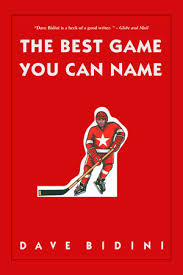
[READ: November 7, 2015] The Best Game You Can Name.
This book is about hockey. Specifically it is about Bidini’s rec team the Morningstars and their quest for another championship (and how after winning two years in a row, they were the main target for all the other teams). Much like how his book On a Cold Road included quotes and stories from musicians, this book includes quotes and stories from former NHL players (I didn’t really recognize any of their names, but then I wasn’t a hockey fan in the 70s and 80s).
So each chapter talks a bit about his team and then has several stories about a specific topic from the hockey guys.
He begins by talking about his athletic renaissance in his 40s (after having given up on professional hockey). I enjoyed the stories from the hockey players who loved playing so much as kids that they would spend hours and hours and hours on the ice. I also liked them saying that you could still become a pro if you only started playing at 15 unlike today when kids are starting at age 5. (more…)
SOUNDTRACK: DAVE BIDINI-The Upstairs, Sydney, Nova Scotia (July 26, 2007).
After the Rheostatics broke up, Dave Bidini did a solo tour and then wrote a book about it. This is that book. And this show is from the mini-tour he did as promotion for the book. I don’t know too many details about this tour.
I wrote notes about these shows before I read the book (which I recently found and tread). But I’m going to leave in some of the notes I took about the audio portion for posterity.
I gather he was in town to promote his book and was invited to do a few shows as well. So these three shows from the Rheostaticslive site include a short reading from the book and then many songs. This show has two readings and 8 songs (and runs over an hour).
He opens with a description of the book and the tour of china with a band they called the Rheos Not Rheos. They were asked over and over to play The Beatles. They played at the Sculpting in Time café. Dave hung out with the Chinese singers Dirt Star and Airbag (who were also in a cover band that played Radiohead).
For the music, it is just Dave an his acoustic guitar (and a tuner). He plays three Rheos songs “My First Rock Show,” “Me and Stupid” and “Horses” (to much applause).
He plays four new, solo songs “Song Ain’t Good,” “The List” “The Land is Wild” and “The Ballad of Zeke Roberts.” All of these would appear on the debut Bidiniband album which would come out in 2009.
“The List” is a diatribe against Canada: Tim Horton’s, Stephen Harper, Zack Werner, and Chad Kroeger. He says that it was inspired by taking a close look Tim Horton’s bacon and wondering just what it was. And the mention of Chad Krueger gets a big reaction from the crowd. The Zeke Roberts song is about a Liberian singer who was killed. “The Land is Wild” is about Bryan Fogarty, a hockey played who died (it’s not the most upbeat concert I’ve heard).
There’s an extra song “Moncton Hellraisers” (you can watch a video of this one).
He ends the show with second reading and there’s a drunk guy who keeps shouting and interrupting. I feel bad for Dave, but he handles it well—different than a rock show obviously. This section involves meeting a TV show producer (of a show called Super Girls) and the Chinese version of the Spice Girls (who sing for them). He also mentions going to an all night record shop and finding a copy of the Toronto band The Diodes. He plays their song “Tired of Waking up Tired” for the employees.
If nothing else, this book will introduce you to a lot of little-known bands.
It’s interesting to hear him in such a casual setting. He sounds good and the audience is really responsive.
[READ: November 5, 2015] Around the World in 57 1/2 Gigs
This book chronicles Dave Bidini’s solo tour after the Rheostatics broke up. He explains that it was Tim Vesely who wanted to break up the band (no doubt inspired somewhat by Dave and Martin’s harsh critiquing of the songs Tim wanted to submit to their final album 2067). Nevertheless, Dave was devastated and angry and unsure what to do, especially since they were planning to gig China for the first time. So he decided to do it himself. A world tour unlike any other.
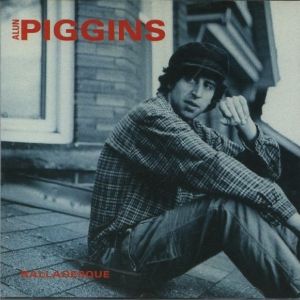
He scheduled a few gigs in Finland. And he decided to invite his friend Alun Piggins along. Piggins has been in a number of bands and has released several solo albums. He seems notable for being a little crazy (with wild hair). And I automatically respect him for making this album cover. When Dave asked Alun what to do about being a solo artist (Dave hadn’t really played solo before). Alun gave him some comforting advice and then said that with his band The Quitters, they would play “our loudest song then tell the crowd, “‘Thank you and fuck off.'”
The two would play separate shows on a double bill and occasionally duet on Rheos songs. They decided to tour Finland. They flew into London and were only staying for 24 hours. He wanted to try to get a gig before they left for Finland. They scored one at the last minute in the Maple Leaf Tavern (which had never staged a live show before) and was themed in Canadian kitsch. He talks about one man bands like Bob Log III “probably the superstar of all one man bands” (his song “Boob Scotch” is surprisingly straightforward). He says he spent most of his 35 minute set worrying an doesn’t recall too much about it.
Then they set out for Finland. First stop Hämeenlinna ( enjoyed typing out all these Finnish towns). (more…)
SOUNDTRACK: BELA FLECK, EDGAR MEYER, ZAKIR HUSSAIN-Tiny Desk Concert #70 (July 26, 2010).
Bela Fleck is a rather legendary musician, and yet I realized I don’t really know that much about him. And somehow I never knew he was a banjo player (that’s a pretty serious omission on my part). I had never heard of the other two musicians, although they are apparently world-class masters of the bass fiddle and the tabla.
I also didn’t expect this Tiny Desk Concert to be so interestingly world-musicy.
This set is only two songs but each is about 7 minutes long and they are both very cool (and from the album The Melody of Rhythm).
Fleck’s playing is amazing, with a tone that is often unlike a standard banjo sound. And I absolutely love the tabla–I am fascinated by this instrument. The first song, “Bubbles” is an amazing demonstration of Fleck’s banjo. About midway through he is playing in a decidedly middle eastern style (which works great with the tabla). And when the bass starts getting bowed around 1:50, it adds an amazing richness to this already cool song. There’s a cool bass solo (I love that the tabla pauses a few times during the solo). The ending is just wonderful.
Before the second song, “Bahar” (which means “springtime”) they talk about being nervous, which is pretty funny. This song opens with the bass fiddle’s bowed notes (including a very very high note). This one seems to be a more solo-centered, with some elaborate work from Fleck after the introduction. And the tabla solo, while brief, is really cool to watch. I prefer the first song, but the more traditional nature of the second song is a nice counterpart to the first.
[READ: August 24, 2015] Grantland #12
I enjoyed this issue as well. This was mostly the spring and summer of 2014, which sounds so long ago, and yet so many things seem so current.
CHUCK KLOSTERMAN-“The Life and Times of Kiss”
I love this article about Kiss. And I wrote about it back here.
WESLEY MORRIS-“Poison Candy”
This is about the disastrous state of female comedies. It focuses on the movie The Other Woman which is ostensibly a female centered comedy but is entirely other.
BILL SIMMONS-“Sterling’s Fold”
A drumming down of Donald Sterling. It’s hard for me to believe that this happened over a year ago.
ZACH LOWE-“Building the Brow”
An article about Anthony Davis of the Pelicans, who is proving to be better than anyone imagined. (more…)
SOUNDTRACK: AND THE KIDS-Tiny Desk Concert #452 (June 30, 2015).
I hadn’t heard of And The Kids before, but I was intrigued by their name and the lead singer’s look (is that a tattoo on her lip?).
But I didn’t like the way the first song started with a modified military “Glory Glory Hallelujah” musical refrain–it seemed strangely forced, especially for the first song I’d heard by them. Although I may have liked it better if I knew the band better. It was a weird way to start.
Especially since I ultimate liked “Glory Glory.” (I am hearing a chorus of “I’ve been picking up floor milk” which is as fascinating as whatever the lyrics really are). The drummer has great harmony vocals that really adds something to the song. I also love at around 2 and half minutes when the song turns into something very different—faster guitars with lead vocals by the drummer. And even the bassist who has been quiet thus far chimes in with another layer of voices (and some interesting bass lines). It’s very cool. So the song which started out kind of shaky really rocks out at the end.
The band trio, with a singer/guitarist, bassist and a great drummer. There’s something about the lead singer’s guitar–it seems really big (maybe it’s just the head of the guitar?). And the sound that the drummer gets is really great too—it may just be this recording, but the snare is really sharp.
For “All Day All Night” the drummer busts out a glockenspiel. It has a kind of shouted chorus that borders on dissonance but isn’t quite. I like the way the song slows down (with the guitarist playing keyboard as it builds back up), the drummer plays the glockenspiel and the drums at the same time. And the all three start singing with interesting harmonies. The ending whoo hoos are sharp and distinct as well.
“Cats Were Born” has a very interesting lyric: “The cats were born to kill for fun.” But perhaps even more interesting than the words are the yodels and screams and yips that punctuate the song. What’s also strange is the way the bassist seems so reticent to look goofy while the other two are wild. The guitarist busted out a small four string guitar for this song which sounds really distinct. And the drummer really shines. Through many of the songs she’s playing rim shots which is a distinctive sound in itself, but when she switches over to a faster style for the middle section, it’s really intense.
I don’t think any bands has gone so far from me not thinking much of them to being really won over by the end of their Tiny Desk.
[READ: February 26, 2015] Gunnerkrigg Court [1-14]
I discovered this book through my Goodreads account. It was suggested because, well, I don’t recall, it had something to do with schools and supernatural and graphic novels or whatever. There was also one that was suggested for Sarah (it was about boarding school and tea) which turned out to be Japanese softcore porn, so beware the Goodreads suggestions.
Although there was nothing to beware of with this book.
I actually thought Sarah would like it more because she loves boarding school fiction. But she gave up on the book after a few stories. Interestingly I almost did as well. It wasn’t that it was bad, in fact we both enjoyed the beginning. But it was the kind of book that once you put it down, you didn’t feel compelled to pick it up again. Perhaps because each chapter feels so self-contained–with no real cliffhanger–that it seemed like the stories were done. And while the stories were good they weren’t awesome…so. She gave up, but I continued
SOUNDTRACK: ANNA & ELIZABETH–Tiny Desk Concert #447 (June 8, 2015).
Anna Roberts-Gevalt and Elizabeth LaPrelle are from different parts of the country but share a love of old stories and songs. This Tiny Desk features three songs and one story (with visuals), and it’s quite different from pretty much anything I’ve ever seen.
“Long Time Traveling” is an a capella song that has a very olde sound of what I can only call “mountain music.” The women have lovely harmonies reminiscent of O Brother, Where Art Thou?
And just when you think you’ve got these two figured out, they do “Lella Todd Crankie.” This is a spoken word piece. Anna (the taller one) explains that they would go into archives and listen to blank CDs of people telling stories from the old days. And this is one that they memorized. But just telling the story isn’t enough. They have resurrected the “crankie” which is like a mural on a spool. Each one is drawn and crafted to be hand-cranked and unfurled at the pace of a song. This visual accompaniment (hand cranked by Elizabeth) follows the story as it is told, with visuals that relate perfectly to the story (I’m not sure who created those either). Part of this story tells of how Miss Lella played fiddle, and as they get to that part, Anna starts playing the fiddle, and it is magical.
“Goin Cross The Mountain” is a war-based song on banjo and guitar with, again, great harmonies. “Little Black Train” is a judgment day dark song sung with great harmonies and Anna’s twangy guitar.
I don’t think I could do a whole concert with them, but this little fifteen minute show is mesmerizing.
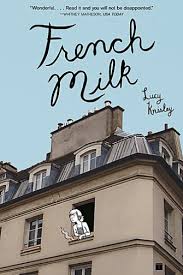
[READ: May 25, 2015] French Milk
I had gotten this book out at the same time of Age of License. But since that one couldn’t be renewed (someone else wanted it) I read that first. So, out of sequence, I now read this, her first book. I’m kind of glad I did read it out of sequence, because the events of Age of License shed some light on this book, which is pretty neat.
This book looks at the trip that Knisley and her mom took to France back in 2007. They lived in a rental apartment for New Years and much of January. The book sets the standard for her other books–lots of (really good but simple drawings–the sample faces on page 78 are really amazing–and belie the simplicity of her other “simpler” drawings ), many photos–rather blurry frankly, which is weird (see page 8 for an example), although the non blurry one of her mom in front of a nudie magazine is very funny.
We see some of her life before the trip. We meet John, the awesome boyfriend (spoiler: she has broken up with him by Age of License). She describes the airport, airplane (complete with kicking child) and arrival. (The descriptions in License are more enjoyable–she had become a better writer by then).
Knisley is a foodie. She talks a lot about the food they eat, including a bunch of foie gras and baguettes, sausages and the delicious French Milk (which she says is the best milk she’s ever had).
I enjoyed her descriptions of her apartment (and the creepy half-cat head on the door). The strange standing screen which blocks nothing and has hunting fabric.
There’s also talk of them not paying attention to the world around them (like the execution of Saddam Hussein–although honestly if you’re on vacation for a month in France I think its okay to be oblivious although by 2015, it would be virtually impossible to be so oblivious).
They spend a lot of time in art museums, and she says by the end that she is basically sick on naked women, even if her favorite painting is “L’Origine du Monde.” And I loved her disappointment to find out that famous Moulin Rouge is “a papier-mache windmill on the roof of a strip joint”
But as the book hits its final third, Knisley gets really bummed out. She starts thinking about failure and that fact that she is turning (gasp) twenty-two. And that’s when I wanted to throw the book against the wall. A 22 year-old being whisked around Paris has no right to complain about financial responsibility–nor even does her mother have a right to talk to her about it on the trip. The quote on page 125: “Even though I’m in my 20s, because I’m an only child, sometimes I feel a little like a spoiled brat…” Well, it has nothing to do with being an only child if you can spend a month in France. And when she says that her pie chart of her time management is spent 50% worrying 30% eating and 20% thinking about sex? No, I will not accept that. Go out and enjoy Paris for Christ’s sake.
I think its’ nice that her divorced parents are still friends and that he came to visit in France (how can a former English professor afford that?).
And then after a few more meals they are wending their way back home. The flight back is hilarious and I love that they punished the person who complained about their DVD player by talking really loudly instead.
I can’t help but feel that each book has gotten progressively better. And while I didn’t enjoy this one as much, I feel like each book has gotten better. But how much more can she travel?
SOUNDTRACK: THE PRETTIOTS–Tiny Desk Concert #448 (June 15, 2015).
I hadn’t heard of the Prettiots before this set, but I loved them right from the bat. The band plays super catchy, simple (funny) pop songs. Kay Kasparhauser plays ukulele and lead vocals and bassist Lulu Prat sings great harmonies. Kasparhauser is quite mobile, singing and bouncing around. While Prat almost stares down the camera. Meanwhile, drummer Rachel Trachtenburg from the Trachtenburg Family Slideshow Players sits mostly stone faced as she thumps along on the drum.
Their songs are rather funny (even when they aren’t). The first song “Boys (I Dated In High School)” names the boys she dated, whether they were good at sex and why she dumped them. All with a call and response in the verses that’s fantastic.
“Stabler” is an ode to the guy From Law and Order, which I don’t watch, but I can still appreciate it. It ups the musicianship a bit from the much simpler first song.
“Suicide Hotline” is a humorous look at a dark subject: The lyrics name check lots of famous suicides and starts with the lyric “On a scale of 1 to Plath I’m like a 4.” Prat switches to guitar for this last song and it boosts the sound a bit.
I actually don’t know what the band really sounds like–I sort of picture them being bigger and more punk, and yet their lyrics work perfectly in this more acoustic style. (They have two songs on Spotify and they are still quite acoustic in their sound). I’m looking forward to hearing more from them.
[READ: July 15, 2015] Displacement
I enjoyed An Age of License, even if I didn’t always love Knisley’s attitude. This book, which is sort of a companion to License (although not really, it’s more like another travelogue released around the same time as the first one), was something I wanted to read.
In a nutshell this book is another travelogue, but it is not anything like the previous one. In this one, Lucy volunteers to go on a cruise with her 90 year old grandparents. The grands wanted to go on the trip, but no one in the family felt that they should go alone. Lucy thought it would be a good way to spend time with her grands and also to get a chance to enjoy a cruise (which she would never be able to afford).
Knisley ends each “chapter/day” of the cruise with a quote (and her own illustration) from a book that her grandfather wrote about being in the war. A decade or so ago he decided to put down all of his memories about his time in the service. He had them bound and gave a copy to each of his children. And his stories are exciting and scary and thoughtful. (I wouldn’t be surprised if Knisley had the whole book published with her illustrations–I’d certainly read it). So, after a trying day with the grands, we get a perspective of the man she was looking after as a young man in a really serious situation. (more…)
I enjoy that the opening of this Tiny Desk Concert shows Genevieve “creating” her backup singers. So that when she gets to the chorus and taps that loop pedal her harmonies really shine.
Genevieve is a poppy singer with a sometimes raspy but often really clean singing style. She has a great voice and vibrant personality (and hair color). Even though she is from Chicago, I hear some tinges of Bjõrk and maybe even Tori Amos in her voice.
Evidently she normally plays with a full band, but for this concert, she is accompanied only by Chris Faller who “plays all of the instruments.”
The first song “Colors” is played only with keyboards (and feels like it could use a little but more music–although her voice is powerful enough and that chorus is super catchy as is). “The Enemy” is accompanied by an acoustic guitar and is a suitably mellower–a kind of sad ballad–which shows how powerful her voice is even in this more quiet setting (she has a lovely range).
The final song “Authority” feels like it might be a big raver (she adds hand claps that seem like the kind that might get the crowd going, but the claps are quiet and subtle here). The chorus is big with lots of long-held notes and is super catchy.
Genevieve would probably be too pop for me in general, but the Tiny Desk Concerts tend to remove a lot of gloss and leave the heart of the musician.
[READ: May 15, 2015] An Age of License
I enjoyed Knisley’s Relish, so when I saw this in the library I decided to check it out.
Unlike Relish, which was about food, this book is about her travels outside of the country. But like Relish, this book is another memoir/journal/autobiography.
Since I have been having a major Norway kick (thanks to Karl Ove Knausgaard and some great sites on Instagram) I was pretty excited to see that her travels began in Norway. Her itinerary is short but very busy. Fly into Iceland than immediately to Norway (for the Raptus Comics Fest in Bergen). Then it’s off to Sweden (to visit a guy she knows in Stockholm). Then to Berlin to join her friends on their honeymoon (which is not as tacky as it sounds). Then it’s off to France to visit her friend in Beaune, and then to hang out with her mom and her friends on Royan. Finally a day in Paris before flying back home. I’m exhausted just writing it all.
Knisley also has the headache of dealing with a breakup (to the nice guy who has been in her previous books) although he is kind enough to babysit her cat while she is gone.
Every few pages has colored (watercolor I assume) drawings which add a nice touch to the otherwise black and white story.
Starting Sept 8th, she arrives in Norway. We see the flight and other people on the flight. We see a nice meal that she eats (Pinnekjott–someday I hope to get to the Scandinavian countries and eat food that I cannot pronounce). Norway is fun–she goes to the Fest (where she gets to draw with Ethan Nicolle of “Axe Cop” (presumably his five-year old brother stayed home). She shows students how to draw (her friend is a teacher), although she declines to eat Lutefisk (which she illustrates as Fish + Lye. Lye??). She also mentions that she was not only stalked, but that the boys who stalked her then made and published (and had it available at the following year’s Raptus Fest) a comic about stalking her–creepy! (more…)
Karl Ove mentions many bands in this book, but the deLillos are the only Norwegian band that he plays. They sing in Norwegian and play sprightly, jangly guitar pop–they would fit in very well with some of the lighter alt bands from the late 80s and early 90s.
I have no idea what they’re singing about (well, the title translates to “love” so I guess I know what they are singing about.
The singer has a high, delicate voice and there’s some interesting harmonies. I really like the way the song transitions from verse to chorus with the picked guitar notes–very catchy.
It comes from their second album, Før var det morsomt med sne (Beforeit was funin the snow), which along with their first was quite popular and was reissued with a bonus disc in the 90s. Having said that I see that Amazon has one copy of the disc and no album cover listed. Worse yet, I can’t find many other songs online (Spotify lists the album, but I can’t get it to play).
Sorry, deLillos (even searching for you gives us more Don DeLillo than you guys).
[READ: June 24, 2014] My Struggle Book Four
I started including the British edition page numbers because at my work we received both editions of the book, and I received the British one first so I grabbed it and started reading. I noticed the page numbers were quite different (the British book is taller and the print is quite bigger, although this doesn’t explain why the previous books have fewer pages).
I had been interested in the differences between editions from the get go. I had enjoyed the American editions, but I enjoyed reading this British edition more (bigger print?). But when I noticed on one of the pages that the word “realise” was spelled as I typed it, it made me wonder if the American edition changed that to the American spelling. [Actually, I see that Don Bartlett lives in Virginia, so perhaps he translates it into American first]. While I wasn’t about to go into a deep inspection of the topic, when I saw the American edition on a shelf at work, I had to do a little comparison.
And what I found out was that even though Don Bartlett is the (amazing) translator for both editions, someone (perhaps Bartlett himself?) is translating the American into British (or vice versa). I looked at a couple of pages and noticed these changes from British to American:
BRITISH EDITION = AMERICAN EDITION
Pack it in, now = Give it up, now
roll-up = rollie [about hand rolled cigarettes]
looked daggers at = gave her a dirty look
a complete prat = completely useless
is that possible? = really?
to cook and wash up = cooking and doing the dishes
I had got = I’d gotten
had penned = had written
and yes, realised = realized.
Other than select phrases, every word is exactly the same. So somebody goes through the books and changes them to British english idioms and spellings. That’s fascinating.
I also see that this is the first book I had not read an excerpt from first. Not that it would have made any difference as to whether I read the fourth one. I couldn’t wait to get my hands on it.
So book four is set in Håfjord, a town in Northern Norway near Finnsnes (a five hour flight away–okay I had no idea Norway was so big!). Karl Ove is 18 and has decided to become a grade school teacher there for one year. The tax breaks are great if you teach, and he plans to teach and write his masterpieces and then get out. He has no interest in teaching, but the town is small (most grades are 3-7 students), so he figures it can’t be too hard.
As in most of Karl Ove’s books, the stories jump around and flash back and do not stay all in this one time, but it is largely set in this locale.
My first thought was that I have never read a story with as much semen (both nocturnal emission and premature ejaculation) in my life. It is a strange take away from the book, but there it is. Karl Ove is 18 and really wants to have sex for the first time. About 3/4 of the way through the book he reveals that he never masturbated (it just never occurred to him, apparently, and at 18 he’s too old to start–what!?). As such, he seems to have wet dreams every night. And every time he gets near a woman, he has an orgasm too soon. He is horny all the time–it’s a bit disconcerting.
And since I mentioned that, I don’t know if Karl Ove’s life is typical of Norway, but I am shocked by the number of women who take their clothes off around him (he may have never had sex, but he was about to on at least a half-dozen occasions). And he says that all through school (from around age 13 and up) it was common place for the boys to lift up the girls’ shirts and kiss and or fondle their breasts. It is mind-boggling to me. And the 16 year olds all seem to be having sex all the time–this may be skewed from Karl Ove’s perspective, but that’s what I now believe happens in Norway.
But while sex is the main theme of the book–sex, sex sex, there is more to it.
Karl Ove’s parents have split up and his father has started drinking in earnest. The dad has remarried and has just had a baby. Incidentally, I was also shocked to read that Karl Ove’s father, who is an abusive stodgy old man who is cranky and mean and abusive and all the stuff that we read about in the other volumes was only 43 at the time that Karl Ove was 18. So the old man who I pictured as a gray-haired curmudgeon in this book is actually younger than me. Great.
In Håfjord, Karl Ove is teaching kids who range from age 13 to 16. It’s disconcerting to read about him thinking lustful thoughts about his students, until he reminds us that for most of the students, he is only 2 years older than them. I am pleased to say that he behaves himself (except in his mind) with all of the students. There’s even a really interesting flash forward to eleven years later when he runs into two of them again.
He proves to be a pretty decent teacher it seems. The kids mostly like him (the girls all think he is hot) and he is young and tries to make it fun (he himself hated school and everything about it). He even seems to help out an awkward boy (although that is never resolved). We see him teaching, trying to interact with the kids and generally being a pretty good guy.
Until the booze comes out.
For in addition to semen, this book is chock full of alcohol. Before graduating from gymnas (high school), Karl Ove basically stopped caring about anything. He spent most of his time drunk. It is astonishing the amount of drinking he does–it’s practically like an Amish Rumspringa how crazy he goes. But even in this retrospective look, he talks about how much he likes it, how it loosens him up and makes him less nervous.
But really he just spends most of his time drunk, hungover or sick. He even got into the hash scene for a while. He was living with his mom at the time and she was appalled at the way he acted–especially when he threw a party which trashed their house. She even kicked him out for a time.
He seemed to be over the drink in Håfjord, but it turns out that there’s precious little else to do except drink up there, especially when it grows dark for most of the day. So there is much drinking–he only misses class once or twice because of it but he comes very close a lot.
The irony that he is appalled at his father’s drinking, while drinking so much himself, is apparently lost on him.
The other main preoccupation with Karl Ove is music. He talks a lot about his great taste in music (he reminds me of me–a little insufferable). Back when he was in gymnas, he spent a lot of time discussing his favorite bands and favorite songs. He got a job (at 16) writing reviews for a local paper (holy crap, jealous!) and then later gets a job writing a column for another paper. For the previous book I listed a lot of the bands he mentioned, and I wish I had written them down for this one. U2 features prominently (this is 1987, so I’m guessing Joshua Tree), but also Talking Heads, a Scottish post-punk/new wave band The Associates and their album Sulk which he describes as “an utterly insane LP.” he and his brother really like The Church and Simple Minds (before they got so commercial). He also has a whole thread in which he makes connections with albums:
Briano Eno, for example, started in Roxy Music, released solo records, produced U2 and worked with Jon Hassell, David Byrne, David Bowie, and Robert Fripp; Robert Fripp played on Bowie’s Scary Monsters; Bowie produced Lou Reed, who came from Velvet Underground, and Iggy Pop, who came from the Stooges, while David Byrne was in Talking Heads, who on their best record, Remain in Light, used the guitarist Adrian Belew, who in turn played on several of Bowie’s records and was his favorite live guitarist for years. (64).
He also specifically raves about “The Great Curve” from the Talking Heads album, and of course, he raves about the first Led Zeppelin album as well.
Music is a huge part of his life (and he dresses accordingly too). It’s unclear whether the kids think this is awesome or not, but he may be a bit too much for some of the locals. The locals are mostly fishermen (which makes sense), and Karl Ove is a bit intimidated that he is so wimpy compared to them–one of the women even teases him about his tiny arms.
But his main focus is writing. He writes a few shorts stories (to my knowledge he has never published any of them). We see some excerpts and they seem fine–he fancies himself Hemingway. But he also mentions a bunch of Norwegian authors (I love when he does that). Sadly again, not too many of them have been translated into English. [I really hope that some mega fan creates a database of all of the bands and authors he mentions]. He also talks briefly about his first novel which alludes to his time teaching here. I happened to read a small summary of said novel (Out of the World) and feared that it spoiled what was going to happen. But, in fact there does appear to be a difference between his fiction and non-fiction.
The book moves very quickly–from party to party, from failed sexual attempt to the next, even from his staying up all night long trying to write. And most of the time he comes off as kind of a dick–he is also very self-critical, which somehow tempers that dickishness.
As with the other books I cannot figure out exactly why I am so addicted to his writing. I brought the book home on Thursday night and finished it (all 548 pages of it) Monday night. This really completes the picture of himself as he moved from childhood to adulthood and really lays the foundation for whatever is to come next. Early in the book he talks about the books that he loved at that age, books that talk about the move from childhood to adulthood. And thus, this book becomes something of a bildungsroman as well. Although whether or not Karl Ove actually grew up at the end of this book will have to wait until volume 5 (which I have to assume is still another year away as there is no information about it online at all!).
For ease of searching, I include: Hafjord, For var det morsomt med sne.
SOUNDTRACK: BASIA BULAT-“Tall Tall Shadow” and “It Can’t Be You” live at Polaris Music Prize (2014).
Swinging to the other side of the musical world from Tanya Tagaq, Basia Bulat also performed at the 2014 Polaris. I like Bulat a lot, she comes across as a sweet singer (no idea if she is actually sweet). And I love that she can make really complex songs out of such random instruments (she plays autoharp, hammered dulcimer and others).
In this performance, she is fairly traditional for “Tall Tall Shadow” on the piano (although the french horn accompaniment is a nice twist), but “It Can’t Be You” on charango really highlights just what you can do with, essentially, a souped up ukulele.
“Shadow” highlights her voice which she holds for some quite long notes. The song is really pretty with a great chorus. “It Can’t Be You” is just her and the charango (which looks like a ten string ukulele but is Andean in origin). It’s quite a song–her voice and that instrument are lovely.
[READ: February 4, 2015] Grantland #11
I enjoyed this issue quite a lot, even if I didn’t know who half of the people profiled were (and won’t remember them in two days time).
I am very curious why Grantland is just so obsessed with basketball than other sports. It’s a little crazy how one sided these books tend to be. They obviously love all sports but the preponderance of NBA articles is really staggering.
I do wish there’d be a bit more about TV and movies (and even more about the shows that I watch), but it is a fun way to learn about shows I would never watch. And maybe that’s why I like these books so much, it’s my chance to vicariously enjoy sports without having to care about any of it (especially since it is all a year old, I never know if anything they talk about actually came to fruition or not).
This issue covers January-March 2014 (it’s fun reading about things almost exactly a year apart–to read about Oscars and Super Bowl stuff but have it be last year’s Super Bowl (especially since it too had the Seahawks) was very trippy indeed).
 SOUNDTRACK: DAVE BIDINI—The Paramount Moncton, NB [audience & soundboard recordings] (July 29, 2007).
 This final show has two different recordings at the Rheostaticslive site, an audience recording and a soundboard. The soundboard recording is cleaner and I suppose better, but the audience recording is a little more fun because you can hear the audience responding to Bidini’s comments and jokes.













 I Just Read About That...