SOUNDTRACK: BRIAN COURTNEY WILSON-Tiny Desk Concert #76 (August 25, 2010).
Brian Courtney Wilson is not Brian Wilson. Rather, this Wilson sings lovely religious songs.
This is an overtly Christian performance and as such I did not really enjoy it. Having said that, his voice is terrific and his backing vocalists are subtle and uplifting without overpowering the music.
He sings three songs: “All I Need” “Believe” and “Already Here.” For some reason, there’s no video for “Believe” so you have to listen to the audio only track to hear it.
[READ: September 29, 2015] The Complete Peanuts 1957-1958
Some new themes emerge in this, the fourth volume of the Complete Peanuts. Charlie seems to get branded with the “wishy-washy” curse a lot more (except when it’s raining and he’s not willing to give up his baseball game).
The angst is getting heavier now too with Charlie Brown saying “sometimes I think my soul is full of weeds). Then in April 1958 he says “It always rains on the unloved.” Even the normally chipper Snoopy (who at one point says “to live is to dance, to dance is to live”) gets a little mopey and introspective “when I was a puppy every day was a happy day suddenly bang, and I’m in my declining years.”
I feel like Lucy and Linus are showing up a lot more. And Pig-Pen, really a one-joke character is appearing less but has not been forgotten.
I particularly enjoyed the concern that the earth was overpopulated (from Lucy). And after she says “The earth can’t feed this many people” Linus replies “Why Don’t You Leave?” (more…)
SOUNDTRACK: MARTIN TIELLI-“We didn’t even suspect that he was the poppy salesman.” (2001).
I wrote about this album once before, and while I made notes about it after listening to it again, I found out that they were pretty much exactly what I thought of the record four years ago. So I’m going to simply repost the review here, but I’m going to add some new notes seamlessly intermingled.
Martin Tielli’s first solo disc is a proper solo release: it’s almost all him on acoustic guitar and his gorgeous alto voice. I hadn’t listened to this disc in a while and I was delighted by how much of the disc I knew so well.
The opening track, “I’ll Never Tear Your Apart” is deceptively simple: beautiful harmonic’d guitars and his gentle voice. There’s a great video to go with it here. That is followed by the wonderful “My Sweet Relief” which sounds like a great Neil Young folk song: great verses an a strong chorus. Lyrically, though, it is all Tielli. “Double X” highlights Tielli’s beautiful acoustic guitar work. It’s another great story song, this one about a destitute person hanging under a superstore with a K and an M.
“Voices in the Wilderness” is a simply beautiful song, a lovely guitar melody and Tielli’s high voice singing along.. I also love that the lyric (mis)quotes Rush very nicely: “‘If you choose not to be free you still have made a choice,’ said a high and squeaky voice.”
“Farmer in the City” is the only track that Tielli didn’t write. It’s a nearly 8-minute song by Scott Walker. I had never listened to the original, but having now done so, I find the Walker version to be far superior. Walker’s voice is so eccentric and wonderful. So even though I love Martin’s voice, he just can’t compare to the original. Also find Martin’s version to be just a little spare (the Walker version has lovely strings. Kevin Hearn plays celeste and Selina Martin plays wine glasses on the track.
It’s followed by the delightful “World in a Wall” which uses mice in the wall as a metaphor for a broken relationship (with wonderful detailed lines like: She’s like a mouse, I know she’s around It’s a gnawing sound. Leaves little brown poohs from a little pink bum.”
This is followed by “That’s How They Do It in Warsaw” which is the first really rocking song (it has bass and drums) and a voiceover in Polish by Kasia Zaton.
It’s coupled with a slightly less rocky but still loud track “How Can You Sleep?” (which makes another fun musical allusion, this time about Guided by Voices). It has a co-songwriting credit from Dave Bidini and has a kind of vocal allusion to Bob Dylan, although I doubt it is about him.
“She Said ‘We’re On Our Way Down’” is a song that I really want to enjoy more. But It is so spare and Martin’s vocal line is so abstract, that I can never really get int it. But the guitar riff is really powerful and cool. And yet, the song seems to eschew melody but then a gorgeous guitar or vocal line shines through and really sounds brilliant. “From the Reel” is a beautiful, aching acoustic ballad.
The disc ends with the odd, seven minute “Wetbrain/Your War.” The first part (wet brain) is kind of slow but it builds into a beautiful dark song about addiction.
This is a really beautiful album, although there are moments when I fell like Martin gets too delicate, it’s amazing to hear just what he can do when he’s on his own.
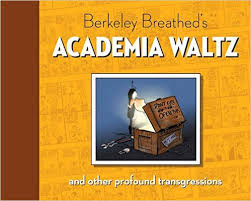
[READ: October 19, 2015] Academia Waltz
Way back a long time ago I was pretty excited to read all of the Bloom County reissue books. Somehow I only got through Books 1 and 2, although I see now that five volumes were released in total.
Presumably at the end of that run, (which technically ended in 2011) comes this volume. Academia Waltz is the strip that Breathed wrote back in college. This book collects some (but apparently not all) of the strips. It’s odd to not collect them all since there is also an art gallery with all kinds of original pieces (complete with edits and scribbled notes) that duplicate many of the earlier strips.
The first part collects pieces from Academia Waltz the 1979 collection. The second part comes from Bowing Out, the 1980 Collection. (more…)
SOUNDTRACK: BUILT TO SPILL-Perfect from Now On (1997).
Built to Spill moved to the major labels and everything changed. No that’s not true. The band (well, Doug mostly) just sounds more serious about their music. What’s impressive is that there are no obvious singles since each song is over 5 minutes long (except for one).
This is considered a classic 90s album but fans of the band and others. And while I like it, it’s not my favorite. A few of the songs are a little too drifty and anticlimactic. But at he same time there’s some really amazing stuff here.
It opens with “Randy Describing Eternity” a cool song with a great riff and an interesting lyrics. My favorite song (most days) on this record is “I would Hurt a Fly.” It has a fairly quiet intro with more intriguing lyrics: “I can’t get that sound you make out of my head/ I can’t even figure out what’s making it.” The song waxes and wanes and even adds some cello. And then at 4 minutes, the song shifts gears entirely, stopping to add a brand new fast section with some great guitar work and wild noisy soloing.
“Stop the Show” is another favorite. It opens with a slow meandering guitar section and then jumps to a great, frenetic set of verses. After about 5 and a half minutes the song turns into a crazy noisy fest and then switches to an amazingly catchy guitar instrumental solo outro, which could frankly go for five more hours. “Made Up Dreams” has several different elements in it. And even though it’s only 4:52, it still packs in a lot of music.
“Velvet Waltz” is over 8 minutes long. It has slow parts, and a lengthy middle section with strings (in waltz time of course). It builds slowly adding some cool guitar sections and a great long solo at the end. “Out of Site” is one of the shorter songs on the disc. It has an immediate, fast section that is very catchy. It then mellows out to a slow cello-filled section. “Kicked it in the Sun” is kind of trippy. At four and a half minutes a noisy section overtakes the music, but behind the noise is a beautiful, pretty guitar/keyboard melody. Then it shifts out of the noise into a more rocking catchy section.
The final song is the nearly 9 minute “Untrustable/Part 2.” It begins loud with great lyrics “You can’t trust anyone because you’re untrustable.” Like the other songs it has several parts. Around 4 minutes it turns into another song altogether. This continues for a bit and then at 7 minutes it shifts gears entirely into a keyboard dominated romp.
There’s so many interesting melodies and changes in this album, and it clear that it was completely influential on late 90s indie rock. But I think what’s even more impressive is that each album get a little bit better.
[READ: September 29, 2015] The Complete Peanuts 1955-1956
Moving on to volume 3 of the Complete Peanuts. Stylistically things are advancing towards the Peanuts characters we know now. Yet they haven’t quite gotten there. I think the kids’ faces (not their heads, just features) are still much smaller. And Snoopy still looks like a real dog, although his nose grows year by year.
In the beginning of the year, there’s a funny line from Lucy, attacking commericalism. Charlie is reading her a book. He says “Once upon a time they lived happily ever after. The end” And Lucy says “What’s on the rest of these pages, Advertising?” Much later there a joke in which Lucy asks Schroeder how much a musician makes, and he relies “Money? Who cares about money? This is art. You Blockhead.” It is ironic of course that Schulz went on to become so staggeringly wealthy–but maybe that just shows what good art can achieve.
Another one of my favorite sophisticated jokes comes when Lucy is flying a kite. The joke is all about perspective. It’s hilarious. (more…)
Cœur de Pirate is the band name of Béatrice Martin, a Québécois singer and piano prodigy. She was 19 when she released this album (and was accepted into conservatory school in Montreal when she was nine).
Given her musical background, one might expect more elaborately created music–more chamber pop, perhaps. But this debut album is delightfully sweet and spare indie pop. It is primarily simple piano songs with occasional extra accompaniment.
Most of the songs are simple, with unfussy arrangements and Martin’s beautiful voice. The songs verge from charming piano melody to simple waltz to piano instrumental and a few upbeat almost dancey songs. There’s even a guitar based song that adds a folk feel to the album.
There are 12 songs and the album runs only to 30 minutes. It is charming and delightful. The only thing I didn’t like so much was when Jimmy Hunt duets with her on “Pour un infidèle.” It’s not that I disliked his voice (which I did grow to appreciate after a few listens) it’s that his voice removes you from the insular little world that Martin has created. When I am in it I don’t want any distractions.
The album definitely has a Francophone feel to it (her songs were described as “bringing la chanson française to a whole new generation of Quebec youth”) although she does remind me a bit of Regina Spektor’s later songs, too.
She also had a fluke hit with “Ensemble” when it was used with a funny baby based YouTube video that went viral (I’ve posted that at the bottom of the page).
You can listen to the whole album below
[READ: September 17, 2015] The Complete Peanuts 1953-1954
Moving on to volume 2 of the Complete Peanuts. As 1953 opened, the characters remained in that older style–Snoopy still looks a lot like a dog, and Charlie’s head is still much bigger (or actually I guess his face is still smaller). By the end of the book, they have morphed a little closer to the Peanuts most of us are familiar with, but they still look “different.”
I enjoy the way the Schulz celebrates the holidays with a simple but nice sentiment (Schroeder playing his piano with the music staff reading “Happy New Year”). Indeed, Schulz celebrates most holidays. Valentine’s Day, Income Tax Day (!) and of course, he has lots of fun with Hallowen (no great pumpkin yet though).
This volume seems to be a lot about Lucy (which may be why she is on the cover). In the first few strips she gets expelled from nursery school. Later on she quits nursery school because they didn’t teach how to be a nurse. Lucy also tends to have a regular punchline, with regard to Schroeder of “I’ll probably never get married.” Lucy also begins in earnest her counting career–trying to count all the stars (and getting exhausted) or all the raindrops, or the amount she jumps rope. And she is still a fussbudget, with a joke at the end of 1954 having Schroeder compose the “Fuddbudget Sonata” for her.
Linus, who is still a baby, has taken to “shooting” people with his finger (he struggles to crawl for a ball only to have Snoopy walk up and take it away, so he looks at Snoopy and says “bang”). He is still crawling and toddling for much of the year, although by the end he seems to be growing up. Nevertheless, Lucy is still giving him a hard time–constantly shouting at him when he is not looking and then commenting that “he’s awfully nervous.”
There’s a lot of baseball jokes as they move into spring (how did he keep coming up with original baseball jokes after all those years?) inducing jokes about sponsorship. And then Lucy starts taking up golf (and is very good at it).
Schroeder continues to play beautifully (and to get upset by everyone who bothers him, especially Lucy and Snoopy. He has a crisis of conscience when he says “sometimes I thin I like Brahms even better than Beethoven.”
Schulz included some occasionally topical material. So there’s a joke about the popularity of “Doggie in the Window” (It went to number 1 in April of 1953 and stayed there for 8 weeks). Snoopy has been listening to it all day.
And of course there is a ton about Snoopy too. he still looks like a dog and still does a lot of doggie things (and Schulz is always spot on with them). I really like the joke where Snoopy eats a moth and then coughs up the dryness. Or when he falls asleep under a tree and wakes up covered in leaves. There are even a few jokes in which Snoopy hates being patted on the head. And of course, Snoopy just loves zooming around (especially through croquet hoops). This is mostly like Snoopy giving everyone a hard time, especially Charlie Brown (with the constant refrain of “You drive me crazy”).
One thing that I like about these early strips is that even though Charlie Brown has a lot of angst, he also has a great deal of self-confidence. Like when he is mad at Violet and the punch line is “but I know you don’t think I’m Perfect) There’s even a funny joke (or series of jokes) about graffiti on a fence (!). In one, it says “Charlie Brown loves all the girls” (in another it says “Charlie Brown loves Charlie Brown”).
The TV jokes continue (I especially like the one with Shermy watching and the screen clears up to say Why Aren’t You in School?). Most of them are variations on people sitting on front of each other. and blocking the view.
In June of 1954, Schulz uses the word security to refer to Linus’ blanket (evidently coining the phrase “security blanket”), which continues in one form or another throughout the book. Linus starts to become really smart–outwitting Charlie Brown at houses of cards and magic tricks and the wonderful punchline of him blowing up a square balloon.
The biggest change comes in July 1954 with the addition of Pig Pen or ‘Pig Pen’ as he was first called. He doesn’t do a lot but it leads to a lot of jokes about being dirty.
And in December 1954, a new short-lived character named Charlotte Braun (or Good Ol’ Charlotte Braun) enters the strip. She has wild curly hair and talks very loudly. She is something of a foil to Charlie, but she is never really developed.
The book has a Foreword by Walter Cronkite. He says that he was supposed to interview Schulz, but on the day they were scheduled, he took ill. So Cronkite never got to meet with Schulz. This is shame although I have to say that Schulz and Cronkite were such huge figures that they certainly should have met many times over the years.
Cronkite reveals a bit more about the Schulz’ Sparky nickname–that he was given the nickname by an uncle who was referencing the horse Spark Plug in the Barney Google strip. I like Cronkite’ summary:
Now here you have a confluence of coincidences that would never be accepted even by the producers of a Hollywood pot-boiler. A baby nicknamed after a cartoon characters growing up to be one of the greatest and most popular cartoonist of all time!
Cronkite also praises Schulz’ economy of dialogue and illustration and likewise keeps his own foreword brief as well.
I’m really excited about continuing through the years with these books.
For ease of searching I include Coeur de Pirate, Beatrice Martin, Quebecois, francaise
And here’s that (very funny) viral video that used the Cœur de pirate song:
Frazey Ford used to be in the Be Good Tanyas. Here she is touring her debut solo album Obadiah. She is quite a character, wearing a leopard print outfit.
But her music is really complex and interesting. On the opener, “Firecracker” she plays the guitar with unusual chord progressions but it’s her voice that is so arresting. She use atypical phrasings and pronunciations that belie her origins (I could never guess where she was from). Strangely, I get a kind of Cat Stevens vibe from the way she says words, but also another inexplicable emphasis: the way she pronounces exploding as explohdun.
She talks briefly about her new record while apologizing for having to tune her guitar. “Lost Together” slower, pretty song.
“If You Gonna Go” is a breakup song which she messes up and then apologizes for, saying she’s nervous and very tired. And she mocks herself for wearing a ridiculous cheetah outfit. She says she bought it in London where everyone was dressed like this. Stephen Thompson chimes in that if it was cooler they’d all be dressed like that.
She asks if they want one more and she ends with “The Gospel Song.”
It’s a really good introduction to an unusual voice.
[READ: September 10, 2015] The Complete Peanuts 1950-1952
After reading the Sunday Peanuts books, I had to go back and start the series from the beginning. Holy cow, Peanuts started in October 1950 and ran into the 21st century! That’ amazing. It’s also amazing to see how different everyone looked back then. It’s very disconcerting. The only thing more disconcerting is to immerse yourself in the old comics, start to really appreciate them, and then see a contemporary version and wonder why he changed them so much.
When the strip first started there were just three of them: Good Ol’ Charlie Brown, Shermy and Patty (not Peppermint Patty) and they are all four years old. Those first comics are really really different–the kids are practically stick figures. (Although Charlie always had that little wisp of hair). The kids all have huge heads and tiny bodies and are very minimal in their expressions. Snoopy is there too and he looks very much like a real dog. As it turns out I like this version of snoopy better than the current one. He looks much more like a dog and he acts alike a dog–Schulz gets some great jokes out of doggie behavior. Things like Snoopy hearing and smelling food and running over to beg started almost from the beginning. As did they ways that Snoopy interacts and often drives the other characters crazy.
What’s mostly different about the early ones is that the kids are all mean to each other and CB sometimes wins in the verbal sparring. He’s as much of a buster as the others. It’s really fun and funny. (more…)
SOUNDTRACK: HOP ALONG–Tiny Desk Concert #450 (June 22, 2015).
Not too long ago a friend asked if there were bands that we wanted to like but didn’t. Some people just said no, of course not, you either like a band or you don’t. But I knew what he meant. There are a lot of bands that I’d like to like. And Hop Along is one of them.
Lead singer Frances Quinlan has the kind of raspy voice that is practically iconic (think Janis Joplin after a rough day). And their music, which is kind of folky, also has a rawness that should combine with her voice to make me listen all the time.
And yet, for all of that, I really don’t like her voice. It should be right up my alley but it, well, isn’t. And that goes a long way to me not really liking the band.
They play three songs and although the blurb about the band talks about the music being more than her voice, I really can’t get past it.
None of the songs is bad, although they all sound a bit the same to me (her voice again). “Horseshoe Crabs” has a folky feel and some soft/loud sections.
“Well_Dressed” has some unusual dissonant chords thrown into the mix. It’s especially interesting given the pleasant acoustic guitar that accompanies this song.
“Sister Cities” has some lyrics about shooting your dog which is a bit of a turn off.
So yes, I would like to like Hop Along more, but I just don’t.
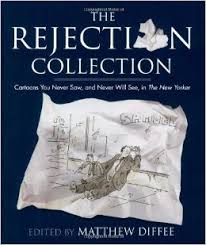
[READ: July 20, 2015] The Rejection Collection
I heard about this book because it was listed under Matthew Diffee’s books in his bibliography. I enjoyed his Hand Drawn Jokes for Smart Attractive People so much that I wanted to see what else he’d done. Well, I didn’t quite understand the premise of the book. Instead of it begin a collection of his rejected cartoons, he had edited a collection of cartoons that were rejected by thirty of the New Yorker’s regular contributors.
Which means there’s a lot more variety and a lot of funny stuff in here.
He gives us some context: each issue of the New Yorker has about 15-20 cartoons. There are some 50 cartoonist vying for these spots. Each of these 50 artists brings 10 cartoons each week and the editor pick the few that will make it (and those that are chosen are the only ones who get paid).
So that means that there are dozens of really good cartoons that just aren’t going to make it. Many of those cartoons will be saved by their creators and submitted somewhere else or even back to the New Yorker in case the editors have a change of heart.
There are many reasons why cartoons are rejected. Some aren’t very good, some aren’t appropriate for the magazine, and some just aren’t as funny as others this week (but may seem even funnier in two weeks’ time).
If you’ve read the new yorker (or ever been in a cubicle) you have seen the work from most of these people (even though you probably don’t know their names):
Leo Cullum, Pat Byrnes, Sam Gross, Mike Twohy, C. Covert Darbyshire, Drew Dernavich, Christopher Weyant, Kim Warp, William Haefeli, John O’Brien, Marisa Acocella Marchetto, Danny Shanahan, Tom Cheney, Mick Stevens, Mort Gerberg, Michael Crawford, P.C. Vey, Barbara Smaller, Arnie Levin, Gahan Wilson, Glen Le Lievre, Alex Gregory, J.C. Duffy, Carolita Johnson, Ariel Molvig, Michael Shaw, Eric Lewis, P.S. Mueller, David Sipress, Jack Ziegler.
SOUNDTRACK: STRAND OF OAKS–Tiny Desk Concert #449 (June 15, 2015).
I didn’t know anything about Strand of Oaks when I first heard them last year. I assumed from the bio info that I’d heard that he, Timothy Showalter, had been in a a band and that this was his solo project. But no. His history is actually far more interesting.
The Wikipedia summary is pretty simple and shocking:
While Showalter was on tour, his wife had an affair. Escaping his detrimental relationship, he moved back to Wilkes-Barre, Pennsylvania in 2003. A couple of months later, he came home to find his house burned down. [WHAT??]. Showalter spent his nights in hotels and on park benches with a borrowed guitar while working at an orthodox Jewish day school. Despite the turmoil, he was able to find inspiration to continue writing music that would later be released.
He released three self-produced albums and then made Heal. Which ALSO has a shocking tale attached to it: On Christmas Day in 2013, Showalter and Sue were driving back to Philadelphia from Indiana when they hit a patch of ice and crashed into two semi trucks. Showalter suffered a concussion and broke every rib on his right side. The near-death experience gave Showalter a boldness during mixing sessions while creating HEAL with John Congleton, just days after the crash.
Yipes. I don’t know his earlier records, but I really like Heal. It’s got an interesting sound, with some great guitar work.
For the Tiny Desk, he plays three songs. The first is the single from his album, “Goshen ’97”. This version is just him on his black electric guitar with lots of echo. It’s very slow and kind of broody. I prefer the original, but this is a very interesting version. And his voice sounds really good in this stripped down style.
After the first song he says how nice it feels to play this gig–just what he imagined it would be like. He says he could play there a long time and when someone says “Ok” he say they’d get sick of him: “Oh that bearded guy is still here.”
“Plymouth” has even more echo on the guitar–this one a hollow bodied steel string guitar. It sounds lovely and since I don’t know the original as well, I like this slower more meditative version.
“JM” is for Jason Molina and for this track, he switches its back to the black electric. I love the album version of this song a lot, as the soloing is just fantastic. This version is quite different. Again, it’s slow and broody, and really good. I still like the album version (because of the solos) but this is good too.
I’m fascinated by Showalter now, and plan to see what his earlier albums sound like.
[READ: June 15, 2015] Hand Drawn Jokes for Smart Attractive People
Although I was unfamiliar with Diffee’s name, I was familiar with his cartoons from the New Yorker. Diffee has three other books out (under the Rejection Collection moniker–he’s great with book titles). I certainly loved the title of this book.
There are 16 chapters in the book–each is devoted to a particular topic and has a rather amusing introduction in which Diffee goes off on that subject: Medical Professionals, Lumberjacks, Relationships, Pet Owners, Old People, Utensils, Real Jobs, Indians and Eskimos, Food, Sex, Prison, Religion, Wealth, Children, Sports and Tattoos.
What I really enjoyed was that the cartoons that fill the introductory sections look very different from his more “official” style (which I recognized immediately from the magazine). It’s cool that he has a distinctive style but is not pigeonholed into that style.
Occasional cartoons have an accompanying silhouette (presumably himself) with an extra bonus joke tangentially related to the topic. Sometimes these are funnier than the original cartoon. (Does a polygamist refer to his wives as his “better eighths?”).
It’s hard to mention favorite cartoons without describing the cartoon, which is never funny, but there are few punchlines that work with out a visual, like:
“Therapist: “These feelings of inadequacy are common among the inadequate.”
Waitress: “Sorry, we don’t serve the Lumberjack breakfast to accountants.”
Drug sniffing dog: “I’m starting to really like the smell of cocaine.”
And this one which is not from the New Yorker: “Wade Greenberg, wearing his hemp blazer, inadvertently became the life of the party when he stood too close to the menorah.”
He also really loves to hate sporks: (50% spoon, 50% fork, 85% useless).
All of these are funnier with the accompanying cartoon of course, and I really like his drawing style.
By the way, the section on tattoos was capped off by “knuckle tats you’ll never see” like FLAU TIST or ALAN ALDA.
I enjoyed this book a lot and will certainly look for his previous collections.
SOUNDTRACK: YOUNG FATHERS-Tiny Desk Concert #442 (May 19, 2015).
Young Fathers may have the shortest Tiny Desk Concert ever. It’s only 4 minutes long. I know that these are edited down from the full show, but wow.
Young Fathers evidently sing a kind of hip-hop, but in these two songs they don’t really rap very much and are more soulful. The members met in Edinburgh but are from distant exotic locales like Ghana and, um, Maryland.
Something must have happened with their technology. As the blurb says, “Full-on drums and electronics weren’t going to happen on this day.” So they chose a simpler path.
They sing two songs virtually a capella. I don’t know any of the members’ names, but there’s one singer for “Am I Not Your Boy” (the guy in the photo above). He has a soulful voice (more or less R&B) and there’s a simple keyboard backdrop.
On “Only Child” there are three vocalists, each taking a turn with a verse. It is surprising that the man who sounds Jamaican (the first singer) is white. The final vocalist raps, and then all three harmonize very nicely over the final chorus.
Bob Boilen raved about them when he saw them live. I’m not all that impressed, as they sound like any other R&B band to me, but a four-minute sampler isn’t all that much to go on.
[READ: February 12, 2015] Prime Baby
I’ve enjoyed just about everything that Gene Luen Yang has done. But I had no idea that a) he wrote a serialized comic strip and b) that it appeared from 2008-2009 in the New York Times Magazine!
It’s interesting to see these strips presented in one strip per page format. But far more interesting is the very strange direction that this story goes in.
It begins with the main character, a boy named Thaddeus K. Fong. He is a reasonably selfish young man with a penchant for saying things to get him in trouble. (He calls himself a martyr for truth). And then his parents have a baby. And his whole life is upended.
The baby girl only says the word, “ga.” His parents say that everyone develops in their own time, but he is not convinced. And one day, when he learns about prime numbers in math class, he realizes that his sister only says “ga” in increments of prime numbers. That is kind of interesting, but even more interesting is when his math teacher says that NASA has theorized that if aliens were to make contact with us it would be through prime numbers. (more…)
Camané is a Portuguese Fado singer. The NPR blurb says that fado, “which means “fate” in Portuguese, emerged from the gritty barrios and docks of Lisbon in the early 19th century and has evolved in fascinating ways. Think of it as the Portuguese blues.”
The songs are sung in Portuguese and I don’t know a word of what’s he’s saying, but as the blurb continues: “[The songs] flow with an ineffable mix of longing, loss and melancholy, framed in resignation. It’s a kind of glad-to-be-unhappy feeling the Portuguese and Brazilians call saudade.”
The most interesting part of this to me was what I thought was a bouzouki but which I see is actually a Portuguese guitar–12 steel strings, played in very fast runs. While Camané’s voice is clearly the focus (and it is amazing), José Manuel Neto’s Portuguese Guitar is pretty darn awesome. And the accompaniment by Carlos Manuel Proença on guitar is lovely too.
[READ: January 7, 2015] Kampung Boy
This book was written (and drawn) in 1979. First Second books had it translated and published in 2006.
This is the story of a boy growing up Muslim in rural Malaysia in the 1950s. Evidently it was serialized in Malaysia back in 1979 (it does feel kind of episodic, but it holds together very well).
It is a charming story of a simple life in the village that is slowly being changed by progress.
It starts with Kampung Boy’s birth and the simple way he was born (midwifed by his grandmother for which she was paid $15) and how he slowly grew from a baby into a naked toddler running around the village. His aunt worked at the local rubber factory (his parents owned the rubber plantation) where they removed latex rubber from the rubber trees. (more…)
Eskmo is a guy from Iceland (Brendan Angelides). He plays electronic music.
His music is pretty and rather mellow. What makes this Tiny Desk so enjoyable is the objects he uses to makes sounds with.
He loops a lot of noises (something that I love) as they build to really add textures to the song. But the things he uses for sounds are awesome. In the first song (“Blue and Gray” about 4 minutes), he crinkles a water bottle to make a percussion sound.
Before the second song “Can’t Taste” (which is about 8 minutes), he asks the audience to bring up random objects for him to play with. So he gets a set of keys that he uses as a chime sound. He opens a can of seltzer for percussion. He plays a metal water bottle. And then he also takes things from the shelves behind him, like the shelves themselves and even a Paul McCartney bobble head.
The music itself is almost an afterthought, as the melody is pretty but he doesn’t really do a lot to lot–he just has a ton of fun playing with the items around (he gets a big smile with the bobble head).
This is a show that works much better visually than audibly, so watch it here.
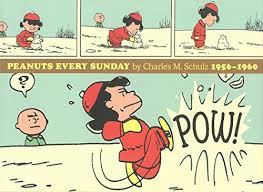
[READ: April 10, 2015] Peanuts Every Sunday 1956-1960
Fantagraphics has been releasing volumes of Peanuts daily comic strips. They are looking to do 50 years of strips in 25 books! (they are up to 1990). And now they have begun releasing the Sunday color strips in their own volumes.
This book picks up where the last one left off. And of course, Snoopy is still the star. There’s some very funny jokes with snoopy–like the one where he tries to fly—there’s something wonderful about Snoopy being insecure (and clumsy).
Linus can’t let go of his blanket (July 1956). And in an early baseball one, the blanket actually causes him trouble (instead of later ones where it is a benefit).
Pigpen gets a strip devoted to himself in July 1956 and then there’s a very funny one about sand in his shoe in 1958.
Lucy yells to make the kites fall out of the tree. And the first full acknowledgment of her pulling football away comes in December of 1956.
I also enjoy how violent the cartoons were. Like this exchange between Linus and Lucy:
Linus: Give it to me or I’ll slug ya.
Lucy: Mom, Linus says he’s gonna slug me.
Mom: Linus that’s no way to talk.
Linus: Well, that’s the way they talk on TV if they can talk that what, why can’t I?
Mom: That’s just one of those things I can’t explain.
Lucy: Listen dope. If you slug me I’ll slug you right back.
Linus: Never mind Mom, it’s just been explained to me in language that I understand.
There’s some really great one liners coming in now too. Lucy: I feel torn between the desire to create and the desire to destroy.
There almost isn’t as much Charlie Brown in this book. Although he is certainly there. In June 1957 he realizes that he won’t ever be president.
And the gang all starts to look pretty much as we know them at this point (except Snoopy still).
There’s lots of funny strips (visual mostly) of Snoopy chasing Linus to try to get his blanket (a joke that recurred for years).
And there’s a very meta joke of Lucy wearing one of CB’s shirts
Sally Brown, CB’s sister is born around August 1959 and CB gains a pencil pal. The following week Aug 16 1959 is a great sibling rivalry with Lucy and Linus. And there’s a wonderful strip where Sally and Snoopy gang up on Linus Oct 25 1959.
The Snoopy jokes are very funny with him (still) walking on all fours and wishing to be a bird or pretending to be a mountain lion.
The 1960 new years strip in which Lucy gives Linus the resolutions he should work on is hilarious.
Later Linus gets so mad at Lucy that “she hath caused me to rend my garment” is one of the funnier punch lines I’ve seen.
The great pumpkin makes its first mention on October 23 1960.
The Snoopy/Linus rivalry is really wonderful throughout with Snoopy trying to steal Linus’ blanket and then later getting into boxing matches—this is the classic Peanuts. Some of these jokes have now been around for ages (the boxing glove on the nose). And Snoopy is starting to look a lot more like his familiar self (although not exactly the same yet).
It’s a great collection, once again. And it looks amazing.
 SOUNDTRACK: BRIAN COURTNEY WILSON-Tiny Desk Concert #76 (August 25, 2010).
 Brian Courtney Wilson is not Brian Wilson. Rather, this Wilson sings lovely religious songs.













 I Just Read About That...