Feeds:
Posts
Comments

Archive for the ‘Children’s Books’ Category

dragonsSOUNDTRACK: THE NELS CLINE SINGERS-Tiny Desk Concert #78 (September 7, 2010).

nelsNels Cline has played guitar with Wilco for over a decade, but he has also played with punk rockers and jazz musicians.

The Nels Cline singers are an instrumental collective  that consists of Cline on guitar, upright bassist Devin Hoff and distinctly jazzy drummer Scott Amendola (he plays a lot of percussion including hitting a cymbal with what looks like a chopstick).  They also have special guest Yuka Honda from Cibo Matto on keyboards.

Cline gets some great sounds out of his old beat up guitar (I have genuinely never seen anyone play harmonics on the guitar in the manner that he does).

The music is airy and spacey (especially “B86 (Inkblot Nebula)” which features bowed bass and interesting sounds from Honda and a fascinating array of bell and cymbals on the drum set.

For “Thoughts on Caetano” he switches guitars.  Unfortunately the video seems to keep cutting out around this point so the rest of the show has to be on audio only.  But the sounds that they create are very cool and interesting.

The biggest surprise to me in these pieces is that they are mostly fairly short.  They seem like they could be side-long explorations, but “You Noticed” comes in around 4 minutes or so, and “B86” is only around 3 minutes as is “Thoughts on Caetano.”

The final song has a more jazzy feel.  Complete with a  bass solo and some very interesting drum sounds (I wish I could see how he’s doing them).  This last song is the longest it’s about 7 minutes.

I was really surprised by this Tiny Desk–I had no sense of what Nels Cline would play, and it was a real treat to hear.

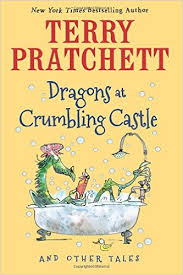
[READ: August 19, 2015] Dragons at Crumbling Castle and Other Tales

Obviously death has never stopped anyone from releasing books.  So here is one of the first collections of posthumous stories from Sir Terry Pratchett.

Interestingly, these are stories from when Terry was a young lad.  This is a selection of children’s stories that were first run in the Bucks Free Press (he was a junior reporter).  They are simple but clever, with lots of ideas that Pratchett would explore in greater details as he got older.

There are 13 stories in the book, and they explore variations on Pratchett’s themes like that the unfamiliar is not the enemy (necessarily) and that people can and often will be surprised by how others react.  He also has some a story idea that would blossom into the carpet people stories later on.

“Dragons at Crumbling Castle” (1966) is a story of everyone overreacting when they find a dragon in the castle  (it proves to be a little baby dragon).

“Hercules the Tortoise” (1968) is the story of a brave tortoise who crosses his pond.

“The Great Speck” (1969) is an interesting story of huge worlds on tiny specks and how even they can be territorial

“Hunt the Snorry” (1966) is  a very funny story about brave hunters going in search of an elusive thing which proves to be something else entirely (and which they inadvertently catch).

“Tales of the Carpet People” (1965) is similar to the Speck story in that it talks about very small people living in a carpet and their adventures as they try to see the world beyond (the dreaded linoleum).  I actually found this first story to be kind of dull and confusing, but I can see how it became the basis for greater things.

“Dok the Caveman” (1966) invents all kinds of things but they usually go wrong–nevertheless the inventions themselves are pretty spectacular.

“The Big Race” (1968) differs from all the other stories in that it is about technology (although it is very Pratchettian in the end).  It proves to be a race between a gas-powered car and a steam-powered car (and anyone else who wishes to join the race and cheat if necessary).

“Another Tale of the Carpet People” (1967) was more successful perhaps because they actually got off of the carpet and met new people.

“The Great Egg Dancing Championship” (1972) was a funny story about how cheaters never win (and about dancing on eggs).

“Edwo the Boring Knight” (1973)  Sometimes boring people to sleep can be your greatest weapon.

“The 59A Bus Goes Back in Time”  (1966-67) This story was fun in its time travel (going to the major historical epochs) but more so because of the way the locals reacted to the bus.  And that the bus should always try to stay on schedule.

“The Abominable Snowman” (1969) had a lot of fun with the conventions of exploration and how easy it is to derail a planner.  It also works with the idea of a very tiny creature that everyone is searching for.

“The Blackbury Monster” (1968) is all about how fame may not be the best thing for a small town after all.

“Father Christmas Goes to Work” (1973)  How is Father Christmas supposed to make any money on the other 364 days of the year?  Get to work!  But what can he possibly do?  Not much it seems.  (There’s a happy ending of course).

The text is manipulated to make it very kid friendly (large print when people yell, different fonts, dark pages when it is a dark scene, that sort of thing.  It also has illustration by Mark Beech, but I found them to be really basic sketches.  I would have loved to see more by Pratchett artist Paul Kidby.

I tried to imagine my kids enjoying these stories, but I didn’t really think they would.  Perhaps because they aren’t British and it isn’t forty years ago.  But I enjoyed them.  And each one brought a smile to my face.

Read Full Post »

flunkedSOUNDTRACK: BUILT TO SPILL-Ancient Melodies of the Future (2001).

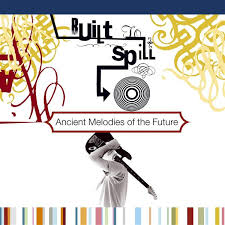
ancientAfter their live album, Built to Spill returned with Ancient Melodies of the Future.  For many fans, this album concluded their first trilogy of great records.  The album is similar in style to Keep It Like a Secret, but there are some new elements added.  Sam Coombs, who supplied keyboards on one song on the previous album is back on this one with prominent keyboards on three tracks (which adds a rather different vibe to the Built to Spill sound).

“Strange” is yet another stellar leadoff track.  It’s got an interesting riff with some great lyrics and what evolves into a stupendously catchy chorus.  It features Sam Coombs on Rocksichord, which has a rather unique sound.

“The Host” has strings, which is quite a departure.  The song is mellow with a simply great vocal line for the verse. “In Your Mind” has an interesting acoustic guitar line with some wild backwards guitar effects over the top. I really like the way the vocal line gets loud and high when he gets to the “in your mind” part.

“Alarmed” slows things down with bigger, louder strings. There’s a lengthy crazy keyboard solo from Sam Coombs

“Trimmed and Burning” gets a little heavier sounding   “Happiness” has a slide guitar—a very unusual sound for BTS. The song picks up pretty quickly and rumbles along.  “Dont Try” comes in with a much louder fuller guitar sound (Brett Netson contributes guitars to this and 3 other songs).

“You Are” is probably my least favorite BtS song, it doesn’t really do anything.  But it’s followed by the up beat and wonderful “Fly Around My Pretty Little Miss” which has really fun guitar solo and is just so catchy.

The disc ends with the acoustic guitar ballad “The Weather.”  It builds to a slightly bigger sound by the end of the song, with interesting effects on the guitars.

I tend to overlook this disc somewhat when I think back to my favorite BtS music, but there are some real gems here.  It might be a little more mellow and introspective than some of the other discs, but it’s still great.

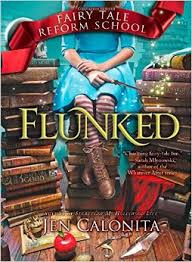
[READ:June 1, 2015] Flunked

I brought this book home because I thought Sarah would like it.  She never got around to reading it, but I decided it might be fun so I read it pretty quickly.  Calonita has written a number of YA books but this is her first series for younger readers (so says the blurb at the back, under her strangely unflattering author photo.  This is a new series (unclear how many books, but the next one is due out next year).

It’s another book that twists around the ideas of fairy tales (which I like).  The premise behind this series is that Cinderella’s stepmother Flora is really, really sorry for what she did to Cinderella (now Princess Ella).  And in order to make it up to the land of Enchantasia (nice) she decided to convert her old castle into Fairy Tale Reform School.  The school is designed to teach bad kids, villains and delinquents the ways of righteousness.  Some teachers include the Big Bad Wolf (Xavier Wolfington), the Sea Witch (Madame Cleo) and the Evil Queen (Professor Harlow).  More than five hundred gnomes, trolls, dwarfs, elves, mer-folks and other fairly tale students have been admitted in the past five years and there is much praise for the school. (more…)

Read Full Post »

sticiceSOUNDTRACK: NEIL INNES-Tiny Desk Concert #127 (May 11, 2011).

innesNeil Innes is one of the musical voices of Monty Python and The Rutles.  He is also the creator of The Bonzo Dog Doo-Dah Band.  I was delighted to see that he did a Tiny Desk concert.

In addition to creating clever songs, he is big into wordplay.  So, he has some great statements before starting:

“Good afternoon, ladies and gentlemen here and viewer.”

“It’s wonderful to be.”

“You know, not so long ago and its been very lucky for me.”

He plays his perhaps most well-known song, “I’m the Urban Spaceman” on guitar.  It is wonderfully surreal (at the end he describes it as a medley of hit).

For “Democracy” he play a tiny ukulele.  This song is not funny (well a little).  It is political, straightforward and pointed.

For the final song, he play The Rutles’ “I Must Be In Love” (with appropriate accent).  He tries to get everyone to sing the really high Ooooh note and then gives up.

And then he’s gone.  It’s delightful.

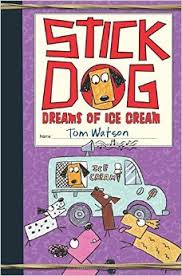
[READ: August 10 2015] Stick Dog Dreams of Ice Cream

By this point (the fourth book) the Stick Dog series has gotten a little predictable.  I mean, basically the dogs want to get food right?  But Watson still manages to keep the stories funny.  I see that for this book the illustrations are “by Ethan Long based on original sketches by Tom Watson”  I have a hard time believing that Watson was too busy to draw these very simple figures, but whatever.

I also find it hard to believe that these dogs have never tasted ice cream before–surely they have scavenged a wrapper somewhere.  But best not to think too carefully, right?

because it is summer time and it is very hot.  The dogs are all looking for something to cool them off.  They go out in search of a nice cool water source.

But the best parts of the story are when the dogs get distracted.  On the way for water, Poo-Poo smells something.  They hope it is hot dogs or pizza, but it is…a squirrel.  Stick Dog is afraid of this because Poo-Poo will be not let the squirrel go.  But Stick Dog convinces him to leave it.  And they are off. (more…)

Read Full Post »

atwq3SOUNDTRACK: YES-Tales from Topographic Oceans (1974).

Tales_from_Topographic_Oceans_(Yes_album)After the huge success of Fragile and Close to the Edge (with its 18 minute suite), what could Yes do next?  Well first they would release a triple live album, which I’ll get to later.  And then?  Why they would release a double album with only 4 songs on it!  That’s right 4 songs each around 20 minutes long!  And it would be ponderous and pretentious and it would be reviled by everyone!

The album shipped gold (because their previous records were so popular) and then sales plummeted.  The album is much maligned and, frankly, deservedly so.  Now, I love me a good prog rock epic.  So, four 20 minutes songs is pretty heavenly for me.  But man, these songs just don’t really have any oomph.

My CD’s recording quality is a little poor, but I don’t know if the original is too.  The whole album feels warm and soft and a little muffled.  You can barely hear Anderson’s vocals (which I believe is a good thing as the lyrics are a bunch of mystical jiggery pokery).  But despite the hatred for the album, it’s not really bad.  It’s just kind of dull.

Overall, there is a Yes vibe…and Yes were good songwriters–it’s not like they suddenly weren’t anymore.  There are plenty of really interesting sections in the various songs.  It just sounds like they have soft gauze between them.  Or more accurately, it sounds like you get to hear some interesting song sections and then the song is overtaken by another song that is mostly just mellow ambient music.

Without suggesting in any way that this album influenced anyone, contemporary artists are no longer afraid to make songs that are super long (see jam bands) or songs that are just swells of keyboards (see ambient musicians).  Yes just happened to put them all in the same song–way before anyone else did.

The album is very warm and soft—rather unlike the last couple of Yes albums which were sharp and harsh.  There are washes of keyboards and guitars and Anderson’s echoing voice. But what you’ll notice is that I haven’t really mentioned Chris Squire.  He’s barely on the album at all, and when he is, it’s usually to provide very simple bass notes–bass notes that anyone could play–it’s such a waste!  And while Alan White is no Bill Bruford (who was off rocking with King Crimson then), he’s also barely there.  In fact, Rick Wakeman himself is barely there–the king of elaborate classical riffs is mostly playing single notes at a time.  According to Wikipedia,

Wakeman took a dislike to the album’s concept and structure from the beginning. He made only minimal musical contributions to the recording, and often spent time drinking at the studio bar and playing darts. [During the recording session] he played the piano and synthesiser on the Black Sabbath track “Sabbra Cadabra”.

Evidently Anderson wanted a pastoral feeling in the studio

According to Squire, Brian Lane, the band’s manager, proceeded to decorate the studio like a farmyard to make Anderson “happy”.  Wakeman described the studio, “There were white picket fences … All the keyboards and amplifiers were placed on stacks of hay.” At the time of recording, heavy metal group Black Sabbath were producing Sabbath Bloody Sabbath in the studio next door.  Ozzy Osbourne recalled that placed in the Yes studio was a model cow with electronic udders and a small barn to give the room an “earthy” feel. Anderson recalled that he expressed a wish to record the album in a forest at night, “When I suggested that, they all said, ‘Jon, get a life!'”

So we have an earthy pastoral album.  But what about the four sides?  Steve Howe describes it:

“Side one was the commercial or easy-listening side of Topographic Oceans, side two was a much lighter, folky side of Yes, side three was electronic mayhem turning into acoustic simplicity, and side four was us trying to drive the whole thing home on a biggie.”

Despite Wakeman’s complaints, he did have some nice thing to say about it.  he said that there are

“very nice musical moments in Topographic Oceans, but because of the […] format of how records used to be we had too much for a single album but not enough for a double […] so we padded it out and the padding is awful […] but there are some beautiful solos like “Nous sommes du soleil” […] one of the most beautiful melodies […] and deserved to be developed even more perhaps.”

And if Rick Wakeman says an album is padded, you can just imagine what the rest of the world thought!

The lyrics (and mood) are based on Jon Anderson’s vision of four classes of Hindu scripture, collectively named the shastras, based on a footnote in Autobiography of a Yogi by Paramahansa Yogananda.  So if I read this correctly–he wrote 80 minutes of music based ona  footnote!

The four songs are

“The Revealing Science of God (Dance of the Dawn)” [which Howe says is the commercial or easy-listening side] builds slowly and eventually adds vocals.  And then come the drums and a decent keyboard riff.  There’s some noodling on the keyboards.  The riff is catchy but not immediate (which might be the subtitle for the album).  At nearly 4 minutes a faster section kicks in and there’s a catchy vocal part, which seems like where Anderson might normally soar but he holds back.  The “must have waited all our lives for this moment moment moment” is catchy, but again I can’t help but feel it would have been much more dramatic sounding on an earlier record.  At 7 minutes there’s a nice jump to something more dramatic—good drums, but the bass is mixed very low (poor Squire).  There’s some good soloing and such but it is short lived and things mellow out again.  It resolves into a new riff at 9 minutes, but resumes that feeling of washes and noodling guitars.  At 11 minutes there’s an elaborate piano section and the song picks up some tempo and drama. Especially when the bass kicks in around 12 minutes.  The most exciting part happens around 17 minutes when the whole band comes to life and adds a full sound, including a good solo from Wakeman.  And while this doesn’t last, it recycles some previous sections which are nice to hear.

Track 2 “The Remembering (High the Memory)” [which Howe described as the much lighter, folky side of Yes] has a slow, pretty guitar opening with more harmony vocals.  The whole first opening section is like this—layers of voices and keys. Then come some keyboard swells and more vocals.  Some bass is added around 6 minutes. And then around 8 minutes the tone shifts and there is a lengthy slow keyboard solo that reminds me of the solo in Rush’ “Jacob’s Ladder” (released 6 years later).  At around 9 minutes there’s a more breezy upbeat section with a cool riff.  At 10:40 a new section comes in with some great bass lines and guitars and an interesting vocal part. It could easily have been the structure for a great Yes song (vocals are singing “relayer” which of course is their next album’s title). But this is all too brief (it thankfully returns again) and then it’s back to the gentle keyboards.  At 12 minutes there’s a new medieval type section with some great guitar work.  When the “relayer” part returns around 13 minutes there’s a whole section that is great fun.  And even though it doesn’t keep up, the song feels rejuvenated. By around 17 minutes there some interesting soloing going on and then the band resumes to bring it to the end (with a reprise of an early section). And the final section is quite lovely.

Track 3 “The Ancient (Giants Under the Sun)” [Howe: electronic mayhem turning into acoustic simplicity] is probably the most interesting.  It opens with some clashing cymbals and then a fairly complex percussion section and mildly dissonant guitar riff.  There’s even some staccato bass line. The vocals come in around 4:30 and the song shifts to a less aggressive sound, but the big bass continues throughout the beginning of the song until a fast riff emerges around 6 minutes. But more unusual Yes-type riffage resume briefly before segueing into the next part with lots of percussion.  While the staccato bass and drums continues, Howe solos away.  Then around 12 :30 the whole things shifts to a pretty, slow acoustic section with a classical guitar and vocals.  This entire end section sounds like it could easily have been its own song and it is quite lovely.  Howe’s acoustic work is great and there’s even a lengthy solo.

Track 4 “Ritual (Nous Sommes du Soleil)” [Howe: us trying to drive the whole thing home on a biggie] is also quite good.  It’s probably the most fully Yes track of the four, with many sections of “full band” material.  There’s a noodly guitar intro switching to an interesting dramatic minor key movement.  There’s a pretty, if simple, riff (done by guitar and voice) that is quite lovely.  Around 4:30 the guitar solo brings in a riff from a previous Yes song. By 7 minutes, the song settles into a fairly conventional sounding Yes song (with actual bass and drums and…sitar!).   Around 11 there’s a bit of Wakeman soloing (he did show up for some of the album after all) and then some wild guitar and bass work.   The crazy percussion resumes and there’s a wild keyboard solo on top of it. The end of the guitar solo even has a bit of “Born Free” in it.

I hadn’t listened to this record in probably 25 years.  And so I listened to it 4 times in the last few days.  And I have to say that I thought it was bloated and awful at first, but it slowly grew on me.  I found some really interesting sections and some very cool riffs.  If these pieces could have been truncated into individual songs they would be quite good.  The biggest problem for me is that so much of it is so slow and mellow–like it’s building up to a big climax which never arrives.  On previous albums, Yes had made quite a show of being insane musicians, and that just isn’t here.

So even though I have come around on these songs, they certainly aren’t my favorites.  But if you’re at all interested in Yes, there’s some gems hidden away in these monstrosities (just don’t think too much about what Anderson is talking about).

Since almost every Yes album had different personnel, I’m going to keep a running tally here.  The band stayed together after Close to the Edge, but this was too much for Wakeman who left after the recording:

Chris Squire-bass
John Anderson-vocals
Alan White (#2)-drums
Rick Wakeman (#2)-keyboards
Steve Howe (#2)-guitar

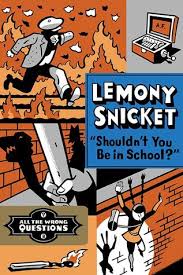
[READ: June 20, 2015] Shouldn’t You Be in School?

I am finding this series to be ever more and more confounding.  And I know that is its intent, but it is still a challenge.  Whenever anyone asks a question someone else replies that it is the wrong question.  But they never say what the right question should be (deliberately confusing!).  There are also so many threads and confusing characters, that if Snicket didn’t make the story funny and strangely compelling, it would be incredibly frustrating.

In this story, Hangfire, having been thwarted in his previous endeavor to capture children (for what end we do not know) is back with a new plan to capture children.  Also, the mysterious (and presumably wicked, but who can be sure) Ellington Feint has returned as well to help or hinder as she sees fit.

The other characters are back too, of course: Moxie is back taking notes, Jake Hix is cooking delicious foods at Hungry’s (in fact there are even some recipes that sound pretty yummy–Snicket himself makes a passable tandoori chicken).  S. Theodora is still his mentor (and the pictures by Seth of her are hilarious).  Late in the book Pip and Squeak show up.  And naturally the policemen and their bratty son Stewie are there too.  And we are still wondering what in the heck is going on with the bombinating beast.

There’s also some new characters, like Kellar Haines, a young boy who when we first meet him is typing up something in the offices of the Department of Education (with posters all over the walls that say Learn! Learning is Fun, etc).  And his mother is also becoming quite chummy with S. Theodora.

The danger in this book is fire.  Building after building is being burnt down.  The Stain’d Secondary School is engulfed.  Even the library is at risk!  And that’s when S. Theodora solves the crime!  She gets the library Dashiell Qwerty arrested for setting the fires.  And even though it is quickly determined that he did not do it (a building was burnt down while he was in custody), that doesn’t stop S. Theodora and her new friend Sharon Haines (in matching yellow nails) from partying.  It also doesn’t stop Qwerty from being taken to prison.

This story is a bit darker than the other ones (which were admittedly pretty dark).  Every kid is being drugged with laudanum which makes you sleepy.  We’re unclear exactly what they are being drugged for, but Snicket has a plan to stop it.  Snicket himself winds up getting beaten up–pretty badly–from Stew and others.

And for the first time, S. Theodora is kind to Snicket (more or less) and apologizes for her behavior (sort of).

By the end of the book a plan is hatched, a bunch of people join the V.F.D. (as seen in A Series of Unfortunate Events) and someone is taken to jail. There’s even a mysterious beast who is living in the fire pond.

As in previous books there is ample definition building–either from people saying they don’t know what a word means so that it can be defined or from Snicket himself simply defining a word.  As in “my brother and I played an inane game” “inane is a word which here means that my brother and I would pretend we couldn’t hear each other very well while we were talking.”  This game actually sounds fun:

What do you think of the weather this morning?
Feather? I’m not wearing a feather this morning.  This is just a hat.
Just a cat? Why would you wear a cat on your head?
A Bat in your bed etc etc.

The artwork by Seth is once again fantastic and noirish.

And the end of the book has a fragmentary plot “a great number of people working together, but they plotted together in such a way that nobody knew exactly what the other people were doing”  And finally we learn what the right question is, but it’s the unsatisfying: “Can we save this town?”  We’ll have to find out in the concluding book 4.

You can also check out the website for some fun.

Read Full Post »
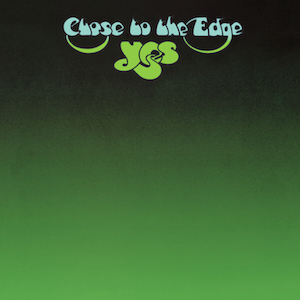
critterSOUNDTRACK: YES-Close to the Edge (1972).

Yes-closeHaving such success with Fragile, the same line up toured that album and then planned a tour for the successful follow-up Close to the Edge.  This album is the first one to feature their now iconic logo and a clearly designed by Roger Dean album cover (even if it’s fairly plain).

This is also their first album to feature a side one suite, the title track “Close to the Edge.”  It also features only two other tracks (10 and 9 minutes each).  And despite (or because of that) it was a huge success.

“Close to the Edge” opens with part I “The Solid Time of Change.”  The opening is soft and then blam, some crazy guitar lines over a fast and complex bass line.  There’s so much going on it’s near cacophony for 3 minutes (I’m not even sure how they did it).  Until a beautiful soaring guitar riff breaks from the noise.  I love that Howe plays the riff a second time with slight variation to it—really keeping it interesting and complex.  And at nearly 5 minutes we get to the “close to the edge” chorus, or at the first part of it (I also love that the chorus gets bigger as the song progresses).  I don’t really know where the “parts” begin, (confusingly they sing the titles of the sections through the song).

Ok, so Wikipedia tells me that part II “Total Mass Retain” begins with the big thudding bass at around 6:04.  And part III “I Get Up, I Get Down” evidently starts right after the keyboard solo around 8:28 which begins with the slow washes of keyboards.  It is the mellow section with the multiple layers of vocals and the gorgeous church organ.  Part IV “Seasons of Man” starts with the reprise of the earlier music (in a weird key change).  There’s a lengthy keyboard solo here and then more vocals reprising all of the section with a slightly different feel. Until it all fades out much like it faded in.  It’s a dynamite track and never feels 18 minutes long.

Side two has two songs.  “And You And I” is only 10 minutes long but it too has 4 parts.

Par I “Cord of Life” opens with what is more or less guitar tuning (although it sounds lovely with his guitar).  And then there’s some very pretty acoustic guitar playing.  I really like when the bass notes come in around 1:15 and then there’s Wakeman’s keyboards.  It gets big and bassy just at the end of part 1.  Part II “Eclipse” starts around 3.48 right after the “call” when the big orchestral instrumental kicks in. This part lasts for 2 and a half minutes.

The opening guitar returns and then part III “The Preacher, the Teacher” begins with a new guitar section (and more keyboards) this is more or less a reprise of the other verses.   Part IV “The Apocalypse” is just 52 seconds long and is the reintroduction of the “and you and I theme” (and is not apocalyptic at all).

“Siberian Khatru” is 9 minutes but only one part. It opens with a fast cool guitar riff and then adds a fast cool keyboard riff.  The bass rumbles through and the guitar floats over the top.  There’s a great guitar riff that comes in around a minute in, which is the main riff of the song.  And then there’s some harmony vocals   After the harmonies, the song sort of resets and we get another verse with more great harmony voices.  The keyboard solo is on a harpsichord and sounds very classical.  Then there’s a trippy guitar solo.  A new section of song starts around 4 and a half minutes.  Around 6 minutes the song switches to the ending coda, a smooth cool riff with a guitar solo floating over the top.  The band jumps in with a sung staccato  “doh dah doh” bit which sounds like it would end the song, but they’re not done, there’ another refrain of that cool keyboards section with a neat noodly guitar solo.

This was a band of soloists that were at the top of their game and not only did great work by themselves but played very well together.

Since almost every Yes album had different personnel, I’m going to keep a running tally here.  Two albums in  row with the same lineup!:

Chris Squire-bass
John Anderson-vocals
Bill Bruford-drums
Rick Wakeman (#2)-keyboards
Steve Howe (#2)-guitar

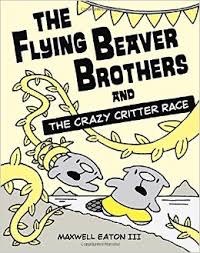
[READ: June 30, 2015] The Flying Beaver Brothers and The Crazy Critter Race

I love the Flying Beaver Brothers.  And even though the last couple haven’t been quite as awesome as the first ones, this one has definitely brought the series back on an upswing.

The book casually mentions the baboons from the previous book and what they did to Beaver Island (don’t ask) and then gets right into the action.  A local businessman is having a race.  Everyone is invited to replant the trees that the baboons destroyed and the winner will win a houseboat.

Turns out the entrepreneur is named Crazy Critter (they assumed that was the name of the race) and he is super gung ho about getting the race started.  In Crazy Eddie tradition, he calls himself crazy a LOT. (more…)

Read Full Post »

6SOUNDTRACK: YES-Yes (1969).

yesThis past weekend bassist and founding member of Yes died.  Up until about six weeks ago he was supposed to tour with Yes this summer.

It was surprising and sad news.  I was a huge Yes fan in college, and of course I love all things prog. But I started to lose patience with Yes since they had such a revolving door policy it wasn’t even clear is the people in the band even were part of the band (although Squire has played on every Yes album).  I hadn’t listened to anything new from them since the 1990s, and I was genuinely shocked to see how much new material they had released since then (about ten).

So here’s a bunch of their albums that I own.  I’m not going to pretend I don’t know their peak period stuff, so I’m looking at their first two albums with the hindsight of the 70s masterpieces.

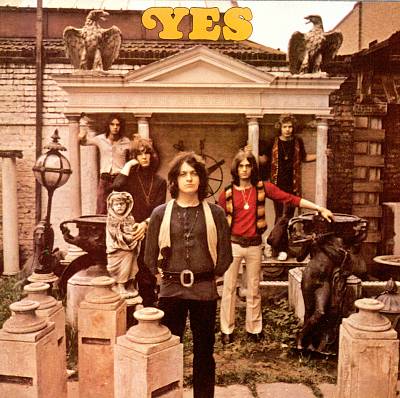
Their debut album (look how 1969 that cover is) opens with a Chris Squire penned song called “Beyond and Before.”  Loud (and high) bass notes announce that this might just be a Yes album, even the vocal harmonies suggest Yes, and yet once the verse begins, it is a much more psychedelic version of Yes. The music feels very Summer of Love. And while Squire’s bass does come out from time to time, after that initial flurry it kind of settles down a bit. The song itself is quite good, as long as you’re not expecting classic Yes.

I feel the biggest sound difference is Anderson’s vocals which, while still powerful have a more gentle/sensitive feel (not too far off from his more famous style later on, but slightly mellower perhaps).

Next come s very jazzy cover of The Byrds’ “I See You” (a song I don’t really know, but the lyric “the cave of your hair” is pretty awesome.   This version is 7 minutes long with an extended jazzy solo from Peter Banks and suitable jazzy percussion from Bill Bruford. Tony Kaye on keyboards also features prominently.  The end is quite loud for such a hippie offering.

“Yesterday and Today” is a piano & vocal performance. It’s very delicate.  “Looking Around” has very heavy keyboard opening. The bass sounds like Squire but this is a very keyboard heavy song.  “Harold Land” opens with a kind of church organ and singing, but then the Yes sound comes in (you can almost hear the band forming). It feels, again very synthy, but certainly heading in the direction of Yes.

“Every Little Thing is a Beatles cover (! two covers on the debut album).  It begins with much chaos—noisy drumming, bass rumblings and keyboard noodling. The song is 5 minutes and the intro is almost 2 minutes. The big bass and drum really makes the song rock and the keyboards build some real drama into the track.

“Sweetness” is indeed a sweet slow track with a lot of acoustic guitars and soft keyboards.  It has a great descending chorus vocal line. If this were rerecorded and made a bit more modern sounding I think it could be a hit (well, maybe update the lyrics a bit too).

“Survival” is probably the most enduring track on the record. It opens with some great fuzzy bass and some actual catchy riffs. The opening vocals sound more like what latter-day Yes would sound like (subtle distinction, yes but it’s there). The chorus is very catchy and it’s a fun romp right until the end.  It’s a good send off, with a promise of better things.

Since almost every Yes album had different personnel, I’m going to keep a running tally here:

Chris Squire-bass
John Anderson-vocals
Bill Bruford-drums
Tony Kaye-keyboards
Peter Banks-guitar

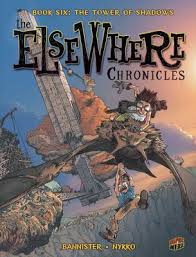
[READ: February 16, 2014] The ElseWhere Chronicles Book Six

I ended my review of the last book by saying “now I’m hooked.”  But in the year since I read the last book I lost all the momentum of the series (since I’d read the first five in quick succession).  Which is a shame since the book was every bit as exciting as the rest, but I wasn’t quite as into it as I wanted to be.

Since Ilvanna died in the last book I should have been more upset about it and been more excited at the prospect of her return in this one, but I’d forgotten about it all.

As for the rest of the story, Theo, Max and Rebecca meet up with an old man who seems to know the secrets of the Other World.  He convinces Theo and Max to capture a creature who can take them to the Other World.

Meanwhile, in the Other World we see that the spirit of Rebecca is held be a mean looking guy known as the Master of Shadows.

At last the Master of Shadows meets the old man and Rebecca meets her double–a creature which he has created from a photo of Rebecca–he just needs her soul to complete the creation.  The final battle is pretty epic with swirling shadows all over the place and Rebecca’s grandfather pleading with her to destroy her doppelganger.

Meanwhile Theo and Max find Ilvanna who may or may not be dangerous, but she seems to want to help them.

This was the final book of series two of the series.  And the cliffhanger shows that the boys have found Dolean and the two Rebeccas have emerged–to what end?

The story was certainly exciting, but I recommend reading the whole second series together to really maximize the impact.

Read Full Post »

babboobSOUNDTRACK: MADISEN WARD AND THE MAMA BEAR-Tiny Desk Concert #444 (May 26, 2015).

wardI love that Mama Bear is actually Madisen Ward’s mother, Ruth.  They play some really wonderful roots music.

Madisen has a powerful soulful voice and Mama Bear’s harmonies are excellent–ranging from deep to high pitched.

And their joint harmonies on second song, “Sorrows and Woes” (especially the final note) are really amazing.

Mama Bear also adds some great licks to some of the songs (Madisen plays leads on “Silent Movies” while mama Bear plays the main riff on “Daisy Jane.”

Between songs, Madisen has some funny banter.  I laughed when he said that he was now going to retire since he has played the Tiny Desk.  And Mama Bear talks about how excited she is that their new record is on yellow vinyl.

The songs are delightful folk songs (with “Daisy Jane” being the boppiest of the lot with some delightful “ooh hoos” at the end).  I’d never heard of them before, but I wish them a lot of success.

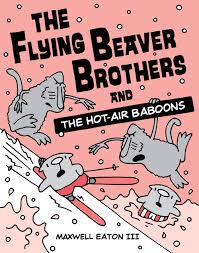
[READ: February 11, 2014] The Flying Beaver Brothers and The Hot-Air Baboons

I saw this book in the library and was delighted to have another Flying Beaver Brothers book to read (I also just saw online that there is a sixth book too!).

Poor Beaver Island is under attack yet again (my kids were surprised to see that there were so many beavers on the island with them, and I admit I didn’t realize there were quite so many either).

The threat this time is a group of baboons who are melting the snow off of the skiing mountain (beaver island really has it all!).  When Ace and Bub finally get caught up to speed with what’s happening, the baboons (Pete, Kyle and Ringo) hilariously get mad about having to repeat the whole story that they told everyone earlier.  There is a helpful chart with Proboscis and Baboon listed as types of monkeys and buffoon as not a type of monkey. (more…)

Read Full Post »

pizzaSOUNDTRACK: BELLOWS-Tiny Desk Concert #440 (May 11, 2015).

bellows I knew Bellows from NPR playing one of their songs.  They are a new band with one album out.  Their Tiny Desk Concert is really short (under 10 minutes) but they do play 3 songs.

I’m curious if they are stripped down for this or if they typically sound this soft and simple.

The opening song “Sacred Heart” is propelled by a very simple synth riff and bass notes (the lefty bassist plays a right handed bass upside down, which is interesting to see).  Perhaps the most compelling thing about Bellows is the harmony voices (and the drummer’s hair).

Lead singer Oliver Kalb has a voice that I wouldn’t call powerful, but it is rather distinctive (and perhaps a bit unusual).  The songs work best when the unnamed keyboardist (female) and bassist (male, deep voice) all sing together, like in “Hello Morning.”

The final song, “White Sheet” is the one I knew from NPR.  It sounds just as good here.  It is easily the best of the three songs, probably because the keyboardist does more than sing harmony.  (And the ah ah ah ah section, combined with the deep breathing section is very catchy too).

I think it may be the simplicity of the melodies that makes the songs so effective–they do stay with you.  And they definitely leave me wanting to hear more.

[READ: January 5, 2015] Stick Dog Chases a Pizza

I didn’t know there was a third Stick Dog book out.  It is pretty samey compared to the first two (but since I haven’t looked at a Stick Dog book in a while, it was okay).   In the first book, the dogs were after a hamburger.  In the second it was a hot dog. In this book they are after a pizza.

The book opens with the dogs all laughing at Karen (the dachshund) trying to catch her tail.  When that is over (Stick Dog doesn’t like that they are teasing her even if it is funny), he suggests that they go the park and play Frisbee.  There is plenty of funniness as the dogs ignore him but pretend they were paying attention.  And then they all come back with what they think is a Frisbee (the results range from bottle caps to flat tires (the poor bike rider) to cardboard discs.

But the cardboard disc has red stuff and white stuff on it and it tastes delicious. I have to say I am surprise that they never tasted pizza before (all dogs root through garbage and grab pizza boxes at some pint right?). (more…)

Read Full Post »

[LISTENED TO: May 24, 2015] The Penderwicks at Point Mouette

penderwicmouMy family loved the first Penderwicks book.  We listened to the second one but I missed a large part of it so I didn’t write about it.

In this third book, which is set but one year after the events of the first book, quite a lot has changed.  And the main characters are somewhat different in this book.

It is summer time and the Penderwicks are headed to Point Mouette, Maine for a vacation.  Except that Mr Penderwick is away in England [I won’t say why, I don’t want to spoil the part I know from book two] and Rosalind is vacationing in New Jersey with friends.  We don’t get to see Rosalind at all (I’d like to hear a bit more about her time in Ocean City), and we only get occasional phone calls from her (it’s as if Rosalind grew up and didn’t want to be part of the show anymore, so she was “written out” of the script).

That means that 12-year-old Skye is the O.A.P. (Oldest Available Penderwick) and she will look after 11-year-old Jane and 6-year-old Batty.  Fear not, they will have some adult help–Aunt Claire will be there too.  Although she is quickly taken out of the action when she twists her ankle and is on crutches for most of the book.

The one major problem I had with this book is that as O.A.P., Skye is annoyingly insecure in this book.  In general, Skye is a major bad ass.  She’s tough, she takes no guff from her sisters (even though she loves them dearly) or from boys.  And yet for this whole book she is petrified of being O.A.P.  And she comes across as a bit whiny.  While this does work to humanize her a bit, it also seems excessive.  Of course, this may also be the decision of audio book reader Susan Deneker to make her sound quite so frantic, but it’s weird to think of Skye as being so insecure.

On the other hand, she is the one who is mostly in charge of everyone and she is only 12, for crying out loud.  So her concern is understandable, it’s just that her reaction seems out of character.  Indeed, the whole premise of these books–that these kids make pretty big decisions on their own–is just crazy (but that does it give it a cool retro feel too). (more…)

Read Full Post »

cleoSOUNDTRACK: JOHN REILLY & FRIENDS-Tiny Desk Concert #418 (February 3, 2015).

johnI started this show without observing who it was (it was just next on my queue) and I listened without watching first.  At first I thought, hmm, interesting old timey songs.  And then the guy spoke and I thought, wow, he sounds a lot like actor John C. Reilly, I wonder if he’s from the same place.  And then I clicked over and saw that it was John C. Reilly, in full beard and hat playing old timey, spiritual songs.

A lot of actors have vanity music projects, but there’s nothing vain about this. It’s all old music (they use an old timey microphone) and they’re clearly not looking to top any charts.  Rather, Reilly plays acoustic guitar and sings—he has a great, solid voice. And his backing group is full of great musicians who all have careers doing other things: Tom Brousseau on guitar and harmony vocals, Becky Stark from Lavender Diamond on harmony vocals, Andru Bemis on banjo and fiddle, as well as Soul Coughing’s Sebastian Steinberg.

I didn’t recognize any of the four songs they played–which is probably the point.  He explains that Tom is their archaeologist and he uncovered a number of these songs.

The second song references Jesus and after the song Reilly talks tells everyone that he’s a lapsed Catholic but it seemed a shame to ignore all these beautiful songs because of religion.  So when they say Jesus you can think Buddha or… Satan or… the ocean. Becky Stark comes across a bit more, um, something, with her comment “we are advocates for deathless bliss.” (Reilly deflates the silence by saying “deathless bliss” is their other band).

It’s a charming group of songs and would not sound out of place with some tracks from O Brother, Where Art Thou.

[READ: January 8, 2015] Cleopatra in Space Book One

I brought it home for C. but it looked really fun so I read it too.  I enjoyed this book so much that I can’t wait for the next part.

I love Maihack’s artistic style, it’s simple and very clean, and his drawings of the people and aliens are cool and expressive

The basic setup here is that Cleopatra, yes, that Cleopatra, is about to have her 15th birthday.  This means she is about ready to rule the country.  But in the meantime she is stuck going to school and taking Algebra, ugh.  She gets her friend Gozi out of class (by hitting him with a pebble and making him yell).  So they sneak out.  I loved the joke when he asks where she got the slingshot since her father confiscated them all–“It’s not like they’re hard to make, Gozi.”

While they are shooting rocks at things, they uncover a giant tomb door.  When it opens, they see all kinds of cool artifacts.  One of them is a panel of some sort.  And when Cleo (she prefers Cleo) reads it, she is sucked into a portal to a new planet generations into the future.  The great great great great grandson of her cat is there (and he can talk–in fact all the cats can talk).  And they inform her that she is the prophecy sent to defeat the Xerx.  The Xerx are a race of brutes who are ruled by Xaius Octavian, a power-hungry dictator.

He evidently sent out some kind of EMP to destroy all of the electronic records in the world but also managed to keep copies for himself.  So he has all the knowledge in t universe.  And it was written that Cleopatra would come and save them from this terrible scourge. (more…)

Read Full Post »

« Newer Posts - Older Posts »