Feeds:
Posts
Comments

Archive for the ‘Biography’ Category

SOUNDTRACK: MY MORNING JACKETZ (2005).

I’ve enjoyed My Morning Jacket since I bought their live album Okonokos.  I’ve enjoyed all of their releases since, but I never listened to Z, the album that forms the basis of much of Okonokos. Finally, I saw it cheap and picked it up.

And I was really surprised.  The reason I hadn’t gotten it was because I figured I had all of the songs already in live format, so who needed the studio?  Well, it turns out that the studio versions are quite different from the live ones.  In fact, on my first listen, I didn’t really like the studio versions all that much.  After a few listens of course, I like them just fine, but they are indeed quite different.

There are three songs here that didn’t make the live record: “Into the Woods,” “Anytime” and “Knot Comes Loose.”  But the other seven songs appear (often in slightly longer form) on the live disc.  And the live disc is fuller, louder and more energetic than the studio.  That’s what a live album is supposed to sound like.

Z, on the other hand, sounds a bit more polished, more almost dancey–reflecting the kinds of sounds they would incorporate down the road (like on Circuital).  But Z isn’t quite as full-sounding.  Despite that, the songs are top-notch.  And Jim James’ voice is truly a thing to behold (check out that crazy high note at the end of “What a Wonderful Man”).

I hate to sound like I’m down on this disc, because indeed, I am not.  It’s a really fascinating mix of psychedelia and Prince-inspired keyboard rock (I’m not going as far as funk, but it’s certainly Prince-y.  There’s some folk tracks, there’s the amazing “Wordless Chorus” which has a kind of 70;s soft rock feel, which is followed by the Prince-titled “It Beats 4 U” which sounds nothing like Prince, but has a great subtle guitar intro.  “Gideon” doesn’t match any of the over the top epics of earlier records, but it sure feels close.  And “Off the Record” is a practically ska.  The album even has a near 8 minute closing track, the awesome “Dondante.”

All in all, Z is pretty great.  But I still like the live versions better.  That’s what happens when you listen to things out of order, I guess.  But when do live albums count for anything?

 [READ: July 11, 2011] 3 book reviews

According to Five Dials, Zadie Smith is an official member of Harper’s staff now (funny I found out about it from Five Dials, but they really do have tentacles in all aspects of my life).  Congratultions, Zadie.

I can’t imagine having to review two or three books a month (I know I review a lot here, but most of them are short stories).  Zadie plows through a lot of books for this column, but what is wonderful is that the diversity of what she reads is really pronounced.  Just witness this months’ books.

MELA HARTWIG-Am I a Redundant Human Being?
Zadie takes a great angle on this novel.  She (with the help of an online reviewer) compares the protagonist of this novel (written in the 1930s) with Carrie Bradshaw from Sex in the City.  Why?  Because both protagonists seem to live their lives in the male gaze.  And yet they both also continue on their merry way regardless of what the men say or do.  True, Hartwig’s novella has much more angst, but really, there is a similar attitude present.

I especially like Zadie’s argument that women writers have never really had they way to express the bragging rights that men have employed time immemorial “We can’t, as the saying goes, pull it out and slap it on the table.”  And as such, women have had to achieve their victories through more roundabout means.  I rather liked this analysis.  And, I think it makes for more interesting reading most of the time. (more…)

Read Full Post »

SOUNDTRACK: THE KOPECKY FAMILY BAND-Tiny Desk Concert #131 (June 6, 2011).

I’d never heard of The Kopecky Family Band, but the write-up about them was pretty interesting, so I decided to give the Tiny Desk concert a listen.  The band (all 7 of them) play a great collective of music: two guitars (acoustic & electic) bass, cello, violin, drums and keyboard.  They play a sort of traditional folk with a very full sound.

Indeed, they remind me an awful lot of The Head and the Heart (the singer’s voice in particular), although they are from different edges of the continent and have been playing music about as long as each other (indeed, The Kopecky Family Band released an EP in 2008 whereas Head and the Heart formed in 2009).

And the Kopecky website offers lots of free music (which is very cool).

“Howlin’ at the Moon” is a full acoustic sounding track.  “Birds” has a simply gorgeous whistle/xylophone melody that is as beautiful as it is catchy.  “Disaster” is a tender ballad with wonderful harmonies.  And “Red Devil” is a somewhat more rocking song, which really helps to demonstrate the bands’ diversity.

And the band is charming.  Keyboardist/singer Kelsey admits to having left a trinket of some kind of the office bookshelves (which are littered with things).  It’s a wonderful set, and because of it, I downloaded the band’s first EP from their site.

[READ: June 5, 2011] Great Philosophers Who Failed at Love

Shaffer was signing books at BEA this year.  My coworker told me that he was very funny and that he signed her book in an amusing way.  He happened to be signing at the table next to the line I was on. Sadly, he finished before I was able to get to him.  But I was pretty close to the beginning of the line, so I asked if I could grab a copy of his book, which I did (although no autograph for me).

This is a silly book of nonfiction.  It looks at thirty-seven philosopher or thinkers and their utter failure at love.  Each man (and occasional woman) has had some distinguishing characteristic that made them pretty lousy in the emotional range.

The title of the book is funny and is meant to be kind of surprising: these smart folks were terrible at love.  Of course, spending a minute or two thinking about who these people were and what they did, it’s not surprising that they were lousy at love.  These were intellectuals, people who spend most of their time in their own mind.  Of course they couldn’t have a serious relationship.

Nevertheless, these stories are all more or less amusing (Louis Althusser accidentally strangled his wife to death(!) which isn’t amusing per se, but the story of it is, kind of).  Shaffer does a great job at keeping each entry brief but really retaining the salient points of the thinker’s philosophy and a cogent example of his or her lousiness at love.  He also throws in some amusingly snarky comments of his own as he goes along.

I was delighted that the book order was done alphabetically rather than chronologically.  A chronological list would have been a little too samey in terms of each person’s context.  The alphabetical list allows for jumping around from say Plato to Ayn Rand which keeps the stories interesting and fresh.

At the end of each person’s piece, there’s an “In His Own Words” which offers a quote that details his or her written philosophy regarding love.

Dare I say that this is an ideal bathroom book?   It certainly is. And it makes you feel a little better about yourself (if you haven’t for instance, adopted your mistress as your daughter (Sartre)).

Read Full Post »

SOUNDTRACK: PJ HARVEY-Live at the Warfield Theater, San Francisco, April 14, 2011 (2011).

NPR was given permission to share this PJ Harvey concert.  However, they were only allowed to share about half of it.  The show is fairly short to begin with (about 75 minutes) but the downloadable portion is barely 40 minutes.  It turns out that NPR was given the rights to all of the songs from the new album, Let England Shake.

Now, I have no idea how things like this work, why they are only given access to these songs as opposed to the other ones, or why an artist (or management) would not let her fans hear the ten or so other songs she played that night.  Legal restrictions are weird and usually stupid. But as I’ve mentioned before, you shouldn’t complain about free stuff.

So, what we get here is a spliced together concert (it sounds seamless, although they have removed all of the banter (if there was any)).  The album is played in its entirety (although we were not given “Written on the Forehead” which happens to be the song they are playing the most on the radio here), but it’s not played in order.  It was also interspersed with older songs “The Devil” and “Silence” from White Chalk, “The Sky Lit Up” and Angeline” from Is This Desire, “Pocket Knife” from Uh Huh Her, “Down by the Water” and “C’mon Billy” from To Bring Her My Love, (I’d like to hear how she handles the older songs, now that’s she’s singing primarily in the higher register).  And, “Big Exit” from Stories from the City.

It’s pretty clear that Harvey is no longer the young woman who made those first couple albums.  And she sounds strong and confident here.  It’s a great set; the autoharp never sounded better.

[READ: April 20, 2011] Five Dials Number 5

I have been enjoying all of the Five Dials, but this issue is easily my favorite so far.  The “theme” of this issue is translation.  Translators are the unheralded workers in literature, and while I have been trying to give them credit in my posts, I don’t always pay them enough attention (except when a translation is awkward or clunky).

But in addition to the theme (and the really cool interviews with some translators, I thought the fiction was outstanding and I loved Alain de Botton’s Advice column.  The whole issue was great. (more…)

Read Full Post »

SOUNDTRACK: KANYE WEST-My Beautiful Dark Twisted Fantasy (2010).

Before buying this album I really only knew of Kanye West as a loudmouthed guy who tweeted a lot and told off George Bush.  But then everyone was raving about this album (Pitchfork gave it a 10 out of 10!).  So I decided to check it out.  And I can’t get over how great an album it is.

Now I’m going to start this review by mentioning a few things I dislike about rap as a genre.  1) I dislike all of the “guests” that appear on a record–I bought the album because for you, not your friends.  2) I dislike excessive use of “unh” and “yeah” at the beginning of a track; when you have nothing to say–let the backing music flow, save your voice for actual words.  3) Rap is still terribly misogynist and vulgar–I’ve nothing against vulgarity per se (I do have something against misogyny) but excessive use is lazy, and it stands out much more in a rap song since you’re saying the words not singing them.

The Kanye West album is guilty of all three of these things, and yet I still think it’s fantastic.  The first reason is because it goes beyond a lot of rap by introducing real musical content into the songs.  This is not an “all rap is just a beatbox” dismissal of rap, it’s an observation that rap tends to be more about the lyrics and the musical accompaniment can get kind of lazy.  West’s songs have (beautiful) choruses, strings, and samples that augment the rest of the song, as opposed to samples that ARE the song.  And Kanye West’s voice is great.  His delivery is weird and twisted, a little cocky but more funny, with a twisted attitude that is really cool–and to my rather limited palate of rappers, it’s original.

The opening of the disc “Dark Fantasy” has a chorus singing “Can we get much higher” which is catchy and cool (and is used in the promo for The Hangover 2).  The switch from this opening to the rapping works well (aside from the FOUR “yea”s).  Although I don’t love the yeahs, I love his delivery, and that he occasionally ends lines with these weird “hunh” sounds, that are wonderfully emphatic.

The guests start showing up on track 2, but even the guests can’t detract from the excellent guitars of the song (and the cool solo). And I’ll say about the guests that I like some of them, but for the most part I’d rather hear Kanye.

“Power” samples King Crimson’s, “21st Century Schizoid Man”; anyone who samples King Crimson is alright with me.  But to use it so perfectly, to make it part of your song is real genius.  It works musically as well as within the overall concept of the album.

“All of the Lights” (with the pretty piano intro) features scads of guests including John Legend, The-Dream, Elly Jackson, Alicia Keys, Fergie, Kid Cudi, Elton John (!), and Rihanna.  I can hear some of these people but not Elton John (why would he agree to be on a track where you can’t even hear him?).  It is a beautiful pop track nevertheless.

“Monster” is a monster of tracks with yet more guests (I like that some of these guests break with the typical guest, like Bon Iver (!)).  And I really like Nicki Minaj’s verse.  [I’m not familiar with her work at all (in fact I keep wanting to say Minja instead of Minaj) but her verse with the wonderfully crazy vocal styling she displays is weird and cool and very powerful–I would like to check out her solo album, but the samples I heard weren’t that interesting].  It also has a great repeated chorus of being a “motherfucking monster.”

It’s followed by the even more catchy “So Appalled” (with FIVE guest rappers–some of whom I’ve never heard of but who do a good job.  I love Cyhi da Prince’s lyrics: “I am so outrageous, I wear my pride on my sleeve like a bracelet, if God had an iPod, I’d be on his playlist”  or  “So call my lady Rosa Parks/I am nothing like them niggas baby those are marks/I met this girl on Valentine’s Day/fucked her in May/she found out about April so she chose to March” or this line, “y’all just some major haters and some math minors.”

“Devil in a New Dress” opens with a bunch of “unhs” (which I dislike) but this is nice ballad in the midst of all of the noise (and it has some clever lyrics).  It morphs right into “Runaway” one of the more audacious singles I can think of.  The piano melody is so simple (a single note to start) and the lyrics show Kanye as a loser in relationships.  It’s a surprisingly thoughtful song for a song with a chorus that goes: “Lets have a toast for the douchebags, let’s have a toast for the asshole; a toast for the scumbags every one of them that I know.  You been putting up with my shit for way too long…runaway fast as you can.”  It gets even more audacious when you realize the last 4 minutes of the song are a solo with distorted voice.  And the video…the video is 35 minutes long!

The sentiment of that song is erased by the next one, “Hell of  a Life”.  It opens with a great distorted guitar riff and lyrics about sex with a porn star.   “Blame Game” is a surprisingly honest song about being nasty to your girlfriend (“I’d rather argue with you than be with someone else”).  It features a sample of Aphex Twin’s (!) “Avril 14th”.  And it’s quite a sad but lovely track.  It ends with a very long skit by Chris Rock.  I like Chris Rock, but this dialogue is kind of creepy because the woman who Rock is talking to (about the great sex she gave him) seems to be a robotic sample–why not have an actual woman talk to him?

The final track, “Lost in the World” has a lengthy intro by an auto-tuned Bon Iver.  It’s one of my favorite tracks on the disc, especially the end, where the processed vocals get even weirder but accent the beat wonderfully.  This track morphs into what is the actual final track, “Who Will Survive in America” which is basically a long recitation from Gil-Scot Heron.  It works great as an album closer.

So, despite several things I don’t like about the disc, overall, it’s really an amazing release.  And I can overlook the few things I dislike because the rest is so solid.  I can’t decide if it’s worth looking for his earlier releases.  How can they live up to this one?

[READ: May 6, 2011] McSweeney’s #37

This is the first McSweeney’s book where I’ve had to complain about the binding.  The glue peeled off pretty quickly from the center cover.  Fortunately, the back cover held up well.  I’m guessing it’s because there’s an extra book tucked into the front cover which prevents the book from closing nicely when it’s removed.

But aside from that, the design of the cover is very cool.  It is meant to look like a book (duh), but actually like a 3-D book, so the bottom right and top left corners are cut on diagonals (this makes for a very disconcerting-looking book inside–with triangles cut across the top).  The artwork inside is also cool.  In keeping with this appearance, each two page spread looks like a book with a spine drawing in the gutter of the pages).  And the bottom of each page has lines making it look like the bottom of a book.  (The illustrated margins are by SOPHIA CARA FRYDMAN and HENRY JAMES and there are interior paintings by JONATHAN RUNCIO).

The front matter is wonderful.  Although it gives the usual publishing information, the bulk of this small print section is devoted to counteracting all the claims that the book is dead.  It offers plenty of statistics to show that not only are the public reading, they are reading more than ever.  The introduction also goes a long way towards arguing against the idea that people are reading less now than in the past.  When was this “golden age” of readers?  There’s also the wonderfully encouraging news that 98% of American are considered literate.

This issue opens with letters. (more…)

Read Full Post »

SOUNDTRACK: DAVID FRANCEY AND MIKE FORD-Seaway (2009).

Mike Ford introduced me to Louis Riel on his album Canada Needs You, Volume One.  The song “Louis & Gabriel” features the lyrics “Oh, Louis Reil, here comes your friend Gabriel” outrageously simplistic (it is for kids after all) but so incredibly catchy it’s in my head whenever I see this book.  This is Ford’s most recent album, a collection of songs by himself and David Francey–who I didn’t know before this disc.

Seaway is a collection of 16 songs which are in one way or another about the sea.  Two of the songs appear on Ford’s release Satellite Hotstove, but the rest are new.  I don’t know if Francey’s songs are new or not.  I’m also unclear from the credits if Ford and Francey worked on these songs together (the notes suggest they did) or if they were recorded separately and then compiled.

The songs are primarily folk–simple acoustic numbers, often solo guitar, but sometimes with accompaniment.  Mike Ford has a great, strong voice, and is capable of some interesting stylistic changes.  His songs are more vibrant on this disc.  Francey has a wonderful, almost whispered voice.  He has a gentle Scottish accent which is great for his storytelling songs.  Mostly he speak-sings, but on some tracks, like “The Unloading” he sings a full-bodied chorus.

But it’s Ford’s song that bring a lot of variety to the disc.  “There’s No Rush” has a sort of calypso feel to it and “When You’re the Skip” has a wonderfully dramatic sea-shanty/musical feel to it.   And “21st Century Great Lake Navigators” is a rap–Ford frequently raps a song on his various albums.  His voice is very well suited to it, and his rhymes are clever and often funny.

This is a charming disc.  I wouldn’t say it’s essential, but it’s a good introduction to both singers, and, of course .

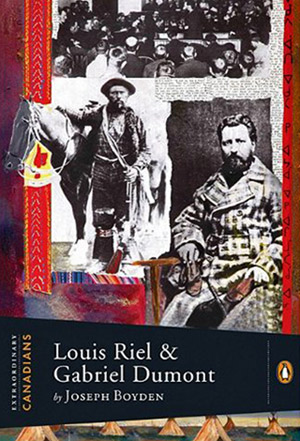
[READ: January 26, 2010] Louis Riel & Gabriel Dumont

Of the six Extraordinary Canadians books, I was least excited to read this one.  I’m not sure why, but I wound up leaving it for last.  But lo and behold it was easily the most engaging and, dare I say, exciting story of the six.  I’m sure part of that is because I didn’t know the outcome (even if Gabriel was somewhat famous in the U.S., I still didn’t know what had happened to him or to Louis).  And by the end of the book, I absolutely couldn’t put it down.

Joseph Boyden is a Métis writer (who I’ve never read before).  It’s obvious from the get-go that he is sympathetic to Riel and Dumont (which is to be expected in a biography, I would think).  He gets a tad heavy-handed about John A. Macdonald, but it seems justified.  For really you can pretty much take only one of two points of view about Riel and Dumont: they are either rebel heroes, standing up for the oppressed Métis, or they are traitors, intent upon destroying Canada’s expansion.

Now, I admit that I don’t know much about Canada’s expansion.  The first prime minister, John A. Macdonald, was instrumental in Canadian Confederation and was the driving proponent for the completion of the Canadian Pacific Railway.   But as with American westward expansion, Native cultures are in the way of this expansion. (more…)

Read Full Post »

SOUNDTRACK: JIAN-The First 6 Songs (2001).
Being American and apolitical in my youth, I had no idea who Pierre Trudeau was until about 2001.  And my first real introduction was through this album by Jian Ghomeshi.  Jian was one of the four guys in Moxy Früvous (and man has his career skyrocketed since then…watch his great interview show Q online–in particular, check out the crazily uncomfortable interview with Billy Bob Thornton or the wonderful hour long interview with Rush).

Moxy Früvous had just broken up and Jian, who was one of my faves in the band, put out the optimistically title The first 6 songs (no other songs have arrived yet).

Jian is a mostly folk rock album which features Jian’s gentle voice.  And gentleness is one of Jian’s trademarks, it would seem.  But more than gentleness, his songs are about accountability and justice.  And yet lyrically, he’s not naive or obvious.  “Quebec City” is about the Summit of the Americas in Quebec City in 2001 (“the whole world is watching”).

I’ve always felt connected to the last track, “Lousy Boy”:

“And a man Is a man If he’s got a gun in his hand
Well I never wanted to destroy I always made a lousy boy….  And I know guys who are just like me
They like hockey and poetry
I think in retrospect that we have won
I’m a full-grown man and I don’t own a gun.”

Früvous has similarly thoughtful lyrics but in addition to the lyrics, the music is always interesting.   So the unexpected chord changes in the bridge to “Astronaut” turn the song from a simple folk song into a moving rocker.  And “Baby Don’t Lie” is a 5 minute track that builds on a folk base and is a catchy sing along.

of course, this all leads to the song “Father (For Pierre Trudeau)” the song that first taught me a little bit about the Prime Minister.  The song covers a few moments of his media-saturated leadership.  But mostly it’s a reflection about Trudeau on the day of his death.  The personal touch of course is that Ghomeshi’s father wanted to meet him (as did Jian) but now they w0uld never get to.  It’s a very touching song, and I have a hard time imagining someone writing a similar song about a President.

It was this song that got me to investigate the life and leadership of Trudeau.  (I even wrote an email to Jian, to which he quickly responded…I only wish I still had that email account active).

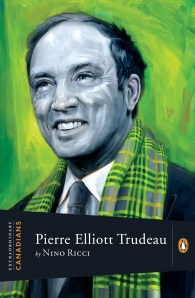
[READ: January 12, 2011] Pierre Elliot Trudeau

This is one of the more exciting biographies that I’ve read.  Which is pretty great.  Although one of the reasons it is so exciting is because he presumes that the reader knows a lot about Trudeau already.  And to be fair, I assume most Canadians would know the global picture (and most of the details) about him already.  So, basically, you get a summary picture of Trudeau, but instead of a quick outline that glosses over details, we get a lot of details, but no gloss.

What I’m getting at is that there are a number of places where Ricci talks about events and movements as if we know them.  So this makes for incredible fluency even if the novice is left puzzling exactly what all the fuss was about.  In fairness, contextually it’s easy to figure out, it’s just a bit surprising.

Another fascinating thing: Ricci skips over Trudeau’s childhood pretty much completely.  The book opens with Ricci’s memory of seeing Trudeau in 1967 when he (Ricci) was a young boy and seeing the way his teachers an adults seemed mesmerized by him.

Nostalgia aside, Ricci quickly explains what a polarizing figure Trudeau has been.  Warmly loved by many and yet (according to Macleans) ranked 5th of all Canadian Prime Ministers (despite being re-elected several times).  Actually, the way that Ricci words it it sounds like he came much lower than that (he says “third tier” which seems much mower than 5th).  And, judging by comments on YouTube videos, utterly hated by others.

The next chapter continues in 1968 at the beginning of Trudeaumania. Treudeaumania sounds a lot like Obamamania–a young, relatively inexperienced politician makes some noise and is thrust into prominence.  (Of course, in 1968, Trudeau only ran for office for a month and a half before being elected–ah the bliss of a short campaign season).

A video of Trudeaumania shows people swooning over him.

The biography does cover some of Trudeau’s earlier years (taken largely from Young Trudeau by Max and Monique Nemni).  He was a somewhat rebellious youth and his teen behavior was full of the usual (and not so usual) rebellions.  But the thing with Trudeau is that it is never clear whether he seriously held certain beliefs or if he was just trying to get a reaction out of people.

He established a society called les X whose purpose was to create an independent Quebec (organized under fascist principles).  les X faded from Trudeau’s life and existence with very little fanfare, and evidently radical groups like that sprang up all the time in Quebec at that time.  Really, it seems to point to his growing bored at his school and with the provincialism of Quebec.

When he left Quebec for Harvard and later for Europe, his mind was expanded and his beliefs opened up accordingly.  He had written many anti-Semitic things in his Montreal youth but once he actually met some Jews, he quickly changed his tune. Indeed, Harvard seems to have really shaped his later outlook in life.  And his exposure to vastly different attitudes during his studying Paris and then later in London exposed him to so much more in the world.

When he returned home to Quebec he found everything small and narrow (which is exactly how it (and he) was when he left it).  And he quickly finds himself embroiled in politics with the Asbestos Strike of 1949.  He took a position (and offered free legal assistance to anyone striking) which raised his profile and quickly made him persona non grata in his province.

This led him to leave for Ottawa, where he was less known and (since his credentials were great) where he could easily get a low position in politics and establish his career.  The main thing he learned, though, was that Ottawa was not the enemy (as is generally held to be true in Quebec).

Trudeau eventually returned to Quebec for Cité libre.  This is one of the things that Ricci glosses over…I’m still not exactly sure what Cité libre is (okay, an influential political journal), but I’m well aware of Trudeau’s involvement in it.  And how it helped him to state his principles and beliefs.

There’s a lengthy passage where Ricci explains how Trudeau’s federalism came to blossom so powerfully for him.  And this argument is one of the reasons why I am in the camp of Trudeau, because even though his piece is meant to be just about Quebec, I find it holds true for the U.S. as well (substitute out Quebec for any special interest).

The sort of independent Quebec he had dreamed of as a young man, he saw now, would only have given greater rein to the ruling elites to exploit nationalism for their own end, as Duplessis has done. In a Quebec obsessed with the survival of French-Canadian culture it was too easy for leaders to manipulate the electorate by promoting vague ideological goals rather than more practical ones, such as those providing infrastructure and employment (103).

Trudeaumania quickly swept him into office, but he was most reviled by his home province which felt betrayed by his turning his back on separatism.  He was the target of an attack by the FLQ, which captured and killed Trudeau’s friend and cabinet minister Pierre Laport. This was known as the October Crisis.  Trudeau’s reaction was swift and hard, he called for martial law (and the Mounties certainly abused their rights). But when questioned about whether he should or could step so hard on a province his answer was “Just watch me”

Now, it turns out that that quote comes at the end of a lengthy interview and makes for a glib soundbite when in fact Trudeau was anything but glib.
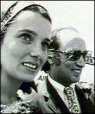
The next big moment of excitement for Trudeaumania was when he married Margaret Sinclair.  For a brief time, they were the it couple.  He was 51, she was just 22, and she was beautiful.  Trudeau seemed to be a confirmed bachelor or at least a consummate playboy, so to have him settled down was quite a story.  But how hard must it have been to be a young woman suddenly thrust into the political spotlight.

Naturally, cracks would surface in their marriage.  In fact, in 1977, Maggie decided to party with The Rolling Stones rather than attend her sixth wedding anniversary party (read the wonderful article in People about it–I love the tsk tsk tone!).

But the penultimate chapter is, mostly, about Trudeau’s disappointments.  He had taken office in a hail of excitement but really had not a lot to show for it.  He was even set for retirement, until he was drawn back in.  And in this final term, he was finally able to achieve his legacy.  And this legacy seems to be summarized by two words: federalism and patriation.  (With the downside being summed up in the word “notwithstanding”).  Now, this is obviously something that Canadians know all about, and it seems foolish to summarize what this meant for readers who lived it.  But for me, who knows precious little about the mechanics of Canadian politics, I was a little lost in the details.

I got the Federalism thing, but the constitution is a bit confusing.  And the whole notwithstanding clause really kind of lost me.  Nevertheless, the chapter that covered this was rather exciting because Ricci writes as if there is one man whose mission is to see him fail.  And this nemesis is Rene Lévesque.  It’s a classic mano a mano battle between two Quebeckers and it’s really rather exciting (especially if you didn’t know the results).

The final chapter talks of Trudeau’s legacy.  And in this chapter Ricci seems to side with Trudeau.  He cites specific examples of being the best man at a same-sex wedding ceremony, something that would not be possible without Trudeau (even though Trudeau never envisioned it).  Indeed, there’s a comment that:

during the 1968 leaders’ debate, Réal Caouette, leader of the Ralliement créditistes, joked that Trudeau’s Criminal Code amendments might lead to a situation where “a man, a mature man, could in the future marry another mature man” Caouette had his joke while Trudeau, awaiting his response time, smiled civilly and held his tongue.

Because I’m not part of the culture, I don’t know to read Ricci’s take on the man.  He is not afraid to show off all of Trudeau’s faults.  In fact, in many instances he rather highlights them.  For instance, the debt under Trudeau expanded exponentially.  When Trudeau took office in 1968 Canada had a debt of $18 billion; when he left office in 1984, that debt stood at $200 billion, an increase of 83% in real terms.  And yet at the end of a nasty passage he will present some evidence which ameliorates Trudeau either in whole or (more typically) in part.

I guess in that sense it is an excellent primer on Trudeau’s political life.  But it’s also personal enough that you can see how one man impacted people.  Not citizens, but people.  And when he describes the people lined up for Trudeau’s funeral it ties right back to Jian’s song.  It really shows the impact that one person can have on the lives of so many.

And, here’s a shameless plug to the folks at Penguin Canada–I will absolutely post about all of the books in this series if you want to send me the rest of them.  I don’t know how much attention these titles will get outside of Canada, but I am quite interested in a number of the subjects, and will happily read all of the books if you want to send them to me.  Just contact me here!

For ease of searching I include: Fruvous, creditistes, Real Caouette, Rene Levesque, Cite libre

Read Full Post »
SOUNDTRACK: SARAH HARMER-Oh Little Fire (2010).

I found Sarah Harmer when she had a left field hit (“Basement Apt”) in the states.  I went back and discovered her band Weeping Tile (who are quite good and recorded a version of the song on their EP Eepee) and have been following her continued solo career.

Since that first record, she released a killer second disc, followed by a re-release of an intimate 1999 record she made for her dad which let her revel in her country roots.  She followed this up with I’m a Mountain, a very country, but very catchy album.  Finally, four years later, she put out Oh Little Fire.

Although she hasn’t lost her country roots, this album returns to more of the rock sound that first attracted me to her.  It’s not hard or heavy by any stretch, but it’s moved beyond the country of I’m a Mountain.

Sarah and I listened to this album a lot at night when it first came out, and it slowly seeped into my system.  I had kind of forgotten about it for a while, and upon rediscovering it I was delighted to hear that the melodies were fresh and still with me.  The album seems like a simple indie folk or the work of an adult alternative singer songwriter, but the thing with Harmer is that she has that wonderful background with Weeping Tile, a band that was always slightly off-center.  So, she writes beautiful melodies but puts little grace notes into them to keep them from being disposable.  And yet they are still super catchy.

The only hard thing about this disc is wondering which song will be stuck in your head after listening to it.

[READ: January 7, 2011] L. M. Montgomery

I’ve never read any L. M. Montgomery (although I’ve seen the miniseries of Anne of Green Gables) and I’ve never read any Jane Urquhart (but I love her name!).

This biography is so radically different from the other three I’ve read so far.  I wondered immediately if it was because Montgomery (and Urquhart) are women.  It deals with subjects that the other books didn’t at all: lost loves, mental incapacitation, family crises.  But it becomes clear through the book that these issues were THE issues that a woman at Montgomery’s time would have dealt with.  Unlike the men in the other books, Montgomery did not have a professional life (outside of being an author, which she did at home).  She was hardly a public figure, and since she was a woman, she was always in danger of losing what she had.

This biography is also vastly different from the others in the way it is constructed.  You can tell by some of the chapter headings: Her Death (the first chapter), Orphan, Sorrow, Madness.  You can also tell by these chapter titles that Montgomery did not have a happy life.

Indeed, between a husband who believed he was destined for Hell (he was a preacher!) and children whose life choices she disapproved of, not to mention terrible insomnia coupled with nightmares, her late adult life was nothing but torment.  But, sadly for her, her early life was nothing but torment either.  Her mother died when she was two, she was sent to live with her aunt and uncle (which was never a happy place).  But the most depressing of all of these events is when she lost her dearest friend at a terribly young age, a death she never really recovered from.

So how is it possible that Montgomery wrote such charming stories?

The answer to that (and the basis for most of this biography) is in her diaries.  Montgomery kept meticulous diaries (which she wrote and rewrote and then rewrote with posterity in mind).  She wrote about her childhood and her life as (sort of) an orphan.  She wrote about the places where she lived and the beautiful outdoors which impressed her.  She wrote about the sadness and the happiness.  Nothing was lost on her, and she saved it all (she also took photos of everything she loved, which are a beautiful and sometimes contradictory records of her diaries), and there are many published volumes that we can read to learn even more about her.

To me, the most fascinating (and horrible) part of the story was when she finally had Anne of Green Gables published.  The publishers took complete advantage of her.  They forced her to write sequels that she didn’t want to (although they are still quite good) and even compiled a final book from castoffs of the previous books (Return to Avonlea) that they published in her name.  Eventually the case was settled in her favor, phew, and she was able to write new characters that inspired her.

Montgomery had a rough life, and as her diaries come to an end, she stopped writing about things.   It’s hard to know exactly what she went through towards the end, but it doesn’t seem very positive.  And yet for all of her disappointments in life, she left us with some engaging and memorable stories.

The last chapter is a fascinating personal account of how Montgomery’s stories impacted Urquhart’s family.  It was incredibly touching and convinced me that Urquhart’s fiction would be enjoyable too.  Some day, some day.

This was a really enjoyable (but major downer) biography.  And, more than anything it has really inspired me to read Montgomery’s stories (and even one or two or Urquhart’s).

And, here’s a shameless plug to the folks at Penguin Canada–I will absolutely post about all of the books in this series if you want to send me the rest of them.  I don’t know how much attention these titles will get outside of Canada, but I am quite interested in a number of the subjects, and will happily read all of the books if you want to send them to me.  Just contact me here!

Read Full Post »

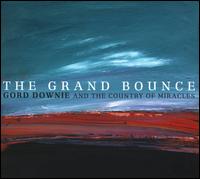
SOUNDTRACK: GORD DOWNIE AND THE COUNTRY OF MIRACLES-The Grand Bounce (2010).

I knew I was going to write about Canadian musicians for this series of Extraordinary Canadians, but I wasn’t sure who would get matched to whom. I figured I’d match Gord Downie to Mordecai Richler, but when I saw this in the liner notes to this disc, I knew I’d made the right choice:

Thank you to the Richler Family for the font you are presently reading.  The Richler font, not publicly available, was created and named for the great Mordecai Richler.  It was commissioned by Louise Dennys, designed by Nick Shinn and graciously made available by Florence Richler.  I am grateful for this honour.

So Gord Downie is the driving force behind The Tragically Hip.  I’m always curious when a guy who pretty much runs a band needs to do a solo album (or three).  And in this case, since the last Hip album was much more mellow and almost country, it seemed like he got some of his less rocky side out on that disc, so what’s the need?  Unless, of course, it’s just the need to play with some other folks once in a while.

Well, whatever the reason, this disc finds Downie in incredible form.  In fact, I think I like this disc better than the last Hip disc (which I did like, but which was a little too mellow overall).  The songs are all great, from the simple folk tracks to the more elaborate rockers.  And, yes, while the disc never rocks as hard as some Hip songs tend to, this is not a simple acoustic guitars and solo vocals record.

“The East Wind” is a wonderful starter.  It’s fairly simple with awesomely catchy lyrics.   I learned that the lyrics are from a quote by Todd Burley.  And they are an awesome way to describe a hostile and violent wind: it’s lazy, because “it doesn’t go around you, it goes right through you.”  Fantastic.

“Moon Over Glenora” sounds a lot like a Hip song.  Downie’s lyrics are almost mumbled and understated until he gets to the end of each verse when he raises his voice an octave for maximum effect.   The stops and starts in the bridge are also great.  “As a Mover” is also smoothly catchy with a wonderful rising chorus.

“The Dance and the Disappearance” is another great conceit.  This song is inspired by a quote from Crystal Pite: “Dance disappears almost at the moment of its manifestation.”  It is suitably dramatic with some great verses.  “The Hard Canadian” is a gentle acoustic number that would not be out of place on the more recent Hip records.  “Gone” feels like a continuation of “Heart,” almost like the slightly more rocking second half of it.

My favorite track is “The Drowning Machine” (I seem to like anything that Downie writes that’s about the sea).  It’s a minor chord wonder, dark and mysterious and wonderfully catchy.  The rock comes back on the rather simple “Night is For Getting.”  It’s probably the least essential track on the disc except that once again the chorus/bridge is really great and memorable.

The last three tracks bring on the mellow, which is a fitting ending for the disc, although since the three t racks take up about 12 minutes, it makes the end drag a bit.  “Retrace” is a country-tinged (steel guitar) mellow track (again, Downie’s voice brings out the excitement) .  “Broadcast” has an extended outro of gentle guitars and piano that for all the world sounds like the end of a disc, so I’m always surprised that there’s a final track after it.   And so the final track “Pinned” feels like filler.  It has a movie projector clicking sound and gentle piano with almost inaudible vocals.  It’s actually a pretty song, but it feels almost discarded here.

One of things I’ve always liked about Downie’s lyrics is that they are atypical of rock songs.  They’re not “about” sex or rock or drugs or swagger or anything like that.  In this case they are about locations and events.  And it really paints a picture.  And speaking of painting, Downie painted the cover art.  The beautiful simplicity of the painting is not unlike the beautiful simplicity of the music on the disc.

Oh and my copy is autographed too! (although I wasn’t there when he autographed it, so it could have been anyone who scribbled on the cover).

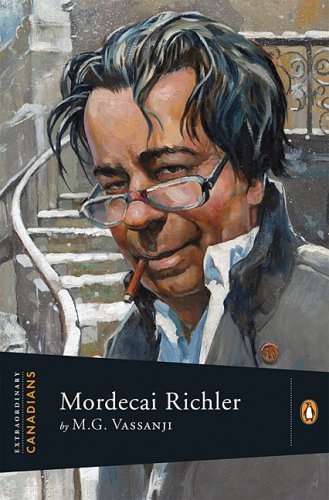
[READ: November 15, 2010] Mordecai Richler

I don’t know a lot about Mordecai Richler, although I feel like whenever I read about him it’s in hushed tones (a neat trick, that).  Nevertheless, for a number of reasons I have wanted to read him for many years but have just never done it.  Now, the stars are aligning with me for Richler.

There’s this book, there’s the cover of the October 2010 issue of The Walrus and the recent filming of his book Barney’s Version (the filming of which is discussed in the same issue).  And then a patron asked for the film of The Apprenticeship of Duddy Kravitz.  So, it’ about time to read one of his books.  But here’s the rub…do I start with the great books or do I start at the beginning and work my way through his career?  And, there’s also a huge new biography coming out (the review of which mentions a wonderfully offensive event in which Richler absolutely dismisses his Jewish audience).

This book was written by M.G. Vassanji.  I feel that I’ve heard of him but I’ve never read him.  And yet listen to this incredible biography:

M.G. Vassanji was born in Kenya and raised in Tanzania.  He attended University in the United States, where he trained as a nuclear physicist, before coming to Canada in 1978.  Vassanji is the author is six novels and two collections of short stories…and he has twice won the Giller Prize.

Damn.

Since I read this right after Coupland’s McLuhan it’s tempting to compare them.  And yet, as I said in that review, it seems quite apparent than Coupland’s book will be like no one else’s, so I won’t say much about that.  Instead, Vassanji opens the book by talking about the similarities between himself and Richler and their few awkward but pleasant meetings.  (In this respect yes, it is sort of like Coupland’s book in that the author puts himself into the text). (more…)

Read Full Post »

SOUNDTRACK: SHAD-TSOL (2010).

I first heard Shad on CBC Radio 3 online.  The track was “Yaa I Get It” and I really enjoyed it.  I haven’t listened to a lot of rap in the last few years; I’ve more or less grown bored by the genre, especially all the violence.  So, I was happy to hear this track, which was boastful but funny.

I decided to get the whole disc, and I wasn’t disappointed.  “Rose Garden” features a sample of “I Never Promised You a Rose Garden” which sets some of the tone of the disc.  But it’s on the next song “Keep Shining” that Shad’s uniqueness shines through.  This song is about women.  But not in any way that I’ve heard in rap before: “I can’t speak for women.  We need more women for that.”  And the inspiring final verse:

My mom taught me where to keep my heart.
My aunt taught me how to sing two parts.
My sis taught me how to parallel park,
and tried to teach me math but she way to too smart.
My grandma in the 80’s is still sharp.
My girl’s cousin is in activism in art.
They taught there’s no curls to tight, no mind too bright, no skin too dark to keep shining.

Later on the disc is “We Are the Ones” an oddball jam that sounds like one of those bizarre Atlanta rap tracks (funky vocals and all) and an amusing line about being Lost like Matthew Fox.  But his name checks aren’t all pop culture (Moredcai Richler gets a mention as does Glenn Beck (he “better duck like foie gras”).

And of course, there’s the wonderful “Yaa I Get It.”  With great horn blast samples and all kinds of noise competing for our attention.  Yet, throughout the lyrics stand out: “Maybe I’m not big cus I don’t blog or twitter…Dawg, I’m bitter.”  And there’s this wonderful couplet: The precision of my flows in terms of tone and diction/Is akin to that of the old masters of prose and fiction.”  Or take this lyrics from “Call Waiting,” “But what they say is hard for a pimp is harder for a man of faith.”

“Listen” has some great scratching on a heavy rocking track.  It’s followed by “At the Same Time.”  This is a mellow, sad song, which I don’t really like, yet which I find very affecting.  And lyrically, it’s great: “I never laughed and cried at the same time… Until, I heard a church pray for the death of Obama.  And wondered if they knew they share that prayer with Osama.”

The disc ends with “We, Myself and I” another noisy rocker and the one minute “Outro” an acapella rant.

Shad is a great rapper, doing interesting things and trying to make a difference.  He’s worth checking out.

[READ: November 1, 2010] “Marshall McLuhan”

I learned about this book because I’m a fan of Douglas Coupland.  And, as it turns out I’ve always had a vague interest in Marshall McLuhan, so it seemed like a sure thing. The problem was that the book was not readily available in the U.S.  So, I had to order it from Amazon.ca.  And, since you can’t get free shipping to a U.S. address from amazon.ca, I thought it would make sense to order 6 titles in the series, all of which I’ll post about this week.

So, here’s a shameless plug to the folks at Penguin Canada–I will absolutely post about all of the books in this series if you want to send me the rest of them.  I don’t know how much attention these titles will get outside of Canada, but I am quite interested in a number of the subjects, and will happily read all of the books if you want to send them to me.  Just contact me here!

Each book in the series has an introduction by John Ralston Saul, in which he explains the purpose of the series and states globally why these individuals were selected (“they produce a grand sweep of the creation of modern Canada, from our first steps as a democracy in 1848 to our questioning of modernity late in the twentieth century”).  It also mentions that a documentary is being filmed about each subject.

Perhaps the most compelling sentence in the intro is: “each of these stories is a revelation of the tough choices unusual people must make to find their way.”  And that’s what got me to read thee books.

This volume was probably a bad place to start in the Extraordinary Canadians series if only because it appears that Coupland’s volume is markedly different from the others.  Coupland being Coupland, he has all manner of textual fun wit the book.  The other authors seem to write pretty straightforward books, but you know something is up right away when you open the book and the first six pages comprise a list of anagrams of “Marshall McLuhan.”

On to Marshall McLuhan.  The Medium is the Message.  That’s about all anyone who has heard of McLuhan knows about him (and that he has a hilarious cameo in Annie Hall).

When I was a freshman in college, I took a class in Communications which focused an awful lot on Marshall McLuhan.  I didn’t like the teacher very much, but the message stayed with me all these years.   And so even though I’m not a student of McLuhan or anything, I was happy to relearn what I should have known about the man and his ideas.

(more…)

Read Full Post »

SOUNDTRACK: RADIOHEAD-Hail to the Thief (2003).

After the claustrophobia of Amnesiac, Hail to the Thief was a nice compromise between their earlier guitar rock and the ambience and the technology of Kid A.  “2 + 2 =5” is one of their most satisfying songs, opening with a nice guitar lick and Thom Yorke’s keening vocals, it abruptly jumps into a full-fledged rocker.  “Sit Down Stand Up” has similar properties–it opens quietly with a distant guitar riff.  The song builds and builds into a manic intensity.  By the end, when the pace is much faster and the lyrics are repeating “the raindrops” over and over, it’s a glorious mess.

“Sail to the Moon” is a keening piano-based ballad.  Not one of their best, but with very nice melodies.  “Backdrifts” flashes back to the experimental side of Kid A, with lots of percussive noises tapping into the electronic groove.

The band surprises everyone with a very acoustic sounding song, “Go to Sleep.”  It’s a really wonderful track, especially placed amidst the electronica of the other tracks.  The bridge brings Yorke’s vocals into the stratosphere (and the guitars get noisier and noisier).  “Where I End and You Begin” is a noisy staccato piece of fun with effects and more effects trying to hide Yorke’s voice.

“We Suck Young Blood” is a spare, almost completely stripped song composed of pianos and handclaps.  It is eerie and not a little disturbing.  While “The Gloaming” is practically all electronics.  It’s one of those transitional songs, not terribly exciting in itself, but not throwaway either.  And it leads into the gorgeous quintessential Radiohead of “There There” which could be an OK Computer outtake.

“I Will” is mournful dirge with just guitar and multitracked voice that lasts only 2 minutes and leads into the experimental “A Punchup at a Wedding.”  “Punchup” opens with that rarest of Radiohead sounds: a solo bass.   But it is quickly swallowed by more electronica.

“Myxamytosis”  is a nother great rollicking track with a great slinky keyboard riff that propels the song through the murky depths.  “Scatterbrain” features a cool guitar motif that shows that they can still play pretty music and which leads to the album closer, “A Wolf at the Door.”  “Wolf” ends the disc wonderfully with a cool guitar song and awesome almost-spoken lyrics.  It is kind of sinister and kind of sad at the same time.

This is a disc that rewards repeated listens (and headphones). If OK Computer was difficult, Thief is much more so, but for very different reasons.  But it pays wonderful dividends.

[READ: January 6, 2011] A Naked Singularity

I received a copy of this book about a year ago in March.  It is self-published and seems to have been sent to many folks who blogged during Infinite Summer (because it’s a big book, you see).  I was interested in reading it, but I had a lot of other things that I was reading first, so I put it aside until last month.  And I am really bummed that I waited this long.

A Naked Singularity is a wondrous, beautiful mess of a book that I was so absorbed in, I couldn’t put it down.  The writing style is great: funny, clever, funny, philosophical, funny, legal, funny and at times rather violent.

I’m torn when writing this how much of the “story” to give away.  I didn’t know anything about the book (the blurb on the back is just a quote from the book–there’s no summary or anything).  So I’m going to rob you a little of the “what the hell is going on in this story” aspect that I had, but I’m not going to give anything major away.

The story opens in a the middle of a conversation between a prisoner and a lawyer.  It’s a bit confusing until the story pulls back and we get the whole deal.  The story is about Casi.  He is a wunderkind lawyer who has never lost a trial (in 14 attempts).  He plays the system, but he’s also dedicated to getting his clients off (even though he–and everyone else on staff–knows they are guilty) mostly because he is undefeated.

The entire first Part of the book (320 pages) introduces us to Casi, to his workload, to his clients, to his coworkers and to his family.  His clients are mostly drug dealers. His coworkers are mostly jaded and are no longer excited by their jobs.  His family is wonderful, a group of Colombian immigrants who love each other and fight with each other loudly.  (The early scene at his family’s house is hilarious scene in which unattributed dialogue overlaps–it’s wonderful).

And yet for all of that, the first part never quite gives us a plot.  This might be a problem for some books, but the whole set up is so compelling that you just go with it, from one amusing (or hilarious) segment to the next.

In addition to introducing us to his cast of drug addicts and low level criminals, Casi also indicts the New York Justice system (in hilarious detail).  There are quite a few chapter spent talking about “bodies” (criminals) and how many of them sit in jail for 72 hours until they see a lawyer.

Of course, when he gets home, all is not normal there either.  His apartment is free (because his downstairs neighbor’s father owns the building and Casi squats there).  The neighbors are a curious bunch of college students.  One of them is a total TV junkie.  And, there’s a bizarre, wonderful subplot about him trying to bring Ralph Kramden from The Honeymooners to life in his room by watching the shows nonstop for weeks.  Yes.

Textually, the story also plays with lots of styles.  In addition to the dramatic scene with his family, we also see many court transcripts.  The second one with Mr McSlappahan is quite funny not least of which because the judge cannot get the poor man’s name right and the official transcript changes his name throughout the case.  There are also letters to and from one of the clients.   There’s a chapter-long epic poem (which was probably the hardest thing in the book for me to digest).  There’s even a recipe for empanadas (which sounds delicious).

In addition to some wonderful wordplay and punning there is also childish gross-out humor.  A scene with frozen burritos (pp. 150-158) had me laughing out loud for several pages.  But there’s also a lot of commentaries on society.  For instance Television is always capitalized and treated as a proper noun.  The mayor of New York is named Toad.  There are street vigilantes with cameras everywhere and, most amusingly, there’s an in-the-making TV show: Clerical Confessions.

By the time Part Two comes around a plot starts forming.  I was concerned that all of part two would follow this nascent plot, but it doesn’t. The book continues in a similar vein with the plot-instigator [coworker and lawyer, Dane, one of the most consistently amusing characters I’ve read in a long time] continually popping up on Casi’s periphery to try to get him to help him with…the perfect crime.

And that’s when boxing comes into play.  Casi is a fan of boxing, specifically a fan of Wilfred Benítez (who I didn’t know was a real boxer, but whenI looked him up I found this part of the story even more compelling).  And so, interspersed throughout the rest of the book is Benítez’ biography and fight history. It’s a rather lengthy character study of the man himself and boxing in general.  Now, I’m not a fan of boxing, I’ve never watched a fight, but I was totally engrossed by the storytelling.

Because he is setting up a whole story about muiddleweight champiosn, the novel follows many boxers who I had heard of and knew from pop culture (I checked and even Sarah knew who most of these boxers were, so they really must get into the pop culture world): Sugar Ray Leonard, Marvelous Marvin Hagler, Thomas Hearns (I didn’t know him, but De La Pava’s description of the 3 round Hearns-Hagler fight is so exciting that I’m going to watch them on You Tube) and Roberto Durán (she didn’t know him).  And so the story of these middleweight fighters trying to knock each other over for the title becomes something of a metaphor for the Casi’s life pre- and post- crime.  In fact, when they go to execute the perfect crime, the first half of that chapter is taken up with a story about Benítez…that’s quite unexpected.

While the crime is beign set up, Toom, one of Casi’s coworkers asks him to help with a case in Alabama.  A severely mentally retarded man is to be executed and Toom has taken on the case to rescue the man.  This plot adds a surprising amount of pathos to the story, especially when Casi flies to Alabama and meets the man.  But even that sequence is lightened by a wonderfully absurd hotel scene.  I totally want to stay at this hotel.

Part Three of the story is where the whole thing devolves into a crazy quilt of insanity.  The crime has happened, and it is messing with everything. There is a city-wide blackout, Casi has no heat, no cars are allowed on the streets so he can’t even escape to his mother’s house.  There’s also a strange guy in is building who looks and sounds suspiciously like Ralph Kramden.  And, Casi is accused of contempt (and is about to be ousted by his law office’s morals group, the childish but amusingly named Committee to Oust Casi Kwickly). Both trials are as absurd as a Marx brothers movie (Karl of Groucho?).

The lead up to the end is very satisfying will all kinds of loose ends tied together (things that I thought he’s never address were in fact cleared up!).  But with a story this all over the place, it’s hard to imagine how you would finally end it.  The ending goes in a direction that is supported by the title (and is a little overwhelming).  It’s a little unsatisfying, but aside from a tidy happy ending (which you knew you weren’t getting) I don’t know how else you could have ended the book.

Ending aside, this is a fantastic novel.  There is just so much going on in it (I didn’t even mention the discussion of Hume vs Descartes “I guessed there was nothing wrong with Hume provided it was acknowledged that Descartes was The Man” (510)) or the whole subplot about the two kids who kidnap a baby), and it is very well constructed and tied together.

Somebody please publish this book officially!  Yes it’s long, yes it’s multifaceted, yes it demands a lot of the reader,but the payoffs are wonderful and, frankly, this is the kind of unexpected story that could be embraced by, well, not the general public, but a niche market who enjoys clever books (and yes, probably fans of David Foster Wallace (and his progenitors)).

Give De La Pava a contract, huh!  You can read an excerpt here.

Read Full Post »

« Newer Posts