Feeds:
Posts
Comments

Archive for the ‘Big Books’ Category

karlove1SOUNDTRACKWHITEHORSE-“Pins and Needles” and Kickstarter campaign (2014).

photo-mainI really enjoyed seeing Whitehorse live.  I would absolutely see them live again.  I was delighted then that their album was also fantastic (I didn’t think it could match their live show…and it doesn’t but it is great in a different way).  In a very short time I became a big fan of the band.

THey havea  new song, “Pins and Needles” and a Kickstarter campaign.  The song begins with Melissa McClelland’s voice singing in it beautiful way–there’s guitar in the right ear and bass in the left ear.  Then Luke Doucet comes in for verse two.  And when their voices fill the bridge it feels so complete.  Until they get to the chorus when they push it even further and it sounds amazing.

  They sing so well together.  Her voice has a slight country twang, and his is a low baritone.  Their harmonies are superb as they sing the compelling chorus: “Fake Your Death and I’ll Fake Mine”

Lyrics are certainly interesting for the band.  How many times do you hear a woman singing a line like: “I’m the villain in this piece  And back when I was a thief, I broke hearts like they were teeth.”

I love this song.  And it may or may not end up on the new album for which there is a Kickstarter campaign.

And I’m in.  I’m a little unclear about exactly what they aim to do with the money they raise.  They say quite plainly that there will be an album regardless of whether they raise the funds.  And their label, Six Shooter, is totally behind the band.

Rather seems to be a way to raise some money and some attention for the band.  And, apparently it will give fans a glimpse of the album as it is being made–a sort of behind the scenes featurette that comes before the disc itself.  The prizes are varied and moderate–from a download, to the CD, to a T shirt, to sheet music (all for reasonable donations), all the way to the grand prize–for $8,000 they will play a private show for you.

I’m in for a CD, and I’m happy to pay regular ticket price when they come around again.

Check out the Kickstarter campaign for more details where you can also hear “Pins and Needles.”

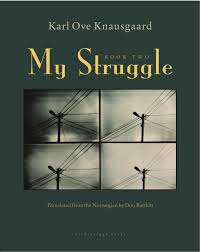
[READ: April 24, 2014] My Struggle Book Two
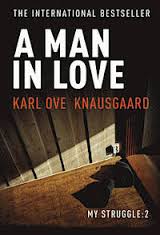
maninloveI read an excerpt of Book Two in Harper’s well over a year ago So when I got to that section again (it’s the end of the book) I was trying to remember why it sounded so familiar–an accident during a soccer match that leaves Karl Ove with a broken collarbone and an unhappy girlfriend (who will be looking after three kids without him), and then I remembered the excerpt that started it all.

The translation of Book Two by Don Bartlett is fantastic, just as in the first book–I can only assume the original Norwegian is just as compelling.  Book one was 430 pages and now book two was 573, so I’m in to Karl Ove’s life for 1003 pages, and there’s four more books due (Book Three comes out next month).

As I mentioned for Book One, this series has caused some controversy because it is given the same title as Hitler’s Mein Kampf (Min Kamp in Norwegian), and also because he says some pretty mean stuff about people who are still alive.  Book One was about the death of his father.  It was pretty dark.  Book Two is about his first daughter and about falling in love with Linda, his children’s mom (although not yet his wife).  And it is also pretty dark.

I was trying to figure out why I like this series so much.  Not a lot happens, Karl Ove is not a very nice person and he seems to be pissed off most of the time.  And I think what I realized is that I share a lot of opinions as him, but he takes everything to the extreme.  And he is kind of an asshole.  I mean, anyone who writes a six part autobiography called “My Struggle” (okay, really it’s called My Head) is kind of an asshole.  But so when I see things that I would only think in my deepest recesses of my mind printed on a page, it’s strangely visceral to me.  I realize this means that I’m kind of an asshole too, but the key difference is that I don’t act on the things that I think, nor do I write 4,000 pages about them.

I told Sarah that she might laugh at some of the opinions that he lists but that she would not enjoy reading the books.  Indeed, this book, this series, is not for many, I’m sure.  But to me there is something strangely engaging about him and his strange life and his writing style.  And I really flew through this book, finishing it in about a week.

So this book begins (started in July 2008) with Karl Ove being pissed off.  He talks about finishing the first part of the novel (which I have to assume is Book One, given when this was written and how this book ends) just last month (in other words he is really churning this stuff out!).  He and Linda have been fighting (as the book opens they have three children, Vanja, Heidi and John–it’s also hard to believe that his children are young enough to not really know much about this series). The tension is high between them–glares, comments, nasty sniping.  Karl Ove says that he is afraid to say things around her because he knows how she’ll react.  But at the same time, some of things he desires are simply not defensible in a relationship or when you are parent.  And the main conflict seems to be that Karl Ove is selfish and Linda is (at least according to him) mildly suicidal and possibly bipolar).  And mind you, at the time of his writing this, I think they are still together….  (I could look that up, but it seems kind of fun not exactly knowing). (more…)

Read Full Post »

univSOUNDTRACK: BECK-Mutations (1998).

mutationsThis is the first album that shows a wholly different side to Beck. It is pretty much an entirely traditional album.  There’s no samples, just consistently strong songwriting.  The overall feel is mellow and it comes as quite a shock after the chaos of Odelay!

Although the album has a very consistent vibe, it’s not all samey.  There’s a lot of different instrumentation like the harpsichord on “Lazy Flies,” and the old-timey piano and slide guitar on “Canceled Check” which has a very country feel.  It’s not all simple and normal though, as “Check” ends with a strange musical breakdown that keeps it from being a smooth song.  “We Live Again” is a very mellow track with Beck singing sweetly over the waves of music.

As befits the name “Tropicalia” has a very tropical feel, it’s totally danceable and was a very wise choice as a sample.  “Dead Melodies” has a classical music feel (with vocals of course).  “Bottle of Blues” is, unsurprisingly, a somewhat rowdy blues song.  “O Maria” is a slow but upbeat piano song that also feels old timey.  “Sing It Again” has a melody that is similar to “Norwegian Wood,” but the song is nothing like that Beatles classic.  This is gently sung and played acoustic guitar number.  And “Static” is a quiet disc ender.

This disc also feature a “bonus” track, and this is the first one that is actually enjoyable.  It is a fleshed out song (and a good one at that). It is comparatively rambunctious and noisy and quite different from anything else on the disc.  It’s called “Diamond Bollocks” and has a great bass line and cool backing vocals.  This song could easily have been a hit if it weren’t tucked away at the end of the disc.  (Well, and there are some weird moments to, but overall, easily a hit).

Despite all that Beck is known for his crazy songs and samples, Mutations is an extremely cohesive record with enough diversity to keep it from ever getting dull.  It’s a great record and is somewhat overlooked in his catalog.

[READ: March 16, 2014] The Unknown University

This is a collection of almost all of Roberto Bolaño’s poetry.  Some (but not all) of the poems from his collection The Romantic Dogs are included here, although some of those are apparently modified a little.  It also includes what was earlier released as Antwerp but is here called “People Walking Away.”  (I found Antwerp and “People” to be quite unusual and would never remember what is the same in the two.  But translator Laura Healy says that she more or less uses Natasha Wimmer’s translation of Antwerp for the parts that are the same (a task which must have been harder than it sounds if the two pieces weren’t exactly the same).

This book is 830 pages with facing pages of Spanish and English.  According to the publisher’s note, this collection was found on Bolaño’s computer as is—a collection of all of his poems from throughout his career.

Most of the early poems were written when Bolaño was young (in his 20s).  Even at such a young age, he writes powerfully.  Not all of his poems are great of course (how could they be when there are so many) but there are dozens and dozens of poems that I thought were fantastic.  I’m going to include some below, but I also wanted to get some criticisms out of the way too.

He tends to revisit ideas quite a lot, which is normal for a poet, but it seems weird to revisit an idea in subsequent poems (especially when the poems are just a few lines long each).  It almost feels like he fixated on a subject and thought of a number of ways to work with it and rather than make one long poem, he made several short ones.  Like this strange occurrence: (more…)

Read Full Post »

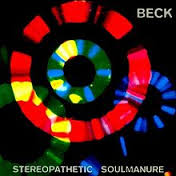
tintinSOUNDTRACK: BECK-Stereopathic Soulmanure (1994).

soulmanureDepending on who you believe, this was Beck’s first or second or even third album.  Certainly it was recorded earlier than the other records but who knows what the actual release date was, or if it even matters (it doesn’t).  This album plays like a demo tape of home recordings of a talented folksinger who doesn’t want to be labelled as a folk singer ans is experimenting with all kinds of other sounds, including tape manipulation, home recording and utter noise (there’s a Sonic Youth sound connection here, before they ever did anything together).

But anyway, that’s got nothing to do with this album.  My version has 23 listed tracks and two bonus tracks.  And since I’ve no intention of doing a track by track analysis of the album, I’m going to group some tracks together.

There are a few styles of music on the record.  There are about a half-dozen noise/nonsense tracks–distorted guitar, distorted voices, sometimes sheer noise–like the “bonus” track which is some ten minutes of just nonsense.  There are about a half a dozen tracks that are basically just talk–old home recordings from when he was a kid, and other spoken tracks.  There are even a few tracks from a guy named Ken who is apparently an older guy singing what sounds like hobo songs (which I suspect Beck does not play on at all).

There are also a number of different instruments which (I assume) Beck is playing. He plays banjo very well, there’s an accordion track, and of course guitar.

What sets this apart from being a simple nonsense album is that there are nearly a dozen “real” songs.  There are a couple of well sung country tracks, with a slide guitar. There’s also some anti-folk, rap and live numbers.  These are fleshed out, proper songs–musically complete.  It’s in the lyrics that you can hear Beck fighting the folk/country pigeonhole.  He has three songs that are more or less rapping (like “Loser”).  There’s a couple of songs that were recorded live (in a club with half a dozen people), and are mostly silly.  And then there’s a series of anti-folk songs.  These are pretty traditional sounding songs, but with layers of noise or weirdness that keeps them from being traditional folk.  Like “Satan Gave me a Taco” which is complete song but is obviously quite silly.  And yet, Johnny Cash covered the song “Rowboat” on one of his Americana albums.

None of the recordings sound more than lo-fi, but the good songs all sound good.   It honestly sounds like a guy trying desperately to show off what he can do–and hoping desperately to get accepted by just about any genre.  Except that he clearly has his own identity (as varied as it may be).  This record is certainly not for everybody (as suggested by the incredibly low sales), but if you like Beck’s early experimental stuff, there’s enough really good stuff here that’s worth checking out.

[READ: March 9, 2014] Tintin: The Art of Hergé

Sarah bought me this book for our tenth anniversary (which is “tin”, get it?).  We’ve both enjoyed Tintin over the years, more as an icon than as a collection of stories (which I believe she has not read and which I’ve read about 1/3 of).  The Spielberg film and subsequent video game are both really cool too.  This book is an amazing look at Hergé as an artist and at the Hergé museum, which looks amazing.

When Sarah and I were in Belgium, we went to an animation museum which featured Hergé heavily.  Since it was a decade ago, I actually thought that this book was about that museum, but no, the Musée Hergé opened in 2009 and was designed by French architect Christian de Portzamparc.  The first chapter of the book is dedicated to the Museum, and do de Portzamparc’s designs and execution in the spirit of Tintin.  And I have to say the building looks amazing.  The facade alone is beautiful, and his explorations light and dark and shape look really awesome. (more…)

Read Full Post »

momentSOUNDTRACK: NICK BUZZ-Circo (1996).

nickbuzzNick Buzz is a side project of Rheostatics singer/lead guitarist Martin Tielli.  This album was reissued in 2002, when I bought it  But it came out in 1996, right around the time of the concerts I’ve been posting about.  Martin says that this album is pure pop, and that he is genuinely surprised that people don’t see this.  Of course, when your album has screeching monkeys, cars honking and circus music, pop is not the first thing that comes to mind.  There are certainly pretty songs on here, but it is an album that resists easy entrance.  There are short manic pieces, slow, languorous, almost lounge music pieces, and an improved cover of Joni Mitchell’s “River.” And then there’s the instrumentation: piano, violin, guitar, voice (no drums, although there is percussion on some tracks) and other weird sound effects.

“Step Inside” opens the disc.  It seems like a normal, mellow song (with slightly falsettoed vocals).  But 34 seconds in the circus music starts—a deviant and unsettling circus that pushes its way into the song briefly then vacating and allowing the pretty melody to return.  It’s like a mild form of Mr Bungle (with more actual circus).  It’s unsettling at first but then strangely catchy after a few listens.  There is fanfare as the song ends, interrupted by the sound of a tape speeding up (or going backwards) until song two bursts in.

“That’s What You et for having Fun” is less than three minutes and while weird, it is certainly accessible and funny.  The guitar sounds like he is slapping the strings rather than strumming them.  The refrain of “there’s a monkey in my underwear” gives a sense of the absurdity (especially when the President of Canada (sic) says he has one too).  “Just Because” mellows things out a lot—simple guitar with a kind of lullaby feel (it’s a bout wishing on stars).  It’s so slow after the craziness of the first two songs.  After  3 minutes of a lounge type song, it ends with a distant radio sound of an even more loungey song which melds into the live version of “River.”

The mellow “River” is followed by a raucous bass clarinet solo and wild guitar solo that is interrupted by the long (nearly 6 minutes) “Sane, So Sane.”  This is the most conventional song on the record—a simple piano melody with repeated lyrics (conventional aside from the weird distant music in the background of course).  Although it does gone on a bit long.  “A Hymn to the Situation” is an eerie two-minute wobbly song.

“Fornica Tango” is indeed a tango presumably sung in Italian. This song features a crying baby, an interesting sounding “Italian” chorus and the screeching monkey at the end.  “Love Streams” is a pretty, slow ballad.  “Aliens Break a Heart” is another pretty song.  Although this is the song that ends with traffic sounds.  “The Italian Singer/Just Because I’m Nick the Buzz” has a kind of Kurt Weill atmosphere to it with spoken words and falsettos.

It took me several listens before I could really find purchase with these songs.  I find that I really enjoy most of them now–some of those slow ones are a little too meandering for my liking.  But it seems like a fun outlet for Tielli’s songcraft.

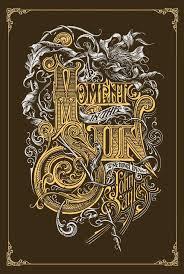
[READ: October & November 2013] A Moment in the Sun

I read this book last year…finished it just before Thanksgiving, in fact (I was proud of my pacing).  But it was so huge that I didn’t want to write about it until I had a good amount of time.  And now here it is four months later and I probably have forgotten more details than I should have and the post will be nowhere near as in depth as I was saving time for in the first place.  Bah.

When people see this book, they say, “That’s a big book.”  And it is a big book.  It’s 955 pages (and they are thick pages, so the book itself is nearly three inches thick–see the bottom of this post for an “actual size” photo); it’s got three “books” and dozens of characters whose stories we read about in full.  It is about the United States, racism, The Gold Rush, the assassination of a President, the Spanish American War, a World’s Fair and even the exploration of moving pictures.  This is a fairly comprehensive look at the Unites States from the 1890s to the early 1900s.  And, man was it good.

John Sayles is known more for his movies than his books (18 films directed, nearly as many different ones written and only 4 novels), but the cinematic quality that is clearly in his blood comes through in this book as well. (more…)

Read Full Post »

smekdaySOUNDTRACK: SUPER XX MAN-Tiny Desk Concert #12 (January 27, 2009, recorded Oct. 22, 2008).

superxxI included the recording date because this is the first one that actually mentions the recording date.  I had always known that the shows were recorded before they were posted, but i had no idea they were so far apart.

Super XX Man is another “band” that I only know about because of NPR.  Scott Garred is Super XX Man (pronounced Super Double X Man), and he has recorded most of his albums at home.  Interestingly, he is also a music therapist in the maximum-security wing of the Oregon State Hospital—the location where they filmed One Flew Over the Cuckoo’s Nest.  His job is helping psychiatric patients cope with drug addiction, severe mental illness and other assorted disorders.

I’m not sure exactly what his recorded output is like (he has been recording for 15 years and had recently recorded with a band for Volume XII: There’ll Be Diamonds), but this solo venture is just him with a guitar.  He has a very nice voice and his melodies are simple and catchy.

“There’ll Be Diamonds” is a very nice catchy song—very positive.  The second song, “Big Balloon,” is for the newly admitted patients at the hospital.  It is a very tender look at people who are dealing with something quite traumatic.

“Collecting Rocks” comes from Volume VI, and is based on a story his grandfather told him a while ago.  It’s an incredibly sweet song about two people in love.  But it’s also fun how he gets the room to sing along at the end.  I imagine that NPR employees are more docile than his usual audience.

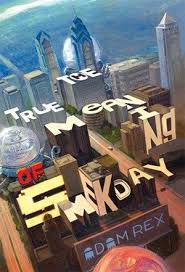
[READ: January 5, 2014] The True Meaning of Smekday

I have known Adam Rex first as an illustrator.  Then I knew him as a children’s picture book author.  And now, the other day, I saw that he also wrote larger children’s books.  In the library I saw Unlucky Charms. I was going to grab it but then I saw that he was “the author of” other books.  So, being the kind of person I am, I decided to read his first novel first, which was this one.

This novel combines art (photographs—which are drawn by Rex), comics (as drawn by an alien) and a school story written for a time capsule (as such, the font is in a weird sans-serif that I found bothersome to read (man I am really getting old)).

Anyhow, I thought this book was very very funny on so many level.  There were pop culture jokes, there was great dialogue and there were fun internal jokes.  There were some sophisticated jokes and some really juvenile jokes.  And they all combined to make for a very good read.

The only problem with the book was that it was so damned long.  No one needs to write a 422 page book about an alien invasion.  The story could easily have lost 100 pages and not been harmed at all.  And I say that because I loved the beginning and I devoured the end, but I felt rather adrift in the middle. (more…)

Read Full Post »

grantldnSOUNDTRACK: VOIVOD-Killing Technology (1987).

killingAs I said, this album’s art looks much better.  And you can hear from the first notes that this album is better produced and is going to be a lot more interesting than the previous two.  It’s hard to know just how much of a leap this is from Rrröööaaarrr because that album was so muddy–maybe there were gems of guitar chords under all that noise.  Like the previous openings, there’s a sort of prologue to the album.  But unlike the previous album’s swirls, this one is beeping with a computer voice announcing “we are connected”

The opening chords are heavy, but man they sound clear—like they weren’t recorded underground.  You can also hear all of Piggy’s weird higher notes—he’s playing complicated chords, not just solo notes.  And when the chorus of “Killing Technology” rolls around, it offers stop and start rhythms and Snake’s voice even goes up an octave at the end.  But the first real indication that Piggy is on to something new comes in the bridge. Underneath the robotic voice, Piggy is playing some really strange-sounding chords.  The story is that he had been admiring Robert Fripp’s guitar work and so he added some of those King Crimson-y angular weird chords to his repertoire.  And he melds them perfectly with the heavy thrash that the band had been playing.

Lyrically also, this album has moved away from killing and headaches.  “Killing Technology” while having “killing” in the title is a very different subject:

The star wars have started up
The new invention is coming out
Making a spider web over the atmosphere
To make them sure that we can’t get out of here

Computers controlling your functions
Seems like we got electronic alienation
Trading children for a new kind of robot
Waiting for the old people to disappear

Quite a departure from Rrröööaaarr’s “Fuck Off and Die”

Stand up, right now, kill

No pleasure, the pain comes down here
No return, don’t look back, there’s no tomorrow
And if you’re a fucker and don’t believe it
I’d say fuck off and die, fuck off and die

“Overreaction” leans more towards the heavier side—Snake screams a bit more—but the subject (nuclear disaster) is thoughtful.  Then comes their first truly amazing song: “Tornado.”  Not only building like a tornado, this song allows them to talk about violent imagery without resorting to bloodshed. It’s even scientific:

Cumulonimbus storms arrive
Lightning flashes a hundred miles around
Electrical collision course
Creates the elephant trunk

But the best part is the chorus—it’s simple enough (just the word Tornado repeated) but it’s completely catchy and sing-alongable with bright major key chords.

“Forgotten in Space” features some great drumming from Away—he’s really quite underrated both in speed and technique—which explands even more on later albums.  “Ravenous Medicine” is another highlight—an interesting series of uncomfortable chords opens this track about scientific research.  It’s a pretty fast, heavy song.  Although not too complicated except for the occasional breaks as the story progresses.

“Order of the Blackguards” is another fast song, but this one has so many parts that if you don’t like one, just wait a few seconds for the next one.  “This is Not an Exercise” ends the disc proper.  The middle section has a great heavy riff.  But it’s the beginning of the ending sequence which is so perfectly sci-fi that really sets the tone of the album and looks towards the next one.  It’s cool to think of Piggy playing these spacey chords on his guitar.  And when Blacky’s bass rumbles in to resume the song, it’s quintessential Voivod.

By th way, this disc is a concept album as well.  There’s a “Killing Side” (the first three songs) and a “Ravenous Side.”  The strange thing about the CD though is that they have added two tracks from their Cockroaches EP which is nicockroachesce.  But they put one song at track 4 (the end of side one).  How odd to put a bonus track in the middle of a sequenced album.

The EP came out before the album and it has a slightly different feel from the album proper.  Although as a step towards Killing Technology it’s perfectly in sync.  “Too Scared to Scream” is heavy and has some interesting time changes—I love the way the song feels like it is crashing to a halt around 3:30.   “Cockroaches” feels like more traditional metal.  It opens with drums and Piggy playing a typical sounding metal solo.  Then the riffing starts and it’s very heavy indeed. Even the staggered section near the end sounds like a mosh section more than the prog time changes that Voivod uses on the album proper.  The song ends with Snake screaming as the cockroaches are coming.  A good ending to the EP and a pretty good ending to the disc.

The whole album has a very mechanical and robotic feel—the chords that Piggy plays just sound like mechanical failure, it’s very well constructed and foreshadows the music of their future.

[READ: July 9, 2013] Grantland #6

Grantland #6 covers from Sept 2012-Dec 2012.  Despite the short time frame, this is the largest issue yet.  And it maintains all the quality that I’ve come to expect from the book/magazine thing.  Which means, I love the writing (especially about people/sports I’m not that interested in).  And it also means that the editing is typically crap.  In this issue the editing was crap more because they simply forgot to remove mention of hyperlinks.  At least I assume that’s why sentences like “See here for ____” are included in any given article.  But yes, there are some very simple typos that Word would correct pretty easily.

But beyond that, I really enjoyed this issue.  And I’m finding it amusing how much certain people and shows crop up in a given time frame.  So this is a four month period and Kobe Bryant still dominates (there will never be an issue without at least one Kobe article).  But this time Homeland is the big show (since Breaking Bad has been on hiatus I gather).  Basketball remains the favorite sport here (even though they speak of football as being the most popular sport).

Chuck Klosertman and Charlie Pierce continue to write thoughtful (sometimes funny) articles.  And I like how there is still talk of Jeremy Lin even if Linsanity has gone away somewhat. (more…)

Read Full Post »

artofmcSOUNDTRACK: SUGAR-“Helpless” single (1992).

helplessI loved that first Sugar album and even bought the single for “Helpless” (back then singles were ways for record labels to get more money out of fans of a band rather than for people to pay for one song).  In addition to “Helpless,” the single contains three songs.  “Needle Hits E” is a poppy song–very Mould, very Sugar.  The song is a bright and vibrant addition and would fit nicely on Copper Blue.

The second track is an acoustic version of “If I Can’t Change Your Mind” which sounds wonderful.  Mould really knows how to record a 12 string guitar to make it sound huge.  “Try Again” is the final track.  It reminds me of The Who, especially the bass line at the end of each verse.  It’s a darker song (especially for his single which is so up).  But I love the way the acoustic guitar seems to make it build and build.  Then, some time around the two and a half minute mark, a feedback squall starts building.  It’s way in the background (and actually sounds a bit like squealing balloons).  It continues until the last thirty seconds just degenerate into full blown feedback noise–just so you know Sugar aren’t all pop sweetness.  All three songs were later released on Sugar’s Besides collection.

[READ: May 10, 2013] The Art of McSweeney’s

Sarah got this book for me for my birthday and I devoured it.  It answers every question I’ve had about McSweeney’s and many more that I didn’t.  It provides behind the scenes information, previously unseen pieces and all kinds of interviews with the authors and creators of the issues as well as The Believer, Wholphin and some of the novels.

The real treasure troves come from the earliest issues, when there was very little information available about the journal.  So there’s some great stories about how those early covers were designed (ostensibly the book is about the artwork, but it talks about a lot more), how the content was acquired and how the books were publicized (book parties where Arthur Bradford smashed his guitar after singing songs!).

The cover of the book has a very elaborate series of very short stories by Eggers (these same stories appeared on the inside cover of McSweeney’s 23).  For reasons I’m unclear about, the rings of stories have been rotated somewhat so it is does not look exactly the same–although the stories are the same.  The inside photo of the book also gives the origin of the phrase “Impossible, you say? Nothing is impossible when you work for the circus.”

The opening pages show the original letters that Dave Eggers sent out to various writers seeking stories and ideas that were rejected by other publications (and interesting idea for a journal). (more…)

Read Full Post »

mystrugglSOUNDTRACK: TRICKY-“Christiansands” (1996).

christiansandsThis book is set in Kristiansands, and so naturally this song was ringing through my head the whole while I was reading it.  I’ve known this song for ages, but had no idea that Chirstiansands was an actual place in Norway.

This song is dark and tense.  Over a slinky beat, a spare guitar riff introduces Tricky’s voice as he rasps (his voice is slightly modified to give him a weird echo).  And while he’s reciting his verses, the gorgeous voice of Martina Topley-Bird, repeats what he’s saying in a whispered voice until she sings out the chorus “I met a Christian in Christiansands.”

The verses repeat with Tricky emphasizing, “master your language and in the meantime I create my own.  It means we’ll manage.”

I honestly don’t know what the song is about, and it feels like it never properly ends–that riff, at once menacing and gripping never seems to conclude.  It’s a masterful track and hard to forget once you’ve heard it.

[READ: May 11, 2013] My Struggle Book One

I read an excerpt of Book Two from this series in Harper’s.  And despite the fact that nothing really happened in it, I was drawn in by the writing style.  This first novel is very similar in that not a lot happens but the voice is very captivating.  The translation is by Don Bartlett and it is fantastic–I can only assume the original Norwegian is just as compelling.  So, despite the fact that this autobiographical series contain six books (six!) and totals over 4,000 pages (how could this be if Book one is a mere 400?  Books 4-6 are over 1,000 pages each), I decided to give it a try.  (Incidentally, Book Two has just been translated into English this month).

This series has caused some controversy because it is given the same title as Hitler’s Mein Kampf (Min Kamp in Norwegian), and also because he says some pretty means stuff about people who are still alive (like his ex-wife).  Although there isn’t much of that in Book One.

death in the familyIndeed, Book One basically talks about two things–a New Year’s Eve party when Karl Ove was youngish and, as the bracketed title indicates, the death of his father.  (The title A Death in the Family is the same book as My Struggle Book One–from a different publisher.  It has a totally different cover but is the same translation.  I don’t quite get that).  But indeed, these two events take 430 pages to write about.

How is this possible?  Because Karl Ove writes about every single detail.  (I assume this why the books are considered novels, because there is no way he could remember so much detail about every event).  I’m going to quote a lengthy section from a New Yorker review (by James Wood) because he really captures the feeling of reading the book:

There is a flatness and a prolixity to the prose; the long sentences have about them an almost careless avant-gardism, with their conversational additions and splayed run-ons. The writer seems not to be selecting or shaping anything, or even pausing to draw breath….  There is something ceaselessly compelling about Knausgaard’s book: even when I was bored, I was interested. This striking readability has something to do with the unconventionality of “My Struggle.” It looks, at first sight, familiar enough: one of those highly personal modern or postmodern works, narrated by a writer, usually having the form if not the veracity of memoir and thus plotted somewhat accidentally, concerned with the writing of a book that turns out to be the text we are reading.  But there is also a simplicity, an openness, and an innocence in his relation to life, and thus in his relation to the reader. Where many contemporary writers would reflexively turn to irony, Knausgaard is intense and utterly honest, unafraid to voice universal anxieties, unafraid to appear naïve or awkward. Although his sentences are long and loose, they are not cutely or aimlessly digressive: truth is repeatedly being struck at, not chatted up.

That idea of being bored but interested is really right on–and it may sound like a bad thing, but it’s not.  You can read along thinking that there’s no way he is going to give so much unimportant detail.  But you get this description of drinking a cup of tea: (more…)

Read Full Post »

heartSOUNDTRACK: CHELSEA LIGHT MOVING-“The Ecstasy” (2013).

clmWhen Chelsea Light Moving played at KEXP, they went out for a break before playing live on air.  One of the DJs had a chocolate bar.  And Thurston was inspired.  According to the NPR [page:

The Sonic Youth veteran and his bandmates in Chelsea Light Moving had been jamming off-air in the KEXP studios. When they stepped outside to get some fresh air, KEXP’s DJ Sharlese followed, offering them some of her chocolate bar. At first, Moore politely declined, but as the candy got eaten away, piece by piece, a poem (John Donne’s “The Ecstasy”) was revealed underneath, printed on the candy wrapper.

“Can I have that?” he asked, and the next thing we knew, he was sprinting back into the studio, taping the tattered wrapper to a mic stand, and belting out his own version of the poem against discordant guitar chords.

The music is great.  It works perfectly with the meter of Donne’s poem and, the way Thurston delivers it, it sounds like he could have written it.  There’s some great screaming guitars, a very cool discordant chord or two and wailing solo.  I really enjoyed that Thurston doesn’t play guitar through much of the song (he leaves that to the other guitarist), he just comes in when some wildness is needed.  Awesome.

It’s a great song and hard to believe it was tossed off so easily.

Check it out here.

The lyrics are indeed from Donne’s poem, which begins:

WHERE, like a pillow on a bed,
A pregnant bank swell’d up, to rest
The violet’s reclining head,
Sat we two, one another’s best.

[You can read the rest here].

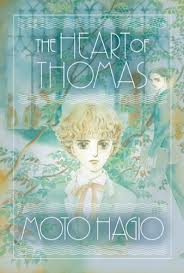
[READ: April 14, 2013] The Heart of Thomas

I brought this home from work because Sarah loves boarding school books.  But this is a manga book, and it is set up to be read right to left.  Sarah admitted that she can’t easily get her mind to work that way.  Which I understand. So I gave it a go.  I found it rough going, but after about 20 pages it became pretty natural.

The Heart of Thomas is an early example of Shōjo manga (少女漫画) which is manga marketed to a female audience roughly between the ages of 10 and 18. The name romanizes the Japanese 少女 (shōjo), literally “little female”. Shōjo manga covers many subjects with a strong focus on human and romantic relationships and emotions.   Shōjo manga does not comprise a style or a genre per se, but rather indicates a target demographic.  shōnen-ai.  The stories were published mostly in magazines targeted at girls–which had a huge audience.  And that is where The Heart of Thomas was originally published in 1974.

The Heart of Thomas is a fascinating story—it’s set in a German boys boarding school (written by a Japanese woman!). The story opens with the death of a character named Thomas.  He falls off a bridge and the story is predicated upon wondering whether he jumped or he fell.  There are a lot of clues that he committed suicide because of his unrequited love for Juli, the prefect of boys at the school.  Juli is quite different from the other boys, he has dark hair and Greek features, he is not golden haired and blue eyed like so many of the other boys.  This makes him stand out.  Indeed, he even stands out in his own home, where he lives with his mother and grandmother.  His grandmother is disgusted by his coloring and believes him to have impure genes (yikes!).  She even tells him as much!  But Juli is a serious student and a hard worker, with no time for nonsense from his grandmother or his classmates.  He also has no time for farce.

The farce refers to a game that Thomas and Ante created in which they would both vie for Juli’s love.  Thomas pursued this heavily but was never successful.  And that may be why he killed himself (if indeed he did). (more…)

Read Full Post »

[WATCHED: Summer 2012] Great Expectations

300px-Great_expectations_titlecardSometime after I read Great Expectations, PBS aired this BBC production.  I don’t know if it’s a movie or a mini series and I don;t really care, so I’m calling it a movie.  So I thought I’ll just wait until after I watch the movie and then write my post about both.  And now here were are, several months later.  Sigh.

Anyhow, this movie version of the book was outstanding.  One of the main criticisms leveled at movie versions of books is that your own imagination makes things far “more” than any film could.  For instance  monsters in your head are far more scary than any special effects could make them.  But the opposite was true here.  I never would have guessed that the people in the book could be so horrible, that the squalor could be so extreme and that the atmosphere could be so stifling–I assume years of good breeding made me forget just how bad things used to be

Part of the fault also belongs to Dickens–he was writing for a contemporary audience–for people who didn’t need to be told, for instance, how old Pip was (they would just know) or how old he would need to be to receive his inheritance.  The story was serialized in a magazine, so it was very current.  And so those of us with a great remove from daily life in 1850 don’t always get the details we need.  This is not to say that Dickens himself was not a master writer or an evocative picture creator.  He often includes lots of details they are very helpful, but some things are left out.  So the movie filled in gaps and details that I didn’t know, and they brought the book to life in a way that reading it alone didn’t.  Again, no disrespect to the book–it’s the same way that seeing Shakespeare is better than reading him).   (more…)

Read Full Post »

« Newer Posts - Older Posts »