The only thing I could think of to pair with a complete telling of Wagner’s Ring Cycle (aside from the entire thing itself, which… forget about it), was the smallest, most inconsequential music I could find.
Enter HMSTR.
HMSTR played the Tiny Desk Christmas show in 2014. And really, they must be seen to be believed. Not because they are spectacular, but because the joke isn’t really very funny if you just listen to the music.
Starting with some bizarre synth sounds, after 20 seconds the songs bursts into a lo-fi punk anthem. It’s all buzzing guitars and a simple synth over some majorly lo fi drums. There’s even a somewhat catchy “chorus” section. After a minute, the guitars fade and sleigh bells signal the end of the song.
So whats the joke? See for yourself
All in a tiny Tiny Desk setting.
[READ: May 20, 2015] Richard Wagner’s The Ring of the Nibelung
Yes, this is a massive graphic novel depicting Wagner’s “Music Dramas.” The text was translated by Patrick Mason and then Russell adapted the whole thing to fit his story.
Everyone loves “Flight of the Valkyries,” but hardly anyone has listened to the entire Ring (it’s 4 operas and 15 hours long). Except for the Bugs Bunny version, of course. I have been interested in the Ring for a long time, but I wasn’t willing to devote that much time to it either. So this book is perfect. (more…)
SOUNDTRACK: MARTIN TIELLI-Ottawa Bluesfest Ottawa, ON (July 5, 2008).
This brief set at the Ottawa Bluesfest was for a Six Shooter Records showcase. As such it is short (about 30 minutes). By the end there are tons of guests playing with him, which is fun.
He opens with three solo acoustic songs: “I’ll Never Tear You Apart” which sounds great and “Something in Those Woods” which would appear on his third album The Ghost of Danny Gross the following year. When the song ends, he says he is still “working on it.” The third song “The Underbrush” will also appear on Danny.
Then the band comes in: Ford Pier, Greg Smith and Doots (Steven Pitkin) on drums. Someone in the band says that Martin looks great, the treatments really paid off to which Martin replies “What?” incredulously.
The rocking “My Sweet Relief” segues nicely into the rocking “That’s What You Get for Having Fun.” Interestingly, Martin seems to forget the words, so they play an entirely instrumental verse (complete with a solo) before resuming the song.
The final song is a great version of “Shaved Head,” with a full cast of Six Shooter Records players in the guest list: Luke Doucet, Paul LaPlante, Christine Fellows, Justin Rutledge, NQ Arbuckle, Casey Laforet and Mark Sasso as well as a few others whose names I missed.
It’s a great fun show and a great quality recording.
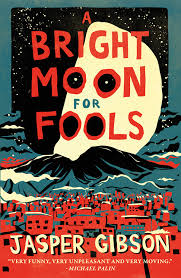
[READ: July 1, 2015] A Bright Moon for Fools
I found this book at work and was intrigued by it. Not by its title or cover, which is dreadful, but because on the edge of the pages was printed Up on two legs, man! I love a book that plays with convention so I decided to check it out. Then on the front is a blurb from Michael Palin(!) which says “Very funny, very unpleasant and very moving.” And this is a very apt blurb for this book. It is quite funny, it is very unpleasant and it is also rather moving.
The story is about a man named Harry Christmas. Christmas is a scoundrel. He is mid-fifties but appears much older–fat, drunk and be-mustached. He fancies that he looks fantastic, but no one is fooled.
Christmas suffers no fools. He expounds vociferously about any slight (especially slights against common courtesy–for although he is belligerent, he does believe in common courtesy). He hates all of the vulgar inanities of modern life, which he calls, “The Rot.” He hates people who use air quotes, he hates people who listen to walkmen (or whatever other technological marvel is out there), he hates people who want to sit and talk to him while he is eating, and worst yet he hates those who assume that because he is British, he loves football. None of these hatreds seems that unreasonable to me, but since Harry is a big drunken man, his belligerence moves past justifiable and into the realm of scary.
And yet, he is a funny and enjoyable protagonist to be sure. Well, except that he has stolen the life savings from his previous girlfriend and has fled London for Venezuela. (more…)
[LISTENED TO: August 2014] The Hero’s Guide to Being an Outlaw
This audio book was ten hours long. We listened to it on a long car trip (from New Jersey to Canada).
I wasn’t quite sure how the title of this book would make sense since the heroes are heroes after all. But we quickly learn that all of the good guys have been accused of killing Briar Rose (they didn’t even know she was dead!). And her father has put a bounty on all of our heroes: Prince Frederic, Prince Gustav, Prince Liam, and Prince Duncan and Cinderella, Snow White, Rapunzel, and Princess Lila.
Of course, it shouldn’t take anyone long to determine that there has been a nasty plot afoot and that someone from their past has some pretty evil plans to attend to.
However, the way the story is written–with each character getting his or her hilarious chapter–it does take a little time before the truth comes out. But it takes only a few pages before the scary news comes out–Rundark, Warlord of Dar is back, and he is angry. Well, he was always angry, but I suspect he’s even more angry. (more…)
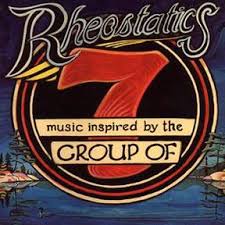
SOUNDTRACK: RHEOSTATICS-Music Inspired by the Group of 7 (1995).
In music there’s always a… key in which the composition is set… In painting there’s a mother color that goes through all–it holds the painting together…you might call it the signature of the painting.
And thus opens the Rheostatics Group of 7 record. I had always been vaguely dismissive of the album because it is mostly instrumental and, while good, I just didn’t listen to it that much. After seeing it live it’s time for a reappraisal.
The disc opens with “One” a lovely minute-long piano introduction. It’s followed by “Two” which has a series of piano and guitar trills as they set a bucolic mood. Then the drums kick in. This song starts slowly with some plucked strings (and a sample from Queen Elizabeth). What I love about this piece is that after the trills, the song seems to build to a very cool cello riff (provided by drummer Don Kerr). Then there’s a vocal section (of bah bahs) which was really highlighted when they played it live.
The first highlight of this record for me is “Three,” which is known as the Boxcar song. Someone shouts “All aboard” as the chugging begins and the cello and drums keep an excellent rhythm with Martin’s amazing guitar melody. “Five” is another waltz with, to my ears, a vaguely Parisian sound. Martin sings a few verses (and a chorus of “blue hysteria”). It’s a lovely, delicate piece.
“Six” is a longer piece which centers around a slowly swirling guitar and cellos motif. It ends with some noisy moments and more rainfall. Until a noir sounding coda creeps up with piano and upright bass,.
Then comes “Seven” a cello based version of the awesome song “Northern Wish.” I prefer the original because it is so much more intense, but this quieter version is really interesting and subtle. “Nine” starts slowly with some gentle acoustic guitars. But it builds and grows more intense (it has the subtitle “Biplanes and bombs”). As the song progresses (around 3 minutes) Tielli’s guitar comes in and the backing notes grow a little darker. The last 15 second are sheer noise and chaos (live they stretched this section out for a while, and it was very cool to see Hugh Marsh makes a lot of noise with his violin).
“Ten” uses some nontraditional instruments including what I assume is a didgeridoo and all kinds of samples. On stage Tim and Kevin were swinging those tubes that whistle to make the noises).
Eleven is a reprise of track one, Kevin’s Waltz, with the vocals sung by Kevin Hearn.
I have really come to appreciate this album a lot more. It doesn’t have any of my favorite songs on it, but it is a really amusing collection fo songs.
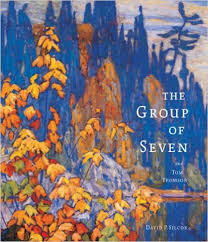
[READ: August 20, 2015] The Group of Seven and Tom Thompson
I have had this book for a number of years. I’m not even sure where I got it (in hardback no less). I know that I purchased it because of the Rheostatics, because I had never heard of the Group of Seven before the band made their record inspired by them. Since I was going to see the paintings live, I decided to read up about the Group a bit more (I liked the paintings a lot, I just hadn’t read much).
Sadly, the Art Gallery of Ontario wasn’t open for viewing when we went to the concert (which makes sense as it was at night) and we didn’t have another opportunity to go to AGO. Fortunately, we also went to Casa Loma which had a room full of Go7 paintings, so I was delighted to see some of these up close. (They may have been prints, it was unclear, but it was cool seeing them).
So the Group of Seven were (initially) seven Canadian painters who joined together to create uniquely Canadian works of art from 1920 to 1933. Their art was meant to celebrate their country which they felt was under-represented in art. They planned to not follow conventional European styles of painting and often made striking scenes of nature. They are largely known for their landscapes, although they also painted portraits and other works.
SOUNDTRACK: LAURA VEIRS-Tiny Desk Concert #49 (March 1, 2010).
I have decided to contradict myself. I simply cannot keep up with the regular release of Tiny Desk Concerts (sometimes 3 a week), so I’m going to focus on these older recordings for a while and occasionally devote a week or two to new ones. we’ll see how that works out.
I only know Laura Veirs’ name, but not really anything she’s done. So I wasn’t really sure what her “solo” work would sound like. Well, she has a delightful voice and she writes really pretty songs.
She also offers one of the most dramatic screw ups I’ve seen in a live performance. She opens her song “Carol Kaye” with this lovely melody–just her and her guitar. And then after about a minute, her band comes in with a beautiful harmony–in the wrong key! The introduction of their voices is so dramatic (to go from her gentle voice to this huge chorus) was really amazing. So much so that I didn’t quite realize they were in the wrong key at first. Turns out that Laura put her capo on the wrong fret and it wasn’t until the keyboardist played the right note that they all sounded off. And his mouth drops opens as he stares at Laura. She laughs and says “you looked like this terrified Muppet.”
They play the song again, this time perfectly–and the harmonies are truly lovely. As is the violin that swirls throughout the song.
“When You Give Your Heart” is another lovely song in which Viers’ voice and the violin play the same lilting melody.
“Sun is King” has some more lovely (that’s the word to describe her, clearly) harmonies–she has picked a tremendous backing band. And they sound great in this small setting.
It’s hard to believe that the whole set (miscue and all) is only ten minutes long.
[READ: May 1, 2015] House of Leaves
I read this book when it came out in 2000. I had the “2 Color” edition which the t.p,. verso explains has as features: “either house appears in blue or struck passages and the word minotaur appear in red (I had the blue version). No Braille. Color or black & white plates.”
The Full Color edition (which is the same price, amazingly) differs in this way:
The word house in blue, minotaur and all struck passages in red
The only struck line in Chapter XXI appears in purple
XXXXXX and color plates
So basically the full color edition isn’t really that big a deal although the three or four full color plates are much nicer.
Why do I have both? Well, I bought the two color when it came out and then I won a free book at the library and there was this full color edition, so I brought it home. I was amused to find that the previous owner had deciphered a clue in the back of the book (the first letters of sentences spell out a secret message). She (it looks like woman’s handwriting) wrote out the secret message, which I appreciated as I didn’t feel like figuring it out.
ANYWAY.
This book had a huge impact on me when I read it. Although I forgot a lot of the details, the overwhelming effect of the book has stayed with me an I never forgot the central conceit of a house that opened secret passages and expanded or contracted at will. For, make no mistake about all of the accolades, this is a horror story. One accolade, from Bret Easton Ellis: “One can imagine Thomas Pynchon, J.G. Ballard. Stephen King and David Foster Wallace bowing at Danielewski’s feet, choking with astonishment, surprise, laughter awe.” [Ellis will not be bowing apparently, and actually I can’t imagine Pynchon bowing before anyone]. It’s a very cool horror story with all kind of textual experimentation and twists and turns, but it’s still a pretty damned scary story.
The experiments are many and varied and they begin right from the start, as the title page lists Mark Z. Danielewski’s House of Leaves by Zampanò with an introduction and notes by Johnny Truant. The forward from the editors notes: “The first edition of House of Leaves was privately distributed and did not contain Chapter 21, Appendix II, Appendix III or the index.
Karl Ove mentions many bands in this book, but the deLillos are the only Norwegian band that he plays. They sing in Norwegian and play sprightly, jangly guitar pop–they would fit in very well with some of the lighter alt bands from the late 80s and early 90s.
I have no idea what they’re singing about (well, the title translates to “love” so I guess I know what they are singing about.
The singer has a high, delicate voice and there’s some interesting harmonies. I really like the way the song transitions from verse to chorus with the picked guitar notes–very catchy.
It comes from their second album, Før var det morsomt med sne (Beforeit was funin the snow), which along with their first was quite popular and was reissued with a bonus disc in the 90s. Having said that I see that Amazon has one copy of the disc and no album cover listed. Worse yet, I can’t find many other songs online (Spotify lists the album, but I can’t get it to play).
Sorry, deLillos (even searching for you gives us more Don DeLillo than you guys).
[READ: June 24, 2014] My Struggle Book Four
I started including the British edition page numbers because at my work we received both editions of the book, and I received the British one first so I grabbed it and started reading. I noticed the page numbers were quite different (the British book is taller and the print is quite bigger, although this doesn’t explain why the previous books have fewer pages).
I had been interested in the differences between editions from the get go. I had enjoyed the American editions, but I enjoyed reading this British edition more (bigger print?). But when I noticed on one of the pages that the word “realise” was spelled as I typed it, it made me wonder if the American edition changed that to the American spelling. [Actually, I see that Don Bartlett lives in Virginia, so perhaps he translates it into American first]. While I wasn’t about to go into a deep inspection of the topic, when I saw the American edition on a shelf at work, I had to do a little comparison.
And what I found out was that even though Don Bartlett is the (amazing) translator for both editions, someone (perhaps Bartlett himself?) is translating the American into British (or vice versa). I looked at a couple of pages and noticed these changes from British to American:
BRITISH EDITION = AMERICAN EDITION
Pack it in, now = Give it up, now
roll-up = rollie [about hand rolled cigarettes]
looked daggers at = gave her a dirty look
a complete prat = completely useless
is that possible? = really?
to cook and wash up = cooking and doing the dishes
I had got = I’d gotten
had penned = had written
and yes, realised = realized.
Other than select phrases, every word is exactly the same. So somebody goes through the books and changes them to British english idioms and spellings. That’s fascinating.
I also see that this is the first book I had not read an excerpt from first. Not that it would have made any difference as to whether I read the fourth one. I couldn’t wait to get my hands on it.
So book four is set in Håfjord, a town in Northern Norway near Finnsnes (a five hour flight away–okay I had no idea Norway was so big!). Karl Ove is 18 and has decided to become a grade school teacher there for one year. The tax breaks are great if you teach, and he plans to teach and write his masterpieces and then get out. He has no interest in teaching, but the town is small (most grades are 3-7 students), so he figures it can’t be too hard.
As in most of Karl Ove’s books, the stories jump around and flash back and do not stay all in this one time, but it is largely set in this locale.
My first thought was that I have never read a story with as much semen (both nocturnal emission and premature ejaculation) in my life. It is a strange take away from the book, but there it is. Karl Ove is 18 and really wants to have sex for the first time. About 3/4 of the way through the book he reveals that he never masturbated (it just never occurred to him, apparently, and at 18 he’s too old to start–what!?). As such, he seems to have wet dreams every night. And every time he gets near a woman, he has an orgasm too soon. He is horny all the time–it’s a bit disconcerting.
And since I mentioned that, I don’t know if Karl Ove’s life is typical of Norway, but I am shocked by the number of women who take their clothes off around him (he may have never had sex, but he was about to on at least a half-dozen occasions). And he says that all through school (from around age 13 and up) it was common place for the boys to lift up the girls’ shirts and kiss and or fondle their breasts. It is mind-boggling to me. And the 16 year olds all seem to be having sex all the time–this may be skewed from Karl Ove’s perspective, but that’s what I now believe happens in Norway.
But while sex is the main theme of the book–sex, sex sex, there is more to it.
Karl Ove’s parents have split up and his father has started drinking in earnest. The dad has remarried and has just had a baby. Incidentally, I was also shocked to read that Karl Ove’s father, who is an abusive stodgy old man who is cranky and mean and abusive and all the stuff that we read about in the other volumes was only 43 at the time that Karl Ove was 18. So the old man who I pictured as a gray-haired curmudgeon in this book is actually younger than me. Great.
In Håfjord, Karl Ove is teaching kids who range from age 13 to 16. It’s disconcerting to read about him thinking lustful thoughts about his students, until he reminds us that for most of the students, he is only 2 years older than them. I am pleased to say that he behaves himself (except in his mind) with all of the students. There’s even a really interesting flash forward to eleven years later when he runs into two of them again.
He proves to be a pretty decent teacher it seems. The kids mostly like him (the girls all think he is hot) and he is young and tries to make it fun (he himself hated school and everything about it). He even seems to help out an awkward boy (although that is never resolved). We see him teaching, trying to interact with the kids and generally being a pretty good guy.
Until the booze comes out.
For in addition to semen, this book is chock full of alcohol. Before graduating from gymnas (high school), Karl Ove basically stopped caring about anything. He spent most of his time drunk. It is astonishing the amount of drinking he does–it’s practically like an Amish Rumspringa how crazy he goes. But even in this retrospective look, he talks about how much he likes it, how it loosens him up and makes him less nervous.
But really he just spends most of his time drunk, hungover or sick. He even got into the hash scene for a while. He was living with his mom at the time and she was appalled at the way he acted–especially when he threw a party which trashed their house. She even kicked him out for a time.
He seemed to be over the drink in Håfjord, but it turns out that there’s precious little else to do except drink up there, especially when it grows dark for most of the day. So there is much drinking–he only misses class once or twice because of it but he comes very close a lot.
The irony that he is appalled at his father’s drinking, while drinking so much himself, is apparently lost on him.
The other main preoccupation with Karl Ove is music. He talks a lot about his great taste in music (he reminds me of me–a little insufferable). Back when he was in gymnas, he spent a lot of time discussing his favorite bands and favorite songs. He got a job (at 16) writing reviews for a local paper (holy crap, jealous!) and then later gets a job writing a column for another paper. For the previous book I listed a lot of the bands he mentioned, and I wish I had written them down for this one. U2 features prominently (this is 1987, so I’m guessing Joshua Tree), but also Talking Heads, a Scottish post-punk/new wave band The Associates and their album Sulk which he describes as “an utterly insane LP.” he and his brother really like The Church and Simple Minds (before they got so commercial). He also has a whole thread in which he makes connections with albums:
Briano Eno, for example, started in Roxy Music, released solo records, produced U2 and worked with Jon Hassell, David Byrne, David Bowie, and Robert Fripp; Robert Fripp played on Bowie’s Scary Monsters; Bowie produced Lou Reed, who came from Velvet Underground, and Iggy Pop, who came from the Stooges, while David Byrne was in Talking Heads, who on their best record, Remain in Light, used the guitarist Adrian Belew, who in turn played on several of Bowie’s records and was his favorite live guitarist for years. (64).
He also specifically raves about “The Great Curve” from the Talking Heads album, and of course, he raves about the first Led Zeppelin album as well.
Music is a huge part of his life (and he dresses accordingly too). It’s unclear whether the kids think this is awesome or not, but he may be a bit too much for some of the locals. The locals are mostly fishermen (which makes sense), and Karl Ove is a bit intimidated that he is so wimpy compared to them–one of the women even teases him about his tiny arms.
But his main focus is writing. He writes a few shorts stories (to my knowledge he has never published any of them). We see some excerpts and they seem fine–he fancies himself Hemingway. But he also mentions a bunch of Norwegian authors (I love when he does that). Sadly again, not too many of them have been translated into English. [I really hope that some mega fan creates a database of all of the bands and authors he mentions]. He also talks briefly about his first novel which alludes to his time teaching here. I happened to read a small summary of said novel (Out of the World) and feared that it spoiled what was going to happen. But, in fact there does appear to be a difference between his fiction and non-fiction.
The book moves very quickly–from party to party, from failed sexual attempt to the next, even from his staying up all night long trying to write. And most of the time he comes off as kind of a dick–he is also very self-critical, which somehow tempers that dickishness.
As with the other books I cannot figure out exactly why I am so addicted to his writing. I brought the book home on Thursday night and finished it (all 548 pages of it) Monday night. This really completes the picture of himself as he moved from childhood to adulthood and really lays the foundation for whatever is to come next. Early in the book he talks about the books that he loved at that age, books that talk about the move from childhood to adulthood. And thus, this book becomes something of a bildungsroman as well. Although whether or not Karl Ove actually grew up at the end of this book will have to wait until volume 5 (which I have to assume is still another year away as there is no information about it online at all!).
For ease of searching, I include: Hafjord, For var det morsomt med sne.
SOUNDTRACK: CRASH TEST DUMMIES-Jingle all the way… (2002).
Even though the Crash Test Dummies are often seen as a joke band or a one hit wonder (which I guess they are), I’ve liked them for a while (their earlier stuff a lot more than their later stuff, admittedly). But it seemed like they’d have a fun take on Christmas music.
And it starts out in a comical sort of way with Brad Robert’s deeper-than-ever voice reciting about his life in Los Angeles, where it is warm and sunny at Christmas time. I like that he rhymes 24th with up north. The spoken section is quite loud in the mix (it sounds like he is right in your ear). Unfortunately, that is the case when he starts singing too–he is uncomfortably loud in the mix and it sounds like he is holding back because of it–he doesn’t sound great and his voice sounds more comical than interesting. Which is a shame because the music (with cheesey keyboards) is great.
Roberts sings lead on about half of the songs. Ellen Reid sings lead on the other half except for a couple where they split lead duties.
The rest of Robert’s songs include: “Jingle Bells” (which is certainly comical–it sounds like a chain gang song with the “Hey!s” sounding almost like a prison chant). It’s weird and cool though (even if his voice is once again too loud in the mix). “God Rest Ye Merry Gentlemen” has his voice mixed much better–he seems to be really singing. And this version–a loungey/jazzy rendition is much great fun. “God King Wenceslas” sounds proper (with Reid’s close backing vocals). It has a pretty penny whistle keeping the song going.
Ellen Reid has a great voice and I love hearing her sing. But in the first two songs she sings lead on in this disc she sounds like she is singing too slowly. “O Little Town of Bethlehem” especially sounds like the music is going to pass her up at any minute. I also don’t like the country vibe of the song. “In the Bleak Midwinter” is also (intentionally) slow, which I don’t like. Perhaps I just don’t like this song (although I do think the melody is lovely). “The Little Drummer Boy” is beautiful and Robert’s bass backing vocals are perfect. “Silent Night” is done in a countryish style, but I like this version. Although normally this song can make me cry, this version absolutely does not–too honky tonkish.
The final song, “The Huron Carol” is quite formal and proper–just Reid and a piano opening the song. It sounds very holy, very pretty. When Robert’s bass backing vocals come in, it adds more depth to the song. And it’s a lovely way to end.
[READ: October 30, 2014] Freedom
I read this a couple months ago and then got so caught up in reading other things that I never got around to posting about it. And that’s a bummer because I really liked the book a lot and I fear that I won’t remember everything I wanted to say about it.
I had read a couple of excerpts from the book in the New Yorker (quite some time ago). They were helpful in grounding the story for me, but they didn’t prepare me for the breadth of the story. It follows one family, the Berglunds, through several decades, focusing on each of them in great detail as they navigate through the Reagan, Bush, Clinton, Bush and a smidge of the Obama years.
The Berglunds are a liberal family. They were among the first white families to move onto their urban street in St. Paul, Minnesota (after white flight to the burbs). Patty is a charming (some say smug) homemaker and Walter is a lawyer (public defendant, naturally). They have two kids, Jessica and Joey. Patty dotes on Joey to an embarrassing degree (Joey is embarrassed by it, Jessica is infuriated by it and even Patty is kind of embarrassed when she really thinks about it). At the same time she is rather neglectful of Jessica. Naturally, Jessica becomes quite the success (loves reading, committed to the environment), while Joey rebels and finds all kinds of ways to disappoint them and make money. (This isn’t a bad thing, but the family has plenty of money and Joey doesn’t need to (especially not the way he goes about it). Not to mention Walter and Patty are not into the money for money’s sake thing.
The book opens that there was some “news” about Walter. He and Patty had moved to Washington DC two years earlier. He clearly did something bad (we won’t find out until much later). But that serves as an introduction to the Berglunds. And then we go back to see them, years earlier, settling into St Paul. (more…)
[LISTENED TO: November 5, 2014] Escape from Mr. Lemoncello’s Library
We were looking for an audiobook for a recent trip and I decided to get Escape from Mr. Lemoncello’s Library. I didn’t know anything about it, but the title sounded fun, especially for two librarians.
Well, I had no idea how much fun it would be for two librarians (and for others, too, I assure you).
So Mr Lemoncello is a game maker. He has hundreds and hundreds of board games and in this universe, everyone loves playing them. In the very first scene, Kyle Keeley and his brothers are playing Mr Lemoncello’s Indoor-Outdoor Scavenger Hunt (which is just what it sounds like). In an attempt to finally beat his brothers, Kyle tries to sneak back into his house through a basement window (thereby saving the time of going down the stairs. He inadvertently breaks the window and is grounded or a week (although he did win, so that’s something–and it shows just how intensely they play games in that family).
The next chapter opens up on the finishing touches of the brand new library in Kyle’s town. Alexandriaville, Ohio has not had a library for 12 years and Mr Lemoncello’s gift to the town is the coolest most state of the art library ever built. (Seriously, it is practically every librarian’s fantasy library with books and books and books (rooms coded by dewy number) and all kinds of high tech gadgetry to go with it. I would love to see this place built).
Kyle is bummed about being grounded. And to make matters worse, he forgot about the extra credit essay contest “Why I am excited about the new public Library.” At the last minute he throws together a lousy essay (which consists of “Balloons. There might be balloons,” and he is laughed at by just about everyone. But when the essay winners are announced (12 of them), he is the final winner–how could that be? (more…)
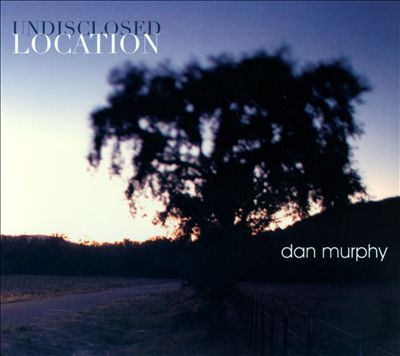
I never would have guessed that there would be a song called “Drinion.” But there it was, on Dan Murphy’s album, Undisclosed Location. Now, I don’t know anything about Dan Murphy. In fact, when I looked him up there also seems to be a country music singer named Dan Murphy (or maybe he is the same person?).
Anyhow, Undisclosed Location is mostly jazz piano. “Drinion” is instrumental (so there’s no clue for me about why it is called this–if it has any connection to The Pale King or what). There’s no levitating that I can hear.
I do hear a bit of the “All Things Considered” theme (the jazzy version, naturally), in part of it.
I like jazz piano a bit but I’m not knowledgeable about it at all. So, this was a fun find, and an enjoyable 6 minutes of jazz. Thanks Dan. Can you really be a country singer, too?
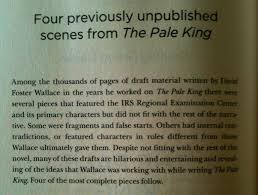
[READ: September 8, 2014] Pale Summer Week 9 (Notes & Asides and Bonus chapters)
As has been stated many times, The Pale King was unfinished. It was assembled by editor Michael Pietsch. Pietsch decided, based on the evidence given to him, what this book would look like. It’s an unimaginably daunting and thankless task, especially given how many ideas DFW was tinkering with. The Notes and Asides not only change the book, they change characters, emphasize nonexistent plot lines and basically make it seem like perhaps what we have here is but a small fraction of the overall work (rather than seemingly like a mostly completed book with a few pieces left out).
The final ten pages of the hardcover edition collects these notes and collates them in section by section fashion, with some overall notes about the book included at the end.
Since the notes are just notes, I’m not going to really go into them (otherwise I’ll just be copying the notes), but I would like to stress some that I think are interesting or revealing about what we might have gotten had he finished the book. (more…)
SOUNDTRACK: TOADIES-“Summer of the Strange” (2012).
Toadies had a hit (which is still played on “Modern Rock” radio today) in 1994 called “Possum Kingdom.” I really liked the song because the tempo was way off kilter and the lyrics were inscrutable (“Do you wanna die?” “So help me Jesus.”). And the singer had a screamy kind of voice that sounded like he might be unhinged. It was a very improbable hit and yet there it was. And then Toadies went away.
When I heard that they had put out other albums I was surprised, so I looked them up and saw that they got into all kinds of legal grief with their record label during the (abandoned) release of their second album. And they basically broke up for like ten years. And then they got back together and then re-recorded their delayed album and then put out the album that this song is on.
I’ve only listened to couple of songs from Play.Rock.Music. I didn’t like the one with the horns (that may have been a remix actually), but overall the albums sounded quite Toadies-like. And this song (with the very weird–perhaps too intentionally weird) contained some of the craziness of that first single. It opens with a simple bass and drum set up. Then there’s some odd ball vocals and some fuzzy smattering of guitars. Then the guitars roar in and the chorus is strangely catchy, and the lead vocalist sounds like he still might be a bit unhinged.
By the end of the song, the guitar solo is a wild affair and the rest of the band is noisy and distorted and a little sleazy and you kind of leave the song feeling just a bit dirty–a perfect Toadies song.
[READ: September 1, 2014] Pale Summer Week 8 (§48-§50)
Because I was on vacation, I didn’t notice that the Pale Summer group read had stayed on an earlier chapter and were just getting the read rolling again. So, I’m already ahead of the spoiler line. But since I have this post written and I’m anal retentive, I’m going to post my final sections on the originally slated date (okay a day late for Labor day). But as a concession to everyone else, I’m going to save the end pages and my thoughts on the book for next week.
So this week’s post is about the end of the book proper. And next week will contain the comments from Pietsch at the end of the book as well as the additional materials that were included in the paperback.
A lot of information is handed out in these first two sections. However, it’s not entirely clear what happened. And as with the unfinished book we’re left wondering if any more of the story would have clarified anything. (more…)
 SOUNDTRACK: HMSTR-Tiny Desk Concert #413 (December 24, 2014).
 The only thing I could think of to pair with a complete telling of Wagner’s Ring Cycle (aside from the entire thing itself, which… forget about it), was the smallest, most inconsequential music I could find.











 I Just Read About That...