Feeds:
Posts
Comments

Archive for the ‘Babies’ Category

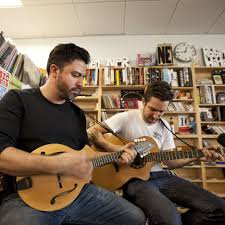
karlove1SOUNDTRACKWHITEHORSE-“Pins and Needles” and Kickstarter campaign (2014).

photo-mainI really enjoyed seeing Whitehorse live.  I would absolutely see them live again.  I was delighted then that their album was also fantastic (I didn’t think it could match their live show…and it doesn’t but it is great in a different way).  In a very short time I became a big fan of the band.

THey havea  new song, “Pins and Needles” and a Kickstarter campaign.  The song begins with Melissa McClelland’s voice singing in it beautiful way–there’s guitar in the right ear and bass in the left ear.  Then Luke Doucet comes in for verse two.  And when their voices fill the bridge it feels so complete.  Until they get to the chorus when they push it even further and it sounds amazing.

  They sing so well together.  Her voice has a slight country twang, and his is a low baritone.  Their harmonies are superb as they sing the compelling chorus: “Fake Your Death and I’ll Fake Mine”

Lyrics are certainly interesting for the band.  How many times do you hear a woman singing a line like: “I’m the villain in this piece  And back when I was a thief, I broke hearts like they were teeth.”

I love this song.  And it may or may not end up on the new album for which there is a Kickstarter campaign.

And I’m in.  I’m a little unclear about exactly what they aim to do with the money they raise.  They say quite plainly that there will be an album regardless of whether they raise the funds.  And their label, Six Shooter, is totally behind the band.

Rather seems to be a way to raise some money and some attention for the band.  And, apparently it will give fans a glimpse of the album as it is being made–a sort of behind the scenes featurette that comes before the disc itself.  The prizes are varied and moderate–from a download, to the CD, to a T shirt, to sheet music (all for reasonable donations), all the way to the grand prize–for $8,000 they will play a private show for you.

I’m in for a CD, and I’m happy to pay regular ticket price when they come around again.

Check out the Kickstarter campaign for more details where you can also hear “Pins and Needles.”

[READ: April 24, 2014] My Struggle Book Two
maninloveI read an excerpt of Book Two in Harper’s well over a year ago So when I got to that section again (it’s the end of the book) I was trying to remember why it sounded so familiar–an accident during a soccer match that leaves Karl Ove with a broken collarbone and an unhappy girlfriend (who will be looking after three kids without him), and then I remembered the excerpt that started it all.

The translation of Book Two by Don Bartlett is fantastic, just as in the first book–I can only assume the original Norwegian is just as compelling.  Book one was 430 pages and now book two was 573, so I’m in to Karl Ove’s life for 1003 pages, and there’s four more books due (Book Three comes out next month).

As I mentioned for Book One, this series has caused some controversy because it is given the same title as Hitler’s Mein Kampf (Min Kamp in Norwegian), and also because he says some pretty mean stuff about people who are still alive.  Book One was about the death of his father.  It was pretty dark.  Book Two is about his first daughter and about falling in love with Linda, his children’s mom (although not yet his wife).  And it is also pretty dark.

I was trying to figure out why I like this series so much.  Not a lot happens, Karl Ove is not a very nice person and he seems to be pissed off most of the time.  And I think what I realized is that I share a lot of opinions as him, but he takes everything to the extreme.  And he is kind of an asshole.  I mean, anyone who writes a six part autobiography called “My Struggle” (okay, really it’s called My Head) is kind of an asshole.  But so when I see things that I would only think in my deepest recesses of my mind printed on a page, it’s strangely visceral to me.  I realize this means that I’m kind of an asshole too, but the key difference is that I don’t act on the things that I think, nor do I write 4,000 pages about them.

I told Sarah that she might laugh at some of the opinions that he lists but that she would not enjoy reading the books.  Indeed, this book, this series, is not for many, I’m sure.  But to me there is something strangely engaging about him and his strange life and his writing style.  And I really flew through this book, finishing it in about a week.

So this book begins (started in July 2008) with Karl Ove being pissed off.  He talks about finishing the first part of the novel (which I have to assume is Book One, given when this was written and how this book ends) just last month (in other words he is really churning this stuff out!).  He and Linda have been fighting (as the book opens they have three children, Vanja, Heidi and John–it’s also hard to believe that his children are young enough to not really know much about this series). The tension is high between them–glares, comments, nasty sniping.  Karl Ove says that he is afraid to say things around her because he knows how she’ll react.  But at the same time, some of things he desires are simply not defensible in a relationship or when you are parent.  And the main conflict seems to be that Karl Ove is selfish and Linda is (at least according to him) mildly suicidal and possibly bipolar).  And mind you, at the time of his writing this, I think they are still together….  (I could look that up, but it seems kind of fun not exactly knowing). (more…)

Read Full Post »

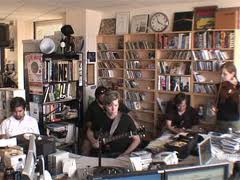
eleanorSOUNDTRACK: BILL CALLAHAN-Tiny Desk Concert #21 (July 13, 2009).

billcBill Callahan (formerly known as Smog) plays beautiful slow ballads.  He has a deep, calming, gorgeous voice.  And his songs have a very traditional acoustic feel (even when he plays electric guitar).  He is excellent at what he does.

But I’m afraid I just don’t really like his style all that much.  I can absolutely appreciate why he is so well-regarded, because even as I’m listening to this Tiny Desk set I keep thinking how good everything he is doing is.  Man, his voice is so interesting, and his music is so pretty (the strings add a very nice touch).

But I just can’t imagine myself ever choosing to listen to his album.

In fairness, a song on a mix tape would probably be awesome, and I did enjoy the three songs here: “Jim Cain,” “Rococo Zephyr” (great title, and my favorite of the three) and “Too Many Birds.”  And I can imagine if I was ever on a mellow music kick that this would be where I’d start.  So if you enjoy pretty, mellow music done incredibly well, Bill Callahan is definitely your guy.  I feel like he is not as well-known as he ought to be, so check him out.

[READ: January 23, 2014] Eleanor Rigby

Completing three Douglas Coupland novels in two weeks may seem daunting, and it is especially so when the books are as dark as these have been.  (With Coupland’s follow up book, JPod, he would go in a different direction and kind of break the darkness somewhat.  And the new book which just came out seems like it is more humorous than dark).  This book is perhaps the most insular of his career and perhaps the most insular book I’ve read.  The title is puzzling (and is ultimately revealed), although Coupland says that he was inspired by wondering what happened to Eleanor Rigby after the (Beatles, duh) song was over.

So in this story, the main character is named Liz Dunn.  Liz is a blank.  She claims that she is so dull that if she were an extra in movies, she would be asked to leave the scene because she is too devoid of character to even be an extra.  (Actually, Liz lays the self-pity on a little too thickly throughout the book–we got the point).  Liz has a brother, who is an accomplished world traveller, and a sister who lives nearby and pops in to check on her once in a while.  Both are married and have their lives together, unlike Liz who lives by herself in a room with no personality at all.

Liz’ sister is beautiful and got up to all kinds of trouble in school and William has always been successful, but Liz was…nothing.  She didn’t like to do much.  And she pretty much holds herself up as the antithesis of her sister.  She watches movies all the time in her living room. And then she goes to sleep.  She works at a well paying but dull job and she has saved a ton of money because she never spends it on anything.

As the story starts, she is getting wisdom teeth out. She takes a week off from work, but he boss (the Dwarf Whom I Report To) calls to say that someone will bring some work over to keep her busy.  She has bought a bunch of tear jerker movies in hopes of riding out the painkillers with them.  And then she gets a phone call.  A man named Jeremy has her name on his medic alert bracelet and he is in the hospital.

Liz doesn’t know who he is, but then takes a guess and goes to see him in the hospital.  And it turns out to be…her son. (more…)

Read Full Post »

CV1_TNY_09_30_13Blitt.inddSOUNDTRACK:WOVEN HAND-Tiny Desk Concert #11 (January 9, 2009).

wovenWoven Hand is yet another band that I hadn’t heard of until this Tiny Desk concert (and I thought I knew a lot of bands).  They are a band, but for this Tiny Desk Concert David Eugene Edwards plays solo.  He has a cool baritone voice that has a nice ponderous quality.  This suits his chosen instrument–a mandolin-banjo hybrid made in 1887 by the Pullman Train Company (!)–perfectly.  Turns out that Edwards was the voice behind 16 Horsepower, so that explains some of the sound he’s going for.

The opener “Whistling Girl” and the closer “Kingdom of Ice” (which is practically a mini-epic) are beautiful slices of Americana made slightly more esoteric by the instrumentation and his voice.  I like them a lot.  The middle song he plays is a Bob Dylan song “As I Went Out One Morning.”  I know that I’m not a big Dylan fan, but I just can’t get over how many songs he has written that people cover.  I’d never heard this one, which with this instrumentation takes on a kind of fairy tale quality (which I assume the original doesn’t).

This makes me want to bust out my 16 Horsepower CD and to check out more from Woven Hand.  I enjoyed his solo performance so much I can’t imagine what a full band version would sound like.

[READ: January 7, 2014] “The Breeze”

I have really enjoyed Joshua Ferris’ work, so I was excited to read this.  But I was ultimately disappointed by this story.

The construction is interesting, so of.  It looks at multiple possible outcomes of a situation.  But I felt like even that was done a little too vaguely to be really effective.

It also features one of my most hated scenarios in real life and one which I guess I have no patience for in fiction.  It concerns a person who is bored, existentially bored.  So when she wants to do something, she proceeds to ask her partner what he wants to do.  Thus, Sarah asks her husband to come home from work early.  She is sitting on the balcony of their apartment enjoying a perfect spring breeze.  When he gets home, she is excited to have a wonderful excursion with him.  So she asks him “What do you want to do?”  And naturally he hasn’t thought of this at all, so he has no opinion.  But this makes her mad.  She asks if he doesn’t want to do anything.  He says he does. And then she asks him what.  I don’t know if this is a gender-specific scenario, but I have been in it many times in many different relationships and I know my parents went through it as well—my mother always complained about my father’s lack of wanting to do things and he would always say all she had to do was say what she wanted to do and he would do it.  So, I guess Ferris has tapped into something, but I hated reading about it. (more…)

Read Full Post »

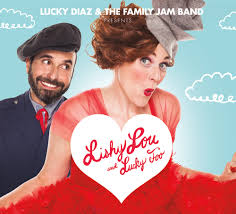
hardluckSOUNDTRACK: LUCKY DIAZ AND THE FAMILY JAM BAND-“Thingamajig” (2013).

luckyThis song made the XPN Kid’s Corner Top ten.   When the played it on the radio, I was surprised at how ..quiet it was.  Even now listening to it, it just seems like all of the sounds are at the same level, it all kind of blends together, which is a shame because the song is really kind of fun.

Now that I’ve listened a few times I like it more.  It actually has a kind of Death Cab for Cutie feel.  The bass is particularly nice, but of course the fun part is the lyrics (a thingamajig, a whatchamacallit, who what where why).

So a couple of listens and I’m won over by the song.  I wish it was a bit more dynamic in the production, but it’s a catchy little number.  And I’m curious to hear what the rest of the album sounds like.

[READ: December 27, 2013] Diary of a Wimpy Kid: Hard Luck

Clark was so excited for this book!  This is the first one that he knew about before I did.  We decided to save it for a Christmas present, and man was he chomping at the bit.  He even borrowed it from a friend (because there were 100 people on the waiting list a the library).  And yet, even though he had already read it, when it arrived on Christmas, he was still really excited.  And has already read it four times.

And what was sweeter was that he really wanted me to read it.  He thought it was the best one yet.

I was surprised by this as the whole first section is about how lost Greg feels now that Rowley has a girlfriend, Abigail.  I can’t really imagine how he related to that as it’s not an issue for an 8-year-old (in fact the whole series is skewed a little old for an 8-year-old, but he still loves it).  Mostly Greg isn’t so much jealous that Rowley has a girlfriend so much as he is jealous that she is keeping Rowley from being Greg’s slave, I mean, friend.  Normally, Rowley walks in front of Greg to look out for the (newly added, I think) Mingo kids who threaten anyone who comes close to their wood (which is on their way to school) or for dog land mines–the scene where the dog figures out how the electric fence works is so funny.  And speaking of dogs, Clark absolutely cracked up about the joke with the little dog Sweetie who sniffs herself if you make a raspberry sound near her. (more…)

Read Full Post »

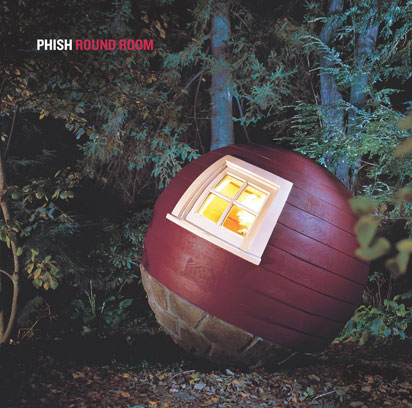
wallsSOUNDTRACK: PHISH-Round Room (2002).

round After Farmhouse, Phish went on a hiatus.  No one knew it would be quite so brief, but there was really a feeling that they were done.

And then they quietly released Round Room in 2002.  And it bursts forth with an 11 minute song.

“Pebbles and Marbles” has an interesting riff—complex and pretty.  And when I listened to it again recently I didn’t really quite recognize it.  But that’s because it’s nearly 12 minutes long and the really catchy part comes later in the song.  At around 5 minutes, the catchy chorus of “pebbles and marbles and things on my mind” announces itself.  And it is a good one.

“Anything but Me” is a pretty, mature song that is slow and piano heavy.  “Round Room” is a boppy little ditty (clearly a song written by Mike).  It is sweet and a little weird.  “Mexican Cousin” sounds a lot like a cover (maybe an old song by The Band) except for the solo which is very Trey.  It’s a funny, silly ode to Tequila.  “Friday” is a slow six minute song with two sections.  The verses are spaced out a bit, delicate riffs that are mostly piano once again.  The middle section is sung by Mike (which makes it more mellow somehow).

“Seven Below” is an 8 minute song.  It has another great riff (and the intro music is cool and bouncey).  When the vocals come in, it’s got gentle harmonies as they croon the sweet song).  Most of the 8 minutes are taking up with a guitar solo.  “Mock Song” is another of Mike’s songs.  This one seems to be a random selection of items sung to a nice melody.  Then when the chorus comes it’s quite nice, how this is a “just a mock song.”  The first verse is sung by Mike, then Trey does a kind of fugue vocal with different words in verse two.

“46 Days” opens with funky cowbells and turns into what seems like a classic rocking folk song—few words but a great classic rock melody (complete with 70s era keyboards).  “All of These Dreams” is a mellow piano piece, another mature song.  “Walls of the Cave” has an interesting piano melody that opens the song. The song is nearly ten minutes long and the middle part has a nice flowing feel to it.  There’s also a few sections that are separated be drum breaks—something that doesn’t often happen in Phish songs.  When the third part opens (to almost exclusively percussion, their vocals all work in a very nice harmony.  It’s a long song but with so many parts it always stays interesting.  “Thunderhead” is another piano-based song with some guitar riffs thrown on top. But it is largely a slow, mellow piece.

“Waves” is an 11 minute song with long instrumental passages.  It also begins with a kind of Santana feel to it, but it is a largely meandering song, with a simple melody that they stretch out for much of the song.  So this album proves to be an interesting mix of long jams and mellow ballady type songs.  It seems like Phish had a big mix of things to let loose.

[READ: November 1, 2013] If Walls Could Talk

This book reminds me of the work of Mary Roach—exploring a topic in great detail and including lots of amusing insights.  The two big differences here are that Worsley is British and that she goes back very far in British history to give us this fascinating information about the development of certain rooms of the house.

Worsley begins with the bedroom.  She looks at the furniture—the history of the bed from lumps with straw to fantastically ornate full poster beds that were made for kings who might never actually use them.

Then she moves on to more personal matters—sex (including deviant sex and venereal disease); breast feeding (for centuries mothers felt they were not equipped to take care of and nurse their own children, hence wet-nurses) and knickers (royalty had an entourage designed specifically to assist with underthings).  Indeed, privacy was an unknown thing in olden times.  Even royalty was expected to receive people in all of the rooms in the house.  Initially the bed chamber was for their most intimate friends, not just for sleeping.

The section on old medicine was also fascinating, they believed that it was vaporous miasma that did you more harm than say, excrement-filled water.

The section on Sleep discusses what was also in a recent article by Gideon Lewis-Kraus—that there were two sleep times at night.  With no electricity there was no artificial light to keep people up late so they would go to sleep early, wake up in the middle of the night (the best time for conception of children) and then sleep again. (more…)

Read Full Post »

ornerSOUNDTRACK: PHISH-Hoist (1994).

hoistI always think of Hoist as a kind of goofy album because of the way they are dressed on it (and the crazy cover).  But it is absolutely not.  Indeed, opener “Julius” sounds like a ZZ Top song.  In fact, every time they’ve played it live I assumed it was a cover.  It is less restrained in the live setting, because this version has more acoustic guitar.  There’s even backing vocalists and horns.  “Down with Disease” has that great watery bass, but the song (which sounds good) here is a little stiffer than the live version.  It also has something of an R&B feel (with backing vocals) even if the guitar is certainly not R&B at all.  It bleeds right into “If I Could” a pretty harmony-voiced mellow song.  The big surprise comes from the Alison Krauss vocals–she gets a solitary line or two and then harmonies.  The song is very pretty but the strings are overkill.

“Riker’s Mailbox” is indeed a reference to the Star Trek character, although the 30 second burst of noise is pretty hard to explain. Nevertheless, the trombone is played Mr Riker himself, Jonathan Frakes.  It jumps into the rocking “Axilla, Pt. 2” which is usually a little faster live (I like the sloppier crazier live version better). There’s some vulgar dialogue in the middle of the song.

“Lifeboy” is a mellow acoustic song that builds from just guitar.  Lyrically it’s interesting: “God never listens to what I say…and you don’t get a refund if you overpray.”  It folds into “Sample in a Jar,” which is just as good here as any live set.  “Wolfman’s Brother” ahs horns thrown on top and some interesting sound effects.  Although overall l don’t like this version nearly as much—I don’t care for the horns or the backing vocals plus in the live version they emphasize the bruh of brother more which is cooler.  (Although I do enjoy the weird “Shirley Temple” line at the end).  “Scent of  Mule” opens so strangely with crazy guitars and a thundering drum.  The singing is very silly (with silly voices) and has a very twangy style (complete with banjo and yeehah).

“Dog Faced Boy” is a sweet (but weird) acoustic guitar number.  “Demand” is a ten minute song which I don’t really know at all.  It has a strange, staccato style riff.  At 2 minutes in, a car starts and after a commercial on the radio the driver pops in “Split Open and Melt” (a nod to “Detroit Rock City,” perhaps?).  This goes on until 9:30 at which time there’s a car crash and choir of angels (sick!).

I don’t car for the horns and R&B flavoring of this album, but the song selection is really quite good.

[READ: September 24, 2013] Last Car Over the Sagamore Bridge

I read about this book in Tom Bissell’s reviews recently.  He really made it sound like an interesting book.  So when I saw that we had just received a copy, I grabbed it and brought it home for the weekend.

There are 52 short stories in the short book (which is less than 200 pages).  Some of the stories are very short (1 page) with a few coming in at 5 or 6.  The 1 page stories are like flash fiction but they seem to be more of snapshots than actual full stories and they seem like they might be diary entries or something. The fact that a number of them are italicized with dates at the end make them seem like a selection from the same person rather than individual stories.

The stories are set all over the world, although they tend to focus on Chicago and Boston.  They are pretty universally dark with themes of death and loss permeating the collection.  And yet despite their overall negative feeling, the stories aren’t really depressing, exactly.  Bissell described the narrators as like someone telling a story about someone telling a story.  And that is true and that distance seems to take some of the edge off the stories.

But what’s impressive is the consistently strong and powerful writing.  The way that Orner is able to convey so much with such few words.  Some stories are just a scene, others are a whole lifetime.  But either way they are all really gripping.

I wasn’t going to write about each story, but it would have nagged at me if I didn’t, so here’s a few words about 52 stories. (more…)

Read Full Post »

vanSOUNDTRACK: FRANK TURNER-Tiny Desk Concert #287 (July 13, 2013).

turnertinydeskNPR introduced me to Frank Turner and I’m pretty delighted that they did.  I really enjoyed his set at the Newport Folk Festival.  And here’s another live recording (a Tiny Desk Concert).

In this brief set, Frank and mandolin player Matt Nasir (he’s only been playing it for 6 months) blast through 3 of his rockingest folk songs.  “Recovery,” “The Way I Tend to Be,” (with a very funny lead story) and a rousing mandolin solo-filled and a (reluctant) NPR audience singalong. of the great “Photosynthesis.”  I imagine it was quite loud in their offices that day.

Turner is fantastic live—he’s personable and funny and even more so in this intimate setting.  It’s a wonderful set.

Check it out.

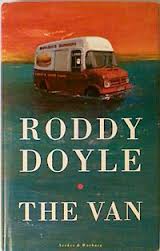
[READ: August 23, 2013] The Van

This is the final book in the “Barrytown Trilogy” (except for the new one coming out next year).  Whereas The Snapper was tied to The Commitments by virtue of it being the same family, The Van is tied to The Snapper because it follows the same guy—Jimmy Rabbitte Sr.

It’s 1990 (a few years after The Snapper because the baby from that book is now talking and mobile) and like many older people in Ireland, Jimmy Sr. has been laid off.  The first third of the book looks at life on the dole in Ireland—skimpy Christmas presents and getting handouts from your son.  And yet there’s always money for a pint or two—so Jimmy still gets to hang out with his mates at the pub a few nights a week.  He also goes out with the baby from time to time and occupies himself in various ways (pitch n putt).  There’s a lot of humor and silliness in this section–especially within the family when the twin girls start getting older and even cheekier.  And the focal point is the World Cup—because Ireland is actually going to be in it this year—Italia ’90!

And the Jimmy’s mate Bimbo gets laid off.  And that’s where the titular van comes in (over 100 pages into the story).  Bimbo is crushed to be laid off, but Jimmy is a little pleased.  He’s not happy that Bimbo is laid off, but he is happy that he has someone to waste the day with.  They go golfing together (and win a prize or two) and they do their best trying to stay happy.  But they’ve noticed that the fish and chips van that used to be parked outside of the bar is no longer there.  It’s a sad state of affairs when you’re drunk and hungry at midnight and can’t get a fish n chips.

And that’s when their friend Bertie (who can get anything for anyone) comes through on Bimbo’s half serious question–could Bertie get him a chipper van?  Bertie finds one—an unholy filthy mess of a thing with no engine.  And Bimbo uses his redundancy money, £800, to buy the mess.  Jimmy is appalled until Bimbo starts talking about the two of them being partners—working together to makes some money and sell chips to their drunken mates and—even better—to the punters who are enjoying the World Cup!  And suddenly it seems like a real idea. (more…)

Read Full Post »

misswyomingSOUNDTRACK: THE TALLEST MAN ON EARTH-Live at KEXP (September 8, 2012).

tmoeThe Tallest Man on Earth is Kristian Matsson a Swedish singer songwriter.  His albums have a very full sound, but when he plays live, it’s just him and his guitar.  And man, is he a compelling performer.  His guitar playing (primarily classical-sounding but often heavy and mostly rocking) is gorgeous–fast and pretty.  And his voice is gravelly and powerful.  I’ve enjoyed the studio songs I’ve heard, but he is transcendent live.

This set opens with a buzzy guitar that sounds like the show is not recorded well.  But that quickly goes away and the songs shine.  Matsson is a charming and self depreciating performer and when he has a malfunction as in “Love is All”and at the end he says “that was kind of embarrassing.”  But he not bothered by it and plays on with a great, short set.

The set includes some (then) new songs and a few older ones as well: “A Field of Birds,” “King of Spain”, “Tangle in This Trampled Wheat,” “Thrown Right at Me,” “The Gardener” and “Like a Wheel.”  It’s a great introduction to the guy and his amazing voice. which you can enjoy at KEXP.

 [READ: August 20, 2013] Miss Wyoming

I first read the book during my trip to Vancouver on the eve of Y2K (the best flight I’ve ever had—mostly empty and we were given champagne).  I started reading it on the plane and then in the second chapter the heroine is in a plane crash.  So I stopped reading.  I’m sure I finished it later, although I didn’t remember much of anything about it.

I read it again now and I was a little disappointed when I started reading it.  The first few chapters are so full of similes it is insane.  The word “like” is tossed around at an incredulous pace.  Like:

  • John’s teeth were big and white, like pearls of baby corn
  • …his skin like brown leather.
  • His eyes looked like those of somebody who’s lost big.
  • They crossed San Vicente Blvd, passing buildings and roads that once held stories for each of them, but which now seemed transient and disconnected from their lives, like window displays.
  • Susan was wrapped in a pale light fabric, cool and comfortable, like a pageant winner’s sash.
  • John was sweating like a lemonade pitcher,
  • …his jeans, gingham shirt and black hair soaking up heat like desert stones.
  • John felt as close to Susan as paint is to a wall.
  • Staring at the pavement, like Prince William behind his mother’s coffin.
  • This man with sad pale yes, like snowy TV sets

That’s all in the first chapter!

Now, I have come to see that the story is cyclical and it’s about people looking for their real selves.  So it’s possible that the simile heavy beginning is meant to reflect the fact that the protagonists are looking for themselves—they have no substance so they can only be compared to other things.  But man, it is hard going with that many comparisons.

The other major problem I had with the story was the really aggressive use of coincidence.  Susan and John both end up eating out of fast food dumpsters; just as Susan’s mother wants to sell their house, a pile of garbage from an airplane falls on it.  Right after we learn of a guy hoarding gasoline, the house explodes.  Again there are arguments for why these things might happen in this story (numerology is an important aspect of the book), but it seems too…easy.

But once the story starts moving the actual plot is really interesting and compelling. (more…)

Read Full Post »

snapperSOUNDTRACK: KISHI BASHI-“Philosophize In It! Chemicalize With It!” (2013).

kishiI’m still really enjoying Kishi Bashi’s debut album 151a, so it’s a treat to get a new track from him.  This one is a 7″ (and apparent digital download).

It doesn’t depart radically from Kishi Bashi’s formula (high vocals, violins and bouncy, exuberant melodies).  Although this song just has…more.  More instruments, more layers, more everything.

The biggest surprise comes around two minutes in when some of the layers drop out and we get this really cool bass (which reminds me of Paul Simon) that propels the song along.  But that’s a fleeting moment amidst the swirling and swelling violins.

Kishi Bashi is one of those artists who seems to release a lot of singles and digital releases and unless they get compiled somewhere, NPR podcasts are the only place I’ll ever hear them.  Nonetheless, I’m delighted to get to jam to this one.

[READ: August 19, 2013] The Snapper

When I first got into Roddy Doyle (around 1993), I read all three of the books that are considered the “Barrytown Trilogy” (which I have just learned, thanks Louise, that there’s going to be a fourth) very quickly.  Doyle’s writing in these books is very fast and very funny–tons of dialogue that flow easily and wittily.

The Snapper was also made into a film (not as popular as The Commitments, but much funnier–check it out just to see Colm Meaney down a pint).  And Doyle’s writing is just as sharp and screenplay-friendly as The Commitments was–which makes it a real joy to read.

Although this is considered part of a “trilogy” there’s very little connection to The Commitments.  The family is the same but Jimmy Rabbitte, the protagonist of The Commitments, is a minor character in The Snapper (I’m actually not sure if it is set before or after The Commitments).  [Oh and in the movie, the family name had to be changed from Rabbitte to Curley because the company that made The Commitments owns the rights to Rabbitte (Jaysus!)].  This book is about Jimmy’s sister Sharon and, for the most part, their da, Jimmy Sr.  [There’s a slew more members of that family–Veronica their mammy, Darren, the twins Tracy and Linda, Les, and of course, Larrygogan, the new pup.

So, what the hell is The Snapper about?  Well, “Snapper” is a slang for baby (apparently).  And it seems that young Sharon (19) has gotten herself “up the pole” (pregnant).  The surprising thing about the story is the family’s reaction.  It is largely positive.  She won’t say who the father is, and after the family accepts that, things seem largely fine.

Sharon is afraid to tell her friends, but even they, including her best friend Jackie, take it well (especially after a few drinks).  So where is the conflict? (more…)

Read Full Post »

commitSOUNDTRACK: KANYE WEST-Late Registration (2005).

I lateregcan’t get over how much I’ve been enjoying Kanye West’s music as of late.  So much so that I went back and bought Late Registration.  I wanted to check out his early stuff, so naturally I started with…his second album.  And it’s a really enjoyable, soulful, gospel-filled rap album. Complete with Kayne’s bizarre, humorous and often offensive lyrics.

Musically the samples are wonderful—they create a very specific feel of pop soul that both works with and sometime against the lyrics.  The album suffers from two things that I’ve found I do not like in rap, and in articular in Kayne’s albums.  It bugs me when rappers intro their songs with several “uh, yeah”s.  I don’t know why but it does and that’s how Kanye opens the disc.

And, I wish there weren’t so many guests on the record.  While I understand the guest singers who provide backing vocals, I don’t get all the guest rappers (and there are a lot: Paul Wall, GLC, Lupe Fiasco, Common, Game, Jay Z, Really Doe, Nas, Cam’ron Consequence).  I mean, I’m not here for them, so why devote so much time to others, it makes you seem like you couldn’t thin of enough to say (and we know that’s not true about Kanye).  After a few listens, I have grown to appreciate the guests, but I like Kayne’s style so much that the other guys are just distractions.

Late Registration is largely produced by Jon Brion, who has made some amazing music with Fiona Apple and Aimee Mann—and while it is certainly stripped down Brion, the flourishes that Brion often employs are apparent here.  Like the tinkly pianos and farty bass that opens “Heard ‘Em Say.”  There’s some falsetto R&B-esque vocals from the singer from Maroon 5 here—I had no idea he sang like that.  It fits very well with the song.  And the instrumental section at the end is very Brion.

“Touch the Sky” uses a long sample (slowed down quite a bit) of Curtis Mayfield’s “Move on Up.”  But the sample is so much of that original song that it almost seems like cheating.  Except that he has slowed it down and modified it somewhat, and…his raps work perfectly with it.  The other really crazy sample is from Gil Scot-Heron which samples “Home is Where the Hatred Is.”  The strange thing is that the song is 1:44 and the last 45 seconds of the song are just Scot-Heron’s song playing along by itself.  It’s weird to have given up that much to another song…but it sounds great.

“Gold Digger” is a very funny song about, well, gold diggers.  The topic isn’t new (the fact that it samples an ancient Ray Charles song attests to it), but the chorus of “I ain’t saying she’s a gold digger, but she ain’t messin’ with no broke niggers” is great.  There’s also an intro section with Jamie Foxx doing his now patented Ray Charles.  It’s a pointed song but done with a very funny twinkle in his voice (the Kayne twinkle).  “Drive Slow” is a cool slow-tempoed number with a great sample from Hank Crawford and an interesting slowing effect at the end of the song.  “Crack Music” is a great political song equating making records to selling crack.  The metaphor works well.  And this is one of Kayne’s strong pro-black songs.  It’s really powerful.

The surprising thing is the two really sensitive songs: “Hey Mama” which is a sweet song to his mother in which he promises to go back to school and get his doctorate and “Roses,” which is an angry but beautiful song about his grandmother being in the hospital.  There’s a great verse about her being poor and therefore not getting the best care: “you telling me if my grandmother was in the NBA right now she’d be okay”   As well as a line about a nurse asking for his autograph while they are worried about his grandmother—although, realistically, how often is a nurse going to meet a star like Kayne?  The end of the song has some great soulful crooning by (as far as I can read) an uncredited singer.  And I feel like Brandy, who opens up the next song really falls flat in comparison to this unnamed singer (I don’t care for the way newer black singers wail their scales).  But the Etta James sample of “My Funny Valentine” that floats through “Addiction” is gorgeous.

“Diamonds from Sierra Leone: is a surprisingly political song that samples “Diamonds are Forever.”  There’s two version on the album.  I like the remix featuring Jay-Z a lot less, in part because I’ve never been a huge Jay-Z fan, but also because his verses completely interrupt the flow of the song.  “We Major” has  a very retro, almost easy listening vibe. There’s a lot of backing vocals going on and they remind me somewhat of Ben Folds Five’s backing vocals (which is pretty weird, I suspect). This song is interesting for its talk of worrying about daughters—as with many rappers, women are bitches and hos unless they are your grandma, your mama or you daughter—which is kind of awkward, really.

“Celebration” is perhaps the weirdest juxtaposition of contents.  It’s a celebration, bitches.  A celebration apparently about the fact that he and a woman (who had a fatty) accidentally had a baby (“You my favorite accident”).   That line makes it sound like the child is at the party, which makes the chorus “Grab a drink, grab a glass, after that I grab your ass” hard to fathom.

 “Gone” has a nifty piano melody (and some cool interstitials very Brion-infused melodies) that plays under Cam’ron and Consequence’s raps.  The song is kind of a muddle (although a funny muddle) until Kanye comes in at around 4 and a half minutes.  I really like the way the album ends: with Kayne rapping “Sorry Mr West is gone” and the music completely cutting off.

The bonus tracks include the original of “Diamonds from Sierra Leone” and “We Can Make It Better” (which features Q-Tip, Talib Kweli, Common and Rhymefest). It’s an interesting track (especially the sped up backing vocals) but it seems like a bit of a throwaway (which is surprising given the number of guests).  “Late” is a unlisted bonus track which is very strange.  There’s lots of “ah ha ha has” in a posh sounding falsetto).  But there’s some witty lines in here, especially this verse:

They said the best classes go to the fastest
Sorry Mr. West there’s no good classes, and that’s what yo’ ass get
Not even electives? Not even prerequits?
You mean I missed my major by a couple of seconds?
Now I’m in the shop class or the basket weavin
With all the rest of the muh’fuckers underachievin

So Kayne is clever and stupid.  A great rapper and a not so great singer.  And amazing producer and a good song writer.  And this is as good an album as I’ve heard it was.

[READ: August 8, 2013] The Commitments

I have been reading a number of big, heavy books lately (which I have yet to post about…later in the week), so I decided to take a break with a light, fun book. And one that I’ve read before (and seen the movie of many times).  I looked on the inside cover where I wrote the date of acquisition (a thing I did for a while until I realized it was kind of silly, and yet I’m glad i did it here) October 1993, almost twenty years ago.

But aside from Jimmy playing songs on vinyl, there’s very little that’s dated about the album–which may even be the point of the book.

This is the story of a bunch of misfits in Ireland who join together to form a soul band.  The nucleus of the band is Jimmy Rabbitte, a local kid who lives and breathes music.  He had Frankie Goes to Hollywood before anyone else and he knew they were shit before anyone else.

Some of his mates have started a band (called hilariously And And! And) which plays new wave.  Jimmy tells them they should play soul instead.  He plays them some James Brown and they love it.  Which leads to the talk of music and sex.  And they are really into it.  And then there’s  the oft quoted line from the movie: “The Irish are the blacks of Europe. And Dubliners are the blacks of Ireland. And the Northside Dubliners are the blacks of Dublin. So say it once and say it loud, I’m black and I’m proud.”

And so they begin a quest to find the rest of the band.  Jimmy puts an ad in Hot Press (the Irish music magazine) and interviews everyone (some very funny jokes in there).  And the recruits form a crazy quilt of characters.  (more…)

Read Full Post »

« Newer Posts - Older Posts »