Feeds:
Posts
Comments

Archive for the ‘Kurt Vonnegut’ Category

SOUNDTRACK: …AND YOU WILL KNOW US BY THE TRAIL OF DEAD-Live on KEXP, March 12, 2009 (2009).

Back in 2009, …And You Will Know Us by the Trail of Dead had been hit by a truck.  Really.  Evidently no one was hurt too bad, but they did have to cancel a show in Salt Lake City. 

Nevertheless, they managed to get to KEXP to play a four song set from their latest album The Century of Self.  The opener “The Giant’s Causeway” is full of bombast and noise  and has a surprisingly catchy melody in the middle.  It merges into “The Far Pavillion” (just like on the album) which sounds like pretty typical Trail of Dead–rocking and yet melodic, with some good screaming parts.

“Luna Park” is something of a surprise to me as it’s a piano-based ballad (which I suppose Trail of Dead plays, but which I don’t associate with them).   “Bells of Creation” also opens with a piano, but it quickly grows very loud.  It’s a cool song with lots of depth.

I had actually stopped listening to Trail of Dead after Worlds Apart (and album I liked, but I guess the band fell off my radar) so it’s nice to hear they’ve still got it.  At least as of three years ago.

[READ: September 17, 2012] Galápagos

Each of these 1980’s era Vonnegut books gets darker than the last.  In this one the entire human race is wiped out (except for a few people who spawn what eventually becomes of the human race in a million years).  For indeed, this book is set one million years in the future and it is written by a person who was there, one million years in the past when the human race destroyed itself.  It’s not till very late in the book that we learn who the narrator is and, hilariously, what his relationship is to the Vonnegut canon.

In typically Vonnegut fashion, the story is told in that spiral style in which he tells you a bit of something and then circles back to it again later and comes back again later until finally 200 or so pages into the book you get all the details of what is happening.  Interspersed with the respawning f the human race (and flippers) is the story of the Adam and Eve and Eve and Eve and Eve and Eve who created the human race–how they got to be together, what their lives were like before and what contribution they made to humanity, such as it is now.

In another bizarre and fascinating twist, every character who is going to die in the near future gets a star next to his name so that the reader knows that that person is going to die.  We get a lot of things like ★Andrew MacIntosh for many pages until the character finally dies.  And pretty much everybody does die.  Well, obviously if it is set a million years in the future, but aside from that part, only a few of the characters survive.

So here’s how these few people managed to create a new human race in the Galápagos Islands.   (more…)

Read Full Post »

SOUNDTRACK: OF MONSTERS AND MEN-Live from Iceland Airwaves (2011).

This brief set was recorded at KEX hostel in Reykjavik, Iceland (how on earth KEXP in Seattle was there I don’t know).  This set was performed before the release of their debut EP, although “Dirty Paws” which they play was not on that EP.  “Little Talks” their (reasonably) huge hit them was on the EP and is on their full length album–it’s a great duet (and reminds me a bit of Stars).

There’s an amusing fail in the horn solo on “Lake House,” which is kind of surprising, but not terribly tragic or anything.  The band sounds great, especially in front of a home country crowd (I love hearing them say “Takk” at the end of the songs).  There’s five songs in all, and by  the final one, they feel  sound like they’re really enjoying themselves.

[READ: September 1, 2012] Wampeters, Foma & Granfaloons

This collection contains essays reviews and speeches.  So it’s non-fiction.  Except that, ever the contrarian, Vonnegut includes one fiction piece–a short play.  The title of this book comes from three words from his novel Cat’s Cradle: “a wampeter is an object around which the lives of many otherwise unrelated people may revolve.  The Holy Grail would be a case in point.  Foma are harmless untruths, intended to comfort simple souls.  An example: ‘Prosperity is just around the corner.’ A granfallooon is a proud and meaningless association of human beings.”

That all comes from the preface.  The preface also says that there are people who have collected everything he has ever written (even stuff he has forgotten about) but he will not let most of that see the light of day.  Here he has whittled down the least embarrassing stuff for publication.  He also explains that at some point (supported by reading this) he decided to stop giving speeches; to stop “talking” and to concentrate on writing.  So he did.

The final straw for this was a comment from the President of the American Academy of Arts and Letters.  Vonnegut had prepared a speech.  The president reread it and hated it, but the president told Vonnegut that nobody would actually listen to the words: “People are seldom interested in the actual content of a speech.  They simply want to learn from your tone and gestures and expressions whether or not you are an honest man.”

While Vonnegut’s essays are powerful and effective, it’s the Preface that really tells it straightg.”Not nearly as many Biafrans were butchered by the Nigerians at the end of the war as I had thought would be.  At a minimum those damaged children at the exact middle of the universe will be more honorable than Richard M Nixon.  [Nixon] is the first president to hate the American people and all they stand for.”

Get ready for a happy collection. (more…)

Read Full Post »

SOUNDTRACK: PINK FLOYD-Alan’s Psychedelic Christmas (1970).

I’ve always loved Pink Floyd’s Atom Heart Mother.  I have no recollection of how I stumbled upon this live bootleg, but when I saw that it contained one of the few live recordings of “Alan’s Psychedelic Breakfast” I had to give it a listen.

So this show is from 1970 and was recorded in Sheffield just before Christmas (Nick Mason evidently introduced the show while wearing a Santa Claus suit).  The sound quality is pretty good given that it is 40 some years old.  There’s a bunch of hiss, and the quieter talking bits are hard to understand, but the music sounds fine.

So the show opens with “Alan’s Psychedelic Breakfast” and what is so silly (and I assume funny to watch (a little less funny on bootleg) is that the band made and ate breakfast on stage.  As Collectors Music reviews writes: “This is the only known live recording of ‘Alan’s Psychedelic Breakfast’ but also hosts an amazing performance by the band which included them making morning tea on stage which is audible. Just like most of their earlier performances, the performance of “Alan’s Psychedelic Breakfast” slightly differs from the album version due to some nice jamming done by the band, especially Gilmour with his delay pedal.” As I said, some of the audio is static and hard to make out in this song–the band is conversing during their tea, but who knows what they are saying.  And who know what is o the radio.

Then the band gets down to business.  One of things I love about this period Floyd which is so different from their later work is that the played really long spacey jams often with very few lyrics.  So we get a 12-minute version of “The Embryo” (the only available studio version is a very short one on Works which is quite a shame as the song is really good).  A 14-minute workout of “Fat Old Sun” which is usually only about 5 minutes.

There’s a great version of “Careful with that Axe Eugene” and “Set the Controls for the Heart of the Sun” (15 and 12 minutes respectively).

Then in a killer version of “Saucerful of Secrets,” just as they get to the end, there’s a power failure (at least according to the song title).  The band is rocking out just hitting the climax when suddenly all you can hear are un-miked drums.  Ha. After a couple of minutes, power comes back and they pick up from just before where they left off.

Then the band launches into a full 31-minute version of “Atom Heart Mother” complete with horns and choir  of voices.  It sounds quite good (the horns seem a little sketchy but that might be expected with such staccato music).

The set ends and the band needs an encore.  Apparently they couldn’t remember anything else because they just re-do the last few minutes of “Atom Heart Mother” again.

One of the things that cracks me up about these shows in the 70s in England, is that the audience is so polite. Their applause sounds like a classical theater rather than a rock show.  And with a bootleg you know they didn’t try to make the audience sound bigger than they are.

The whole package is a fun trip.

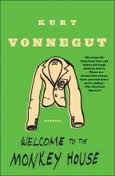
[READ: August 17, 2012] Welcome to the Monkey House

So this book is Vonnegut’s second collection of short stories.  But there’s a twist.  This collection contains all of the short stories from Canary in a Cat House except one. It also contains many of the stories he had written since then as well as stories not collected in Canary.  So you get basically 18 years worth of stories here.  And it’s interesting to see how much he has changed over those years (during which he wrote 5 novels, but not yet Slaughterhouse Five).

Since I read Canary a little while ago (see comments about the stories here), I knew that his 50’s era stories were influenced by WWII.  So it’s interesting to see how his stories from the 690s are not.  They deal more with day to day things and, of course, abstract concepts about humanity, although politics do enter the picture again once Kennedy is elected .

  • Where I Live (1964)

This was a good story to open with because it shows the then-later-period Vonnegut’s mindset and location.  This story is about Barnstable Village on Cape Cod (where I assume Vonnegut lived since there are a number of stories set on the Cape).  This is a very casually written story about an encyclopedia salesman who goes to the local library and sees that their two encyclopedias are from 1910 and 1938.  I enjoyed this line: “He said that many important things had happened since 1938, naming among others, penicillin and Hitler’s invasion of Poland.”  He is told to talk to the library directors who are at the yacht club.  I love the attitude that Vonnegut creates around the village which “has a policy of never accepting anything.  As a happy consequence, it changes about as fast as the rules of chess.” For really, this story is about the Village more than the encyclopedia salesman, and it’s an interesting look at people who move into a new place and want it to never change. (more…)

Read Full Post »

SOUNDTRACK: REGINA SPEKTOR-Soviet Kitsch (2004).

After the poppy, polished joy of Far, I went back and decided to check out the one other Regina Spektor album I knew of–Soviet Kitsch.  This album has always stuck with me as an interesting title.  I ordered it from Amazon and was bummed to get a little cardboard sleeve rather than an entire disc (her artwork is really nice).  So I was a little biased against this disc from the start.  The music also doesn’t have any of the polish and sleekness of Far.  So it took a while for me to see the beauty within.

This album is largely simple piano (with strings and other addition), but it’s a much more raw album (akin to something like Tori Amos’ Little Earthquakes).

“Ode to Divorce” is a quiet piano song with some catchy moments.  “Poor Little Rich Boy” has some interesting percussion to accompany the piano.  And in this song you know that she’s in a slightly different territory than Tori Amos, which is good–the feeling is similar but the end result is unique.  Lyrically the album explores different ideas and on this song the repeated refrain of “you’re so young you’re so god damn young” is a little unsettling.  “Carbon Monoxide” introduces a more full sound (bass and drums).  And Regina shows off yet another side of her personality–playful, flirtatious and now almost childish (“C’mon, daddy.”)

“The Flowers” introduces another new aspect to the disc–more aggressive/borderline classical piano playing (rapid, loud notes).  It suits her style quite well and this song is  a definite highlight.  The end of the song has a very Russian-style nonsense syllable sing along which is very fun.   “Us” adds strings to the song and some great sing along parts.  “Sailor Song” is a funny song from a sailors perspective with the sing-along shanty chorus “Mary Anne’s a bitch” (complete with broken glass sounds).

The next song “****” is a whispered little conversation in which a young girl asks Regina when the next song is coming.  It makes the next song, “Your Honor” even more loud.  It really stands out on this disc because it is a full on punk song with screamed vocals and band work from Kill Kenada (who I don’t know anything about).  The song is about getting in a fight to defend a woman’s honor.  The slow piano middle section features the amusing question “gargle with peroxide a steak for your eye but I’m a vegetarian so it’s a frozen pizza pie…you fight for my honor but I just don’t know why.:”

“Ghost of Corporate Future” has a kind of lullaby feel and some amusing lyrics, ” When he gets to the crowded subway platform/He takes off both of his shoes/He steps right into somebody’s fat loogie/And everyone who sees him says “ew”/Everyone who sees him says “ew”/But he doesn’t care/Cause last night he got a visit/From the ghost of corporate future/The ghost said take off both your shoes/Whatever chances you get/Especially when they’re wet.”  It’s all sung in a manic style over a quiet piano melody.

“Chemo Limo” is certainly the highlight of the disc.  It’s 6 minutes long and is quite dramatic.  The basic premise is that dying from cancer sucks, so she’s going to live instead: “I couldn’t afford chemo like I couldn’t afford a limo/And on any given day I’d rather ride a limousine.”  There are several sections in the song–allowing Regina to show off her dynamic and dramatic vocal range (serious falsettos) and very impassioned sections, “Oh my God Barbara she looks just like my mom”  She even does some (very mild) beatboxing at the end of the song.  “Somedays” is a pretty, simple ballad, with some great vocals although it kind of gets lost at the end of the disc.  Although I was not that into this record when I first got it, repeated listens revealed wonderful surprises inside.

[READ: July 15, 2012] Canary in a Cat House

This is Kurt Vonnegut’s first collection of short stories.  It is currently out of print.  That’s not a big deal because almost all of the stories were later collected in Welcome to the Monkeyhouse.  But I thought it would be fun to read them in the original book.  When it came in from the library I was surprised at how tiny it was.  But what was really surprising was how small the print and how small the margins were.  They really crammed stories into collections back then!

These stories were all written in the 1950s and what was also surprising to me was how serious and unfunny some of those first stories were.  I realize that these were some of his first works, but the Vonnegut voice is so distinctive–a misanthropy tempered by jokes and absurdity, that I was surprised that some of these stories were not only serious but seriously emotional as well.  It’s been clear from all of his stories that WWII impacted his life tremendously (as one would expect), but in these early stories he talks very deliberately about violence and the cold war and the aftermath of WWII.  It’s pretty intense.  By the end of the book the more typical Vonnegut voice surfaces–sci-fi kinds of stories with dark humor involved.  It’s quite a collection. (more…)

Read Full Post »

SOUNDTRACK: WOLF PARADE-Expo 86 (2010).

Wolf Parade is a strange band, no doubt. Both singers can craft super catchy songs, but they like to layer them with odd sounds and lots of song parts making the songs more challenging (and better in the long run).

“Cloud Shadow on the Mountain” starts the disc off with drums and an eccentric voice.  And the lyrics? “I was asleep in a hammock/I was dreaming that I was a web/I was a dream-catcher hanging in the window of a minivan/Parked by the water’s edge./I’d say that I was all alone.”

The song has some loud guitars, some great guitars riffs and (the most notable feature on the album) retro sounding keyboards.  On this song the keys play an alternate melody that compliments the song very well.  There’s some heavy rocking sections and a slowed down drums and vocals section.  It’s fairly exhausting how much is in this one song.  By the end, he’s repeating “you will never be born as a scorpion.”

“Palm Road” is a more straightforward and catchy song, although it’s certainly offbeat.  “What Did My Lover Say” opens with a cool guitar riff an counterpointed keyboards.  As with most of the songs on this record headphones or at least good stereo speakers really make a difference.  The rest of the album is hard to speak of in different terms because each song is unusual with angular guitars and interesting vocals.  The keyboards also provide unsettling atmospherics.   None of the songs are easy to sing along to, until one day the shifts in melody and phrasing sink in and it all sounds wonderful.

What I find notable about these songs is that they are all long (most are around 5 minutes) and they feel long–not in a dragging out way (although maybe “In the Direction of the Moon” drags) but in a–so much has been going on, this song must be really long kind of way.

Some other highlights include “Ghost Pressure” with its great keyboard riff (that feels not unlike The Cars).  Speaking of The Cars, the keyboards on “Oh You, Old Thing” have the great spacey Cars sound from the 80s.  “Pobody’s Nerfect” melds the catchiness that the guys are capable of with just the right mix of unexpectedness.  And the closing song “Cave-O-Sapien” seems to combine all of the best qualities of the above songs in to one–a great riff, catchy “oh oh ohs,” and bizarre lyrics, “I had a dream of a gorilla.”

This album is definitely not for everyone, but multiple listen reap big rewards.

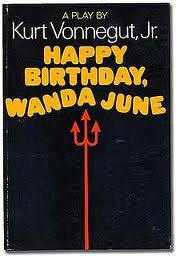
[READ: July 8, 2012] Happy Birthday, Wanda June

I have been chugging along nicely through Kurt Vonnegut’s oeuvre.  My plan was to read all of his novels and then read his short stories.  And then maybe read his plays (I wasn’t sure about that last bit).  But as I mentioned yesterday, reading a simple play can be a delight (and can be a very quick read, too).

Vonnegut opens the book with a prologue about how and when he wrote the book.  It was originally a play called Penelope, and he thought it was terrible.  Fifteen years later he kept the basic idea and rewrote it as Happy Birthday, Wanda June.  And the idea is straight out of Homer.  In the Odyssey, Penelope is Ulysses’ long-suffering wife.  When Ulysses came home from his travels some twenty years later, he was feted as a hero and the world (well, his world) rejoiced (except for Penelope’s suitors, of course).

So in this play, Harold Ryan is a loud, manly hunter and soldier, ready and happy to kill anything in his way.  He has been on an expedition for eight years–his plane went down and he  is presumed dead–even Mutual of Omaha thinks so.  His wife, Penelope Ryan believes him to be dead and has been entertaining two suitors–Dr Norbert Woodly, a pacifistic doctor and Herb Shuttle, a vacuum cleaner salesman.  The only person who doesn’t presume him dead is their son Paul Ryan, who bristles not only at the thought of his father being dead, but even more so at these wimpy suitors.  Although Paul is too young to ever have rally known his father (he’s 12), he keeps hopes alive that his father will return one day.

What I like about the play is that it maintains Vonnegut’s voice right from the start.  It opens with a speech from Penelope:

My name is Penelope Ryan.  This is a simple-minded play about men who enjoy killing–and those who don’t. (more…)

Read Full Post »

SOUNDTRACK: SIX ORGANS OF ADMITTANCE-“Even If You Knew” (2012).

Lars from NPR’s All Things Considered picked this as his summer music preview song.  I don’t know a thing about Six Organs of Admittance, but their discussion of this song makes it seem like this is atypical for the band (which has a massive output).  Evidently they’re usually more droney sounding. But man, this song is pummeling and wonderful.

It’s seven minutes long and opens with a simple, plodding heavy bass riff.  The vocals are kind of whispered and strained.  But then comes the guitar solo–a raging piece of distortion that complements the bass.  And that’s just the first three minutes.

The second half of the song features a quieter section–the bass is quieter, while the guitar noodles around and the vocals play over the rhythm.  The song slowly builds again, and by the last minute or so there’s another fierce guitar solo. Until the song is exhausted by the final distorted notes.

This is some beautiful noise.  And, no I have no idea what the band’s name means.

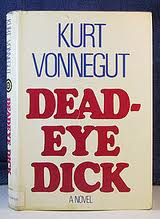
[READ: June 27, 2012] Deadeye Dick

Deadeye Dick is the last Vonnegut book that I was completely unfamiliar with.  I had no idea what it would be about.  So I didn’t realize until very late in the book, and then I looked online and confirmed that this book is set in the same location as Breakfast of Champions, Midland City, Ohio.  Indeed, some of the same characters appear in this book as appeared in that book.  But more about that later.

Vonnegut is not known for his happy books.  Misanthropy is pretty rampant in his pages.  But this book is one of his bleakest books yet.  The story concerns the Waltz family–Rudy (the protagonist) and his brother Felix are the only children of Otto and Emma Waltz.  Pretty early in the story we learn that Rudy is a double murderer.  Yipes!

As with most Vonnegut stories, this one is told in a convoluted and non-linear fashion.  He foreshadows (and really just casually mentions) a lot of crazy things that are going to happen in the book.  Like the fact that Midland City is going to be devastated by a neutron bomb.  In fact, his preface (like with many of his prefaces) tells us a lot about what’s in the book and who the characters are based on and the fact that there is a neutron bomb (but the reality of a neutron bomb is different from what he says).  There is something about knowing this information ahead of time that impacts the way you read the story.  Whether you think maybe he’s not telling the truth about what will happen (can the narrator really be a double murderer?) or maybe somehow the foreshadowing makes it even worse when it actually happens–the revelations are perhaps more deliberate.  But the style–a recursive style in which he says what happens and then he goes back and fills in the details, makes the events that much more powerful.

The funny thing about this story is that a lot happens to the characters in the beginning of the story and then not too much happens to them after that.  But that early stuff is pretty exciting and it has an impact all the way through. (more…)

Read Full Post »

SOUNDTRACK: MOGWAI-Special Moves (2010).

This is Mogwai’s first live album and it really captures the band in all of its intense glory.  This is a good year for a Mogwai live recording because they play some of their newer song which are a bit more melodic (and sometime have words) but they also revisit their older songs–which still sound intense.  It’s a great overview of their career so far and it’s a great testament to how different their music sounds over the course of so many years–even though they still sound like Mogwai

We get two songs from Their (then) latest The Hawk is Howling –“I’m Jim Morrison I’m Dead” and “I Love You I’m Going to Blow up Your School.” Two songs from Mr Beast “Friend of the Night” and the stunning set closer “Glasgow Mega Snake.” Two from Happy Music “Hunted by a Freak” and “I Know You Are But What am I.” Two from Rock Action “You Dont Know Jesus” and “2 Rights Make 1 Wrong.”  From Come On Die Young we get “Cody” and from their debut, two classics: “Like Herod” (which is amazing live) and “Mogwai Fear Satan” (also amazing)–each one over 10 minutes long and full of the emotional release that we’ve come to expect from Mogwai.

This is a great place to start if you want to hear what Mogwai is all about.

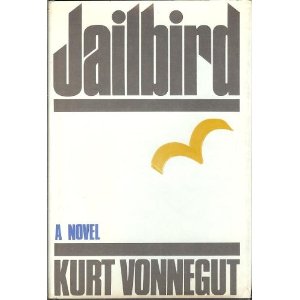
[READ: June 4, 2012] Jailbird

First off I want to say how neat it is that I took this book out of the library and that it’s from 1979.  Thirty-three years old!  Books are cool.

Anyhow, I have a stack of dozens of books I want to read, and yet somehow Vonnegut said, no, read me now.  In addition to Vonnegut books being relatively short, they are also very quick to read.  I read this in a couple of days, which is very satisfying.

My old boss at the library told me that she thought Vonnegut more or less stopped writing good books after Breakfast of Champions.  I disagree, but that has certainly colored the way I look at his later books before I read them–which one had she read that turned her off?  I kind of suspect it was this one.

In some ways this is a minor novel.  It’s fairly brief (240 pages, although there’s  30 page Prologue which I gather is from Vonnegut himself (you never know, he has so many layers going on)).  He explains some of the details that are in the book and several other interesting preface-type things.  I enjoyed the bit about the fan who wrote to Vonnegut and (Vonnegut claims) summed up all of his works in just seven words: “Love may fail, but courtesy will prevail.”  And that is the basic plot of this book. (more…)

Read Full Post »

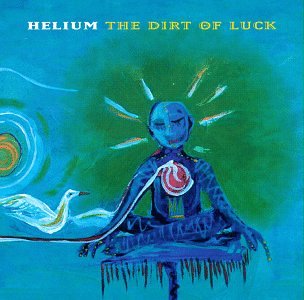
SOUNDTRACK: HELIUM-The Dirt of Luck (1995).

Mary Timony fronted Helium for a few years.  In that time she was recognized as something of a guitar wizard–not in her speed and flash, but in the weird sounds she conjured from the instrument.

She also had very peculiar musical sensibilities (these songs are quite odd) and a cool feminist attitude.  This album features the amazing song “Superball” (one of the best songs of the mid 90s–check out the video and watch the guitarist playing the strings with a screwdriver!  Man I miss the 90s) as well as a number of unpolished gems like “Medusa” and “Pat’s Trick” (the dual vocals are very cool and the dispassionate “oh oh oh” is very interesting, plus I love the lyric about “long-ass curly hair”).

Her singing style is often quite slacker-y, like in the opening of “Medusa”–she’s not always audible, and she often seems like a kind of buzzy sound more than a voice.   She sounds like she’s singing from very far away–seemingly powerful and yet quiet at the same time.

But combine that with the cool scratchy/noisy guitar sounds she gets and she’s pulling off a very cool combination (think Dino Jr without the hooks and killer solos).

Like “Baby’s Going Underground” features some crazy shoegazer guitar washes for most of its 6 minutes which really changes the pacing of the record.  There’s also the great “Skeleton,” a riff so cool that Sonic Youth used it for “Sunday.”

She also has a way with haunting melodies as on the piano  instrumental “Comet #9” and on “All the X’s Have Wings” which sounds very medieval. I think of Timony as a guitarist and yet there is there are lots of keyboards on the album too–mystical keyboards that are fascinating and seem out of character with the guitars, but actually work quite well.   But the prettiest song is “Honeycomb.’  It’s a sweet song with a wonderful melody.  It is followed by the ender “Flower of the Apocalypse” a guitar-based instrumental that is mostly feedback but is also surprisingly melodic.

Helium had mild accolades back in the 90s.  They released a couple of albums and then Mary Timony went solo.  It’s nice to have her playing now with Wild Flag.

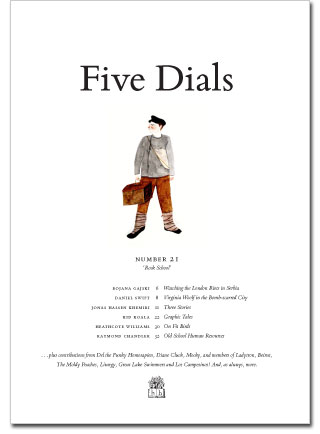
[READ: November 11, 2011] Five Dials Number 21

This is the first issue of Five Dials that I was ready to read when it was sent to me (I’ve been all caught up for a while now).  So that’s pretty exciting!

I was tempted to say that i enjoyed this issue more than other issues, but I have enjoyed most Five Dials issues equally.  But this one is definitely a favorite.

CRAIG TAYLOR–A Letter from the Editor: On Turning 21 and Thinking About Rock Stars and Greece.
The magazine introduction jokes about them now being legal to drink in the U.S. and also about now being old enough to run for M.P. in England.  He also tells us about their “new” section Our Town, which has vastly expanded in this issue.  He also explains that there are many rock stars on hand to give the magazine tutelage (authors that the rock stars enjoy) and three short stories.  He ends with a notice that they have gone to Greece where they are gathering material for Issue 22. (more…)

Read Full Post »

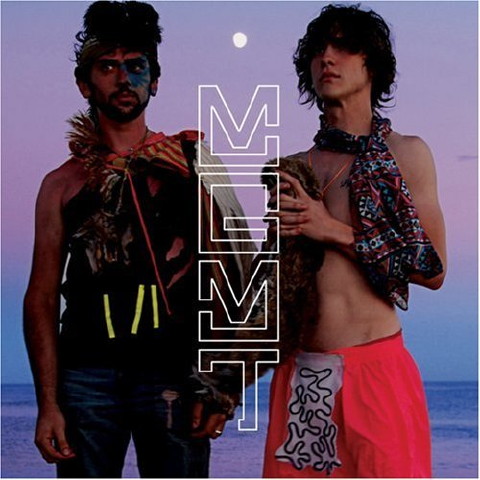
SOUNDTRACK: MGMT-Oracular Spectacular (2008).

I bought this album a few years after it was hailed as the best album by everyone.  I never quite realized that they did all the songs I knew from it, but I was pleased that I bought it.  Then I promptly lost the disc.  I found it about seven months later in another case (doh!).  And I have given it a number of listens since then.

I’m confused as to why this album was so popular.  I’m not saying it’s bad, I’m just not sure why it was so hailed.  It’s a strange kind of record. There are a number of dancey hits (which aren’t really that dancey or anything), but there’s also a bunch of trippy psychedelic stuff as well.

The opener, “Time to Pretend” has a wonderfully catchy keyboard line that expands into a wonderfully simple, but catchy verse/chorus.  “Weekend Wars” reminds me of some of the weirder alternative hits of the early 90s.  The sound is kind of trebly and slightly off, but the middle of the song is full of beautiful swells of keyboards, giving it a strangely hippie vibe.

“The Youth” is a slower track which has a gentle sound and a nice chorus.  It’s pretty far from the danciness of the opener.  “Electric Feel” brings in some disco and funk.   The keyboards are very 70s trebly with a big bottom bass.

The standout track is “Kids.”  It marries the weird keyboard sound of the opener with a wonderfully catchy riff.  It also has a simple chord structure and big drums.  It’s the kind of song that sticks in your head from the first time you hear it.

The second half of the disc is where things change and the more psychedelic aspect so the band come in.  The album was produced by Dave Fridmann (Mercury Rev, Flaming Lips) and while that style is evident in the front of the album, it’s hidden under the more brash punk sounds.  n the last few songs the punky elements are absent and the psychedelia shines through.  “4th Dimensional Transition” is a wash of interesting sounds.  “Pieces of What” is a simple acoustic guitar with vocals that sound like they come from outer space.  “Of Moons, Birds & Monsters” never really coalesces, although the parts are interesting.  “The Handshake” is another folkie kind of song with overtones of David Bowie (who is never really absent anywhere on the disc) especially at the end of the song.  “Future Reflections” ends the disc with a synthy ballad.

The disc is quite different from the first five to the last five songs.  And I find that when I’m enjoying the hits, I’m less excited by the trippy parts (which meander as opposed to the immediacy of the hits).  But I think I could find myself enjoying the vibe of the second half of the disc more if the first half didn’t prep me for that stark pop punk sound.  I guess it has something for everyone.

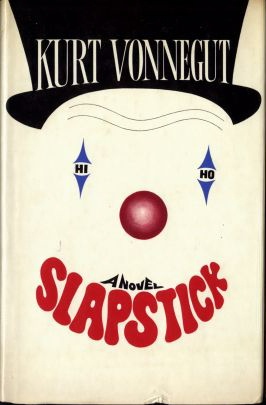
[READ: June 28, 2011] Slapstick

I tend to read books that are long, or at least that feel long.  So Vonnegut is like a guilty little pleasure.  I read this in three lunch hours. And it felt like something of an accomplishment.

I can honestly say I didn’t enjoy this one as much as his previous books.  It was a lot darker and felt a bit more mean-spirited than his others.  True, Vonnegut is nothing if not mean-spirited, but there was something different about this one.  Was it that the protagonists were two meters tall with six fingers and toes and for the first several years of their lives spoke in nothing but baby talk?  Was it that they were so reviled by their parents that they were sent away to the parents’ second home and allowed no visitors?  Or was it that Manhattan was now called “The Island of Death?”  Or maybe it was just the repeated use of “Hi Ho” at the end of virtually every paragraph.

Or maybe it’s that the story doesn’t really feel complete.  There isn’t a lot of story here, but as with lots of Vonnegut, there are a lot of little details that join the story together.  The novel is constructed as chapters, but within the chapters are very short almost paragraph long sections separated by dots.  These little paragraphs sort of work as small scenes, with most having a kind of punch line at the end (this is not too dissimilar from Breakfast of Champions, but the sections are even smaller here).

The two aforementioned protagonists are as described.  But although they speak in nothing but nonsense syllables, they are in fact quite intelligent.  Indeed, when they put their minds together (literally) they reach epochal levels of genius.  And when they put their heads together they write several massively intelligent treatises and the most popular child-rearing manual in history, So You Went and Had a Baby.  Well, actually, Wilbur wrote it for Eliza is illiterate (she just has most of the brainstorms).  Technically, the real protagonist of the story is Wilbur, for these are his memoirs. (more…)

Read Full Post »

SOUNDTRACK: PEARL JAM-East Rutherford, NJ 6.3.06 (2006).

This concert was a free download with the purchase of Backspacer. I chose this because this is the show that I should have gone to.  [How many concerts have I seen at the Meadowlands–or whatever it is called now?].  Not to mention, this is the last concert date of the first leg of the tour, and the last concerts are usually a little longer, a little wilder, a little more fun.

And there’s a number of reasons why this is true during this show.

The first is the technical flaw.  Midway through their fifth song, “Animal” there is some kind of power failure (the flaw with audio from concerts is that you have no idea what’s really going on).  The song shuts down, there’s some crowd chanting and then the power comes back on.  This gives Eddie Vedder a chance to make a Springsteen joke (did he leave for tour without paying the electric bill) and the band resumes, even more intense than before.

There are a number of Springsteen moments during the show.  They thank him for introducing them to the Community Food Bank of New Jersey–where proceeds from this night’s show go).  Later, Eddie’s explains that his failure to figure out the chords to Springsteen’s “Atlantic City” led to his creating the song “Gone”.  And Eddie’s “Pre-Opener” (sadly not on the download, but you can hear it here) is a cover of Springsteen’s “No Surrender.”

Springsteen aside, this is a great show.  The download is three discs long (the first disc is 25 minutes or so and comprises the audio from up to the power failure).  But even with the confusion, the band sounds wonderful.  They run through all kinds of songs from throughout their career, “Even Flow,” “Alive,” “Why Go,” “Black,” “Porch,” and “Garden” from Ten.  “Animal,” “Rats” and “Leash” from Vs. “Last Exit,” “Whipping” and “Corduroy” from Vitalogy, “Habit” and “Lukin” from No Code, “In Hiding” from Yield. “Love Boat Captain” and “I am Mine” from Riot Act, and about half of the songs from Pearl Jam.  There’s also a whole bunch of songs from Lost Dogs: “Hard to Imagine,” “Yellow Ledbetter,” “Last Kiss” and “Don’t Gimme No Lip” and even “State of Love and Trust” and “Crazy Mary.”

The show is a pretty rocking show overall.  In fact, as you can see above they don’t even play their more crowd pleasing ballads (“Betterman,” “Daughter”).  And the set in no way suffers from it.

This show also has a special guest and a special announcement.  Vedder explains that June 3 is West Memphis 3 Recognition Day.  Wikipedia says The WM3 are three teenagers who were tried and convicted of the murders of three little boys in West Memphis, Arkansas in 1993 by a prosecution team that put forth the idea that the only purported motive in the case was that the slayings were part of a Satanic ritual. In July 2007, new forensic evidence was presented in the case, including evidence that none of the DNA collected at the crime scene matched the defendants, but did match Terry Hobbs, the stepfather of one of the victims, along with DNA from a friend of Hobbs’ whom he had been with on the day of the murders.

The WM3.org site shows that many musicians are behind them, offering support and free music.   A new trial date has been tentatively set for October 2011.  If they are found not guilty they would have spent eighteen years in jail for nothing.  Damien Echols (who was sentenced to death) co wrote “Army Reserve” with Vedder, and Echols’ wife says a few words on stage.

Another great moment comes in “Crazy Mary” when Boom Gaspar and Mike McCready have a kind of dueling organ vs guitar solo.   It goes on for several minutes and Gaspar’s Hammond sounds great.  Later in the show, Vedder toasts the crowd for being great.  It may also be the only toast to incorporate the phrase “fucking assholes” (as in if people don’t think you were amazing, they’re fucking assholes).

One of the great things about Pearl Jam shows is that they pack a lot of music into them.  I was especially mindful that when they came out for their second encore, they played nine more songs for about 30 minutes.  Not a bad encore at all.

This is a great set if you’re looking for live Pearl Jam.

[READ: May 24, 2011] Breakfast of Champions

I read this whole book during my trip to BEA.  I read it while on the bus (two and a half hours total) and then while waiting on line for various author signings.  I don’t know that I’ve ever read a book in such a short period before.  It’s not a long book by any means and it is full of illustrations (more on that later).  It was an ideal book to choose for a day of book reading.

So the novel is actually set up as a story within a story.  The Preface explains that the story is written by Philboyd Stuge (Vonnegut has a lot of fun with names).  It explains that “Breakfast of Champions” is a trademark of General Mills and he is neither  associated with GM nor disparaging them by using the phrase so much (it doesn’t occur frequently until much later in the book).  Stuge explains some of the background information about ideas in the book (that people are actually robots and how Armistice Day was a better name for the holiday than Veterans’ Day).  He also explains that he is writing this book as a 50th birthday present to himself (Vonnegut was born in 1922).  And for his 50th birthday, he is going to act childishly and draw illustrations in the book.  So I found this picture from the novel
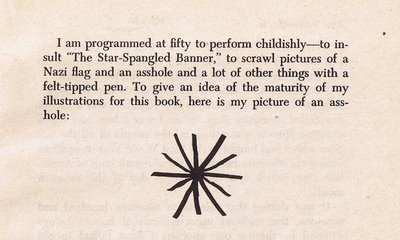
That may give you an idea of what to expect inside (although most of the illustrations are “better” than that one).

What is especially helpful about the story is that it tells you what will happen as it goes along.  So the novel starts:

This is a tale of a meeting of two lonesome, skinny, fairly old white men on a planet which was dying fast.

One of them was a science fiction writer named Kilgore Trout.  He was a nobody at the time, and he supposed his life was over.  He was mistaken.  As a consequence of the meeting, he became one of the most beloved and respected human beings in history.

The man he met was an automobile dealer, a Pontiac dealer named Dwayne Hoover.  Dwayne Hoover was on the brink of going insane.

And that is literally the story.  So why is the book 297 pages long then?  Vonnegut is really out to talk about contemporary society:  America mostly, but not exclusively.  And does he ever. (more…)

Read Full Post »
« Newer Posts - Older Posts »