Feeds:
Posts
Comments

Archive for the ‘Haruki Murakami’ Category

2015_02_23SOUNDTRACK: THE LOW ANTHEM-Tiny Desk Concert #43 (January 20, 2010).
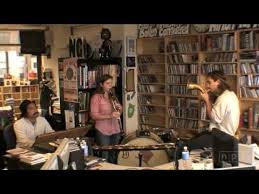
lowanthemThe Low Anthem grow more charming as the Tiny Desk goes on.  The first cool thing is the story that accompanies them. They played at the Newport Folk Festival and when Bob talked to the organizer about them, the organizer said that “Last year, they were volunteers at the festival, picking up trash.”

Then things get more interesting as each of the three songs introduces new instrumentation and ways of making music.  They brought a lot of gear to this Tiny Desk.

The first song, “Ghost Woman Blues” opens with strummed acoustic guitar and upright bass.  The first surprise comes with the clarinet solo (by harmony vocalist Jocie Adams).  Lead singer Ben Knox Miller has a voice not unlike Vic Chesnutt’s and these songs follow along his rather simple and spare style.

The biggest surprises come in the second song, “This God Damn House.”  Miller starts the song by playing a small bras horn (not sure what it is).  Adams plays more clarinet (in a very cool echoing style) and upright bassist Mat Davidson switches to an old-sounding organ.  But the coolest thing is when Miller takes out his cell phone (what!).  He has dialed another phone in the room which he then answers.  With both phones flipped open (it is 2010 after all), he begins whistling into them, playing with the feedback and echoes and creating a very cool sound to end the song.

It’s a shame there’s a cut to the next song, because I’m sure Bob asked him about that.  For the final song, “To the Ghosts Who Write History Books,” Miller switches to the organ (and harmonica, man that guy is talented). Davidson is back on bass and Adams plays a bunch of cymbals with a violin bow (I wish that was a little louder).

I generally don’t like super mellow music like this, but there’s something really captivating about The Low Anthem–the instrumentation, the voices–something, really elevates them.

There is a drum kit set up although no one uses it.  I can’t imagine it would have made a lot of difference.  Check them out here.

[READ: April 11, 2015] “Kino”

This longer story was a typically enigmatic one from Murakami.  In it, he does a great job of melding the real with the psychological, so that things that seem very surface level are actually much deeper.

Kino is a pretty simple man.  He was a runner until he pulled his Achilles tendon and could no longer run.  So he started working for a shoe company.  He sold the premium shoes to good runners.  The brand was not super popular, but it had a devoted following.  And Kino made decent money for him and his wife.

He was a salesman and often went on business trips.  As happens, he came home early one day to find his wife in bed with a fellow coworker.  He walked out and never went back. (more…)

Read Full Post »

oct13SOUNDTRACK: PRIMUS-The Brown Album (1997).

brownThis is the first Primus album to not feature Tim Alexander on drums.  Brain has taken over.  And while the difference isn’t that substantial, the overall feel of the band has shifted, to a less progressive, more heavy, loud band.  Brain evidently brought super-sized, very tall bass drums which added a big whomping sound.  And while for the most part his is a simpler style, he doesn’t shy away from fills and noise when necessary.

I haven’t listened to this album as much as many of their others but after revisiting it lately I’ve decided that it has a lot more really good songs than I remembered.

“The Return of Sathington Willoughby” is a great introduction–a far richer and more complex song than I remembered.  It begins with some ominous drum and bass with Les’ spoken word proclamations from Willoughby.  But I love the way the fast part of the song jumps in and features a really fast funky bass and some great squeaking guitars–which absolutely make the song.  “Fisticuffs” is a really deep heavy song (the drums are really loud).  It’s a classic story song from Les, with great stomping bass and cool guitars from Ler.

The riff from “Golden Boy” is quite good–complex and interesting.  One of the nice things about most of these songs is that they are largely shorter.  This song for instance would have suffered if it were 5 or 6 minutes, but at 3 minutes, it’s a tidy little fast number.  “Over the Falls” is one of their slower singles, a story song that’s under three minutes.  Not super catchy, but interesting.  “Shake Hands with Beef” was the first single–it’s a big stomping song with a group chorus–something unusual for Primus.  It’s no less weird than some of their other singles, but I feel like it’s missing something–maybe guitars?

The next few songs are kind of muddy and not terribly memorable.  “Camelback Cinema” is a sludgy kind of song without a lot of interesting components.  On the other side of the spectrum is “Hats Off,” a short honky-stomping song that feels like a country number.  It’s not terribly interesting but it does break up the album nicely.  “Puddin’ Taine” has a kind of classic Primus stomp, although it’s a little muddier.

After those middle songs, I love “Bob’s Party Time Lounge” which switches between slow verses and a super chorus that has a great bass riff and some nice big guitars.  It’s a simple song, but really effective and fun.  It’s one of may favorite late period Primus songs.  I also like “Duchess and the Proverbial Mind Spread” for the fun riff and style of the song.

“Restin’ Bones” actually has a lead guitar riff (!)  It’s nice to hear a lead guitar but the song is only so so and a little too long.

But I do love “Coddington” which is another of my favorite later period songs.  It features the (really fast) bowed bass and a thumping drum.  This song whips by and is amazingly catchy.  I also really like “Kalazmaoo” both for the great guitar riff and because he references “I’ve Got a Gal in Kalamazoo” with the same alphabetical introduction.

I like “The Chastising of Renegade” for the nice big drum openings.  The guitar and bass riffs are also really cool and the switch to the reggae guitar strumming is quite a surprise.  It feels a tad long, but it’s overall a good one.  The final song, “Arnie” opens with big loud distorted drums.  It has a groovy bass and simple but cool guitars.  I feel like this should have been an instrumental, as the lyrics aren’t that interesting.

So overall this one is a bit of a mixed bag.  There are definitely some great songs that I would absolutely have out on a greatest hits record.

[READ: January 10, 2015] “Scheherazade”  Ted Goossen

I really enjoyed this story.  As with a lot of Murakami, I feel like he has an interesting perspective and tells stories that are unlike anyone else’s.

This story is interesting for the layers that he puts into it.  It opens “Each time they has sex, she told Habara a strange and gripping story afterward.”  Okay, simple set up.  He thinks of her as Queen Scheherazade from A Thousand and One Nights (although he had no plans to chop off her head).

Habara keeps a journal and he keeps track of her visits, using a secret code–her name and a one word summary of whatever she talked about that day.  He didn’t know if her stories were true or not and he didn’t care–he just enjoyed them, usually more than the sex.

Then details of their relationship emerge–she is a housewife with two children and he is a housebound man–he never leaves.  She was sent to him as part of his situation (which is never explained–is this a common thing in Japan?).  She brings him food and books and DVDs two or three times a week, although he cooks for himself. He simply never leaves the house.  She also has sex with him–he’s unclear if this is supposed to be part of the deal or if it is her own impetus.  The sex is not passionate, but it is enjoyable.  And yet as the story shows, it is the stories that she tells afterwards that he enjoys more. (more…)

Read Full Post »

jun9SOUNDTRACK: NICOTINE-“Yesterday” (2005).

dudeSince this story is about a guy making up words to “Yesterday,” I thought I’d find a cover of it.  Evidently there are several hundred covers to choose from, so I chose this one, from a band I didn’t know.

As you might judge by the cover, this is a punk version of the song.  But what a little research tells me is that Nicotine is a Japanese punk pop band.  And you can hear in Howie’s vocals that although his English is quite good, his accent shows up at certain moments.

The guitar starts out nicely, in a non-punk way.  Then when the vocals kicks in, you will either love it or hate it camp.  Howie’s voice is kind of whiny/bratty sounding, making the song either funny or irritating depending.

After the first verse, the band turns into the kind of fast pop punk that NOFX does–speedy drums, heavy guitars, etc.  Interestingly, his voice doesn’t speed up for the verses which makes the contrast all the more striking.

The album pictured above is indeed a full album of Beatles covers (the band seems to do a lot of covers), most of which are entertaining enough to listen to more than once.

[READ: September 17, 2014] “Yesterday”

As this story opens the narrator says

As far as I know, the only person to put Japanese lyrics to the Beatles song “Yesterday” (and to do so in the distinctive Kansai dialect, no less) was a guy named Kitaru.  He used to belt out his own version when he was taking a bath:

Yesterday
Is two days before tomorrow
The day after two days ago.

While “Yesterday” features prominently in the story, it is really a story of love and romance and friendship.  The narrator met Kitaru at the coffee shop where they worked.  There is a great deal of emphasis placed on Kitaru’s use of the Kansai dialect (which I know little about except to know that it is not the dialect of Tokyo).  The strange thing about Kitaru (well, one of the strange things) is that he was born in Tokyo.  But he adopted the Kansai dialect because he was a fan of the Hanshin Tigers.  He was such a big fan that he learned their dialect to be able to communicate with the fans when he went to the games.  (Learning Kansai is apparently like learning another language).  He was so into it, that he spoke it all the time.

The narrator, on the other hand, grew up speaking Kansai but after living in Tokyo for a month, he became fluent in Tokyo Standard (which also shows how odd it for Kitaru to do this).

This is mostly set up to show how odd Kitaru is.  Kitaru is a super nice guy and is clearly smart (if he learned the dialect), and yet he has failed his college entrance exam twice.  This is a problem because his girlfriend, the very pretty Erika, got into college on her first try, and he says he can’t date her properly unless he is also in college.  He and Erika have known each other for ever and are romantic without actually “doing ” anything.  He admits that he thinks of her almost like a sister and can’t imagine touching her in that way.  They are super close, and he considers her his girlfriend, but that’s it. (more…)

Read Full Post »

SOUNDTRACK: RA RA RIOT-“Is It Too Much” (2013).

raraI loved the first Ra Ra Riot album The Rhumb Line.  This song expands on some of the ideas from that album, but I fear that it goes in the one direction I would have preferred they not go.  The album had strings, nice harmonies and a great singer all melded into an interesting rock structure.

This song retains all of the elements that were interesting, but it removes it from the rock structure, making it  sound much more lightweight.  It’s pushing too far into easy-listening.  And do I hear autotune on the vocals?  The instrumental middle section is the most interesting part of the song.  But Ra Ra Riot seems to have removed the riot part of their sound.  If this is the direction of the album, I’m afraid I won’t be following.

[READ: January 8, 2013] “Consider the Writer”

I just finished the D.T. Max biography of David Foster Wallace.  I was curious what kind of reception it received.  And lo, here’s a review by Rivka Galchen (something I would have read anyhow since I enjoy her so much).

Galchen opens with two main points–the biography is gripping (and it is, I’ll be saying more about that tomorrow, too).  She writes: “In writing a chronologically narrated, thoroughly researched, objective-as-­imaginable biography, Max has created a page turner.”

The second idea is that you keep thinking “that you just don’t find Wallace all that nice”  (which I also thought).  But then she wonders if it is fair to be worried about that.  We should not judge others after all.  Especially since, as she points out, “We don’t always find ourselves asking whether a writer is nice. I’ve never heard anyone wonder this at length about, say, Haruki Murakami or Jennifer Egan.”  So why is that a concern about Wallace?  Because niceness is what Wallace wrote about, tried to encourage.  And perhaps “One understandably slips from reading something concerned with how to be a good person to expecting the writer to have been more naturally kind himself.”  But that is not necessarily the case–people strive for things that they cannot achieve.   I like her example “the co-founder of A.A., Bill W., is a guru of sobriety precisely because sobriety was so difficult for him.”   And her conclusion: “Wallace’s fiction is, in its attentiveness and labor and genuine love and play, very nice. But what is achieved on the page, if it is achieved, may not hold stable in real life.”

And Galchen talks a bit abut DFW himself (the book is a biography after all).  How he wore the bandana because he sweated so much–how self conscious he was about that and by extension nearly everything he did.  This mitigates his not-niceness somewhat.  It also ties in to his alcoholism  drug use and depression.  And his competitiveness, which is obvious in the biography.  She enjoys the pleasure of Wallace’s correspondences, “especially with his close friend and combatant Jonathan Franzen, but also with just about every white male writer he might ever have viewed as a rival or mentor. Aggressive self-abasement, grandstanding, veiled abuse, genuine thoughtfulness, thin-skinned pandering — it’s all there.”  I rather wished that the authors’ own reactions were included (of course it’s not biographies of them, and they are still alive), just to see if they sparred back with Wallace or if they were put off by yet indulgent of his needs. (more…)

Read Full Post »

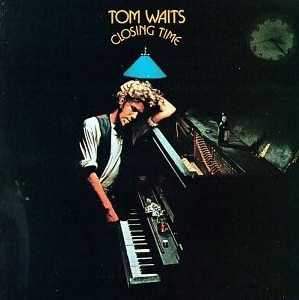
SOUNDTRACK: TOM WAITS-Closing Time (1973). 

This is the first official Tom Waits release.  There’s a couple “Early Years” collections which are really fascinating for how much he doesn’t sound like the 21st century Tom Waits, but these at least show glimpses of the man to come.  There are some songs on here that I knew of from different artists, and had no idea TW had written them  (Tim Buckley covered “Martha” the same year this came out (that’s pretty amazing), The Eagles covered “Ol’ 55” on their album the following year.  However, Van Halen’s “Ice Cream Man” is not a cover of Tom’s song). The funny thing about the record is how much he sounds like a late 70s lounge singer. How can an album as stripped down as this sound of an era? I don’t know, but it does. It’s also nice to know that his opening song “Ol’ 55” has had such a long life.

My wife does not like Tom Waits, but I think I could sneak this album past her.  You can tell that it’s Tom (before years of abuse to his vocal chords).  His voice is in fine non-gravelly form, just a little bass heavy.  And he is crooning to us.  He even has one of his sweet songs (“Midnight Lullaby”).  It’s hard (but not impossible) to imagine that this man would have turned into the man from Bone Machine.

As I was saying about the mid 70’s, the style of songs here could easily have been played on the same radio station as Springsteen (this album came out the same year as Greetings from Asbury Park–and Springsteen made famous “Jersey Girl” one of Tom’s early songs).  Indeed, many of these songs were covered by other artists.  The funny thing to me about the album is that although Tom is the pianist, I feel like the album is more focused on the trumpet (that muted trumpet seems to be everywhere (giving the album more of a jazzy feel than a rock feel).  And yet, despite this overall jazziness, “I Hope That I Don’t Fall in Love with You” and “Old Shoes (& Picture Postcards)” is a pretty straight-ahead folk song.  There’s also the beautiful ballad “Martha” played only on piano–such a gorgeous melody.  Perhaps the least exciting song is the instrumental ballad “Closing Time.”  It’s a simple piano melody with more trumpet.  There’s nothing wrong with it, it’s just not that inspirational.

I find that as I get older I like this album more (which is somewhat ironic since he recorded it when he was 24).  It’s tempting to say that the album–with its many styles–is unfocused, but Waits’ albums all seem to follow in this multiple-styles vein.  He’s not afraid to try something new (see his entire output since 1983).  But this one is a surprisingly straightforward album.  I can’t wait to see if Sarah likes it.

[READ: September 21, 2011] “Town of Cats”

Murakami is (in my limited experience) a master of the surreal. And yet for his more recent short stories, he seems to be switching into more of a story within a story conceit.  And that’s fine too, because the stories and the stories within the stories are clever and creative and still a bit surreal.

This story starts out a little awkwardly: at Koenji Station, Tengo boards a train with absolutely no destination in mind.  He can get off anywhere that he wants, he decides. He imagines going to the beach and enjoying a nice day.  But then he realizes that all along he has ben heading in one specific direction: to visit his father in a nursing home.  This is especially surprising for Tengo as he has not visited his father in over two years (and Tengo is his only relative).

As Tengo thinks back to his childhood, it is full of nothing but anger.  Anger that his father took him on his work (collecting fees for Japanese TV) every Sunday and that Tengo never had any chance for fun.  In fairness to Tengo’s father, Tengo’s mother died when Tengo was just a baby and his father had to take care of him as best as he could.  But there was no love, no warmth, no emotion.  And the more he thought about his father he realizes that that’s what his father was like–no intellectual curiosity of any kind.  Just work work work.

And yet Tengo can’t shake a memory from when he was only a year and a half or so of his mother standing near hs crib with a man who wasn’t his father kissing her naked breasts.  This memory has always been with him and he can’t help but wonder if his father really isn’t his father at all.  (more…)

Read Full Post »

SOUNDTRACK: GOGOL BORDELLO-Tiny Desk Concert #66 (June 28, 2010).

I had heard a few minutes of Gogol Bordello before this concert but it was during a TV show that I was half watching.  When I sat down and listened to this show, I was blown away by hem and immediately bought two of their CDs. Gogol Bordello is a multi-piece, multi ethic band that plays rocked-up Russian folk music (mor or less).  The sound is very traditional, with a kind of gypsy edge sprinkled onto it.  I’m not sure how many people are in the band, or how may people showed up for this concert but it sounds like about 100 in the tint room.  This is also the longest Tiny Desk show that I’ve heard (it runs almost 25 minutes).

The band plays five songs (and there’s a little chatting in between) and as the session goes on the band gets more rowdy (and more fun).  The video (also available at the same site) shows the singer sitting in the laps of the NPR folks and jumping on some desks and just having a blast.  And even though I enjoy shoegazing music, this is the kind of rollicking fun that I would love to see in concert.

The songs are political, but not overtly so, it’s more of a communal feel, of people uniting (which is indeed political).  I think they could get old kind of quickly, but in small doses the band is energizing and wonderful.

[READ: March 27, 2011] “U.F.O. in Kushiro”

This story was originally published in the March 19, 2001 issue and was inspired by the incidents of the 1995 earthquake in Kobe, Japan.  It was reprinted here to memorialize the recent earthquake in Japan.  The story is accompanied by rather devastating photos (and some surreal ones) of the aftermath of the earthquake in Kobe.

The story (translated by Jay Rubin) opens a few days after the Kobe Earthquake.  And even five days after the Kobe earthquake, Komura’s wife is still engrossed in the TV footage from Kobe.  She never leaves the set.  He doesn’t see her eat or even go to the bathroom.  When he returns from work on the sixth day, she is gone.  She has left a note to the effect that she’s not coming back and that she wants a divorce.  Komura’s wind is knocked out of him. (more…)

Read Full Post »

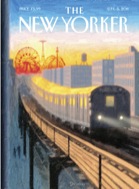
ny1It took me going to Seattle to learn about The New Yorker magazine.  I was visiting my friend Rob and he was really surprised that I didn’t read the magazine all the time (my reading always seems to surprise people, see The Believer.)

Upon my first read of the magazine, I was surprised to see that the first twenty pages or so are taken up with upcoming shows: films, concerts, sports, everything.  I actually wondered how much content would be left after all that small print.

Since then I have learned that Sasha Frere-Jones writes columns in here quite ofuiten.  For reasons known only to my head, I was convinced that Sasha was a black woman.  Little did I realize that he is not.  And that he was in a band that I have a CD of called Ui.  He is an excellent resource for all things music, whether I like the artist he’s talking about or not.  Some entries are here.  This audio entry about Auto-Tune is simply fantastic.

But of course, there’s a lot of content.  And the first thing you get are letters.  I don’t think I have EVER looked at the letters section. (more…)

Read Full Post »

believerA few years ago I was visiting my friend Roman.  He asked me if I read The Believer.  I told him I hadn’t heard of it.  He silently reproved me, knowing that it would be right up my alley and being quite displeased that I wasn’t keeping up with the hip.  I was very impressed with what I saw.

The Believer is put out through McSweeney’s.  It seems to have filled in for the non-fiction niche that McSweeney’s slowly removed from its pages.

And since then, I have become a devoted follower.  At some point (probably around issue ten or eleven) I decided that I was going to read every word in every issue.  And so, (this was pre-kids) when I went to an ALA conference with Sarah, I spent a lot of the down time reading all of the back issues’ articles that I hadn’t read.

Since then, I have read every issue cover to cover.  The thing that I love about the magazine (in addition to all of the stuff that I would normally like about it) is that every article is so well written that even if I don’t care about the subject, I know I’ll be interested for the duration of the piece.  Whether or not I will go on to read anything else about the person or topic is neither here nor there, but when I’m in the moment I’m really hooked. (more…)

Read Full Post »

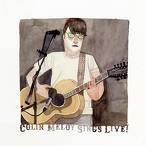
scan0014SOUNDTRACK: COLIN MELOY-Colin Meloy Sings Live! (2008).

colinColin Meloy is the lead singer and songwriter for the Decemberists.  This is a recording of Meloy’s solo acoustic tour from 2006.  The recording is from several venues on the tour, although it is mixed as if it were one concert.

Meloy is a great frontman, and this translates perfectly into the solo atmosphere.  He is completely at ease, telling stories, bantering with the crowd, and generally having a very good time.

The set list includes some popular Decemberists songs as well as a track from Meloy’s first band Tarkio (whom I have never heard, but figure I’ll get their CD someday).  Meloy also adds a couple of covers, as well as snippets of songs added to his own (Pink Floyd’s “Fearless” gets a couple of bars, as well as a verse from The Smiths’ “Ask.”)

This disc is not going to win anyone over to the Decemberists, as Meloy’s distinctive voice is a love it or hate it deal.  However, if you’re on the fence about them, hearing these songs solo can only convince you of what great songs they are.  The Decemberists add a lot of arrangements to their songs.  You get a lot of interesting and unusual instruments.  Which I like a great deal.  But to hear that these songs sound great with just an acoustic guitar is testament to Meloy’s songwriting.

The intimacy of the venues also really lets these songs shine.

[READ: May 29, 2009] McSweeney’s #4

This is the first time that McSweeney’s showed that it might be something a little different. #4 came, not as paperback book, but as a box full of 14 small, stapled booklets. Each book (save two, and more on those later) contains a complete story or non-fiction piece.

There is something strangely liberating about reading the stories in this format. It gives me a sense of accomplishment to finish a book and put it down, so having 14 makes it seem like I’ve accomplished a lot.
This was also the first issue that I’m certain I didn’t read when it originally came out, for whatever reason. So, it’s all new to me.

DIGRESSION: When I was looking up publications for my Wikipedia page about McSweeney’s publications, I kept encountering records for these individual booklets.  This was rather confusing as I couldn’t find any other records or ISBNs for these booklets.  Rest assured they are all collected here. (more…)

Read Full Post »

« Newer Posts