Feeds:
Posts
Comments

Archive for the ‘Dave Eggers’ Category

artofmcSOUNDTRACK: SUGAR-“Helpless” single (1992).

helplessI loved that first Sugar album and even bought the single for “Helpless” (back then singles were ways for record labels to get more money out of fans of a band rather than for people to pay for one song).  In addition to “Helpless,” the single contains three songs.  “Needle Hits E” is a poppy song–very Mould, very Sugar.  The song is a bright and vibrant addition and would fit nicely on Copper Blue.

The second track is an acoustic version of “If I Can’t Change Your Mind” which sounds wonderful.  Mould really knows how to record a 12 string guitar to make it sound huge.  “Try Again” is the final track.  It reminds me of The Who, especially the bass line at the end of each verse.  It’s a darker song (especially for his single which is so up).  But I love the way the acoustic guitar seems to make it build and build.  Then, some time around the two and a half minute mark, a feedback squall starts building.  It’s way in the background (and actually sounds a bit like squealing balloons).  It continues until the last thirty seconds just degenerate into full blown feedback noise–just so you know Sugar aren’t all pop sweetness.  All three songs were later released on Sugar’s Besides collection.

[READ: May 10, 2013] The Art of McSweeney’s

Sarah got this book for me for my birthday and I devoured it.  It answers every question I’ve had about McSweeney’s and many more that I didn’t.  It provides behind the scenes information, previously unseen pieces and all kinds of interviews with the authors and creators of the issues as well as The Believer, Wholphin and some of the novels.

The real treasure troves come from the earliest issues, when there was very little information available about the journal.  So there’s some great stories about how those early covers were designed (ostensibly the book is about the artwork, but it talks about a lot more), how the content was acquired and how the books were publicized (book parties where Arthur Bradford smashed his guitar after singing songs!).

The cover of the book has a very elaborate series of very short stories by Eggers (these same stories appeared on the inside cover of McSweeney’s 23).  For reasons I’m unclear about, the rings of stories have been rotated somewhat so it is does not look exactly the same–although the stories are the same.  The inside photo of the book also gives the origin of the phrase “Impossible, you say? Nothing is impossible when you work for the circus.”

The opening pages show the original letters that Dave Eggers sent out to various writers seeking stories and ideas that were rejected by other publications (and interesting idea for a journal). (more…)

Read Full Post »

[WATCHED: December 16, 2012] McSweeney’s #11

11

THE DVD that came with Issue #11 was listed as a “Deleted Scenes” bonus feature for this issue.  The colophon of the book explains in great detail what they wanted to do and how they went about doing it all.  And that’s all quite amusing in itself.

Now, of course, there are no “deleted scenes” up front.  The DVD is, at first glance, authors reading from the works in the book.  But as you scroll down the menu, there are some deleted scenes, as well as behind the scenes features and audio commentary.  All in all there’s about two hours worth of stuff crammed in here and some of it is quite interesting.

DELETED SCENES

This is where the authors read from their works.  They each read between 3 and 6 minutes, with some of them reading different sections (Samantha Hunt), but most of them reading a chunk.   (more…)

Read Full Post »

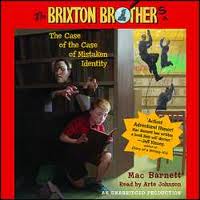
[LISTENED TO: October 2012] The Case of the Case of Mistaken Identity

I found this book because I was looking for audio books for my kids.  When we take longish car trips, they absolutely love audio books (which is pretty frikkin awesome by itself).  Anyhow, I was browsing the shelf and saw this title.  Clark and Tabitha enjoy A to Z Mysteries, so I thought this might be a bit more stimulating (it says it’s for 8-10 year olds, but Tabitha (5) enjoyed it and I didn’t find it too harsh for her).

I had never heard of the author [that is not true…more on that later], but the back of the book had accolades from Jeff Kinney, Dave Eggers and Jon Scieszka a triumvirate of trustworthy praise.

The audio book was read by Arte Johnson (yes, that Arte Johnson).  I don’t know if it was Arte’s delivery, but I enjoyed this book more than anything I have read in a long long time.  I wonder if the book would have been as enjoyable had I read it–I assume so because it was really fantastic, but it was a lot of fun listening with the whole family.

So this story is about 12-year-old Steve Brixton, a regular kid who happens to love the The Brighton Brothers Mysteries, a classic series of adventures (think Hardy Boys) in which two brothers get into scrapes and situations, take out thugs using their combination of brawn and brains and solve the mystery.  Steve loves them so much he has written down all of their suggestions for successful sleuthing which he keeps in his Secret Book Box.  He also got the Detective License for 12 box tops and $1.95.

He and his chum (all good detectives should have a chum) Dana have plans for the weekend until their teacher assigns them an 8 page research paper due on Monday.  Topics are randomly assigned and while Dana gets “detectives,” Steve gets “early American needlework.”  Miss Gilfeather suggests that it might be more interesting than he fears.

And boy is she correct. (more…)

Read Full Post »

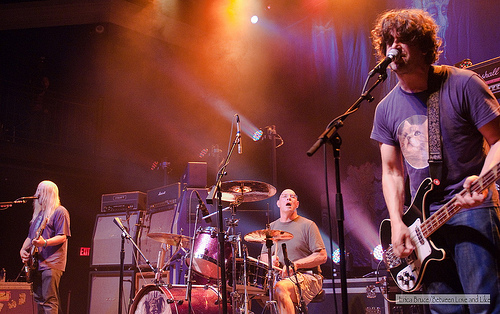
SOUNDTRACK: DINOSAUR JR.-Live at the 9:30 Club, Washington D.C. October 8, 2009 (2009).

This was one of the first shows I downloaded from NPR.  I’ve been a fan of Dinosaur Jr. since my friend Al turned me on to Green Mind back in college.

This is an amazing show created by the original Dino Jr. members.  This tour is in support of their second album since reuniting, Farm. This set-list is an outstanding mix of old songs, new songs, Barlow-sung songs and even some songs from when Barlow and Murph weren’t in the band.  (Green Mind is still my favorite album by them).

When the band reunited there was much joy, and I’ve said in reviews of the newer albums, I’m not entirely sure why.  I mean, Dino Jr has always been about Mascis, and it’s not like Barlow is such an unusual bassist (although Murph’s drumming is always solid).  I’ve nothing against Barlow (I love Sebadoh and Folk Implosion) or Murph, it just seems odd to get excited about having them back in the band aside from nostalgic reasons.

Having said that, the band sounds amazing (and yes, Barlow does get to sing on “Imagination Blind”).  What never really came across to me until hearing all of these great songs live was that Mascis has always been a great pop song writer.  These songs are catchy as hell. But Mascis buries them under loud squalling guitars and a voice that is almost whiny, almost off-key, a total slacker voice.  (But you’ll notice it is never actually off-key.  He must work very hard at that.)

By the nd of the show Mascis chastises the audience for not moving (we obviously can’t see what they’re doing), saying he forgets that people don’t move in Washington, D.C.  But during the encore break, NPR host, Bob Boilen, points out that Mascis himself doesn’t move either–he just stands in front of that wall of Marshall stacks (Boilen wonders how he can hear anything anymore).  And looking at the pictures it’s comical the way he looks, surrounded by amps.  The picture above doesn’t fully do it justice, but check out the extra photos at the NPR page.  And while you’re there, listen to this show. It is amazing.  For a total slacker, Mascis can rock a guitar solo like nobody’s business.

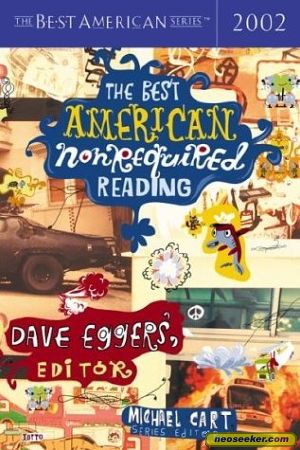
[READ: July 20, 2011] The Best American Non Required Reading

I’d been meaning to read this series for years (yup, Eggers fan), But I have a hard time starting “collections” because I feel like I’d rather be reading a novel.  Nevertheless, I have most of these Nonrequired books, so it seemed like I should dive into one and see what it was like (I don’t think the year really matters all that much–some of the articles are topical but most are not exactly).  Then Sarah said this would be a great book to read on vacation because it’s all short essays, and she was right.  It was perfect for late nights when I wanted something to read but didn’t feel like getting involved in the novel I was reading.

DAVE EGGERS-Introduction
Eggers’ introduction is actually a partial short story about kids who go swimming in pools around town. It reminded me of the opening of Life After God by Douglas Coupland, but of course, lots of kids did that so I’m not saying it was “lifted” from DC.  The story “ends” (it doesn’t really end so much as stop) with an interesting scene between two unlikely kids who get caught.

After this story Eggers includes these three notes about the collection: It’s not scientific, It’s alphabetical, and We had a lot of help with this.  Of the three, it’s the middle one that’s most useful because Eggers says that you shouldn’t necessarily read them in order just because they are printed this way: “In the first half of this collection, you get a good deal of hard journalism, primarily about war and refugees, from Afghanistan to the Sudan, followed immediately by a number of less serious pieces, about malls and Marilyn Manson.  We didn’t group anything by theme , and won’t be offended if you skip around.”  This was good to know (not that we needed the permission of course), but yes, the beginning of the book is pretty heavy. (more…)

Read Full Post »

SOUNDTRACK: President Obama reading Where the Wild Things Are (2009).

A President who is literate!

Apparently my video won’t fit here unless I space this section out better.

I don’t really have anything to say, except that I enjoyed hearing him read this.

And it’s fun to watch the Secret Service pretend to be invisible.

One more line should do the trick.

See the video here.

[READ: August 24, 2011] Wild Things

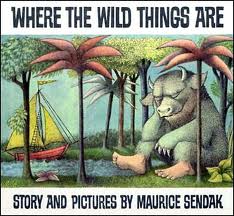
Okay, so this is a novel.  It is based on Where the Wild Things Are, the film by Spike Jonze and Where the Wild Things Are, the book by Maurice Sendak.  Obviously, Sendak’s book came first.  But, it’s only got about 60 words in it.  So, how do you make a film based on it?  Eggers and Jonze worked together for a long time to craft a screenplay and then (as Egger’s Acknowledgments explain) Jonze more or less took over the film and Eggers went off to write this book.

Hence, the book is fully titled:

The Wild Things: A Novel by Dave Eggers Adapted from the Illustrated Book “Where the Wild Things Are” by Maurice Sendak and Based on the Screenplay “Where the Wild Things Are” co-written by D.E. and Spike Jonze

I had read Egger’s except “Max” that was printed in the New Yorker ages ago and I liked it well enough, but it seemed so much like WTWTA, that I wasn’t sure what the point was (I didn’t realize it was an excerpt and, strangely enough, it’s an excerpt from several sections).  And since I had seen the film not too long ago (and honestly was kind of bored by it) I wasn’t really that excited about reading this.

But since I loved Zeitoun and this fur-covered book has been sitting near my bed for a couple of years now, I decided it was time.  And I really enjoyed it.

Well, here’s the thing.  This book is not a novelization of the film.  You notice that right away because the first chapter (which is awesome) is not in the film at all.  In it, Max rides his bike to his neighbor’s house.  His friend is not home but his mother is and when she sees Max all by himself and on his bike without a helmet she freaks out (even though they live about four houses apart).  His reaction and her overreactions are really very funny.

There are scenes from the movie in the book, of course.  It is adapted after all.  Indeed, it is more or less the same as the book, but there are many scenes which Eggers has added that really help to flesh out the story and give depth to everyone involved.  As a matter of fact, Max doesn’t reach the Wild Things’ Island until page 100 (out of 285 pages). (more…)

Read Full Post »

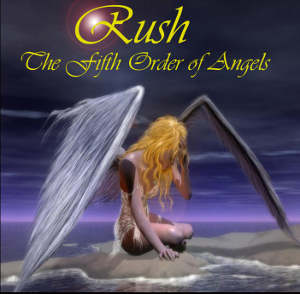
SOUNDTRACK: RUSH-The Fifth Order of Angels (bootleg from the Agora Ballroom,Cleveland, 26 August 1974) (1974).

I have mentioned this concert before, but I played it again today, and was struck by a couple of things.

1) According to the liner notes, Neil Peart had been in the band about two weeks.  How did they decide that their new drummer was going to be doing a drum solo during the show?  I mean, by now, everyone knows that the solo is its own song.  But, he’s been in the band two weeks.  It’s obvious he’s a good drummer, better than their original drummer, but a drum solo?  Is that just what rock bands did back then?

2) I’m struck by how much this show sounds like early Kiss.  I never really thought that  their first album sounded like Kiss, but in this live setting, a number of the songs, or perhaps just  the way they are recorded make me think of early Kiss.  In particular, during the crazy “one, two, three, FOUR!” of “In the End,” when the guitars kick back in, it sounds like a Kiss show from circa Alive!.

3) It’s amazing how guitar-centric the band was back then.  The mix is a little rough so it’s not entirely clear how insane Geddy is on the bass (when he gets a few solo notes, the bass sounds really tinny).  But the concert is like a showcase for Alex’s solos.  True, the whole first album really demonstrates what a great soloist he is, but it’s really evident here that Alex was the star.

4) Their earlier songs are really not very good.   I mean, every Rush fan knows that the first album is almost not even a real Rush album, but it’s shocking how pedestrian these songs are compared to even what would show up on Fly By Night.  Still, circa 1974 I’ll bet this show kicked ass.

It’s available here.

UPDATE: The missing content has been added!

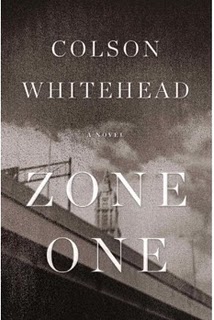
[READ: August 9, 2011] Zone One

After reading the excerpt from Zone One in Harper’s I decided it was time to read the book (which is due to be published in October).

I admit I haven’t read Whitehead’s other works, but I have read excerpts, and I thought I knew the kind of things he wrote.  So it came as a huge surprise when the excerpt ended the way it did. I didn’t want to spoil anything when I wrote the review of the excerpt, but since the entire book is set in the dystopian future and since it explain what has happened right on the back, I can say that Zone One is set in the aftermath of a kind of zombie apocalyptic plague.  And I can’t help but wonder if the rousing success of McCarthy’s The Road has more or less opened up the field of literature to more post apocalyptic, dare I say, zombie fiction.  [I haven’t read The Road, so there will be no comparisons here].

Actually there will be one.  Sarah read The Road and complained that you never learned just what the hell started the end of the world.  Indeed, in this book you don’t either.  There is an event called Last Night, and after that, there’s simply the current state of affairs.  I suppose you don’t really need to know, and since the story is all about dealing with the zombies, I guess it doesn’t really matter how it all started, but I think we’d all like to know.

Now what makes this story different from the typical zombie story is that for the most part there aren’t all that many zombies (or whatever these undead people are called) in the story.  There are some of course, and they are inconvenient to the main characters, but unlike a story like Zombieland, (which was awesome) or the more obvious Night of the Living Dead, the story isn’t really about fighting zombies, it’s more about the rebuilding of the country in a post-zombie world. (more…)

Read Full Post »

SOUNDTRACK: BILLY BRAGG-Live at the Newport Folk Festival (2009).

Billy Bragg is one of the great holdouts of aggressive political liberalism in music.  For every “American Idiot” that young bands play, Billy can whip out “There is Power in a Union” or the more prescient, “No Power without Accountability.”  Lyrics:

IMF, WTO,
I hear these words just every place I go
Who are these people? Who elected them?
And how do I replace them with some of my friends?

He’s an old school American folkie, despite the fact that he is so outrageously British that his singing accent is stronger than most British folks’ speaking voices.

But he’s not all politics (well, yes he is, but sometimes he disguises it).  Like on his minor hit “Sexuality.”  With some of the first gay positive lyrics I can remember hearing on the radio: “I’ve had relations with girls from many nations/I’ve made passes at women of all classes/And just because you’re gay I won’t turn you away/If you stick around I’m sure that we can find some common ground.”

Billy’s set is pretty great.  He plays the electric guitar for most of it (with an amusing moment where he switches to the acoustic guitar and references Dylan), and really, he needs no accompaniment.  He plays several of his own songs as well as a number of Woody Guthrie songs (both ones that Guthrie recorded and ones that Bragg and friends recorded for the Mermaid Avenue project).

Bragg also talks.  A lot.  His stage banter is as funny as it is impassioned.  And he urges people not to give in to cynicism about their newly elected President (the task is too great for him to please everyone).   Sometimes he comes across as really inspirational and other times as simply idealistic.

The only part of the show that I don’t really like is the “cover” of “One Love.”  I don’t particularly like the song to begin with and this version is 6 minutes long.  True, he modifies the lyric, but the basics are  the same.  Aside from that it’s a pretty rousing set (even if the DJs interrupt him about 40 minutes in, apparently thinking he was going to be end).

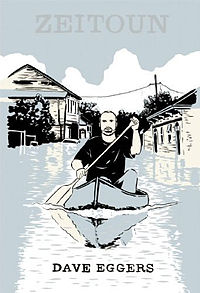
[READ: August 1, 2011] Zeitoun

I loved A Heartbreaking Work of Staggering Genius.  And I liked You Shall Know Our Velocity quite a bit too (and I just found out that YSKOV was rereleased as Sacrament with an extra 45 page section from Hand’s point of view–and that apparently there is only one copy available anywhere in the world and it costs $250!).

Anyhow, It was through Eggers that I found McSweeney’s (and its vast empire).  And yet during that time, I sort of gave up on reading Eggers’ published works.  When Zeitoun came out, I wasn’t all that interested to read it.  Mostly because I knew the book was about Hurricane Katrina, and I didn’t think I could handle a book about such a tragedy.

But recently, several people in book clubs had mentioned how good (and quick) of a read it was.  So I decided to give it a read.  And I’m really glad I did.

The book is about Abdulrahman Zeitoun, a Syrian born American.  He was living in New Orleans and was the owner of a very successful remodelling business (as well as the landlord of several properties around New Orleans).  Zeitoun is a hard-working, exceptionally conscientious man (the flashback to him running to work, carrying his broken bicycle on his back is as inspirational as it is amusing).  He rarely takes a vacation (much to his family’s chagrin) and oftentimes his wife has taken their kids on a vacation without him.  (One time they dragged into the car with his bags already in it without telling him they were going away for a weeklong vacation). (more…)

Read Full Post »

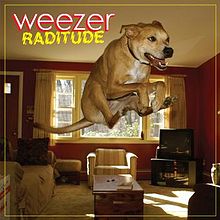
SOUNDTRACK: WEEZER-Raditude (2009).

I didn’t buy this Weezer album when it came out because I had heard really bad things about it (like the “guests”), but when I saw it cheap I decided to check it out.  This has to be the most polarizing Weezer album of them all.  I listened to it twice yesterday.  The first time I thought I had been too harsh on it.  The second time I thought it was godawful.  It’s amazing what a couple of hours can do.

It opens with a wonderful bit of poppy wordplay ala Cheap Trick: “(If You’re Wondering If I Want You To) I Want You To.”  It’s catchy as anything and is a wonderful start to the album, even if it is probably their poppiest song ever.  From there though, the album really degenerates.  And mostly it’s because it’s so dumb.  I mean the album title should tell you what you’re in for, but who would have expected the moronic sub-pop-metal of “The Girl Got Hot” or even the reprehensible lyrics of “I’m Your Daddy” “You are my baby tonight And I’m your daddy.”  It’s just creepy.  Or gah, a song about the mall?  “In the Mall.”  It’s not even worth mocking.  And really, try to picture Rivers Cuomo in a mall.  Any mall.

But nothing could prepare anyone for “Can’t Stop Partying.”  Unlike Andrew WK’s ouvre, which is so sincere about partying that you can’t take it seriously, this song really seems to be about the guys partying.  It’s laughable.  The anemic rap but Li’l Wayne certainly doesn’t help.

Even the collaboration with Indian musicians on “Love is the Answer” (yes, seriously) doesn’t really work.  It feels like they wrote the song and then said, “Hey let’s throw some sitar on it.”  It’s not enough to be exciting but too much to ignore.

This is not to say that these songs aren’t catchy.  I mean, geez, I still have “Can’t Stop Partying” in my head while I’m listening to something else.   Rivers knows how to write a pop trifle.  And the more he writes songs like this, it makes me thing that Pinkerton was the fluke.  Which is fine. The music world needs poppy songs, right?

[READ: early August 2011] various nonfictions

I thought about doing individual posts for all of Arthur Bradford’s non-fiction that’s available on his website (that’s right,  yet another author that I have read short uncollected pieces by without having read any of his bigger works–I’m looking at you Wells Tower).  Bradford has links to all of his nonfiction ( I assume) on his website.  There are 12 links in total.  One is to his blog (which I’m not reviewing).  The rest are for articles covering a pretty broad array of topics from a pretty broad variety of sources.  (more…)

Read Full Post »

SOUNDTRACK: MOGWAI: GovernmentCommissions: BBC Sessions 1996-2003 (2005).

It’s unlikely that Mogwai will ever release a greatest hits (well, someone probably will, but the band themselves don’t seem likely to do so).  As such, this compilation of BBC Recordings will certainly work well as one.

As I’ve mentioned many times, the BBC recordings are universally superb.  The quality of the recordings is unmatched.  And, typically the band takes the sessions very seriously.  The major different between these sessions and the official studio release is that the band is playing these songs live.  They are mixed well and sound great but they are live, so you can catch occasional subtle differences.

Mogwai, despite their seemingly improvised sound (all those noises and such) can recreate everything they do perfectly, and their live shows are tight and deliberate (except for the occasional moments where they really let loose).

The ten songs here span their career and are not played in chronological order.  This allows all of these wonderful songs to play off the tensions of each other.  And it shows that their later songs, which are less intense than their earlier ones, are still quite awesome and in a live setting don’t really lack for intensity after all.

The highlight of this disc is the scorching eighteen minute version of “Like Herod.”  The original is intense and amazing, and this live version allows them to play with the original in small ways, including allowing the quietness to really stretch out before they blow the speakers off the wall with the noise section of the track.

Even though I’m a fan of Mogwai, I don’t hear a radical difference between these versions and the originals.  Or should I say, it’s obvious which song they are playing.  There are some obvious subtleties and differences as befitting a live album, but unlike some live discs you don’t immediately notice that this version is “live.”

And that works well for both fans of the band (because as you listen and you hear the subtleties) and for newcomers–(because you’re not listening to weird, poorly recorded versions or versions that are for fans only).  And so, you get ten great Mogwai tracks.  Just enough to make you want to get some more.

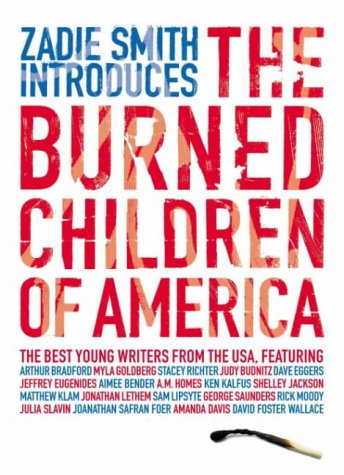
[READ: June 11, 2011] The Burned Children of America

I found this book when I was looking for other publications by Zadie Smith.  This book kept cropping up in searches, but I could never really narrow down exactly what it was.  As best as I can tell, it is a British version of a collection of American authors that was originally published in Italy (!).  Editors Marco Cassini and Martina Testa work for minimum fax, an Italian independent publisher.  In 2001, they somehow managed to collect stories from these young, fresh American authors into an Italian anthology (I can’t tell if the stories were translated into Italian or not).

Then, Hamish Hamilton (publisher of Five Dials) decided to release a British version of the book.  They got Zadie Smith to write the introduction (and apparently appended a story by Jonathan Safran Foer (which was not in the original, but which is in the Italian re-publication).  This led to the new rather unwieldy title.  It was not published in America, (all of the stories have appeared in some form–magazine or anthology–in America), but it’s cool to have them all in one place.

The title must come from the David Foster Wallace story contained within: “Incarnations of Burned Children,” which is one of his most horrific stories, but it sets a kind of tone for the work that’s included within (something which Zadie addresses in her introduction): why are these young successful American writers so sad?  So be prepared, this is not a feel good anthology (although the stories are very good).
Oh, and if you care about this kind of thing, the male to female ratio is actually quite good (for an anthology like this): 11 men and 8 women.

ZADIE SMITH-Introduction
Zadie Smith was a fan of David Foster Wallace (she wrote a  lengthy review of the ten-year anniversary of Brief Interviews with Hideous Men which is republished in her book Changing My Mind), so she is an ideal choice to introduce this book.  Especially when she provides a quote from DFW’s interview in 1995 about how living in America in the late 90s has a kind of “lostness” to it.  With this in mind, she sets out the concerns of this collection of great stories: fear of death and advertising.

Zadie gives some wonderful insight into each of these stories. The introduction was designed to be read after the book, and I’m glad I waited because while she doesn’t exactly spoil anything, she provides a wonderful perspective on each piece and also offers some ideas about the stories that I hadn’t considered.  And it’s funny, too. (more…)

Read Full Post »

SOUNDTRACK: FRANK ZAPPA-Does Humor Belong in Music? (1995).

Frank Zappa made money and found fame by writing dirty, funny songs.  Yet he was really a great guitarist and a serious composer.  But hey, when you need the money to make your studio, you write songs about “Penguins in Bondage.”  When I was in high school my friend Al introduced me to Shiek Yerbouti, and I was hooked.  I’d never heard songs that were so intentionally funny.

So, this live collection is kind of an odd assortment, given the title.  I mean the first song is an instrumental (ie. not funny at all except for the title “Zoot Allures”).  “Tinseltown Rebellion” however is pretty darn funny.  The mockery that goes on (and the call-outs range from The Scorpions to Culture Club and The Tonight Show) is nasty and offensive, but never really wrong.  And this is when you find out how good a Zappa stage show was.  The band was tight, they could play all kinds of crazy things and, as in this song, they were always in sync even when improvising.

This disc is a collection of songs from a 1984 tour.  I rather like this incarnation of the Zappa band (Ike Willis is pretty amazing at any time).  And they play tracks from across Zappa’s output.  Although there’s times when the disc sounds really abrasive (some of the solos–like on “Bondage”–are really piercing and not very smooth, and the drums can be very electronic sounding).

Of course, that’s the kind of music that Zappa wrote (“What’s new in Baltimore” is very electronic sounding–beautiful but mechanical–which is why it’s so amazing to hear it live–even if it doesn’t sound human, exactly).

And just so you know it’s not only Zappa showing off (although he kind of is since he hired all the musicians) in “Let’s Move to Cleveland,” everyone gets a solo…keybaords, drums…everyone.  And the final track “Whipping Post” sees his son Dweezil taking the lead guitar solo (which feels really human and rocks the dickens off the place).

For many of Zappa’s later “live” records, he compiled songs from all over the place (a very common practice for live records).  On some of the collections he even mixed a tour from the 70s with one from the 80s.   Now the thing that I just recently realized (even though it’s spelled out in the liner notes) is that these songs are cribbed together from different songs (!) (on “Cleveland” the piano solo is from St. Petersburg, the drum solo is from Vancouver, and the guitar solo is from Amherst College…weird, eh?  And what about the backing music, where does that come from while the solos are spliced in?)).  So, they’re not really live, except they kind of are.  And, heck that’s kind of funny too.  If you care about things like that it kind of ruins the “authenticity” of the recording.   But if you don’t, they sound pretty darn good anyway.

So this is not his funniest stuff, but it’s still an interesting live collection.

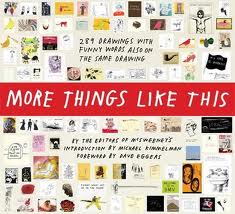
[READ: November 12, 2010] More Things Like This

I don’t know where I learned about this book, but I recently found it used for about $4 and I was pretty psyched to both find it and to pay a pittance for it.

As the subtitle indicates, this book is a collection of drawings that have words on them and are funny (but which are not “cartoons” (although some kind of are)).  The impetus for the book was a show at apexart of exactly this sort of thing.  The book expands on the show and includes many artists who were not in the show (including several very famous artists).

The Foreword by Dave Eggers offer the rationale behind the show & the book: Image + Text (usually referring to the image) + Humor = Good enough for us.  And it also asks pertinent questions: Why is it that so many of these artists can’t spell?  And why is it that when they screw up a word, instead of starting over, they just cross the word out and write it again?  Why is it important to some of the artists that the drawings appear casual, even sloppy?

And more. (more…)

Read Full Post »

« Newer Posts - Older Posts »