Feeds:
Posts
Comments

Archive for the ‘Artists’ Category

percy3SOUNDTRACK: TROMBONE SHORTY-Tiny Desk Concert #162 (September 29, 2011).

tromb Trombone Shorty is from New Orleans and his backing band is called Orleans Avenue.  I can’t think of too many bands that are fronted by a trombone player.

This is a super fun set.  It opens with “Dumaine St.” a short (just over 2 minutes) jazzy number that comes from his then recent album For True.  There’s some great rhythm in the low end–the baritone sax and bass guitar keep a great groove, especially during the trombone solo (!).  It’s short, but it’s great.

Dan “Uncle Potato Chip” Oestreicher, opens the second song with a great bass line on the baritone sax.  The song is called “Lagniappe which is “a little gift you get for buying something. It’s an especially common practice in certain corners of the world, including Louisiana, where the term originates.”  It’s an improvisational piece built around the great bass line.  It features a trombone solo and great tenor sax solo by Tim McFatter.  The song builds (for about 5 minutes) to an exciting  conclusion (“a light workout,” Shorty calls it).

The final song has lyrics sung by Shorty. It’s probably my least favorite of the three as the lyrics aren’t that great (although his voice is good).  It’s got a good funky rhythm, but it slows things down when he is singing.  And I just want to hear him play.  Once he picks up the trombone again, the song springs to life and is a super amount of fun–with another great melody.

I wasn’t sure I’d like this set but I enjoyed it a lot.

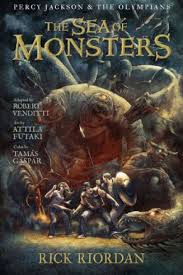
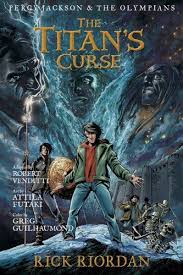
[READ: November 22, 2015] The Titan’s Curse

The good news was that I could get both the second and third graphic novels at the same time (both with art by Attila Futaki).  The bad news is that apparently the fourth (and fifth) books were never made!  I don’t know if there are plans for them to get made but as of right now, we’re stuck at a to be continued.

Of the three, I found this book to be the most confusing because so many characters looked alike.  There was also the addition of several new characters (and as with the previous book, there was very little in the way of introduction).

We don’t know why, but Percy and Annabeth have gone to a specific place to rescue two orphans, Bianca and Nico.  They are both half-bloods, unbeknownst to them.  Bianca is initially suspicious of the heroes, but Nico is right on board.

In terms of action, there’s quite a lot.  We meet Artemis, goddess of the hunt who has arrived with her hunters.  She speaks formally and is suspicious of men.

After careful consideration Bianca decides to join Artemis’ hunters (which gives her immortality–death may only come in battle–as long as she forswears romantic love, which she has no problem doing).  Meanwhile, Nico decides to return to the camp with the others.

Oh and Annabeth, while fighting a manticore, is thrown over the side of a cliff, presumably lost forever.  Percy is freaking out but they convince him to head back to camp for reinforcements.

A new quest is decided upon, but Percy’s first goal is to rescue Annabeth.  Although we soon see that she is not dead, she just has the weight of the world on her shoulders.  Literally.

And then Apollo shows up in his golden chariot (which is a sports car naturally).

Back at camp, the director has them don helmets for more training, this time hunter against half-blood.  The hunters win every time.  This was a hugely confusing scene since everyone is in battle gear. The book is also hugely confusing because several of the scenes are done with characters in close up and Zoe (whose origin I can’t even recall) and Percy look quite a lot alike

But there’s some really wonderful scenes, like when the horse speaks to Percy and later when Percy rescues the Ophiotaurus (which he calls Bessy).

I liked that the middle section takes place in the Museum of Natural History–which allows for some cool details.  The dinosaur teeth are actually dragon teeth and the lion is really the Nemean Lion.  And when the bad guys get some skeletons to rise from the earth, they are sent on a single mission–to destroy Percy.  And they cannot be stopped by half blood weapons.

There’ a great scene with a large flying statue and then a cool scene at the Hoover Dam.

I typically enjoy when the scenes turn mystical but I was confused a bit when Artemis returned to her sisters.  I think the character of Zoe perplexes me too much, even when she reveals her true identity.

And speaking of true identity, Nico’s reveal is pretty fantastic, too.

The final scene shows a meeting of the Gods again, which I liked.  Unfortunately it seems to set the stage for book four, which we won’t seem to ever get.

More reason to rad the actual novels, then, right?

Read Full Post »

percy2SOUNDTRACK: JENNY LIN-Tiny Desk Concert #160 (September 6, 2011).

linJenny Lin is an amazing pianist.  So it’s slightly disconcerting that she is playing these beautiful pieces on a Korg keyboard.

The write up says

It’s rare to see a world-renowned pianist willing to make such a sacrifice, but that’s how strongly Lin feels about getting the music out there, knowing that (with even more downsizing) folks could watch her perform this Tiny Desk Concert on their iPhones.

And while I wouldn’t think that a great pianist would have a problem playing an electronic piano, I had to wonder if the keyboard weight impacted her at all.  It sure doesn’t seem like it.

She plays five pieces altogether.  And they are all modern pieces.  I don’t know a lot about Shostakovic, but the blurb says that  Shostakovich, inspired by Bach wrote his own set of Preludes and Fugues in all 24 keys in 1950.  I would have guessed they were Bach, but you can hear differences in his more modern style (and not just because of the keyboard).  The notes are fast and furious (and beautiful).

I don’t know Federico Mompou at all, but the blurb says  “Barcelona-born Federico Mompou was a contemporary of Shostakovich’s, but that’s where the comparisons end. In the 1960s, he completed four volumes of piano music he called Musica Callada, or “Silent Music.” Mompou’s sound, [features]  austere beauty and emphasis on the spaces between notes.”  And you can really hear the way the notes ring out (I’ll bet even more so on a grand piano).

The final song is an arrangement of Gershwin’s “Fascinatin’ Rhythm” which has been “souped up by the late American virtuoso pianist Earl Wild. His arrangement turns the Gershwin song into a kind of stride-jazz extravaganza.”

Watch Lin’s hands fly around the keyboard.  It is hard to comprehend.  I don’t know which hand I am more impressed by.

It’s amazing to be able to watch a master so closely.

The setlist:

  • Dmitri Shostakovich: Prelude and Fugue No. 2 in A minor, Op. 87
  • Dmitri Shostakovich: Prelude and Fugue No. 7 in A major, Op. 87
  • Federico Mompou: Musica Callada — Nos. 1, 15
  • Gershwin (arr. Earl Wild): “Fascinatin’ Rhythm”

[READ: November 22, 2015] The Sea of Monsters

Clark really liked the first graphic novel and asked me to get the rest.  So I did.  And then I had to see how the story continued, too.

Book two of the graphic novel series (also with art by Attila Futaki) begins with Percy at home.  He is told he shouldn’t return to Camp Half -Blood, but his mom won’t say why.  At “regular” school, he is still picked on, but he now has help from a huge boy known as Tyson.  The bullies make fun of Tyson too, calling him a retard, but Percy sticks up for him. [The one problem with the graphic novels is they have to edit down so much, there’s no real introduction to Percy’s school or to Tyson].

On the next page, though, we learn that the bullies are actually demons and that Tyson is able to fight them off because he is …a cyclops.  (It must be very hard to create a cyclops–visually, they are just so wrong–where do you put that eye?  Do the normal eye sockets still exist? I always find them disconcerting to look at). (more…)

Read Full Post »

SOUNDTRACK: LOpercy1CAL NATIVES-Tiny Desk Concert #113 (February 21, 2011).

localI’ve decided to cherry pick some Tiny Desk shows for the end of the year–order be damned.

Local Natives are from L.A.  They play (in this Tiny Desk Concert anyway), a folkie alt rock which really emphasizes the band’s gorgeous harmonies.

For this set there are two acoustic guitars, an acoustic bass, a drummer and some cool extra percussion.  It also makes me laugh to see them all packed so tightly in that little space.

The first song “Wide Eyes” has lovely harmony vocals by the guitarist and the percussionist.  But when the backing vocals kick in, the sound really soars.

“Cards & Quarters” has a lovely guitar intro and fantastic three part harmonies.  I love the way the songs builds and builds to the end–it’s very dramatic.

For the final song, “Airplanes,” the percussionist switches to guitar (and sings lead vocals) and one of the guitarists plays the mandolin.  This song is very personal, with lots of details about the singer’s grandfather.  Again, the harmonies are gorgeous.

I’ve heard a lot about Local Natives and now I need to check them out more closely.

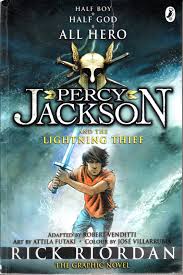
[READ: May 23, 2015] The Lightning Thief

I have seen the Percy Jackson movie and now I’ve read the comic book, but I have yet to read the actual novel (or series).  I figure I will some day.  But for now I’ve had this cool graphic novel to flesh out the movie.

It’s interesting how the movie and graphic novel (with art by Attila Futaki) emphasize different things.  It felt to me like the movie spent more time on introducing the characters once they got to “camp,” while the graphic novel seemed to gloss that.  But there were some other adventures that the group went on which were different between the book and movie (which may have just been for expenses).

Okay, so the brief summary of the book is that Percy Jackson is a boy in school.  He has trouble reading and his teacher gives him a hard time.  As we open, the class is learning about ancient Greek myths and the teacher is emphasizing how important they will be for Percy.  On the next page, one of Percy’s teachers turns into a demon and attacks him.   But no one else is aware of it.  Except maybe his best friend, Grover.

When school ends, Percy heads home to his mother’s house.  His mother is living with a totally awful guy (there was more about this in the movie) and explains that Percy’s father left before he was born.  But just as they settle in, Grover shows up and tells them they have to go.  Now. (more…)

Read Full Post »

sing no evilSOUNDTRACK: STILE ANTICO-Tiny Desk Concert #86 (October 25, 2010).

stile I’ve said before that one of the great things about the Tiny Desk Concerts is being introduced to bands that I never would have heard of anywhere else.  And that is certainly true of Stile Antico.  I really enjoy this kind of a capella music, although I never listen to it.  And I wouldn’t even know where to start looking for it.

So, lucky for me, I now know a band that performs gorgeous 16th-century choral music.  There are twelve singers.  And it is comforting in this day of pop singers who are more hot than musical that Stile Antico is all about the voice.  They don’t dress flashy or sexy, they don’t really do anything…except sing to the heavens.

They perform four pieces in about 20 minutes.  I don’t know any of them and I honestly couldn’t really tell them apart, but I loved the whole show.

The lead speaker (unnamed in this show) says that William Byrd is the best songwriter of the era, which is why they do two of his songs.  After the first one, he says that they want to transform this office into some kind of Tudor Chapel.

The second piece, “The Lord’s Prayer” is not done in any melody that I have ever heard it (and I assume it is in Latin).

But it’s the final piece that is really the showstopper, and the one that is fun to watch (even though, as I say they’re not actually doing anything–okay not true, they are nodding to each other instead of using a conductor).  Praetorious’s piece weaves 3 choirs together with 12 independent voices.  And the speaker jokes that each of the three choirs wind up flirting outrageously with each other.  It’s breathtaking.

Their voices are simply beautiful, and it’s amazing to see them working together silently as they sing.

The only problem is that now that I know who they are, which of their 11 records do I start with?

The songs:

  • William Byrd: “Vigilate”
  • John Sheppard: “Lord’s Prayer”
  • William Byrd: “Ecce Virgo Concipiet”
  • Hieronymus Praetorious: “Tota Pulchra Es”

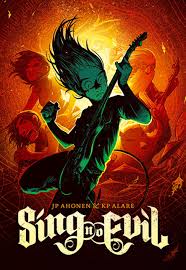
[READ: July 10, 2015] Sing No Evil

I saw this book at the library and loved the title.  As soon as I flipped through it I knew I had to read it.  This book was originally written in Finnish (cool!) and was translated by JP Ahonen into English.  It is all about Fininish death metal bands and the devil.  And it is cool and very funny.  It was originally called Perkeros (which is what the protagonist’ band is called) and which I can’t quite define, but that’s okay.

The book opens on Aksel rocking out (in his imagination).  He and his band are getting ready to go on stage and he is nervous.  Aksel is a perfectionist and his riffs and progressions are second to none (Perkeros is a progressive death metal band which I’d rather like to hear).  The problem for the band is that Aksel’s singing is poor.  But the band likes what they do.  So they keep playing.

Here’s the fun part.  The band consists of Aksel and Lily on keys (and here I have to comment that Lily and Aksel don’t look all that different in drawing style but somehow Alarea has made these simple lines create two very different looking characters, and with those simple lines you can see just how pretty Lily is).  There’s also Kervinen, a really old guy with a chest-length beard (he used to be a monk), and, well, a bear, yes, a bear, on drums (the bear’s story is never given).

The band is opening for Nelum Lucifera, a grease-painted death metal band (with names like Belphegor and Samael).  A fight ensures and the bands are banned from every playing that gig again. (more…)

Read Full Post »

acSOUNDTRACK: LOWER DENS-Tiny Desk Concert #84 (October 10 2010).

lowerLower Dens are a band from Baltimore who I’ve heard of but who I didn’t really know.  And after hearing this Tiny Desk, I immediately fell in love with their peculiar song structure and wonderfully expansive sound.

The set opens with “Two Cocks Waving Wildly At Each Other Across A Vast Open Space, A Dark Icy Tundra” which has a long (nearly 2 minutes) instrumental opening.  And then the song proper changes style completely.  It has great interplay of guitar and bass and gentle vocals.  And amazingly the song is only 4 minutes long, even with all that build up.

“I Get Nervous” is slower with waves of guitar washes.  It builds and ends quite suddenly.

Just before the third song, “Rosie” you can hear singer/guitarist Jana Hunter whisper “This is fun.”  She busts out an old beat up acoustic guitar on which she plays a slow 90 second guitar pattern before the chords kick in and then seconds later the vocals come along.  I love the soaring electric guitar over the top.  And again it is over before you suspect (the song is only 3 minutes).

The final song, “What Isn’t Nature” is moody and minor key.  It goes on for longer than the other songs and is just as good.

I have to check out more from this band who totally fell under my radar.

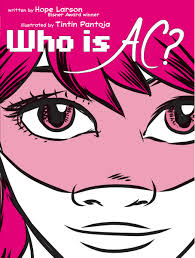
[READ: July 12, 2015] Who is AC?

I really like Hope Larson’s books and I especially like her drawing style.  So I was a little bummed to see that she didn’t draw this one.  Tintin Pantoja’s art style is very different and it was easy for me to forget this was a Larson story.  I liked Pantoja’s style but not as much as Larson’s–it’s just very different.

At the same time I didn’t really like this story that much.  There were some very cool elements but whether it was poorly explained by Larson or if the illustrations didn’t quite convey what was meant to be there, I’m not sure.

The book starts with Lin on a plane writing her zine, Rhea Ironheart.  She is flying to a new city and misses her friends already.  But mid-flight she receives a strange phone call from a number that is all binary.  She answers the phone and blacks out, but what could it mean? (more…)

Read Full Post »

dragonsSOUNDTRACK: THE NELS CLINE SINGERS-Tiny Desk Concert #78 (September 7, 2010).

nelsNels Cline has played guitar with Wilco for over a decade, but he has also played with punk rockers and jazz musicians.

The Nels Cline singers are an instrumental collective  that consists of Cline on guitar, upright bassist Devin Hoff and distinctly jazzy drummer Scott Amendola (he plays a lot of percussion including hitting a cymbal with what looks like a chopstick).  They also have special guest Yuka Honda from Cibo Matto on keyboards.

Cline gets some great sounds out of his old beat up guitar (I have genuinely never seen anyone play harmonics on the guitar in the manner that he does).

The music is airy and spacey (especially “B86 (Inkblot Nebula)” which features bowed bass and interesting sounds from Honda and a fascinating array of bell and cymbals on the drum set.

For “Thoughts on Caetano” he switches guitars.  Unfortunately the video seems to keep cutting out around this point so the rest of the show has to be on audio only.  But the sounds that they create are very cool and interesting.

The biggest surprise to me in these pieces is that they are mostly fairly short.  They seem like they could be side-long explorations, but “You Noticed” comes in around 4 minutes or so, and “B86” is only around 3 minutes as is “Thoughts on Caetano.”

The final song has a more jazzy feel.  Complete with a  bass solo and some very interesting drum sounds (I wish I could see how he’s doing them).  This last song is the longest it’s about 7 minutes.

I was really surprised by this Tiny Desk–I had no sense of what Nels Cline would play, and it was a real treat to hear.

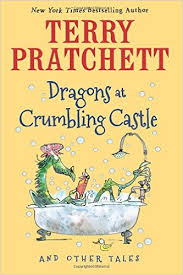
[READ: August 19, 2015] Dragons at Crumbling Castle and Other Tales

Obviously death has never stopped anyone from releasing books.  So here is one of the first collections of posthumous stories from Sir Terry Pratchett.

Interestingly, these are stories from when Terry was a young lad.  This is a selection of children’s stories that were first run in the Bucks Free Press (he was a junior reporter).  They are simple but clever, with lots of ideas that Pratchett would explore in greater details as he got older.

There are 13 stories in the book, and they explore variations on Pratchett’s themes like that the unfamiliar is not the enemy (necessarily) and that people can and often will be surprised by how others react.  He also has some a story idea that would blossom into the carpet people stories later on.

“Dragons at Crumbling Castle” (1966) is a story of everyone overreacting when they find a dragon in the castle  (it proves to be a little baby dragon).

“Hercules the Tortoise” (1968) is the story of a brave tortoise who crosses his pond.

“The Great Speck” (1969) is an interesting story of huge worlds on tiny specks and how even they can be territorial

“Hunt the Snorry” (1966) is  a very funny story about brave hunters going in search of an elusive thing which proves to be something else entirely (and which they inadvertently catch).

“Tales of the Carpet People” (1965) is similar to the Speck story in that it talks about very small people living in a carpet and their adventures as they try to see the world beyond (the dreaded linoleum).  I actually found this first story to be kind of dull and confusing, but I can see how it became the basis for greater things.

“Dok the Caveman” (1966) invents all kinds of things but they usually go wrong–nevertheless the inventions themselves are pretty spectacular.

“The Big Race” (1968) differs from all the other stories in that it is about technology (although it is very Pratchettian in the end).  It proves to be a race between a gas-powered car and a steam-powered car (and anyone else who wishes to join the race and cheat if necessary).

“Another Tale of the Carpet People” (1967) was more successful perhaps because they actually got off of the carpet and met new people.

“The Great Egg Dancing Championship” (1972) was a funny story about how cheaters never win (and about dancing on eggs).

“Edwo the Boring Knight” (1973)  Sometimes boring people to sleep can be your greatest weapon.

“The 59A Bus Goes Back in Time”  (1966-67) This story was fun in its time travel (going to the major historical epochs) but more so because of the way the locals reacted to the bus.  And that the bus should always try to stay on schedule.

“The Abominable Snowman” (1969) had a lot of fun with the conventions of exploration and how easy it is to derail a planner.  It also works with the idea of a very tiny creature that everyone is searching for.

“The Blackbury Monster” (1968) is all about how fame may not be the best thing for a small town after all.

“Father Christmas Goes to Work” (1973)  How is Father Christmas supposed to make any money on the other 364 days of the year?  Get to work!  But what can he possibly do?  Not much it seems.  (There’s a happy ending of course).

The text is manipulated to make it very kid friendly (large print when people yell, different fonts, dark pages when it is a dark scene, that sort of thing.  It also has illustration by Mark Beech, but I found them to be really basic sketches.  I would have loved to see more by Pratchett artist Paul Kidby.

I tried to imagine my kids enjoying these stories, but I didn’t really think they would.  Perhaps because they aren’t British and it isn’t forty years ago.  But I enjoyed them.  And each one brought a smile to my face.

Read Full Post »

concavityStarting this month, Matt Bucher and David Laird, scholars and fans of David Foster Wallace have created the first regular Podcast devoted to Wallace.  And the intro and closing music is from Parquet Courts’ “Instant Disassembly” which is also pretty cool.

This introductory episode serves as an introduction to Bucher and Laird, their love of Wallace’s work, and what they hope to do in future episodes.

Matt Bucher lives in Texas, not far from the Ransom Center where the Wallace archives have been settled (he assures us that he moved there before the site was selected). David Laird is from Kelowna, in British Colombia (4 hours east of Vancouver).  The claim to fame of Kelowna is the mythical lake monster Ogopogo.  But in Infinite Jest, a character is spoken of as being addicted to a thick apple juice that comes from BC.

Bucher also runs Sideshow Media Group which published Elegant Complexity, Nature’s Nightmare, and Consider David Foster Wallace. He says he and his brother founded the press because no one would publish Elegant Complexity, and he felt it needed to get out there. (more…)

Read Full Post »

tsugeSOUNDTRACK: MOPS-“White Rabbit” (1968).

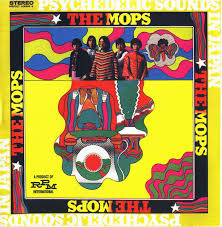
mopsAfter totally grooving on The Mops’ songs in yesterday’s post I decided I had to check out their cover of Jefferson Airplane’s “White Rabbit.”

And, boy do I love it.  It came from their debut album Psychedelic Sound in Japan which was released in 1968 (“White Rabbit” came out in 1967).   The album also includes covers of “Somebody to Love” by Jefferson Airplane, “Light My Fire” by The Doors and two songs by The Animals.  They received much press for being the “first psychedelic band” in Japan, and performed with elaborate light shows.

Lead singer Hiromitsu Suzuki really nails all the notes (even if he doesn’t quite nail all the words), but I especially enjoy the instrumentation they employ–the violin is an interesting addition.  And the way the instruments are separated in headphones (all drums in the right ear?) is really psychedelic.

It is really a trippy version (“Somebody to Love” is pretty fine too, especially when the really buzzy guitar kicks in about half way through).

Trash Market

Tadao Tsuge is a Japanese cartoonist considered “one of alternative manga’s cult stars.”  He has been making cartoons since 1959 and has contributed to all manner of Japanese publications.

What seems to set him apart from other cartoonists (according to the interviews and such that fill out the book) is that Tadao grew up in the slums of Tokyo and is willing to write about them.  He also worked for many many years at a blood bank (one that paid people for their blood).  It was there, amid the terrible conditions, that he believes he contracted hepatitis.

The amazing thing to me while reading these six cartoons (which I assume are only a tiny fraction Tadao’s total output, but I’m not sure) is that I had no idea when they were written–they have a timelessness that is really amazing.  So when I finally flipped back to the front and saw that the first story was written in 1968, I was blown away. (more…)

Read Full Post »

pablo SOUNDTRACK: BUILT TO SPILL-Live (2000).

btsliveSoon after releasing “Carry the Zero,” Built to Spill released this, their first (and so far only) live disc.

This disc shows a jamming side of the band that their records up to now hadn’t really displayed (sure there was some evidence of the jam band within, but who would have guessed 2 songs on this disc would stretch to 20 minutes?).

The live set also shows a rather contrarian spirit in that there are only 9 songs in 70 some minutes and only 5 of the songs are actual Built to Spill songs.

The disc opens with “The Plan,” a great version of their most recent disc’s opener.  Then they jump right into Perfect from Now On’s  opening track “Randy Described Eternity.”  That song has a lot of parts and sections, and they do them perfectly.  They follow it with another song from Perfect, “Stop the Show” which also has multiple parts and again, they nail it.  These three songs were recorded in New York.  Brett Netson joined them for “Randy,” and “Stop” which really helps to flesh out those songs.

The next song is a cover of The Halo Benders’ “Virginia Reel Around the Fountain.”  And if it sounds very fitting for Doug, he was in The Halo Benders with Calvin Johnson before he started Built to Spill.  Then comes the centerpiece of the record–a 20 minute version of Neil Young’s “Cortez the Killer.”  And it is amazing.  He sounds enough like Neil to be totally respectful, without just being a rip off.  It’s probably the best version of this song I’ve heard (until I saw Neil do it this summer).

They switch gears to their first single, “Car,” a delightful 3 minute song.   And then, to fill out this almost all covers section, they play “Singing Sores Make Perfect Swords” a song originally done by Love as Laughter.  I don’t know the original, but it fits in with Doug’s style.  These four songs were record in Seattle.

There’s one song that was recorded in Denver, “I Would Hurt a Fly,” which is yet another song from Perfect, and is one of my favorite songs of theirs.  It does not disappoint.

The final song on the disc is a nineteen minute version of the song “Broken Chairs” (which is 8 minutes long on Secret).  They do the whistling section and a ton of solos.  Indeed, the way they stretch out the song out with guitar solos and noise (and the way the song ends with feedback) is really cool.  Netson joined them for “Fly” and “Broken Chairs” (which is why that ending solo is so intense.

It’ s a great live collection of songs and the sound is outstanding.  You’d never know it was recorded in different venues, either.

[READ: October 4, 2015] Pablo

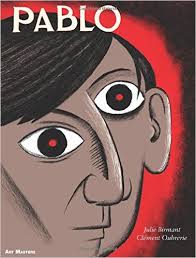
Judging this book by its cover you would be correct in assuming that it is about Pablo Picasso.  But rather than being a simple history of the Art Master (the title of the series), this is a thorough recounting of Picasso’s life.  And what’s even more interesting is that the story is told from the point of view of Picasso’s lover and model Fernande Olivier.

And Fernande’s diary entries make up the bulk of the story and allow for a very personal look into the man and the stylistic choices that Picasso made over the years.  As the book says on the back, the authors show “how Picasso’s style developed in response to his friendships and rivalries.”  And of his rivals none was greater than Henri Matisse.  (The book also covers Picasso’s life before she met him too, of course).

The original work was published (in French) in four volumes.   This edition was translated by Edward Gauvin.

I especially like the way the book begins from the point of view of Fernande as an old woman, still alive and reminiscing about her life. (And yes, it’s amazing to realize that Picasso died in 1973…in my lifetime!).  (more…)

Read Full Post »

1955SOUNDTRACK: BUILT TO SPILL-Perfect from Now On (1997).

330px-Perfect_From_Now_OnBuilt to Spill moved to the major labels and everything changed. No that’s not true. The band (well, Doug mostly) just sounds more serious about their music. What’s impressive is that there are no obvious  singles since each song is over 5 minutes long (except for one).

This is considered a classic 90s album but fans of the band and others.  And while I like it, it’s not my favorite.  A few of the songs are a little too drifty and anticlimactic.  But at he same time there’s some really amazing stuff here.

It opens with “Randy Describing Eternity” a cool song with a great riff and an interesting lyrics.  My favorite song (most days) on this record is “I would Hurt a Fly.” It has a fairly quiet intro with more intriguing lyrics: “I can’t get that sound you make out of my head/ I can’t even figure out what’s making it.”  The song waxes and wanes and even adds some cello. And then at 4 minutes, the song shifts gears entirely, stopping to add a brand new fast section with some great guitar work and wild noisy soloing.

“Stop the Show” is another favorite.  It opens with a slow meandering guitar section and then jumps to a great, frenetic set of verses. After about 5 and a half minutes the song turns into a crazy noisy fest and then switches to an amazingly catchy guitar instrumental solo outro, which could frankly go for five more hours. “Made Up Dreams” has several different elements in it. And even though it’s only 4:52, it still packs in a lot of music.

“Velvet Waltz” is over 8 minutes long. It has slow parts, and a lengthy middle section with strings (in waltz time of course). It builds slowly adding some cool guitar sections and a great long solo at the end. “Out of Site” is one of the shorter songs on the disc.  It has an immediate, fast section that is very catchy. It then mellows out to a slow cello-filled section. “Kicked it in the Sun” is kind of trippy.  At four and a half minutes a noisy section overtakes the music, but behind the noise is a beautiful, pretty guitar/keyboard melody.  Then it shifts out of the noise into a more rocking catchy section.

The final song is the nearly 9 minute “Untrustable/Part 2.”  It begins loud with great lyrics “You can’t trust anyone because you’re untrustable.”  Like the other songs it has several parts.  Around 4 minutes it turns into another song altogether. This continues for a bit and then at 7 minutes it shifts gears entirely into a keyboard dominated romp.

There’s so many interesting melodies and changes in this album, and it clear that it was completely influential on late 90s indie rock.  But I think what’s even more impressive is that each album get a little bit better.

[READ: September 29, 2015] The Complete Peanuts 1955-1956

Moving on to volume 3 of the Complete Peanuts.  Stylistically things are advancing towards the Peanuts characters we know now.  Yet they haven’t quite gotten there.  I think the kids’ faces (not their heads, just features) are still much smaller.  And Snoopy still looks like a real dog, although his nose grows year by year.

In the beginning of the year, there’s a funny line from Lucy, attacking commericalism. Charlie is reading her a book.  He says “Once upon a time they lived happily ever after.  The end”  And Lucy says “What’s on the rest of these pages, Advertising?”  Much later there a joke in which Lucy asks Schroeder how much a musician makes, and he relies “Money?  Who cares about money?  This is art. You Blockhead.”  It is ironic of course that Schulz went on to become so staggeringly wealthy–but maybe that just shows what good art can achieve.

Another one of my favorite sophisticated jokes comes when Lucy is flying a kite.  The joke is all about perspective. It’s hilarious. (more…)

Read Full Post »

« Newer Posts - Older Posts »