Feeds:
Posts
Comments

Archive for the ‘Dogs’ Category

SOUNDTRACK: LEE FIELDS-“Still Hanging On” (Field Recordings, April 18, 2012).

This was another Field Recording from SXSW filmed on the patio of Joe’s Crab Shack [Lee Fields: Early Morning Soul].

Lee Fields is soul singer who I don’t know.  Evidently he toured in the 1970 sand resurfaced in the ’90s.  He’s got a great powerful voice, but you can tell he’s a bit wiped out.

It was Friday morning during South by Southwest, and Lee Fields was gassed. The veteran soul singer told us he’d given his all in a concert the night before, and you could tell that our early appointment at Joe’s Crab Shack in Austin, Texas, had left his voice gravelly and raw.

He has steadily put out funk-tinged blues and gospel records, crooning love songs and belting world-weary anthems with an expressive voice full of swagger and regret.

So on that March morning, Lee Fields reached deep, fought off the morning fog and gave a passionate, stripped-down performance of “Still Hanging On” with the help of guitarist Vince John. It was a rare peek at a legendary, impossibly gracious singer who proved that, after all these years and even with little sleep, he’s still got it.

Somehow the rawness and weariness of his voice makes it all the more poignant and impressive.

[READ: January 8, 2017] “The Weir”

This was a fascinating story that went in a few different directions.

It begins with a fifty-something year old man throwing tennis balls to his dogs.  He is on a large swath of land that abuts a river.  He is using this time with his dogs to think about his family.  His wife left him six weeks ago and he feels he is coping well (the dogs help).

But his son was the real problem.  He was gone missing.  For years.  His wife had even said that it would be better if he were dead.

While in his thoughts, he sees a young woman hugging the cliffs on the edge of the river.  As he watches her he realizes that she is going to jump in (the river is extremely fast and dangerous).  He rushes to try to stop her, but she can’t hear anything with the noise of the river.

Without even realizing he did it, his jacket and shoes were off and he was jumping in.  The river is crazy and violent and he is tossed around.  Finally he catches up to her, but she is attacking him–whether on purpose or not he doesn’t know.  Eventually he is able to drag her to the shore.  The water was really cold.  The air is cold.  She is cold and he is cold.  She is breathing but not responsive.

He hauls her back to the car and wraps the dogs’ rug around her. The only thing she says is “not the hospital.”  So he brings her to his house.

It’s all really exciting. (more…)

Read Full Post »

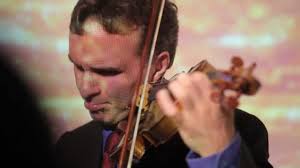
SOUNDTRACK: GIL SHAHAM-“Partitat No. 2 “Gavotte en Rondeau” by J.S. Bach” (Field Recordings, January 12, 2012).

This was the very first Field Recording posted on the NPR site back in 2012 [Gil Shaham: A Violinist’s Day At The Museum].

Shaham plays Bach in the Hirshiorn Museum.

As Gil Shaham wandered through the back offices of the Hirshhorn Museum and Sculpture Garden in Washington, D.C., he said he felt “like Ben Stiller in Night at the Museum.” For this impromptu Bach mini-recital, the violin superstar momentarily became part of the art, bathed in the modish lighting and projections of a multimedia installation during the performance.

He is introduced with the rather amusing:  “A world famous, world renowned violinist who, by the way, starts every morning with a bowlful of Cap’n Crunch.  He told me that.”

I love that this first Field Recording was, like many of NPR’s best things, a spontaneous idea:

A crowd packed the exhibit room to watch as Shaham launched into Bach’s third partita. After the performance, the violinist greeted fans in the museum, many of whom were headed to his concert at the Kennedy Center that night. He seemed surprised and delighted that the guerrilla concert, announced only on local classical station WETA and Twitter that day, drew so many people willing to hear Bach in the afternoon.

[READ: January 22, 2017] “Are We Not Men”

Boyle’s stories aren’t usually as fanciful as this.  But I loved it just as much as many of his other more down to earth stories.  I particularly enjoyed that it was set in the future, although there was no real statement of that until late in the story.  There were hints, which seem obvious in retrospect, but which at first just seemed like hyperbolic or metaphorical.

Like “the dog was the color of a maraschino cherry” or that the lawn incorporated “a gene from a species of algae that allowed it to glow under the porch light at night.”

The story opens with the cherry-colored dog killing an animal in the narrator  Roy’s front yard (on that grass).  He wanted to chase the dog away because it might ruin his grass.  Then he noticed that what the dog had killed was his neighbor Alison’s pig.  She loved that pig and anthropomorphized it.  To try to salvage the pig, he ran up to the dog waving his arms.  It immediately latched onto his forearm instead.

As Roy fights with the dog, the dog’s owner, well, the daughter of the owner, came running across the street.  She looked like a teenager but was actually 11 or 12.  When the girl says, “You hit my dog,” he replies that she bit him.  The girl says Ruby would never do that–she’s just playing.

Amid this horrorshow of blood and violence and death, and a sprinkling of genetic splicing, Boyle throws in a very funny experiment gone wrong.  Crowparrots were a modified bird which blended crows with the invasive parrot population.  It believed that the experiment would turn the parrots into carrion eaters.  But instead it made their calls loud and more frequent.  And they mimicked, so they “were everywhere, cursing fluidly, (“Bad bird! Fuck, fuck, fuck!“).” (more…)

Read Full Post »

SOUNDTRACK: CÉCILE McLORIN SALVANT-Tiny Desk Concert #790 (September 25, 2018).

The blurb talks about Cécile McLorin Salvant’s punk roots.  This made me thing that their might be some rough elements in these songs.

But these songs sound akin to old-fashioned-sounding jazz standards (even if she wrote them recently) in the vein of Ella Fitzgerald or Sarah Vaughn.

The nod to punk seems to come in the vaguely erratic piano which verges on atonality at times.  And yet:

From listening to McLorin Salvant’s exquisite performance here, I also couldn’t tell that when she was 15, she was listening to Alice in Chains, sported a Mohawk and was into what she calls “radical feminist punk stuff,” as she told NPR after the performance. “Sometimes I still really like Bikini Kill, and I still have my little Pearl Jam grunge moments.”

What can be heard in each song is a seasoned jazz singer with a vast vocal range, meticulous technical execution and a superb classical vocal foundation, which actually began when she was just 8. Her background in classical piano is evident in the inventive harmonic and melodic construction of the first three songs heard here; all are romantically themed McLorin Salvant compositions from her third album, For One to Love, recorded in 2015. The record won her a 2016 Grammy for Best Jazz Vocal Album.

“Fog” opens with some striking minimalist almost atonal piano playing.  The song veers through many different tones and styles throughout its five plus minutes.

About “Look At Me” she says, “This was originally called “‘Friend Zone’ which is a zone I know so well.”  The piano is delicate–twinkling–as she sings about being the friend when she wants more.

She says the next song is called “Monday,” “Lets see if I remember the lyrics.”  After introducing Foster, he comments, “I just learned this on the train here, so bear with me.”  This is notable because there is a lengthy, lovely piano instrumental part in the middle.

After a hog, Foster leaves and McLorin Salvant prepares for the last song.

McLorin Salvant closes with “Omie Wise,” an American folk song that tells the tragic story of murder victim Naomi Wise and her husband and killer, John Lewis:

Then pushed her in deep waters where he knew that she would drown
He jumped on his pony and away he did ride
The screams of little Omie went down by his side.

Feminist themes are common in McLorin Salvant’s music, and while “Omie Wise” addresses gender-based violence, she says she sings difficult songs like this to address an important historical legacy. “We don’t sing to our kids and we don’t know any of our folk music anymore,” McLorin Salvant says. “But like all of the history of race songs, coon songs, minstrel music, music from Vaudeville, all of that is like, ‘No, we’re not going to address that — that’s too ugly.'”

This song is especially powerful sung a capella and even more so when it is heard on the weekend that that piece of excrement Kavanaugh is having his Supreme Court hearings.

[READ: January 19, 2018] “Admiral”

T. Coraghessan Boyle is an incredibly prolific writer.  He writes about a huge variety of topics as well.  Some of his stories are down to earth and realistic while others, like this one, are based in a near-future fantasy.

The premise of this story is simple and not all that far-fetched (especially in 2007).  A rich couple has cloned their beloved dog, an afghan named Admiral, for $250,000.  They want to raise this dog exactly as the first Admiral was raised.  They believe in the cloning to create an identical dog, but they also believe in the nurture aspect which means they need the girl who dog-sat for him to do everything exactly as she did all those years ago.

That girl, now a woman, was recently laid off and needs some cash. So when Mrs Striker called and told her she had an opportunity, Nisha said… why not?

She returned to the house where she hadn’t been in four years but which was such a large part of her childhood. (more…)

Read Full Post »

SOUNDTRACK: JUPITER & OKWESS-Tiny Desk Concert #784 (September 7, 2018).

Jupiter Bokondji comes from the troubled capital of Democratic Republic of the Congo.

He and his band Okwess dress in wonderfully colorful garb.  Jupiter’s jacket is practically a zoot suit with blue and white stripes on one side, a red field on the other and giant white stars  He has a big hat as well.  But he can’t hold a candle on the shirtless drummer who is wearing a red white and blue wrestling mask the whole show.

The guitarist has a beautiful patterned gold shirt with blue lapels and the percussionist in addition to wearing another cool hat has on a terrific sweater.

The band plays “the vibe of Kinshasa street musicians, that feels both African and American” and indeed, “their fierce energy here is an astonishing performance.”

Then of course there’s Congolese rumba, the popular dance music from as early as the 1940s, not too dissimilar from some Cuban music of the day. And the message of the music has been steeped in the complicated politics of the region, stumbling between chaos, anarchy and oppression.

This is urgent music … that stems from the gut but has thought and theatrics to flesh out the feelings. It’s music to be experienced. This is your entry point.

They play 3 songs each with a similar feel but with a very different sound.

“Ofakombolo” is so wonderfully catchy with the percussionist and drummer chanting the chorus on the first time around.  On the second the rest of the band sings too, for a nice harmony.  The bassist gets what sounds like a rap guest verse before playing a kind of funky bass solo.  The percussionist is great for shouts and trills animals noises, too.  The music is nonstop, propulsive and fun, with a distinctive guitar solo sound.

“Pondjo Pondjo” starts with a quiet guitar intro.  But it is joined by the drummer whistling and the percussionist pulling a string through a plastic container, making a crazy squeaky sound that works wonders as a percussive sound.  The bassist seems to be singing lead on this song (a very different voice).

 Jupiter introduces “Ekombe” by saying “Let’s go to dancing!” It opens with a funky bass line and the drummer playing a fast hi-hat beat and chanting.  It’s a very dancey with a slinky guitar line running throughout the song.  There’s a nifty breakdown in the middle which features some fun on the bass and a wild solo to end the song.

This is a wonderful introduction to Congolese music.  Stay for the end, as they end the show with a post-credits kung fu pose.

[READ: January 5, 2017] “In the Act of Falling”

Boy this was a dark, dark story.  After the last line I actually said aloud, “Jesus, Danielle, what the hell.”

This is the story of a family: a woman, her husband and their nine-year-old son, Finn.  Finn was recently suspended from school for punching a fellow student in the mouth.

They live in a an old house that they imagined fixing up but two years later even the dining room is unfinished.

Finn is in the yard setting up a volleyball net–but he is doing it sideways like a hammock.  It turns out he is setting it up to catch ducks as they fall from the sky.  Birds were the next heralders of the apocalypse.  And, she had seen that all of the ducks in St Stephen’s green were dead–all of them.  She probably shouldn’t have told Finn this, but she did. (more…)

Read Full Post »

SOUNDTRACK: CAMP COPE-Tiny Desk Concert #778 (August 22, 2018).

Camp Cope recently played PhilaMOCA, but it sold out so quickly I didn’t even have a chance of going.  Camp Cope plays a deceptively simple poppy punk that really allows the excellent lyrics to shine through.  I love the sound of Kelly-Dawn “Kelso” Hellmrich’s bass lines, which contribute a great melody while singer guitarist Georgia “Maq” McDonald plays a somewhat muted guitar, with a ton of power in here voice.

Camp Cope’s Tiny Desk performance opened — fittingly — with “The Opener,” a song about overcoming the obnoxious, exhausting and all-too-common sexism endemic to the music industry.

Great lyrics:

You worked so hard but we were ‘just lucky’
To ride those coat tails into infinity
And all my success has got nothing to do with me
Yeah, tell me again how there just aren’t that many girls in the music scene

It’s another all-male tour preaching equality
It’s another straight cis man who knows more about this than me
It’s another man telling us we’re missing a frequency, love ya Kelly

[Lyrics genius explains this last line: The bass lines in many Camp Cope songs, contributed by bassist Kelly-Dawn Helmrich, are played primarily in the upper register of that instrument, so there are few low bass frequencies in their music. On the average Camp Cope clip on Youtube, you can usually find a dozen or so dudes helpfully pointing this out in the comments.].

It’s a stunning and deeply gratifying performance; Maq lists off what exes, industry insiders and fellow musicians have said to undermine the band with a measured determination that sometimes tips into a full-throated, impassioned cry. Bands like Camp Cope get told they’re “just lucky,” that they “can’t fill up a room,” that they should “book a smaller venue.” But when Maq roars from behind the Tiny Desk, “See how far we’ve come not listening to you,” she makes it clear which voice deserves the attention.

I love the dismissive final line:

“Yeah, just get a female opener, that’ll fill the quota.”

The second song, “The Face of God” features complex guitar patterns from Maq and (at the start) a simpler bass line).  But once the song takes off, the bass starts throwing in notes all over the instrument.

is a stunning, delicate song about feeling lonely and distraught in the aftermath of sexual violence. It’s a standout from the band’s debut album, How to Socialise & Make Friends, and shows what Camp Cope does so well: using tiny moments of introspection to illuminate life’s bewildering, terrifying, isolating aspects — especially as they apply to women. You can hear equal parts conviction and desperation in Maq’s voice as she sings:

I saw it, the face of god
And he turned himself away from me and said I did something wrong
That somehow what happened to me was my fault.

Camp Cope must usually play more raucously live since after “Face of God” Maq  laughed, “We’ve never done this before — we’ve never been quiet. Not once in our entire lives!” Hellmrich joked that it was perhaps a “good lesson” to “rock out in your mind.”

The band closed its set with “Keep Growing,” an older track about autonomy and heartache.   It opens with Sarah “Thomo” Thompson’s drums, simply and direct and then Hellmrich’s bass is at the fore once again, playing a cool melody.

Elsewhere, it might be too easy to tune into Camp Cope’s powerful message and overlook the strength of the band’s songcraft. But at the Tiny Desk, you can’t miss it: Maq’s gargantuan voice; Hellmrich’s clever, melodic basslines; Thompson’s stoic drumming.

I wish even more that I’d seen them in a small venue while I had the chance.

[READ: August 21, 2017] “Dogs Go Wolf”

This was a peculiar story that felt like it was part of a larger story.  It felt incomplete and yet also that it had accomplished everything it intended.  Which was odd.  In the same way that the title makes sense but only when you think about it.

I enjoyed the way the story worked its way backwards.  Two sisters are on an island.  They are young (four and seven) and they are alone.  Even the dog that was with them has been strangely quiet lately.  The dog was mean and although they missed its companionship they weren’t sad to see it go.

The big sister tells the little sister stories to comfort her.  But they can only go so far when food is scarce, when the generator has run out and when they have little else to do.

(more…)

Read Full Post »

SOUNDTRACK: FLASHER-Tiny Desk Concert #770 (July 30, 2018).

I haven’t heard of Flasher, but the description of the band (noisy) makes me think I’d like them.  I’m also intrigued by the various guitar and bass lines.  The vocals are also really nice–wonder just how buried they are on record:

For its visit to the Tiny Desk, this young Washington trio set aside the distortion and worked up a semi-acoustic set of three songs — taken from its debut album, Constant Image.  Voices sometimes in unison, sometimes swapping leads, adding a shifting point of view to songs that, on record, give equal footing to a precise noise.

These three high school friends, Taylor Mulitz (guitar, vocals), Daniel Saperstein (bass, guitar) and Emma Baker (drums) have been bouncing around the D.C. punk scene of house shows and DIY venues for some time.

I rather got a kick out of this little “How Bob knows the band”

I’ve been aware of Taylor’s work for a while…in the potent D.C. band Priests; Daniel I’ve known (a bit) since he was a child, mostly from Hanukkah parties with his family (his mom was the executive producer at All Things Considered when I was the show’s director); Emma can be seen playing around town with another band, Big Hush.

I really enjoyed the stops and starts of “Pressure” I imagine it’s really fun when they rock.  It also has some really clever word play: “saving face / self-effacing / keeping pace / in a stasis.”  Most of the delicate harmony vocals come from the bassist (who is actually playing acoustic guitar), although when all three of them sing it sounds even better.

The interchange of electric and acoustic guitar works great on “XYZ.”  All three sing in tight harmony.

I love the way “Who’s Got Time?” seems to be constantly catching up on itself, like they are running out of time to finish the song–even though it never sounds like they are out of sync with each other.

Their overall sound is wonderful acoustic shoegaze.  At least at the Tiny Desk.

[READ: August 15, 2018] “A Refugee Crisis”

I didn’t love Wink’s last story (about killing cats), but I found this one fascinating because of how many elements were included here.

The narrator is a writer living in a place where one can cross-country ski regularly (Bozeman, MT).  The trail is mostly unused except for a guy who runs tours by dogsled–and there is plenty of dog shit on the trail to show where the sled went.

When he gets home, M is lying on his couch.  She says she let herself in since she knew the key was still under the mat.  She says she just came back from Serbia.  (She had been in Athens, Budapest and Frankfurt among other places).  The refugee camps there were really bad–people are trying to get across Hungary and the military is beating them, shooting at them.

She is twenty-three but looks forty and her personal hygiene is atrocious.  They have sex anyhow.  She says they can’t get pregnant because she already is–from a nineteen year old boy from Raqqa.  She didn’t tell the guy.  She is planning to get an abortion shortly. (more…)

Read Full Post »

SOUNDTRACK: PHISH-Live Bait Vol. 13 [Baker’s Dozen Edition] (2017).

Live Bait 13 was a special release to tie in with the Baker’s Dozen shows at Madison Square Garden.  It’s a little strange that 11 of the 13 songs are from MSG and not all of them, but whatever.  The MSG recordings date from 1994-2016, and the additional two songs are a relativity recent song from Chicago and a 1993 track from Pittsburgh.

The set starts with a 14 minute “The Wedge” (7/20/14 FirstMerit Bank Pavilion at Northerly Island, Chicago, IL).  It seems to be a little stiff and almost “formal” to start with although by around 9 minutes it loosens up and gets funky with some cool drum breaks.  By 11 minutes it turns into a loos jam of chords that sounds familiar like an other song, but I can’t place it.

The “Run Like An Antelope” is from 1993 (7/18/93 I.C. Light Amphitheater, Pittsburgh, PA) and it opens fun with woodblocks and a dramatically dissonant chord.  Trey launches into Led Zep’s “Heartbreaker” riff while the band keeps going.  The middle slows down and gets noisy before ending.

The rest of the tracks are from Madison Square Garden.

“Tube” (12/29/97) starts off quite angular and harsh but grows funky with a cool keyboard sound and solo from Page.   Moving back to (12/30/95) they play a spirited “It’s Ice” which segues into a rather mellow “Kung.”  Most of the nonsense from “Kung” is spoken, including the runaway gold cart marathon. But then they start screaming “Stand up!  STAND UP!”

I love that “It’s Ice” has the kind of vocals that are done in something of a round or a fugue.  It’s followed by “Piper” (12/30/11) that also has that kind of vocals in the round.  Its a nice pairing.  This version is pretty grooving and eventually gets really rocking.  Although the last five minutes are trippy and chill.

There’s a surprise (to me) “Icculus” from 2013. (12/31/13).  Trey has a lot of fun with the story of the helping friendly book.  He talks about how when they first started playing they had a message to impart.

Some of you are not getting the message and it’s pissing us off.  We’re here tonight in the middle of Madison Square Garden to give to the fucking message!  I’m looking around and I’m thinking a lot of you haven’t read the fucking book.  Up next is the fun segue of “Mike’s Song > Swept Away > Steep > Weekapaug Groove” from 1996 (10/22/96) is a large 20 minute block. There’s a good jam that lasts almost ten minutes before “Swept Away” comes in quietly for a minute. It stays quiet through “Sleep” until they launch onto the “Groove.”

The next song is from 2016 (12/30/16) , I think the most recent Live Bait.  “Light” sounds “mature” until the jam plays on for a while and its drifts all over the place until Fish pulls it back around 16 minutes to a wholly unexpected “Party Time.”

I love this version of “Carini” (12/28/98).  It is dark and angular with a really dark and moody jam.  At 8 minutes its gets kind of trippy but by 12 Page takes it into a dark place with synth sounds> Wolfman’s Brother (12/28/98 Madison Square Garden, New York, NY) 37:23

Ghost (12/31/10( is groovy with a half time solo while “Tweezer” (12/30/94) is fast and peppy for nearly the whole 20 minutes. The “Ebenezer” part comes at around 4 minutes with a lot of prolonged nonsense after the word.  “You Enjoy Myself (12/4/09) is a full 20 minutes as well and they seem to stretch it out with the second part coming at 3 minutes and the lyrics starting around 6 minutes in  there’s some great solos by Page and Trey as well.  There’s a funky watery bass solo around 17 minutes before the final vocal jam which is mostly a series of rising and falling yells until they grow quiet by the end.

“No Men In No Man’s Land” is a newer song and they play it nice–stretching it out with a grooving sound and jam.  By 10 minutes it chills down, but it picks up again by 11:30.  At 15 minutes it gets angular and dark and around 20 minutes they start the countdown to Auld Lang Syne.  They come out of ALS with a wonderful “Blaze On,” a fun welcome to the new year.

Nothing could prepare anyone for Phish playing a no repeat 13 night series, but this was certainly a fun reminder of the great shows they’ve played at MSG.

[READ: February 7, 2018] “August”

This story is a slice of life at a lake in August.

The family went to the lake for five seasons over he years.

The narrator says he primary memory is of his father reading intently.  He could read for hours without moving.  Sometimes he would pick up a drink and there was the possibility that he would not drink it before getting to the bottom of the page and then simply put it down, forgotten.

His mother would not read until she picked up a book and then would read intently for a couple of days and then seem to just give up.

It was the second season that his father shot the dog.  Yup, its one of those stories, but not as bad as all that. (more…)

Read Full Post »

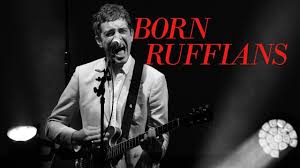
SOUNDTRACK: BORN RUFFIANS-Live at Massey Hall (October 14, 2017).

Born Ruffians are a trio who plays fairly punky music but with a surprisingly high-pitched singer Luke Lalonde.

When the show opens, he says I don’t think I ever considered that I would play here–it wasn’t even something …it seemed out of the realm of possibility.  Look at all the people who have played here (waves at pictures) Bassist Mitch Derosier says that these are employees of the month.  And t here is silence.  Drummer Steve Hamelin says do we have to laugh for that?  Mitch: I wanted someone to.

Lalonde says “it feels cool as hell when you’re on that stage.”  Hamelin: “hopefully it is the first of more.”

“Ocean’s Deep” has a loping bass and mostly high chords until the chorus when they burst forth more.  Lalonde’s guitar is almost rockabilly sounding (because it is a hollowed body?)  The drums totally pound (and Hamelin is up front facing the other two).

“Don’t Live Up” has an interesting guitar melody with rather unexpected notes

“& On & On & On” has a cool bass line and a catchy oh oh oh oh oh oh verse melody.  Then he tells the crowd that they just recorded a record and its out soon so they’re going to play some songs off it. (Which this last song was but he next song isn’t).

“Fade to Black” has punchy drums and a fast punky bass. The chanted backing vocals give it a real punk edge.”  After the song someone shouts, “you guys fucking rock, man,” to which Mitch responds: “that was my mom.”

“Miss You” has a great call and response punk feel “with your head held high–with your head  held high” it sounds great.

“Love Too Soon” opens with gentle echoed guitars a weird-sounding whistle from Luke–echoed or processed and rather eerie, but very compelling.

“Forget Me” is a song about dying.  It starts acoustically followed by a kick drum with Hamelin encouraging everyone t clap along with him.  The song dramatically changes pace midway through–slowing down with big thumps until it slowly speeds up again.

Lalonde switches to electric guitar with a heavy echo for “Needle”.  This was my favorite song and I wondered if I’d heard it before, the vocal melody was very familiar and catchy.

The final song, We Made It” has some cool fast plucked guitar chords (from bass and guitar) and some great triplets on the drums.  It’s a powerful punky thrasher with a big, loud, crashing (very satisfying) false ending.

[READ: February 2, 2018] “Patrols”

I really enjoyed the way this story began.

Marty Mason was staying at a place which housed a dog, Murphy.  Each night the dog left his owner’s room, snuffled around and came to settle by Marty.  He would settle by Marty’s bed, alert, for the night.  If Marty looked at the dog, it would slap its tail against the floor.  If he tried to lock the dog out it would scratch and whine.

This prevented Marty from sleeping, but also prevented him from getting up.

Then the story flashes back to a military scene and I kind of lost focus. (more…)

Read Full Post »

SOUNDTRACK: GZA & The Soul Rebels-Tiny Desk Concert #738 (May 2, 2018). 

GZA is the latest rapper to come to the Tiny Desk with a live band.  He had a six piece brass band Manuel Perkins (Sousaphone), Julian Gosin (Trumpet), Marcus Hubbard (Trumpet), Erion Williams (Saxophone), Corey Peyton (Trombone), Paul Robertson (Trombone) and two percussionists Lumar LeBlanc and Derrick Moss.

It turns out that on a recent tour The Soul Rebels were actually the headlining band and GZA was a special guest:

This set was recorded when The Soul Rebels were in Washington, D.C. for a performance at the 9:30 Club that featured GZA and Talib Kweli. It was one of just a handful of live concerts GZA has done with the group.

I was surprised to hear than GZA (or frankly anyone from Wu-Tang Clan was “notoriously introverted.”  Also that “Most rap fans would name RZA as the head of the Wu-Tang Clan. But Wu purists know that GZA, or The Genius, is the crew’s unspoken elder statesman.”

Once they stepped behind the desk they got right down to business, opening with the sparkling “Living In The World Today,” from GZA’s 1995 solo album Liquid Swords. These 23-year old lyrics and metaphors felt timeless.

After the song he smiles, “That was cool.”

GZA continued his onslaught of poetic precision with another beauty from Liquid Swords, “Duel of the Iron Mic.” “I ain’t particular,” he spat, starting to break into a sweat behind the desk. “I bang like vehicular/Homicides on July 4th in Bed-Stuy.” At one point, GZA even channeled his cousin, the late great Ol’ Dirty Bastard, who provided the hook on the original version of the track.

By the third and final song at the Tiny Desk, driven by unbridled passion and his command of the room, GZA was soaked in sweat as they broke into the title track of Liquid Swords. The Soul Rebels perfectly recreated the track’s seamless horn hits while adding on a bit of their own flare. The cherry on top arrived when GZA used his final minutes to tell the story of how the hook originally came together. In RZA’s basement, smoking and drinking with fellow Wu lyricist Masta Killa, RZA was sold on a routine he, GZA and ODB used to perform as teens.

I don’t know GZA’s solo stuff.  I don’t really know his flow.  He sounds a bit old and a little rusty, but his delivery is strong (even when he “forgets his own verse” in “Liquid Swords”).   I love the way The Soul Rebels play the eight notes over and over in an almost menacing holding position.

And the tale he tells about the final song is pretty great.


[READ: April 10, 2018] “The Mastiff”

This is one of those stories (translated from the French by Linda Coverdale) that to me just seems endless despite its brevity.

The Master has never seen this thing before.

He releases the howling mastiff.

He follows the dog.

For the rest of the story. (more…)

Read Full Post »

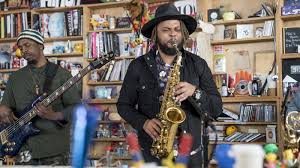
olymmpSOUNDTRACK: LOGAN RICHARDSON-Tiny Desk Concert #734 (April 23, 2018).

Logan Richardson is a jazz saxophonist.

I’ve been down on saxophones lately, but I do really like the sound he gets.  I’m a bit more impressed by the rest of his band, though.

Since I don’t know Richardson, I’ll let the blurb speak for me, with some of my comments.

Richardson ‘s latest project, Blues People,  … was derived from the early slave calls that inspired the earliest American jazz and blues musical traditions. Here at the Tiny Desk, the saxophonist revisits that history with four remarkable songs from the album, all performed with a hope that our country’s future will be less painful than its past.

“80’s Child” is a reflection on the decade Richardson was born. Its colorful melody complements the band’s energetic fusion groove. Continually pushing forward with momentum and anticipation, its 8/8 time signature moves seamlessly into 10/8 to create an intensity that is both focused and free.

I love the opening guitar work (by Igor Osypov) which sounds very un-jazzy to me–you could hear an alt-rock sound being built out of that.  While Igor is doing a simple but pretty guitar solo rhythm guitarist Justus West keeps the rhythm work with some interesting whammy bar bending.   About three minutes in, drummer Ryan Lee gets some great little improv moments.  I really enjoy the song even if I find myself tuning out the sax and listening to the guitar.

Richardson notes, “The desk is tiny but it’s mighty.  I have a tiny saxophone that I forgot to bring.”

The next groove, “The Settlement,” maintains a similar tone and features DeAndre Manning slapping on his funky bass.

This song feels more jazzy to me–prominent sax with jazz guitar chords.  But I do love the jazz/prog rock section with the slap bass and the guitars following suit.  I definitely tune out the sax to listen to the great riffage from the strings

While the band is ringing out the last notes of the song, Richardson introduces the next

The song gently segues into the only vocal piece, “Black Brown & Yellow,” a lovely reminder that racial diversity is something to celebrate.

They do a short chant of “Black, brown and yellow is beautiful.”  It’s a pretty, almost sensuous song sung first by West and then joined by everyone else.

I love that I am now quoting someone quoting some else about this last song:

“Anthem (To Human Justice)” ends with brilliance best described by my colleague Nate Chinen, “By design, too, Richardson’s alto saxophone often functions more like a lead vocalist than as a virtuoso solo instrument. He’s a good conduit for soaring, plaintive melody…. And however the band surges or thrashes around him, there’s a feeling of urgent communion in this music.”

The backing music is once again excellent and interesting, with cool time changes a nifty guitar solo (while the second guitar is doing some other cool stuff too) and some great bass work.  I really like the way the whole band jams it out at the end–the band sounds great and Logan’s sax is right there with them soloing the whole time.

I feel like this is jazz for people who don’t like jazz.

[READ: March 17, 2018] Olympians 10

I’m still not sure how many books O’Connor has planned for this series, although in his introduction he talks about saving his favorite books for the end, so I assume there are at least two more (although 12 seems reasonable).

Here’s the summary of the man himself:

George O’Connor is a massive geek and Greek scholar.  He has done lots of research for these books, including going to Greece and visiting sites and antiquities as well as comparing all manner of ancient stories to compile the most interesting pieces. He explains that since these stories were orally passed down, they were modified over the years.  He doesn’t change the myths, he merely picks the story lines that are most interesting to him.  And then he adds a lot of humorous modern touches (and dialogue) which keep it from being at all stuffy.

O Connor’s drawing style is also inspired by superhero comics, so his stories are presented in a way that seems much more like a super hero than a classical hero, which is also kind of fun.

Each book ends with an author’s note which is hugely informative and gives plenty of context.  It also has a bibliography, but more importantly, it has a list of notes about certain panels.  Do not skip these notes!  In addition to providing a lot of insight into the myths of the characters themselves, there are a lot of funny comments like “Greeks raced in the nude (point and laugh)” which really bring new depths to the stories. (more…)

Read Full Post »

« Newer Posts - Older Posts »