Feeds:
Posts
Comments

Archive for September, 2012

SOUNDTRACK: KISHI BASHI-Tiny Desk Concert #215 (May 10, 2012).

A few days after the concert at the 9:30 Club, K Ishibashi stopped in at the NPR offices to record a Tiny Desk concert.  The Tiny Desk  concerts are always fun–incredibly intimate and always well recorded.  He plays three of the five songs that he played at the 9:30 Club, and while they sound quite the same, there are little differences.

I find it very cool how similar they sound–since most of the sounds he makes are with his voice, it’s quite cool that he has that much control.  But I also like that he varies things a bit (although it sounds like a slightly flat note that plagues “Atticus in the Desert”).

What’s interesting is that although he doesn’t play things very differently, the feel of “I am the Antichrist to You” is quite different in the Tiny Desk setting.  I don’t really understand why, but it sounds very different, and equally wonderful.

Watching the Tiny Desk show is also neat–I’ve never seen anyone strum chords on a violin before.   And watching all of the technical adjustments is very cool too.  I’ve definitely become a fan of Kishi Bashi.

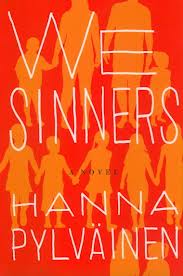
[READ: August 28, 2012] We Sinners

This has got to be the fastest turnover I’ve ever had where I read a short story and then read the author’s novel.  Well, it turns out that “Jonas Chan” was not a short story, but an excerpt from this novel.

The novel is a series of short stories about the same family.  I’m reluctant to brand it one of those connected-short story novels, but I think it really is.  Each chapter has a title and a specific focus and, as the excerpt showed, each chapter can work independently–although having all of the information certainly fills out the story.  (Unless I am mistaken, a few things that really depend upon the rest of the book were left out of the excerpt).

The novel is about the Rovaniemi family.  They are a very traditional Finnish family living in the midwest United States.  More than just Finnish, they practice Laestadianism, a very conservative kind of Lutheranism that is unique to the Finns.  There are nine children in the family (and 11 chapters in the book), and the novel follows them through about 18 years (the youngest, Uppu, is born in the first chapter and the second to last chapter is about her leaving for college.

There’s even a handy family tree:

WARREN  –  PIRJO  (parents)

BRITA  TIINA  NELS  PAULA  SIMON  JULIA  LEENA ANNI  UPPU

There isn’t an overall plot so much as an evaluation of this traditional family and how modern life impacts them.   And wisely, the book opens with the oldest daughter.  This (as opposed to first looking at the parents) allows us to see what kind of difficulties the kids will have with their religion.  We see Brita in school facing a tough decision.  The Laestadian religion doesn’t permit dancing (or TV, or much of anything).  And Brita has to inform her “boyfriend” that she can’t go to the dance because she isn’t allowed.  When Tiina finds out that Brita revealed their religious secret she freaks out that people will know about her too. (more…)

Read Full Post »

SOUNDTRACK: KISHI BASHI-Live at the 9:30 Club May 1, 2012 (2012).

I had never heard of Kishi Bashi before this concert.  Kishi Bashi is a one man band headed by K. Ishibashi.  He plays violin and sings and, as is the trend it seems, he records and loops his own beats and melodies.  Whether or not this is overdone by others, Kishi Bashi does an amazing job.  His songs are powerful and his soaring falsetto is fantastic.

I find myself singing lines from “Atticus in the Dessert” all the time.  And who could resist the title “I am the Antichrist to You.”  Hearing him pull this stuff off live is really impressive.  When he’s not sampling and beatboxing, his violin is gorgeous–I never really understood the folks who could violin and sing at the same time, but he does it wonderfully.  He’s got a funny, charming stage presence and this whole brief set is really enjoyable.  Check it out (audio and video!).

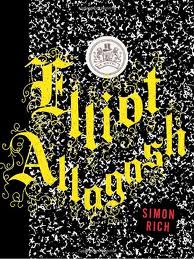
[READ: September 1, 2012] Elliot Allagash

I really enjoy Simon Rich’s humorous pieces.  But somehow I totally missed that he had written a novel (or two–the second one came out in August).

This novel eschews Rich’s humor style–there’s no absurdist takes on life–and focuses on a plot. The plot is pretty straightforward.  Seymour Herson is a middle school loser–everyone picks on him.  In a nice twist on the high school loser, Seymour’s family is pretty cool.  They play Monopoly every Friday night, they eat together and are generally supportive of each other.  While they might be somewhat geeky, they are not played as straw men for Seymour’s problems.

At his school there are three rows of lunch tables.  The popular kids sit at the first row.  The rest of the kids sit at the second row.  And Seymour sits in the final row.  By himself.  In part that is his plan, so he can score a minimum of 5 chocolate milks at lunchtime without the other kids seeing.  Then one day Elliot Allagash sits next to him. (more…)

Read Full Post »

SOUNDTRACK:  SLAYER-Live from Sonisphere 2011 (Palladia TV 2012).

Did I get into heavy metal because I loved typography or was it the other way around?  All metal bands love creating logos, and images that resonate with their music.  Nearly every metal band that I liked had a logo, easy to identify from a distance.  Perfect for marketing.The Metallica logo is pretty iconic, but the Slayer logo moves it up a step–crazy lettering with swords that almost make a pentagram.

When I was a young metalhead, Slayer was like forbidden fruit–so evil it was scary.  I love how this video dispels this image of the band.  Kerry King talking about “the kids,” and look how much Tom Araya is smiling through the whole set.  Never has anyone been happier singing the word “eviscerated.”

This show was during the Big 4 tour–Megadeth, Anthrax, Slayer and Metallica.  So Slayer performs a few of their more popular songs.  I actually don’t know how long their set was, but this thirty show must have contained about half of it.

And the band sounds really good–still playing really fast (Dave Lombardo on drums is a madman).  It also makes me laugh to think of Kerry King back in the early days having a leather bracelet with 4 inch ten-penny nails sticking out of it.  Now he’s just got a huge chain hanging from his belt (and a shaved, tattooed head and a very very long goatee).  Gary Holt from Exodus is replacing Jeff Hannemann for this tour because Jeff has Necrotizing fasciitis (which sounds like a Slayer song anyhow)

The Palladia show isn’t online, but there’s another show from this Big 4 Tour recorded in Chile that’s online.  And the interview with Tom Araya at around 11:30 is amazing,  Tom is such a nice, soft-spoken guy–and he was given the key to the city!  Incredible to hear him scream like that.  (And I see that Kerry has the nail bracelet on for the first song in this show too).

I’m also very pleased to see how many fans are wearing earplugs.  Not metal, but sensible.

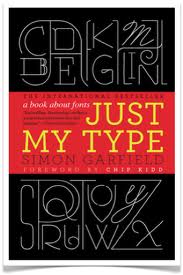
[READ: September 10, 2012] Just My Type

A few months ago, Karen wrote posts about this book (links are below).  All I need to do was to read her first paragraph to know that I wanted to read this book.  I love typography.  I took a typography class at the School of Visual Arts and I have always been fascinated by logos and text.

This book is an awesome book for anyone who loves fonts but who doesn’t want anything too heavy.  There is some history of the various type creators, but for the most part this looks at type faces in the past and in popular culture.   Chapter 1, for instance, is called “We don’t serve your type” and is ll about the overused and much derided Comic Sans.

Karen wisely spread her review over five posts because there was so much in the book.  Looking at her review now, I had already forgotten these two things that she mentions: “the quandary Westminster Abbey was in when it was discovered the designer of the signage at the Stations of the Cross was an incestuous pedophile (among other things).  Or the story of the font that was drowned to keep it out of the wrong hands.”

Each chapter (about 8-10 pages) follows the adventure and misadventure of a font,  a series of fonts or the creator of said fonts.  In between chapters we got Fontbreaks, two or three pages about a specific font. (more…)

Read Full Post »

SOUNDTRACK: SISKIYOU-“Bad Days” (2012).

Siskiyou has had some medical problems and have canceled their recent tour.  They are also going on a brief haitus.  This is a shame as after their second album, they really had momentum and they sounded better than ever.

As a kind of peace offering to fans who would not be able to see the band, they recorded a cover of The Flaming Lip’s “Bad Days.”  The cover souds remarkably like the original, with one big difference: rather than squalls of feedback, Siskiyou uses only piano.  And it works very well, getting down  to the basics of the song and sounding a bit like Wayne Coyne singing.

It’s a nice tribute and  a nice “until later”

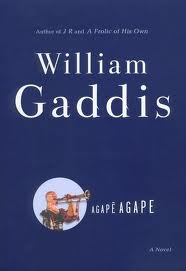
[READ: August 27, 2012] Agapē Agape

I have a long history with this book.

I was working at Baker and Taylor, a book supplier, when this book was released.  Some of the higher ups were able to get free books from the publishers they dealt with.  The guy who dealt Viking was not the friendliest guy, but since B&T paid absoluet crap wages, I was going try to get any books I could for free.   So, I asked for this book.  It was embarrassing enough to walk in and say this title with confidence, since I knew how it was pronounced (yes I took Greek in college), but knew he didn’t.  After some groveling, his reaction led me to think I wouldn’t be getting it.

But lo and behold a few weeks later it was sitting on my desk.

And now, ten years later, I’ve finally read it.

In JR, Jack Gibbs is writing a book with the name Agapē Agape, it is a jumbled history of the mechanization of the arts, starting with the player piano.  JR was finished in 1975–who knows for how long he had been working on it until then.  According to the Afterword of this book by Joseph Tabbi, Gaddis was pretty all-consumed by the idea of the player piano.  (It’s really quite an obsession).

This book is the culmination of all of Gaddis’ work on the player piano and how it removed all of the artistry from music (this theme of art and mechanization is in JR as well).   But rather than write this as an essay, which he didn’t think would be very effective, Gaddis decided to make this a novel.   I admit to not really knowing if he finished it–Gaddis died in 1998.  While it doesn’t feel unfinihsed, I’m just not sure if he was “done” with it. (more…)

Read Full Post »

SOUNDTRACK: Nyckelharpa (2012). 

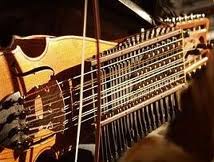
At ScanFest we also heard the American Nyckelharpa Association play a few tunes.  Like most of the  world, I had never heard of a  Nyckelharpa , but since I love unusual instruments, I couldn’t wait to find out more about it.    From the ANA website:

The modern chromatic nyckelharpa has 16 strings: 3 melody strings, one drone string, and 12 sympathetic vibration (or resonance) strings. It has about 37 wooden keys arranged to slide under the strings. Each key has a tangent that reaches up and stops (frets) a string to make a particular note. The player uses a short bow with the right hand, and pushes on the keys with the left. It has a 3 octave range (from the same low “G” as a fiddle’s 4th string) and sounds something like a fiddle, only with lots more resonance.

It was really neat to watch half a dozen or so people playing this odd instrument with all those strings.  They held it like a guitar and the bow is really short.  And, indeed, they were playing the keys instead of the fretboard.  How cool!  I didn’t really get to experience the sympathetic strings in the auditorium (I honestly can’t even imagine how that works), but it sounded wonderfully folksy.

Check it out!

[READ: June 6, 2011] Squish: 

This is a weird experience for me–I’ve now read the new Squish and the new Babymouse pretty much right as they came out.  Wow!

The Power of the Parasite continues the interesting juxtaposition of what Squish is reading (a Super Amoeba comic) and what’s happening in his life.  In an interesting graphic choice, the comic book is rendered in black and white while the scenes of Squish are lovingly rendered in the creepy green that they use.

In this story, it’s summer vacation and time for camp.  Interestingly, Squish’s two best friends Peggy and Pod go to ballet camp while Squish opts for swim camp (not that there’s anything wrong with ballet camp).  This means that we don’t see much of Squish’s cohorts.

When he gets to camp, he is pretty unimpressed (and he’s afraid of water) so he decides that he will avoid the SUPER AWESOME FUN that the counsellor promises.  Instead, he reads his Super Amoeba comic.  But then a new character Basil,a hydra, comes along and bonds with him (not literally, although he is capable of growing  a new limb (or tentacle or whatever) when one breaks off.  Basil also has the ability to shock others.  Yes literally.  (scientific fact: A hydra’s tentacles can paralyze you!).  And when he is bored, he uses this to make more fun. (more…)

Read Full Post »

SOUNDTRACK: NORSEWIND-“Landvaettir” (2011).

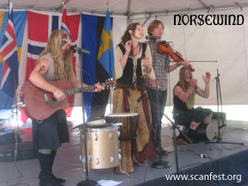
On September 2, we went to ScanFest, a festival of all things Scandinavian.  We had a wonderful time (despite the downpour).  The food was great, the stalls were selling cool wares and the entertainment was stellar (I loved the wife carrying contest–win your wife’s weight in beer!).

There were also musicians.  We were only able to see a couple, but one was Norsewind, a folk band from Berks County, PA, who play traditional Scndinavian music (and Irish pub songs).  I don’t know any of the songs they played that day, but I happened upon their reverbnation site, where you can hear 11 tracks.  And I chose this title because I have no idea what it means.

Live, the band was loud and really dynamic.  I especially enjoyed what I think was the intro to a song–three members on stage pounding the hell out of traditional drums–it was very cool.  These studio recordings are a little anemic–at least compared to their live show.  But they do display a nice range of sounds and styles and I enjoyed them very much.

[READ: August 2012] Beast Quest 1-6

When we finished Droon we wanted to move on to a new series.  Beast Quest was heavily advertised in the back of the Droon books, so we thought we’d give it a try.  Adam Blade (really?) has created a vast world in Avantia.  As of this writing, there are 72 books in the series (not including several special edition).  Yes, that is eighty-three books in total.

Sadly I just learned that Scholastic, the American publishing company of Beast Quest has only released 24 books (plus 2 special editions) in the United States.  A brief rant here.  I think Scholastic books is really wonderful.  They have released  some amazing books over the years.  I can’t even count the number of awesome series that Scholastic has picked up.  HOWEVER, Scholastic has a horrible track record of starting to release series and then ceasing in the middle.  The biggest crime has been Ulysses Moore, which they have ceased after 4 books (even though the series is up to Book 10 or 11 in their native Italy AND they are releasing the author’s newer series now.  Now we have this.  As you’ll see in the post, I’m the first to admit that the first six books in the series aren’t very good.  But now that we’re up to 20, the books and plots have gotten so much better.  And just as we’re getting really into it, the plug has been pulled?  I understand the economics of publishing and that if something isn’t selling you give up on it.  But seriously, you’re heavily advertising a series that you’re not going to finish?  How expensive can it be to produce these series of kids books?  It’s so disappointing.

End rant.

Begin review. (more…)

Read Full Post »

SOUNDTRACK: CIRCLE TAKES THE SQUARE Live at Black Cat Washington DC, August 31, 2011 (2011).

I had never heard of Circle Takes the Square before seeing the link to this show on NPR (Thank you, Viking!).  I like the band name (Hollywood Squares reference), and couldn’t imagine what they sounded like.

Song titles like “In the Nervous Light of Sunday” and “We’re Sustained by the Corpse of a Fallen Constellation” and even “Non-Objective Portrait of Karma” lead one in many possible directions.  But it turns out that the band is sort of pigeonholed as screamo, a post-hardcore style that allows mostly for screamed vocals.  And yet these guys also incorporate intricate playing, odd time signatures and some beautiful instrumental passages.

Even though the band plays fast, they don’t play only short songs.  The shortest songs run about three minutes but they have two songs that are over 6 minutes, with several different sections.

I listened to this show a few times and I confess I never really got into it.  I liked some of it but I was never fully able to grasp what was going on.  It could have been the recording quality.  Usually NPR shows are crystal clear, but this one was a bit muddy–which may have been intentional from the band as they are pretty raw sounding.  I did like  the split male/female vocals which added a cool depth to the songs.  But mostly I was impressed by the kind and almost sweet attitude of the lead singer.  He was polite and thankful to the audience (thanking them for braving the weather–the show was during Hurricane Irene–thanking them for coming from both far and near and talking about how excited he was about Pg. 99, the headliners.  It’s funny to hear polite thankfulness and then screaming lyrics like: “Embrace the sweet sound of self-destruction.”

I’d like to hear a studio release before passing final judgment, because there was a lot to like here.

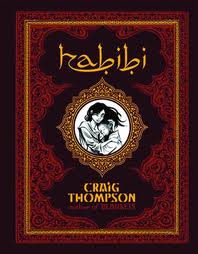
[READ: August 29, 2012] Habibi

I saw this book in a review by Zadie Smith in Harper’s a while back.  I didn’t realize at the time that the author was the same person who did the wonderful Blankets.

This book is an amazing piece of art.  And the story is very good too.

So this massive book (almost 700 pages) is the story of  a woman born into a fictional Middle Eastern country called where the Qur’an is studied and women are more or less chattel.  As the story opens Dodola is sold by her father to a wealthy man who becomes her husband.  The scene of her deflowering, while not graphic at all, is very disturbing nonetheless.  She is afraid of this man and cowers in the fear until they gradually start to see each other as human beings.  And although their age difference is substantial (and yes, gross), she learns to appreciate him.

Until he his killed by the king’s men and Dodola is taken away to the king’s palace to be sold as a slave–her hair is tied to another girl’s hair so they cannot escape.

Through a series of events, she does escape, and when she is hiding out she manages to save the life of a black baby named Cham.  She calls him Zam after the Well of Zamzam (Arabic: زمزم‎) in Mecca, the holiest place in Islam.  And while she is only 12, she takes care of this 3-year-old boy and raises him as her own child. (more…)

Read Full Post »

SOUNDTRACK: PHOENIX in Studio at KEXP (2009).

For this in-studio  performance, two members of Phoenix showed up to play a stripped down acoustic performance.

They play four songs (and all of the songs are quite short, as well).  Three songs from Wolfgang Amadeus Phoenix (“Listzomania” “1901” and “Armistice”) and a cover of Air’s “Playground Love.”  Given how different Phoenix and Air sound (even if they are both French), it’ an impressive change of style for the set.

This stripped down version really shows what a great voice the singer has.  And these songs, while not quite as catchy as the originals, still sound fantastic.  There’s also a brief chat with the DJ about their then recent appearance on Saturday Night Live.

If you like Phoenix, this is a great show to download.

[READ: September 1, 2012]  An Iliad

Since I really enjoyed the two Baricco stories that I’ve read so far, I decided to try something else from him. An Iliad is a fascinating book from conception to execution.

Baricco wanted to read Homer’s Iliad aloud on the radio.  But when he investigated the project further he found that a) it was way too long and b) it wasn’t really well suited to contemporary audiences.  So (and he gives details about exactly how he modified it), he decided to remove sections of the original, restructure it and try to give it a more contemporary feel.

But he also tried to keep as much of the original as he could.  So, rather than rewriting the book, he worked with a prose translation (poetry being way too convoluted for his project) and used his  translation of that translation  (which for us gets further translated into English, yipes, although the translation is again a very good job by Ann Goldstein) to create his Iliad.  One of the major excisions he did for the book was to remove all of the sections with the gods.  They are alluded to, but he removed the gods (and all supernatural aspects) from the book reasoning that the mortals reference what the gods say and do so anyway, so he simply took away the duplication.  Plus, the gods aren’t really relevant to contemporary listeners. (more…)

Read Full Post »

SOUNDTRACKFUJIYA & MIYAGI-Live at Gibson Showroom, New York (2008).

This set is available for Download from KEXP.  I don’t know Fujiya & Miyagi all that well, but I really enjoy everything I’ve heard from them.  They place a keyboard-heavy, almost-dance music, but they use a lot of guitars to propel their songs further.

The most noteworthy thing about the band is the vocals–they are whispered (and often nonsensical–“Vanilla, strawberry, knickerbocker glory”) but the whisper seems to make the song move faster somehow–adding an almost sinister edge to the tracks (although sometimes it can feel sensual as well–it’s a neat trick).

This show has five songs from the album Lightbulbs–and it’s their first tour with a live drummer, which adds a nice complexity to their set.  One of these days I’m going to have to check out  their studio releases.

[READ: September 8, 2012] “My Journey to the Outer Limits of Funk”

Here’s another author I admire writing a short piece in Rolling Stone.  This one, unlike Lethem’s recent contribution, is about something he himself has done.  This article is a kind of music-based background explanation of his new book, Telegraph Avenue.

The premise of one of the plotlines is that two guys work in a record store, Brokeland Records, and are aficionados of jazz.  But he felt that was kind of dull, so Chabon delves into how he was able to get his characters to feel more interesting.  He didn’t wan them to just be “into jazz”–blah–he needed to add even more details so that they were more than just jazzies.  So he talks a bit about what he learned from Wax Poetics a magazine that refracted black popular culture through hip hop.   (more…)

Read Full Post »

SOUNDTRACK: OF MONSTERS AND MEN-Live from Iceland Airwaves (2011).

This brief set was recorded at KEX hostel in Reykjavik, Iceland (how on earth KEXP in Seattle was there I don’t know).  This set was performed before the release of their debut EP, although “Dirty Paws” which they play was not on that EP.  “Little Talks” their (reasonably) huge hit them was on the EP and is on their full length album–it’s a great duet (and reminds me a bit of Stars).

There’s an amusing fail in the horn solo on “Lake House,” which is kind of surprising, but not terribly tragic or anything.  The band sounds great, especially in front of a home country crowd (I love hearing them say “Takk” at the end of the songs).  There’s five songs in all, and by  the final one, they feel  sound like they’re really enjoying themselves.

[READ: September 1, 2012] Wampeters, Foma & Granfaloons

This collection contains essays reviews and speeches.  So it’s non-fiction.  Except that, ever the contrarian, Vonnegut includes one fiction piece–a short play.  The title of this book comes from three words from his novel Cat’s Cradle: “a wampeter is an object around which the lives of many otherwise unrelated people may revolve.  The Holy Grail would be a case in point.  Foma are harmless untruths, intended to comfort simple souls.  An example: ‘Prosperity is just around the corner.’ A granfallooon is a proud and meaningless association of human beings.”

That all comes from the preface.  The preface also says that there are people who have collected everything he has ever written (even stuff he has forgotten about) but he will not let most of that see the light of day.  Here he has whittled down the least embarrassing stuff for publication.  He also explains that at some point (supported by reading this) he decided to stop giving speeches; to stop “talking” and to concentrate on writing.  So he did.

The final straw for this was a comment from the President of the American Academy of Arts and Letters.  Vonnegut had prepared a speech.  The president reread it and hated it, but the president told Vonnegut that nobody would actually listen to the words: “People are seldom interested in the actual content of a speech.  They simply want to learn from your tone and gestures and expressions whether or not you are an honest man.”

While Vonnegut’s essays are powerful and effective, it’s the Preface that really tells it straightg.”Not nearly as many Biafrans were butchered by the Nigerians at the end of the war as I had thought would be.  At a minimum those damaged children at the exact middle of the universe will be more honorable than Richard M Nixon.  [Nixon] is the first president to hate the American people and all they stand for.”

Get ready for a happy collection. (more…)

Read Full Post »

« Newer Posts - Older Posts »