 SOUNDTRACK: SONIC YOUTH-Experimental Jet Set, Trash & No Star (1994).
 “Bull in the Heather” is one of my favorite Sonic Youth songs. I love everything about it (even if I haven’t got a clue what it’s about): the simple opening, the switch to harmonics, and, my favorite part, the drum break that leads to the chorus (who ever heard of getting a drum break stuck in your head?).
There’s a lot to speak for this disc even though it seems to be overlooked (as the empty spot between Dirty and Washing Machine). Take the absolute variety of textures, and the almost surreal mixtures of styles within (short) songs (like “Bone” which opens with super fast paced drumming and howls from Kim and then breaks into a very mellow (and catchy) chorus).
For sheer variety: the disc opens with an acoustic guitar strummer by Thurston (“Winner’s Blues”), and then, after the single “Bull in the Heather,” there’s the 2 minute noise-fest “Starfield Road.” This is followed by the cool and catchy “Skink,” which is like Kim’s version of the slinky and cool “Self-Obsessed and Sexxee.” This is definitely Kim’s disc, she sings about half of the songs, and shows a great variety of styles here.
“Androgynous Mind” is one of those weird songs that has a wonderfully catchy vocal line but where the music is pretty much abstract nonsense. And speaking of catchy, this disc continues with SY’s notion of sing along choruses (even if what you’re singing doesn’t make a lot of sense (“Screaming Skull” fits that bill perfectly)). And then “Quest for the Cup” does a 90 degree turn after the intro. All of these shifts and changes occur in less than half an hour.
The last 20 minutes or so settle the disc down somewhat (except for the brief “In the Mind of the Bourgeois Reader,” but the 7 minute closer “Sweet Shine” ends the disc on a mellow note.
This is also the last SY disc produced by Butch Vig. Vig’s production is often described as clean. But Vig doesn’t clean up the noise that SY makes, he just makes it, I guess, crisper would be a better word. Compare the way that Garbage’s “Vow” opens with a big grand noise and then stops dead after a few seconds. Vig seems to be a master of controlling noise to make it stand out more. And in that respect, his technique really shines through on this disc…it feels almost mechanical in its precision.
From this point forward, Sonic Youth would break away from this style of music into a freer and looser almost jazz feel, so even if the album title doesn’t make literal sense, it describes the disc quite well.
[READ: Week of August 10] Infinite Jest (to page 589)
Last week, showed Gately’s car speeding through Cambridge. He runs over a discarded cup which we follow as it sails down the street and hits the Antitoi’s door. It was very cinematic. Discussions abound about whether IJ could (or should) be filmed. I’m not going to add to that discussion but I did want to mention what I see as the filmic way the book written.
In many movies you are introduced almost casually to many of the protagonists, seeing them in their most typical place of employment or hang-out spot or some such thing. And in films, it doesn’t seem that weird to get a two minute or even 30 second establishing shot of character A before jump cutting to character B.
And that’s how IJ starts, with all of these jump cuts, establishing shots, of characters. Clenette’s scene is hard to read, but if you saw it in a movie, you’d say, okay that’s her character. And, for the most part you would expect her to reappear later in the movie. I’m not sure what anyone expects to happen in IJ, so who knows what we think the Clenette scene is about, but realistically, the character has to come back, even if what she said didn’t make any sense at the time.
And as movies go, so does the book, cutting back and forth between scenes building the stories along as they inevitably intertwine.
It’s also not unheard of to have what seems like it may be the end of the chronological story appear first (we haven’t seen any return to the Year of Glad yet).
And so, yes I will say a thing about the filmic possibilities of this book. Sure the book is long, and yet so much of the book is description, stuff that in a movie can be done with an establishing shot, even a slow one. The whole Joelle/overdose scene which covers so many pages could be filmed rather quickly. So could Eschaton. The question of course is how much would be lost in translation. And that I can’t answer (although I expect quite a lot).
Be a hell of a film, though.

So, in a few places, especially on Infinite Tasks, people have been mentioning some crucial information that happens on Page 17. I felt bad that I didn’t recall anything that happened on page 17, so I went back and re-read this section (and how weird is it to re-read parts of a book that you haven’t even finished yet?)
And so Page 17 feels like a major spoiler! It feels like so much is given away! It feels like such an essential part of the story that it’s amazing how it’s sort of tossed off in a hallucinatory sequence.
I think of John N.R. Wayne who would have won this year’s WhataBurger, standing watch in a mask as Donald Gately and I dig up my father’s head. There’s very little doubt that Wayne would have won.
Wow. So much packed into those two sentences! Holy cow.
And, the end of that sequence has an orderly ask Hal, “so, yo, then man what’s your story?”
Is that the device that sets up that Hal is telling this whole book? I just blew my mind.

This week’s reading begins with the aftermath of The Escahton debacle. Or the precursor to the aftermath, anyway. And it features the color blue. A lot.
It also gets to a question I’ve been puzzling about for sometime: why is every IJ book jacket/promotional material designed in a sort of cloud motif. Well, in the section we lean that Uncle Charles’ office is decked out in an unsettling cloud wallpaper (which is coincidentally the same wallpaper as Hal’s dentist). It has only appeared briefly so far, so it seems odd that it would take on such an iconic feel. But we’ll see if it comes back.
(more…)
Read Full Post »
 SOUNDTRACK: SONIC YOUTH-SYR 2: Slaapkamers Met Slagroom (1997).
 The second SYR release is like the other side of the coin from SYR1. The premise is the same, the players are the same, but the result is rather different.
 SOUNDTRACK: SONIC YOUTH -SYR 1 Anagrama (1997).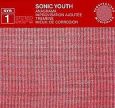

 SOUNDTRACK: SONIC YOUTH-TV Shit (1993).
 This is a funny little addition to the SY catalog. It is essentially four covers of a song by Youth Brigade called “No Song II” (which is from Dischord records, Possible EP
 SOUNDTRACK: SONIC YOUTH-Washing Machine (1995).
 After the short blasts and diverse collection fo songs on Experimental Jet Set Trash and No Star, Washing Machine sounds like almost a different band. For although there are a few shorter pieces here, they also give us the 9 minute title track and the, brace yourself, almost 20 minute “The Diamond Sea.”
 I’ve been reading Entertainment Weekly for years and years. I think I subscribed back in like 1993 or so. And I’ve always had a love/hate relationship with it. I’ve canceled my subscription on a number of occasions, mostly because I believed that it didn’t cover enough of the indie stuff I enjoyed (which is still largely true). But then I’d see an issue and realize that it is a fun magazine to flip through, so I’d re-subscribe.
 read the entire half-a-column-length of an article. But they removed that, and it’s back to simple reviews.

 SOUNDTRACK: SONIC YOUTH-Dirty (1991).
 I think of Dirty as a pretty commercial album. I mean, it’s got Butch Vig as a producer for crying out loud. And, it has three singles released from it.

 SOUNDTRACK: SONIC YOUTH-Goo (1990).
 I’m not sure exactly why this Sonic Youth album was the first one I really got into. I assume it’s because I was working at the radio station and probably got a bit of hype about their switch to DGC records.
 SOUNDTRACK: VOIVOD-Nothingface (1989).
 In light of Marathe and the Antitois, and Quebec separatists everywhere, I figured I’d mention my favorite CD by a rocking Quebecker band. When Voivod started they were a rumbling thrash band. They put out an album with the wonderful title of RRRÖÖÖAAARRR. They were very fast, very loud, and their singer had a really peculiar delivery style. I later learned that this was because he’s a Quebecker and French is his first language. Since he sings in English, his stresses and emphases are off-kilter, (and the guitarist seems to play to this particular feature, so the music is off-kilter as well) making for a very surreal experience.

 I Just Read About That...