Feeds:
Posts
Comments

SOUNDTRACK: TEENAGE FANCLUB-Shadows (2010).
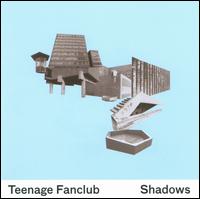
Back in the 90s, Teenage Fanclub released a few noisy, feedbacky records that were quintessential 90s alt rock.

Since then they have mellowed considerably, and this album is one of their most mellow to date. Usually for me this kind of mellowing is a sign that I’m done with a band; however, Teenage Fanclub’s songwriting gets better with every disc.  And these folky tracks are all fantastic.

What’s neat about the arrangement of the album is that each of the three members of the band writes four songs.  They are collated so that you cycle through each singer before repeating. You get maximum diversity–and it’s easy to tell which songwriter is your favorite.

The opening two songs, “Sometimes I Don’t Need to Believe in Anything” and “Baby Lee” are two wonderful upbeat pop confections.  They sound very different and yet both are infused with wonderful pop chops.

It seems that Blake is my favorite songwriter on this disc. He did “Baby Lee”, “Dark Clouds” (a pretty piano based number) and by far the prettiest song on the disc “When I Still Have Thee.”  It’s an amazingly catchy folk song that sounds timeless (and even has the great couplet: “The Rolling Stones wrote a song for me/It’s a minor song in a major key.”

That’s not to dismiss the other songwriters at all.  In fact, hearing their different takes on pop music is really pretty amazing.  It’s a shame that it takes them so long to put albums out (about 5 years these days).

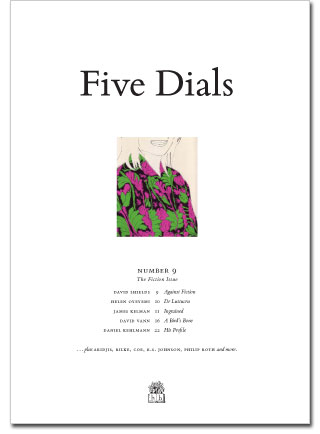
[READ: June 10, 2011] Five Dials Number 9

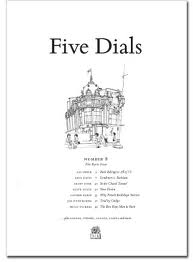
Five Dials Number 8, The Paris Issue, was pretty big (45 pages), but it had a lot of pictures.  Five Dials Number 9 is also pretty big (41 pages) and it’s (almost) all text.  For this is the Fiction Issue, and there are a lot of short stories in here.

CRAIG TAYLOR-A Letter from the Editor: On ‘Summer Reading’ and Fiction Issues.
Since most of what I talk about in the introduction to these posts is covered in Taylor’s Letter from the Editor, I figured I’d switch formats and start talking about his letter right away.  In this letter, Taylor talks about the serious pitfalls of  ‘Summer Reading’: We pledge to read mammoth books over the summer, but really we never finish War and Peace over the summer, do we? (except those of us who finished Infinite Summer, am I right?).  And so, this Fiction Issue was released in December (finally, a date is given to a Five Dials!).  Taylor briefly talks about all of the authors who contributed (including a pat on the back to Five Dials for securing the rights to a Philip Roth contribution in its first year of publication).  He also talks about the essay from David Shields that is decidedly anti-fiction.   And the final note is that Taylor’s own father has a piece in this issue (nepotism is alive and well!) Continue Reading »

SOUNDTRACKDUNGEN -Skit I Allt (2010).

I’ve enjoyed every Dungen release that I’ve bought and this one is no exception.  Although I will admit that the other ones grabbed me a bit more (there are some amazing songs on earlier discs).  This one is a bit more sedate in general; perhaps this is Dungen’s ballad album.

It opens with “Vara Snabb,” an instrumental with lots of flute (!).  While  “Mid Edna Vän” is a gentle ballad (Gustav Ejstes’ voice is very nice: soft and delicate”).  “Brallor” is a duet with Anna Järvinen–her voice is haunting and beautiful.

“Soda” is another delicate ballad.  It opens with some loud drumming but quickly settles into a very gently sung song.  “Hogdalstoopen” opens with a quiet piano and slowly morphs into a noisy instrumental with an expansive, wailing guitar solo–the kind of which attracted me to Dungen in the first place.  It devolves into some chaotic noise, which is fun and works as a cathartic moment on this mstly quiet disc.

“Skit I Allt” is a pretty standard rock song (very 70s sounding).  And “Blandband” is a catchy piano number with a tone that reminds me of Peanuts, but which concludes with another trippy flute solo.  The last two songs return to the mellow quality of the earlier tracks and “Marken låg stilla” ends the disc with a super catchy chorus.

As I said, compared to their earlier discs which highlighted Ejstes’ firework-like guitar playing, this one shows the bands’ softer side.  It works as a nice companion piece (and still shows off the band’s instrumental chops).

Here’s your quick Swedish translation guide: Dungen (“the grove”), “Vara snabb” (“Being quick”) “Min enda vän” (“My only friend”) “Brallor” (“Pants”) “Skit i allt” (“Fuck it all”) “Barnen undrar” (“The children are wondering”) “Blandband” (“Mixtape”) Nästa sommar” (“Next summer”) “Marken låg stilla” (“The ground lay still”)

[READ: May 23, 2011] “What Animal Are You?”

Etgar Keret was recently in McSweeney’s 37 (I really liked his story).  This short piece is from his forthcoming book, and if they are all unusual like this I would be very excited to read it.

This story seems so much like non-fiction, that I can’t really decide what, if anything, has really happened to him already.  As the story opens, the narrator explains that he is writing for German Public Television.  Literally.  A reporter from GPT is in the room with him right now.  They are filming him for a show and need him to be “writing.”

He tries to fake it, but she says that it will look bad on TV.  So she insists that he write something for real, perhaps about her being there and how it makes him feel to be under pressure like this.  And so he begins writing.  Then his son comes home and gives him a big hug (he’s used to performing for cameras) but his wife (when she arrives) seems far more unnatural on camera–and will probably be cut.

The title comes from a phrase that his son (who is 4) says.  He sits on the stairs and asks everyone who walks by, “What kind of animal are you?”  The narrator reflects on how people respond to him: his wife, some random people who the boy encounters and, ultimately, the reporter.

The whole piece feels like several different snippets, and yet Keret ties them all together very nicely.  And it’s funny too.

It was translated by Miriam Schlesinger.

SOUNDTRACK: RICHARD THOMPSON World Cafe Live, September 5, 2005 (2005).

World Cafe love Richard Thompson.  And this set from 2005 seems to have RT playing more than they actually air.  I say that in part because I have no idea how the World Cafe shows work.  Do they just play three or four songs?  The sets where they play in the studio between interviews sure makes it seem that way.  But this set is clearly Richard being interviewed after a performance.  So who knows how many songs he played.

5 songs make this download.  Two of them come from his (then) new album Front Parlour Ballads (“Let It Blow” & “The Thames Side”).  There’s one “brand new” song, which doesn’t appear anywhere as far as I can tell called “Hots for the Smarts” which is one of RT’s great funny clever songs (the lyrics are all very smart things).

The final two songs are classics: “Hokey Pokey” (where’d he pull that one out of?) and “1952 Vincent Black Lightning” (which always sounds great).

RT has hundreds of great songs, so it’s impossible to winnow down to a great set (especially one that’s just five songs long) but this set (which is just him solo) sounds really great and is worth hearing for any RT fan.

[READ:April 8, 2011] “Tom Cruise at Lake Vostok”

This is a very short story that I feel is hindered by the title.  Sure, the title is a major grabber, but it’s also a spoiler.

The story is set at the Vostok Station in Antarctica.  Scientists are doing an amazing amount of research in all manner of departments.  The protagonist is there to study Europa, Jupiter’s sixth moon; meanwhile, a Russian scientist is there to study under the ice (she has a cryobot and all kinds of cool things that burrow through the thick layer of ice).

There are many other scientists at the Station, but since it take a full month to reach Vostok by tractor train, many of them have nothing to do but wait for their ride back.  In the meantime, there is gossip about everyone there–especially the protagonist and the Russian woman who seem so antagonistic towards each other that everyone suspects they’re having an affair.

Then she uncovers an artifact that is so amazing she has to talk to someone about it.  So she calls him on his walkie-talkie.  And this is where the spoiler happens. Continue Reading »

SOUNDTRACK: CHARLOTTE GAINSBOURG-KEXP in studio May 11, 2010 (2010).

Charlotte Gainsbourg is a fascinating individual.  Between her acting and her singing, she’s had quite a life.  And even moreso since she had a near fatal accident.

That accident formed the nexus of her album IRM.  And this interview and performance is done in support of that disc.  IRM was made with Beck.  Beck’s not here, and the songs are more stripped down, but they sound really good in this format.

Gainsbourg sings the Beck-sung-on-IRM “Heaven Can Wait” and really makes it her own.  The other three songs here work very well in this more acoustic setting.  “Me and Jane Doe” is practically acoustic already and “Time of the Assassins” and “Trick Pony” are reworked very well.  And Charlotte is a charming interviewee as well.

It’s another excellent in-studio performance from KEXP.

[READ: March 31, 2011] “The Dead Are More Visible”

I read all of The Walrus stories when I received the magazines.  I wondered when I would completely recognize a story when re-reading them now.  Well, this was the first one that I remembered parts of vividly.  And why not–there’s a search for a missing eye on an ice hockey rink.  That’s hard to forget.  However, I didn’t remember the ending and in fact, my memory added many more details than actually occurred in the story.

The beginning of the story, which is very different from what I just described, was less memorable but perhaps more interesting.  The story opens with a woman reflecting about her graveyard shift job.  In this case the job is literally a graveyard shift, because the park she works in has a graveyard within it. However, her job is not really scary–she is there to make the ice for the upcoming skating season.  It takes several nights of very cold weather and she must go out in all her gear and fill up the rink, several tousand litres of water at a time.

While the ice settles, her time is her own–to listen to music and read. She gets a few hundred pages read a night (dream job!)  She prefers romance and horror novels.  The introduction of horror novels into the story foreshadows a bit about the scene ewith the eye later on, although for this is not a horror story. Continue Reading »

SOUNDTRACK: JÓNSI-Go (2010).

Jónsi is the lead singer from Sigur Rós. This is his first solo album and, honestly it’s not radically different from Sigur Rós (were we expecting trip hop or something?).   However, within the confines of the type of music that Sigur Rós play (swirling orchestral songs), Jónsi’s solo disc is kind of different.  And the difference comes in tone.

For while Sigur Rós records are orchestral and swirly, the are also kind of dark and moody.  Jonsi’s songs are more upbeat.  They’re ethereal both in style and tone.

I’m also surprised to see just how short these songs are.  They feel like they are very long (epic in a good way) but in fact, only two songs go over 5 minutes–most are in the mid fours.

There’s no question that if you dislike Sigur Rós you will not like this record. Jónsi’s voice is the same after all–gorgeous sweeping, helium sounding and out of this world.  But if you doubted whether Jónsi could work without his mates in the band, you need not worry. This album is a beauty.

[READ: May 19, 2011] “The Trusty”

I didn’t think I would like this story.  It concerns a subject that I generally don’t have a lot of interest in: chain gangs in the south.  And yet, Rash’s writing was excellent and the story was quite compelling.

The Trusty of the title is named Sinkler.  Sinkler is a prisoner on the chain gang–he stole money from a business and got 5 years.  He has served 18 months with very good behavior and has been given the unofficial title of Trusty, which means he can do things like walk a mile up the road to the next farm house to see if their well has water for the men on the gang.

And this is what he does.  They are working on a road and have moved far enough past their current source of water that Sinkler offers to walk up to the next house to bring water back.  When he arrives, the door is answered by a young woman (between 18-22–Sinkler himself is in his 20s).  She is standoffish and unmoved by him.  She is also married–her (much older) husband is plowing the field.  She agrees to give Sinkler two buckets of water if, at the end of the day he agrees to leave one bucket there as payment.

Sinkler agrees and decides that he would like more than water from the young woman.  And over the next few weeks he returns every day and tries to win her over.  And Lucy begins to sweeten on Sinkler. Continue Reading »

SOUNDTRACKDINOSAUR JR-Beyond (2007).

This was Dino Jr’s reunion album of the original line up.  And it sounds like the band had hardly gone away.

The opening tracks showcases the diversity of Dino Jr’s dynamic: a heavy, fast poppy number and then a “ballad” (Mascis style) and then a more heavy chugga chugga song.

By the middle of the album the band loosens up even more.  “Been There All the Time” has that kind of sloppy (but really not sloppy, they are actually very tight) sound of great Dino.  “I Got Lost” is the inevitable falsettoed Mascis track.  It’s slow and unusual for the rest of the disc, but it really showcases the band’s diversity.

The most notable things about Dino are Mascis’ voice (a kind of slacker pseudo-whine) and his wild guitar soloing.  And they are prominent here.  Mascis’ voice sounds great (of course, if you didn’t like it then, you wont like it now), and his songwriting is top notch.

I am actually more partial to the Dino Jr albums after Barlow left (blasphemy!–although even I admit the diminishing returns on the last few discs).  But on this disc, the band sounds totally revitalized and the songs are uniformly great.

Lou Barlow gets two songs.  They sound very Barlow: a bit slower but very catchy.  As I wondered about Farm, I’m not sure what would make Barlow return to Dino since the band still feels like Mascis’ band with Barlow getting a few songs.  I mean, they sound great together on the disc, but it’s clear that Mascis is the star here.  But whatever the reason, it’s a wonderful return to form and one of those rare reunions that really works.

[READ: May 18, 2011] “The Cat’s Table”

The combination of this title and the accompanying picture (a large cruise ship) was very confusing to me.  It turns out that the Cat’s Table is what a passenger on the cruise ship calls the table that they are assigned because it is as far from the Captain’s table as you can get.

The story opens in the third person as it describes a young boy (aged 11) who is seen boarding this large cruise ship which is travelling from Colombo, Ceylon to England (a 21 day journey).  The boy is traveling by himself to meet his mother.

After that brief section, the story switches to first person, from the boy’s point of view.

I was shocked to read that this eleven year old boy was dropped off on a cruise liner with no adult supervision.  But it turns out that there are several boys on board who are his age, and he even knows one from his school.  Coincidentally, his neighbor Emily, the closest thing he has to real family, is also on board. Continue Reading »

SOUNDTRACK: MOGWAI-EP +2 (1999).

There’s a fascinating release history behind this EP (which mostly means fans wind up with three copies of “Stanley Kubrick.”  First it came out as EP with 4 tracks (which I ordered on import).  Then it was released in the US as EP+2 with two songs from the Fuck the Curfew EP (which was not released in the US) and finally in 2000 it was reissued again as EP+6 with ten songs in total (compiling 1997’s 4 Satin, 1998’s No Education = No Future (Fuck the Curfew), and 1999’s EP–I didn’t buy this version because by then I had the original imports).

“Stanley Kubrick” is a slow burner with a great repeated mournful guitar.   It’s one of their best songs. “Christmas Song” is a slow, upbeat track with a very pretty melody.  “Burn Girl Prom Queen” opens with some really quiet guitar.  After about 90 seconds, a brass band kicks in adding amazing horns over the simple guitar melody.  It’s my favorite track on the disc.  “Rage: Man” is the first song on the album where Mogawai’s noise tendencies really come to the fore.  Once again, it’s a simple slow melody (with piano).  About two minutes in, the song is bombarded with noise guitars that take over the song but don’t obscure the melody.  There’s also a noisy guitar solo played over the noise.  Soon enough all the noise ends, and the simple, harmonic’d guitar comes back and the song ends peacefully.  It’s a great example of Mogwai dynamics.

The other two tracks, “Rollerball” and “Small Children in the Background” come from the other EP as I mentioned.  It’s odd to squeeze in songs from a different release, but Mogwai don’t sound terribly different on these early EPs, so these songs work well together.

Despite their length, Mogwai EPs are pretty uniformly wonderful.

[READ: June 1, 2011] Five Dials Number 8 bis

After publishing Five Dials Number 8, they quickly rushed out this addendum to the issue, which they’ve called Five Dials 8 bis.  According to the introduction: “The definition of ‘bis’ is a passage to be repeated, so here is a small bis for our eighth issue.”

It’s only 9 pages long and really only contains one long piece.  Primarily, this is a memento of their Paris-issue release party, which they held in Paris (duh).  The opening pages includes scans of postcards (“One of our volunteers waded into conversations and asked attendees to write down their own thoughts on Paris. We’ve reprinted five of our favourites.”)  The editor’s letter, which explains all about the party and this issue, is not credited to anyone, so I can’t so who is responsible.  [This lack of proper crediting is the one major flaw with this publication–just saying illustrations by, and then not saying which is whose, or not including the date of publication is maddening].

The big article is by Guy de Maupassant (translated by Siân Miles). Continue Reading »

SOUNDTRACK: AUDIOSLAVE-Audioslave (2002).

Despite the pedigree of this band: Rage Against the Machine + Chris Cornell, I wasn’t all that interested in the band when they came out.  I was over Rage and was bored by Cornell’s solo stuff.  But then recently, someone donated a copy of this album to th elibrary, so I thought I’d see what all of the fuss was about (nine years ago).

There are times when this album is really superb.  The Rage guys get an amazingly full sound out of their instruments (the choruses of “Show Me How to Live” are so full).  And when it works, and Cornell’s amazing voice is in full force, this seems like a genius pairing.

But there’s a lot that feels kind of clunky here (and there’s some really bad choices of guitar solo work by Tom Morello–the weird noises that compriose he solo of “What You Are”–in Rage the noises were weird but exciting and inflammatory, these are just kind of dull.  Worse yet, is the, well, stupid solo in “Like a Stone”–boring and ponderous at the same time).  Although he redeems himself somewhat with the cool solo on the otherwise dull “Intuition”.

The biggest surpise comes in “Like a Stone” which is insanely catchy and mellow–something one assumed Rage didn’t know how to do).  Lyrically the song is pretty stupid (as are most of the songs), but the combination of melody and Cornell’s great vocal lines really raise this song high–shame about the solo).  Also, a song like “Shadow of the Sun” seems to highlight Cornell’s more mellow moments (and shows that the Rage guys can actually play that slow), and they all seem to be in synch.

And there are several songs that rock really hard, sounding at times like Rage and at time like Soundgarden, but working on all cylinders together.  “Cochise” and “Set It Off” are simply great riff rock songs.

But ten or so years later, and twenty years since Badmotorfinger (my favorite Soundgarden album), it’s nice to hear Cornell rocking again.  Although man, the record is too long!

[READ: June 1, 2011] Five Dials Number 8

For Issue Number 8, Five Dials went to Paris.  And so the whole issue is given over to French concerns and ideas.  For a magazine that didn’t need a change of pace, it’s a delightful change of pace.  The feel of the magazine is different, and there’s an air of vacation about it (which is not to suggest that it is slacking off in any way), and it feels really vibrant.

I don’t know a lot about France in general.  I mean, I’ve been there, and I keep up with things, but I am not a Francophile by any means. So a lot of this stuff was simply new to me, which is always fun.  What I especially liked about the issue was that they were not afraid to show some of France’s uglier sides as well–it’s not just a tourism booster.

It even starts out differently than the other issues. Continue Reading »

ATTENDED: WEIRD AL YANKOVIC-Live at the State Theater, New Brunswick, NJ May 19, 2011 (2011).

I’ve seen “Weird Al” live three times now and I have never been disappointed by the show.  The first year my friend Matt and I waited out by the bus and got the bands’ (minus Al’s) autograph.  The second time we waited even longer and Al had an autograph (and picture taking) session in the theater after the show (how cool is that?).

This year, Sarah and I didn’t wait around afterwards (kids at home) but the show was still great.  Al made a joke after the first song thanking his opening act, Technical Difficulties. (There were indeed 45 minutes of technical difficulties before the show, but Al’s joke made us quickly forget it–and, kudos to the State Theater: I ordered my tickets online from their site and the day after the concert, the theater owner sent an email apologizing for the delay. Classy!).

Sarah had never seen him perform before, so she was pleasantly surprised by the set selection.  I was also surprised by the set selection because he pulled out a few older, more obscure tracks (“Frank’s 2000″ TV” (!), “You Don’t Love Me Any More”–complete with Al smashing a guitar!).  But he also dazzled with some new tracks from his forthcoming album.

The set opened with the polka medley (“Polka Face”).  This is the first polka medley that I didn’t know any (well almost any) of the sped up songs, but it’s always a treat to watch them play it live.  The one complaint with the show was that the sound in the theater wasn’t very good (which is surprising given that it’s an old theater) so it was hard to make out a lot of the words, especially to the new songs–and what’s Al without the lyrics?).  But his new song “I Perform This Way” (parody of Lady Gaga’s “I Was Born This Way”) was fantastic (Al was dressed up like a cartoon peacock).

Yes, costume changes.  One of the most entertaining things about Al’s shows is the costume changes.  For all of his big video hits, he comes out dressed like the video (the band does as well, although it’s a bit more subtle).  So, we get the Amish garb in “Amish Paradise,” the Michael Jackson red jacket for “Eat It”–(another surprise) and, my personal favorite, the fat suit from “Fat.”  One of the funniest costume changes was for a song that will sadly not be released on the album (but you can hear and download it here), “You’re Pitiful,” in which he wore multiple T-shirts (about 5) which all expressed some kind of funny comment (anyone know who was the face on one of the shirts?) and finally ended in a Spongebob Squarepants shirts and tutu.

So how does he do all of these costume changes? In between songs, when the band runs offstage, they play wonderful video clips.  Some of the clips are from his TV shows, some are faux documentaries, and the best are interviews that Al splices together (you can see a whole bunch here) which are hilarious and surprisingly mean-spirited.  I wish he would release them (and any other AlTv segments) on DVD, but I imagine that no one would ever give permission for that–check out the Kevin Federline one, for instance.  But they’re all pretty great.

The crowd was also totally into it (including the guy behind us with an Al wig (and a Harvey the Wonder Hamster).  And the age range was fantastic–from kids to grandparents.  My only hope is that my kids are old enough to come to a concert next time he comes around.

Oh and a brief word about his band.  He’s had the same four guys with him for years and years and years.  Rubén Valtierra is the newest member of the band and he’s been with them since 1991.  Jim West (guitar), Steve Jay (Bass) and Jon “Bermuda” Schwartz (drums) have been with Al since 1980.  They are tight as a drum, can play incredibly diverse styles at the drop of a hat (check out “CNR” which sounds exactly like The White Stripes) and they all seem to have a lot of fun on stage (see them jump in the air on “Fat” or the crazy vocal-only solo at the end of “Yoda”

–which I think is longer than ever and totally mind-blowing).

[READ: May 21, 2011] This is a Book

I recently read Martin’s “This is Me” in the New Yorker. “This is Me” is, along with about 100 other things in This is a Book.  I also heard Demetri Martin on NPR a few Sundays ago and he read a few short things from This is a Book.  And they were quite funny.

Indeed, the funny things in this book are really very very funny.  It seems to work that the shorter the item, the bigger the laugh.  Conversely there are a number of longer, extended jokes which just go on and on, like a Saturday Night Live sketch that just won’t end.  Those quickly lose their humorous value.  Fortunately  there aren’t too many of those in here.

What makes me smile a lot about the book are the jokes he plays with book conventions.  So the title page says “This is a book by Demetri Martin called This is a Book by Demetri Martin.”  Or the previous page:

Also by Demetri Martin

*

*Nothing yet.  This is his first book.

The book opens with “How to Read this Book.”

If you’re reading this sentence then you’ve pretty much got it.  Good job.  Just keep going the way you are.

I’m not going to spoil the rest of the book (or talk about each piece).  But I will mention some real highlights: Continue Reading »

SOUNDTRACK: TRENCHMOUTH-Vs the Light of the Sun (1994).

I learned about Trenchmouth from an interview with Fred Armisen on The Sound of Young America.  He informed us that he was the drummer in Trenchmouth before he was on SNL.  And he and Jesse Thorn had an amusing discussion about how he was sure they would make it big.  I can’t recall if they played a snippet of the band or not, but it’s a pretty laughable thought that Trenchmouth might be his claim to fame.  Because they are awesome, but they are totally NOT commercial.

In fact, just a few seconds into the lead-off track “Washington! Washington!” will tell you how noncommercial they are.  (It’s a sort of fast heavy punk version of prog rock–jazzy guitars, independent bass, wonderful drumming (Armisen kicks ass) and the screamed hyperkinetic vocals of Damon Locks (he’s passionate, man).

There’s a lot of atonal work here (“Washington! Washington!” opens with drums and Lock’s ragged voice), and once the guitars kick in, it actually makes the song more confusing.  “A Prescription Written in a Different Language” opens with wavering harmonic notes before busting into a full on punk noisefest.  The album lurches around to different styles of weird noise rock (most of the songs are quite short, although “A Man without Lungs” runs over 6 minutes).

But before making it sounds like this is a mess of a record, a few listens will reveal the sanity beneath the chaos.  There are even some discernible choruses: “Here Comes the Automata”‘s “Everybody needs protection” and “Bricks Should Have Wings”‘ “Let the bricks fly” are fun to sing along to.  Similarly, the guitar work that opens “Set the Oven at 400” is rather conventional and quite pretty.

This disc is not for most people, but Trenchmouth is a cool band that has been unfairly lost to the annals of history.

[READ: April 4, 2011] “Rome, 1974”

I had received a pre-pub of Bezmozgis’ novel The Free World, but I haven’t read it yet.  I am interested in Bezmozgis’ writing and was planning to read the book.  As it turns out this “story” is really an excerpt from the novel.

The story is about the Krasnansky family, a Jewish extended family emigrating from the Soviet Union to Italy.  The opening scenes detail the physical hardship that such a move would have taken (it’s played for somewhat comic effect when the large duffel bags are thrown off the train).  There is much dissent among the family members although they sem to settle in well–except for patriarch Samuil who is disconcerted by everything and unhappy to have left the communist country he feels comfortable in. Continue Reading »