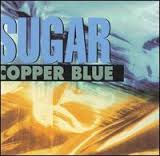
I didn’t know that Beaster, the Sugar EP was recorded at the same time as Copper Blue. Mould’s biography was very helpful in explaining all the details of the timing and styling behind these two recording. As well as how the super pop of Copper Blue could be followed right on the heels with the very very dark EP of Beaster.
I have often thought of this disc as being really dark and insular and Mould confirmed as much—he was really airing out some demons with this disc. But they thought it would be better to put them all in one place rather having them bounce around the poppier full length. What must fans (like myself) have thought to hear this dark album after the pop of Copper Blue. I mean just look at the cover!
I hadn’t listened to this in a long time, so I was surprised by how cool “Come Around” sounds—Mould’s acoustic guitar high in the mix with some appropriately grungey guitars in the background. There are lyrics but for the most part I think of it as just Mould making sounds with his mouth.
It’s followed by the blistering “Tilting.” It’s got superfast drumming with aggressive guitars, it’s like we’re back to the early Hüsker Dü punk sound (with a little more clarity). The drumming is great in this track. The song ends with a preacher being interrupted by dissonance and what sounds like electronic interference. And this song morphs into “Judas Cradle” one of Mould’s darkest songs. It’s very claustrophobic-feeling with echoed vocals, lots of feedback and lots of compression on the overall sound—quite different from the big open sound of Copper Blue. And yet for all of that, the chorus, “Have you seen the Judas Cradle, ah”is really quite catchy.
“JC Auto” has some buzzsaw guitars which make it seem like it’s going to be quite an angry song and yet the bridge is quite welcoming (all this talk of holidays) and then the chorus is amazingly fun to sing along to (Mould always finds pop in anger): “Passing judgment on my life you never really got it right/I can’t believe in anything / I don’t believe in / Do you believe in anything / Do you believe me now… Look like Jesus Christ / act like Jesus Christ I Know I Know I Know Here’s Your Jesus Christ I’m Your Jesus Christ I Know I Know I Know.” And, as always, I love when Mould repeats his lyrics in the background (the “I Know I Know” surfaces throughout the end of the song).
“Feeling Better” has weird synth blasts that kind of works in the song but sounds out of place on this record. This song flips between really aggressive guitars and a very bright poppy chorus. At 6 minutes this song is a little long (because it’s primarily repeating itself by the end), whereas Judas Cradle and JC Autos’ 6 minutes are well justified.
The final song “Walking Away” is a strange one. It is comprised entirely of organs (church organ it sounds like) with Mould delicately singing “I’m walking away back to you” The end starts to wobble giving a bit of a nauseous feeling but then it’s over. So even in his most downtrodden and questioning, Mould still has the chops to write some great music. Down be put off by the cover, Beaster is a great album.
[READ: March 28, 2013] McSweeney’s #16
After the fairly straightforward Issue 15, McSweeney’s was back to fun with Issue #16. The issue opens up into a kind of quad gatefold which has , in order–a comb, a book, another book and a deck of cards.
The main book contains nine stories, by the typical McSweeney’s roster at the time. The other booklet contains a lengthy story by Ann Beattie. The deck of cards is for Robert Coover’s “Heart Suite” and the comb is a comb. It’s a nice one, although it has never touched my hair.
After Bob Mould made some solo albums, he created another band. Another trio, this one called Sugar. Sugar seems to take Mould’s poppiest elements and wrap them in a big 90s grunge sound–a sound that Mould pretty much invented in Hüsker Dü. And in many ways Sugar is not all that different from Hüsker Dü–maybe a bit less experimental and a little more commercial.
One thing I noticed about this album that, once I noticed it I couldn’t avoid it, was that when the drummer plays the cymbal (it might even be a hi hat with a tambourine on it), which he plays a lot, the tinny shimmer of that sound is so pervasive, I find it rather distracting. Or should I say it adds an almost minute level of static over the proceedings.
The disc opens with “The Act We Act,” where big grungy guitars and a simple chugga chugga riff burst out of the speakers. I love the Pixies feeling of “A Good Idea” both that up front bass and the buggy sounding guitars provide an almost false introduction to the catchy verse and chorus that’s to come. I also enjoy the unexpected break after the chorus.
It’s followed by the ringing guitars that introduce “Changes” a classic poppy rock song that is unmistakably Mould. The uneasy almost nauseating sounds at the end of the song are again like a feint in the wrong direction as “Helpless” easily the most pop song Mould has ever written comes out. Of course, as with Mould, this outrageously poppy song is all about feeling helpless.
Keyboards open the next song, “Hoover Dam” (something of a surprise for this album), which proves to be yet another big Mould single. The song is so open with multiple acoustic guitars (and that cool synth solo) and a really wild reverse guitar solo. It’s one of my favorite Mould songs and yet another example of why this album was such a huge hit.
“The Slim” brings back the darker songs that Mould is also known for. And just when you think that Mould can’t pull out another huge big single, he gives us “If I Can’t Change Your Mind,” one of his great big bouncy acoustic guitar songs. It is almost obscene how catchy this song is, right down to the simple scale solo at the end. Mould has this little technique that I find irresistible where he plays a song normally and then plays two fast chord changes segueing into another section. It’s so cool.
“Fortune Teller” is a fast rocker with Mould’s trebly guitar taking the lead. “Slick” is the only song I’m not crazy about. There’s something about it that kind of slows the momentum down, which is odd for a song about a car. It’s got a real middle-period-Who feel to it, which I do like (and I really like the bridge) it just feels odd in this place in the disc. The end of the song has some snippets of chatter that could have been edited out but lend an amusing air to the final track, “Man on the Moon” which ends the disc with that same air that the rest of the album has—big guitars and Mould’s slightly distorted vocals. The solo is weirdly processed and kind of fun. The end of the track with its repeated half step has a very Beatles feel to it. And the very end of the disc has the sound of tape rewinding, an amusing nod to the digital era.
Copper Blue was Mould’s first huge success and in his book he talks about not realizing quite how huge it was until he was in the middle of it.
[READ: March 20, 2013] McSweeney’s #15
I was a little disappointed with McSweeney’s #14, but #15 was once again fantastic. This issue is a smallish hardcover (I like when their books are this size). The bottom half of the cover features a cool 2 color painting by Leif Parsons. The issue is known as the Icelandic Issue because of a few things. The first half of the book features stories by the usual suspects. Each of these stories is accompanied by an illustration of a Scandinavian rune that dates to the Viking era. The stories in the second half of the book have illustrations that are taken from Icelandic grimoires–magician’s handbooks. It is these second half stories that are all from Scandinavian authors. It’s a fascinating peek into a culture few of us probably get to read.
There’s no letters in this book, which removes some of the levity, but that’s okay. The front page has a brief story that it was being written on November 2, 2004 in New Mexico, hoping to bring some voting power to “the good guys “in this “completely fucking terrifying election.” (The bad guy eked out a victory 49.8 to 49.1). They went canvassing door to door with an Iraqi veteran named Joey (who was 21). He was very pro-Kerry and may have even convinced a young girl to vote (she thought her vote didn’t count because she was poor (!)). It really evokes the feeling on that dark night in 2004 when the iota of hope was snuffed out. Continue Reading »
Cirque Zuma Zuma was the final theater show of our 2012-2013 season. When I bought tickets for this I didn’t realize that it was designed as an all ages show (hint, shows that start at 7PM are for families, shows that start at 7:30 are for adults only). So I felt a little bad that the kids didn’t come as there were so many kids there. And they would have enjoyed this, although it’s probably just as well that they had a nice night with their grandma.
So Cirque Zuma Zuma is an African-based show of dance and acrobatics. There was a large banner that said that Cirque Zuma Zuma had been on America’s Got Talent. Now, I don’t quite understand this as the announcer of the show seemed to say that the performers were from countries in Africa. How could they be on America’s Got Talent if they are not American? I don’t get it.
Anyway, the show got off to a rousing start with drumming. Lots of drumming. There was a man with two drums (big bass drum sounding drums) and then two drummers who were playing what I thought of as an African bongo but which I believe is called a Djembe. And, man, they pounded the hell out of these things. It was amazing how musical three (or four) drums can sound. They played lead drum parts while the bass drum kept a steady rhythm. And then the dancers came out. Two women and a man dressed in what I assume is a traditional outfit. And they danced. Ecstatically. Nonstop. For about eight minutes. And what frenetic and crazy dances they were. They moved with such force and power. It was really amazing and it looked exhausting.
Then came the acrobatics. And was surprised at just how many of the acrobatic pieces were the same as ones done by the Chinese acrobats. It strikes me as odd that two very distinct cultures would do the same kinds of things. Are these just standard feats that contemporary performers learn?
The first was the climbing of and doing handstands on a stack of chairs. The big difference here was that these chairs were very large (as opposed to the many tiny ones the Chinese acrobats use). It was still impressive, and the chairs looked quite wobbly, but it was weird to open with a show stopper from another Cirque.
Other things that they did which we had already seen were jumping through hoops, spinning hula hoops, foot juggling and hat juggling. It was very strange to see these same things. The big difference was the music, which was African as opposed to Asian. Continue Reading »
I found this song in heavy rotation on NPR. I had never heard of Savages before (this is from their debut album coming out this week), but they seemed interesting. And the description was intriguing–saying they sounded like Siouxsie and the Banshees. And that is right on, from the shimmery 80s punk guitars that open the song to that strange goth-y wail that Siouxsie possessed, to the rumbling basslines, this song hearkens back to a darker, wonderful era.
It’s a really great sound–evocative without mimicking. It’s certainly an uncool sound that Savages are pulling for (in the 2010s) and I like them all the more because of it. I’m curious to hear what else they do.
And that ending note is a killer. I want to hear this whole album.
[READ: April 30, 2013] “Oh, My Darling”
The “teaser” for this short story says “I am so close you could touch me.” And with this piece of information in mind, this story is dark and creepy right from the start.
The story begins as a letter: “Hello, Vanessa.” And the letter continues to compliment Vanessa on her name, those three satiny syllables (the letter writer won’t deign to use that silly “Nessa” that others do).
The narrator pushes back to some months ago when Vanessa’s husband says he believes that he has Aboriginal bloodlines (despite his blue eyes and Scandinavian features). Vanessa knew immediately it was because of the case he was working on—an Aboriginal case, obviously—with… Connie, a student of Haida birth. She replies to it with a funny (to me) comment: “What part do you think is Aboriginal? I hope it’s something simple, like your foot.” This comment from Vanessa’s husband, intimating infidelity is compounded by their daughter’s insolence: “You are a cruel fucking cow.” (Vanessa has weight issues which makes this hurt even more). Vanessa knows this is just how teenagers are, but it still hurts. Continue Reading »
Mikal Cronin has a very pleasant middle range voice—conventionally good. Indeed, there’s nothing especially unique about this record. But it is a great summer pop album. Lots of great big choruses that are fun to sing along to. And, Cronin is a talented multi-instumentalist. I believe he plays everything on the record, although I’m not sure about that.
The album is 37 minutes. The first song, “Weight” has a simple melody and is incredibly catchy. There’s a nice falsetto before the big loud guitar chorus kicks in. “Shout It Out” is another great pop song—big fuzzy guitars and a wonderfully catchy melody. And I love how it gets mildly chaotic at the end. “Am I Wrong” is a straightforward rocker, with more big crunchy guitars. There’s a fun fiddly keyboard solo (with lots of flubs, which is kind of endearing). This song (and several others) remind me of Sloan.
“See It My Way” has a shambolic feel to it, I can do without the oddball sax solo, but there’s something so oddball about it that I think it works in the end. “Peace of Mind” has a nice harmony vocal on it that gives this simple song a fuller sound. There’s an unexpected violin solo in here. “Change” opens with a real grungy loud guitar which is quickly replaced by a speedy drum over a simple, catchy verse. And a speedy chorus. There’s an interesting middle section with another violin solo (and some unusual squeaky violin noises as well). “I’m Done Running From You” is a fun fast bit of pop with a rocking guitar solo. And “Don’t Let Me Go” is a slow ballady type song (as much as one can be on a rocking record like this). “Turn Away” brings the rock back, although “Piano Mantra” ends the disc with a solo piano intro. But the song builds and builds into a rollicking violin-fueled conclusion.
I’d never heard of Mikal Cronin before, and when i first started listening to the disc I thought it was an okay pop punk album. But the more I listened to it, the more I enjoyed it. It’s still as simple pop punk album but it’s done so very well. I’m going to have to check out his debut as well.
[READ: May 2, 2013] “Mexican Manifesto”
I love that stories from Roberto Bolaño keep popping up. I realize that most of these have been published in Spanish somewhere, but it seems like even if we know that his next book is going to be all poetry (Unknown University coming out in June), somehow there’s at least one short story in it (I assume it comes from here, where else would it have come from?). So, since it seems like there’s a new Bolaño book out every six months, I assume that barrage will come to an end now.
Unknown University is, as far as I can tell, the last thing that will be translated by Bolaño. Wikipedia suggests that there are four other titles that could be translated: A Lumpen Novella (which he completed but which has not been translated), Diorama, an unfinished novel, something being called Part 6 of 2666 (who knows what that means) and an early book that he cowrote Advice from a Morrison Disciple to a Joyce Fanatic which I would really like to read–the title is so intriguing–but who knows is it will ever find a translator.
But that’s got nothing to do with this short story. This short story is about a couple who frequent steam baths. The narrator is the man, and the woman, Laura, I the more adventurous of the two. She is the one who encourages them to go to the baths in the first place and, while he also thinks it is wonderful, it is she who wants them to explore as many different baths in the city as possible. Continue Reading »
SOUNDTRACK: THE KNIFE-Shaking the Habitual (2013).
Since I reviewed the 19 minute song from this album yesterday I thought I’d check out the rest of the disc (still a handful). I kept bearing in mind that The Knife are pretty much a dance duo. So this departure is not only radical, it pretty much undercuts the kind of music they make. The progress is probably exciting but I imagine fans would turn away in droves. I wonder how this record will play out for them in the long run. Incidentally, I wasn’t a fan before, so I don’t really have a horse in this race.
“A Tooth for an Eye” opens the record with an interesting percussion sound an a pulsing keyboard melody. The keening vocals come in sounding weird and distant and more than a little eerie. “Full of Fire” is a 9-minute song with a weird skittery “melody” that seems to float above the battered mechanical “drum.” The whispered vocals are strained and also a little creepy. The middle section has the skittery music jump around while the vocals get even more processed—making it simultaneously more friendly and less so. It’s probably the coolest weird song on the disc, with parts that are catchy and interesting and parts that are just peculiar. This is the single, by the way.
“A Cherry on Top” is 8 minutes of reasonable quietude, with the second half introducing an autoharp. It’s certainly the most mellow thing on the disc. Although it’s not exactly relaxing. “Without You My Life Would Be Boring” seems like it should be the single—it is propulsive and while the vocals are certainly odd, they are the most conventional thing on the album. “Wrap Your Arms Around Me” has big electronic pulsing drums and whispered vocals. It’s a fairly normal sounding song (at least for this album), and could easily play in a goth club.
“Crake” is 55 second of squalling feedback. The album also has “Oryx” which is 37 second of wailing noise. In between is the 10 minute “Raging Lung” which is not available on Spotify. “Networking” a skittering beat with a second beat that may just be a sample of a person making noise in his or her throat. The “voices” get stranger throughout the song, keening, twisting and spinning, reminiscent of The Art of Noise.
“Stay Out Here” is a ten minute song. It starts with a fairly standard electronic drumbeat. Whispered vocals come in giving it a kind of Nine Inch Nails vibe, until the female vocals come in (and are quickly manipulated to sound kind of male). The switch from male and female vocals is interesting, giving it an almost modern sounding Dead Can Dance feel.
“Fracking Fluid Injection” has sounds like scraping, rusted gates as the beat with sampled voices overlaid. Again, this is nearly 10 minute long. The problem with things like this, aside from their relative tediousness, is that they aren’t all that original. Now originality is nothing to hold a band to, we all know, but if you’re going to do non-form sounds that are echoed with little else to it, it would be more interesting if there was something original to pin to it. “Ready to Lose” ends the album with a steady beat and a pretty standard vocal line (even if the voices are processed).
So this album us a pretty radical departure for the band and it’s a pretty radical departure for dance music as a whole. I’m curious to see if this will lead to a anything or if this will be their one weird album.
[READ: April 15, 2013] “The Furies”
The story opens with a rather creepy man stating at his wedding reception that he is in an exclusive club: “There are not too many men who can say that they’re older than their father-in-law.” Ew. He was fifty-eight, his new wife 31. His father-in-law is 56. The father-in-law seems okay with this, but really how could he be?
Ray is a dentist and his new wife, Shelly, had been his hygienist for years. When Shelly told him she was thinking of getting a new job, he professed his love for her, and informed his wife, Angie that he was in love with Shelly. Angie took it badly, but he was surprised when she seemed mad that he didn’t do this years earlier while she still had a chance to meet someone (rather than being distraught that he was leaving her). As a parting shot she says that she wishes him ill. And she hope he suffers with the woman who took him from her.
But they had no children, just assets, and things were divided evenly and cleanly. And he thanked his lucky starts to be with a new woman, someone who was fun and so different from his first wife. Continue Reading »
SOUNDTRACK: THE KNIFE-“Old Dreams Waiting to be Realized” (2013).
With the release of The Knife’s new album, the New Yorker review that I mentioned yesterday pointed out just how radically different this new disc is from the synth pop of yore. Sasha Frere-Jones talked about the weird instrumentation that they use (and made themselves) and the processed vocals that often defy gender. But he mostly focused on this, a 19 minute song.
What’s so radically different for The Knife is that the song isn’t really a song so much as a series of slow washes of keyboards which rise and fall. There’s no melody at all and no singing either. It’s basically an uneasy ambient song–quite a departure from the three-minute pop of “Heartbeats.” There’s also a bunch of percussion, also seemingly random. It sounds like a bleak landscape–the moon perhaps.
At around 10 minutes, the washes of sound (which have been pretty constant and low volume) are eclipsed by a processed steel drum sound which play a little melody and just as quickly goes away. Helicopter-ish sounds come to the fore around 13 minutes. And that louder noise stays with us for a couple of minutes until it is replaced by a very mechanical-sounding moaning.
After 19 minutes of this, it simply vanishes leaving a minute or so of silence at the end of the track. You’re not going to get too many fans playing music like that.
[READ: April 28, 2013] “Long Way Home”
In this piece, Sedaris revisits a moment that has got to be a major fear for a lot of people—the theft of a passport. Sedaris has a British passport with an Indefinite Leave to Remain sticker on it. This basically allows him (and partner Hugh) freedom to come and go as they please in the UK—a handy thing for a traveling author. When the passport is stolen, it means that rather than waltzing back home, he has to go through the same old scrutiny (a writer, eh?) and very real threats that they could simply not allow him back in.
Evidently receiving this sticker is a laborious process not for the faint of heart (and not for those whose grasp of English is not perfect). Which is why David let Hugh do all the prep work for it (although David did ace the test). There’s a very funny sequence in which he wonders how non Westerners might deal with the question, “How might you stop young people playing tricks on you at Halloween?” Needless to say, not having that sticker was a major hassle, but reapplying for it meant surrendering the new passport for several months while bureaucracy got its sticker together. Which is what he eventually had to do. Continue Reading »
I learned of this song from the José González cover that was featured in the (very cool) Sony video with the bouncing balls. The song turned me on to González, but not necessarily the song itself. I knew The Knife did the original and I remember when I first heard it, I didn’t like it nearly as much as the González version.
It’s been a few years and there’s a new The Knife album out and in the New Yorker review of it Sasha Frere-Jones mentioned this song again. So I wanted to listen to it without the cover so prominent. And indeed, the González cover is quite straightforward (acoustic guitar rather than mega synth, but otherwise pretty spot on). The Knife’s version is very retro synth-sounding . It reminds me of a wacky 80s song. Or perhaps a 2000’s Europop song.
The vocals are high-pitched and a wee bit over the top, but all in all it’s very catchy. Frere-Jones said that The Knife version was very popular but evidently I didn’t travel in those circles because I don’t recognize it as being huge.
And I still like José’s version better.
I know it’s not really cool to show the video of the cover version when I’m talking about the original, and it’s really not that cool to use a commercial as a video, but it is still very fun to watch.
[READ: April 30, 2013] Burn This House
For the last day of April, the last day of poetry month, I read a new book of poetry that came across my desk today. This is Kelly Davio’s first collection. She is an MFA and quite an accomplished poet (managing editor and Pushcart nominee). I also thought that I would see if she was a “modern, weird” poet or a more traditional one (I secretly hoped for more traditional as I’d burnt out on wacky ones). For the most part she is more traditional and I liked most of her poems quite a lot.
The book was divided into five sections. And I have to admit that the final few sections contained poems which seems a little forced to me (more on that later). For it was in the early pages that I thought the poetry was most magnificent.
Although when I first started reading I was afraid that the poetry was going to be ponderous without enough concrete detail. Like in “auguries” which showed a series of potential omens (Davio seems to have a thing with birds crashing into windows) which were effective, but I didn’t like the ending: “To what /significance such eroded things?” It seemed too vague to be powerful.
But the poems that came right after were just wonderful with detail like in “The First Lines” which had this description of a scarecrow: Continue Reading »
Not only am I a librarian, I’m also a patron of libraries (we currently use four!). I’m also a huge advocate of library usage. Everyone knows you can get free books at the library. And many people know (but many people don’t) that you can get free CDs and DVDs from the library. Well, I’m advocating a new service that many libraries have implemented (both the library where I worked and my local library have it).
It’s called Freegal and it allows you to download (and keep) three songs a week. The selection is quite impressive, as they have made agreements with 10,000 record labels. That’s 10,000 LABELS, not artists, so huge numbers of songs are available. I did a few random searches and was delighted by how much was there.
Even their genre divisions are impressive. Just check out this sample selection from the B’s: BeBop Big Band Black Metal Bluegrass Blues Bolero Bollywood Brasil Soul Brazilian Breakbeat BritPop Broadway.
So check out to see if your library subscribes. You get three free songs every Monday morning! Not bad for the price of a free library card.
[READ: July 3, 3011] Five Dials Number 27B
I haven’t posted about a Five Dials in a couple of issues, primarily because I find writing about anthologies is very time consuming (I have recently read three McSweeney’s which I haven’t had the time to edit together into posts). The good news is that I have only missed two issues, but I know that at least one of them is pretty large. I was a little bummed to see another new one already, but then I saw that this issue was not only short, it was full of poetry. And, since this is my poetry month, why not end the month with a little more poetry.
I enjoyed the offputting cartoon on the cover of this issue which is creepy and funny at the same time. (Illustrations are by Sophia Augusta, Hannah Bagshaw, Kyle Platts, Tom Rees and Joe Prendergast. I assume Augusta did the cover).
There was no letter from the editor or any of the usual suspects in this issue. Rather this issue opens with a Letter from the Poetry Editor. It is shaped like a poem but isn’t one.
SAM BUCHAN-WATTS-On Parenting Poems
Mentioning a 1954 parenting guide (from Elizabeth Longfellow), Buchan-Watts says that they asked eight young poets to choose a chapter heading from Longfellow’s book Points for Parents, and to make a poem starting from that title.
And it’s now that I admit that these poems have set me back terribly in my appreciation of poetry which I have been nurturing all month. If ever there was a collection of seemingly random words, it is these. Continue Reading »
I went to the Princeton Public Library looking for audio books for the kids (we’ve exhausted most of our town library’s books). There was a nice new selection of audio books at PPL, and this was one of them. I wasn’t familiar with the story but Sarah knew it already.
So in Frindle, (which was Clements’ first chapter book after several picture books), Nick Allen is upset to find out that he has Mrs Granger as his English teacher this year. You see, Nick is beloved by his classmates for his ability to ask the perfect and perfectly timed question that will distract the teacher so he or she forgets to give homework. He has even sidetracked teachers so that they barely taught any lessons at all. But Mrs Granger has been around and has a reputation as being a really really tough teacher.
One the first day, Nick comes up with the perfect question. He learns that Mrs Granger loves dictionaries–she has one propped up on a lectern in the front of the class–so he waits until there’s about six minutes left and he asks her how all those words got in the dictionary. It was genius, it was brilliant. It didn’t work. She turned it around on him and asked him to give do research and give a report about the question. Tomorrow. Ack!
Nick is distraught. But then he decides to get really into it. And the next day he gives a presentation that lasts over thirty minutes. Mrs Granger knows what he’s up to but she is impressed by his tenacity. They have a kind of friendly stand off. But she makes a small comment that sets the rest of the book in motion. She tells Nick that it is him, and really everyone, who decides what words mean. If everyone agrees that a word means something, then it does.
 SOUNDTRACK: SUGAR-Beaster EP (1993).
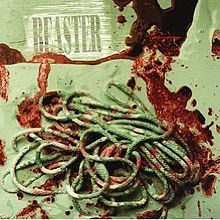 I didn’t know that Beaster, the Sugar EP was recorded at the same time as Copper Blue. Mould’s biography was very helpful in explaining all the details of the timing and styling behind these two recording. As well as how the super pop of Copper Blue could be followed right on the heels with the very very dark EP of Beaster.